
Dave Reed logic Prolog predicate calculus syntax terms

- Slides: 18
Dave Reed logic & Prolog § predicate calculus syntax: terms, predicates, sentences semantics: interpretations, logical consequence, inference rules, proof procedures § logic programming § Prolog facts & rules, SWI Prolog
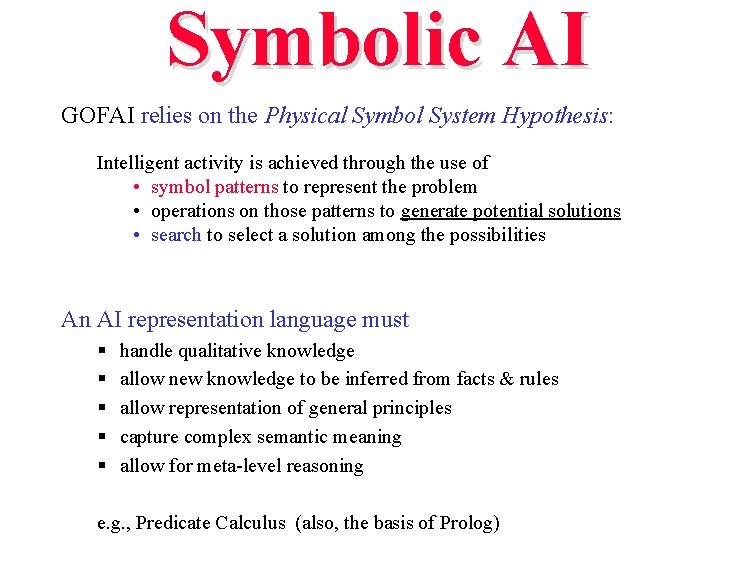
Symbolic AI GOFAI relies on the Physical Symbol System Hypothesis: Intelligent activity is achieved through the use of • symbol patterns to represent the problem • operations on those patterns to generate potential solutions • search to select a solution among the possibilities An AI representation language must § § § handle qualitative knowledge allow new knowledge to be inferred from facts & rules allow representation of general principles capture complex semantic meaning allow for meta-level reasoning e. g. , Predicate Calculus (also, the basis of Prolog)
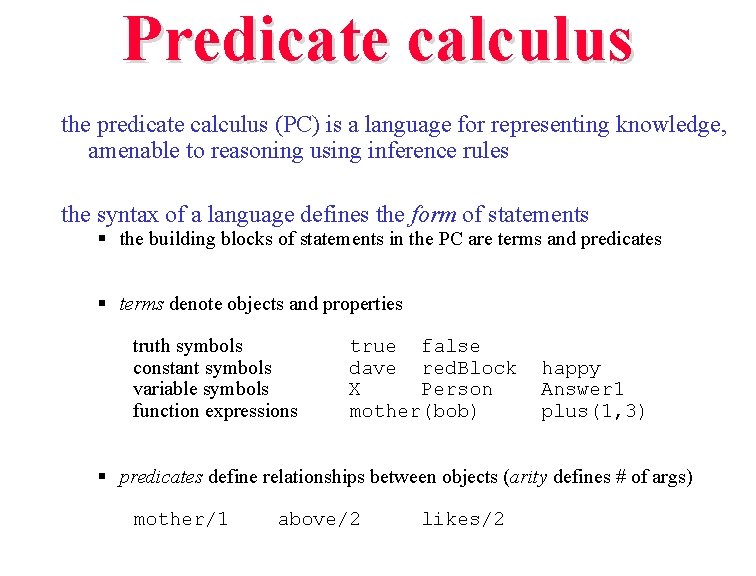
Predicate calculus the predicate calculus (PC) is a language for representing knowledge, amenable to reasoning using inference rules the syntax of a language defines the form of statements § the building blocks of statements in the PC are terms and predicates § terms denote objects and properties truth symbols constant symbols variable symbols function expressions true false dave red. Block X Person mother(bob) happy Answer 1 plus(1, 3) § predicates define relationships between objects (arity defines # of args) mother/1 above/2 likes/2
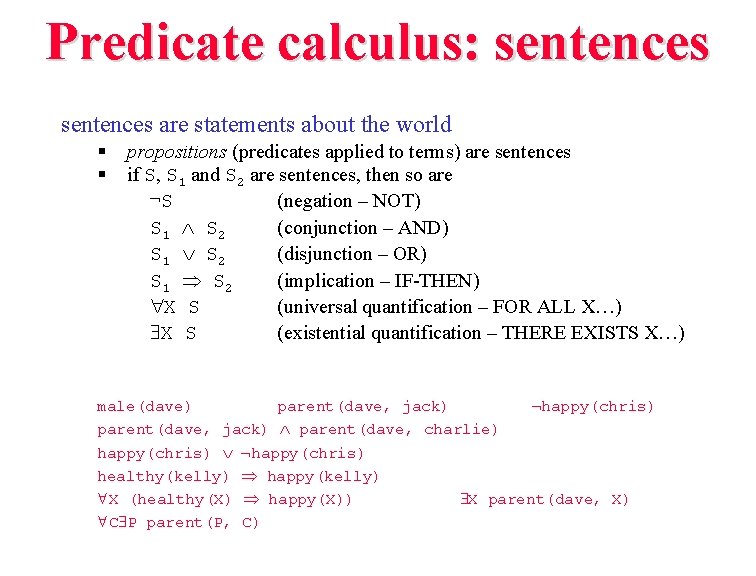
Predicate calculus: sentences are statements about the world § § propositions (predicates applied to terms) are sentences if S, S 1 and S 2 are sentences, then so are ¬S (negation – NOT) S 1 S 2 (conjunction – AND) S 1 S 2 (disjunction – OR) S 1 S 2 (implication – IF-THEN) X S (universal quantification – FOR ALL X…) X S (existential quantification – THERE EXISTS X…) male(dave) parent(dave, jack) ¬happy(chris) parent(dave, jack) parent(dave, charlie) happy(chris) ¬happy(chris) healthy(kelly) happy(kelly) X (healthy(X) happy(X)) X parent(dave, X) C P parent(P, C)
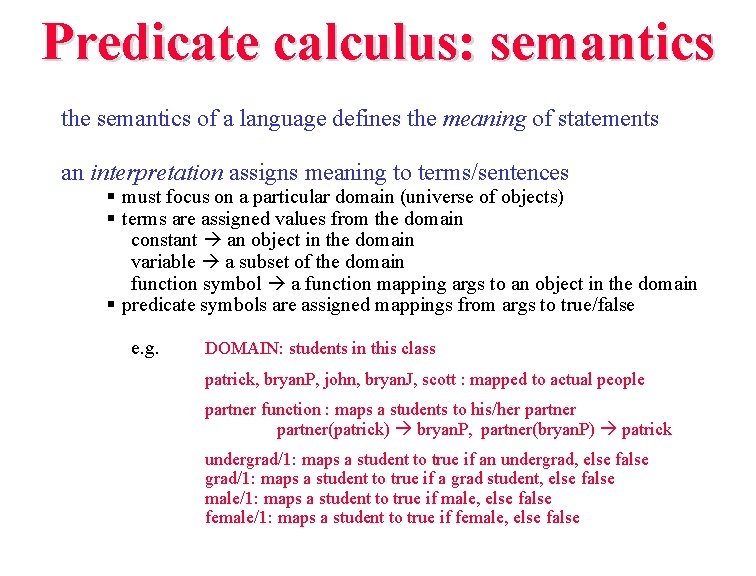
Predicate calculus: semantics the semantics of a language defines the meaning of statements an interpretation assigns meaning to terms/sentences § must focus on a particular domain (universe of objects) § terms are assigned values from the domain constant an object in the domain variable a subset of the domain function symbol a function mapping args to an object in the domain § predicate symbols are assigned mappings from args to true/false e. g. DOMAIN: students in this class patrick, bryan. P, john, bryan. J, scott : mapped to actual people partner function : maps a students to his/her partner(patrick) bryan. P, partner(bryan. P) patrick undergrad/1: maps a student to true if an undergrad, else false grad/1: maps a student to true if a grad student, else false male/1: maps a student to true if male, else false female/1: maps a student to true if female, else false
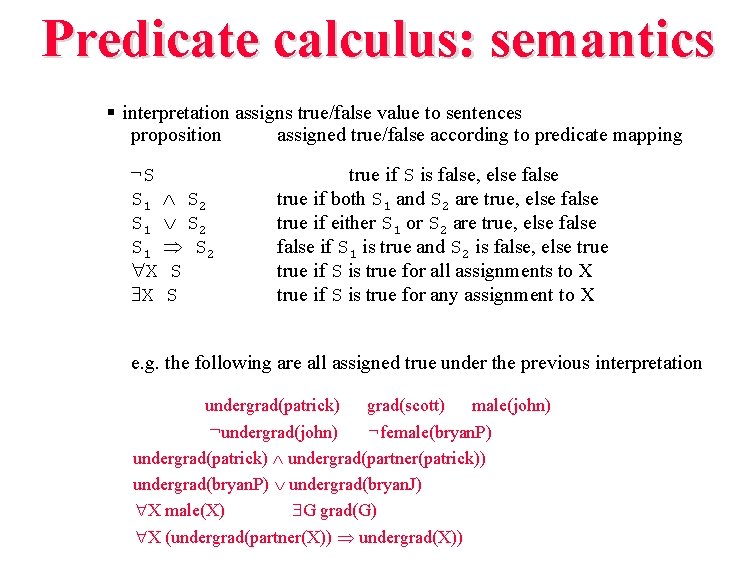
Predicate calculus: semantics § interpretation assigns true/false value to sentences proposition assigned true/false according to predicate mapping ¬S S 1 S 2 X S true if S is false, else false true if both S 1 and S 2 are true, else false true if either S 1 or S 2 are true, else false if S 1 is true and S 2 is false, else true if S is true for all assignments to X true if S is true for any assignment to X e. g. the following are all assigned true under the previous interpretation undergrad(patrick) ¬undergrad(john) grad(scott) male(john) ¬female(bryan. P) undergrad(patrick) undergrad(partner(patrick)) undergrad(bryan. P) undergrad(bryan. J) X male(X) G grad(G) X (undergrad(partner(X)) undergrad(X))
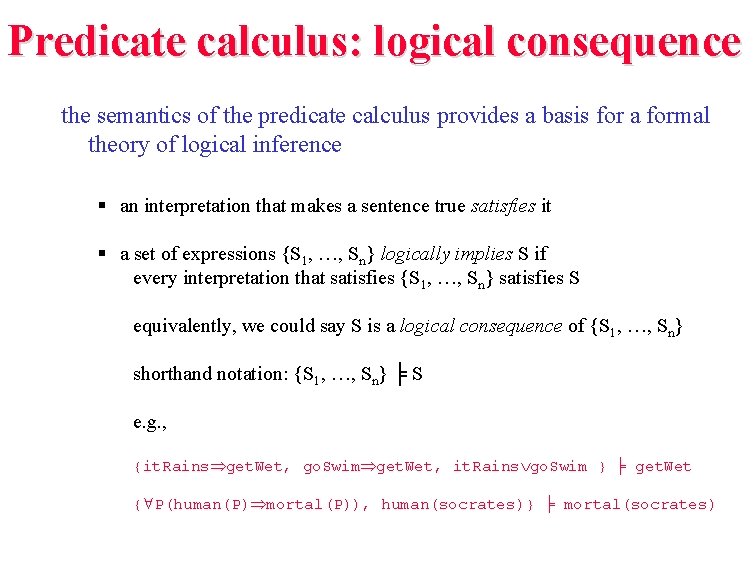
Predicate calculus: logical consequence the semantics of the predicate calculus provides a basis for a formal theory of logical inference § an interpretation that makes a sentence true satisfies it § a set of expressions {S 1, …, Sn} logically implies S if every interpretation that satisfies {S 1, …, Sn} satisfies S equivalently, we could say S is a logical consequence of {S 1, …, Sn} shorthand notation: {S 1, …, Sn} ╞ S e. g. , {it. Rains get. Wet, go. Swim get. Wet, it. Rains go. Swim } ╞ get. Wet { P(human(P) mortal(P)), human(socrates)} ╞ mortal(socrates)
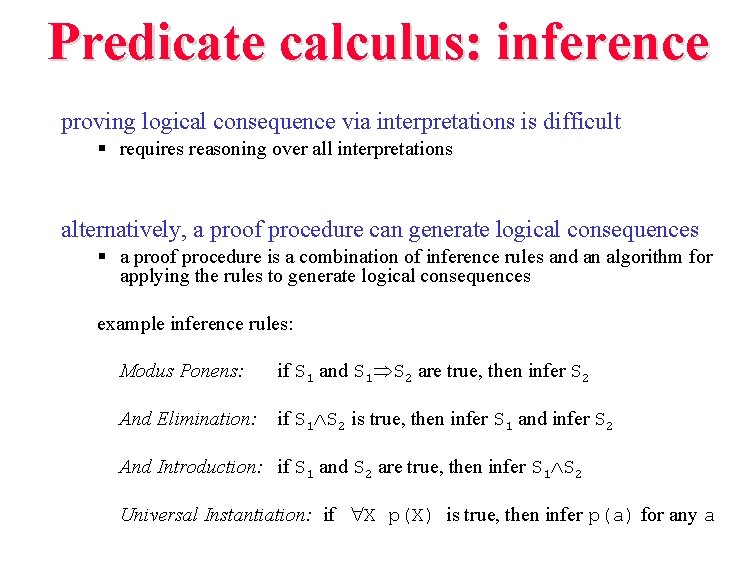
Predicate calculus: inference proving logical consequence via interpretations is difficult § requires reasoning over all interpretations alternatively, a proof procedure can generate logical consequences § a proof procedure is a combination of inference rules and an algorithm for applying the rules to generate logical consequences example inference rules: Modus Ponens: if S 1 and S 1 S 2 are true, then infer S 2 And Elimination: if S 1 S 2 is true, then infer S 1 and infer S 2 And Introduction: if S 1 and S 2 are true, then infer S 1 S 2 Universal Instantiation: if X p(X) is true, then infer p(a) for any a
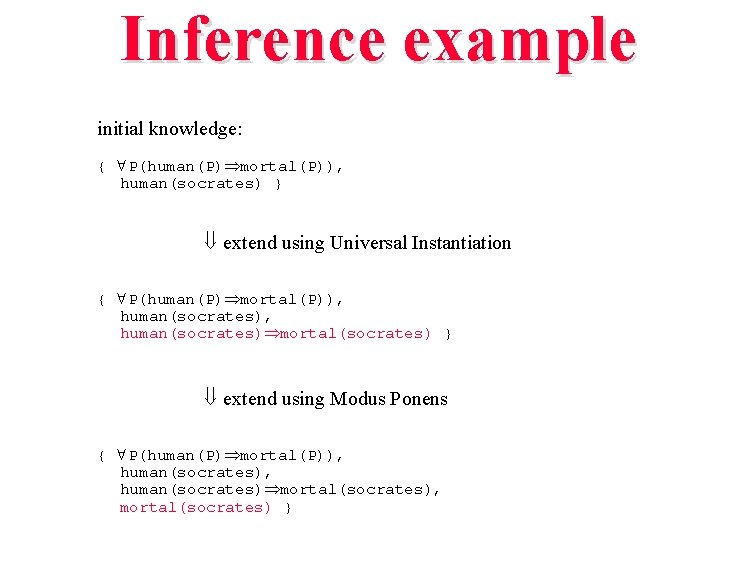
Inference example initial knowledge: { P(human(P) mortal(P)), human(socrates) } ß extend using Universal Instantiation { P(human(P) mortal(P)), human(socrates) mortal(socrates) } ß extend using Modus Ponens { P(human(P) mortal(P)), human(socrates) mortal(socrates), mortal(socrates) }
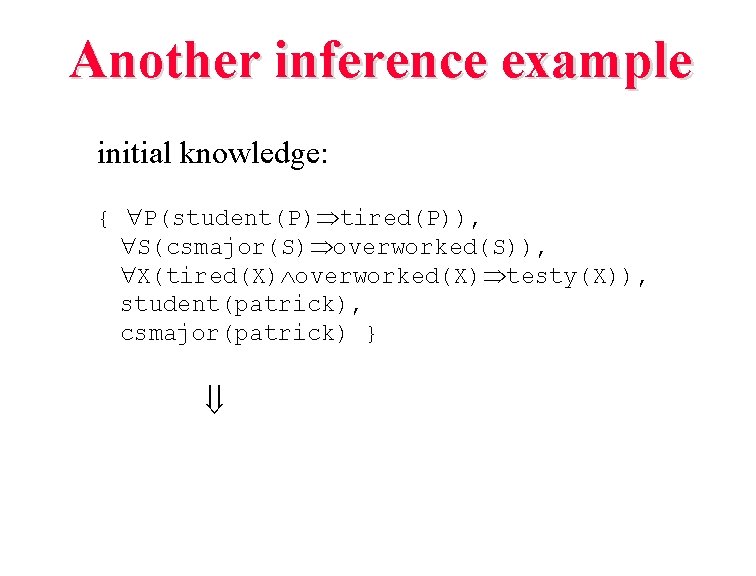
Another inference example initial knowledge: { P(student(P) tired(P)), S(csmajor(S) overworked(S)), X(tired(X) overworked(X) testy(X)), student(patrick), csmajor(patrick) } ß
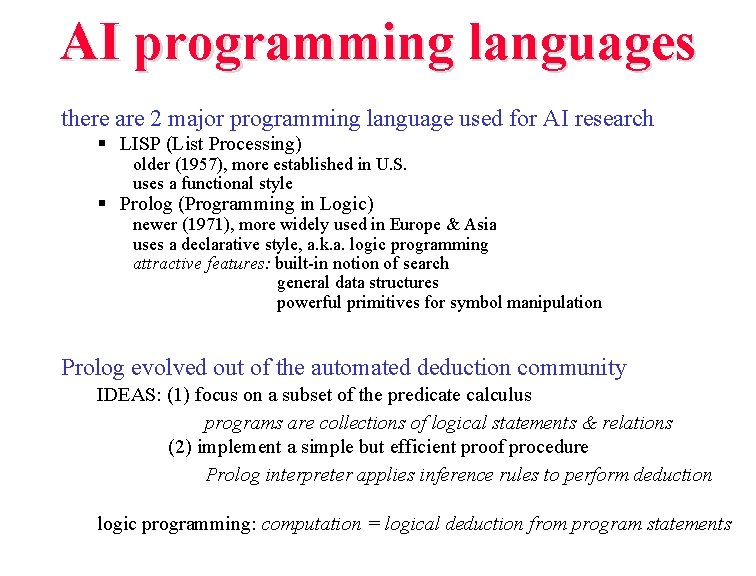
AI programming languages there are 2 major programming language used for AI research § LISP (List Processing) older (1957), more established in U. S. uses a functional style § Prolog (Programming in Logic) newer (1971), more widely used in Europe & Asia uses a declarative style, a. k. a. logic programming attractive features: built-in notion of search general data structures powerful primitives for symbol manipulation Prolog evolved out of the automated deduction community IDEAS: (1) focus on a subset of the predicate calculus programs are collections of logical statements & relations (2) implement a simple but efficient proof procedure Prolog interpreter applies inference rules to perform deduction logic programming: computation = logical deduction from program statements
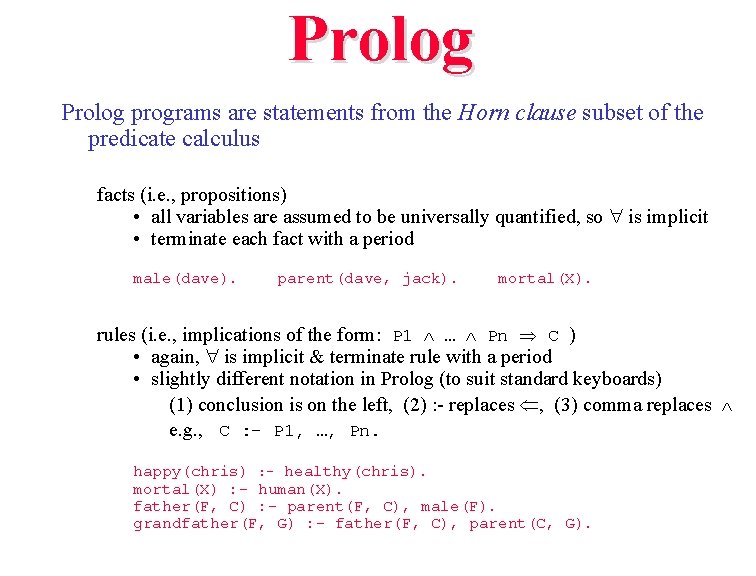
Prolog programs are statements from the Horn clause subset of the predicate calculus facts (i. e. , propositions) • all variables are assumed to be universally quantified, so is implicit • terminate each fact with a period male(dave). parent(dave, jack). mortal(X). rules (i. e. , implications of the form: P 1 … Pn C ) • again, is implicit & terminate rule with a period • slightly different notation in Prolog (to suit standard keyboards) (1) conclusion is on the left, (2) : - replaces , (3) comma replaces e. g. , C : - P 1, …, Pn. happy(chris) : - healthy(chris). mortal(X) : - human(X). father(F, C) : - parent(F, C), male(F). grandfather(F, G) : - father(F, C), parent(C, G).
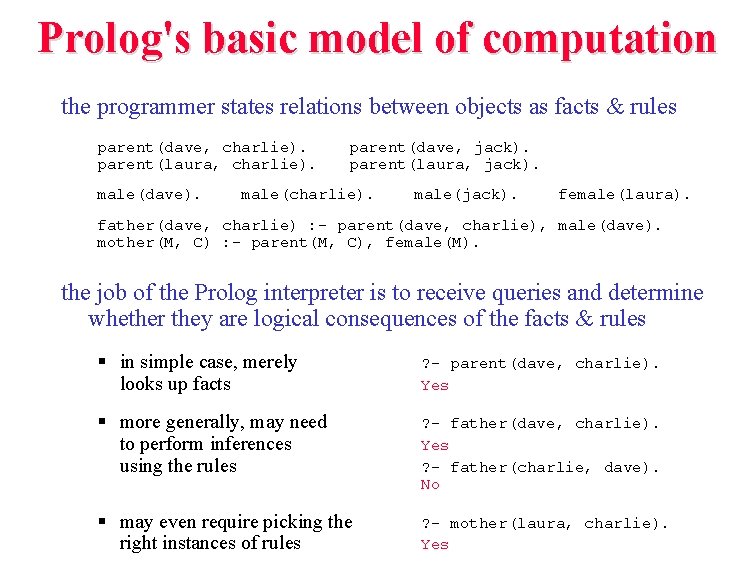
Prolog's basic model of computation the programmer states relations between objects as facts & rules parent(dave, charlie). parent(laura, charlie). male(dave). parent(dave, jack). parent(laura, jack). male(charlie). male(jack). female(laura). father(dave, charlie) : - parent(dave, charlie), male(dave). mother(M, C) : - parent(M, C), female(M). the job of the Prolog interpreter is to receive queries and determine whether they are logical consequences of the facts & rules § in simple case, merely looks up facts ? - parent(dave, charlie). Yes § more generally, may need to perform inferences using the rules ? - father(dave, charlie). Yes ? - father(charlie, dave). No § may even require picking the right instances of rules ? - mother(laura, charlie). Yes
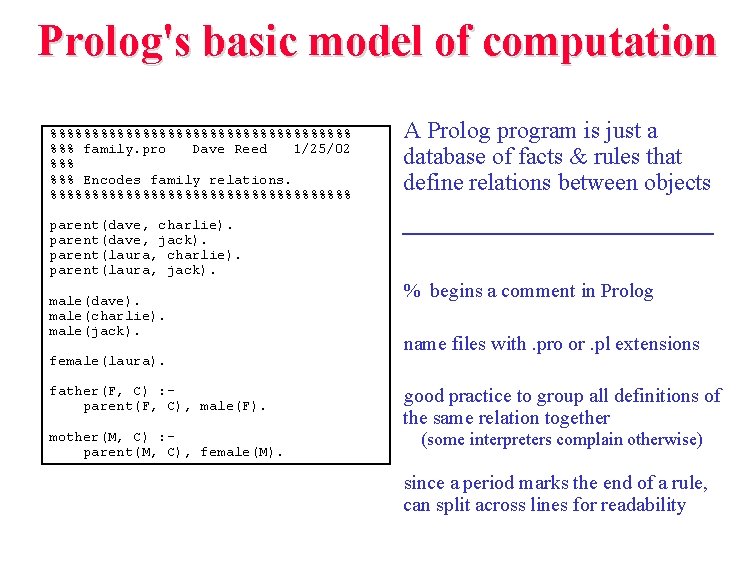
Prolog's basic model of computation %%%%%%%%%%%%%%%%%% %%% family. pro Dave Reed 1/25/02 %%% Encodes family relations. %%%%%%%%%%%%%%%%%% A Prolog program is just a database of facts & rules that define relations between objects parent(dave, charlie). parent(dave, jack). parent(laura, charlie). parent(laura, jack). male(dave). male(charlie). male(jack). female(laura). father(F, C) : parent(F, C), male(F). mother(M, C) : parent(M, C), female(M). % begins a comment in Prolog name files with. pro or. pl extensions good practice to group all definitions of the same relation together (some interpreters complain otherwise) since a period marks the end of a rule, can split across lines for readability
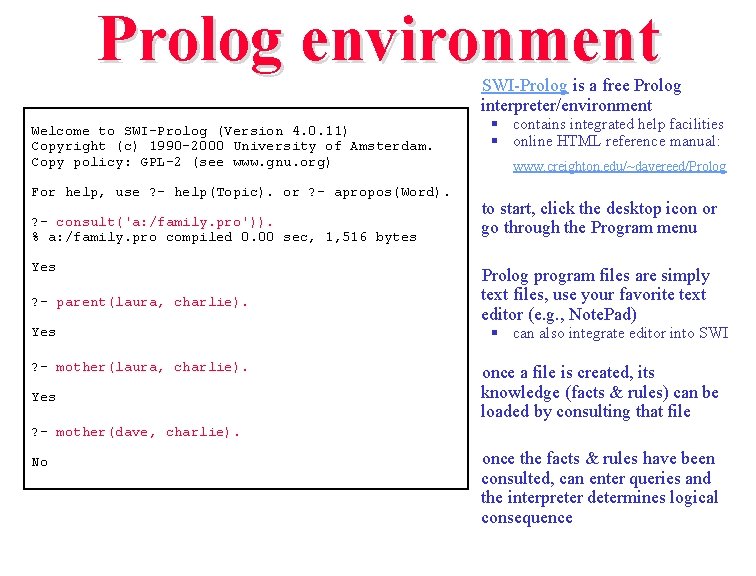
Prolog environment SWI-Prolog is a free Prolog interpreter/environment Welcome to SWI-Prolog (Version 4. 0. 11) Copyright (c) 1990 -2000 University of Amsterdam. Copy policy: GPL-2 (see www. gnu. org) For help, use ? - help(Topic). or ? - apropos(Word). ? - consult('a: /family. pro')). % a: /family. pro compiled 0. 00 sec, 1, 516 bytes Yes ? - parent(laura, charlie). Yes ? - mother(laura, charlie). Yes § contains integrated help facilities § online HTML reference manual: www. creighton. edu/~davereed/Prolog to start, click the desktop icon or go through the Program menu Prolog program files are simply text files, use your favorite text editor (e. g. , Note. Pad) § can also integrate editor into SWI once a file is created, its knowledge (facts & rules) can be loaded by consulting that file ? - mother(dave, charlie). No once the facts & rules have been consulted, can enter queries and the interpreter determines logical consequence
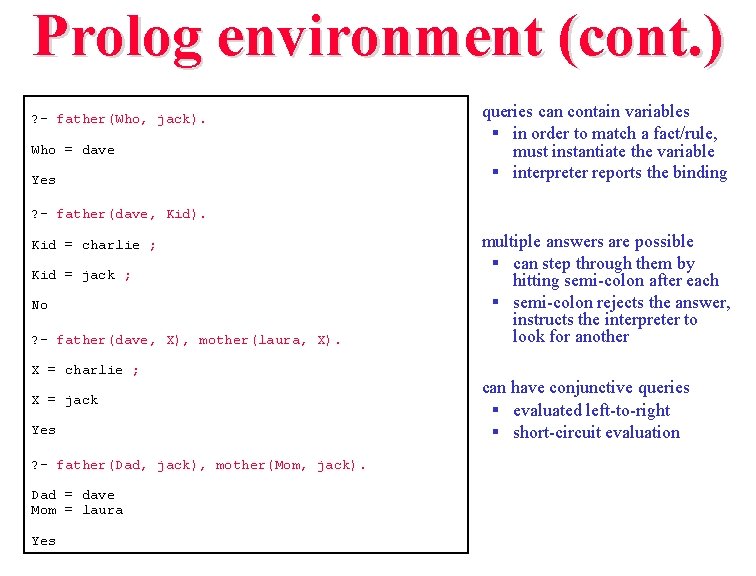
Prolog environment (cont. ) ? - father(Who, jack). Who = dave Yes queries can contain variables § in order to match a fact/rule, must instantiate the variable § interpreter reports the binding ? - father(dave, Kid). Kid = charlie ; Kid = jack ; No ? - father(dave, X), mother(laura, X). X = charlie ; X = jack Yes ? - father(Dad, jack), mother(Mom, jack). Dad = dave Mom = laura Yes multiple answers are possible § can step through them by hitting semi-colon after each § semi-colon rejects the answer, instructs the interpreter to look for another can have conjunctive queries § evaluated left-to-right § short-circuit evaluation
Prolog environment (cont. ) ? - consult('a: /family. pro'). % a: /family. pro compiled 0. 05 sec, 124 bytes Yes ? - consult('a: /ages. pro'). % a: /ages. pro compiled 0. 00 sec, 500 bytes Yes ? - age(jack, Age). Age = 1 Yes ? - father(dave, Child), age(Child, Age). after making changes to a file, can reconsult it to load changes § Prolog only reports the # of new bytes consulted can consult more than one file to combine collections of facts & rules § knowledge from both is active § useful when you have separate but related sources of knowledge Child = charlie Age = 4 ; Child = jack Age = 1 ; No ? - halt exits from the Prolog environment
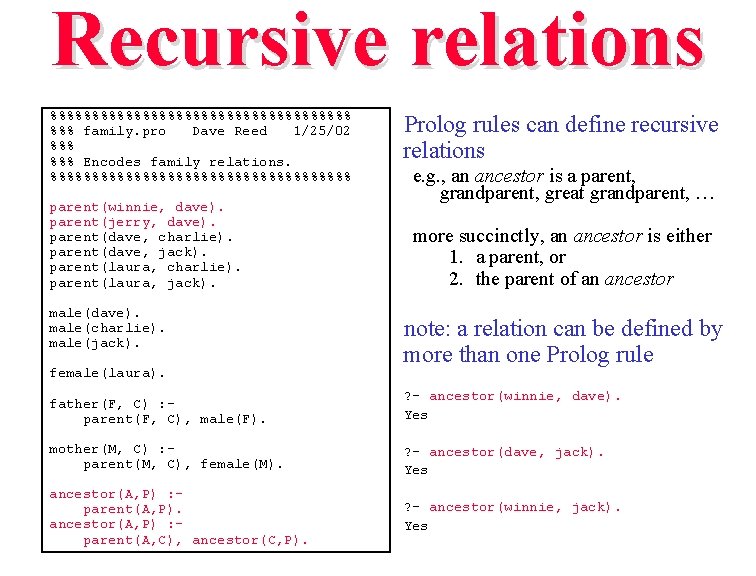
Recursive relations %%%%%%%%%%%%%%%%%% %%% family. pro Dave Reed 1/25/02 %%% Encodes family relations. %%%%%%%%%%%%%%%%%% parent(winnie, dave). parent(jerry, dave). parent(dave, charlie). parent(dave, jack). parent(laura, charlie). parent(laura, jack). male(dave). male(charlie). male(jack). female(laura). Prolog rules can define recursive relations e. g. , an ancestor is a parent, grandparent, great grandparent, … more succinctly, an ancestor is either 1. a parent, or 2. the parent of an ancestor note: a relation can be defined by more than one Prolog rule father(F, C) : parent(F, C), male(F). ? - ancestor(winnie, dave). Yes mother(M, C) : parent(M, C), female(M). ? - ancestor(dave, jack). Yes ancestor(A, P) : parent(A, P). ancestor(A, P) : parent(A, C), ancestor(C, P). ? - ancestor(winnie, jack). Yes