
DAV PUBLIC SCHOOL BERHAMPUR Poem 1 THE ROAD
DAV PUBLIC SCHOOL, BERHAMPUR Poem - 1 THE ROAD NOT TAKEN STD. IX - ENGLISH
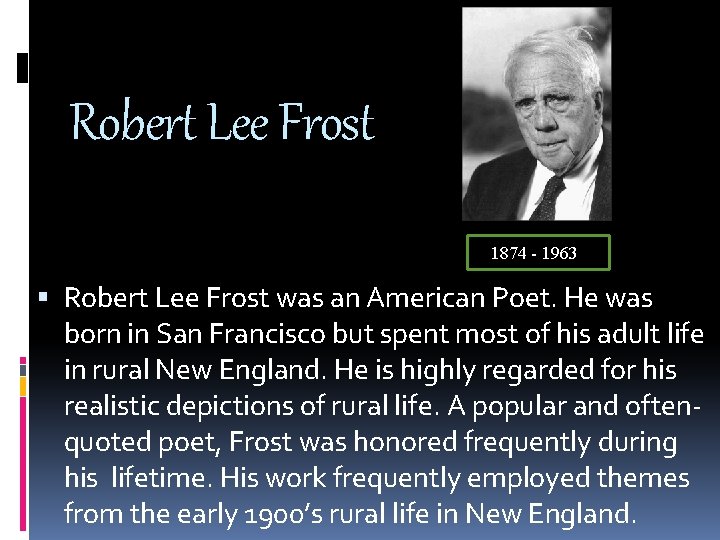
Robert Lee Frost 1874 - 1963 Robert Lee Frost was an American Poet. He was born in San Francisco but spent most of his adult life in rural New England. He is highly regarded for his realistic depictions of rural life. A popular and oftenquoted poet, Frost was honored frequently during his lifetime. His work frequently employed themes from the early 1900’s rural life in New England.
About The Poem This poem is about making choices and the choices that shape us. First published in 1916 , “The Road Not Taken" shows Frost at his best as a pastoral who combines rural simplicity with hidden , indirect and clarity of style and language. In the poem, the two roads serve as a metaphor for the choices one makes in life. The choice that is made has far reaching consequences. Hence, our decision should be taken correctly. Further, Robert Frost also shows a way to make a unique choice.
THEME OF THE POEM The main theme of “The Road Not Taken” is that life is full of choices which will define our destinations.
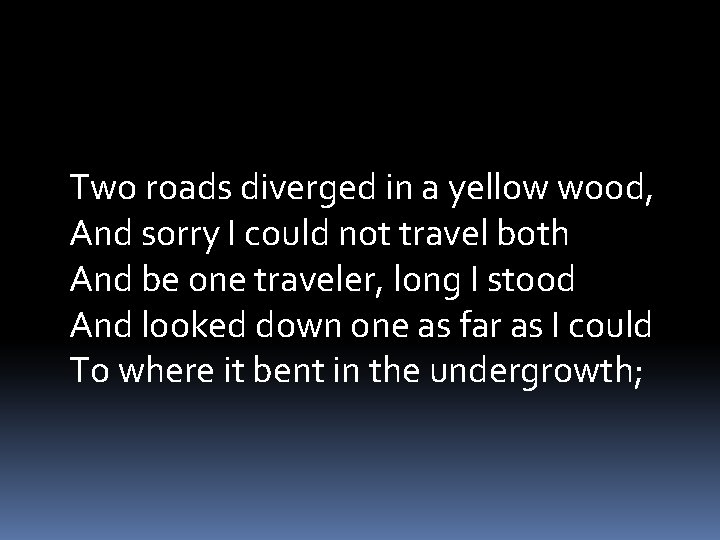
Two roads diverged in a yellow wood, And sorry I could not travel both And be one traveler, long I stood And looked down one as far as I could To where it bent in the undergrowth;
Explanation of first stanza q The speaker describes his position. He has been out for walking in the woods and comes in between the diversion of two roads, he stands there looking as far down as he can see. He would like to try out both, but doubts whether he could do that, so therefore he continues to look down the roads for a long time trying to make his decision about which road to take.
Meanings of stanza - 1 1. Diverged – separated 2. Yellow wood – a forest full of yellow leaves as if in autumn season. 3. Undergrowth – dense growth of plants and bushes.
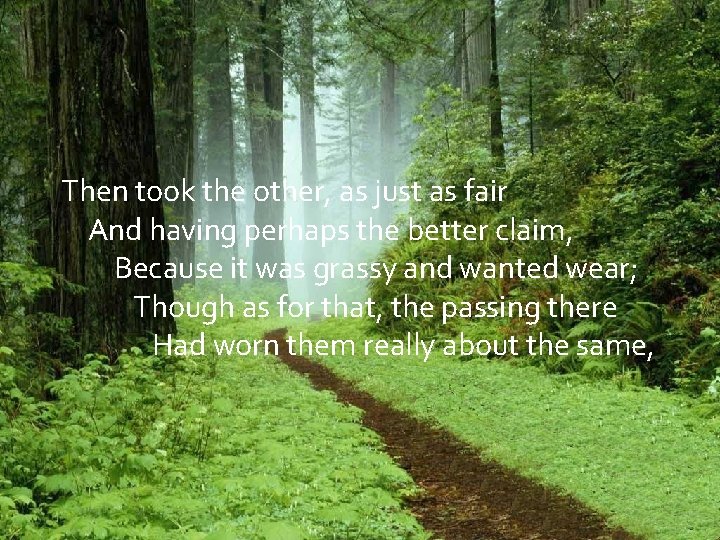
Then took the other, as just as fair And having perhaps the better claim, Because it was grassy and wanted wear; Though as for that, the passing there Had worn them really about the same,
Explanation of second stanza q He looked down the first one “to where it bend in the undergrowth”, and then the second one , and he decided to take the other path, because it seemed to have less traveled than the first. Both roads are similar in appearance. After a moment, he changes his mind, concluding that both roads are equally worn out. The poet is in a state of confusion in order to make the first choice.
Meanings of stanza - 2 1. Fair – good 2. Passing – on walking down 3. Better claim – it seemed better 4. Wanted wear – looked less worn out
And both that morning equally lay In leaves no step had trodden black. Oh, I kept the first for another day! Yet knowing how way leads on to way, I doubted if I should ever come back.
Explanation of third stanza q He had noticed that in the morning both the roads seemed covered with leaves and that no traveler has walked the way. He comes to this conclusion because the fallen leaves are not crushed by the footsteps. He strongly feels that he would take the other road to know what it had in store. The speaker realizes that he may never be able to return to take the “Road Not Taken. ”
Meanings of stanza - 3 1. Equally – were equally covered 2. Trodden black – turned a path black by crushing the leaves. 3. Way leads on to way – one thing leads to another
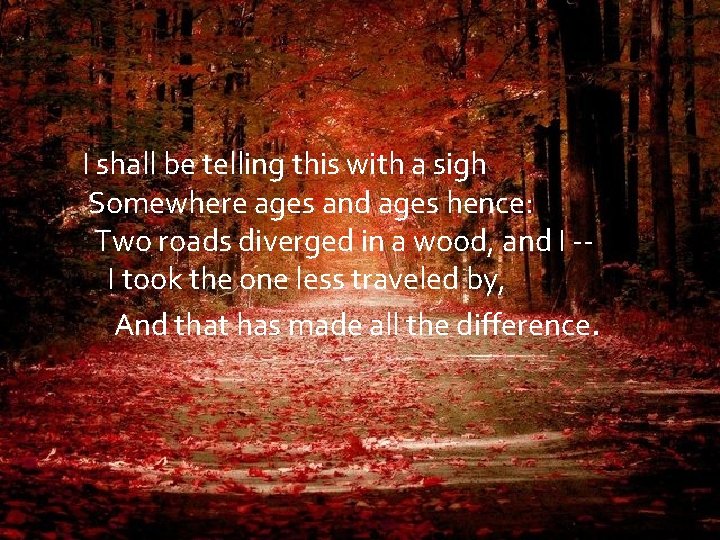
I shall be telling this with a sigh Somewhere ages and ages hence: Two roads diverged in a wood, and I -I took the one less traveled by, And that has made all the difference.
Explanation of fourth stanza Here, the speaker hopes to talk off the decision taken years later with a sigh. This decision would definitely make a difference in life. The speaker finally concludes about confidence in taking a bold decision that he had dared to take the road which was less travelled and it made a difference. This choice made a significant impact in his life.
Meanings of stanza - 4 1. Sigh – to take a deep breath out of sorrow or regret. 2. Ages and ages hence – many years in the future.
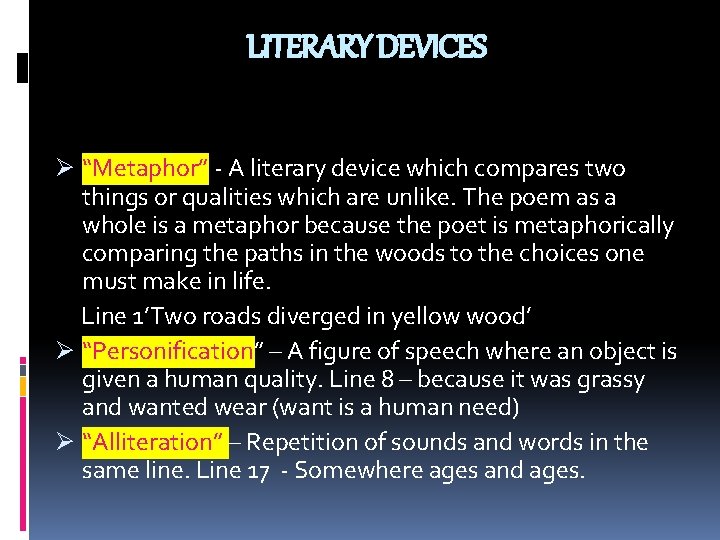
LITERARY DEVICES Ø “Metaphor” - A literary device which compares two things or qualities which are unlike. The poem as a whole is a metaphor because the poet is metaphorically comparing the paths in the woods to the choices one must make in life. Line 1’Two roads diverged in yellow wood’ Ø “Personification” – A figure of speech where an object is given a human quality. Line 8 – because it was grassy and wanted wear (want is a human need) Ø “Alliteration” – Repetition of sounds and words in the same line. Line 17 - Somewhere ages and ages.
Ø Imagery – A poetic device wherein the pattern of images or pictures comes to the mind from what is read in the poem. Line 2 – “Two roads diverged in yellow wood”
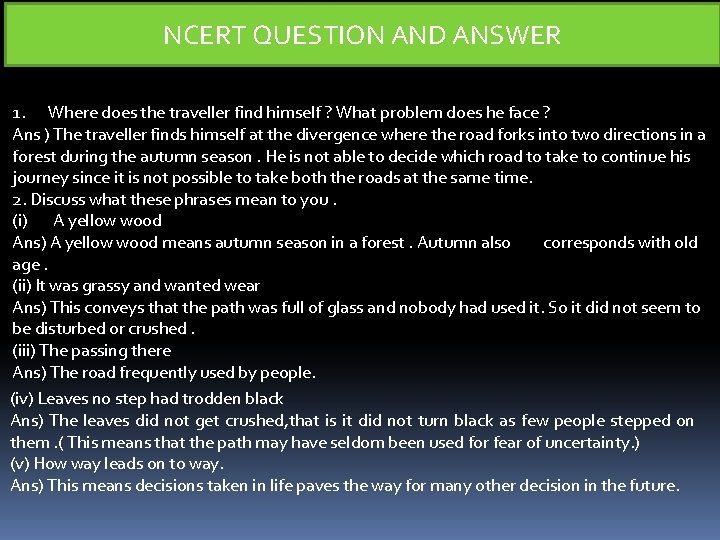
NCERT QUESTION AND ANSWER 1. Where does the traveller find himself ? What problem does he face ? Ans ) The traveller finds himself at the divergence where the road forks into two directions in a forest during the autumn season. He is not able to decide which road to take to continue his journey since it is not possible to take both the roads at the same time. 2. Discuss what these phrases mean to you. (i) A yellow wood Ans) A yellow wood means autumn season in a forest. Autumn also corresponds with old age. (ii) It was grassy and wanted wear Ans) This conveys that the path was full of glass and nobody had used it. So it did not seem to be disturbed or crushed. (iii) The passing there Ans) The road frequently used by people. (iv) Leaves no step had trodden black Ans) The leaves did not get crushed, that is it did not turn black as few people stepped on them. ( This means that the path may have seldom been used for fear of uncertainty. ) (v) How way leads on to way. Ans) This means decisions taken in life paves the way for many other decision in the future.
ANSWER THE FOLLOWING QUESTIONS 1. Is there any difference between the two roadsas the poet describes them (i) In stanzas two and three ? (ii) In the last two lines of the poem? EXTRA QUESTIONS I) Answer briefly 1. What does the road stand for? 2. What decision does the poet take about the 1 st road? 3. Why do you think the poet select the second road? 4. What is common about both the roads that morning? 5. Why did the poet feel sorry? 6. What has made all the difference in his life? 7. Why do you think the poet stood at the juncture for a long time? 8. What choice did the narrator have to make?
II)Answer the questions in about 30 -40 words. i)“And that has made all the difference” What made all the difference in the poet’s life? ii) What was the poet’s doubt? Why did he doubt so? iii) What is theme of the poem ‘The Road not Taken’? iv) What is the dilemma the poet confronts with? v) Describe the two roads the poet comes across? vi) Do you think the poet is happy with his choice? Why/Why not? vii) Why does the speaker say ‘he will be telling this with a sigh’/ Somewhere ages and ages hence. viii) Which road did the poet choose and why? ix) Robert Frost stands for a long time on a point where the two roads diverged. Why? x) ‘And both that morning equally lay’. Explain.
III) Answer in about 100 -150 words. 1. Do you think the title “The Road Not Taken” is appropriate for the poem? Discuss. 2. The road is used as metaphor for life in this poem. Explain why it has been used to describe life? 3. Bring out the contrast and similarities between the two roads mentioned in the poem. 4. “The choice we make has far reaching consequence in life. ” Discuss this in the light of the poem ‘The Road Not Taken. ’
Thank you By V S SUNEETA
- Slides: 23