
DATEX II VERSION 3 0 Methodology improvements Josef
- Slides: 11
DATEX II VERSION 3. 0 Methodology improvements Josef Kaltwasser DATEX II Technical Management Group DATEX II User Forum – Dublin – 13&14 September 2016
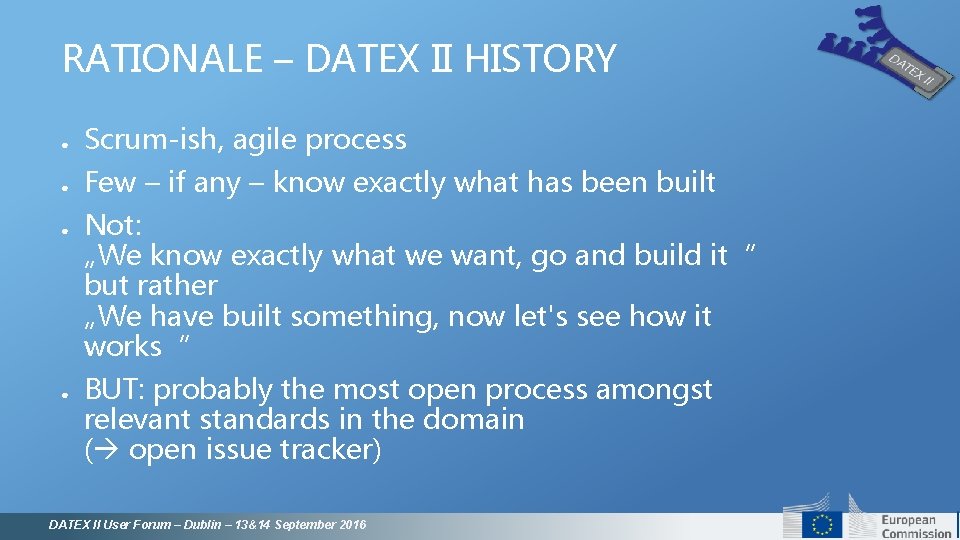
RATIONALE – DATEX II HISTORY ● Scrum-ish, agile process ● Few – if any – know exactly what has been built ● ● Not: „We know exactly what we want, go and build it“ but rather „We have built something, now let's see how it works“ BUT: probably the most open process amongst relevant standards in the domain ( open issue tracker) DATEX II User Forum – Dublin – 13&14 September 2016
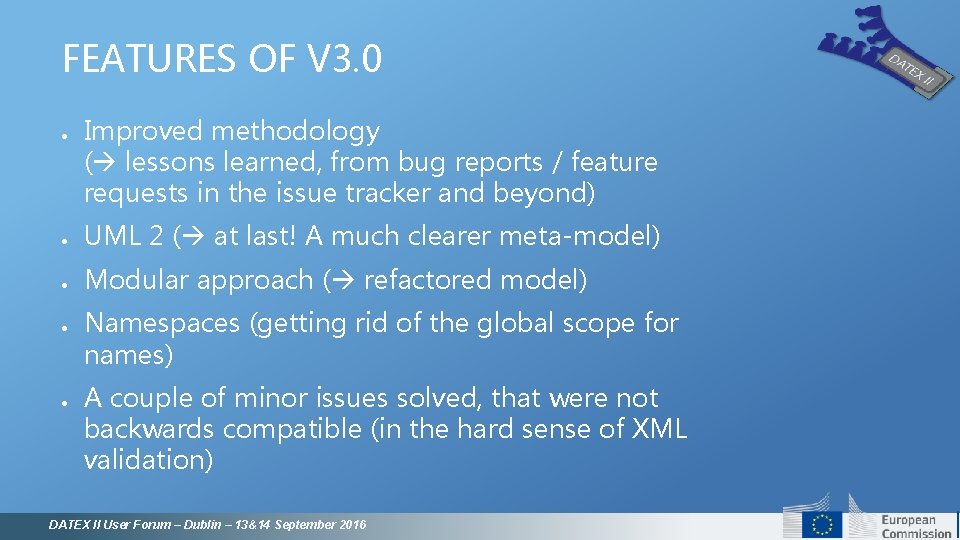
FEATURES OF V 3. 0 ● Improved methodology ( lessons learned, from bug reports / feature requests in the issue tracker and beyond) ● UML 2 ( at last! A much clearer meta-model) ● Modular approach ( refactored model) ● ● Namespaces (getting rid of the global scope for names) A couple of minor issues solved, that were not backwards compatible (in the hard sense of XML validation) DATEX II User Forum – Dublin – 13&14 September 2016
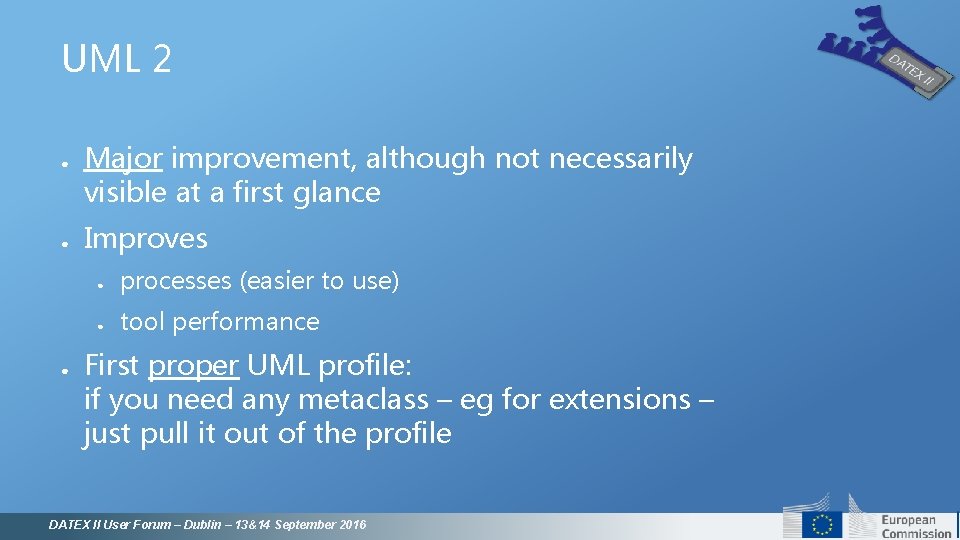
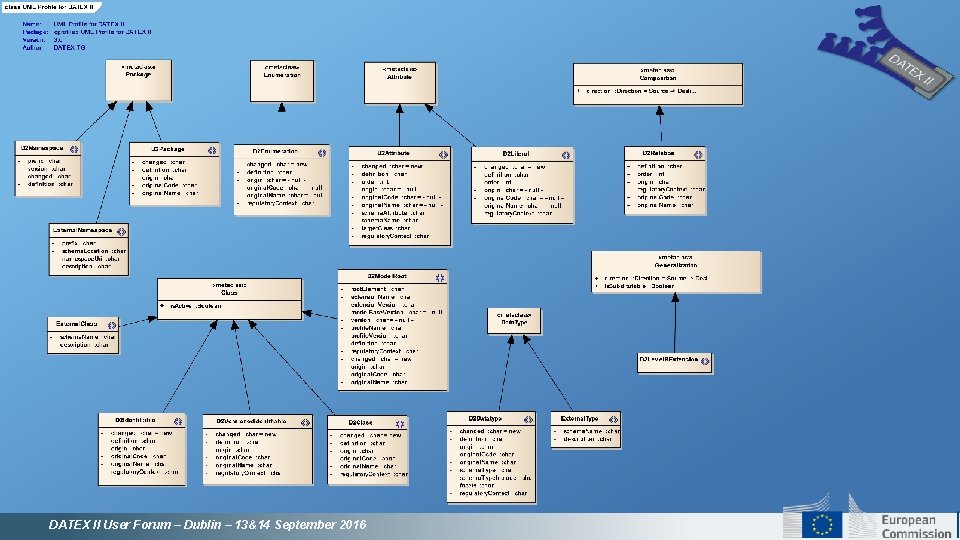
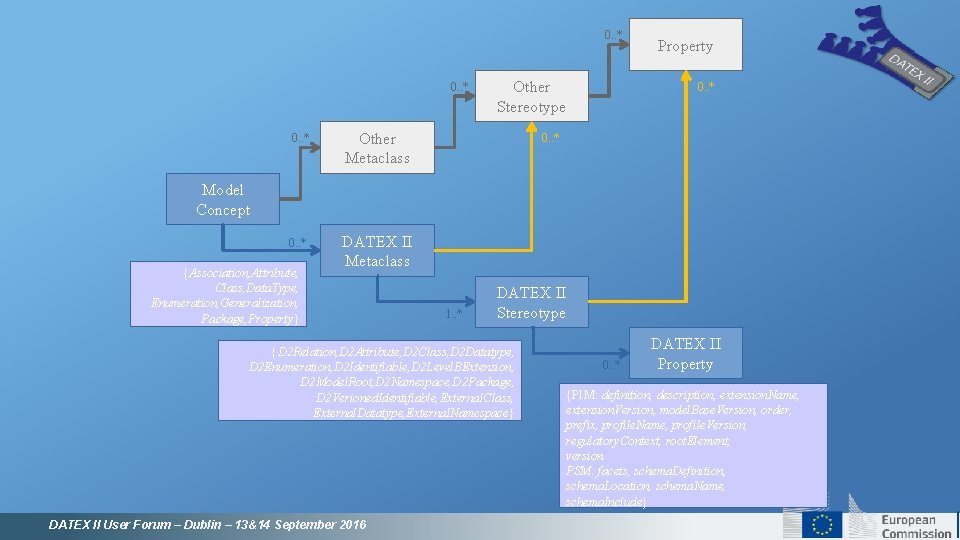
UML 2 ● ● ● Major improvement, although not necessarily visible at a first glance Improves ● processes (easier to use) ● tool performance First proper UML profile: if you need any metaclass – eg for extensions – just pull it out of the profile DATEX II User Forum – Dublin – 13&14 September 2016
DATEX II User Forum – Dublin – 13&14 September 2016
16157 -1 IMPROVEMENTS ● ● ● Leaner: less narrative parts, especially regarding the early Millennium design rationale Clearer: Abandoned the approach to define own M 2/M 3 models and map those to UML – starting M 2 model is now the UML profile More flexible: Modules can be combined in a tailored way DATEX II User Forum – Dublin – 13&14 September 2016
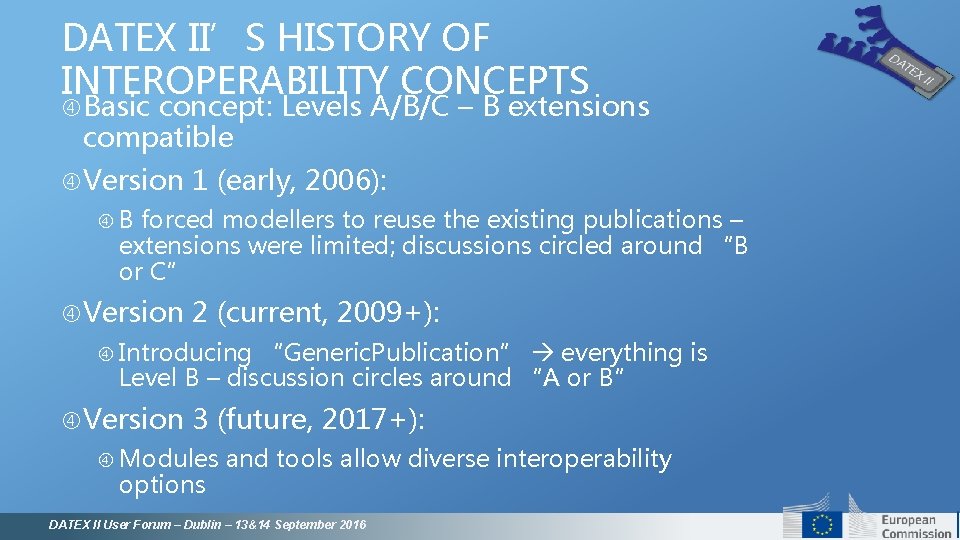
DATEX II’S HISTORY OF INTEROPERABILITY CONCEPTS Basic concept: Levels A/B/C – B extensions compatible Version 1 (early, 2006): B forced modellers to reuse the existing publications – extensions were limited; discussions circled around “B or C” Version 2 (current, 2009+): Introducing “Generic. Publication” everything is Level B – discussion circles around “A or B” Version 3 (future, 2017+): Modules options and tools allow diverse interoperability DATEX II User Forum – Dublin – 13&14 September 2016
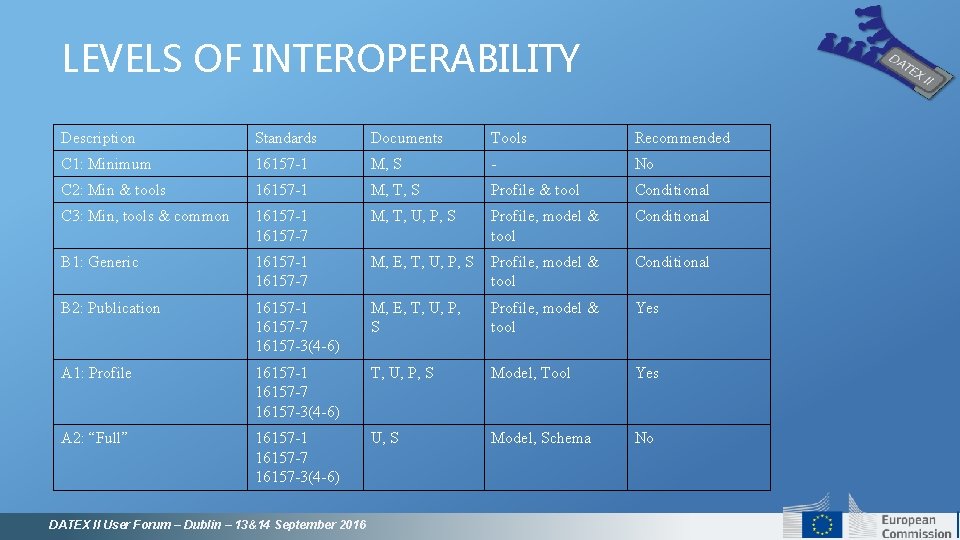
LEVELS OF INTEROPERABILITY Description Standards Documents Tools Recommended C 1: Minimum 16157 -1 M, S - No C 2: Min & tools 16157 -1 M, T, S Profile & tool Conditional C 3: Min, tools & common 16157 -1 16157 -7 M, T, U, P, S Profile, model & tool Conditional B 1: Generic 16157 -1 16157 -7 M, E, T, U, P, S Profile, model & tool Conditional B 2: Publication 16157 -1 16157 -7 16157 -3(4 -6) M, E, T, U, P, S Profile, model & tool Yes A 1: Profile 16157 -1 16157 -7 16157 -3(4 -6) T, U, P, S Model, Tool Yes A 2: “Full” 16157 -1 16157 -7 16157 -3(4 -6) U, S Model, Schema No DATEX II User Forum – Dublin – 13&14 September 2016
FACILITATE CHANGE Current discussions reveal potential need for change, even during the expected lifetime of V 3: ASN. 1 other model representation (ISO/IEC 8824) transfer syntax options: JSON ASN. 1 encoding rules (ISO/IEC 8825, e. g. UPER – ISO/IEC 88252) The DATEX II Methodology has been improved to cope with such requirements without violating the ENs DATEX II User Forum – Dublin – 13&14 September 2016
0. . * Other Metaclass 0. . * DATEX II Metaclass Other Stereotype Property 0. . * Model Concept {Association, Attribute, Class, Data. Type, Enumeration, Generalization, Package, Property} 1. . * DATEX II Stereotype {D 2 Relation, D 2 Attribute, D 2 Class, D 2 Datatype, D 2 Enumeration, D 2 Identifiable, D 2 Level. BExtension, D 2 Model. Root, D 2 Namespace, D 2 Package, D 2 Verioned. Identifiable, External. Class, External. Datatype, External. Namespace} DATEX II User Forum – Dublin – 13&14 September 2016 0. . * DATEX II Property {PIM: definition, description, extension. Name, extension. Version, model. Base. Version, order, prefix, profile. Name, profile. Version, regulatory. Context, root. Element, version PSM: facets, schema. Definition, schema. Location, schema. Name, schema. Include}
CONCLUSIONS DATEX II v 3 is evolution, not revolution Flexibility to adapt to emerging requirements Enhanced usability by modular concept Bugs fixed (e. g. allows for including external schemas) Much improved processes and tool performance Migration is beneficial, but the decision for migration should come from functional requirements, i. e. regarding new data concepts DATEX II User Forum – Dublin – 13&14 September 2016