
Date Title Macbeth Act 5 scene 6 and
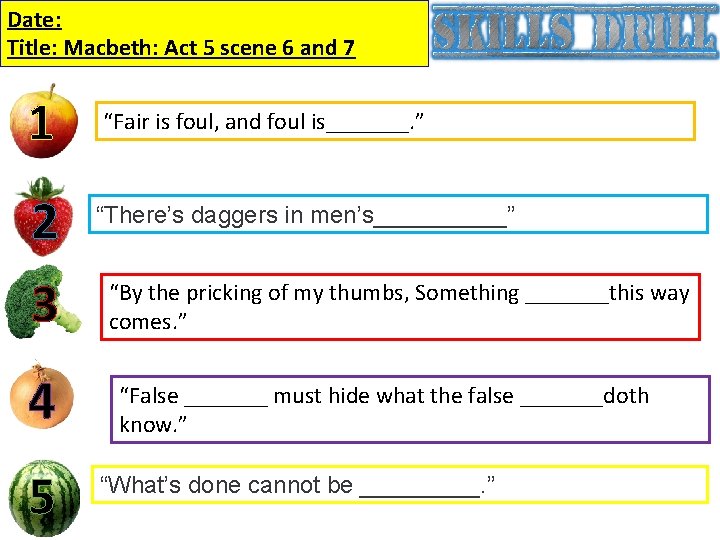
Date: Title: Macbeth: Act 5 scene 6 and 7 1 “Fair is foul, and foul is_______. ” 2 “There’s daggers in men’s_____” 3 4 5 “By the pricking of my thumbs, Something _______this way comes. ” “False _______ must hide what the false _______doth know. ” “What’s done cannot be _____. ”
Act 5 Scenes 6 and 7 ‘Make all our trumpets speak; give them all breath, Those clamorous harbingers of blood and death. ’ What different ideas could blood be used to symbolise? Name 3 moments in the play that have mentioned blood. Why does Shakespeare use blood as a motif across the play?
Act 5 Scene 6 Summary This brief scene presents the English army removing their camouflage and preparing to attack Macbeth’s castle. Malcolm is presented as a respected leader who is orderly and respects his elders. This contrasts with Macbeth’s lawless and irrational leadership in the previous scene.
Act 5 Scene 6 Dunsinane. Before the castle. Drum and colours. Enter MALCOLM, SIWARD, MACDUFF, and their Army, with boughs MALCOLM: Now near enough: your leafy screens throw down. And show like those you are. You, worthy uncle, Malcolm is presented as a natural leader Shall, with my cousin, your right-noble son, which juxtaposes with Macbeth in the Lead our first battle: worthy Macduff and we previous scene. He shows reverence for Shall take upon 's what else remains to do, Siward’s experience by allowing him to lead. According to our order. SIWARD: Fare you well. Do we but find the tyrant's power to-night, Let us be beaten, if we cannot fight. They would prefer to die than live under Macbeth’s tyrannical control. MACDUFF: Make all our trumpets speak; give them all breath, Those clamorous harbingers of blood and death. Macduff’s rhyming couplet acts as a Exeunt rallying cry for the attack on the castle.
Act 5 Scene 7 Summary In a scene that foreshadows the final destruction of a tyrant in single combat, Macbeth is challenged by the courageous son of Siward. Immediately afterwards, Macduff is seen eagerly seeking out the man who was responsible for the murder of his family. Lastly, it is announced that Macbeth's forces have surrendered Dunsinane castle. But the business is not yet finished.
Here, Macbeth compares himself to a bear who must “fight the Act 5 SCENE 7. Another part of the field. course, ” an allusion to the Elizabethan sport of bear-baiting, in Alarums. Enter MACBETH which a bear was chained to a post in the middle of an arena MACBETH and would have to fight various opponents. They have tied me to a stake; I cannot fly, But, bear-like, I must fight the course. What's he Macbeth is still clinging to the witches’ final prophecy that noone born of a woman can kill him. That was not born of woman? Such a one Am I to fear, or none. Enter YOUNG SIWARD: What is thy name? MACBETH: Thou'lt be afraid to hear it. YOUNG SIWARD: No; though thou call'st thyself a hotter name than any is in hell. MACBETH: My name's Macbeth. YOUNG SIWARD: The devil himself could not pronounce a title More hateful to mine ear. MACBETH No, nor more fearful. YOUNG SIWARD Thou liest, abhorred tyrant; with my sword I'll prove the lie thou speak'st. They fight and YOUNG SIWARD is slain Macbeth kills Young Siward and arrogantly boasts MACBETH that no one can kill him. He thinks he can afford to Thou wast born of woman But swords I smile at, weapons laugh to scorn, smile at his enemy’s swords. It reveals how deeply Brandish'd by man that's of a woman born. the witches have tricked him. Exit
Alarums. Enter MACDUFF That way the noise is. Tyrant, show thy face! Macduff feels he must be the one who kills If thou be'st slain and with no stroke of mine, Macbeth to help deal with his grief. My wife and children's ghosts will haunt me still. I cannot strike at wretched kerns, whose arms Are hired to bear their staves: either thou, Macbeth, Or else my sword with an unbatter'd edge I sheathe again undeeded. There thou shouldst be; Macduff is frantically trying to locate Macbeth By this great clatter, one of greatest note during the battle. Seems bruited. Let me find him, fortune! And more I beg not. Exit. Alarums Enter MALCOLM and SIWARD This way, my lord; the castle's gently render'd: He announces the castle has been surrendered The tyrant's people on both sides do fight; and Macbeth’s men have joined the other side The noble thanes do bravely in the war; The day almost itself professes yours, And little is to do. MALCOLM We have met with foes That strike beside us. SIWARD Enter, sir, the castle. Exeunt. Alarums
1. 2. 3. 4. 5. 6. 7. The motif of blood in Macbeth ‘Make thick my blood’ ‘There’s no such thing. It is the bloody business that informs thus to mine eyes’ ‘Will all great Neptune’s ocean wash this blood clean from my hand? ’ ‘A little water clears us of this deed’ ‘Never shake thy gory locks at me’ ‘They say blood will have blood’. ‘I am in blood stepp'd in so far that, should I wade no more, / Returning were as tedious as go o'er’ 8. ‘The blood-boltered Banquo smiles upon me’ 9. ‘Bleed, bleed poor country!’ 10. ‘His secret murders sticking on his hands’ 11. ’Here's the smell of the blood still: all the perfumes of Arabia will not sweeten this little hand. O, O, O!’ FOR EACH QUOTATION COMPLETE THE FOLLOWING 3 QUESTIONS: a) Who says it and when does it happen in the play? b) What does the quotation reveal about the character? c) What methods/techniques are being used to shape meaning?
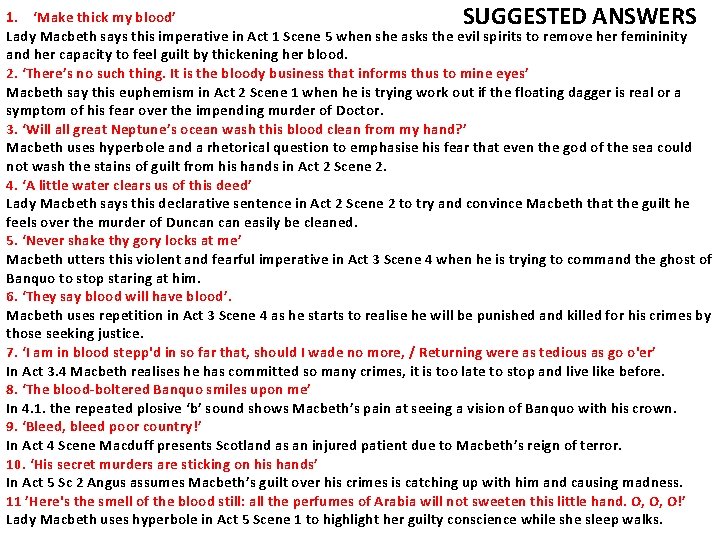
1. ‘Make thick my blood’ SUGGESTED ANSWERS Lady Macbeth says this imperative in Act 1 Scene 5 when she asks the evil spirits to remove her femininity and her capacity to feel guilt by thickening her blood. 2. ‘There’s no such thing. It is the bloody business that informs thus to mine eyes’ Macbeth say this euphemism in Act 2 Scene 1 when he is trying work out if the floating dagger is real or a symptom of his fear over the impending murder of Doctor. 3. ‘Will all great Neptune’s ocean wash this blood clean from my hand? ’ Macbeth uses hyperbole and a rhetorical question to emphasise his fear that even the god of the sea could not wash the stains of guilt from his hands in Act 2 Scene 2. 4. ‘A little water clears us of this deed’ Lady Macbeth says this declarative sentence in Act 2 Scene 2 to try and convince Macbeth that the guilt he feels over the murder of Duncan easily be cleaned. 5. ‘Never shake thy gory locks at me’ Macbeth utters this violent and fearful imperative in Act 3 Scene 4 when he is trying to command the ghost of Banquo to stop staring at him. 6. ‘They say blood will have blood’. Macbeth uses repetition in Act 3 Scene 4 as he starts to realise he will be punished and killed for his crimes by those seeking justice. 7. ‘I am in blood stepp'd in so far that, should I wade no more, / Returning were as tedious as go o'er’ In Act 3. 4 Macbeth realises he has committed so many crimes, it is too late to stop and live like before. 8. ‘The blood-boltered Banquo smiles upon me’ In 4. 1. the repeated plosive ‘b’ sound shows Macbeth’s pain at seeing a vision of Banquo with his crown. 9. ‘Bleed, bleed poor country!’ In Act 4 Scene Macduff presents Scotland as an injured patient due to Macbeth’s reign of terror. 10. ‘His secret murders are sticking on his hands’ In Act 5 Sc 2 Angus assumes Macbeth’s guilt over his crimes is catching up with him and causing madness. 11 ’Here's the smell of the blood still: all the perfumes of Arabia will not sweeten this little hand. O, O, O!’ Lady Macbeth uses hyperbole in Act 5 Scene 1 to highlight her guilty conscience while she sleep walks.
• What knowledge have you learnt today? • What skills have you learnt/developed today? • How has your previous learning helped you in today’s lesson?
Lesson changeover KS 4: 1. Arrive on time 2. Have the necessary equipment 3. Line up outside the classroom in silence 4. Enter the classroom calmly, when the teacher tells you to 5. Sit in the seating plan
- Slides: 11