
Date SWBATA 212016 What is government Materials Needed
Date SWBATA • 2/1/2016 • What is government? Materials Needed Pencil Warm-up Sheet Rules Sheet Student Information Sheet Agenda Warm-up Remediation New Content Independent Practice Closure
Date Warm Up ? • 2/1/2016 • What are three branches of government? • List two questions you have for Mr. Barr
Authoritarianism vs. Democracy A comparison
How To Read This Presentation � Each slide describes an aspect of government. � The first bullet will describe how that aspect of government exists in an authoritarian or totalitarian system. The text for describing these systems will be in red. � The bullets that follow will be written in white. They represent democratic elements.

Extent of Government Power • Authoritarian: –Government is not limited. � Representative Democracy › Government is limited by the consent of the people (republic)
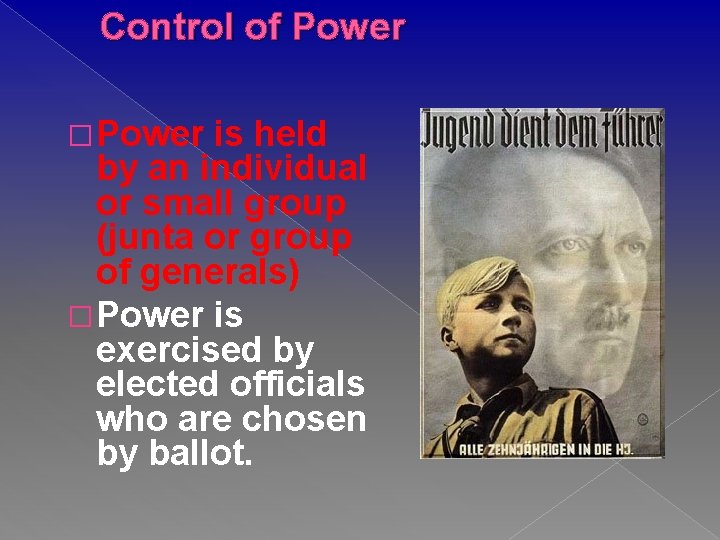
Control of Power � Power is held by an individual or small group (junta or group of generals) � Power is exercised by elected officials who are chosen by ballot.
Civil Liberties and Rights �Rights are not guaranteed in practice. �Liberties and rights are guaranteed by a constitution.
Elections �Elections do not offer a choice. Single party system is in effect. �Elections offer a choice of candidates with differing ideas, usually in a two- or multi- party system.
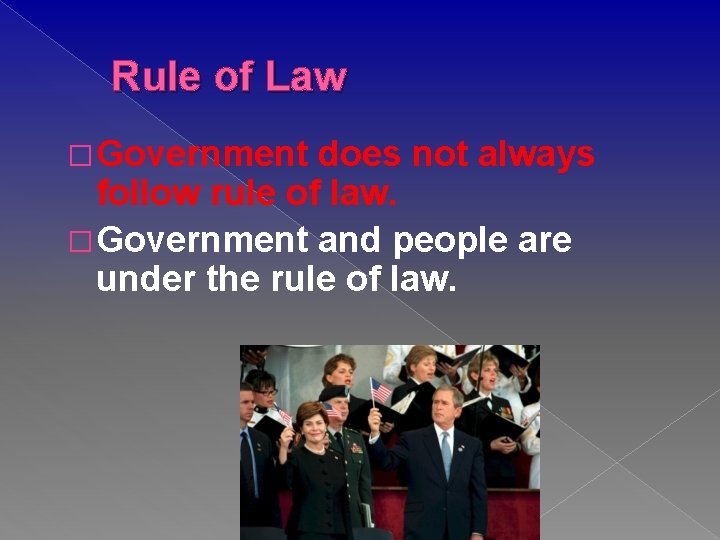
Rule of Law � Government does not always follow rule of law. � Government and people are under the rule of law.
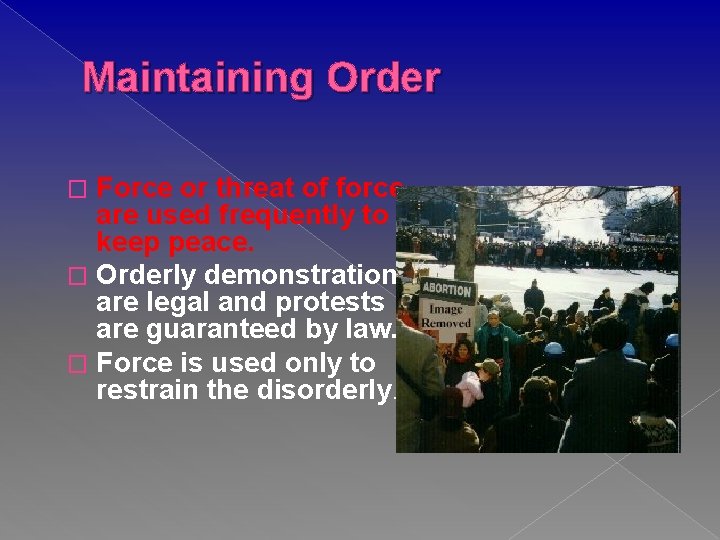
Maintaining Order Force or threat of force are used frequently to keep peace. � Orderly demonstrations are legal and protests are guaranteed by law. � Force is used only to restrain the disorderly. �
Project � In groups, you will research a nation and how they abide by each of the following: › › › Extent of Government Power Control of Power Civil Liberties and Rights Elections Rule of Law Maintaining Order � Then, you will present to the class

Roles � What is your role in your family? � What are the roles of a US citizen?
Obligations � What is a moral obligation? � What is a legal obligation? � How are legal and moral obligations different?
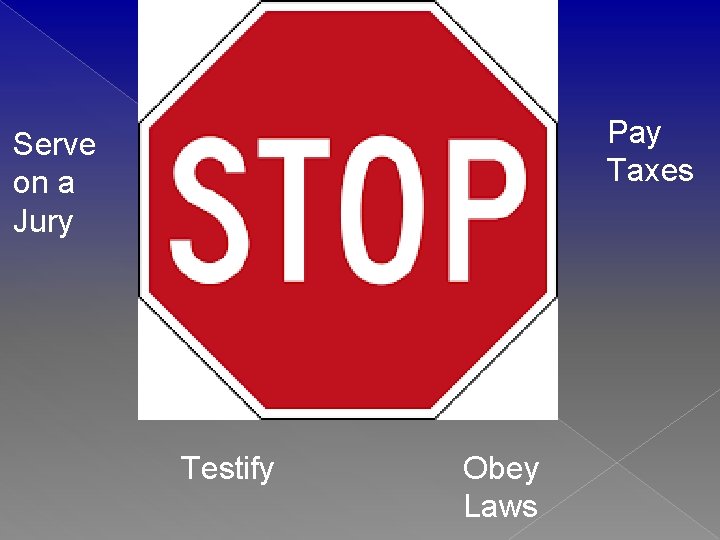
Pay Taxes Serve on a Jury Testify Obey Laws
Gray Areas of Legal and Moral Obligation � If you fail to call 911 if someone is being injured? � If there is an accident and you continue to drive? � Youtube a fight instead of getting help?
Videos Seinfeld http: //www. youtube. com/watch? v=z. Pn. K 0 NCn_MQ &NR=1 � ABC News https: //www. youtube. com/watch? v=pr. XU 9 Ejm 36 Q &feature=related Tort Law https: //www. youtube. com/watch? v=E 1 PLk 4 Lw. WK Y
Good Samaritan Laws � Complete the writing assignment provided from the perspective prescribed � REMEMBER– true learning comes from thinking outside your own bias!
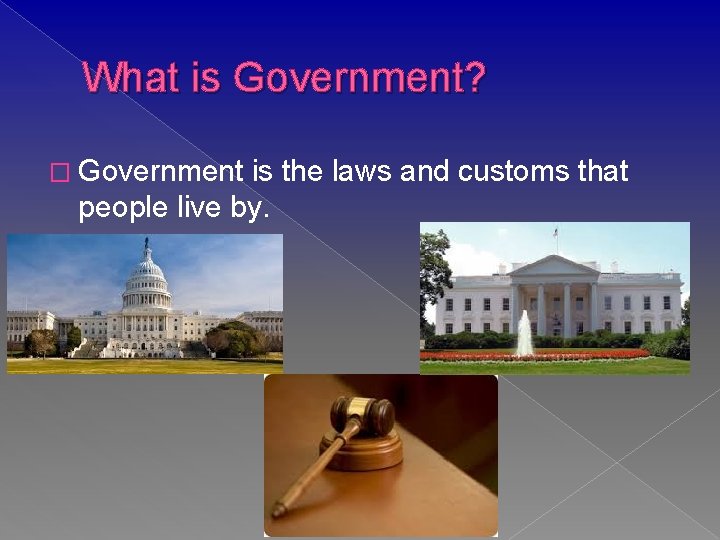
What is Government? � Government is the laws and customs that people live by.
Your Classmates Said… � Government is a way of maintaining mankind. � Government is who runs and operates the public opinion and rights. � Government is a large group of people that create a separate power to run countries. � Government is a class you take in high school.
Homework � Read the several articles about the various civic responsibilities Americans have for Wednesday’s class. › Choose one article to write a ONE PAGE double spaced response to. �Agreement or Disagreement �How would you modify it to make it more effective? �Which of the civic responsibilities is the most important? Justify.
Date SWBATA • 2/3/2016 • How did the United States government originate? Materials Needed Pencil Warm-up Sheet Rules Sheet Student Information Sheet Citizenship Obligations Writing Agenda Warm-up Remediation New Content Independent Practice Closure
Date Warm Up ? • 2/3/2016 • What is the most important citizenship obligation in the United States? Explain.
Principles of Government
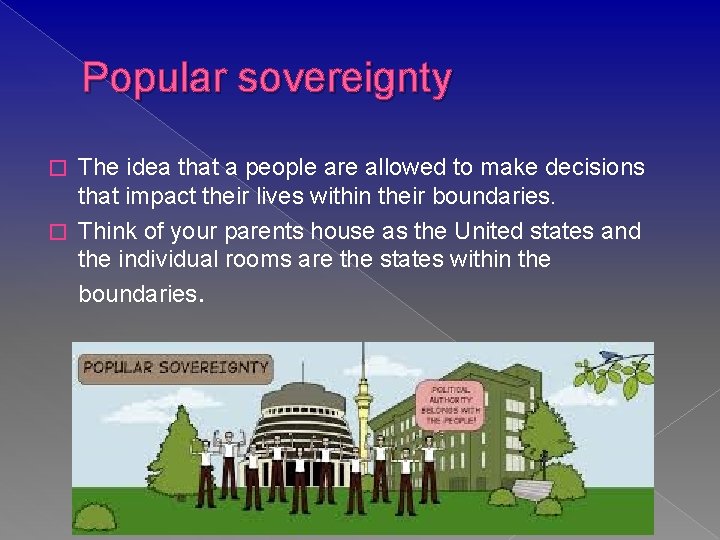
Popular sovereignty The idea that a people are allowed to make decisions that impact their lives within their boundaries. � Think of your parents house as the United states and the individual rooms are the states within the boundaries. �
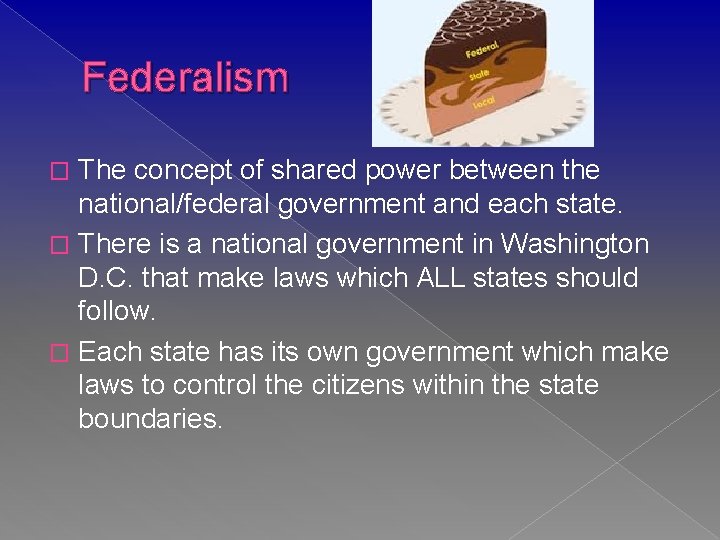
Federalism The concept of shared power between the national/federal government and each state. � There is a national government in Washington D. C. that make laws which ALL states should follow. � Each state has its own government which make laws to control the citizens within the state boundaries. �
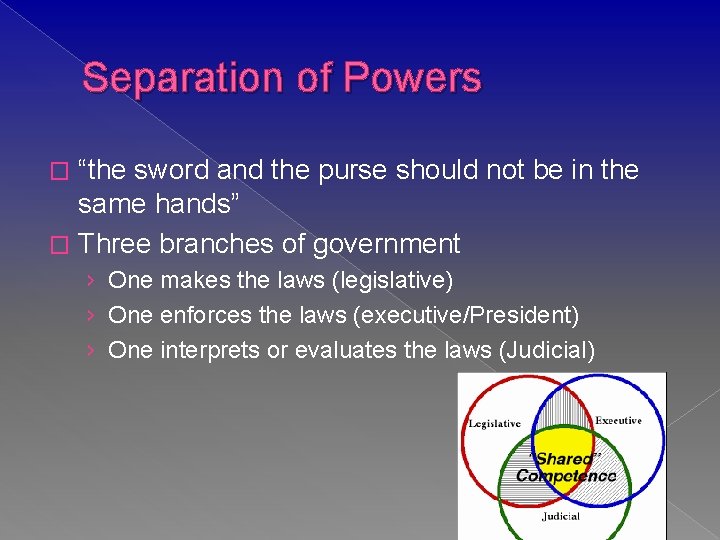
Separation of Powers “the sword and the purse should not be in the same hands” � Three branches of government � › One makes the laws (legislative) › One enforces the laws (executive/President) › One interprets or evaluates the laws (Judicial)
Checks and balances A safeguard against tyranny (misuse of power) � All the branches have power over the other branches in some way › Make a law (legislative) › Veto the law (president) › Declare the law or action of the president unconstitutional (Judicial) �
Consent of the governed � Like the social contract � The government exists because the people have not overthrown it and created a new system. � By default or inaction, the citizens or constituents give their consent.
Majority rule � The democratic principle in which the people have a voice in government and popular vote is acted upon. � It only takes one more vote than your opponent to become elected.
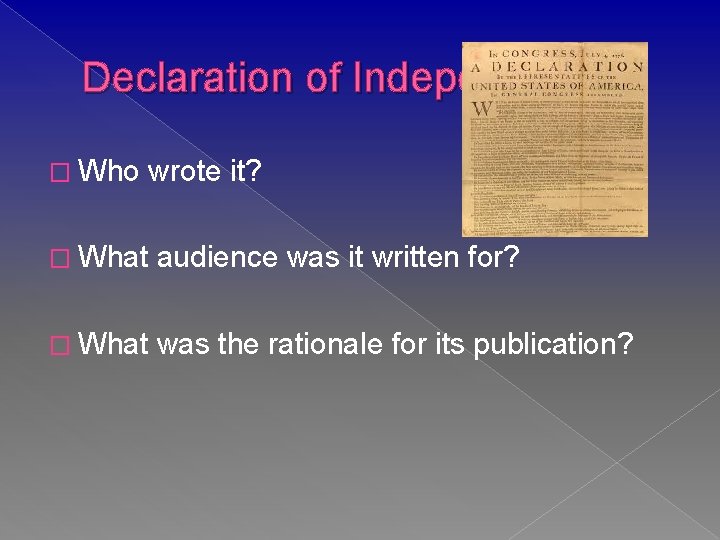
Declaration of Independence � Who wrote it? � What audience was it written for? � What was the rationale for its publication?
Declaration of Independence � Four main parts. � The first part is an introduction › states the purpose of the document, which was to explain why the American people were declaring independence from the government of Great Britain
Declaration of Independence � The second part is a theory of good government and individual rights generally accepted by Americans from the 1770 s until today. › In this theory, all individuals are equal in their possession of certain immutable rights. These rights are not granted by the government. Rather, they are inherent to human nature. Therefore, the first purpose of a good government is to secure or protect these rights. › Further, a good government is based on the consent of the governed -- the people -- who are the sole source of the government's authority. If their government persistently violates this theory of good government, then the people have the right to overthrow it.
Declaration of Independence � The third part of the document is a list of grievances against King George III, who was singled out to represent the actions of the British government. › These grievances are examples of actions that violated the criteria for good government stated in the second part of the Declaration of Independence. These grievances, therefore, justify separation from the King's bad government and establishment of a good government to replace it.
Declaration of Independence � The fourth and final part of the document is an unqualified assertion of sovereignty by the United States of America. › It proclaims the determination of Americans to defend and maintain their independence and rights.
Declaration Break-Up Letter � You are writing a break-up letter to King George. You will include a Preamble (this isn’t working), Grievances (this is what you are doing wrong), and a Resolution of Independence (goodbye). In this letter you will be taking the Founding Fathers words and adding your own twist. � You may quote the Declaration of Independence, but make sure you used quotation marks and that quotes are very rarely used. This activity is meant to be fun and get you into the mind of the Founding Fathers. Make sure this writing has a flare of you in it and is not just a regurgitation of the original.
Constitutional Convention � Federalists versus Anti-Federalists › Circumstances that divided people �Factionalism › What did each side stand for? › Real-World connection? � Primary Source Comparison
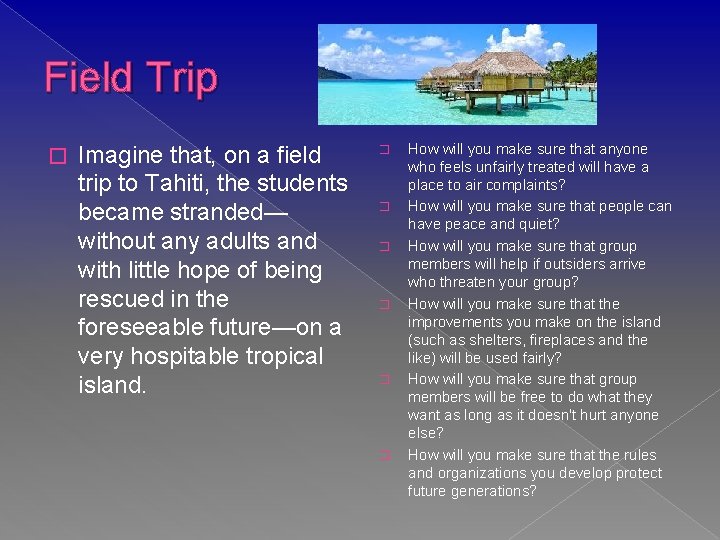
Field Trip � Imagine that, on a field trip to Tahiti, the students became stranded— without any adults and with little hope of being rescued in the foreseeable future—on a very hospitable tropical island. � � � How will you make sure that anyone who feels unfairly treated will have a place to air complaints? How will you make sure that people can have peace and quiet? How will you make sure that group members will help if outsiders arrive who threaten your group? How will you make sure that the improvements you make on the island (such as shelters, fireplaces and the like) will be used fairly? How will you make sure that group members will be free to do what they want as long as it doesn't hurt anyone else? How will you make sure that the rules and organizations you develop protect future generations?
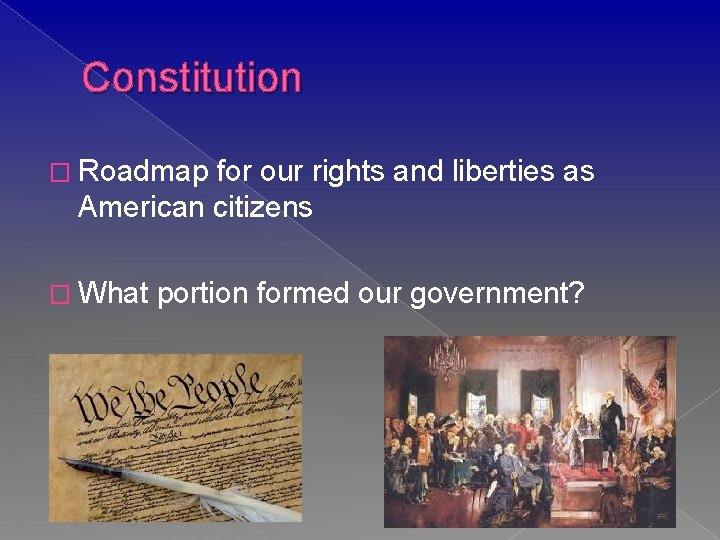
Constitution � Roadmap for our rights and liberties as American citizens � What portion formed our government?
Preamble � We the People of the United States, in Order to form a more perfect Union, establish Justice, insure domestic Tranquility, provide for the common defense, promote the general Welfare, and secure the Blessings of Liberty to ourselves and our Posterity, do ordain and establish this Constitution for the United States of America.
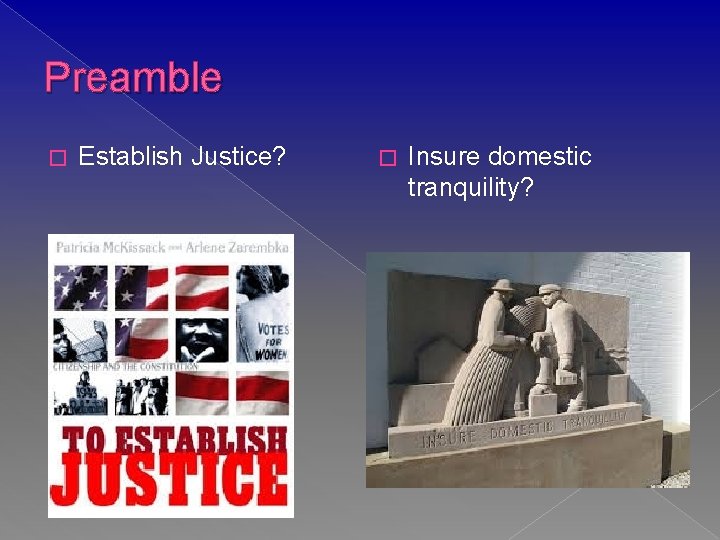
Preamble � Establish Justice? � Insure domestic tranquility?
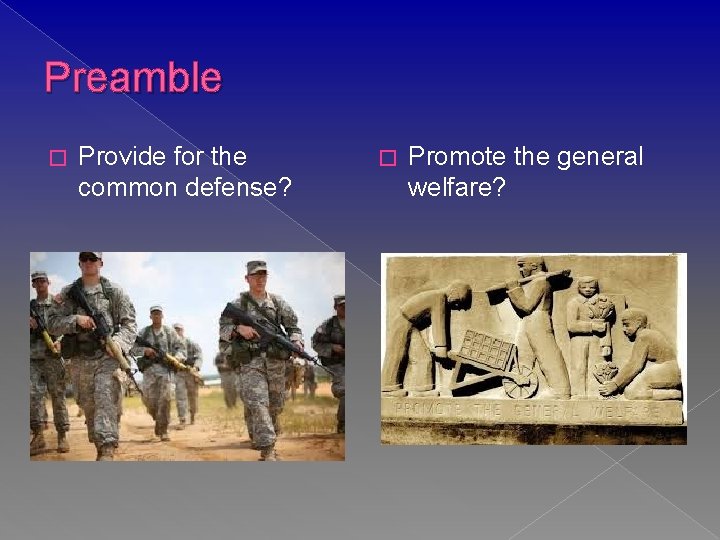
Preamble � Provide for the common defense? � Promote the general welfare?
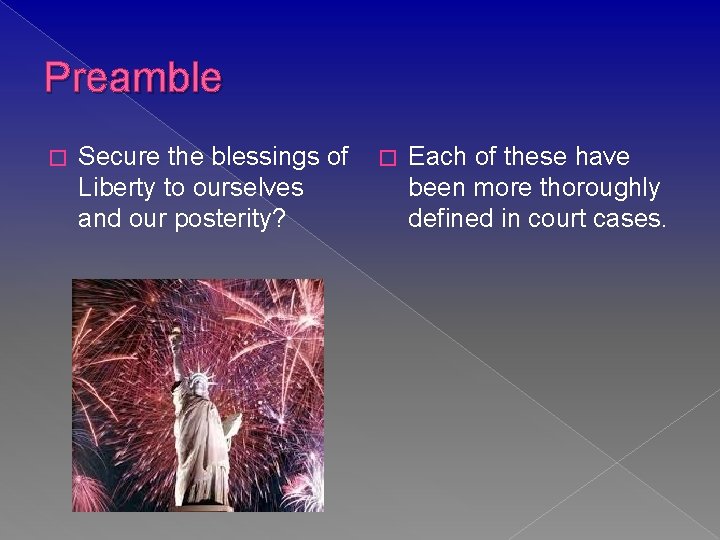
Preamble � Secure the blessings of Liberty to ourselves and our posterity? � Each of these have been more thoroughly defined in court cases.
Homework � Read the Constitution of the United States (Preamble and Articles) › Complete the Constitution Scavenger Hunt for Monday.
Date SWBATA • 2/8/2016 • How are citizens’ rights protected in the United States? Materials Needed Pencil Warm-up Sheet Constitutional Scavenger Hunt Agenda Warm-up Remediation New Content Independent Practice Closure
Date Warm Up ? • 2/8/2016 • How is the Preamble to the Constitution the roadmap to our lives as citizens?
Constitution � Review the Scavenger Hunt › Answers? › What surprised you? › Is there anything you disagree with?
The First 10 Amendments to the U. S. Constitution Protects individuals and limits the government
Who determines what the Bill of Rights means? � The Supreme Court makes rulings on the meaning � The Supreme Court balances the rights of the individual with the needs of society Individual? ? Society? ?
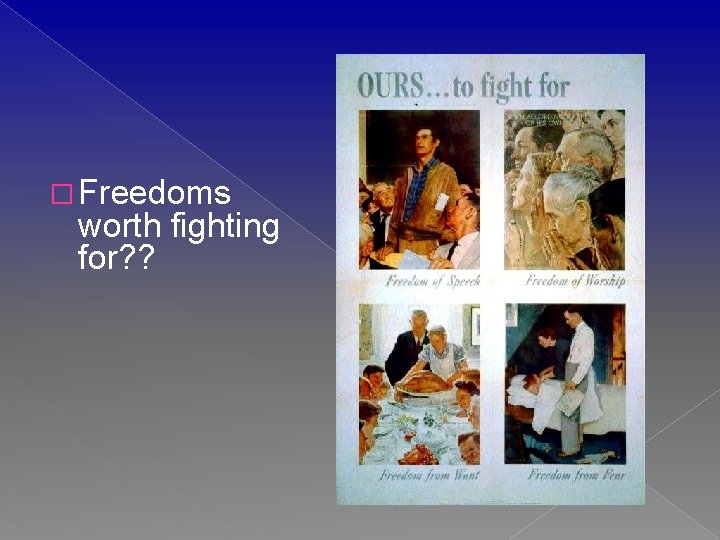
� Freedoms worth fighting for? ?
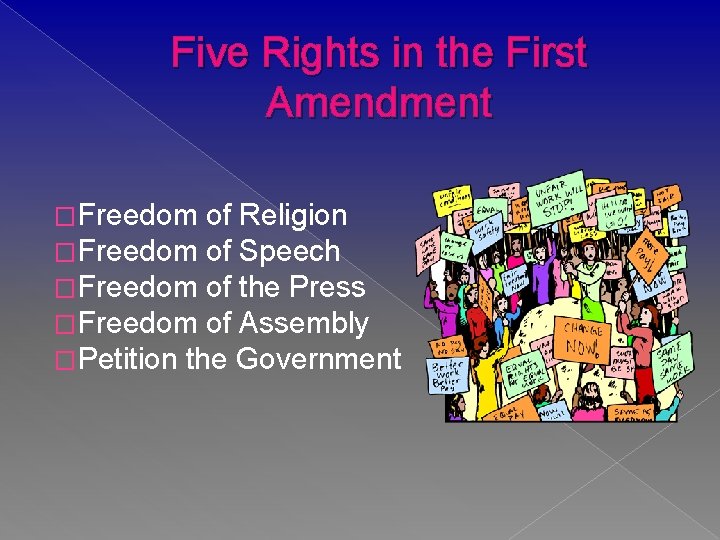
Five Rights in the First Amendment �Freedom of Religion �Freedom of Speech �Freedom of the Press �Freedom of Assembly �Petition the Government
Freedom of Religion � “Congress shall make no law respecting an establishment of religion or prohibiting the free exercise there of” � Two clauses: › Establishment clause › Free Exercise clause
Establishment and free exercise clause often conflict with each other � In schools, the religion issue is most prevalent � If a student raises his hand asks “Teacher, can we say an opening prayer before this test? ” � If the teacher says: � “Yes”, It looks like establishment of religion � “No”, It is denying a student free exercise.
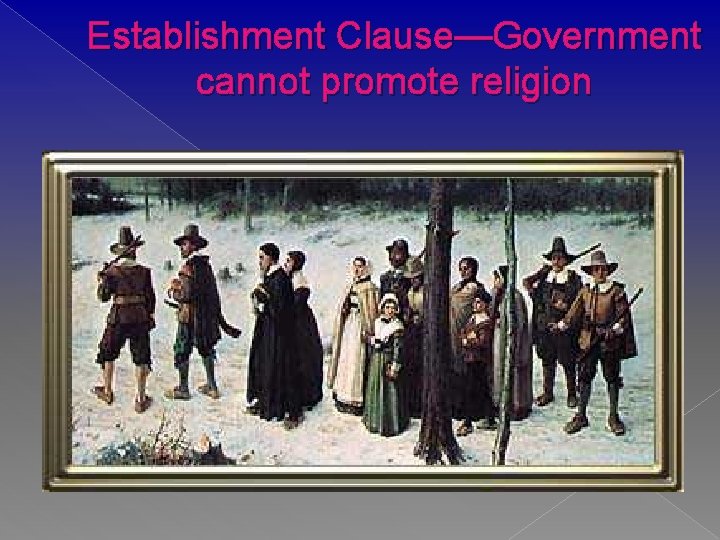
Establishment Clause—Government cannot promote religion
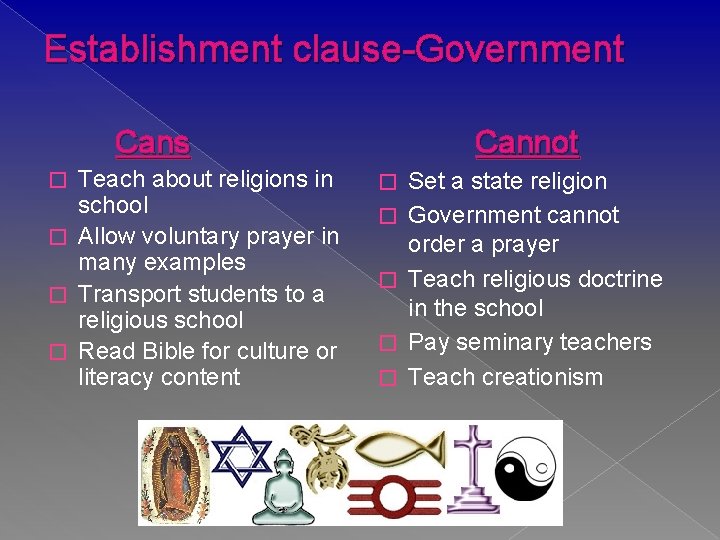
Establishment clause-Government Cans Teach about religions in school � Allow voluntary prayer in many examples � Transport students to a religious school � Read Bible for culture or literacy content � Cannot � � � Set a state religion Government cannot order a prayer Teach religious doctrine in the school Pay seminary teachers Teach creationism
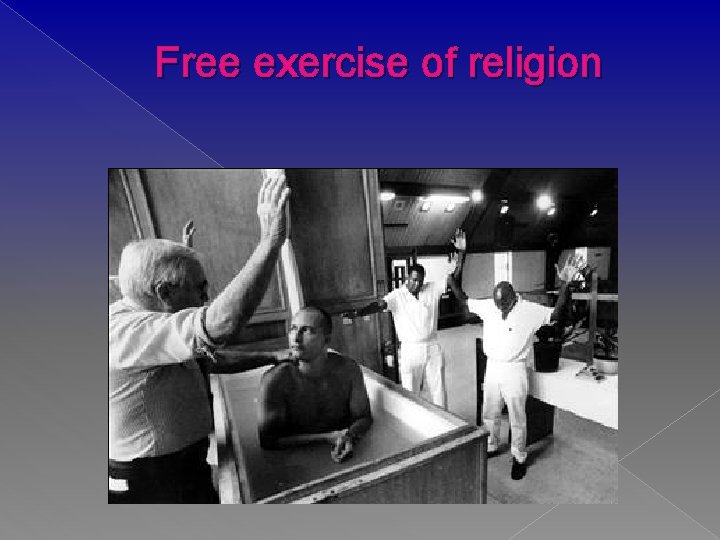
Free exercise of religion
Free Exercise—The person Can Choose whatever religion � Lead a prayer in most examples � Ask questions about religions � Worship whomever you want � Cannot Break the law and claim it is religious belief � Raise children without education � Deprive children of basic needs �
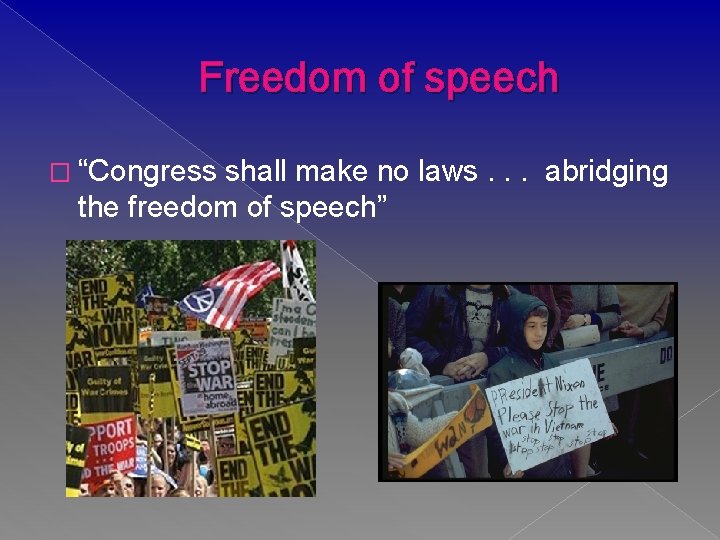
Freedom of speech � “Congress shall make no laws. . . abridging the freedom of speech”
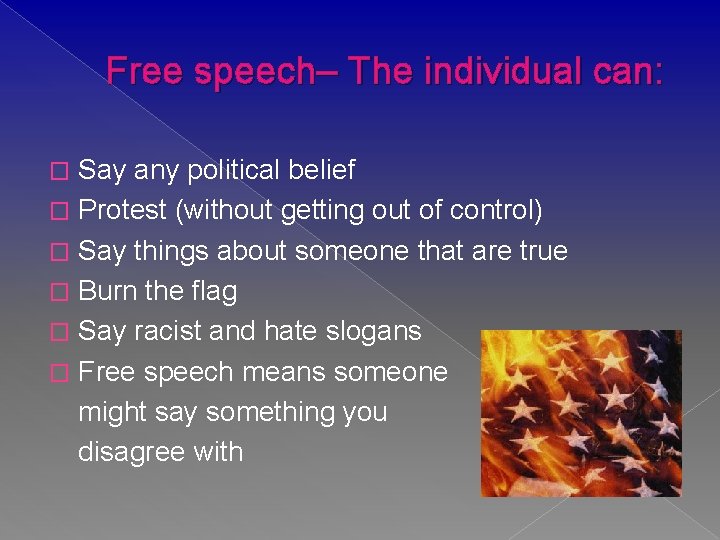
Free speech– The individual can: Say any political belief � Protest (without getting out of control) � Say things about someone that are true � Burn the flag � Say racist and hate slogans � Free speech means someone might say something you disagree with �
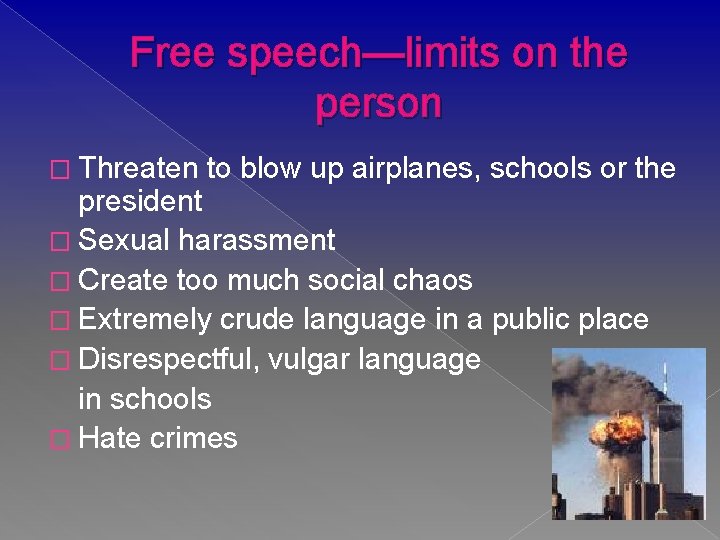
Free speech—limits on the person � Threaten to blow up airplanes, schools or the president � Sexual harassment � Create too much social chaos � Extremely crude language in a public place � Disrespectful, vulgar language in schools � Hate crimes
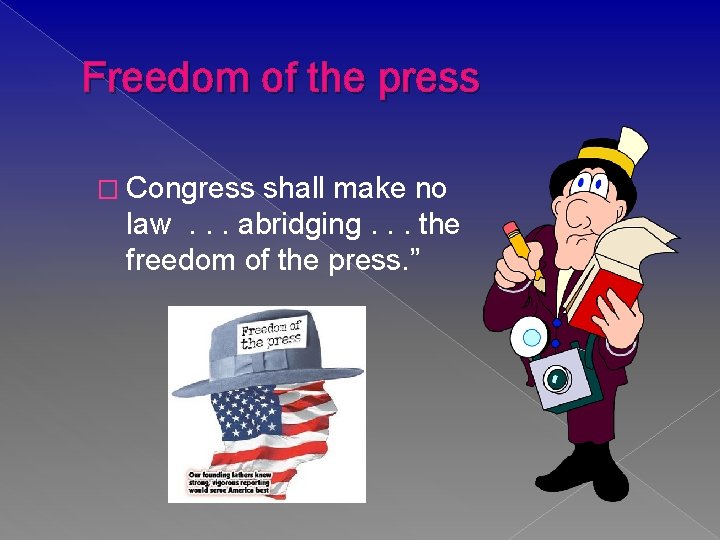
Freedom of the press � Congress shall make no law. . . abridging. . . the freedom of the press. ”
Freedom of the press-the press Can Print any political position � Make fun of people, especially politicians � Expose wrongs by the government � Say things you might not agree with � Cannot Libel– intentionally injuring a person’s reputation by false facts � Disclose defensesecurity secrets � Detail how to make certain weapons �
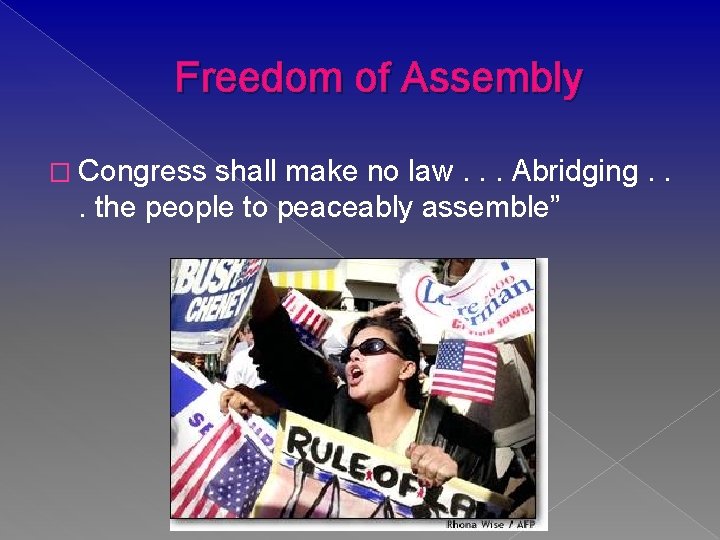
Freedom of Assembly � Congress shall make no law. . . Abridging. . . the people to peaceably assemble”
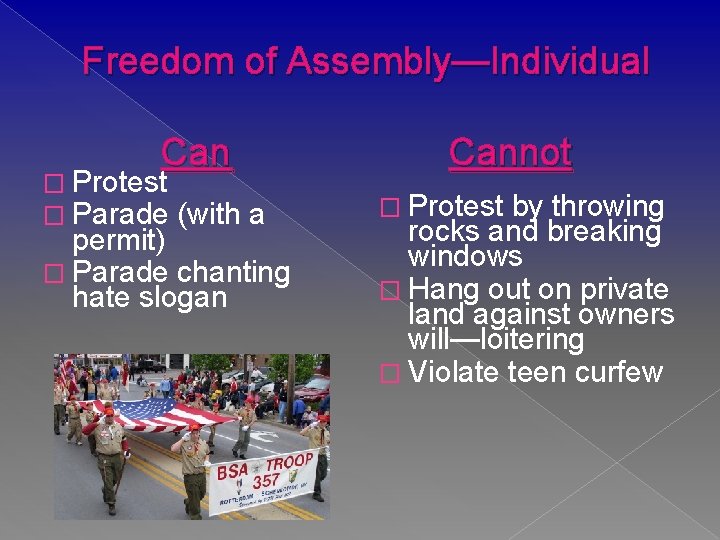
Freedom of Assembly—Individual Can � Protest � Parade (with a permit) � Parade chanting hate slogan Cannot � Protest by throwing rocks and breaking windows � Hang out on private land against owners will—loitering � Violate teen curfew
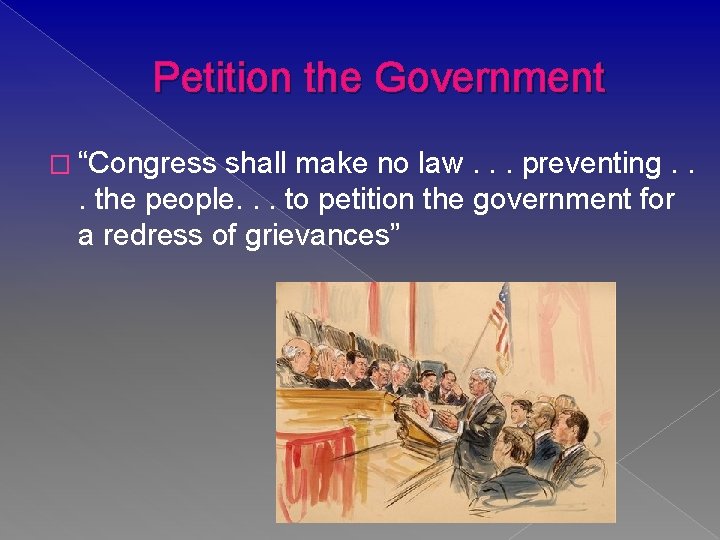
Petition the Government � “Congress shall make no law. . . preventing. . . the people. . . to petition the government for a redress of grievances”
Petition the government � You may sue the government for wrongs � You cannot be punished for exposing wrongs by the government � The courts decide the wrongs
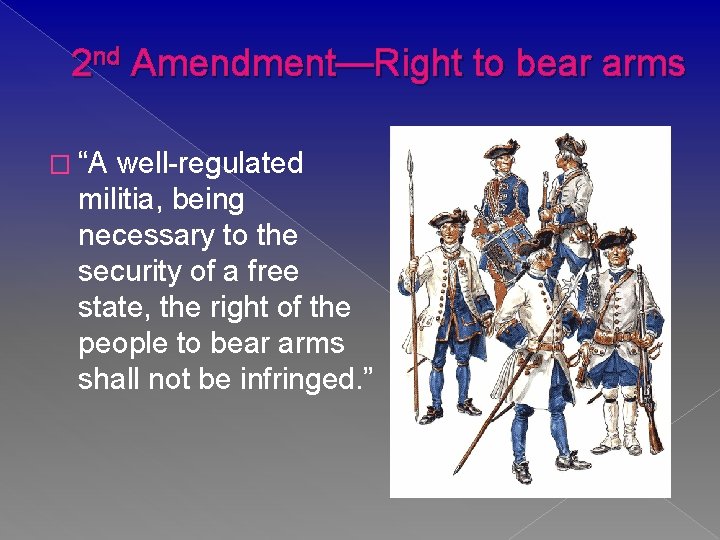
2 nd Amendment—Right to bear arms � “A well-regulated militia, being necessary to the security of a free state, the right of the people to bear arms shall not be infringed. ”
What is the debate with the right to bear arms? How much can the government keep guns from criminals and youth? � In order to keep guns away from criminals, does that limit the right of law abiding citizens? �
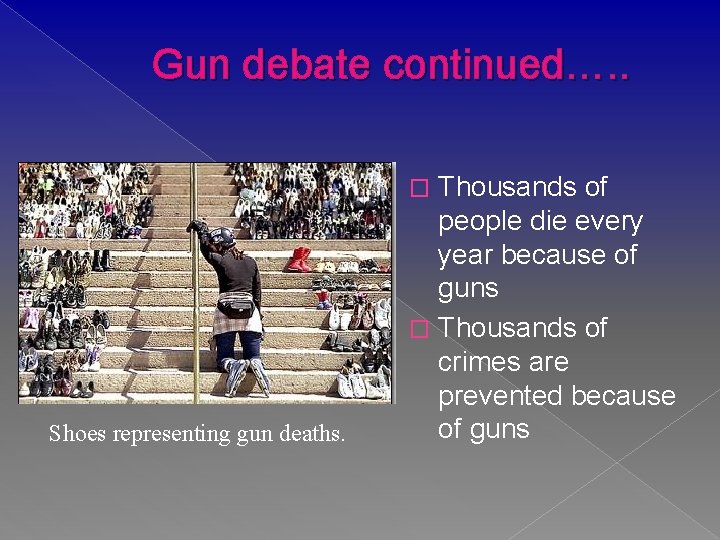
Gun debate continued…. . Thousands of people die every year because of guns � Thousands of crimes are prevented because of guns � Shoes representing gun deaths.
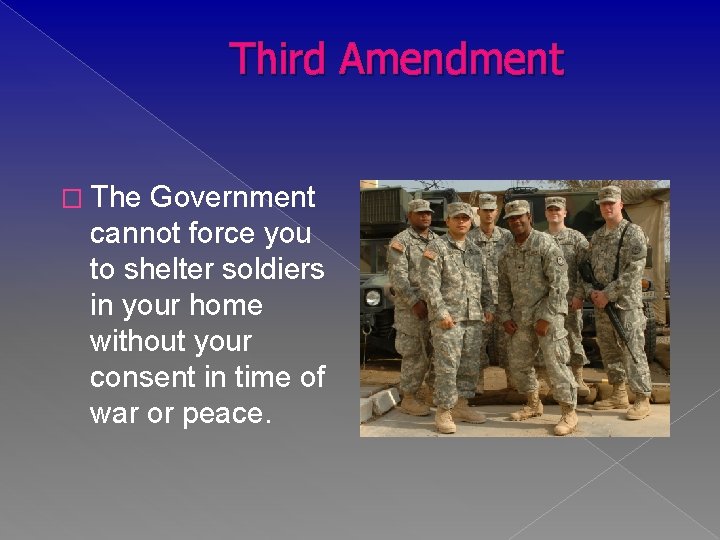
Third Amendment � The Government cannot force you to shelter soldiers in your home without your consent in time of war or peace.
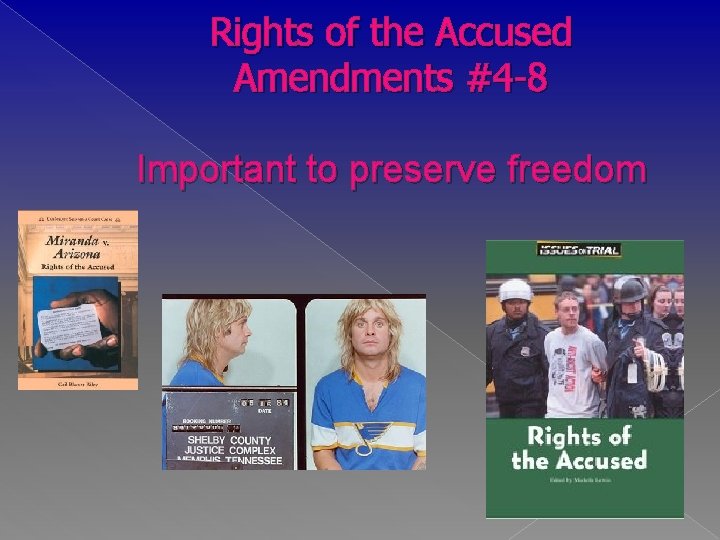
Rights of the Accused Amendments #4 -8 Important to preserve freedom
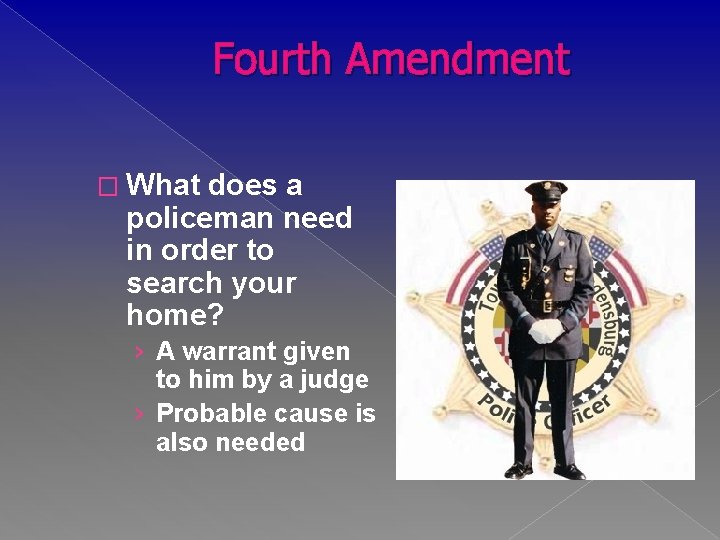
Fourth Amendment � What does a policeman need in order to search your home? › A warrant given to him by a judge › Probable cause is also needed
Fifth Amendment � You cannot be tried for the same crime twice —called “Double Jeopardy” � You do not have to testify against your self. “I plead the fifth” � You must have due process of law before you are convicted � The government cannot take your land unless it pays.
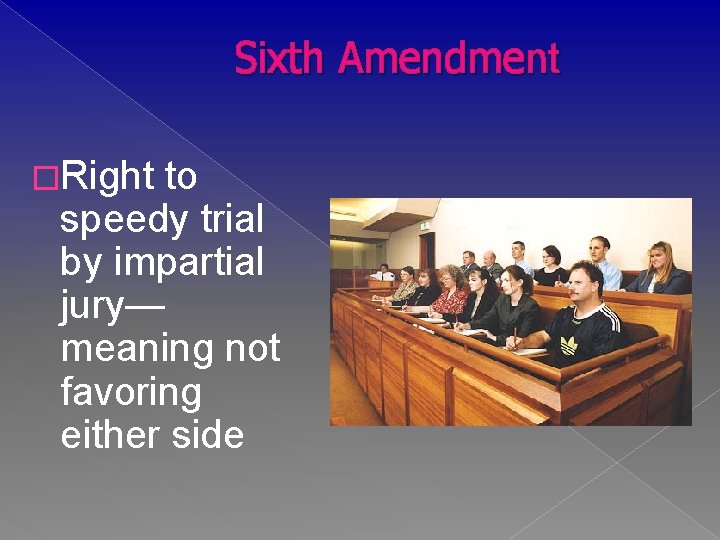
Sixth Amendment �Right to speedy trial by impartial jury— meaning not favoring either side
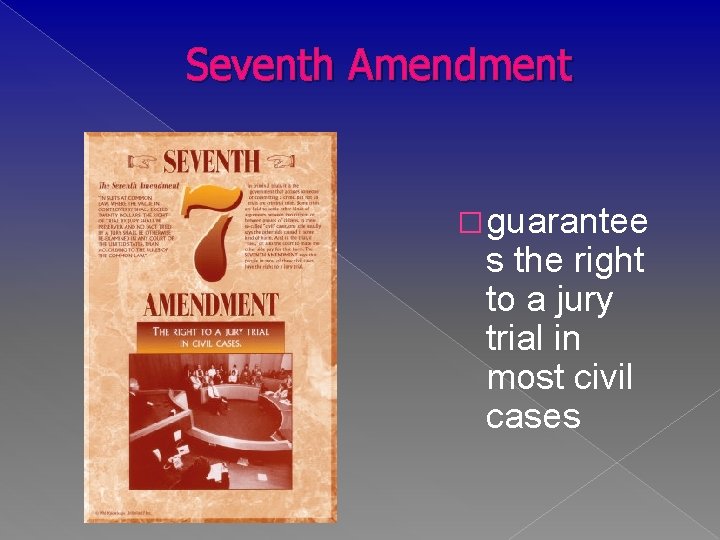
Seventh Amendment � guarantee s the right to a jury trial in most civil cases
Eighth Amendment � No excessive bail � No cruel and unusual punishment
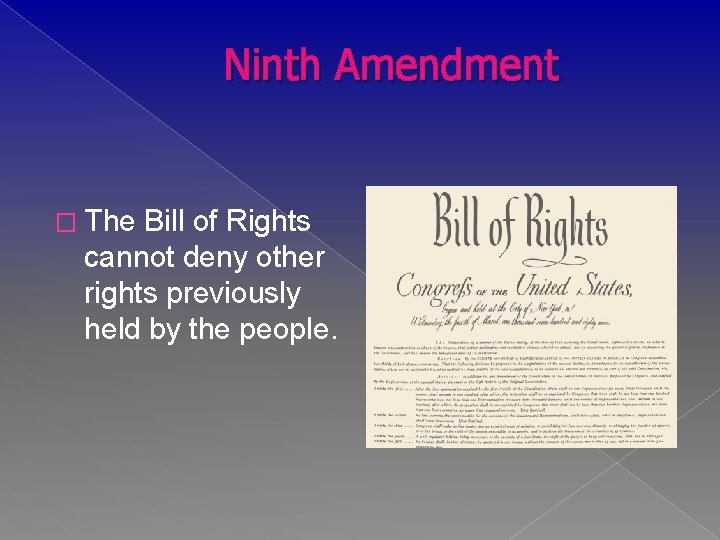
Ninth Amendment � The Bill of Rights cannot deny other rights previously held by the people.
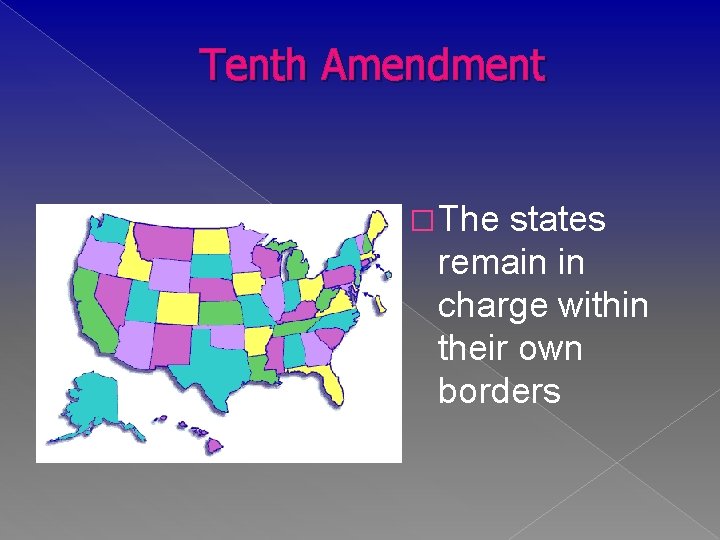
Tenth Amendment � The states remain in charge within their own borders
Bill of Rights � For each scenario on the Bill of Rights Challenge sheet, decide which amendment is being violated in the case. � Why was the Bill of Rights added to the Constitution?
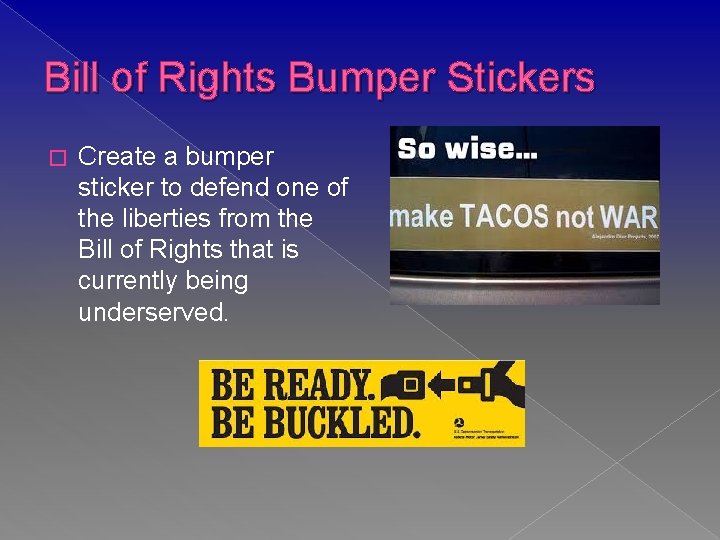
Bill of Rights Bumper Stickers � Create a bumper sticker to defend one of the liberties from the Bill of Rights that is currently being underserved.
Further Amendments � Why were more amendments added to the US Constitution after the Bill of Rights? � 11 th Amendment: Clearly defines original jurisdiction of Supreme Court � 12 th Amendment: Electoral College for selecting President / Vice President � 13 th Amendment: Abolished slavery
Further Amendments � 14 th Amendment: Established citizenship, representation, and loyalty � 15 th Amendment: Gave suffrage to all males of age, regardless of race � 16 th Amendment: Established Federal Income Tax system � 17 th Amendment: Established popular vote for Senators
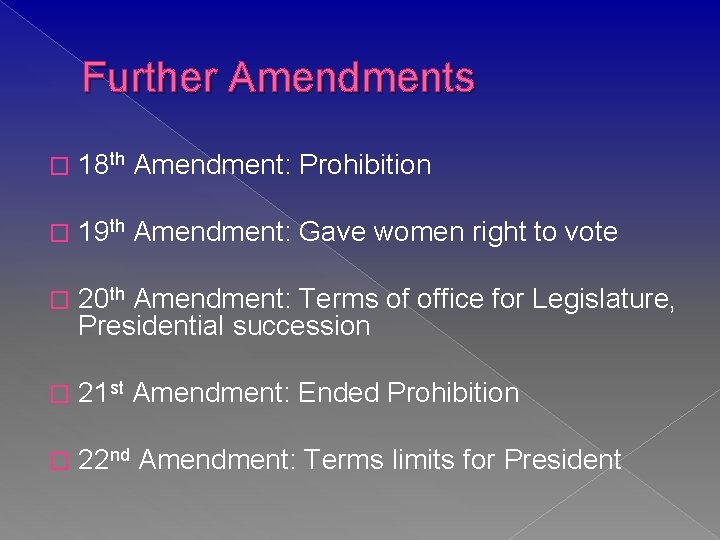
Further Amendments � 18 th Amendment: Prohibition � 19 th Amendment: Gave women right to vote � 20 th Amendment: Terms of office for Legislature, Presidential succession � 21 st Amendment: Ended Prohibition � 22 nd Amendment: Terms limits for President
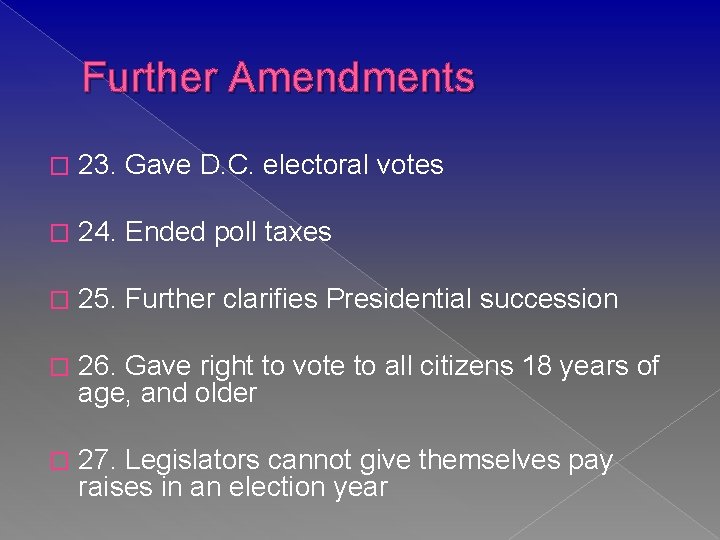
Further Amendments � 23. Gave D. C. electoral votes � 24. Ended poll taxes � 25. Further clarifies Presidential succession � 26. Gave right to vote to all citizens 18 years of age, and older � 27. Legislators cannot give themselves pay raises in an election year
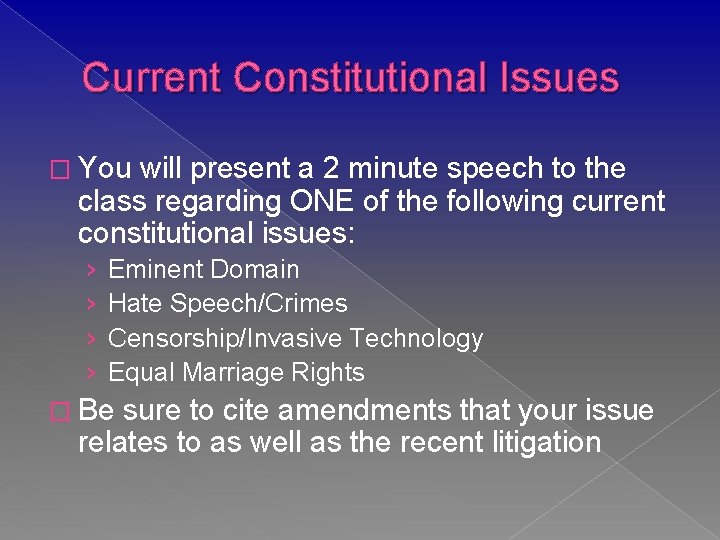
Current Constitutional Issues � You will present a 2 minute speech to the class regarding ONE of the following current constitutional issues: › › Eminent Domain Hate Speech/Crimes Censorship/Invasive Technology Equal Marriage Rights � Be sure to cite amendments that your issue relates to as well as the recent litigation
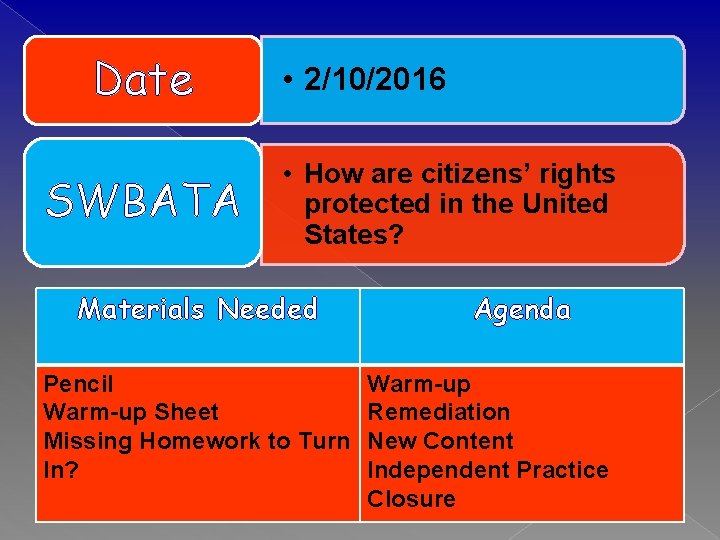
Date SWBATA • 2/10/2016 • How are citizens’ rights protected in the United States? Materials Needed Pencil Warm-up Sheet Missing Homework to Turn In? Agenda Warm-up Remediation New Content Independent Practice Closure
Date Warm Up ? • 2/10/2016 • Why do scholars call the Constitution of the United States a “living document”?
Marbury v. Madison (1803) � Read the i. Civics article together › Complete the activities in the packet � Quickwrite › On the back of your packet answer one of the following questions in AT LEAST 5 sentences �If the Judicial Branch had not acquired the power of Judicial Review, Congress would be its own judge of the constitutionality of its laws. Would it be a good or bad idea for Congress to have this power? Why? �Could the United States have a workable system of government without judicial review? How would such a system be organized? �How might life in the United States be different today if Marbury v. Madison had never established Judicial Review? Justify your answer.
Rules Who makes rules at the school? � Whose rules have more authority: The teacher’s classroom rules, or the rules in the school handbook? � What would happen if a teacher decided one of the handbook’s rules didn’t apply in her classroom? Would that work? � What would happen if the school itself had no authority and only teachers could make rules? �
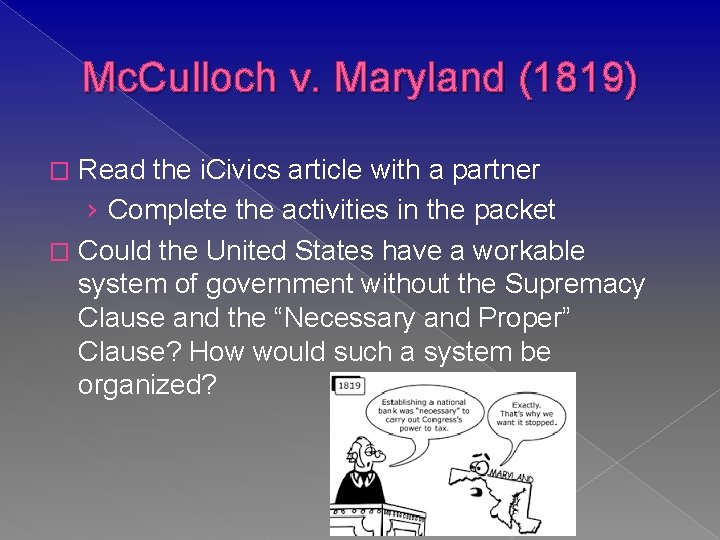
Mc. Culloch v. Maryland (1819) Read the i. Civics article with a partner › Complete the activities in the packet � Could the United States have a workable system of government without the Supremacy Clause and the “Necessary and Proper” Clause? How would such a system be organized? �
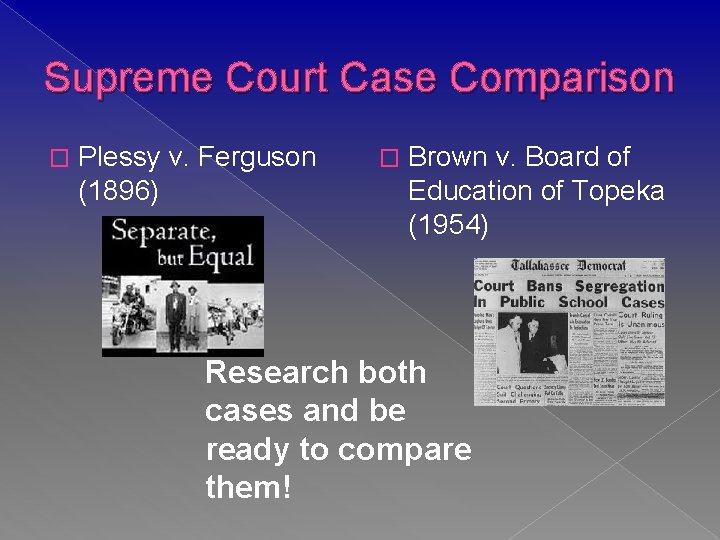
Supreme Court Case Comparison � Plessy v. Ferguson (1896) � Brown v. Board of Education of Topeka (1954) Research both cases and be ready to compare them!
Synthesis � Create an outline for an essay using the graphic organizer provided for the following prompt: › Compare and contrast the impact of Supreme Court cases Plessy v. Ferguson and Brown v. Board of Education of Topeka on citizens of the United States, focusing upon the rights lost or gained. A good essay will summarize each Supreme Court case briefly followed by analysis of how the lives of citizens, especially African Americans, were changed as the result of each decision.
Fifth Amendment No person shall be. . . deprived of life, liberty, or property, without due process of law. "
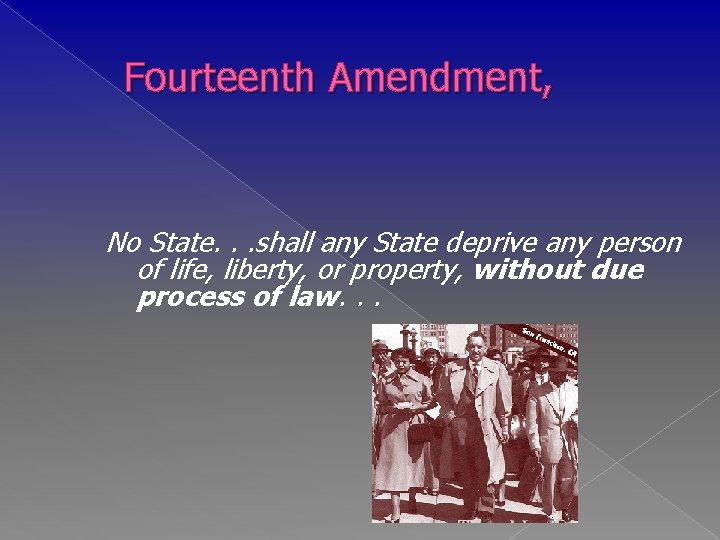
Fourteenth Amendment, No State. . . shall any State deprive any person of life, liberty, or property, without due process of law. . .
Questions Easy ones first. . . � Who is entitled to due process of law? � Who or what must provide due process? � When is due process of law required?
Harder questions � What is due process of law? � Who decides what process is due? Culturally determined? Evolving or static? � What is meant by "life, liberty, or property"?
Meaning: Constitution Words imply fair procedure (“how” action is taken) Steps government must Use before taking away › Life › Liberty › Property
Who decides process “due” � Policy makers make rules � Judges interpret constitutions (national/state)
What are life, liberty, property? � Common sense meanings � Broader meanings Life Includes corporations Liberty includes movement and (past) contracts Property includes reputation, job, inventions
Due process in practice Criminal-Notice, fair trial, counsel, pre and post processes Civil-- Notice, hearing, employ counsel, impartial decision-maker Civil includes administrative actions E. g. , termination of benefits, school discipline, licensing/regulation
Two additional dimensions of due process � Substantive � Procedural due process
“SUBSTANTIVE” due process There are some things governments cannot do at all, no matter what procedures they follow “Fundamental rights” analysis U. S. Supreme Court decides what government cannot do
Examples of substantive due process � Late 19 th century: Liberty of contract › State and national economic regulatory laws struck down � 20 th century: Right of privacy › Banning interracial marriage/Gay Marriage › Abortion
Procedural Due Process � Fairness of the procedures used to enforce the laws › Does not focus on whether a liberty right or an economic right is at stake › How are laws enforced? Is it always fair to the accused?
Procedural Due Process � What procedures are required in order to legitimately deprive someone of their life, liberty or property in the given case? › Importance of the private interest affected. › Risk of erroneous deprivation through the procedures used, and the probable value of any additional/substitute procedural safeguards. › Importance of the state interest involved and the burdens which any additional/substitute procedural safeguards would impose on the state.
Future of due process � Will government be given more leeway over criminal and civil proceedings? � Will courts “discover” additional “fundamental rights” or back away from recognized ones? � How will social/cultural changes affect concept?
Assignments � Check Synergy and www. mrbarrsclassroom. weebly. com to see what assignments you need to complete and turn in. � ALL Unit I assignments will not be accepted after Monday February 22 nd.
Date SWBATA • 2/17/2016 • How does the Constitution guard against tyranny? Materials Needed Pencil Warm-up Sheet Missing Assignments to turn In? Agenda Warm-up Remediation New Content Independent Practice Closure
Date Warm Up ? • 2/17/2016 • Give two examples of procedural due process and two examples of substantive due process.
What is a DBQ? �A DBQ is an essay that measures your ability to analyze and interpret documents � There � All is no wrong answer! the information you need is given to you!
Steps to doing a DBQ � Step 1: Understand the question � Take the time to read the directions! � Make sure you understand what you are being asked › Sometimes, you will be asked multiple questions � Begin to think about an answer, but don’t write anything yet
Steps to doing a DBQ � Step � Get 2: Read through the documents a general idea of what they are telling you � Pay attention to provided information › Author, date
Steps to doing a DBQ � Step 3: Group the documents � There is no right or wrong way › “The documents are like play dough, mold them to be what you need, but don’t eat them. ” � Should be grouped to help answer the question › Demonstration › Bucketing
Steps to doing a DBQ � Step 4: Write your thesis › Notice this is the first time we write anything � Make sure to: › Answer the question › Mention name of three groups
Steps to doing a DBQ � Step 5: Outline Essay � Intro: › Background Info (usually given to you) › Thesis �Answers questions �Lists groups � Supporting paragraphs: › At least 3 (one for each group) �Starts with topic sentence (names group) �Details from documents and class � Remember to cite documents (Doc. 6) � Conclusion: › Restate argument › Impact
Benchmark I � Your first exam will be on Monday! � Use the provided study guide to help you! � If you have any questions… › Refer to your notes › Visit www. mrbarrsclassroom. weebly. com › Email Mr. Barr at barrtim@wcps. k 12. md. us
- Slides: 116