
Date December 2021 Title Crime and punishment punishments
Date: December 2021 Title: Crime and punishment: punishments – change and continuity and applying this to the exam. 1. 2. Aim: To recognise the changes and continuities within punishments To have a discussion about the turning points in punishments 3. To apply this to exam questions.
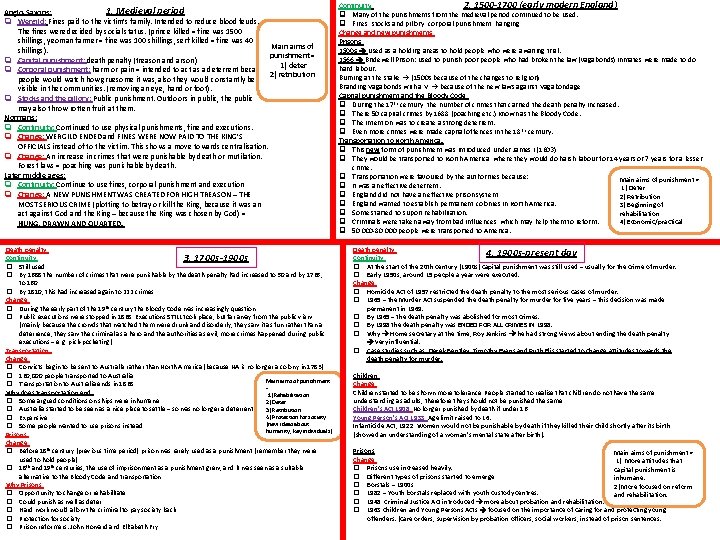
1. Medieval period Anglo-Saxons: q Wergild: Fines paid to the victim’s family. Intended to reduce blood feuds. The fines were decided by social status. (prince killed = fine was 1500 shillings, yeoman farmer = fine was 100 shillings, serf killed = fine was 40 Main aims of shillings). punishment = q Capital punishment: death penalty (treason and arson) 1) deter q Corporal punishment: harm or pain = intended to act as a deterrent because 2) retribution people would watch how gruesome it was, also they would constantly be visible in the communities. (removing an eye, hand or foot). q Stocks and the pillory: Public punishment. Outdoors in public, the public may also throw rotten fruit at them. Normans: q Continuity: Continued to use physical punishments, fine and executions. q Change: WERGILD ENDED and FINES WERE NOW PAID TO THE KING’S OFFICIALS instead of to the victim. This shows a move towards centralisation. q Change: An increase in crimes that were punishable by death or mutilation. Forest laws = poaching was punishable by death. Later middle ages: q Continuity: Continue to use fines, corporal punishment and execution q Change: A NEW PUNISHMENT WAS CREATED FOR HIGH TREASON – THE MOST SERIOUS CRIME (plotting to betray or kill the King, because it was an act against God and the King – because the King was chosen by God) = HUNG, DRAWN AND QUARTED. Death penalty: Continuity: 3. 1700 s-1900 s q Still used q By 1688 the number of crimes that were punishable by the death penalty had increased to 50 and by 1765, to 160. q By 1810, this had increased again to 222 crimes. Change: q During the early part of the 19 th century the Bloody Code was increasingly question. q Public executions were stopped in 1868. Executions STILL took place, but far away from the public view. (mainly because the crowds that watched them were drunk and disorderly, they saw it as fun rather than a deterrence, they saw the criminal as a hero and the authorities as evil, more crimes happened during public executions – e. g. pick-pocketing. ) Transportation: Change: q Convicts begin to be sent to Australia rather than North America (because NA is no longer a colony in 1783). q 160, 000 people transported to Australia. Main aims of punishment q Transportation to Australia ends in 1868. = Why does transportation end: 1) Rehabilitation q Some argued conditions on ships were inhumane. 2) Deter q Australia started to be seen as a nice place to settle – so was no longer a deterrent. 3) Retribution 4) Protection for society q Expensive. (new ideas about q Some people wanted to use prisons instead. humanity, key individuals) Prisons: Change: q Before 18 th century (previous time period) prison was rarely used as a punishment (remember they were used to hold people). q 18 th and 19 th centuries, the use of imprisonment as a punishment grew, and it was seen as a suitable alternative to the Bloody Code and transportation. Why Prisons: q Opportunity to change or rehabilitate. q Could punish as well as deter q Hard work would allow the criminal to pay society back. q Protection for society. q Prison reformers: John Howard and Elizabeth Fry 2. 1500 -1700 (early modern England) Continuity: q Many of the punishments from the medieval period continued to be used. q Fines, stocks and pillory, corporal punishment, hanging Change and new punishments: Prisons: 1500 s Used as a holding areas to hold people who were awaiting trial. 1566 Bridewell Prison: used to punish poor people who had broken the law (vagabonds) Inmates were made to do hard labour. Burning at the stake (1500 s because of the changes to religion) Branding Vagabonds with a V because of the new laws against Vagabondage Capital punishment and the Bloody Code: q During the 17 th century, the number of crimes that carried the death penalty increased. q There 50 capital crimes by 1688 (poaching etc. ) Known as the Bloody Code. q The intention was to create a strong deterrent. q Even more crimes were made capital offences in the 18 th century. Transportation to North America. q This new form of punishment was introduced under James I (1603) q They would be transported to North America, where they would do harsh labour for 14 years or 7 years for a lesser crime. q Transportation were favoured by the authorities because: Main aims of punishment = q It was an effective deterrent. 1) Deter q England did not have an effective prison system 2) Retribution q England wanted to establish permanent colonies in North America. 3) Beginning of q Some started to suport rehabilitation 4) Economic/practical q Criminals were taken away from bad influences, which may help them to reform. q 50, 000 -80, 000 people were transported to America. Death penalty: 4. 1900 s-present day Continuity: q At the start of the 20 th century (1900 s) capital punishment was still used – usually for the crime of murder. q Early 1950 s, around 15 people a year were executed. Change: q Homicide Act of 1957 restricted the death penalty to the most serious cases of murder. q 1965 – the Murder Act suspended the death penalty for murder for five years – this decision was made permanent in 1969. q By 1965 – the death penalty was abolished for most crimes. q By 1998 the death penalty was ENDED FOR ALL CRIMES IN 1998. q Why Home secretary at the time, Roy Jenkins he had strong views about ending the death penalty very influential. q Case studies such as, Derek Bentley, Timothy Evans and Ruth Elis started to change attitudes towards the death penalty for murder. Children: Change: Children started to be shown more tolerance. People started to realise that children do not have the same understanding as adults, therefore they should not be punished the same. Children’s Act 1908: No longer punished by death if under 16. Young Person’s Act 1933: Age limit raised to 16. Infanticide Act, 1922: Women would not be punishable by death if they killed their child shortly after its birth (showed an understanding of a woman’s mental state after birth). Prisons Main aims of punishment = Change: 1) More attitudes that q Prisons use increased heavily. capital punishment is q Different types of prisons started to emerge inhumane. q Borstals – 1900 s 2) More focused on reform q 1982 – Youth borstals replaced with youth custody centres. and rehabilitation. q 1948: Criminal Justice Act introduced more about probation and rehabilitation. q 1963 Children and Young Persons Acts focused on the importance of caring for and protecting young offenders. (care orders, supervision by probation officers, social workers, instead of prison sentences.
What changed and what stayed the same? • Task: Have a look at your punishments sheet and sum up the time period’s punishments with one word. (e. g. deter, harsh etc. ) Then, discuss in your pairs 1. What are the main aims of punishment. 2. When do the aims begin to change. 3. Why do they begin to change. 4. At which points do the biggest changes happen – what factors cause this.
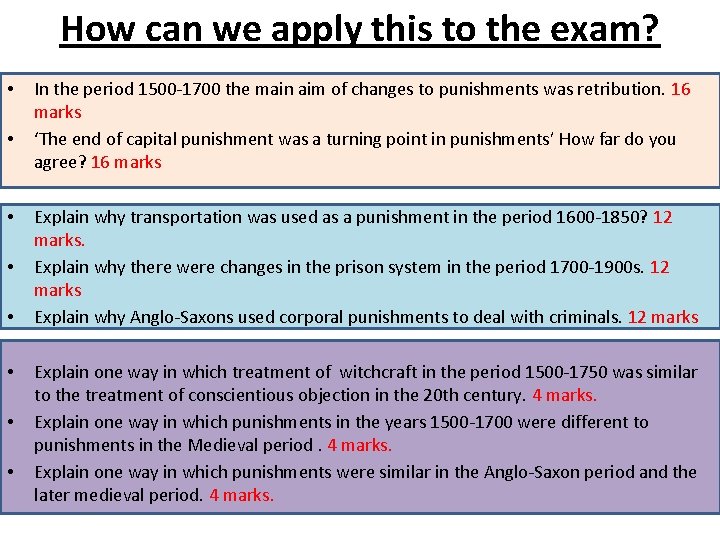
How can we apply this to the exam? • • In the period 1500 -1700 the main aim of changes to punishments was retribution. 16 marks ‘The end of capital punishment was a turning point in punishments’ How far do you agree? 16 marks Explain why transportation was used as a punishment in the period 1600 -1850? 12 marks. Explain why there were changes in the prison system in the period 1700 -1900 s. 12 marks Explain why Anglo-Saxons used corporal punishments to deal with criminals. 12 marks Explain one way in which treatment of witchcraft in the period 1500 -1750 was similar to the treatment of conscientious objection in the 20 th century. 4 marks. Explain one way in which punishments in the years 1500 -1700 were different to punishments in the Medieval period. 4 marks. Explain one way in which punishments were similar in the Anglo-Saxon period and the later medieval period. 4 marks.
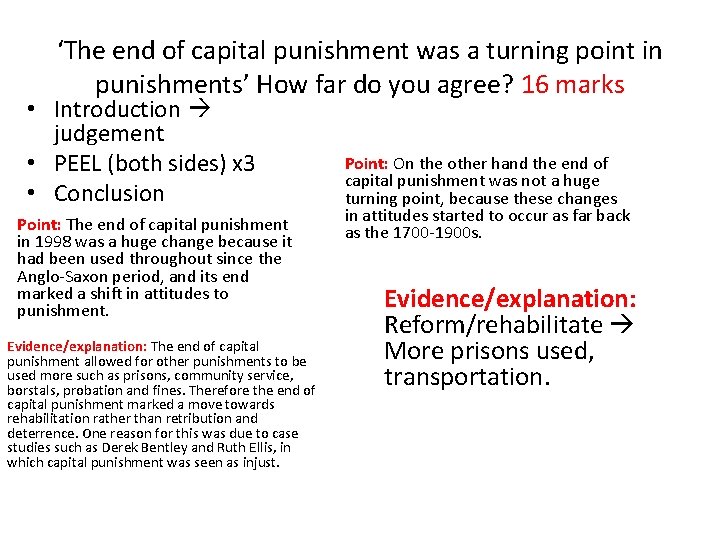
‘The end of capital punishment was a turning point in punishments’ How far do you agree? 16 marks • Introduction judgement • PEEL (both sides) x 3 • Conclusion Point: The end of capital punishment in 1998 was a huge change because it had been used throughout since the Anglo-Saxon period, and its end marked a shift in attitudes to punishment. Evidence/explanation: The end of capital punishment allowed for other punishments to be used more such as prisons, community service, borstals, probation and fines. Therefore the end of capital punishment marked a move towards rehabilitation rather than retribution and deterrence. One reason for this was due to case studies such as Derek Bentley and Ruth Ellis, in which capital punishment was seen as injust. Point: On the other hand the end of capital punishment was not a huge turning point, because these changes in attitudes started to occur as far back as the 1700 -1900 s. Evidence/explanation: Reform/rehabilitate More prisons used, transportation.
- Slides: 5