
DataModel Comparisons Yanhua Liu University of New Hampshire
- Slides: 14
Data-Model Comparisons Yanhua Liu University of New Hampshire GEM Workshop 2013 1
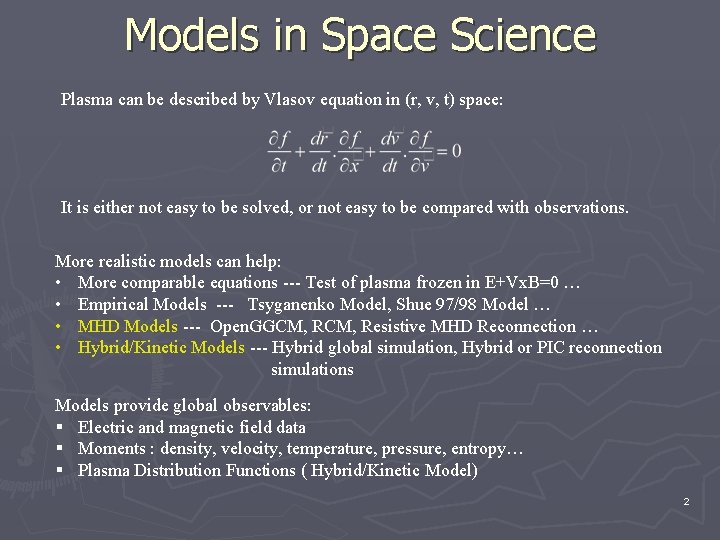
Models in Space Science Plasma can be described by Vlasov equation in (r, v, t) space: It is either not easy to be solved, or not easy to be compared with observations. More realistic models can help: • More comparable equations --- Test of plasma frozen in E+Vx. B=0 … • Empirical Models --- Tsyganenko Model, Shue 97/98 Model … • MHD Models --- Open. GGCM, Resistive MHD Reconnection … • Hybrid/Kinetic Models --- Hybrid global simulation, Hybrid or PIC reconnection simulations Models provide global observables: § Electric and magnetic field data § Moments : density, velocity, temperature, pressure, entropy… § Plasma Distribution Functions ( Hybrid/Kinetic Model) 2
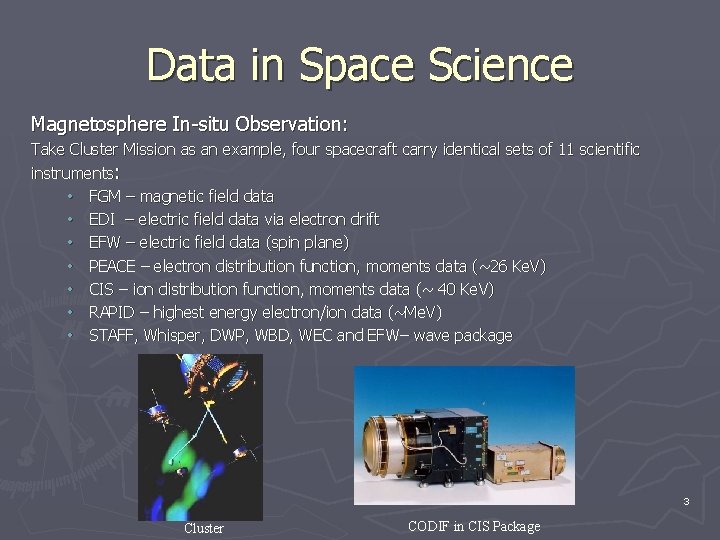
Data in Space Science Magnetosphere In-situ Observation: Take Cluster Mission as an example, four spacecraft carry identical sets of 11 scientific instruments: • FGM – magnetic field data • EDI – electric field data via electron drift • EFW – electric field data (spin plane) • PEACE – electron distribution function, moments data (~26 Ke. V) • CIS – ion distribution function, moments data (~ 40 Ke. V) • RAPID – highest energy electron/ion data (~Me. V) • STAFF, Whisper, DWP, WBD, WEC and EFW– wave package 3 Cluster CODIF in CIS Package
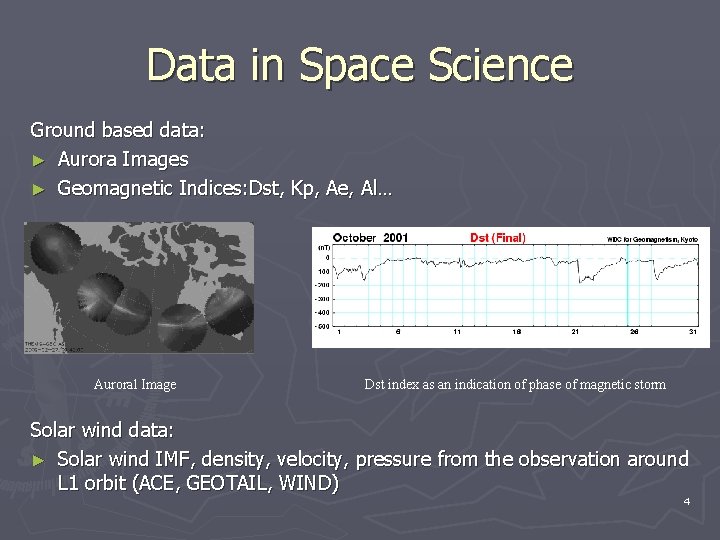
Data in Space Science Ground based data: ► Aurora Images ► Geomagnetic Indices: Dst, Kp, Ae, Al… Auroral Image Dst index as an indication of phase of magnetic storm Solar wind data: ► Solar wind IMF, density, velocity, pressure from the observation around L 1 orbit (ACE, GEOTAIL, WIND) 4
Limitations of Models and Data 1 Limitations of Models: Many assumptions, eg: § Open. GGCM: MHD model, artificial resistivity in reconnection. Maxwellian distribution function is assumed …. § PIC/Hybrid: Not real mass ratio: mi/me ~50, 100… Boundary condition matters: open boundary/ periodic boundary 2 Limitations of Data: § Reliable measurement: quality of data sometimes is limitted, eg: sun contamination § Limitation of instrument: The instruments have their measurement range. Eg: Cluster/CODIF measures 40 -40, 000 e. V. Cluster/EFW measures spin plane electric field and Ez comes from E. B=0 … § Spatial and Time Resolution: only single or few measurements in the space and we can not tell if the change come from space/time 5 evolution (MVA, timing, curlometer techniques)
Comparisons Ø Model-Data-Model Comparison: § Motivated by model result § Check with data § Compare with other model predictions Ø Data-Model-Data Comparison: Ø Motivated by observation Ø Use model to reproduce observation Ø Compare with other model predictions 6
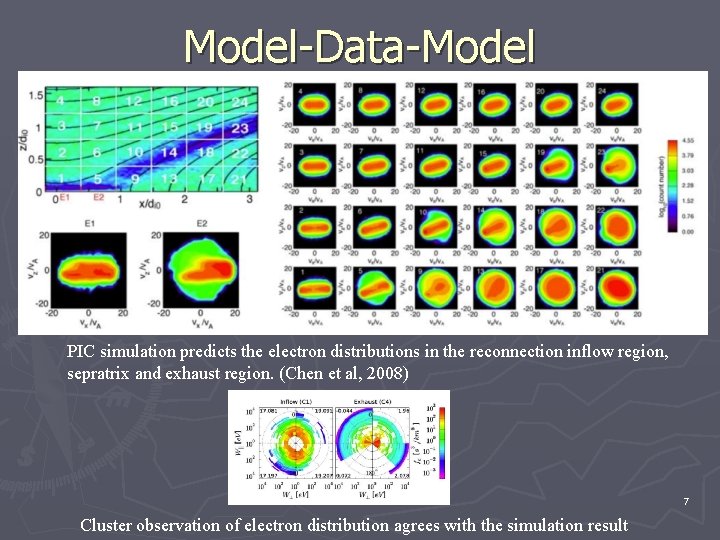
Model-Data-Model PIC simulation predicts the electron distributions in the reconnection inflow region, sepratrix and exhaust region. (Chen et al, 2008) 7 Cluster observation of electron distribution agrees with the simulation result
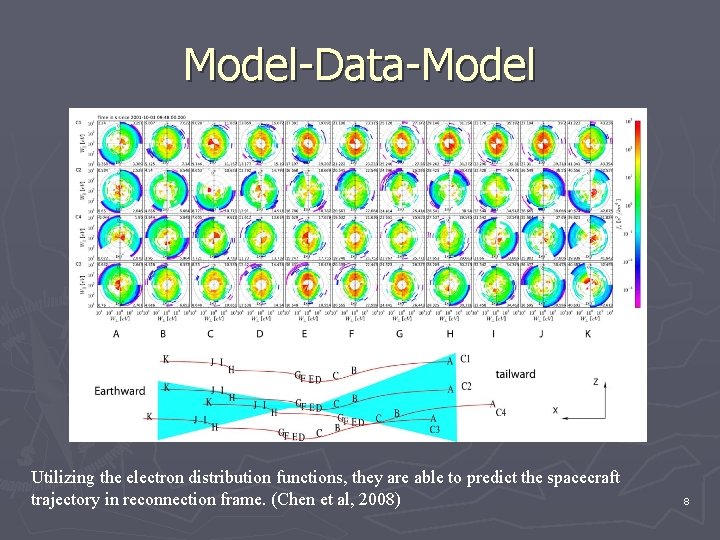
Model-Data-Model Utilizing the electron distribution functions, they are able to predict the spacecraft trajectory in reconnection frame. (Chen et al, 2008) 8
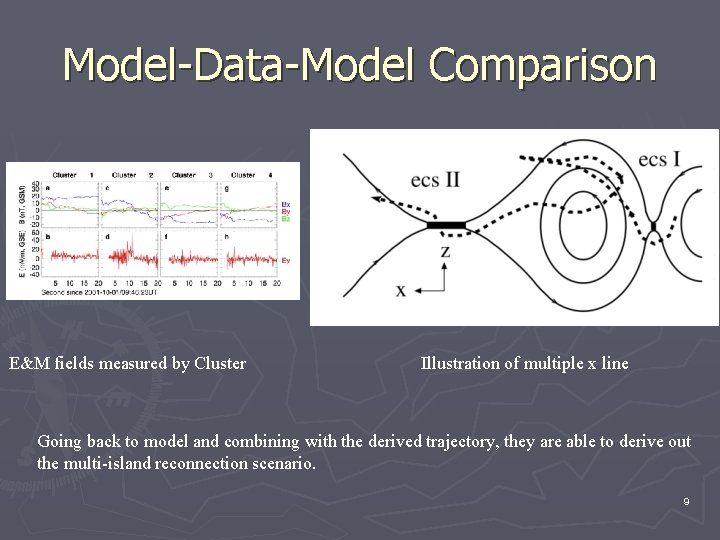
Model-Data-Model Comparison E&M fields measured by Cluster Illustration of multiple x line Going back to model and combining with the derived trajectory, they are able to derive out the multi-island reconnection scenario. 9
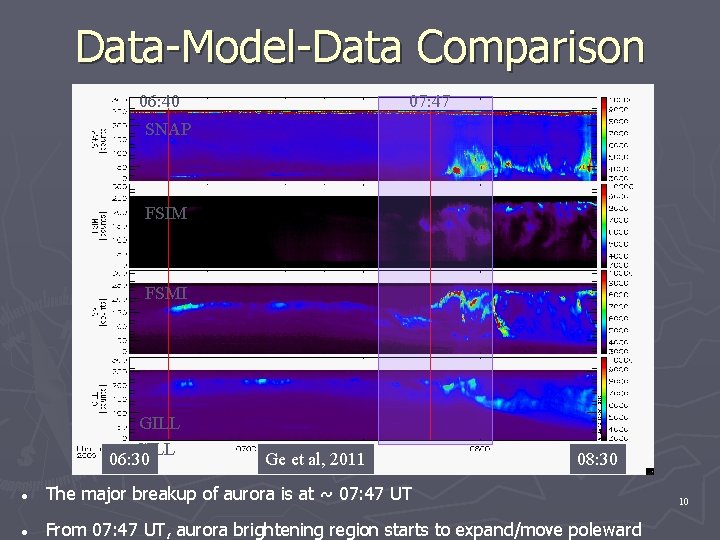
Data-Model-Data Comparison 06: 40 07: 47 SNAP FSIM FSMI GILL 06: 30 Ge et al, 2011 08: 30 The major breakup of aurora is at ~ 07: 47 UT From 07: 47 UT, aurora brightening region starts to expand/move poleward 10
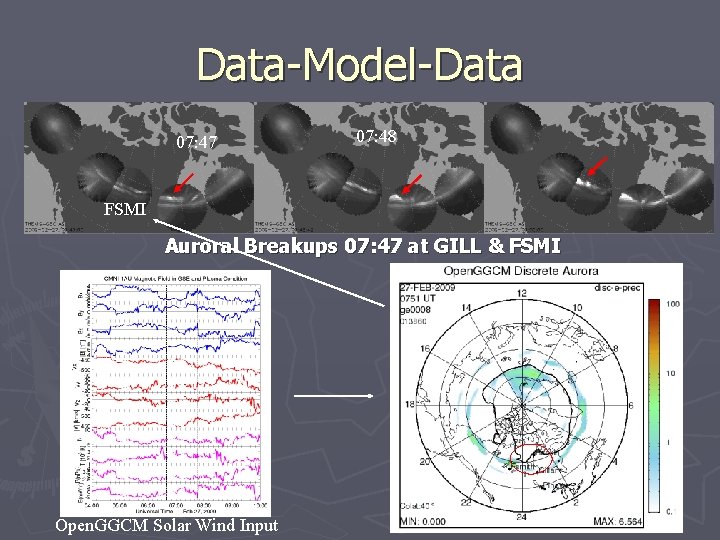
Data-Model-Data 07: 47 07: 48 FSMI Auroral Breakups 07: 47 at GILL & FSMI 11 Open. GGCM Solar Wind Input
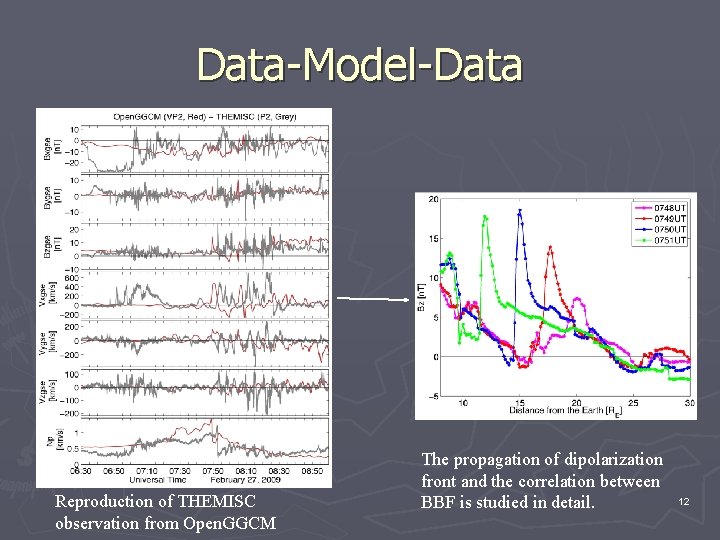
Data-Model-Data Reproduction of THEMISC observation from Open. GGCM The propagation of dipolarization front and the correlation between BBF is studied in detail. 12
Summary ► Model and Data both have their power and limitation. ► Performing data-model comparisons should be cautious of model and data limitations. ► Data-Model Comparisons can be motivated by model or data, but will finally return to a detailed physics question. 13
More Examples ► Model-Data-Model: Counter streaming heavy ions in reconnection Wednesday, reconnection section. ► Data-Model-Data: Cluster encounter of the reconnection hall plane, Thursday, poster# 36 ► Empirical Model: The thickness of O+ mediated reconnecting current sheet, Wednesday, the ionospheric source of magnetospheric plasma section. 14