
DataIntensive Information Processing Applications Session 12 Bigtable Hive
Data-Intensive Information Processing Applications ― Session #12 Bigtable, Hive, and Pig Jimmy Lin University of Maryland Tuesday, April 27, 2010 This work is licensed under a Creative Commons Attribution-Noncommercial-Share Alike 3. 0 United States See http: //creativecommons. org/licenses/by-nc-sa/3. 0/us/ for details
Source: Wikipedia (Japanese rock garden)
Today’s Agenda ¢ Bigtable ¢ Hive ¢ Pig
Bigtable
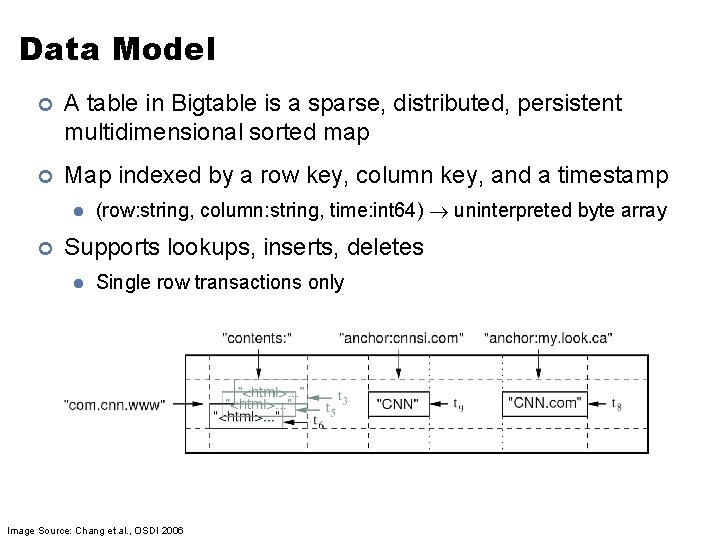
Data Model ¢ A table in Bigtable is a sparse, distributed, persistent multidimensional sorted map ¢ Map indexed by a row key, column key, and a timestamp l ¢ (row: string, column: string, time: int 64) uninterpreted byte array Supports lookups, inserts, deletes l Single row transactions only Image Source: Chang et al. , OSDI 2006
Rows and Columns ¢ Rows maintained in sorted lexicographic order l l ¢ Applications can exploit this property for efficient row scans Row ranges dynamically partitioned into tablets Columns grouped into column families l l l Column key = family: qualifier Column families provide locality hints Unbounded number of columns
Bigtable Building Blocks ¢ GFS ¢ Chubby ¢ SSTable
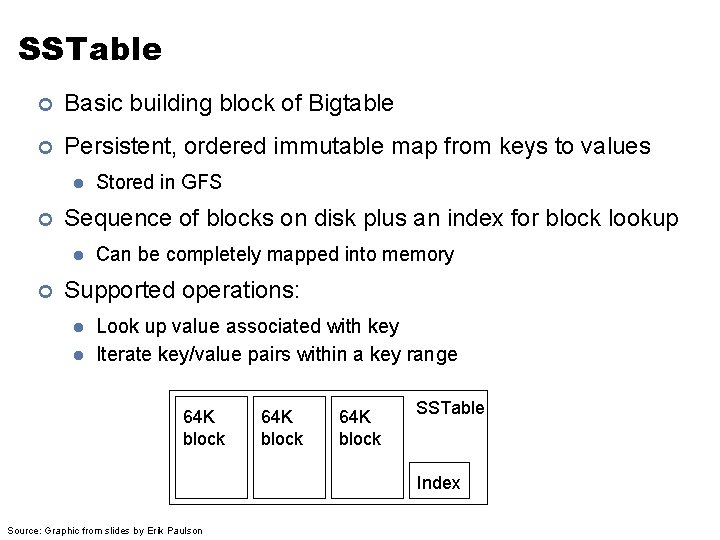
SSTable ¢ Basic building block of Bigtable ¢ Persistent, ordered immutable map from keys to values l ¢ Sequence of blocks on disk plus an index for block lookup l ¢ Stored in GFS Can be completely mapped into memory Supported operations: l l Look up value associated with key Iterate key/value pairs within a key range 64 K block SSTable Index Source: Graphic from slides by Erik Paulson
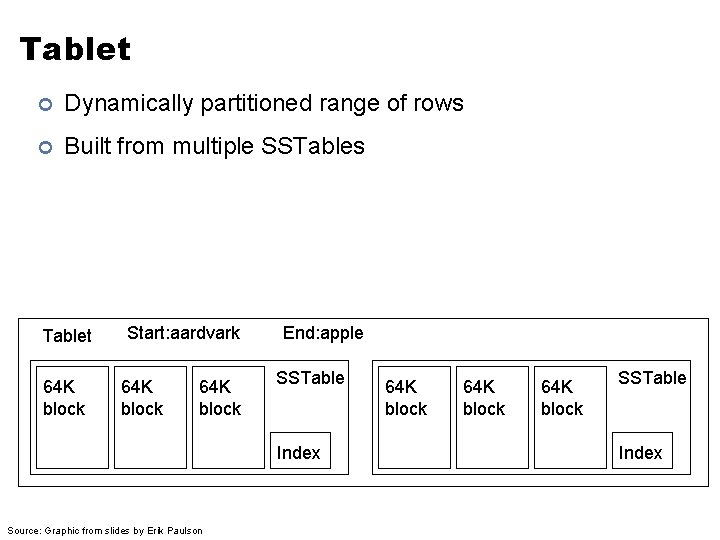
Tablet ¢ Dynamically partitioned range of rows ¢ Built from multiple SSTables Tablet 64 K block Start: aardvark 64 K block End: apple SSTable Index Source: Graphic from slides by Erik Paulson 64 K block SSTable Index
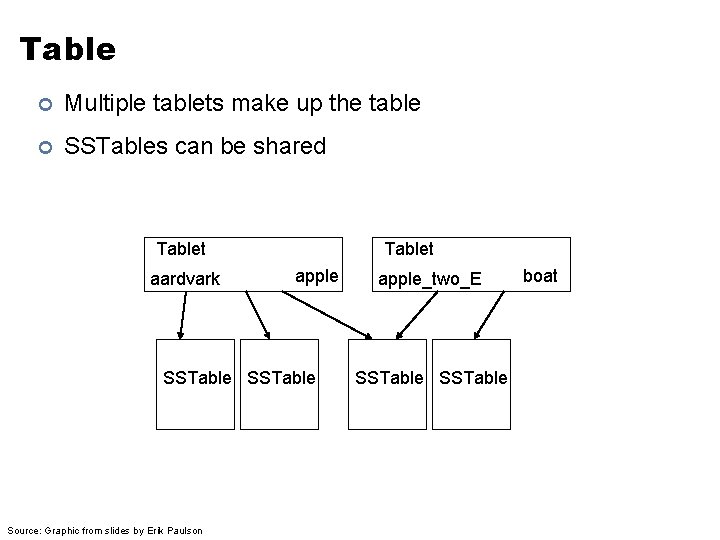
Table ¢ Multiple tablets make up the table ¢ SSTables can be shared Tablet aardvark Tablet apple SSTable Source: Graphic from slides by Erik Paulson apple_two_E SSTable boat
Architecture ¢ Client library ¢ Single master server ¢ Tablet servers
Bigtable Master ¢ Assigns tablets to tablet servers ¢ Detects addition and expiration of tablet servers ¢ Balances tablet server load ¢ Handles garbage collection ¢ Handles schema changes
Bigtable Tablet Servers ¢ Each tablet server manages a set of tablets l l Typically between to a thousand tablets Each 100 -200 MB by default ¢ Handles read and write requests to the tablets ¢ Splits tablets that have grown too large
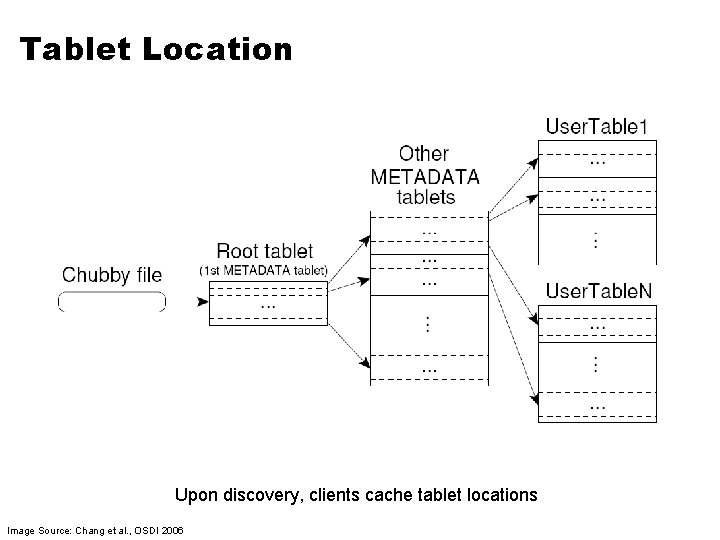
Tablet Location Upon discovery, clients cache tablet locations Image Source: Chang et al. , OSDI 2006
Tablet Assignment ¢ Master keeps track of: l l l ¢ Each tablet is assigned to one tablet server at a time l l ¢ Set of live tablet servers Assignment of tablets to tablet servers Unassigned tablets Tablet server maintains an exclusive lock on a file in Chubby Master monitors tablet servers and handles assignment Changes to tablet structure l l l Table creation/deletion (master initiated) Tablet merging (master initiated) Tablet splitting (tablet server initiated)
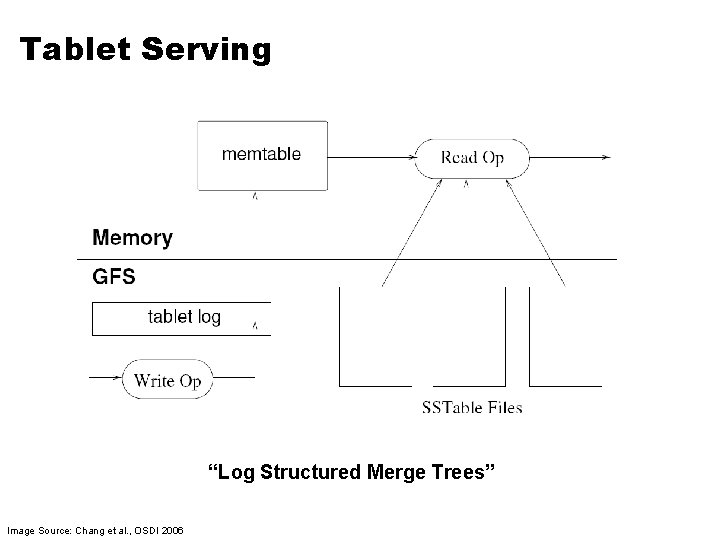
Tablet Serving “Log Structured Merge Trees” Image Source: Chang et al. , OSDI 2006
Compactions ¢ Minor compaction l l ¢ Merging compaction l l ¢ Converts the memtable into an SSTable Reduces memory usage and log traffic on restart Reads the contents of a few SSTables and the memtable, and writes out a new SSTable Reduces number of SSTables Major compaction l l Merging compaction that results in only one SSTable No deletion records, only live data
Bigtable Applications ¢ Data source and data sink for Map. Reduce ¢ Google’s web crawl ¢ Google Earth ¢ Google Analytics
Lessons Learned ¢ Fault tolerance is hard ¢ Don’t add functionality before understanding its use l ¢ Single-row transactions appear to be sufficient Keep it simple!
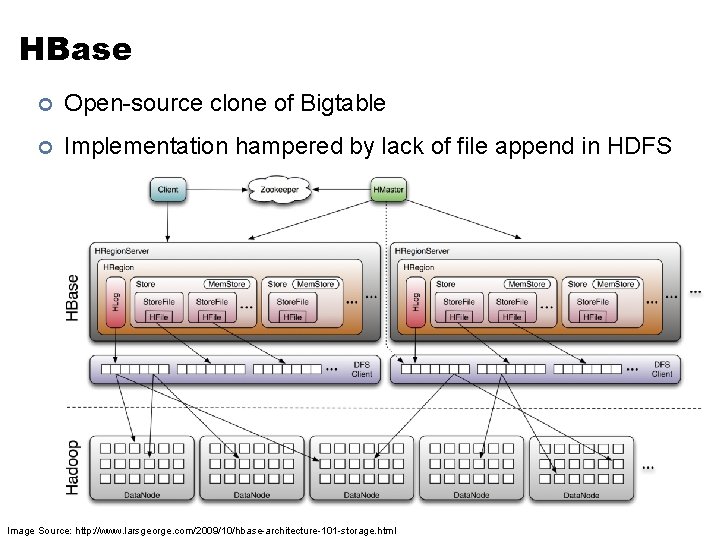
HBase ¢ Open-source clone of Bigtable ¢ Implementation hampered by lack of file append in HDFS Image Source: http: //www. larsgeorge. com/2009/10/hbase-architecture-101 -storage. html
Hive and Pig
Need for High-Level Languages ¢ Hadoop is great for large-data processing! l l ¢ But writing Java programs for everything is verbose and slow Not everyone wants to (or can) write Java code Solution: develop higher-level data processing languages l l Hive: HQL is like SQL Pig: Pig Latin is a bit like Perl
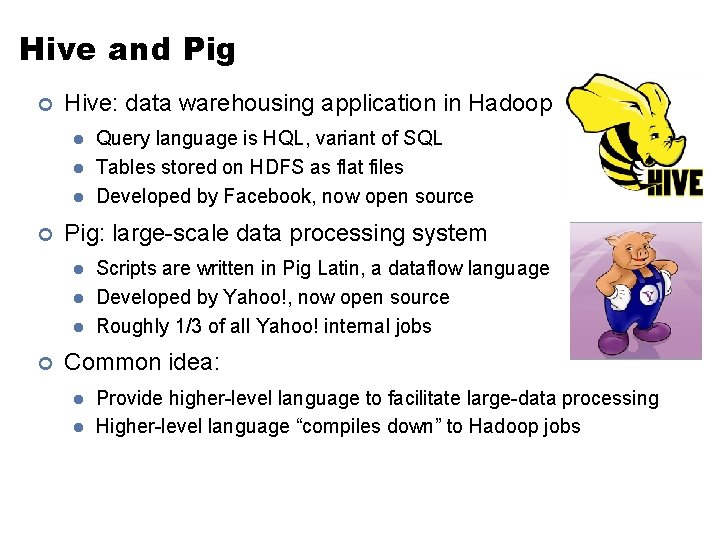
Hive and Pig ¢ Hive: data warehousing application in Hadoop l l l ¢ Pig: large-scale data processing system l l l ¢ Query language is HQL, variant of SQL Tables stored on HDFS as flat files Developed by Facebook, now open source Scripts are written in Pig Latin, a dataflow language Developed by Yahoo!, now open source Roughly 1/3 of all Yahoo! internal jobs Common idea: l l Provide higher-level language to facilitate large-data processing Higher-level language “compiles down” to Hadoop jobs
Hive: Background ¢ Started at Facebook ¢ Data was collected by nightly cron jobs into Oracle DB ¢ “ETL” via hand-coded python ¢ Grew from 10 s of GBs (2006) to 1 TB/day new data (2007), now 10 x that Source: cc-licensed slide by Cloudera
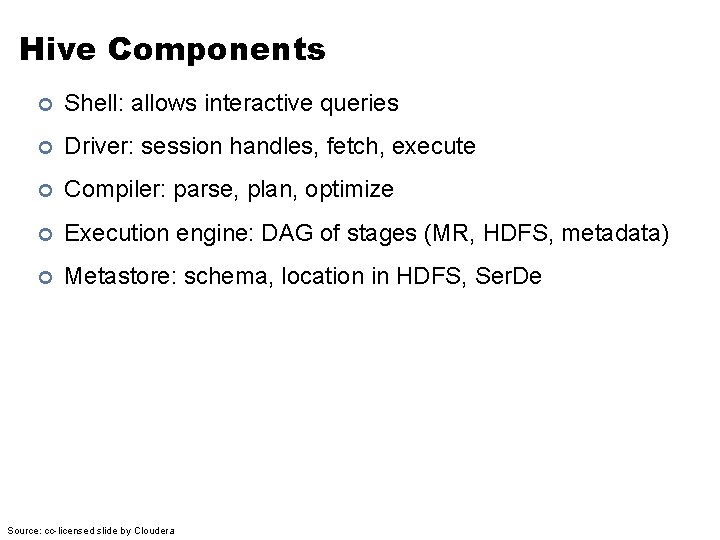
Hive Components ¢ Shell: allows interactive queries ¢ Driver: session handles, fetch, execute ¢ Compiler: parse, plan, optimize ¢ Execution engine: DAG of stages (MR, HDFS, metadata) ¢ Metastore: schema, location in HDFS, Ser. De Source: cc-licensed slide by Cloudera
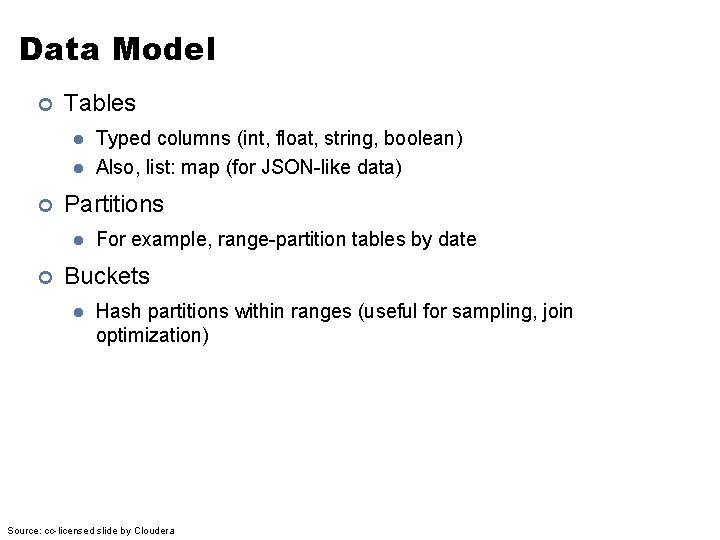
Data Model ¢ Tables l l ¢ Partitions l ¢ Typed columns (int, float, string, boolean) Also, list: map (for JSON-like data) For example, range-partition tables by date Buckets l Hash partitions within ranges (useful for sampling, join optimization) Source: cc-licensed slide by Cloudera
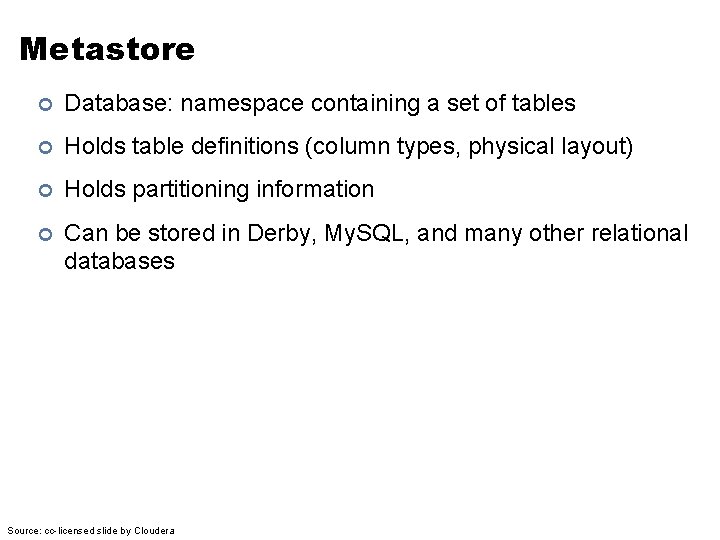
Metastore ¢ Database: namespace containing a set of tables ¢ Holds table definitions (column types, physical layout) ¢ Holds partitioning information ¢ Can be stored in Derby, My. SQL, and many other relational databases Source: cc-licensed slide by Cloudera
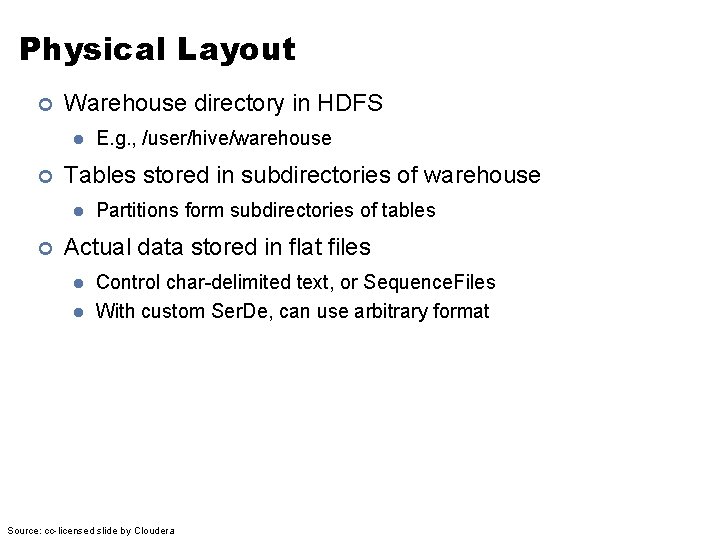
Physical Layout ¢ Warehouse directory in HDFS l ¢ Tables stored in subdirectories of warehouse l ¢ E. g. , /user/hive/warehouse Partitions form subdirectories of tables Actual data stored in flat files l l Control char-delimited text, or Sequence. Files With custom Ser. De, can use arbitrary format Source: cc-licensed slide by Cloudera
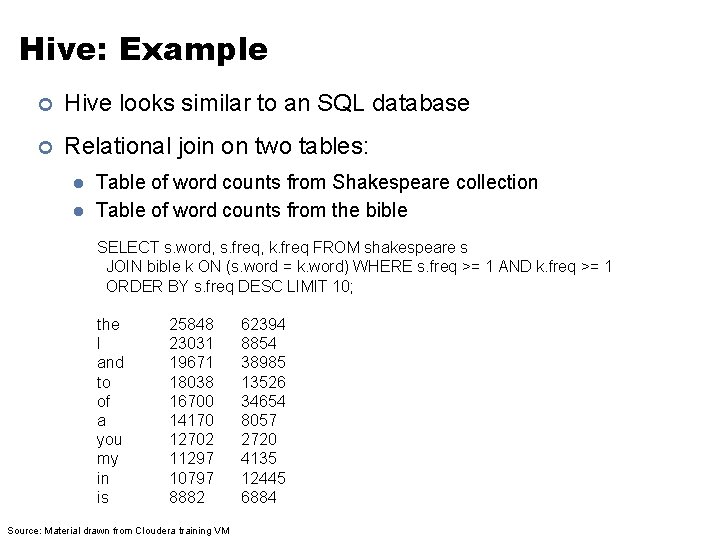
Hive: Example ¢ Hive looks similar to an SQL database ¢ Relational join on two tables: l l Table of word counts from Shakespeare collection Table of word counts from the bible SELECT s. word, s. freq, k. freq FROM shakespeare s JOIN bible k ON (s. word = k. word) WHERE s. freq >= 1 AND k. freq >= 1 ORDER BY s. freq DESC LIMIT 10; the I and to of a you my in is 25848 23031 19671 18038 16700 14170 12702 11297 10797 8882 Source: Material drawn from Cloudera training VM 62394 8854 38985 13526 34654 8057 2720 4135 12445 6884
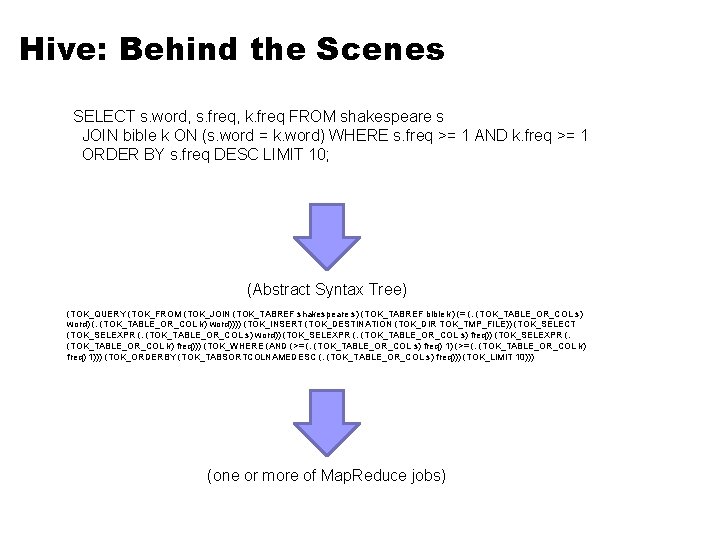
Hive: Behind the Scenes SELECT s. word, s. freq, k. freq FROM shakespeare s JOIN bible k ON (s. word = k. word) WHERE s. freq >= 1 AND k. freq >= 1 ORDER BY s. freq DESC LIMIT 10; (Abstract Syntax Tree) (TOK_QUERY (TOK_FROM (TOK_JOIN (TOK_TABREF shakespeare s) (TOK_TABREF bible k) (= (. (TOK_TABLE_OR_COL s) word) (. (TOK_TABLE_OR_COL k) word)))) (TOK_INSERT (TOK_DESTINATION (TOK_DIR TOK_TMP_FILE)) (TOK_SELECT (TOK_SELEXPR (. (TOK_TABLE_OR_COL s) word)) (TOK_SELEXPR (. (TOK_TABLE_OR_COL s) freq)) (TOK_SELEXPR (. (TOK_TABLE_OR_COL k) freq))) (TOK_WHERE (AND (>= (. (TOK_TABLE_OR_COL s) freq) 1) (>= (. (TOK_TABLE_OR_COL k) freq) 1))) (TOK_ORDERBY (TOK_TABSORTCOLNAMEDESC (. (TOK_TABLE_OR_COL s) freq))) (TOK_LIMIT 10))) (one or more of Map. Reduce jobs)
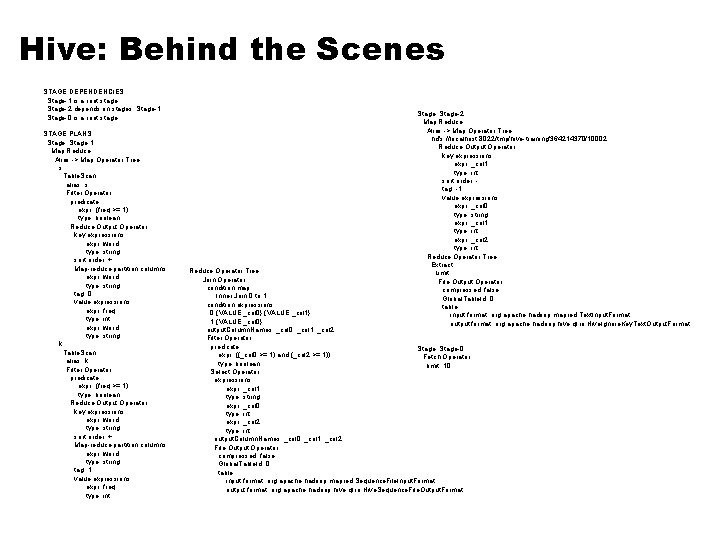
Hive: Behind the Scenes STAGE DEPENDENCIES: Stage-1 is a root stage Stage-2 depends on stages: Stage-1 Stage-0 is a root stage STAGE PLANS: Stage-1 Map Reduce Alias -> Map Operator Tree: s Table. Scan alias: s Filter Operator predicate: expr: (freq >= 1) type: boolean Reduce Output Operator key expressions: expr: word type: string sort order: + Map-reduce partition columns: expr: word type: string tag: 0 value expressions: expr: freq type: int expr: word type: string k Table. Scan alias: k Filter Operator predicate: expr: (freq >= 1) type: boolean Reduce Output Operator key expressions: expr: word type: string sort order: + Map-reduce partition columns: expr: word type: string tag: 1 value expressions: expr: freq type: int Stage: Stage-2 Map Reduce Alias -> Map Operator Tree: hdfs: //localhost: 8022/tmp/hive-training/364214370/10002 Reduce Output Operator key expressions: expr: _col 1 type: int sort order: tag: -1 value expressions: expr: _col 0 type: string expr: _col 1 type: int expr: _col 2 type: int Reduce Operator Tree: Extract Limit File Output Operator compressed: false Global. Table. Id: 0 table: input format: org. apache. hadoop. mapred. Text. Input. Format output format: org. apache. hadoop. hive. ql. io. Hive. Ignore. Key. Text. Output. Format Reduce Operator Tree: Join Operator condition map: Inner Join 0 to 1 condition expressions: 0 {VALUE. _col 0} {VALUE. _col 1} 1 {VALUE. _col 0} output. Column. Names: _col 0, _col 1, _col 2 Filter Operator predicate: Stage-0 expr: ((_col 0 >= 1) and (_col 2 >= 1)) Fetch Operator type: boolean limit: 10 Select Operator expressions: expr: _col 1 type: string expr: _col 0 type: int expr: _col 2 type: int output. Column. Names: _col 0, _col 1, _col 2 File Output Operator compressed: false Global. Table. Id: 0 table: input format: org. apache. hadoop. mapred. Sequence. File. Input. Format output format: org. apache. hadoop. hive. ql. io. Hive. Sequence. File. Output. Format
Hive Demo
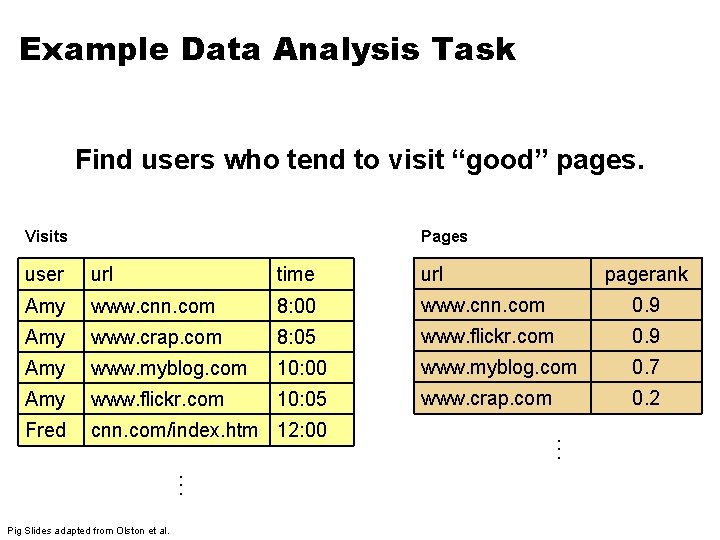
Example Data Analysis Task Find users who tend to visit “good” pages. Visits Pages url time url Amy www. cnn. com 8: 00 www. cnn. com 0. 9 Amy www. crap. com 8: 05 www. flickr. com 0. 9 Amy www. myblog. com 10: 00 www. myblog. com 0. 7 Amy www. flickr. com 10: 05 www. crap. com 0. 2 Fred cnn. com/index. htm 12: 00. . . Pig Slides adapted from Olston et al. pagerank . . . user
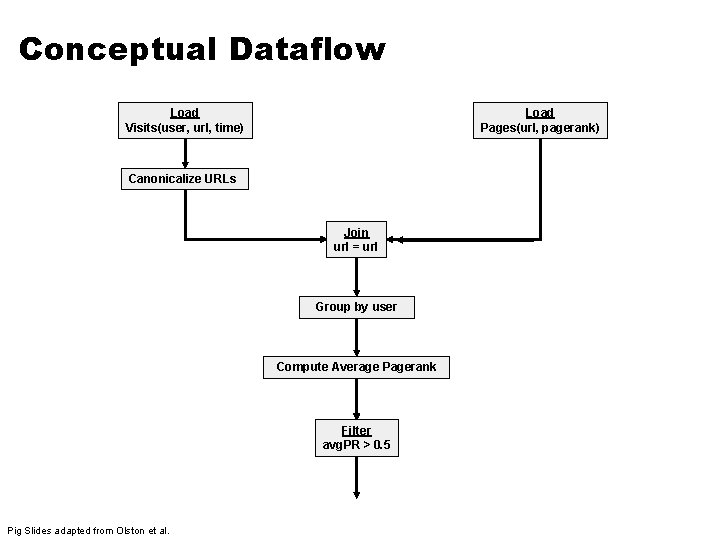
Conceptual Dataflow Load Visits(user, url, time) Load Pages(url, pagerank) Canonicalize URLs Join url = url Group by user Compute Average Pagerank Filter avg. PR > 0. 5 Pig Slides adapted from Olston et al.
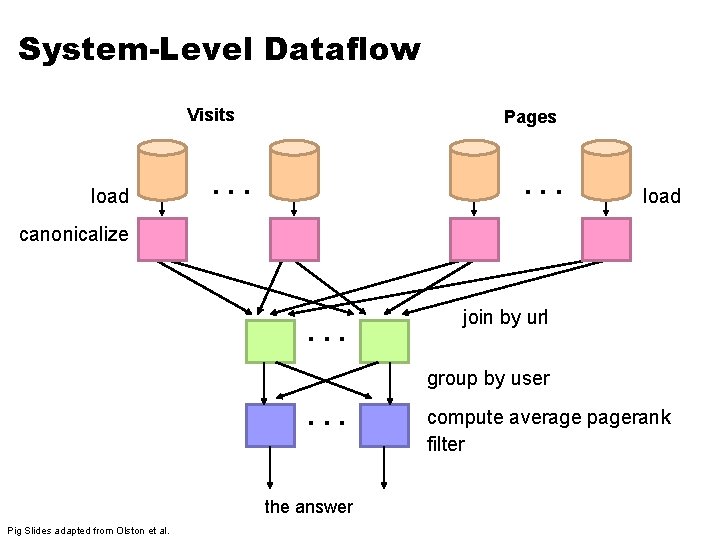
System-Level Dataflow Visits load Pages . . . load canonicalize join by url . . . group by user . . . the answer Pig Slides adapted from Olston et al. compute average pagerank filter
Map. Reduce Code Pig Slides adapted from Olston et al.
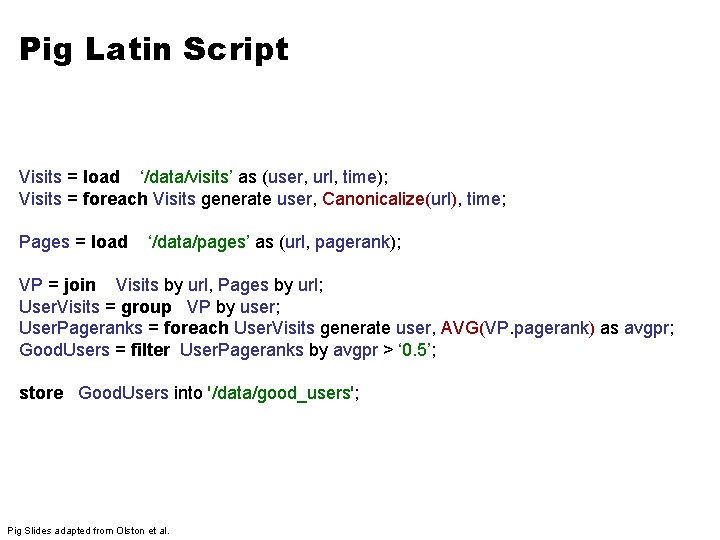
Pig Latin Script Visits = load ‘/data/visits’ as (user, url, time); Visits = foreach Visits generate user, Canonicalize(url), time; Pages = load ‘/data/pages’ as (url, pagerank); VP = join Visits by url, Pages by url; User. Visits = group VP by user; User. Pageranks = foreach User. Visits generate user, AVG(VP. pagerank) as avgpr; Good. Users = filter User. Pageranks by avgpr > ‘ 0. 5’; store Good. Users into '/data/good_users'; Pig Slides adapted from Olston et al.
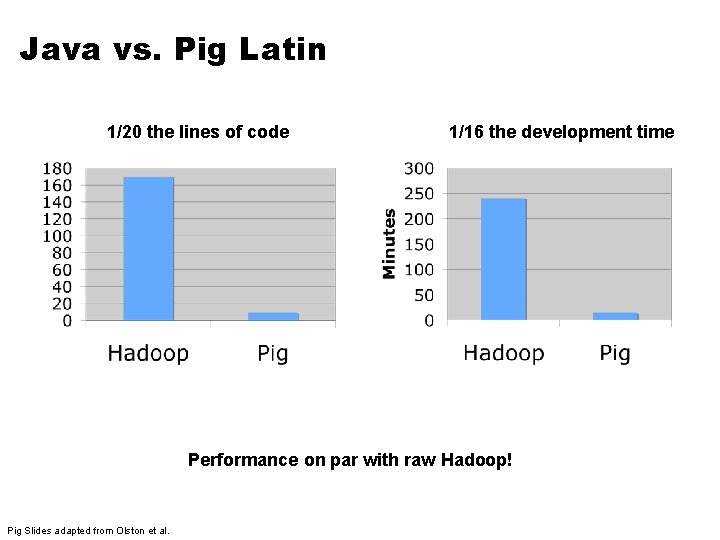
Java vs. Pig Latin 1/20 the lines of code 1/16 the development time Performance on par with raw Hadoop! Pig Slides adapted from Olston et al.
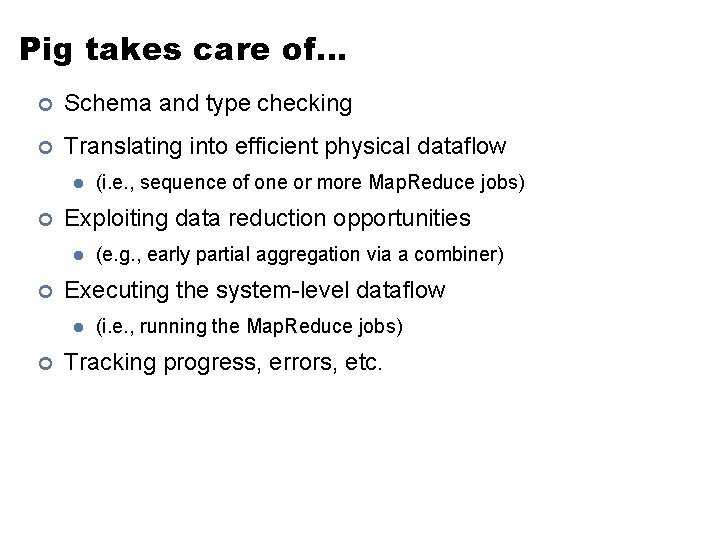
Pig takes care of… ¢ Schema and type checking ¢ Translating into efficient physical dataflow l ¢ Exploiting data reduction opportunities l ¢ (e. g. , early partial aggregation via a combiner) Executing the system-level dataflow l ¢ (i. e. , sequence of one or more Map. Reduce jobs) (i. e. , running the Map. Reduce jobs) Tracking progress, errors, etc.
Pig Demo
Questions? Source: Wikipedia (Japanese rock garden)
- Slides: 41