
Datadriven materiality analysis Powered by Datamaran Materiality assessment

Data-driven materiality analysis Powered by Datamaran Materiality assessment workshop of COMPANY / DIVISION / STAKEHOLDER PANEL Customer success team September 2019
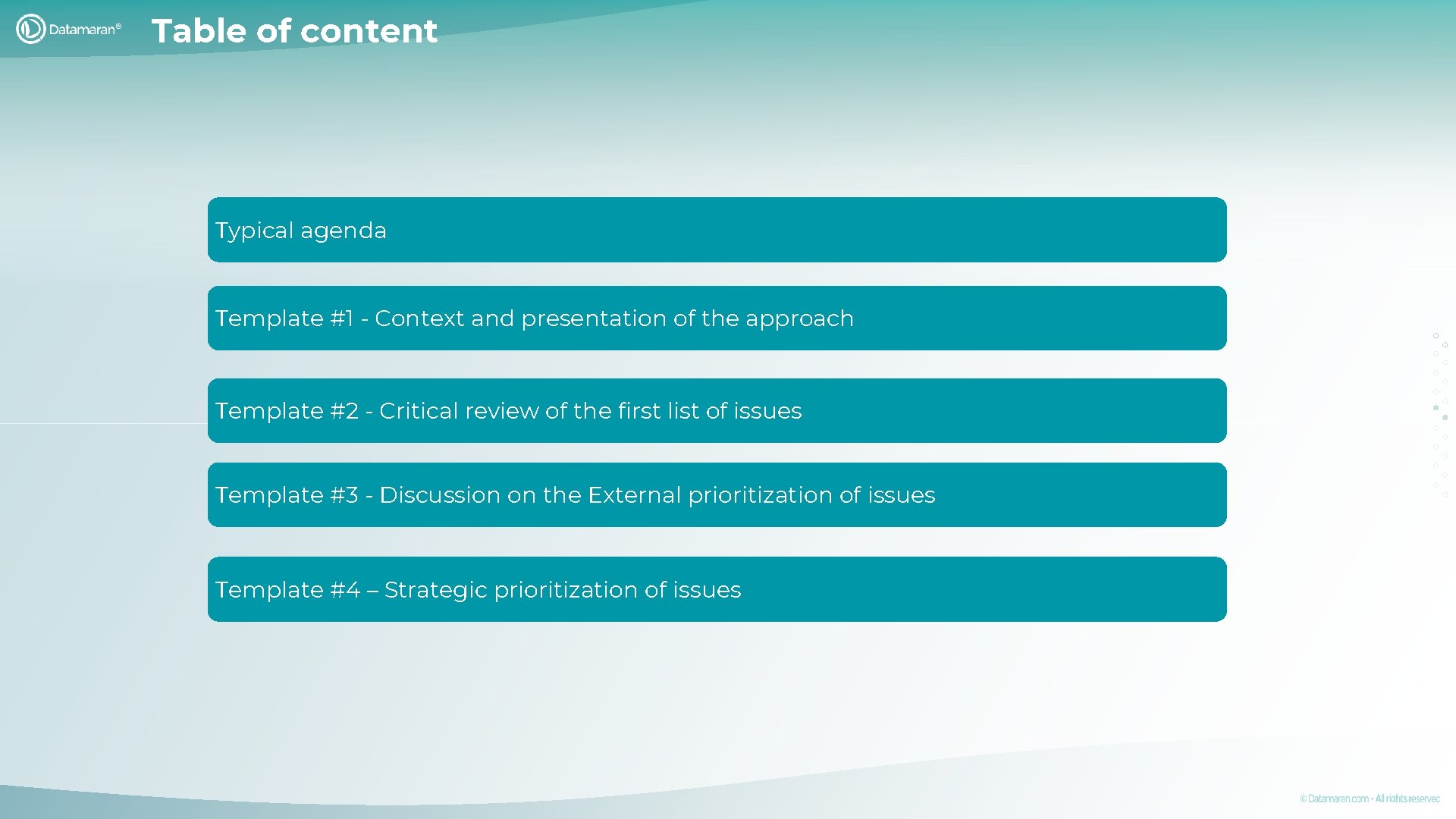
Table of content Typical agenda Template #1 - Context and presentation of the approach Template #2 - Critical review of the first list of issues Template #3 - Discussion on the External prioritization of issues Template #4 – Strategic prioritization of issues
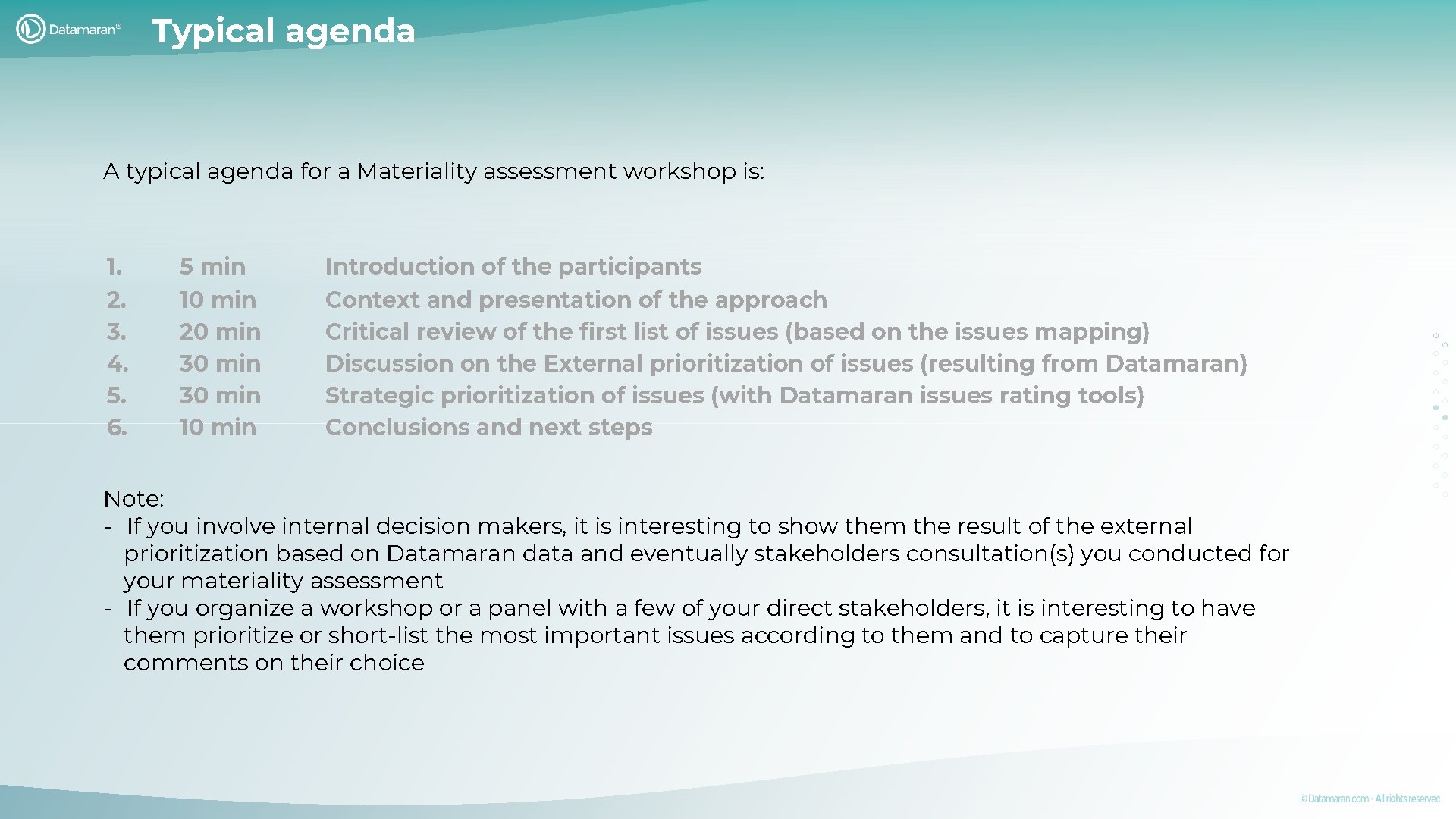
Typical agenda A typical agenda for a Materiality assessment workshop is: 1. 2. 3. 4. 5. 6. 5 min 10 min 20 min 30 min 10 min Introduction of the participants Context and presentation of the approach Critical review of the first list of issues (based on the issues mapping) Discussion on the External prioritization of issues (resulting from Datamaran) Strategic prioritization of issues (with Datamaran issues rating tools) Conclusions and next steps Note: - If you involve internal decision makers, it is interesting to show them the result of the external prioritization based on Datamaran data and eventually stakeholders consultation(s) you conducted for your materiality assessment - If you organize a workshop or a panel with a few of your direct stakeholders, it is interesting to have them prioritize or short-list the most important issues according to them and to capture their comments on their choice
Four templates to lead a workshop Here are the four templates that you can use, based on Datamaran Materiality module, to lead a workshop: Template #1 - Context and presentation of the approach Template #2 - Critical review of the first list of issues Template #3 - Discussion on the External prioritization of issues Template #4 – Strategic prioritization of issues
Four templates to lead a workshop Template #1 - Context and presentation of the approach Template #2 - Critical review of the first list of issues Template #3 - Discussion on the External prioritization of issues Template #4 – Strategic prioritization of issues
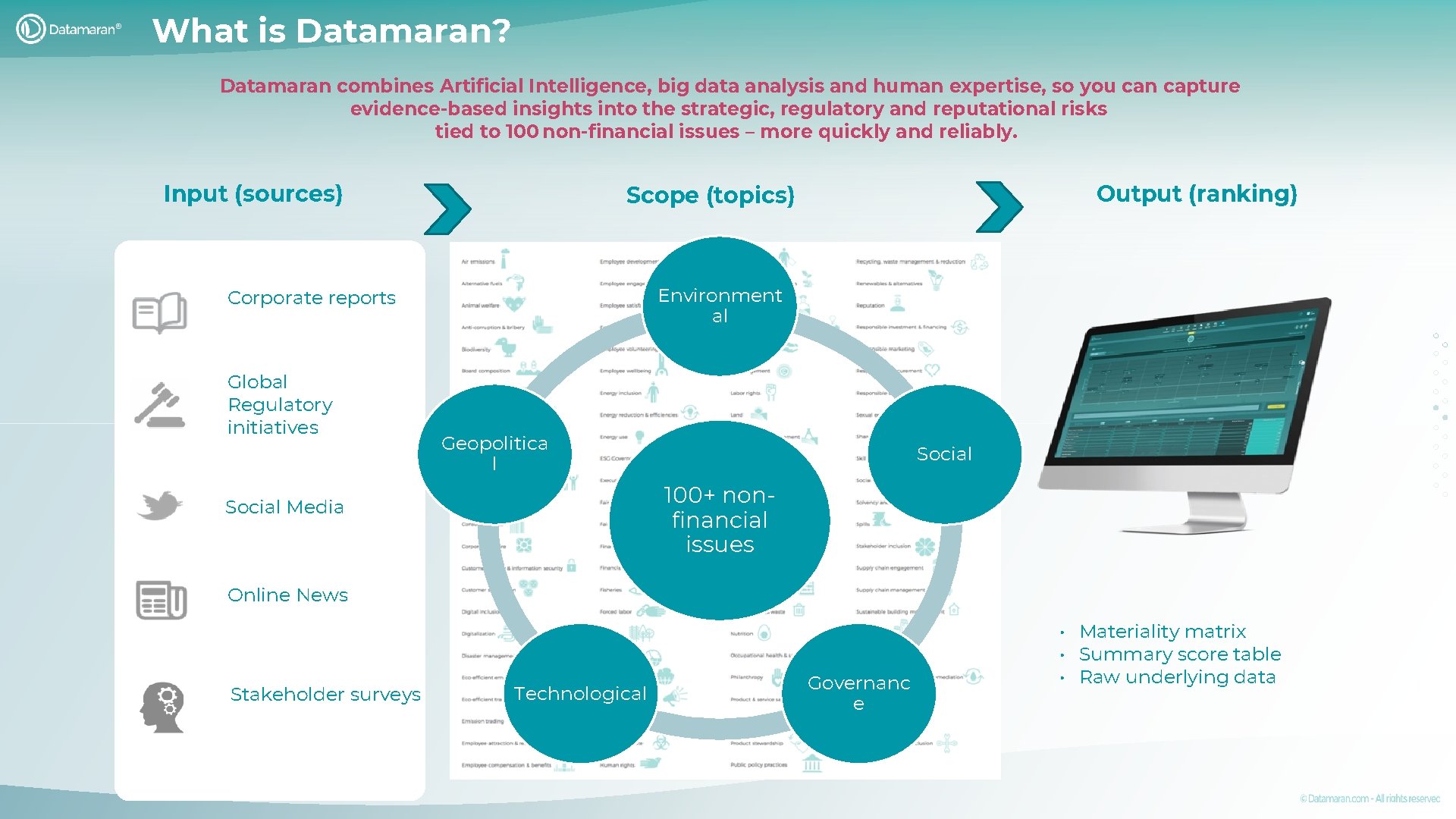
What is Datamaran? Datamaran combines Artificial Intelligence, big data analysis and human expertise, so you can capture evidence-based insights into the strategic, regulatory and reputational risks tied to 100 non-financial issues – more quickly and reliably. Input (sources) Environment al Corporate reports Global Regulatory initiatives Output (ranking) Scope (topics) Geopolitica l Social 100+ nonfinancial issues Social Media Online News Stakeholder surveys Technological Governanc e • Materiality matrix • Summary score table • Raw underlying data
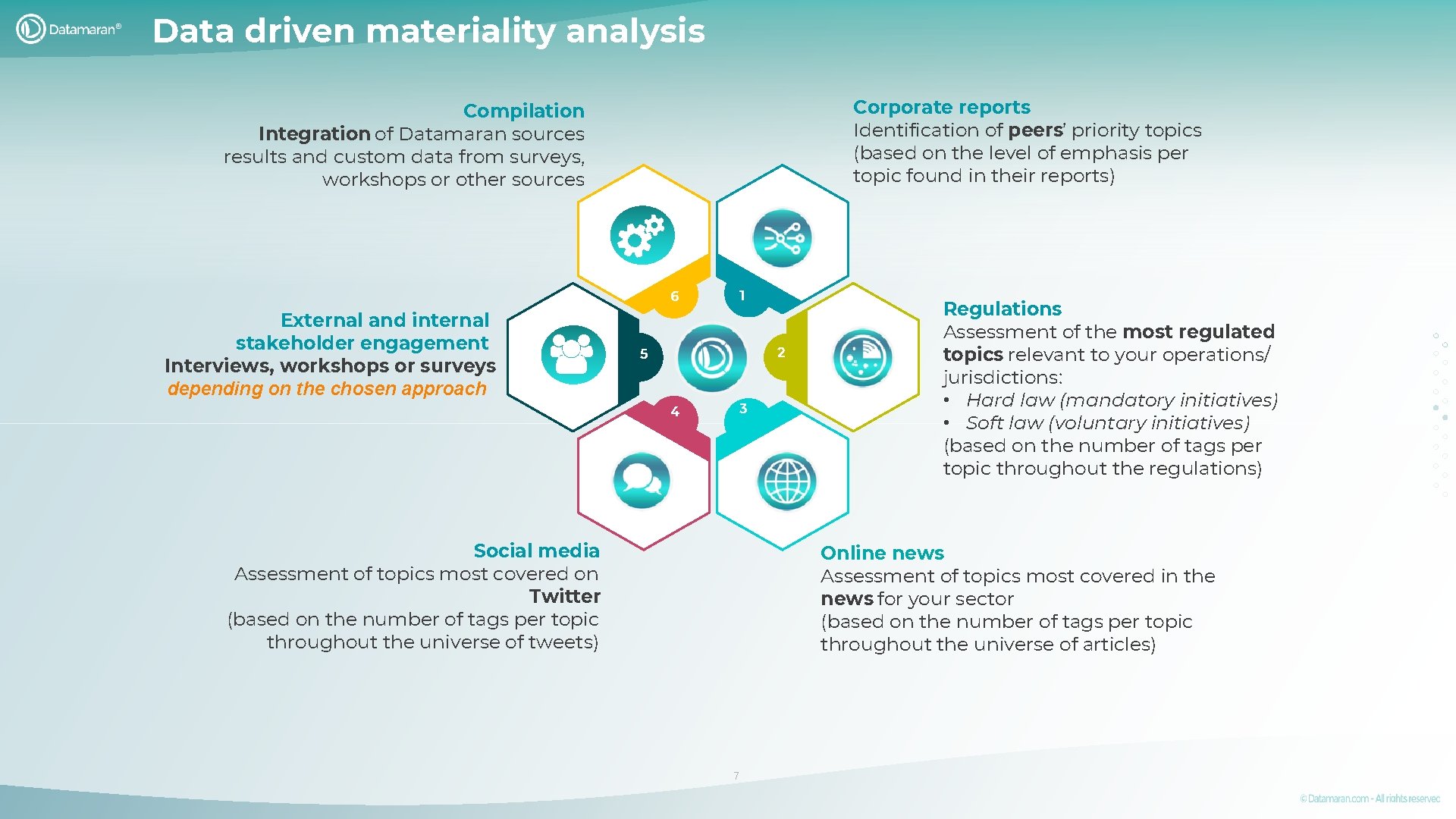
Data driven materiality analysis Corporate reports Identification of peers’ priority topics (based on the level of emphasis per topic found in their reports) Compilation Integration of Datamaran sources results and custom data from surveys, workshops or other sources 1 6 External and internal stakeholder engagement Interviews, workshops or surveys depending on the chosen approach 2 5 3 4 Social media Assessment of topics most covered on Twitter (based on the number of tags per topic throughout the universe of tweets) Regulations Assessment of the most regulated topics relevant to your operations/ jurisdictions: • Hard law (mandatory initiatives) • Soft law (voluntary initiatives) (based on the number of tags per topic throughout the regulations) Online news Assessment of topics most covered in the news for your sector (based on the number of tags per topic throughout the universe of articles) 7
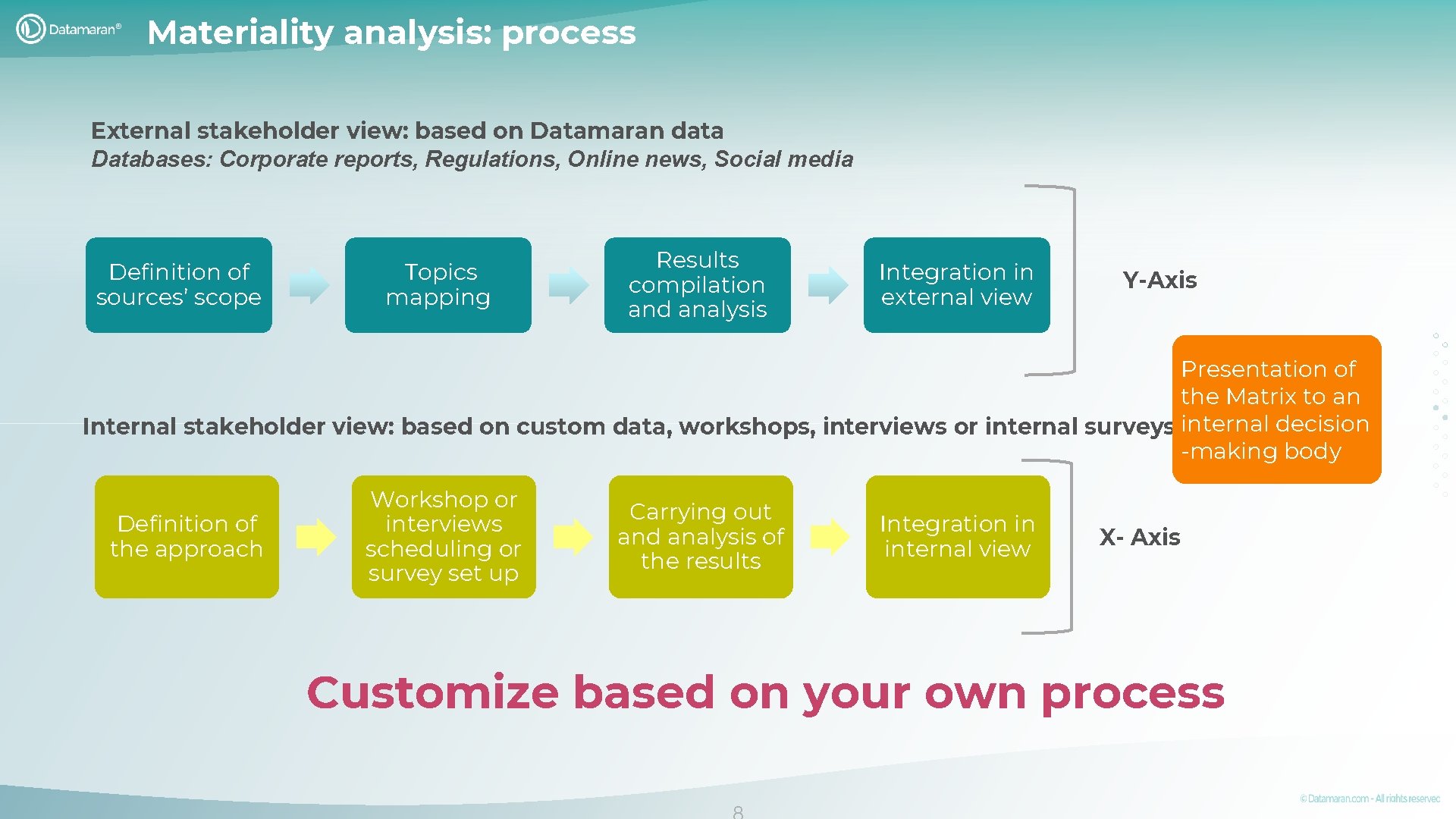
Materiality analysis: process External stakeholder view: based on Datamaran data Databases: Corporate reports, Regulations, Online news, Social media Definition of sources’ scope Topics mapping Results compilation and analysis Integration in external view Y-Axis Presentation of the Matrix to an Internal stakeholder view: based on custom data, workshops, interviews or internal surveys internal decision -making body Definition of the approach Workshop or interviews scheduling or survey set up Carrying out and analysis of the results Integration in internal view X- Axis Customize based on your own process
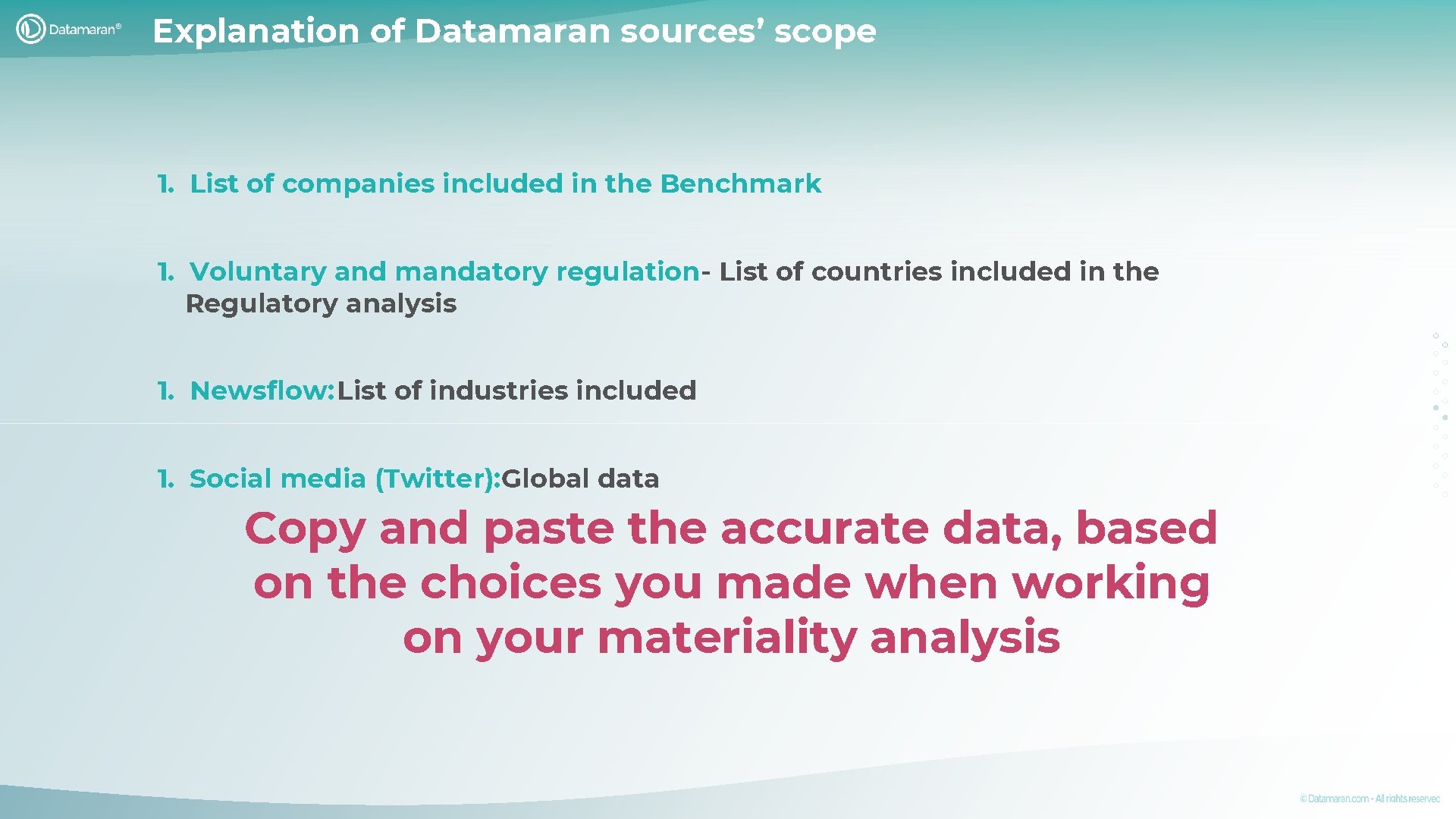
Explanation of Datamaran sources’ scope 1. List of companies included in the Benchmark 1. Voluntary and mandatory regulation- List of countries included in the Regulatory analysis 1. Newsflow: List of industries included 1. Social media (Twitter): Global data Copy and paste the accurate data, based on the choices you made when working on your materiality analysis
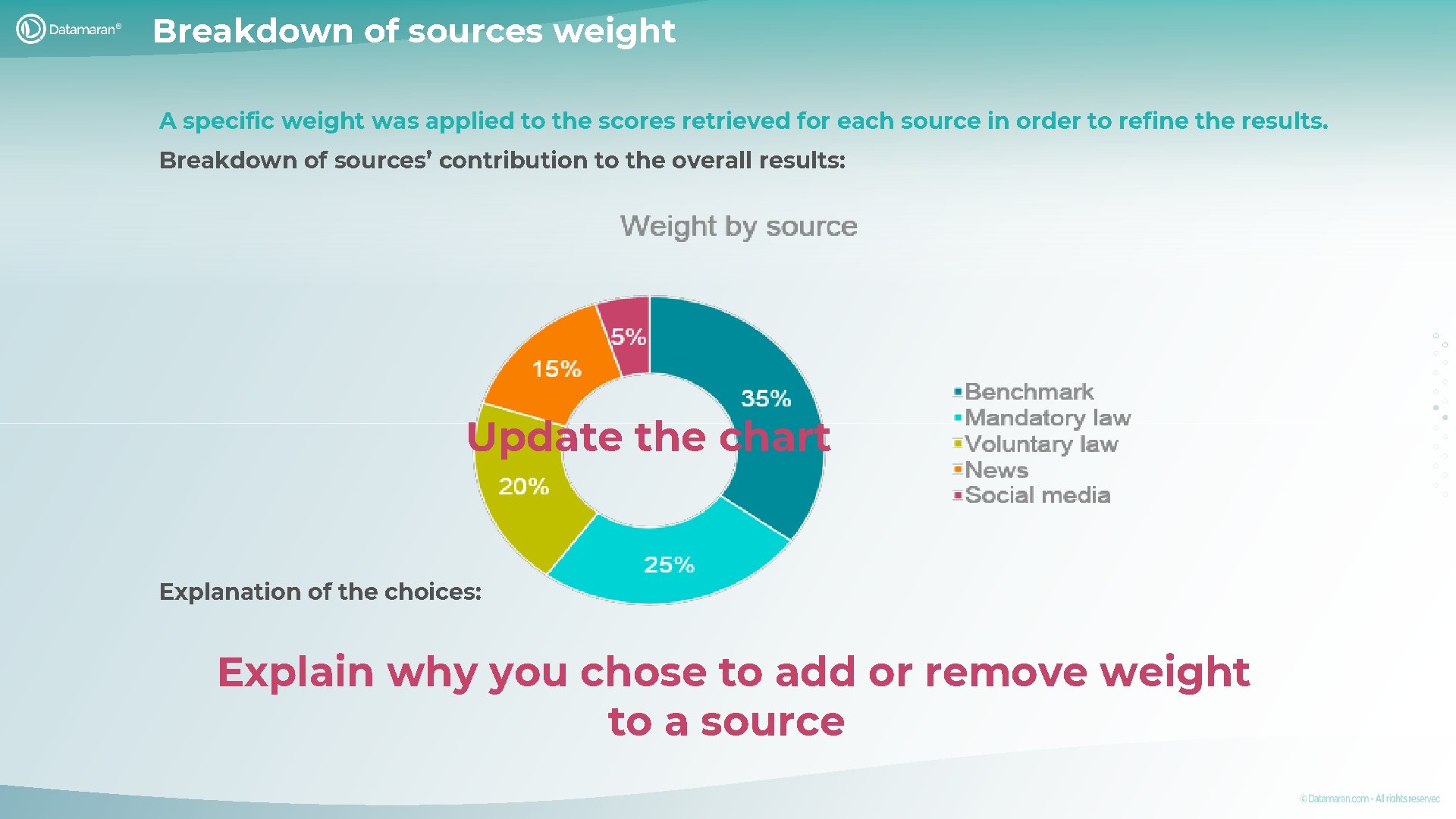
Breakdown of sources weight A specific weight was applied to the scores retrieved for each source in order to refine the results. Breakdown of sources’ contribution to the overall results: Update the chart Explanation of the choices: Explain why you chose to add or remove weight to a source
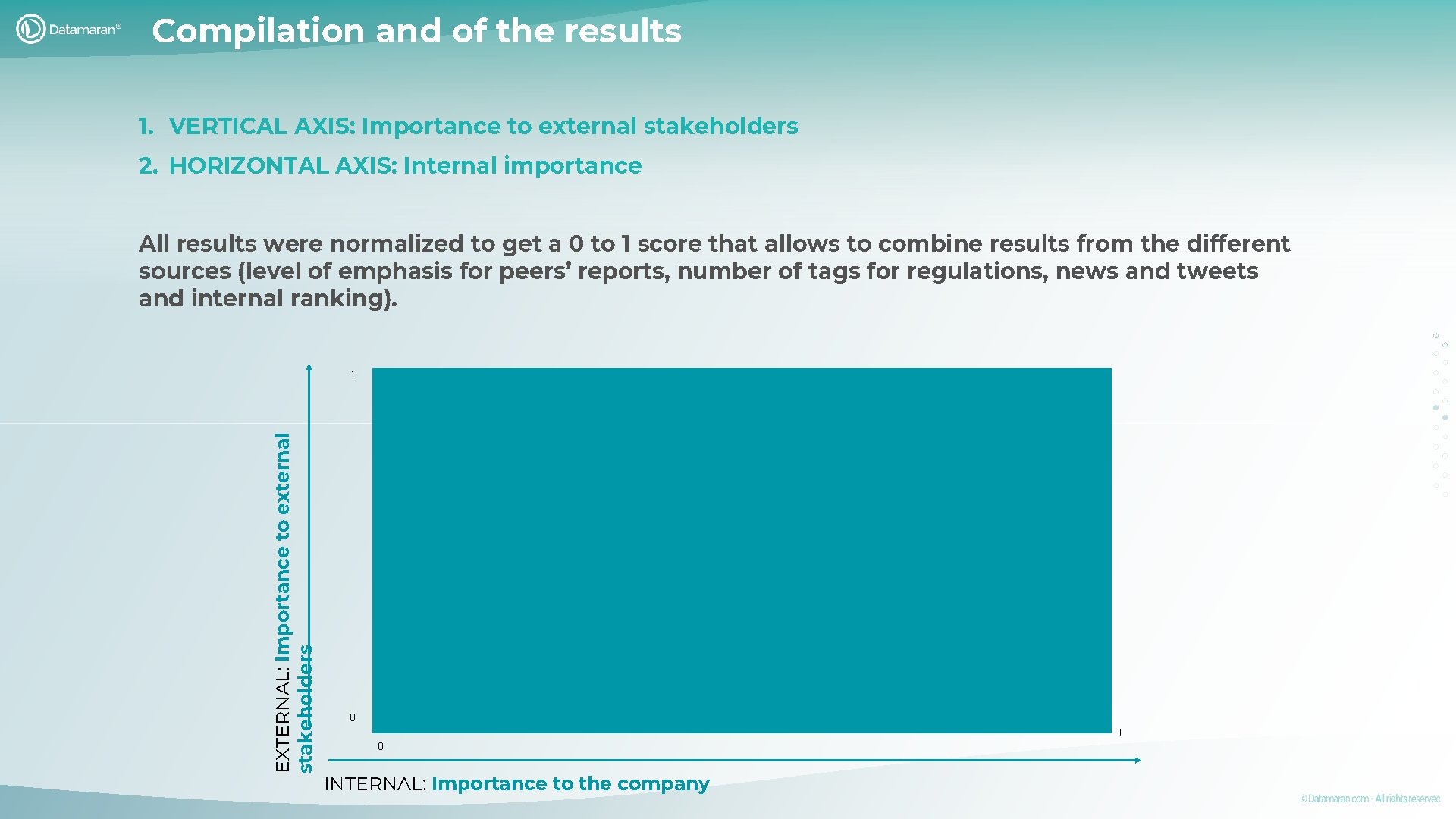
Compilation and of the results 1. VERTICAL AXIS: Importance to external stakeholders 2. HORIZONTAL AXIS: Internal importance All results were normalized to get a 0 to 1 score that allows to combine results from the different sources (level of emphasis for peers’ reports, number of tags for regulations, news and tweets and internal ranking). EXTERNAL: Importance to external stakeholders 1 0 INTERNAL: Importance to the company
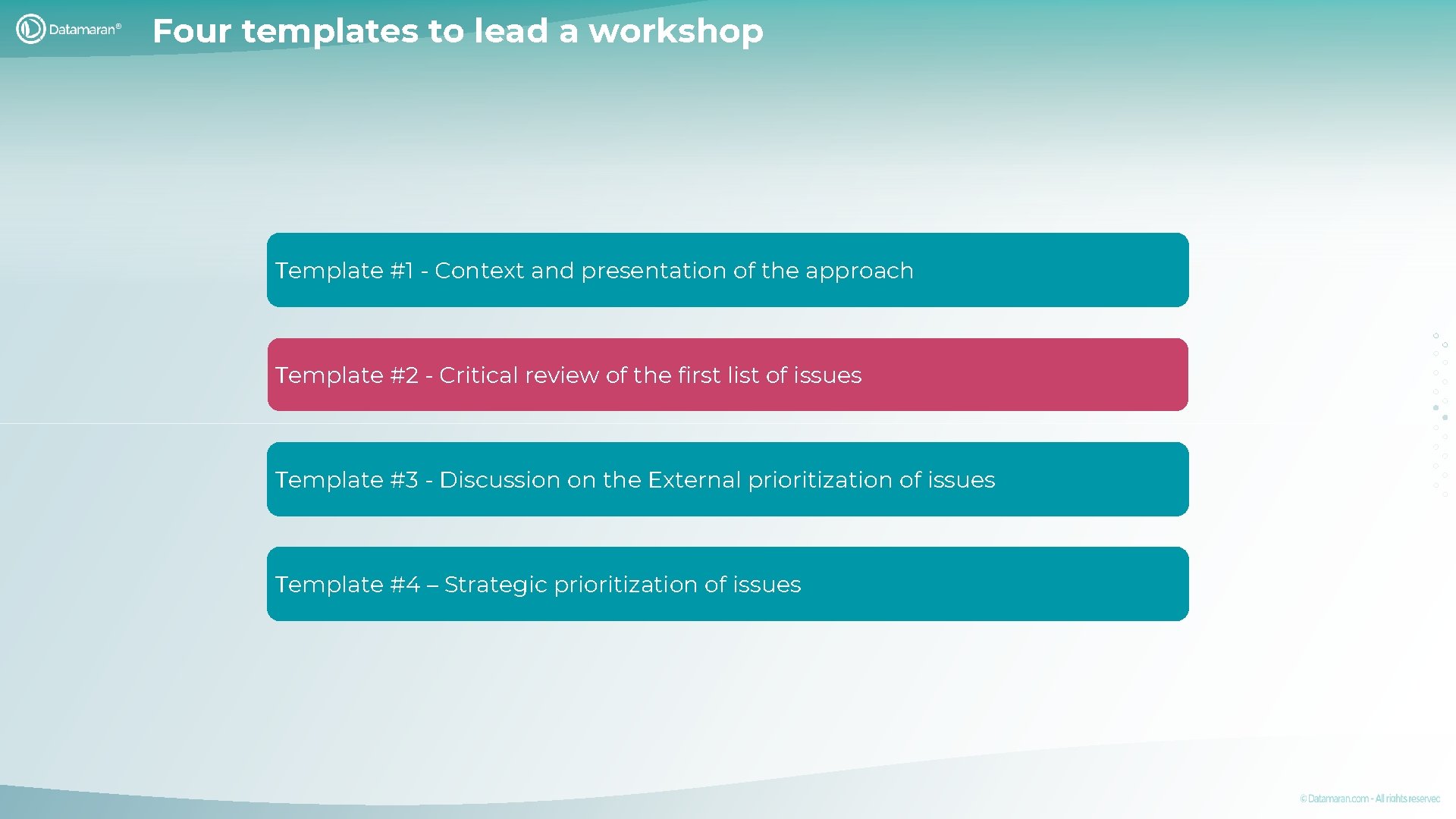
Four templates to lead a workshop Template #1 - Context and presentation of the approach Template #2 - Critical review of the first list of issues Template #3 - Discussion on the External prioritization of issues Template #4 – Strategic prioritization of issues
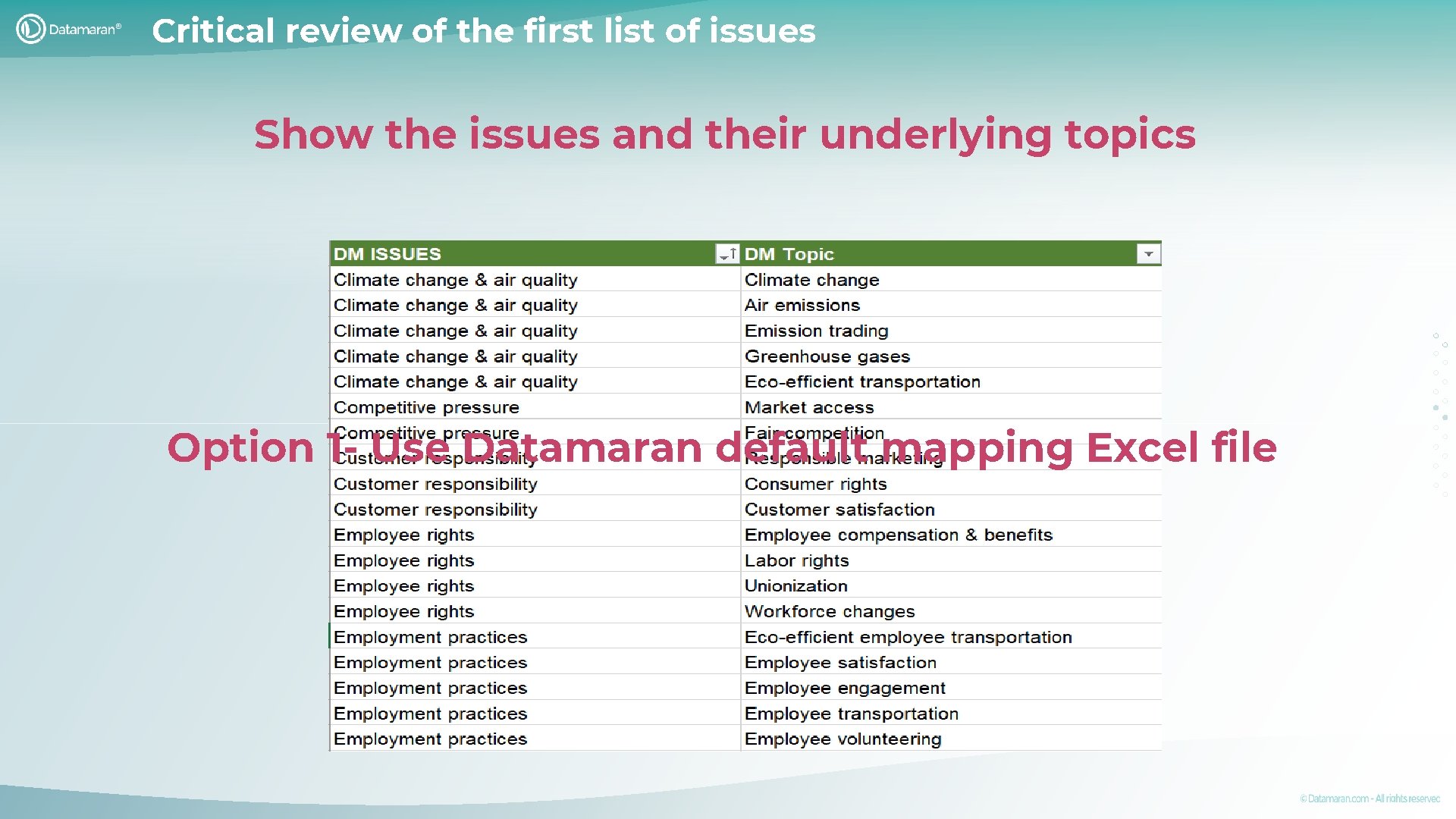
Critical review of the first list of issues Show the issues and their underlying topics Option 1 - Use Datamaran default mapping Excel file
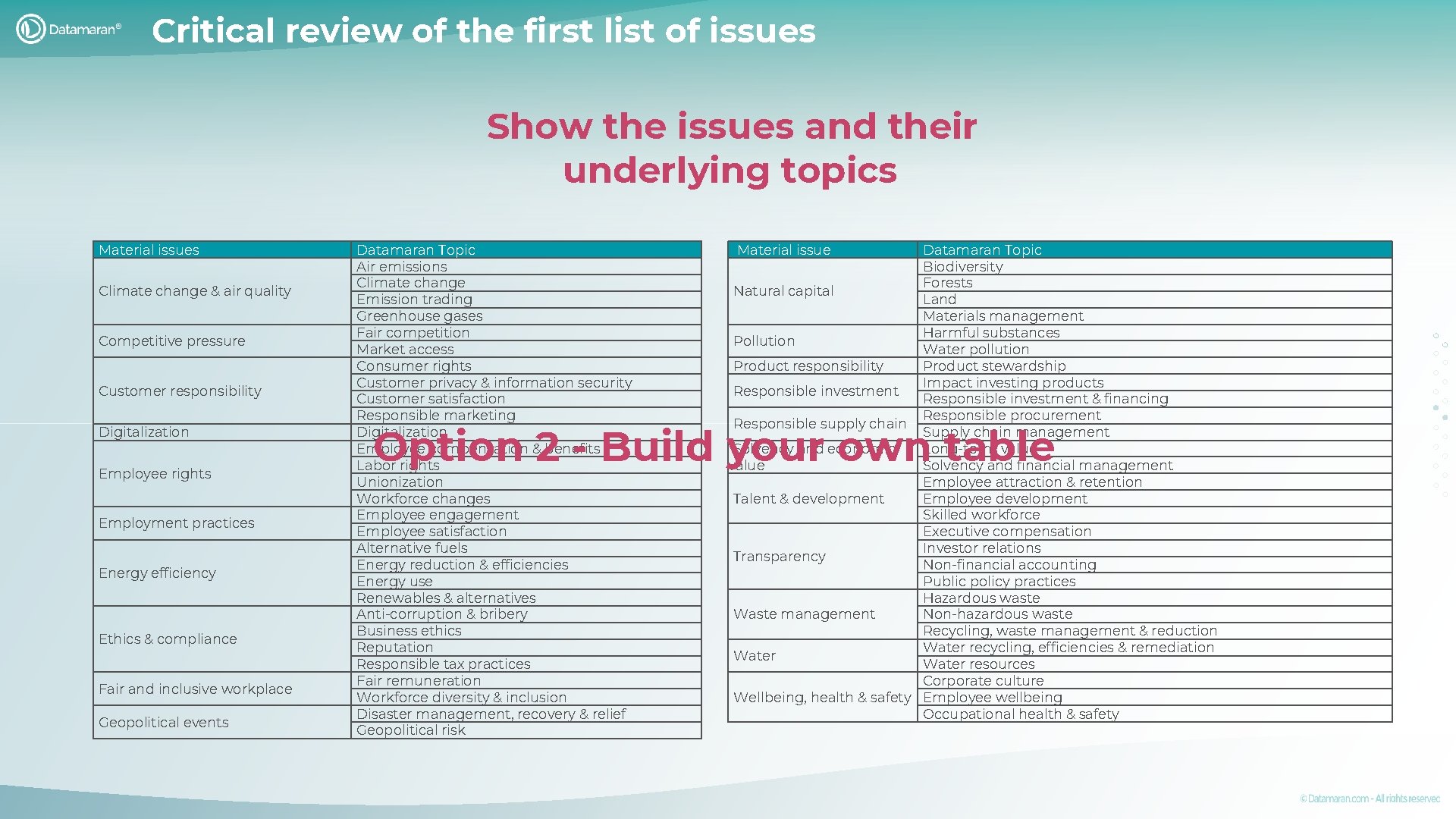
Critical review of the first list of issues Show the issues and their underlying topics Material issues Climate change & air quality Competitive pressure Customer responsibility Digitalization Employee rights Employment practices Energy efficiency Ethics & compliance Fair and inclusive workplace Geopolitical events Datamaran Topic Air emissions Climate change Emission trading Greenhouse gases Fair competition Market access Consumer rights Customer privacy & information security Customer satisfaction Responsible marketing Digitalization Employee compensation & benefits Labor rights Unionization Workforce changes Employee engagement Employee satisfaction Alternative fuels Energy reduction & efficiencies Energy use Renewables & alternatives Anti-corruption & bribery Business ethics Reputation Responsible tax practices Fair remuneration Workforce diversity & inclusion Disaster management, recovery & relief Geopolitical risk Material issue Datamaran Topic Biodiversity Forests Natural capital Land Materials management Harmful substances Pollution Water pollution Product responsibility Product stewardship Impact investing products Responsible investment & financing Responsible procurement Responsible supply chain Supply chain management Long-term value Solvency and economic value Solvency and financial management Employee attraction & retention Talent & development Employee development Skilled workforce Executive compensation Investor relations Transparency Non-financial accounting Public policy practices Hazardous waste Waste management Non-hazardous waste Recycling, waste management & reduction Water recycling, efficiencies & remediation Water resources Corporate culture Wellbeing, health & safety Employee wellbeing Occupational health & safety Option 2 - Build your own table
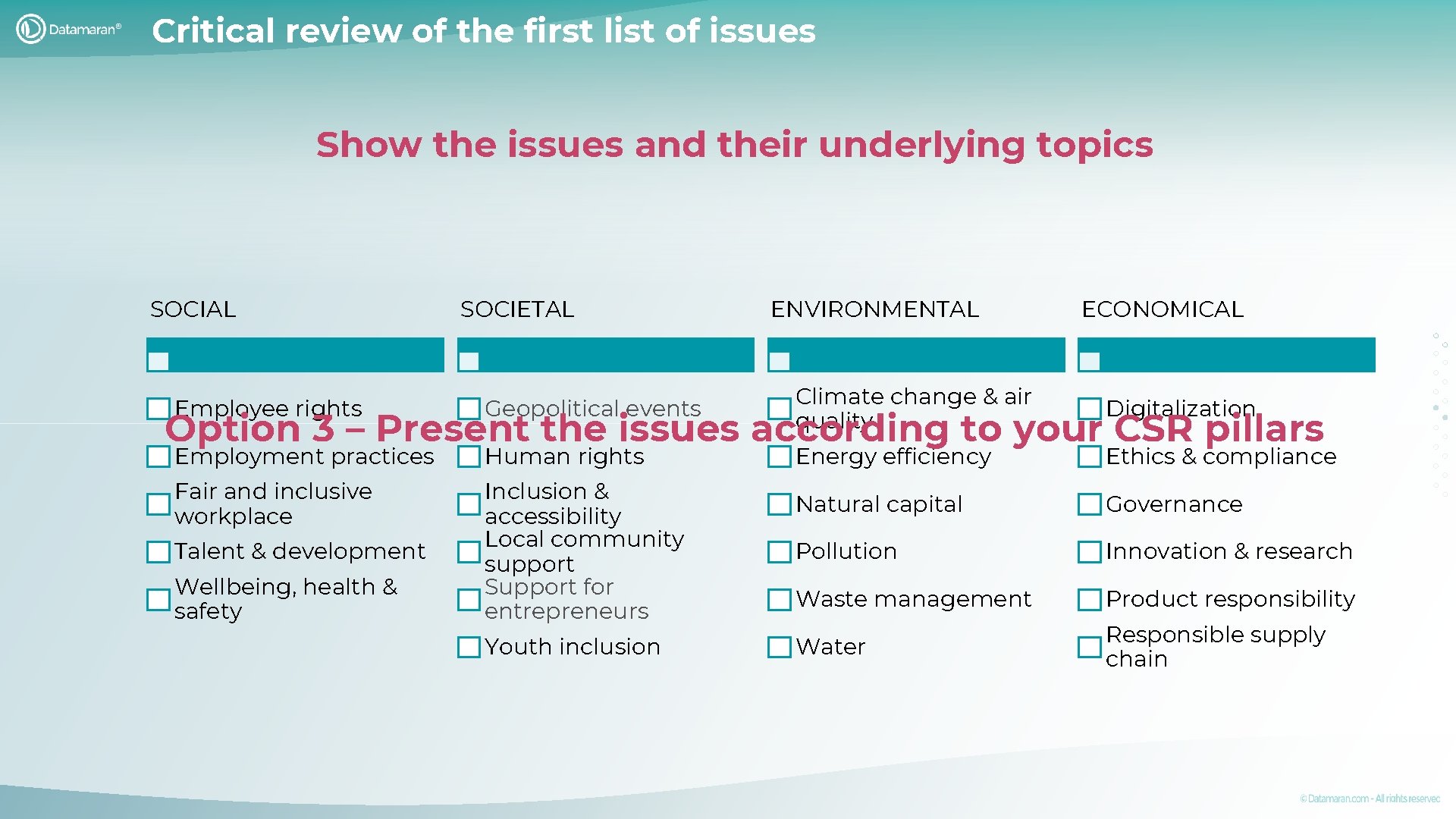
Critical review of the first list of issues Show the issues and their underlying topics SOCIAL SOCIETAL ENVIRONMENTAL ECONOMICAL Employee rights Geopolitical events Climate change & air quality Employment practices Human rights Energy efficiency Ethics & compliance Fair and inclusive workplace Inclusion & accessibility Local community support Support for entrepreneurs Natural capital Governance Pollution Innovation & research Waste management Product responsibility Water Responsible supply chain Digitalization Option 3 – Present the issues according to your CSR pillars Talent & development Wellbeing, health & safety Youth inclusion
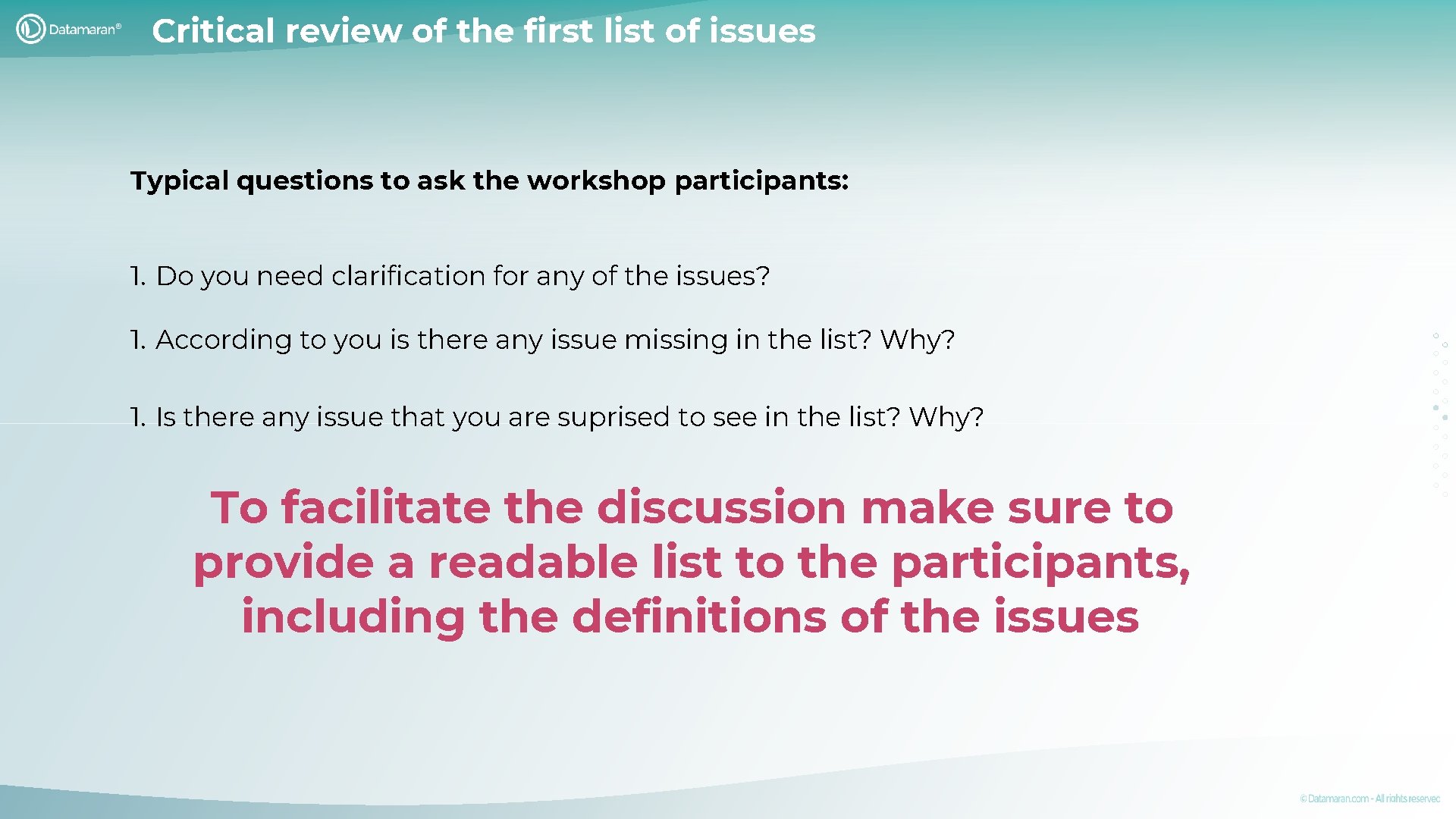
Critical review of the first list of issues Typical questions to ask the workshop participants: 1. Do you need clarification for any of the issues? 1. According to you is there any issue missing in the list? Why? 1. Is there any issue that you are suprised to see in the list? Why? To facilitate the discussion make sure to provide a readable list to the participants, including the definitions of the issues
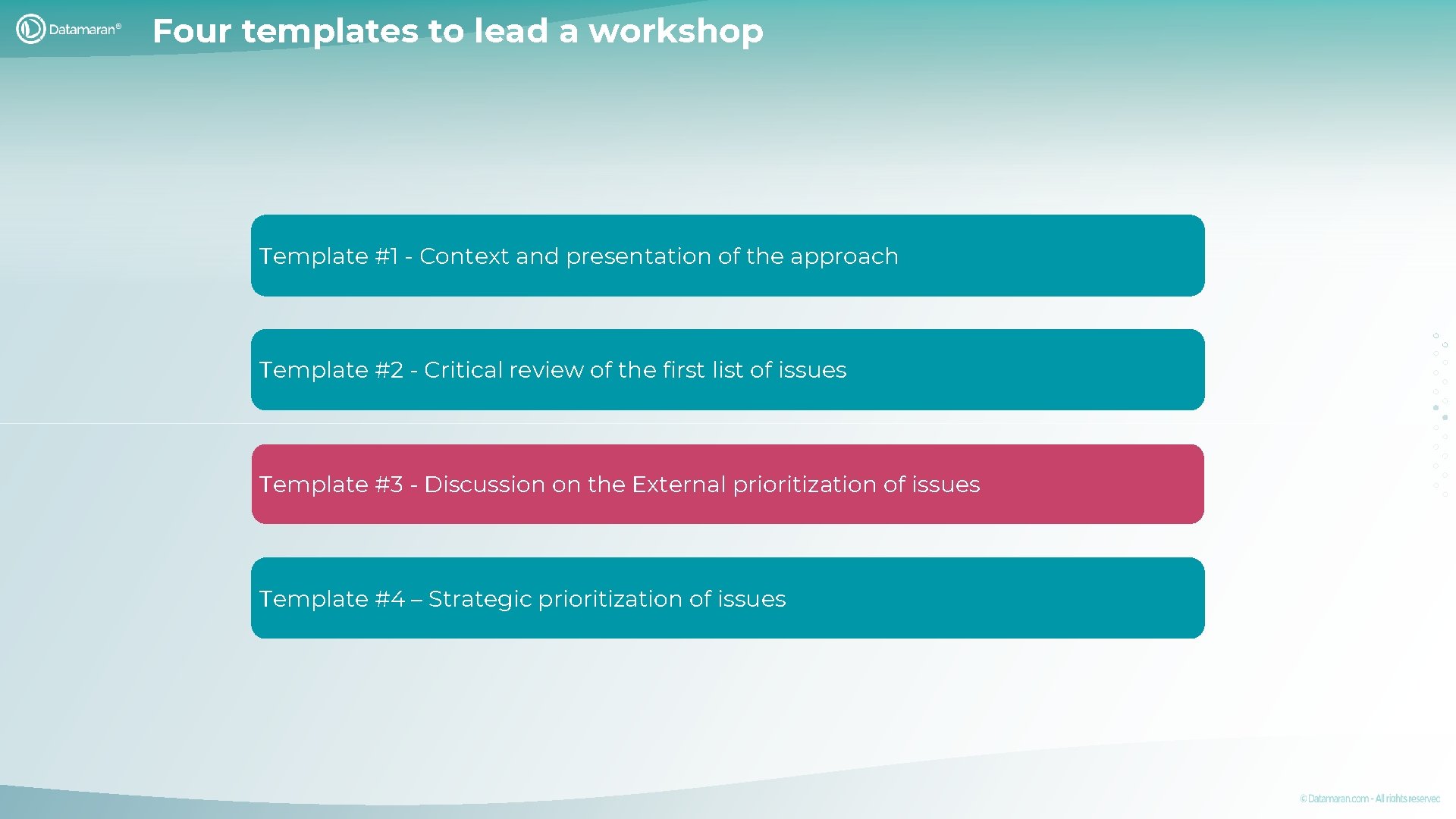
Four templates to lead a workshop Template #1 - Context and presentation of the approach Template #2 - Critical review of the first list of issues Template #3 - Discussion on the External prioritization of issues Template #4 – Strategic prioritization of issues
Discussion on the External prioritization of issues Show the external ranking as produced by the module
Discussion on the External prioritization of issues Typical questions to ask the workshop participants: Comment the assessment of importance to the stakeholders based on Datamaran’s source (External axis) – given your understanding of the issues and external expectations: 1. Individually: Review the ranking and identify the issues that you think should be ranked lower or higher 1. In group: Share the identified issues with other participants, explain the reasons why they are more or less important from an external point of view. Other participants react. 1. Conclusion: Short-list the issues on which there is a consensus that the ranking should be fine-tuned and the additional sources of information to take into account.
Four templates to lead a workshop Template #1 - Context and presentation of the approach Template #2 - Critical review of the first list of issues Template #3 - Discussion on the External prioritization of issues Template #4 – Strategic prioritization of issues
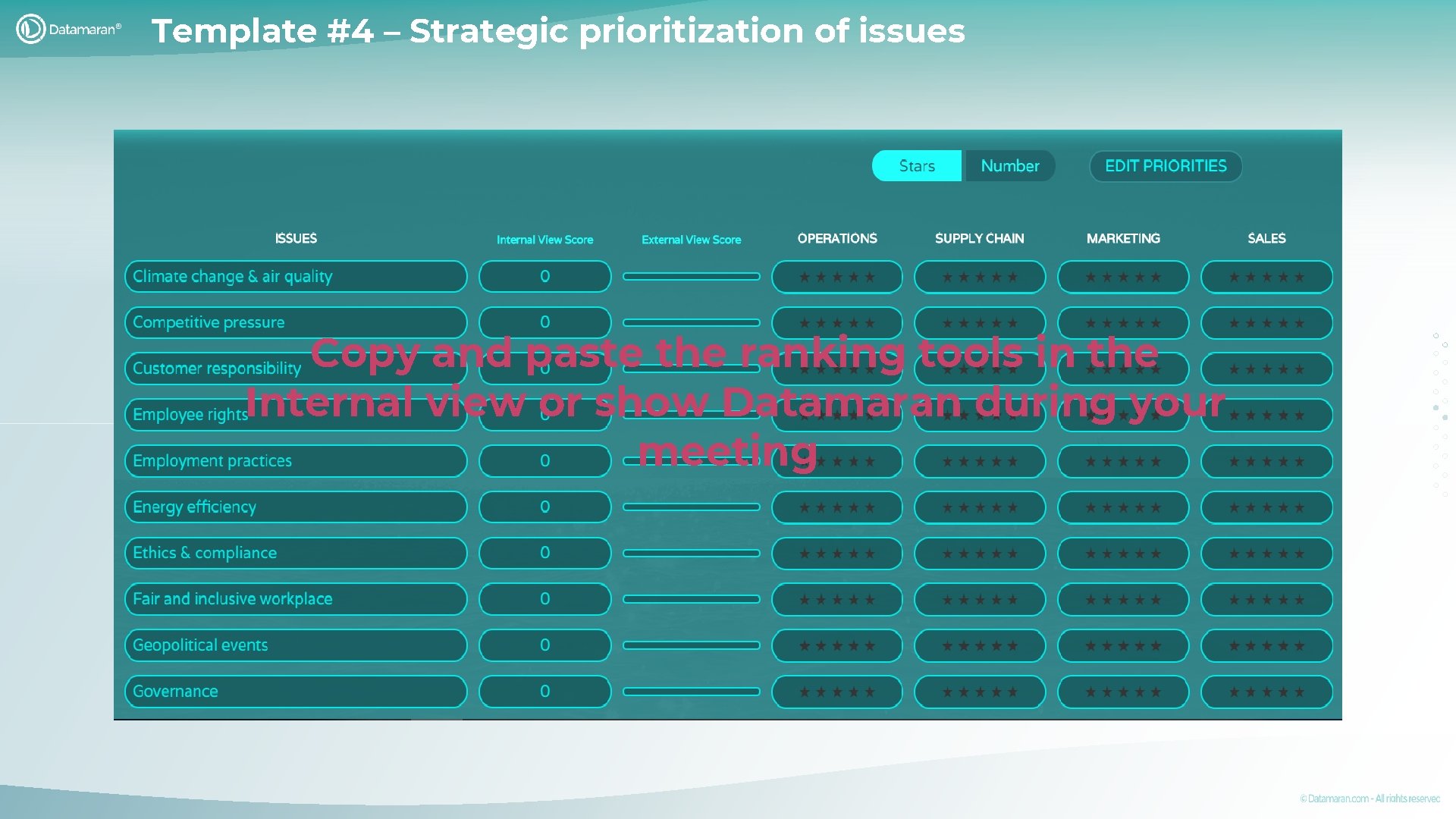
Template #4 – Strategic prioritization of issues Copy and paste the ranking tools in the Internal view or show Datamaran during your meeting
Discussion on the External prioritization of issues Typical questions to ask the workshop participants: Based on your understanding of the company’s strategy and the risks / opportunities associated to the issues, what is the importance of the following issues for the company? 1. Individually: Review again the list and make your assessment based on the ranking methodology chosen (ideally before the meeting). 1. In group: Share most important issues with other participants, explain the reasons why. Other participants react. 1. Conclusion: Confirm the ranking of importance or identify the issues for which the importance should be fine-tuned based on additional sources of information or the involvement of other internal decision-markers or experts.

Thank you! Contact us: info@datamaran. com The Loom 14 Gower’s Walk, suite 4. 8 London, E 1 8 PY United Kingdom Tel: +44 (0)20 3735 2976 Other offices New York City, USA Valencia, Spain
- Slides: 23