
DataDriven Marketing and Product Development Overview The process
- Slides: 12
Data-Driven Marketing and Product Development
Overview The process: Creating & marketing new businesses and products based on data Case Studies: how to apply theory Grade. Guru: data-driven product development Kaplan e. Books: data-driven marketing
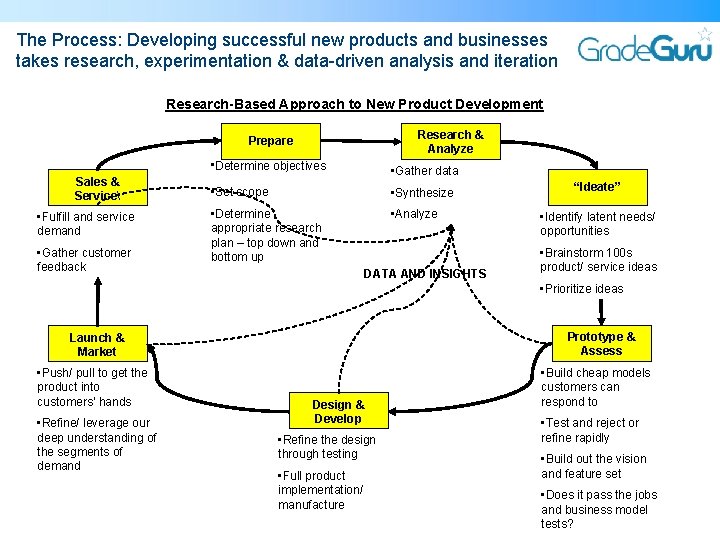
The Process: Developing successful new products and businesses takes research, experimentation & data-driven analysis and iteration Research-Based Approach to New Product Development Research & Analyze Prepare Sales & Service • Fulfill and service demand • Gather customer feedback • Determine objectives • Gather data • Set scope • Synthesize • Determine appropriate research plan – top down and bottom up • Analyze DATA AND INSIGHTS “Ideate” • Identify latent needs/ opportunities • Brainstorm 100 s product/ service ideas • Prioritize ideas Prototype & Assess Launch & Market • Push/ pull to get the product into customers’ hands • Refine/ leverage our deep understanding of the segments of demand Design & Develop • Refine the design through testing • Full product implementation/ manufacture • Build cheap models customers can respond to • Test and reject or refine rapidly • Build out the vision and feature set • Does it pass the jobs and business model tests?
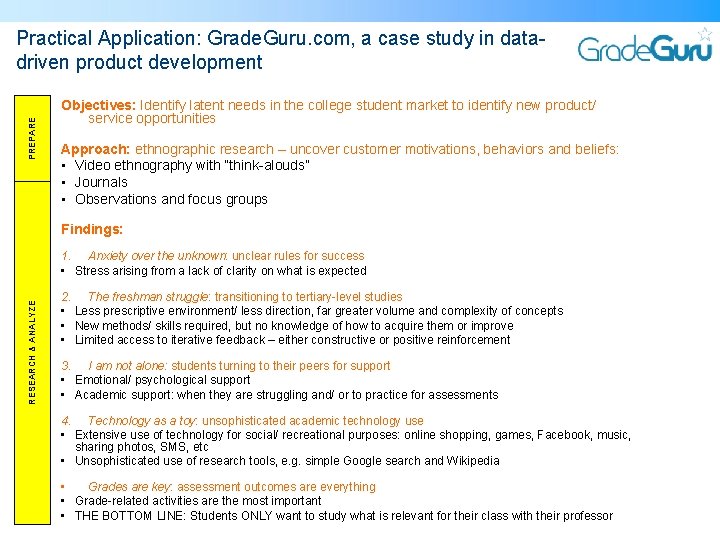
PREPARE Practical Application: Grade. Guru. com, a case study in datadriven product development Objectives: Identify latent needs in the college student market to identify new product/ service opportunities Approach: ethnographic research – uncover customer motivations, behaviors and beliefs: • Video ethnography with “think-alouds” • Journals • Observations and focus groups Findings: RESEARCH & ANALYZE 1. Anxiety over the unknown: unclear rules for success • Stress arising from a lack of clarity on what is expected 2. The freshman struggle: transitioning to tertiary-level studies • Less prescriptive environment/ less direction, far greater volume and complexity of concepts • New methods/ skills required, but no knowledge of how to acquire them or improve • Limited access to iterative feedback – either constructive or positive reinforcement 3. I am not alone: students turning to their peers for support • Emotional/ psychological support • Academic support: when they are struggling and/ or to practice for assessments 4. Technology as a toy: unsophisticated academic technology use • Extensive use of technology for social/ recreational purposes: online shopping, games, Facebook, music, sharing photos, SMS, etc • Unsophisticated use of research tools, e. g. simple Google search and Wikipedia • Grades are key: assessment outcomes are everything • Grade-related activities are the most important • THE BOTTOM LINE: Students ONLY want to study what is relevant for their class with their professor
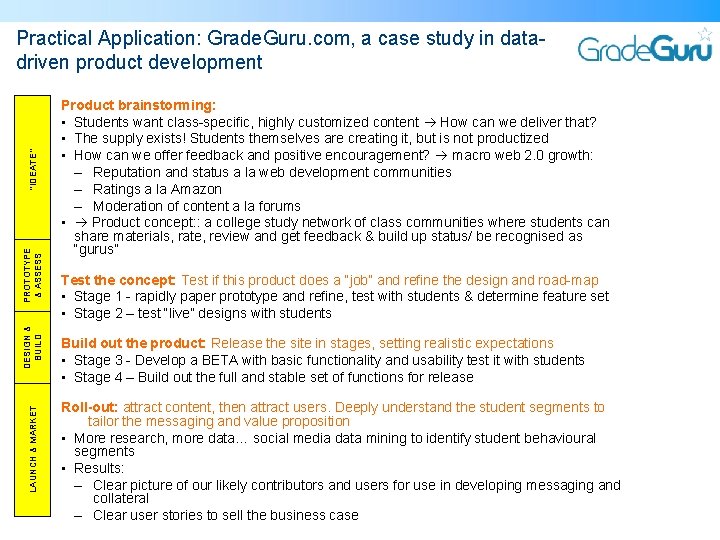
LAUNCH & MARKET DESIGN & BUILD PROTOTYPE & ASSESS “IDEATE” Practical Application: Grade. Guru. com, a case study in datadriven product development Product brainstorming: • Students want class-specific, highly customized content How can we deliver that? • The supply exists! Students themselves are creating it, but is not productized • How can we offer feedback and positive encouragement? macro web 2. 0 growth: – Reputation and status a la web development communities – Ratings a la Amazon – Moderation of content a la forums • Product concept: : a college study network of class communities where students can share materials, rate, review and get feedback & build up status/ be recognised as “gurus” Test the concept: Test if this product does a “job” and refine the design and road-map • Stage 1 - rapidly paper prototype and refine, test with students & determine feature set • Stage 2 – test “live” designs with students Build out the product: Release the site in stages, setting realistic expectations • Stage 3 - Develop a BETA with basic functionality and usability test it with students • Stage 4 – Build out the full and stable set of functions for release Roll-out: attract content, then attract users. Deeply understand the student segments to tailor the messaging and value proposition • More research, more data… social media data mining to identify student behavioural segments • Results: – Clear picture of our likely contributors and users for use in developing messaging and collateral – Clear user stories to sell the business case
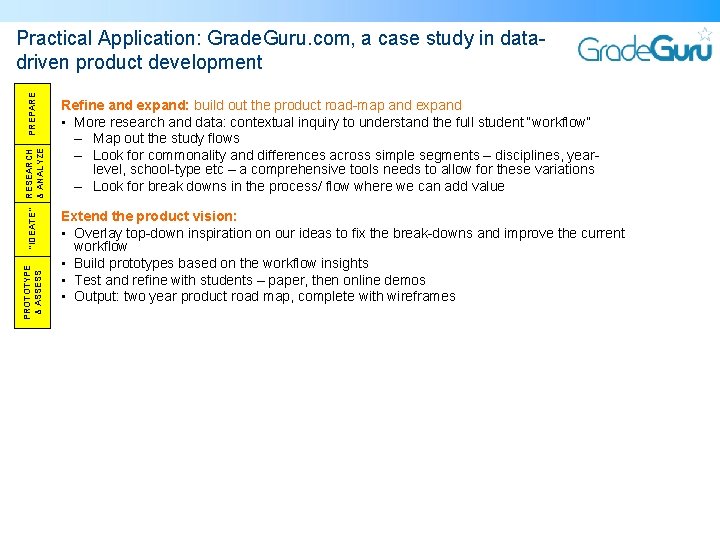
PROTOTYPE & ASSESS “IDEATE” RESEARCH & ANALYZE PREPARE Practical Application: Grade. Guru. com, a case study in datadriven product development Refine and expand: build out the product road-map and expand • More research and data: contextual inquiry to understand the full student “workflow” – Map out the study flows – Look for commonality and differences across simple segments – disciplines, yearlevel, school-type etc – a comprehensive tools needs to allow for these variations – Look for break downs in the process/ flow where we can add value Extend the product vision: • Overlay top-down inspiration on our ideas to fix the break-downs and improve the current workflow • Build prototypes based on the workflow insights • Test and refine with students – paper, then online demos • Output: two year product road map, complete with wireframes
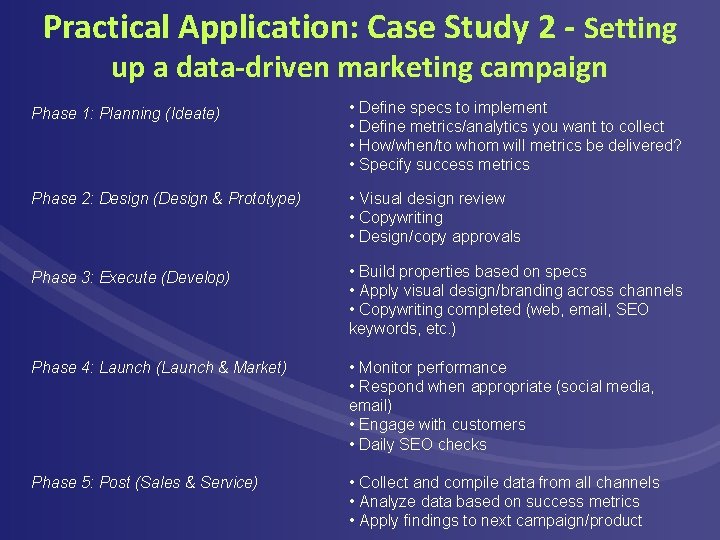
Practical Application: Case Study 2 - Setting up a data-driven marketing campaign Phase 1: Planning (Ideate) • Define specs to implement • Define metrics/analytics you want to collect • How/when/to whom will metrics be delivered? • Specify success metrics Phase 2: Design (Design & Prototype) • Visual design review • Copywriting • Design/copy approvals Phase 3: Execute (Develop) • Build properties based on specs • Apply visual design/branding across channels • Copywriting completed (web, email, SEO keywords, etc. ) Phase 4: Launch (Launch & Market) • Monitor performance • Respond when appropriate (social media, email) • Engage with customers • Daily SEO checks Phase 5: Post (Sales & Service) • Collect and compile data from all channels • Analyze data based on success metrics • Apply findings to next campaign/product
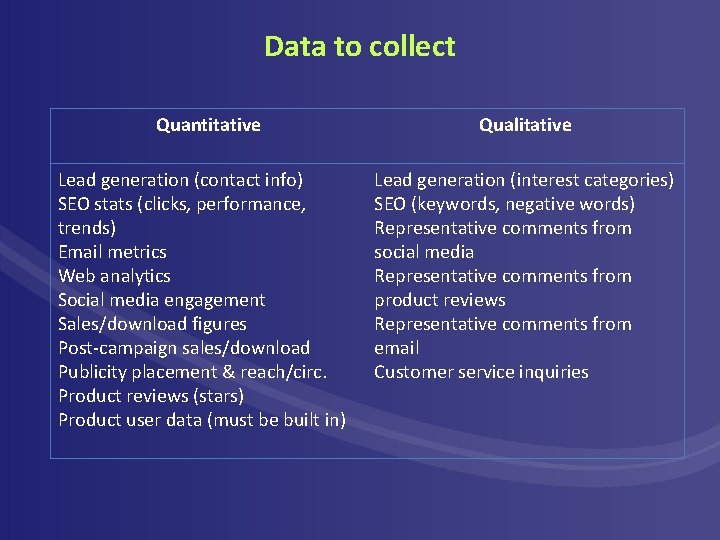
Data to collect Quantitative Lead generation (contact info) SEO stats (clicks, performance, trends) Email metrics Web analytics Social media engagement Sales/download figures Post-campaign sales/download Publicity placement & reach/circ. Product reviews (stars) Product user data (must be built in) Qualitative Lead generation (interest categories) SEO (keywords, negative words) Representative comments from social media Representative comments from product reviews Representative comments from email Customer service inquiries
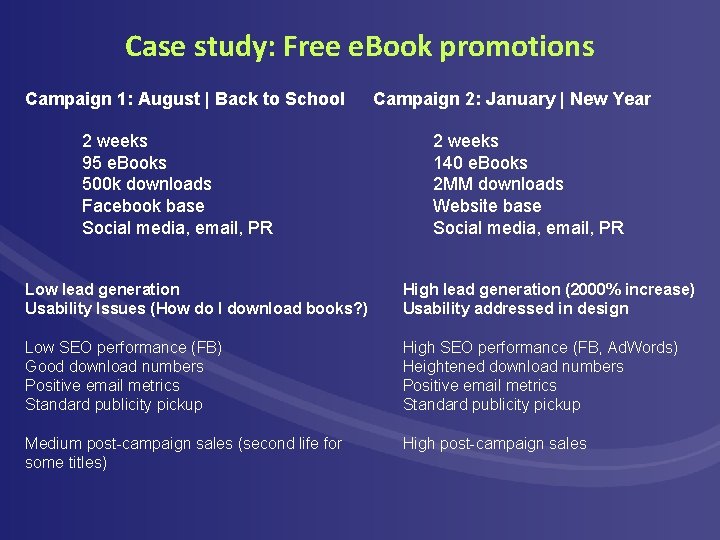
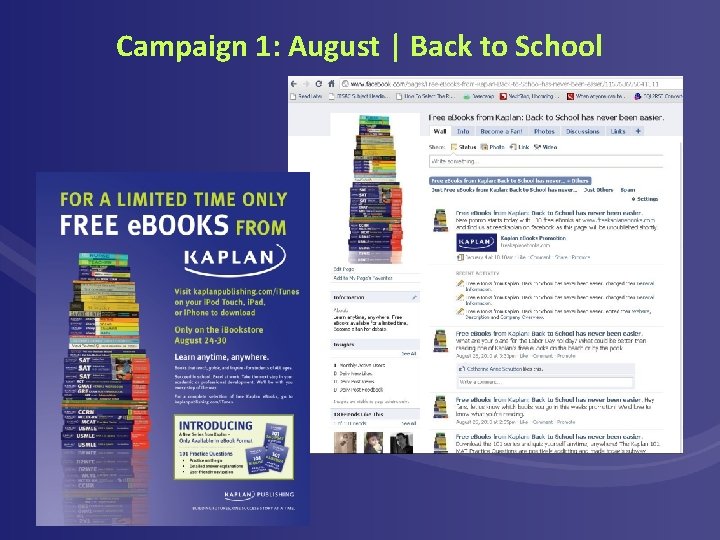
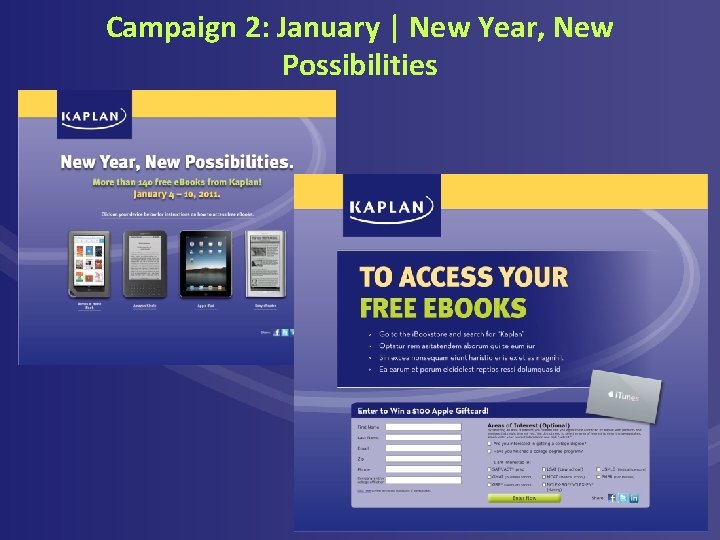
Case study: Free e. Book promotions Campaign 1: August | Back to School 2 weeks 95 e. Books 500 k downloads Facebook base Social media, email, PR Campaign 2: January | New Year 2 weeks 140 e. Books 2 MM downloads Website base Social media, email, PR Low lead generation Usability Issues (How do I download books? ) High lead generation (2000% increase) Usability addressed in design Low SEO performance (FB) Good download numbers Positive email metrics Standard publicity pickup High SEO performance (FB, Ad. Words) Heightened download numbers Positive email metrics Standard publicity pickup Medium post-campaign sales (second life for some titles) High post-campaign sales
Campaign 1: August | Back to School
Campaign 2: January | New Year, New Possibilities
Questions? • Our contact details: • Brett Sandusky, Director of Product Innovation, Kaplan Publishing Brett. Sandusky@kaplan. com Linked In: Brett Sandusky Twitter: bsandusky • Emily Sawtell, Senior Director, Student Innovations, Mc. Graw-Hill Higher Education Emily_Sawtell@mcgraw-hill. com Linked In: Emily Sawtell Twitter: emilysawtell