
Datadriven Indoor Localization in the Internet of Things
- Slides: 1
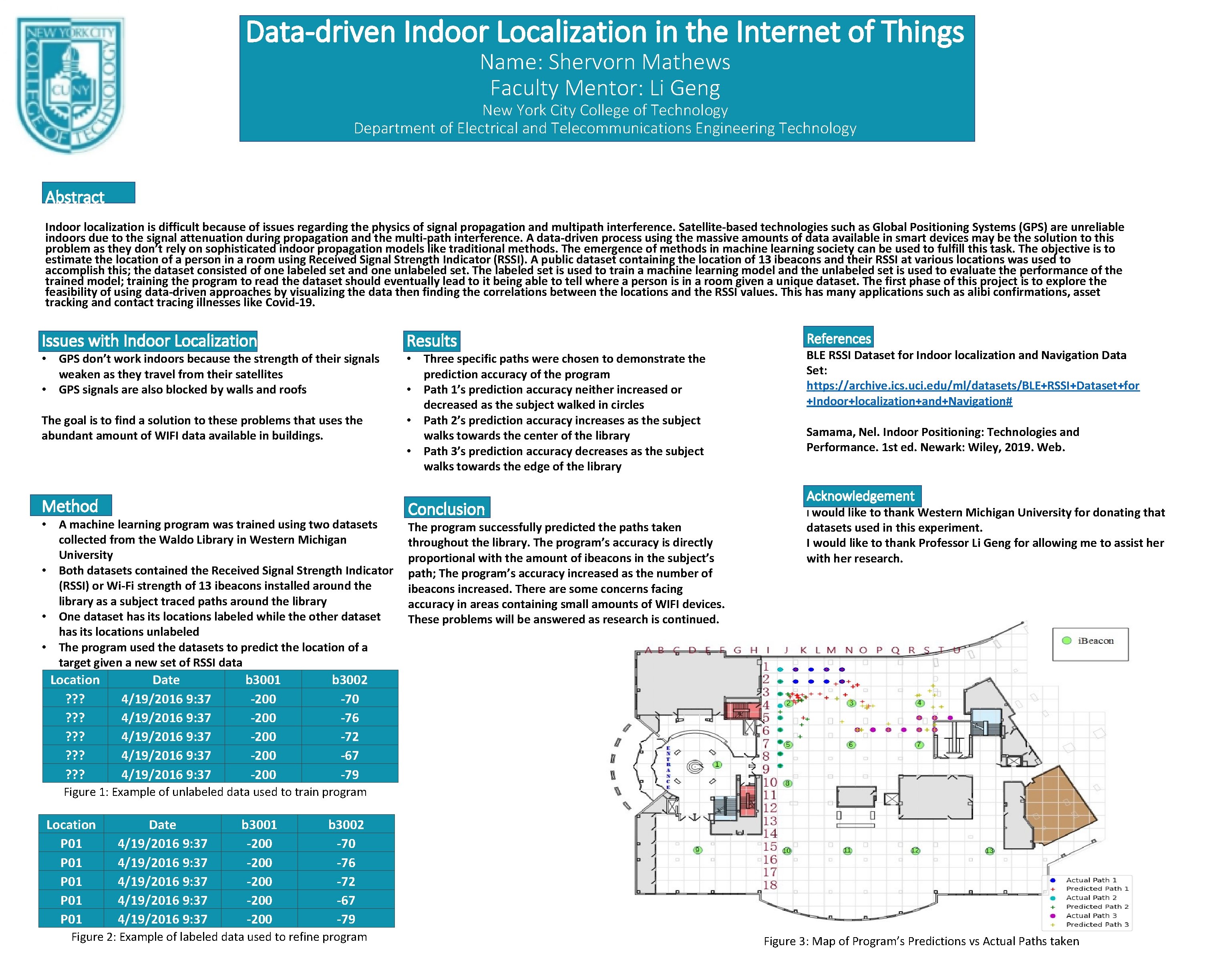
Data-driven Indoor Localization in the Internet of Things Name: Shervorn Mathews Faculty Mentor: Li Geng New York City College of Technology Department of Electrical and Telecommunications Engineering Technology Abstract Indoor localization is difficult because of issues regarding the physics of signal propagation and multipath interference. Satellite-based technologies such as Global Positioning Systems (GPS) are unreliable indoors due to the signal attenuation during propagation and the multi-path interference. A data-driven process using the massive amounts of data available in smart devices may be the solution to this problem as they don’t rely on sophisticated indoor propagation models like traditional methods. The emergence of methods in machine learning society can be used to fulfill this task. The objective is to estimate the location of a person in a room using Received Signal Strength Indicator (RSSI). A public dataset containing the location of 13 ibeacons and their RSSI at various locations was used to accomplish this; the dataset consisted of one labeled set and one unlabeled set. The labeled set is used to train a machine learning model and the unlabeled set is used to evaluate the performance of the trained model; training the program to read the dataset should eventually lead to it being able to tell where a person is in a room given a unique dataset. The first phase of this project is to explore the feasibility of using data-driven approaches by visualizing the data then finding the correlations between the locations and the RSSI values. This has many applications such as alibi confirmations, asset tracking and contact tracing illnesses like Covid-19. Issues with Indoor Localization • GPS don’t work indoors because the strength of their signals weaken as they travel from their satellites • GPS signals are also blocked by walls and roofs The goal is to find a solution to these problems that uses the abundant amount of WIFI data available in buildings. Method • A machine learning program was trained using two datasets collected from the Waldo Library in Western Michigan University • Both datasets contained the Received Signal Strength Indicator (RSSI) or Wi-Fi strength of 13 ibeacons installed around the library as a subject traced paths around the library • One dataset has its locations labeled while the other dataset has its locations unlabeled • The program used the datasets to predict the location of a target given a new set of RSSI data • Location The labeled dataset is used to judgeb 3001 the program’s prediction Date b 3002 accuracy ? ? ? 4/19/2016 9: 37 -200 -70 ? ? ? 4/19/2016 9: 37 -200 Results • Three specific paths were chosen to demonstrate the prediction accuracy of the program • Path 1’s prediction accuracy neither increased or decreased as the subject walked in circles • Path 2’s prediction accuracy increases as the subject walks towards the center of the library • Path 3’s prediction accuracy decreases as the subject walks towards the edge of the library Conclusion The program successfully predicted the paths taken throughout the library. The program’s accuracy is directly proportional with the amount of ibeacons in the subject’s path; The program’s accuracy increased as the number of ibeacons increased. There are some concerns facing accuracy in areas containing small amounts of WIFI devices. These problems will be answered as research is continued. References BLE RSSI Dataset for Indoor localization and Navigation Data Set: https: //archive. ics. uci. edu/ml/datasets/BLE+RSSI+Dataset+for +Indoor+localization+and+Navigation# Samama, Nel. Indoor Positioning: Technologies and Performance. 1 st ed. Newark: Wiley, 2019. Web. Acknowledgement I would like to thank Western Michigan University for donating that datasets used in this experiment. I would like to thank Professor Li Geng for allowing me to assist her with her research. -76 -72 -67 -79 Figure 1: Example of unlabeled data used to train program Location P 01 P 01 Date 4/19/2016 9: 37 4/19/2016 9: 37 b 3001 -200 -200 b 3002 -70 -76 -72 -67 -79 Figure 2: Example of labeled data used to refine program Figure 3: Map of Program’s Predictions vs Actual Paths taken