
Datacenter Standards Best Practices and Success Stories Prof
Datacenter Standards, Best Practices, and Success Stories Prof. Dr. Srisakdi Charmonman www. charm. au. edu President Emeritus of the Computer Association of Thailand CEO of the College of Internet Distance Education Assumption University of Thailand charm@ksc. au. edu Invited Talk for “Datacenter Satellite Conference & Exhibition Series” Auckland, Bangkok, Beijing, Hyderabad, Kuala Lumpur, Melbourne, and Osaka organized thru VDO Conference by Pacific and Strategy Holding Ptc. Ltd. For Bangkok at Westin Sukhumvit Hotel, July 16, 2009 1
Datacenter Standards, Best Practices, and Success Stories. 1. 2. 3. 4. 5. 6. Introduction Datacenter Standards Datacenter Best Practices Green Datacenter Success Stories Concluding Remarks 2 2
1. Introduction. v v As of the year 2009, most organizations depend on computer network and the Internet. Most organizations cannot continue operating without computer network. 3 3
Introduction (Cont. ) v v Therefore, most organizations need backup for their computer network which may be in the form of datacenter. According to Wikipedia, “a data center or datacentre or server farm is a facility to house computer systems and associated components, such as telecommunications and storage systems. ” 4 4
Introduction (Cont. ) v A datacenter generally includes: * Redundant or backup power supplies * Redundant data communications connections * Environmental controls and security devices 5 5
Introduction (Cont. ) v v During the 1980 s, microcomputers were used in most organizations because of their low cost and ease of operation. The word “datacenter” appeared in the 1990 s, when more powerful microcomputers called “servers” were used to replace mainframe, and intalled in old mainframe room. 6 6
Introduction (Cont. ) v v v During the 2000 s, organizations needed nonstop operation and 24/7 presence on the Internet, and so datacenters became more popular. As a matter of fact, they were called “Internet Data. Centers or IDC” In 2009, datacenter may also be operated by datacenter service providers. 7 7
2. Datacenter Standards. A well-known datacenter standard is TIA-942 (TIA = Telecommunication Industry Association) v For more information see www. adc. com/Library/Literature/102264 AE. pdf v 8 8
ANSI/TIA-942 is the first standard to specifically address datacenter infrastructure. v TIA-942 includes guidelines on a wide range of subjects. v Provides a flexible and manageable structured cabling system using standard media. v 9 9
ANSI/TIA-942 (Cont. ) Later, ANSI (American National Standards Institute) also approved TIA-942. v TIA-942 became “ANSI/TIA-942 Telecommunications Infrastructure for Data Center”. v 10 10
ANSI/TIA-942 (Cont. ) 11 11
ANSI/TIA-942 (Cont. ) v The requirements of ANSI/TIA-942 covers the following. 2. 1 Site Space and Layout 2. 2 Cabling Infrastructure 2. 3 Tiered Reliability 2. 4 Environmental Consideration 12 12
2. 1 Site Space and Layout The datacenter should be designed with plenty of flexible “White Space”, empty space that can accommodate future racks or cabinets. v For future growth, surrounding empty space should also be available. v 13 13
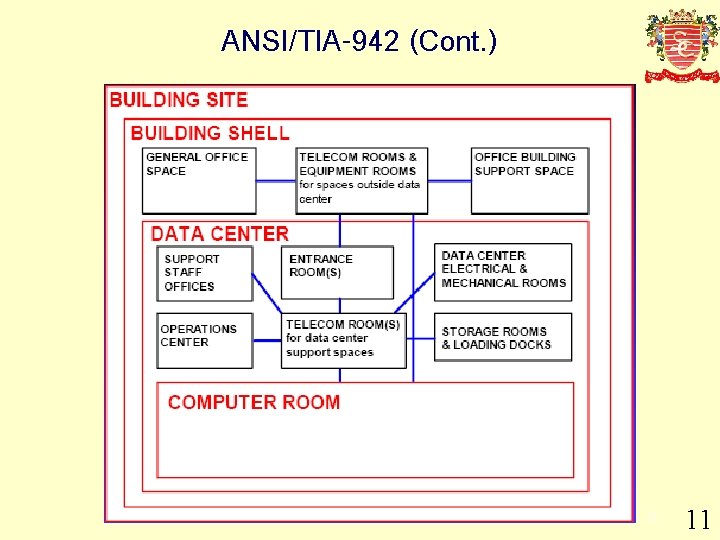
Site Space and Layout (Cont. ) v According to ANSI/TIA-942, a datacenter should include the following key functional areas. * Entrance Room (ER) – outside the computer room for better security. 14 14
Site Space and Layout (Cont. ) * Main Distribution Area (MDA) location of Main Cross-Connect (MC) such as routers and switches. * Horizontal Distribution Area (HDA) location of Horizontal Cross-Connect (HC), such as racks for fiber and coaxial cable. 15 15
Site Space and Layout (Cont. ) * Zone Distribution Area (ZDA) location of Zone Outlet (ZO) or Consolidation Point (CP) * Equipment Distribution Area (EDA) location of equipment cabinets and racks. 16 16
2. 2 Cabling Infrastructure v Horizontal Cabling * Should install the highest capacity media available to reduce the need for re-cabling in the future. * The maximum horizontal distance is 90 m. independent of media type. * The maximum channel distance including equipment cords is 100 m. 17 17
Horizontal Cabling Distances (Cont. ) * The maximum backbone fiber optic cabling is 300 m. * The horizontal copper cabling is 100 m. 18 18
Cabling Infrastructure (Cont. ) v Computer Room & Entrance Room Requirements such as * Minimum clear height of 2. 6 m/8. 5 ft * Minimum door size 1 m/3 ft wide 2. 13/7 ft high 19 19
2. 3 Tiered Reliability v The ANSI/TIA-942 includes 4 levels, each specifying details: * Architectural * Security * Electrical * Mechanical * Telecommunication 20 20
Tiered Reliability (Cont. ) v Tier descriptions include information on * Raised floor heights * Watts per square foot * Points of failure 21 21
Tiered Reliability (Cont. ) v Tier 1 – Basic: 99. 671% Availability * Single path for power and cooling distribution * Optioned raised floor, UPS, generator * Takes 3 months to implement * Annual downtime of 28. 8 hours * Must be shut down completely for preventive maintenance 22 22
Tiered Reliability (Cont. ) v Tier 2 – Redundant Components: 99. 741% Availability * Less susceptible to disruption from both planned and unplanned activity * Single path for power and cooling distribution * Includes raised floor, UPS, and generator 23 23
Tiered 2 (Cont. ) * Takes 3 to 6 months to implement * Annual downtime of 22. 0 hours * Maintenance of power path and other parts of the infrastructure require a processing shutdown 24 24
Tiered Reliability (Cont. ) v Tier 3 – Concurrently Maintainable: 99. 982% Availability * Enables planned activity without disrupting computer hardware operation but unplanned events will still cause disruption * Multiple power and cooling distribution paths but with only one path active 25 25
Tiered 3 (Cont. ) * Takes 15 to 20 months to implement * Annual downtime of 16. 0 hours * Includes raised floor and sufficient capacity and distribution to carry load on one path while performing maintenance on the other 26 26
Tiered Reliability (Cont. ) v Tier 4 – Fault Tolerant: 99. 995% Availability * Planned activity does not disrupt critical load and data center can sustain at least one worst-case unplanned event with no critical load impact 27 27
Tiered 4 (Cont. ) * Multiple active power and cooling distribution paths includes redundant components, i. e. 2 UPS each with N+1 redundancy * Takes 15 to 20 months to implement * Annual downtime of 0. 4 hours 28 28
2. 4 Environmental Consideration v Several environmental considerations exist within the ANSI/TIA-942 datacenter standard that are * Fire suppression * Humidity levels * Operating temperatures * Architectural * Electrical (power) * Mechanical system specifications 29 29
3. Datacenter Best Practices. 3. 1 Microsoft’s Environmentally Sustainable Datacenters 3. 2 IRIDE Environmentally Friendly Datacenter 3. 3 Merger & Acquisition-Driven Datacenter 3. 4 Datacenter Assessment and Design 30 30
3. 1 Microsoft’s Environmentally Sustainable Datacenters. v Microsoft prepared top ten best business practices for environmentally sustainable datacenters. 31 31
Microsoft’s Practices (Cont. ) 1. Provide incentives that support primary goals. v Microsoft provides specific incentives to reward managers for improving the efficiency of their operations, using metrics such as Power Usage Effectiveness (PUE). 32 32
Microsoft’s Practices (Cont. ) v Incentives help achieve results in short time if apply properly. * Datacenter manager rewarded for efficiency and not uptime. * Incentives given for low energy usage. 33 33
Microsoft’s Practices (Cont. ) 2. Focus on effective resource utilization. v Using resources effectively. v Utilizing existing datacenter infrastructure. 34 34
Microsoft’s Practices (Cont. ) 3. Use virtualization to improve server utilization and increase operational efficiency. v Migrating application from physical to virtual machines. v Encourage cloud operating system which use virtualization. 35 35
Microsoft’s Practices (Cont. ) v Key benefits of virtualization. * Reduction in capital expenditures. * Decrease in real estate, power, and cooling costs. * Faster time to market for new products and services. * Reduction in outage and maintenance windows. 36 36
Microsoft’s Practices (Cont. ) 4. Drive quality up through compliance. v There are many regulatory and security standards. v Compliance must be strictly enforced. 37 37
Microsoft’s Practices (Cont. ) 5. Embrace change management. v Standardized procedures for the request, approval, coordination and execution of changes can greatly reduce the number and severity of unplanned outages. v If not well managed, poorly planned changes may cause disastrous results. 38 38
Microsoft’s Practices (Cont. ) v Other features that change management process should include: * Documented policies around communication and timeline requirements. * Standard templates for requesting, communicating, and reviewing changes. * Post-implementation review, including cases where things went well. 39 39
Microsoft’s Practices (Cont. ) 6. Invest in understanding the application workload and behavior. v Require hardware engineering. v Credible and competent in-house expertise. v Provide meaningful feedback to vendors. * To evaluate new hardware properly * Optimizing request for proposal (RFP) process for servers * Experiment new technology. 40 40
Microsoft’s Practices (Cont. ) 7. Right-size server platforms to meet application requirements. v A major initiative in Microsoft datacenters involves right-sizing the platform. 41 41
Microsoft’s Practices (Cont. ) v There are two forms: (1) Work closely with server manufacturers to optimize their designs and remove items that are not used. Focus on high efficiency power supplies and advanced power management features. 42 42
Microsoft’s Practices (Cont. ) (2) Being disciplined about developing the exact specifications for servers to meet the needs, and then not buying machines that exceed specifications. 43 43
Microsoft’s Practices (Cont. ) 8. Evaluate and test servers for performance, power, and total cost of ownership. v Test on short list candidate servers to calculate total cost of ownership. v Not rely on benchmark data, which may not be applicable to needs and environment. 44 44
Microsoft’s Practices (Cont. ) 9. Converge on as small a number of stock-keeping units (SKUs) as possible. v Narrowing the number of SKUs allows Microsoft to make larger volume buys, thereby cutting capital costs. 45 45
Microsoft’s Practices (Cont. ) 10. Take advantage of competitive bids from multiple manufacturers to foster innovation and reduce costs. v Microsoft encourages to analyze proposals from multiple companies that puts most of the weight on price, power, and performance. 46 46
Microsoft’s Practices (Cont. ) v Competition among multiple manufacturers to drive innovation and provide the most energy efficient & lowest cost. 47 47
Microsoft’s Practices (Cont. ) v Microsoft’s Global Foundation Services’ team was taking significant steps in four areas important to environmental sustainability: * Using recycled resources whenever practical * Using renewable resources whenever available * Reducing waste in operations * Taking part in industry environmental groups 48 48
Microsoft’s Practices (Cont. ) v Microsoft announced in March 2009 that it was taking a proactive corporate approach to reduce its carbon emissions per unit of revenue by at least 30 percent. 49 49
3. 2 IRIDE Environmentally Friendly Datacenter. v v v Producing electrical power & thermal energy from renewable sources (Hydroelectric). Two hundred virtual machines on only fifteen physical machines and cost savings up to 70 percent. Reduce the number of physical servers and improve flexibility. 50 50
IRIDE (Cont. ) v v v Using Intel Xeon processors with four cores to meet the need for balance and modularity. Intel Xenon also provide high performance and energy efficiency. Intel Multi-core technology has brought several important improvements for IRIDE. 51 51
3. 3 Merger & Acquisition-Driven Datacenter. v Business Challenge * An Insurance holding company needed to move the IT assets it had acquired into its own data center. According to the terms of the acquisitions, it had to meet a tight deadline in doing so or must pay penalty. 52 52
Insurance Holding Company (Cont. ) v Solution * Establish a parallel operating environment and migrate the applications and data * Assesses all elements of the infrastructure, networking, backups and restores, security and systems monitoring, etc. * Integrate the business unit smoothly step by step 53 53
Insurance Holding Company (Cont. ) v Results * The powering down of the new environment, relocation of the equipment, re-establishment of the environment in the buyer’s datacenter, successful cutover done over the weekend 54 54
3. 4 Datacenter Assessment and Design. v A major book, music and home entertainment. datacenter was * Approaching capacity * Lack a backup generator * Lack comprehensive power source * In a tornado zone 55 55
Datacenter Assessment and Design (Cont. ) v Solution * Detailed assessment of datacenter strengths and weaknesses * Gather information about history > What the datacenter was designed for > How demands had grown > Actual IT utilization > IT asset inventory 56 56
Datacenter Assessment and Design (Cont. ) v Results * A Tier II datacenter operational on time, on budget and without business interruption. 57 57
4. Green Datacenter v There are many examples of green datacenters 4. 1 Amazon Green Datacenter 4. 2 Google Green Datacenter 4. 3 Sun Green Mobile Datacenter 4. 4 Fujitsu Green Datacenter 4. 5 Datacenter in Second Life 58 58
4. 1 Amazon Green Datacenter v From “www. greenm 3. com” dated 1 November 2008, Datacenter Knowledge reported on Amazon. com’s new green datacenter in Oregon, USA. 59 59
Amazon Green Datacenter (Cont. ) The Amazon Datacenter is located on the bank of the Columbia River in Oregon. v The cost of the datacenter was at US$ 100 million. v 60 60
Amazon Green Datacenter (Cont. ) It includes three buildings. v The first building will be 116, 000 square feet. v The hydro electricity on Columbia River basin uses cheap and clean power. v 61 61
4. 2 Google Green Datacenter v From “www. internetnews. com” dated 3 October 2008, Google, the world largest search company announced how its squeeze considerable energy saving out of its datacenter. 62 62
Google Green Datacenter (Cont. ) v The purpose of Google was to reduce datacenter power costs by targeting the center, not the computer. 63 63
Google Green Datacenter (Cont. ) v There are five elements of Google’s strategy for building management: * Clean Energy * Server Retirement * Efficient Equipment * Water Management * Efficient datacenter 64 64
Google Green Datacenter (Cont. ) v v It could save about $30 per server per year. Google removes unused components such as sound and discrete graphics. 65 65
Google Green Datacenter (Cont. ) v v Evaporative cooling has been used instead of refrigerators. Cold water * Run thru the datacenter to absorb the heat from the computer * Run down from the roof to the ground outside the datacenter, similar to at restaurant, to help let the heat dissipate 66 66
4. 3 Sun Mobile Datacenter v From “blog. internetnews. com” dated 18 September 2008, Sun Microsystems * stored the datacenter in a mine deep underground in Japan where the climate is cool 67 67
Sun Mobile Datacenter (Cont. ) * The datacenter consists of Sun systems densely packed in a standard shipping container, 20 x 40 feet * The datacenter hold 240 rack units which could be large servers such as SPARC Enterprise M 4000 and M 5000 or third-party equipments 68 68
Sun Mobile Datacenter (Cont. ) * The datacenters contain not only the system but also the power and cooling necessary to operate the system * One of the most famous examples is 100 meters down an abandoned mine, relying on the natural cool climate 69 69
4. 4 Fujitsu Green Datacenter v From “www. computerweekly. com” in June 2008, Fujitsu has launched Green Infrastructure Solution Service to provide specialists with expertise in both IT and construction to assist customers with planning, design, employment, and operation, as well as building “highly energy-efficient datacenters” or “Green Datacenters”. 70 70
Fujitsu Green Datacenter (Cont. ) v The efficient IT service aims to reduce power consumption and CO 2 emission by as much as 50% of the previous level, excluding power savings from IT product themselves. 71 71
Fujitsu Green Datacenter (Cont. ) v v Fujitsu said the green datacenter is nearly twice as energy-efficient as previous datacenters it has opened. The datacenter uses advanced cooling, heating, and IT systems to tailor power consumption to processing and operational needs. 72 72
4. 5 Datacenter in Second Life v v From “www. informationweek. com” dated 14 August 2008, IBM launched “Eco Datacenter” in Second Life. Visitors who want to check out IBM’s latest eco-datacenter have to do as an avatar in Linden Lab’s Second Life, where the facility “exist”. 73 73
Datacenter in Second Life (Cont. ) v The datacenter is used as a demonstration area for IBM’s eco-friendly technologies and services. 74 74
5. Datacenter Success Stories v There are many examples of successful datacenters 5. 1 UC Berkeley, 5. 2 IBM’s Boulder Facility 5. 3 BAA Inc. 75 75
5. 1 UC Berkeley v UC Berkeley’s Datacenter consisting of nearly 40 years of accumulated technology legacy while minimizing the impact on the more than 40, 000 members of the UC Berkeley community dependent on those systems. 76 76
UC Berkeley (Cont. ) v The space design process for a datacenter is very complex and is, in fact, the first critical step to ensure success. 77 77
UC Berkeley (Cont. ) v A detailed analysis of all of the systems and the technology trends that would impact future designs was necessary to design a space flexible enough to handle legacy systems as well as whatever new computers would be installed in future years. 78 78
UC Berkeley (Cont. ) v The information gained from that process was provides to the architects and systems planners to crate a leading-edge datacenter design that could be connected to the old datacenter via fiber and high-speed connections to allow for electronic “moving” where possible. 79 79
5. 2 IBM’s Boulder Facility v v IBM completed the installation of a 72, 000 square foot raised floor datacenter at the Boulder facility and received Silver LEED certification “LEED” stands for “Leadership in Energy and Environmental Design” 80 80
IBM’s Boulder Facility (Cont. ) v v IBM engaged the services of Texas A&M University, Energy Systems Laboratory, for two phases of commissioning work at the IBM facility. Commission is the process in which mechanical equipment is analyzed and operating specifications are modified to optimize energy efficiency. 81 81
IBM’s Boulder Facility (Cont. ) v v The first survey was performed on the Central Utility Plant equipment. Recommendations from this survey were: * Operate the backup satellite chiller plant as the datacenter primary cooling system instead of the Central Utility Plant 82 82
IBM’s Boulder Facility (Cont. ) * Automate the chiller and the free-cooling control systems * Eliminate three way valves in chilled water systems * Improve boiler efficiency with operational changes 83 83
IBM’s Boulder Facility (Cont. ) v In a second commission effort 70 air handlers were surveys and their operation specifications were modified to include: * Broadening of economizer controls which utilize outside air for free cooling * Implementing static pressure resets for cooling airflow which is dependent on outside air temperature 84 84
IBM’s Boulder Facility (Cont. ) * Implementing static pressure night setback to reduce airflow for overnight operations * Chilled water pump operation for start/stop control based on required demand * Control program changes which eliminate the opportunities for simultaneous heating and cooling 85 85
5. 3 BAA Inc. v v Airport titan BAA needed to consolidate its databases and servers, as well as improve the IT environment’s use of space and energy. Furthermore, the company needed the ability to add more processing power in the future without disrupting business critical services. 86 86
BAA Inc. (Cont. ) v BAA hosts 141 million passengers through its airport in the United Kingdom. With growing numbers of travels and airlines using its facilities. The world’s largest airport operator strives for improve efficiency and customer service 87 87
BAA Inc. (Cont. ) v BAA IT staff must make the best use of space and save energy, which are challenges due to the heat generated, power required, and real estate consumed by numerous datacenter servers. 88 88
BAA Inc. (Cont. ) v BAA IT needed to consolidate about 80 servers running 135 separate Microsoft SQL Server database that contain departmental, parking, environmental, regulatory, financial, and security information. 89 89
6. Concluding Remarks. v v v Datacenters are required to keep organization running 24/7. Standards must be adopted. Best practices should be followed. Green datacenter should be implemented. Success stories should be examined for the benefits of all concerned. 90 90

91
- Slides: 91