
Databases Management systems This course is first fundamental
Databases Management systems
• This course is first (fundamental) course on database management systems. The course discusses different topics of the databases. We will be covering both theoretical and practical aspects of databases. • Areas to be covered in this Course: • Database design and application development: • How do we represent a real-world system in the form of a database? • Concurrency and robustness: • How does a DBMS allow many users to access data concurrently, and how does it protect against failures? • Efficiency and Scalability : • How does the database cope with large amounts of data? • Study of tool to manipulate databases: • SQL server 2012 LGU, Lahore Introduction to the course
Reading LGU, Lahore • “Database Systems Principles, Design and Implementation” written by Catherine Ricardo, Maxwell Macmillan.
Databases… • A shared collection of logically related data, designed to meet the information needs of multiple users in an organization. The term database is often erroneously referred to as a synonym for a “database management system (DBMS)”. • A collection of data: part numbers, product codes, customer information, etc. It usually refers to data organized and stored on a computer that can be searched and retrieved by a computer program. • A data structure that stores metadata, i. e. data about data. More generally we can say an organized collection of information. • An organized collection of information in computerized format.
Databases… • A collection of information organized and presented to serve a specific purpose. (A telephone book is a common database. ) A computerized database is an updated, organized file of machine readable information that is rapidly searched and retrieved by computer. • A collection of related information about a subject organized in a useful manner that provides a base or foundation for procedures such as retrieving information, drawing conclusions, and making decisions. • A Computerized representation of any organizations flow of information and storage of data.
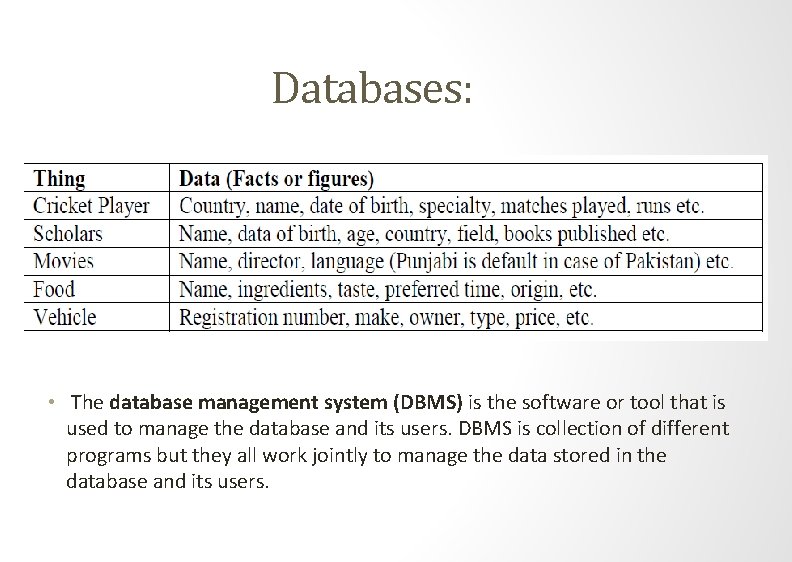
Databases: • The database management system (DBMS) is the software or tool that is used to manage the database and its users. DBMS is collection of different programs but they all work jointly to manage the data stored in the database and its users.
Importance of the Databases Traditionally computer applications are divided into commercial and scientific (or engineering) ones. Scientific applications involve more computations, that is, different type of calculations that vary from simple to very complex. like in the fields of space, nuclear, medicine that take hours or days of computations on even computers of the modern age. The applications that are termed as commercial or business applications do not involve much computations, rather minor computation but mainly they perform the input/output operations. These applications mainly store the data in the computer storage, then access and present it to the users in different formats (also termed as data processing) for example, banks, shopping, production, utilities billing, customer services and many others.
Databases and Traditional File Processing Systems • Traditional File system was laborious, time consuming, inefficient. • Computers, initially designed for the engineering purposes were though of as blessing, since they helped efficient management but file processing environment simply transformed manual file work to computers. • File Processing became very fast and efficient.
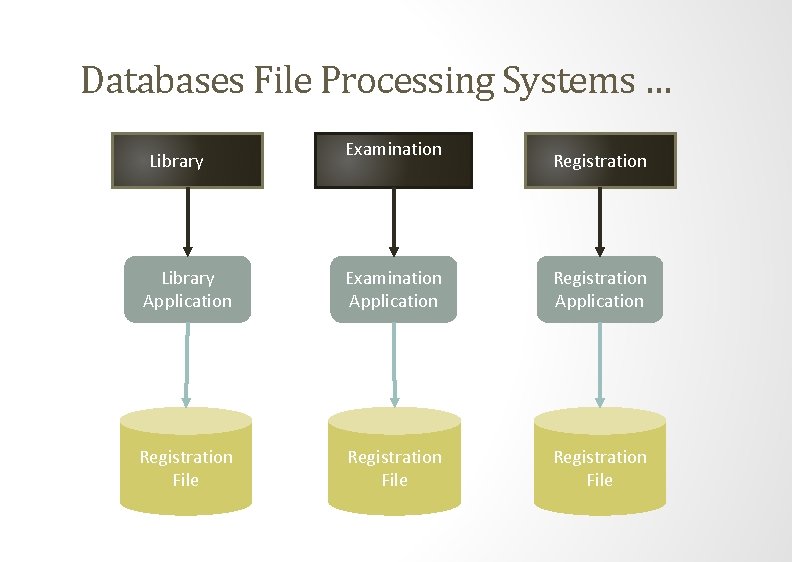
Databases File Processing Systems … Library Examination Registration Library Application Examination Application Registration File
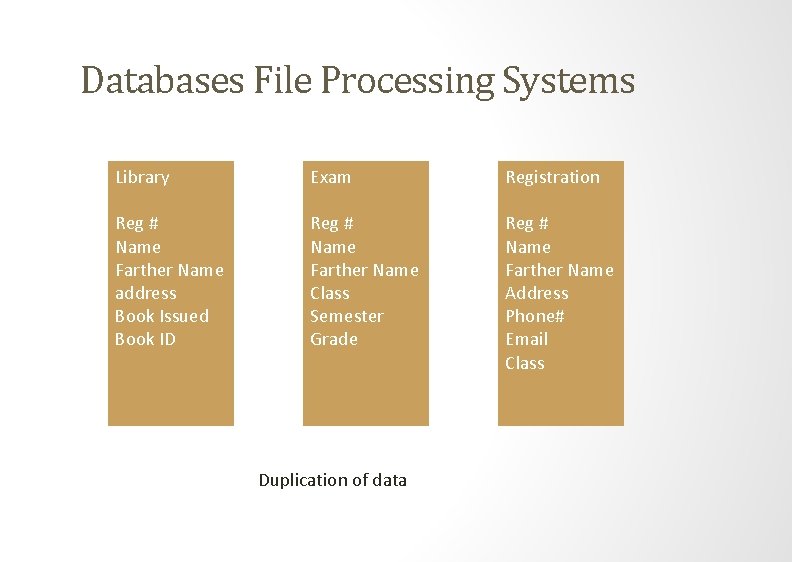
Databases File Processing Systems Library Exam Registration Reg # Name Farther Name address Book Issued Book ID Reg # Name Farther Name Class Semester Grade Reg # Name Farther Name Address Phone# Email Class Duplication of data
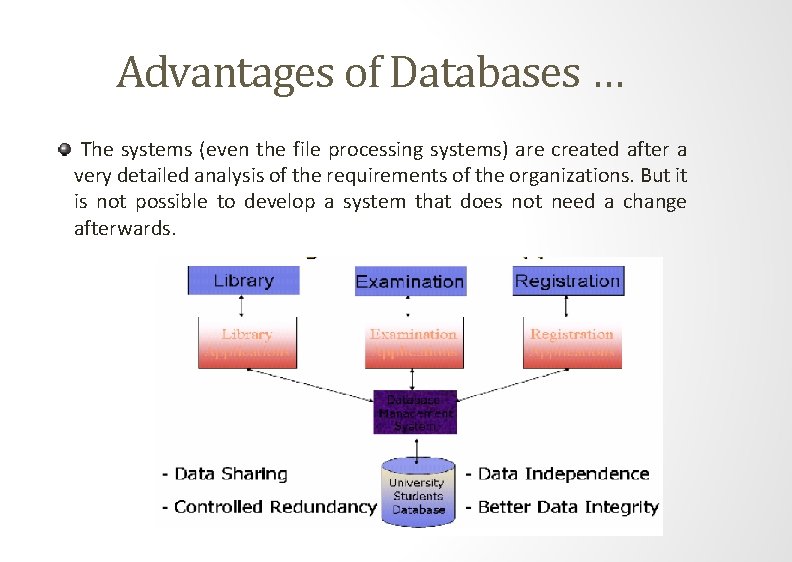
Advantages of Databases … The systems (even the file processing systems) are created after a very detailed analysis of the requirements of the organizations. But it is not possible to develop a system that does not need a change afterwards.
Advantages of Databases … • Data consistency: Data consistency means that the changes made to different occurrence of data should be controlled and managed in such a way that all the occurrences have same value for any specific data item. • Better data security: All application programs access data through DBMS, So DBMS can very efficiently check that which user is performing which action and accessing which part of data , So A DBMS is the most effectively control and maintain security of Data. • Faster development of new applications: The database environment allows us faster application development because of its many reasons. As we know that database is designed with the factor of future development in mind.
Advantages of Databases Better concurrency control : Concurrency control means to access the database in such a way that all the data accesses are completed correctly and transparently. Like, all ATM machines of a bank are interconnected to a central database system worldwide Better backup and recovery procedures: Data is stored on today’s’ storage devices like hard disks etc. , It is necessary to take periodic backups of data so that in case a storage device looses the data due to any damage we should be able to restore data. LGU, Lahore Economy of scale: Databases and database systems are designed to share data stored in one location.
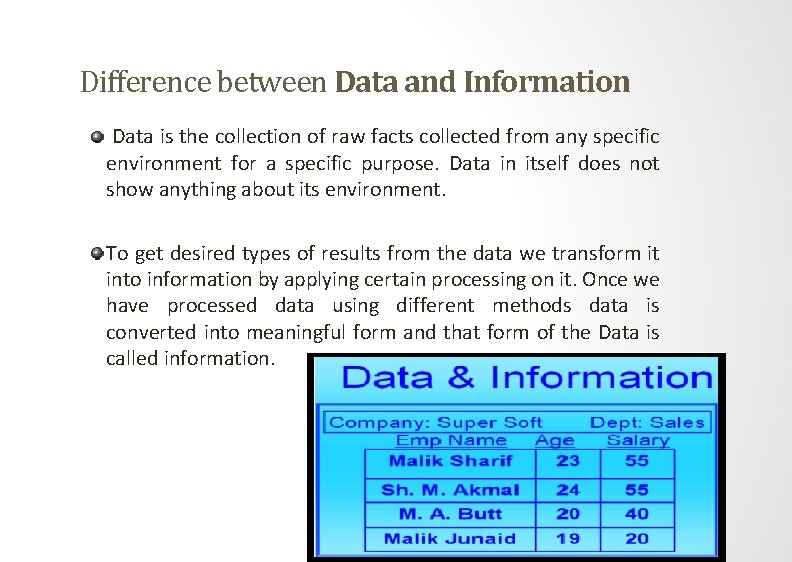
Difference between Data and Information Data is the collection of raw facts collected from any specific environment for a specific purpose. Data in itself does not show anything about its environment. To get desired types of results from the data we transform it into information by applying certain processing on it. Once we have processed data using different methods data is converted into meaningful form and that form of the Data is called information.
Database Application & Database Management Systems: Database Application is a program or group of programs which is used for performing certain operations on the data stored in the database. These operations may contain insertion of data into a database or extracting some data from the databased on a certain condition, updating data in the database, producing the data as output on any device such as Screen, disk or printer. Database management system is software of collection of small programs to perform certain operation on data and manage the data. Management of Data in the Database Management of Users associated with the database.
Cost Involved (Disadvantages of Databases system) High Cost: Database Systems have a number of inherent charges. Needs specialized software which is used to run database systems. Specialized hardware and technically qualified staff are needed. Conversion Cost: It is not only the finance and technical man-power which is required for switching on to database system. Some conversion charges needed for adopting the database system after deciding to convert the system into databases system. Difficult Recovery Procedures: The process of recovering a crashed database is very much technical and needs good professional skills to perform a perfect recovery of the database.
• Data as a Resource: • A resource is anything which is valuable for an organization. • There can be a number of resources in any organization, for example, Buildings, Furniture, Vehicle, Technical Staff, Managers, supporting staff and Machinery etc. • All these are resources for organizations and are consumed very much carefully to get full benefit out of them. • Data in the same way is a very important resource and needs to considered equally important as other resource are considered.
Why we call data as a resource? Data is truly considered a resource because for an organization to make proper decisions at proper time it is only the data which can provide correct information and in-turn cause good utilization of other organizational resources. Organizations can not make good and effective decisions if the required data is not available in time or in the correct and desired format, such bad and miscalculated decisions ultimately lead to the failure of organizations or business.
Levels of Data : Real World Data: The real world level of data means that level of data at which entities or objects exist in reality. It means that any object existing in reality have a name and other identifiable attributes through which we can identify that specific object or entity. Example: Any Student Meta Data: For storage of the data related to any entity or object existing at real world level we define the way the data will be stored in the database. Meta data is also known as schema for the real world data.
It tells that what type of data will be stored in the database, what will be size of a certain attribute of the real world data, how many and what attributes will be used to store the data about the entity in the database. Example: Name , Character Type, 25 character size field, Age, Date type, 8 bytes size Class, Alpha Numeric, 8 byte size field Existence of Data: Existence of the data level shows the actual data regarding the entities as real world level according to the rules define at the Meta Data level. Like , Name Class Age Ali BCS 20 etc.
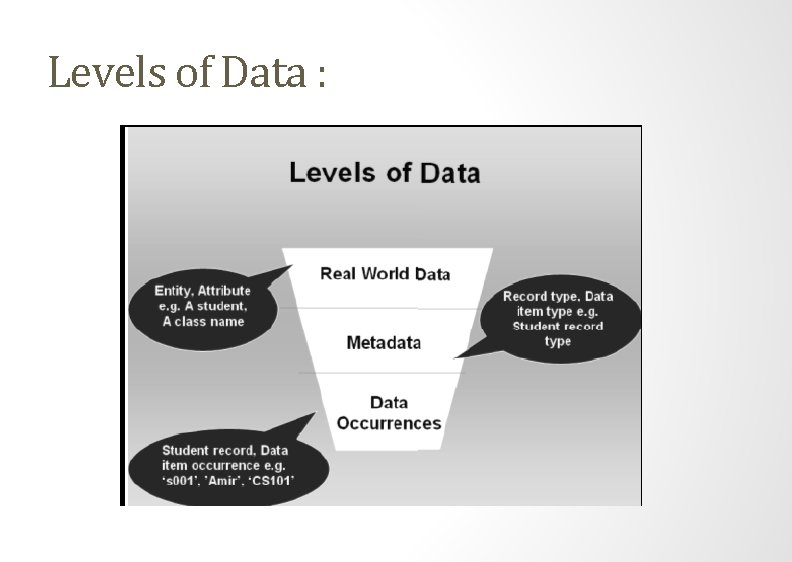
Levels of Data :
Users of Database Systems: Application Programmers Create database application programs. Application programmers design the application according to the needs of the other users. Application programmers are skilled people , have clear idea of the structure of the database and know clearly about the needs of the organizations. End Users (Database users are the end users ) Naïve ( Simply use the application, no interaction with DBMS) Sophisticated (More rights, can view data according to needs) Database Administrators (DBA): The most technical class of DB users. Have the knowledge of how to design and manage the database DBA is a very responsible position in an organization has the responsibility of making proper database backups and make necessary actions for recovering the database in case of a database crash. To fulfill the requirements of a DBA position a DBA needs vast experience and very elegant technical skills.
Duties of the DBA : Schema definition : DBA is the person who create all the meta data information for the organization on which the database is based. In very large scale organizations this job is performed by the database designer, which is hired for the purpose of database design and once the database system is installed and working, it is handed over to the DBA for further operation. Granting data access : DBA is also responsible for grant of access rights to the database users. Routine Maintenance: Backups Monitoring disk space Monitoring jobs running
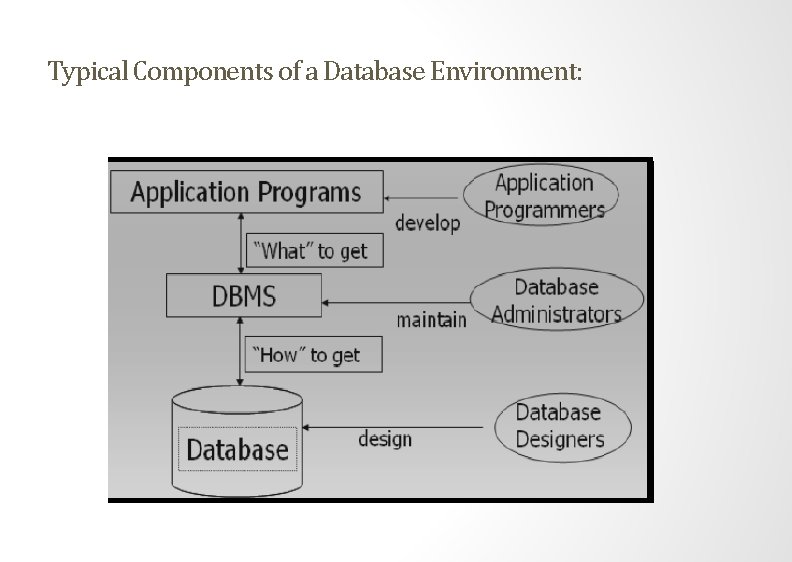
Typical Components of a Database Environment:
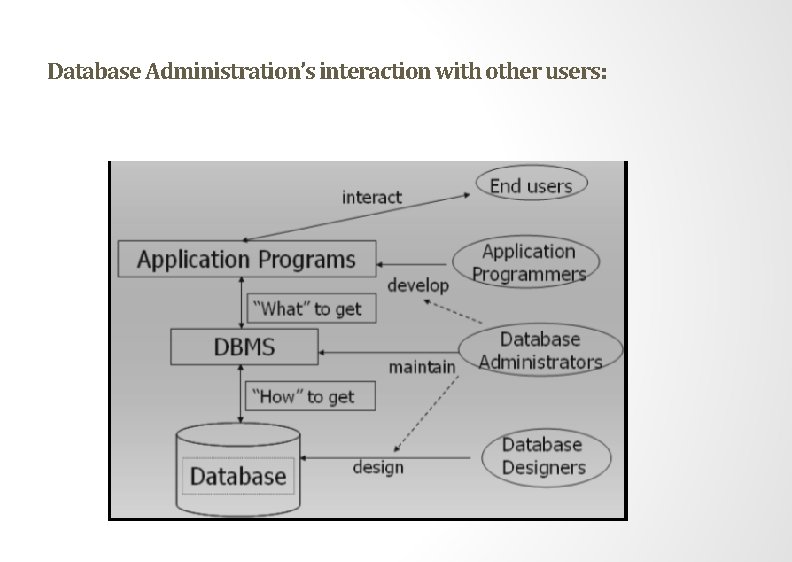
Database Administration’s interaction with other users:

LGU, Lahore

LGU, Lahore
- Slides: 27