
Databases Learning Outcomes LO 1 Be able to
Databases
Learning Outcomes LO 1 Be able to describe and analyse a flat file database. LO 2 Explain what verification and validation is. LO 3 Apply validation to a database and verification to the real world.
Starter How does Google work? First person= what are the different file organisation types used by databases? Second person= which file organization type is used by Google and how does it work? First Person = Why it isn’t the others?
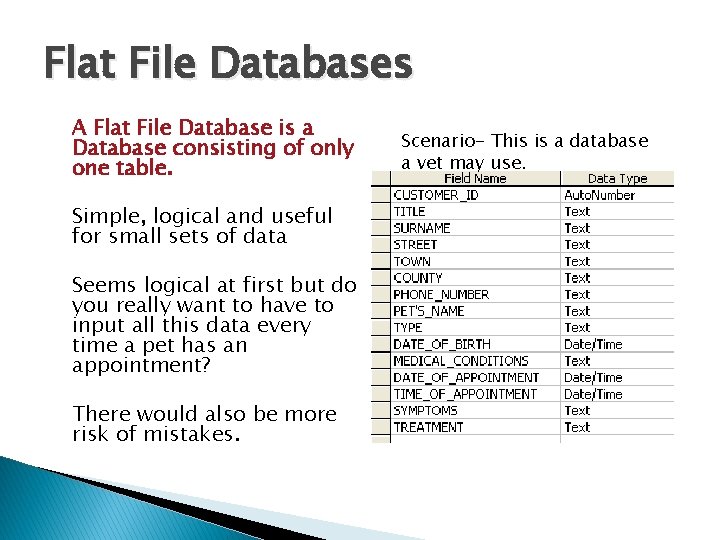
Flat File Databases A Flat File Database is a Database consisting of only one table. Simple, logical and useful for small sets of data Seems logical at first but do you really want to have to input all this data every time a pet has an appointment? There would also be more risk of mistakes. Scenario- This is a database a vet may use.

Data Redunancy Data redundancy: the unnecessary repetition of data. This inevitability leads to complex processing problems because each instance of the repeated data has to be updated. This is inefficient and will probably lead to mistakes.
Data integrity, Validation and Verification Key Definitions: Data integrity= The state of data being as it should be, reflecting reality. Validation= The process of checking data as it is input to ensure that it is reasonable. Verification= The process of checking that data is true or correct
Validation: Checking is done by data handling software and it can be set up to reject any data that does not conform to specific rules. Come up with a mnemonic for validation techniques http: //www. bbc. co. uk /schools/gcsebitesize /ict/databases/3 datav alidationrev 1. shtml
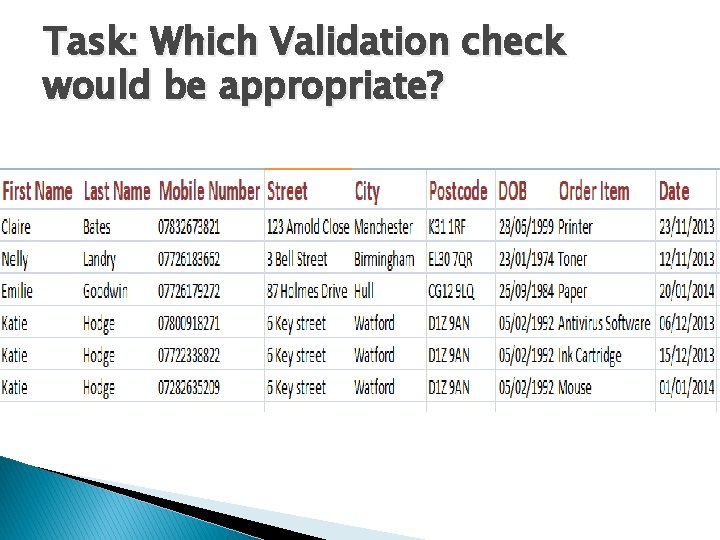
Task: Which Validation check would be appropriate?
Verification Validation cannot make sure data that you enter is correct, it can only check that it is sensible, reasonable and allowable. Methods: v. Checking data onscreen in comparison to the original documents. v. Entering v. Printing the data twice. out a copy of the data and comparing it to the original paper document.
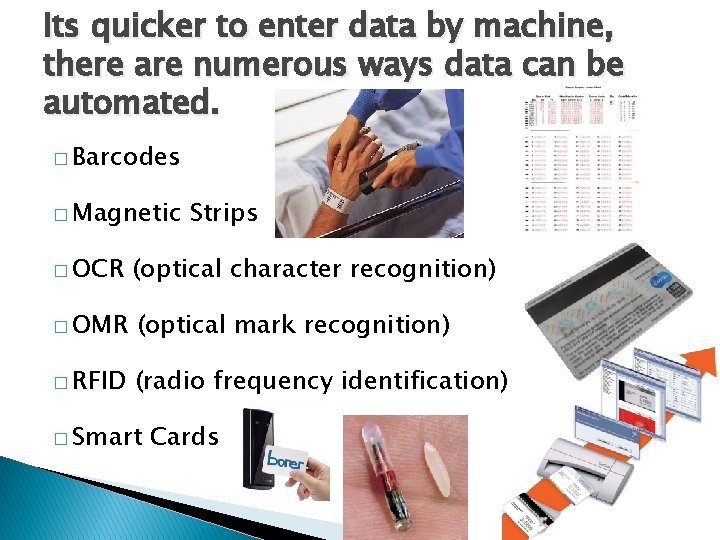
Its quicker to enter data by machine, there are numerous ways data can be automated. � Barcodes � Magnetic Strips � OCR (optical character recognition) � OMR (optical mark recognition) � RFID (radio frequency identification) � Smart Cards
Plenary 1) 2) 3) What is the difference between verification and Validation, give examples? Name 3 data entry procedures and describe them. What is a flat file database?
- Slides: 11