
DatabaseConnection Libraries CallLevel Interface Java Database Connectivity PHP
Database-Connection Libraries Call-Level Interface Java Database Connectivity PHP 1
An Aside: SQL Injection u. SQL queries are often constructed by programs. u. These queries may take constants from user input. u. Careless code can allow rather unexpected queries to be constructed and executed. 2
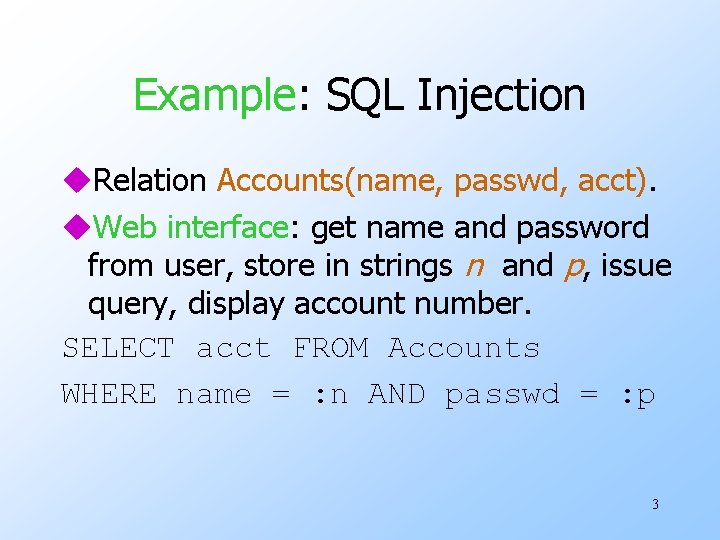
Example: SQL Injection u. Relation Accounts(name, passwd, acct). u. Web interface: get name and password from user, store in strings n and p, issue query, display account number. SELECT acct FROM Accounts WHERE name = : n AND passwd = : p 3
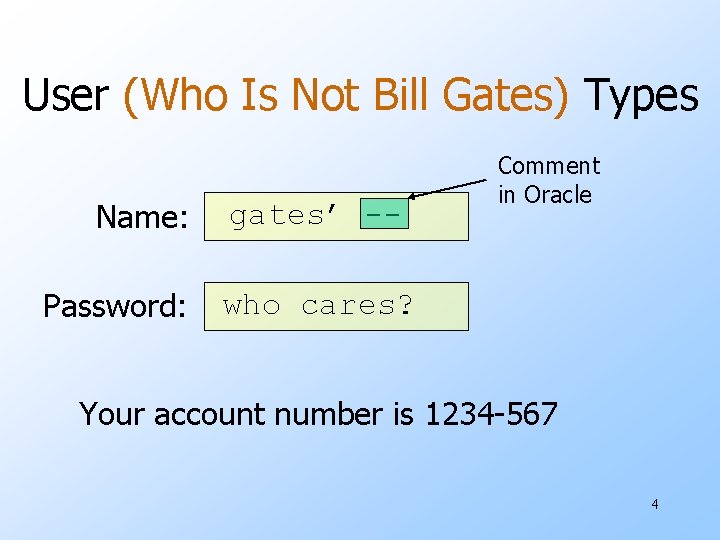
User (Who Is Not Bill Gates) Types Name: Password: gates’ -- Comment in Oracle who cares? Your account number is 1234 -567 4
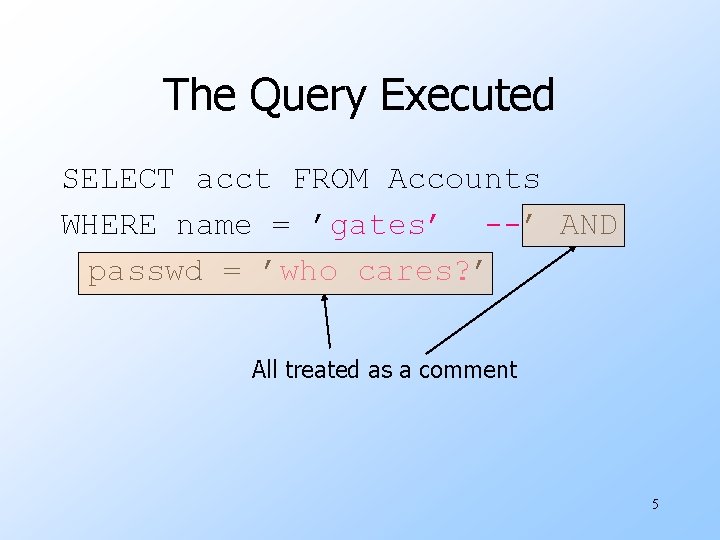
The Query Executed SELECT acct FROM Accounts WHERE name = ’gates’ --’ AND passwd = ’who cares? ’ All treated as a comment 5
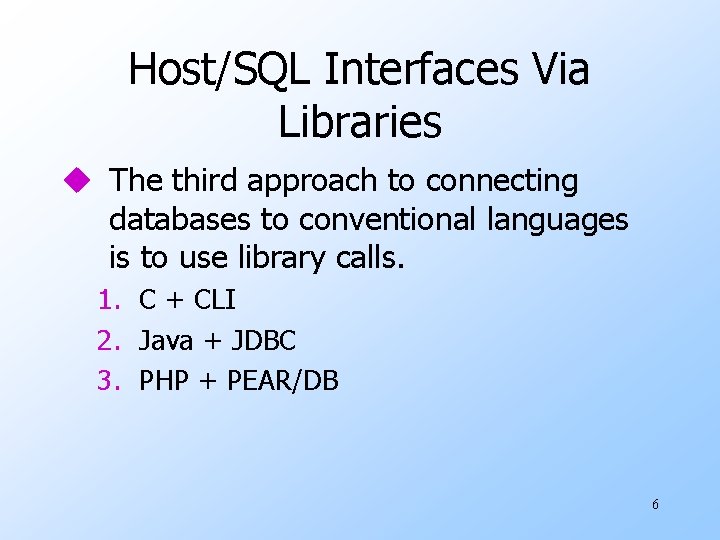
Host/SQL Interfaces Via Libraries u The third approach to connecting databases to conventional languages is to use library calls. 1. C + CLI 2. Java + JDBC 3. PHP + PEAR/DB 6
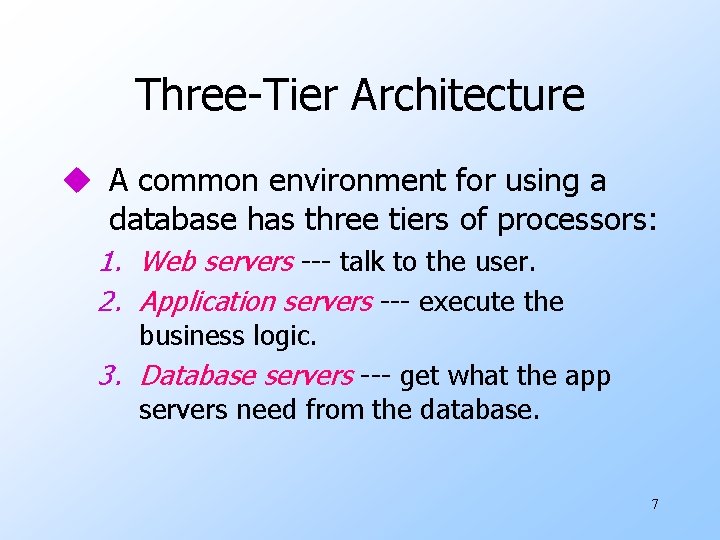
Three-Tier Architecture u A common environment for using a database has three tiers of processors: 1. Web servers --- talk to the user. 2. Application servers --- execute the business logic. 3. Database servers --- get what the app servers need from the database. 7
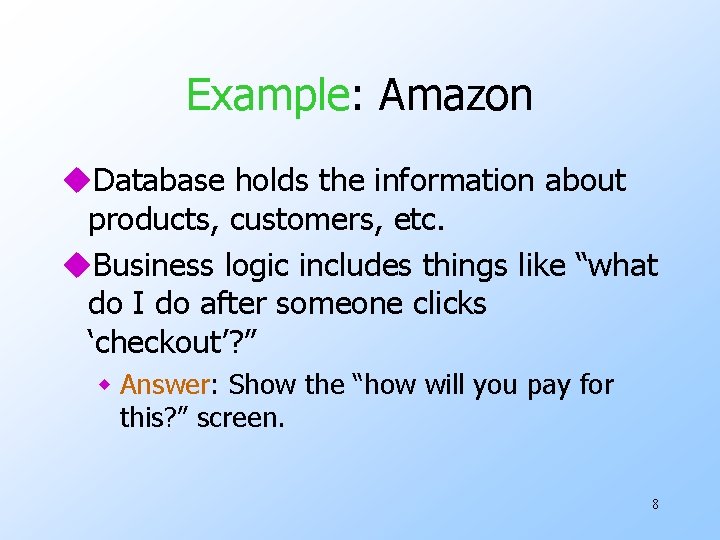
Example: Amazon u. Database holds the information about products, customers, etc. u. Business logic includes things like “what do I do after someone clicks ‘checkout’? ” w Answer: Show the “how will you pay for this? ” screen. 8
Environments, Connections, Queries u. The database is, in many DB-access languages, an environment. u. Database servers maintain some number of connections, so app servers can ask queries or perform modifications. u. The app server issues statements : queries and modifications, usually. 9
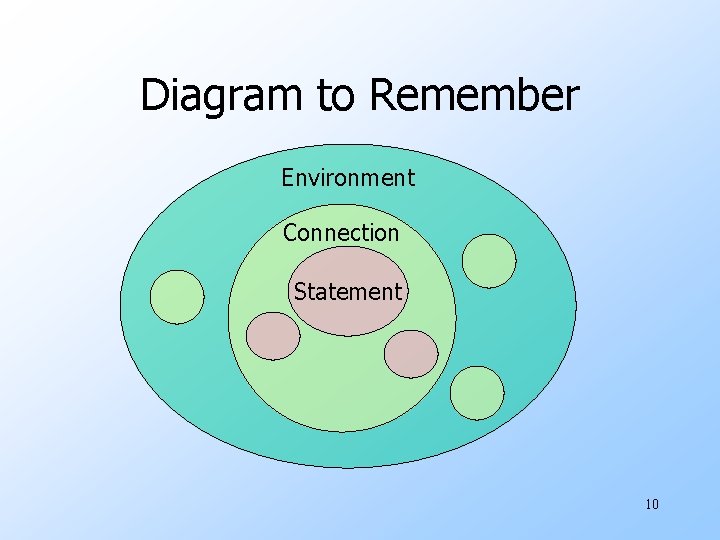
Diagram to Remember Environment Connection Statement 10
SQL/CLI u. Instead of using a preprocessor (as in embedded SQL), we can use a library of functions. w The library for C is called SQL/CLI = “Call. Level Interface. ” w Embedded SQL’s preprocessor will translate the EXEC SQL … statements into CLI or similar calls, anyway. 11

Data Structures u C connects to the database by structs of the following types: 1. Environments : represent the DBMS installation. 2. Connections : logins to the database. 3. Statements : SQL statements to be passed to a connection. 4. Descriptions : records about tuples from a query, or parameters of a statement. 12
Handles u. Function SQLAlloc. Handle(T, I, O) is used to create these structs, which are called environment, connection, and statement handles. w T = type, e. g. , SQL_HANDLE_STMT. w I = input handle = struct at next higher level (statement < connection < environment). w O = (address of) output handle. 13
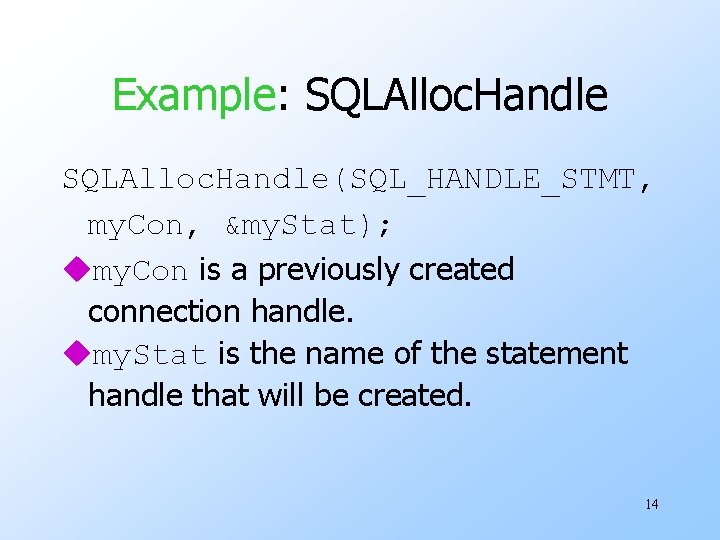
Example: SQLAlloc. Handle(SQL_HANDLE_STMT, my. Con, &my. Stat); umy. Con is a previously created connection handle. umy. Stat is the name of the statement handle that will be created. 14
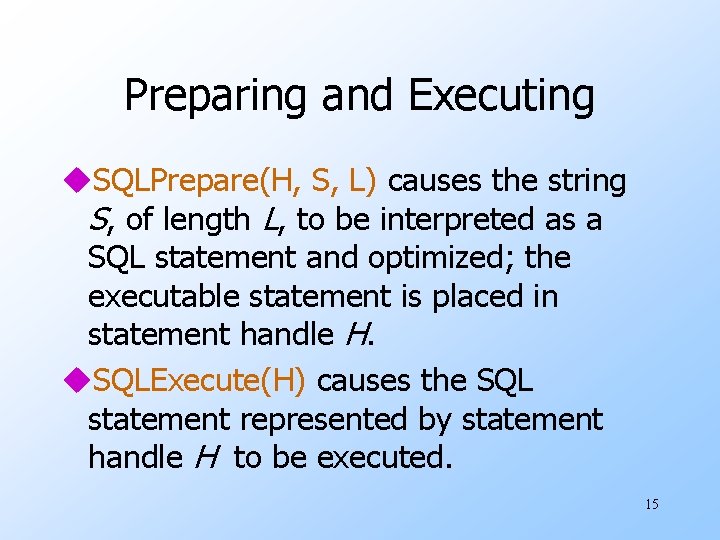
Preparing and Executing u. SQLPrepare(H, S, L) causes the string S, of length L, to be interpreted as a SQL statement and optimized; the executable statement is placed in statement handle H. u. SQLExecute(H) causes the SQL statement represented by statement handle H to be executed. 15
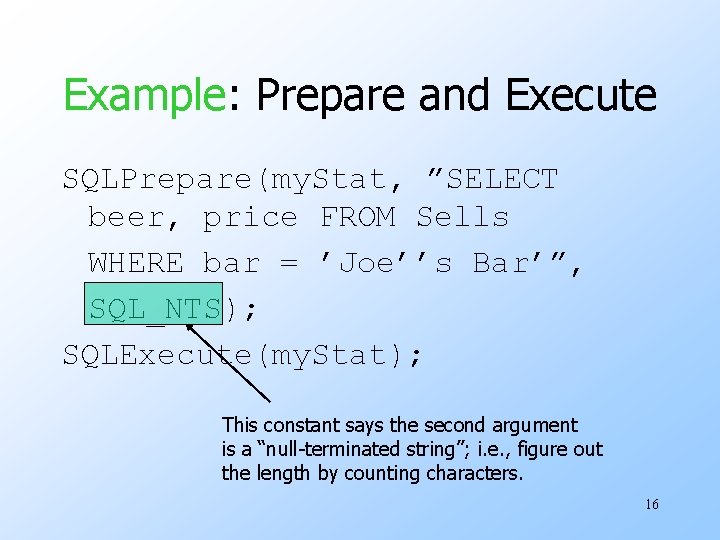
Example: Prepare and Execute SQLPrepare(my. Stat, ”SELECT beer, price FROM Sells WHERE bar = ’Joe’’s Bar’”, SQL_NTS); SQLExecute(my. Stat); This constant says the second argument is a “null-terminated string”; i. e. , figure out the length by counting characters. 16
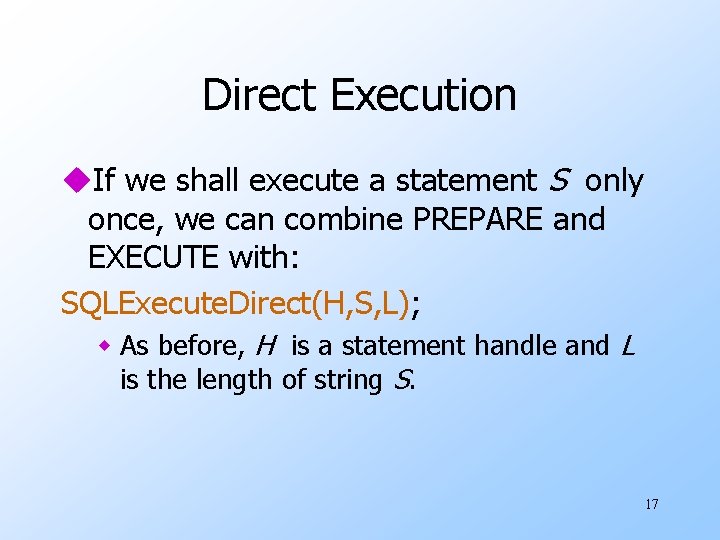
Direct Execution u. If we shall execute a statement S only once, we can combine PREPARE and EXECUTE with: SQLExecute. Direct(H, S, L); w As before, H is a statement handle and L is the length of string S. 17
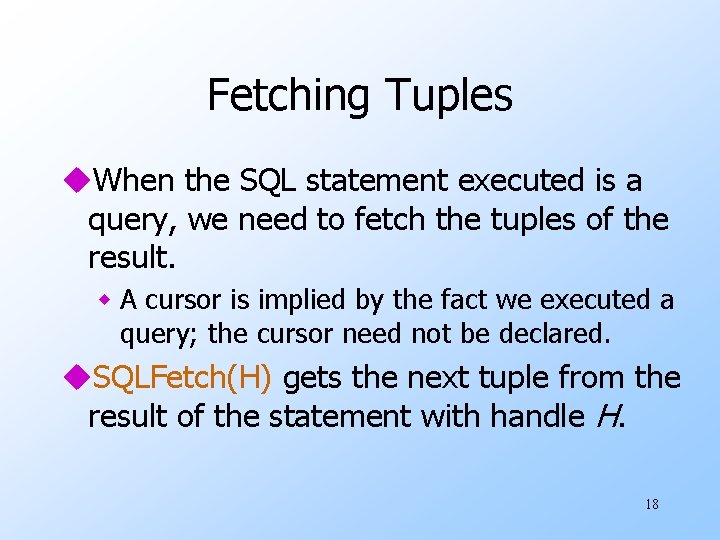
Fetching Tuples u. When the SQL statement executed is a query, we need to fetch the tuples of the result. w A cursor is implied by the fact we executed a query; the cursor need not be declared. u. SQLFetch(H) gets the next tuple from the result of the statement with handle H. 18
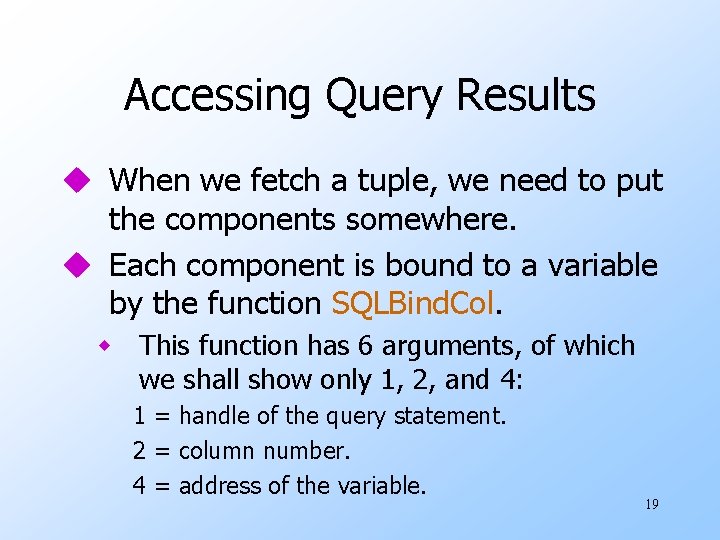
Accessing Query Results u When we fetch a tuple, we need to put the components somewhere. u Each component is bound to a variable by the function SQLBind. Col. w This function has 6 arguments, of which we shall show only 1, 2, and 4: 1 = handle of the query statement. 2 = column number. 4 = address of the variable. 19
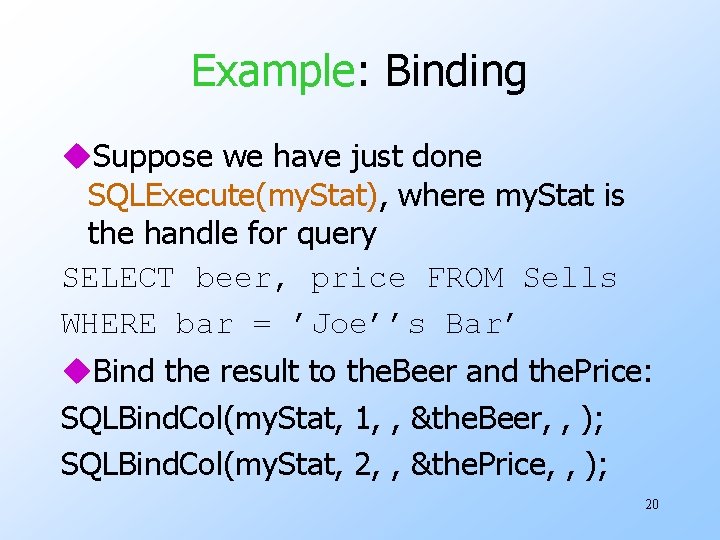
Example: Binding u. Suppose we have just done SQLExecute(my. Stat), where my. Stat is the handle for query SELECT beer, price FROM Sells WHERE bar = ’Joe’’s Bar’ u. Bind the result to the. Beer and the. Price: SQLBind. Col(my. Stat, 1, , &the. Beer, , ); SQLBind. Col(my. Stat, 2, , &the. Price, , ); 20
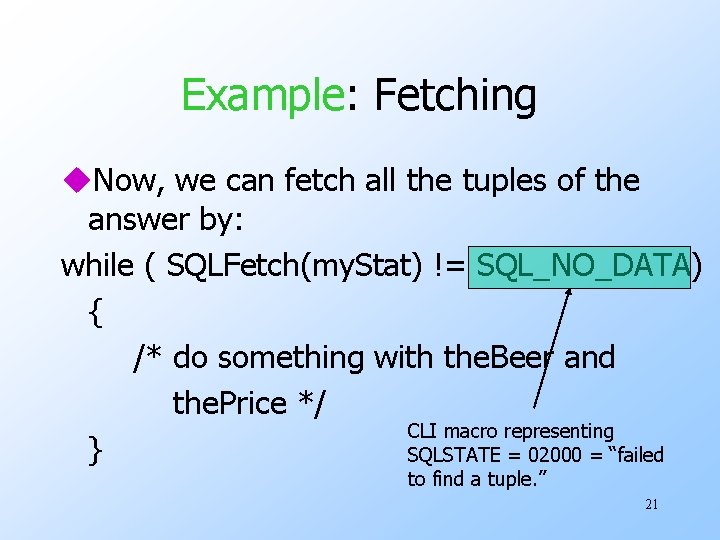
Example: Fetching u. Now, we can fetch all the tuples of the answer by: while ( SQLFetch(my. Stat) != SQL_NO_DATA) { /* do something with the. Beer and the. Price */ CLI macro representing } SQLSTATE = 02000 = “failed to find a tuple. ” 21
JDBC u. Java Database Connectivity (JDBC) is a library similar to SQL/CLI, but with Java as the host language. u. Like CLI, but with a few differences for us to cover. 22
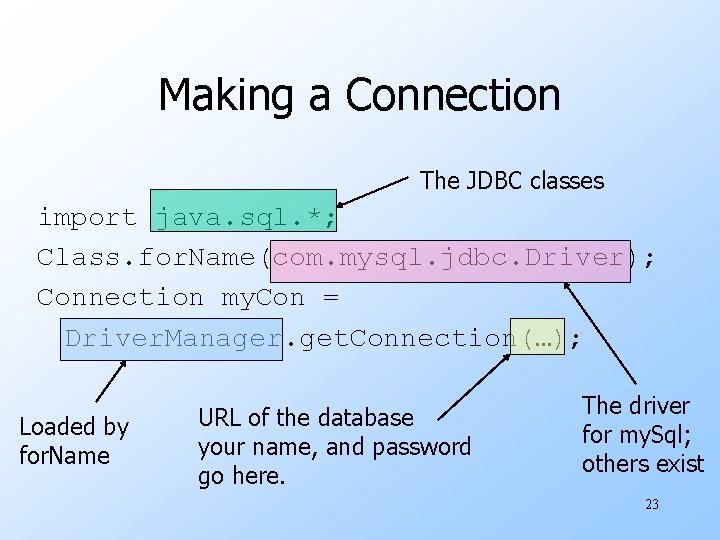
Making a Connection The JDBC classes import java. sql. *; Class. for. Name(com. mysql. jdbc. Driver); Connection my. Con = Driver. Manager. get. Connection(…); Loaded by for. Name URL of the database your name, and password go here. The driver for my. Sql; others exist 23
Statements u JDBC provides two classes: 1. Statement = an object that can accept a string that is a SQL statement and can execute such a string. 2. Prepared. Statement = an object that has an associated SQL statement ready to execute. 24
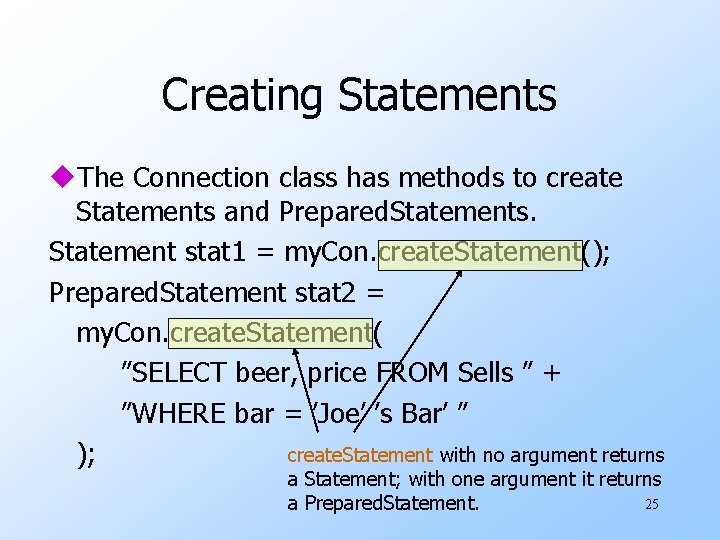
Creating Statements u. The Connection class has methods to create Statements and Prepared. Statements. Statement stat 1 = my. Con. create. Statement(); Prepared. Statement stat 2 = my. Con. create. Statement( ”SELECT beer, price FROM Sells ” + ”WHERE bar = ’Joe’ ’s Bar’ ” create. Statement with no argument returns ); a Statement; with one argument it returns 25 a Prepared. Statement.
Executing SQL Statements u. JDBC distinguishes queries from modifications, which it calls “updates. ” u. Statement and Prepared. Statement each have methods execute. Query and execute. Update. w For Statements: one argument: the query or modification to be executed. w For Prepared. Statements: no argument. 26
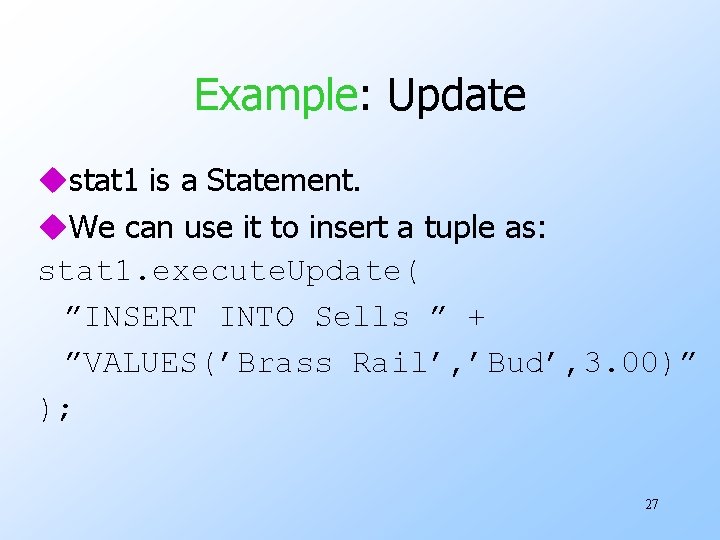
Example: Update ustat 1 is a Statement. u. We can use it to insert a tuple as: stat 1. execute. Update( ”INSERT INTO Sells ” + ”VALUES(’Brass Rail’, ’Bud’, 3. 00)” ); 27
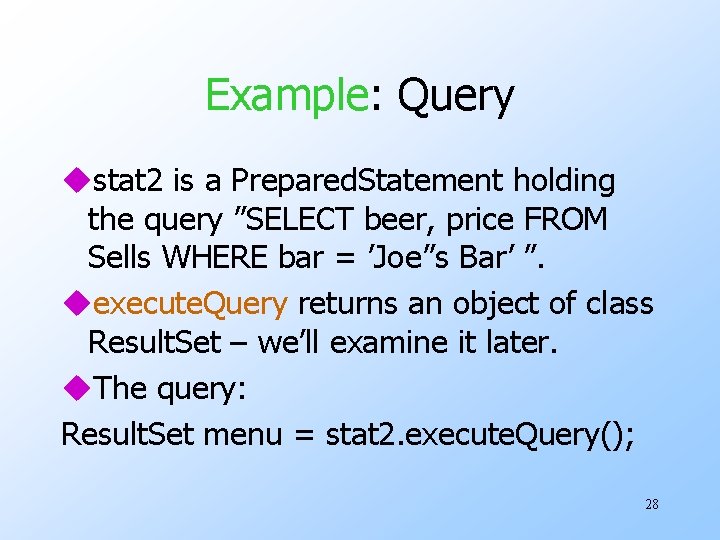
Example: Query ustat 2 is a Prepared. Statement holding the query ”SELECT beer, price FROM Sells WHERE bar = ’Joe’’s Bar’ ”. uexecute. Query returns an object of class Result. Set – we’ll examine it later. u. The query: Result. Set menu = stat 2. execute. Query(); 28
Accessing the Result. Set u. An object of type Result. Set is something like a cursor. u. Method next() advances the “cursor” to the next tuple. w The first time next() is applied, it gets the first tuple. w If there are no more tuples, next() returns the value false. 29
Accessing Components of Tuples u. When a Result. Set is referring to a tuple, we can get the components of that tuple by applying certain methods to the Result. Set. u. Method get. X (i ), where X is some type, and i is the component number, returns the value of that component. w The value must have type X. 30
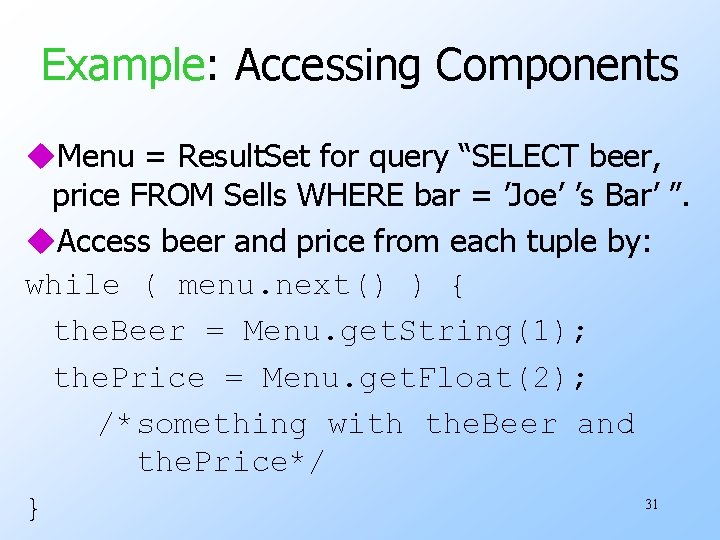
Example: Accessing Components u. Menu = Result. Set for query “SELECT beer, price FROM Sells WHERE bar = ’Joe’ ’s Bar’ ”. u. Access beer and price from each tuple by: while ( menu. next() ) { the. Beer = Menu. get. String(1); the. Price = Menu. get. Float(2); /*something with the. Beer and the. Price*/ 31 }
PHP u. A language to be used for actions within HTML text. u. Indicated by <? PHP code ? >. u. DB library exists within PEAR (PHP Extension and Application Repository). w Include with include(DB. php). 32
Variables in PHP u. Must begin with $. u. OK not to declare a type for a variable. u. But you give a variable a value that belongs to a “class, ” in which case, methods of that class are available to it. 33
String Values u. PHP solves a very important problem for languages that commonly construct strings as values: w How do I tell whether a substring needs to be interpreted as a variable and replaced by its value? u. PHP solution: Double quotes means replace; single quotes means don’t. 34
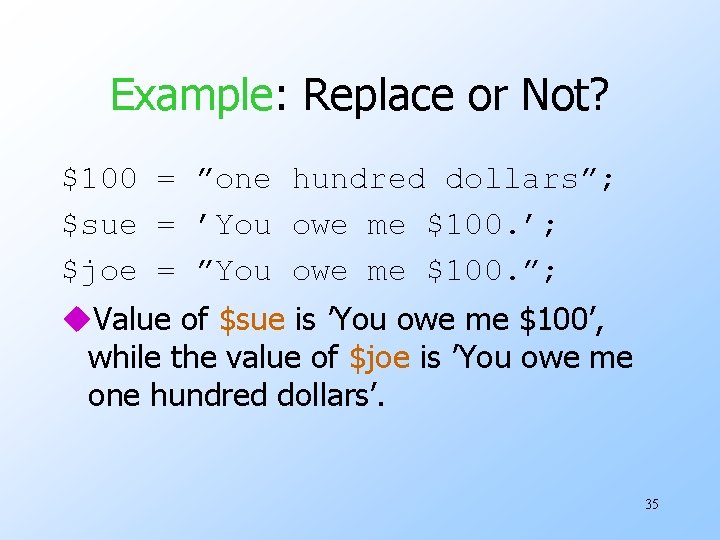
Example: Replace or Not? $100 = ”one hundred dollars”; $sue = ’You owe me $100. ’; $joe = ”You owe me $100. ”; u. Value of $sue is ’You owe me $100’, while the value of $joe is ’You owe me one hundred dollars’. 35
PHP Arrays u. Two kinds: numeric and associative. u. Numeric arrays are ordinary, indexed 0, 1, … w Example: $a = array(”Paul”, ”George”, ”John”, ”Ringo”); • Then $a[0] is ”Paul”, $a[1] is ”George”, and so on. 36
Associative Arrays u. Elements of an associative array $a are pairs x => y, where x is a key string and y is any value. u. If x => y is an element of $a, then $a[x] is y. 37
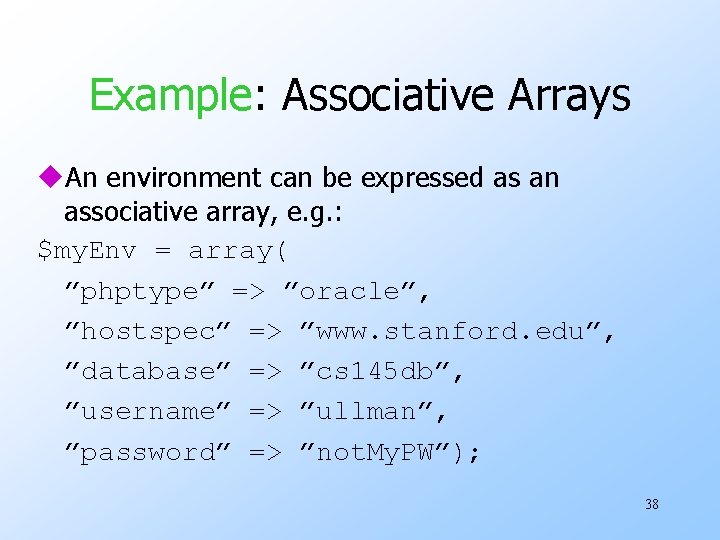
Example: Associative Arrays u. An environment can be expressed as an associative array, e. g. : $my. Env = array( ”phptype” => ”oracle”, ”hostspec” => ”www. stanford. edu”, ”database” => ”cs 145 db”, ”username” => ”ullman”, ”password” => ”not. My. PW”); 38
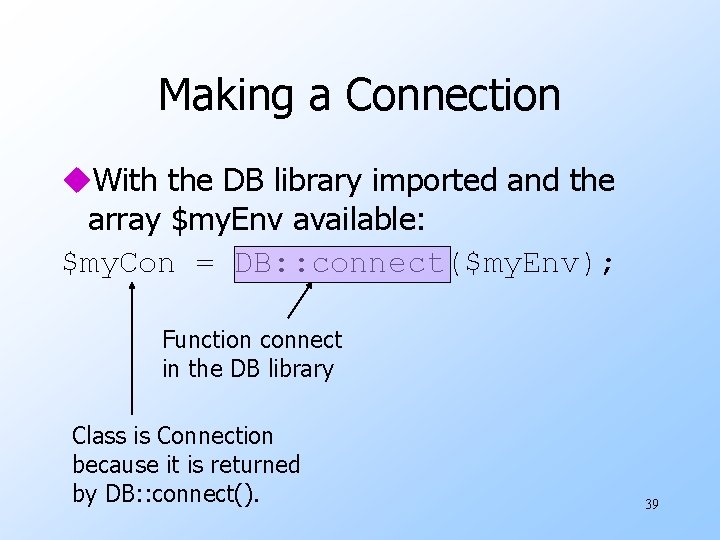
Making a Connection u. With the DB library imported and the array $my. Env available: $my. Con = DB: : connect($my. Env); Function connect in the DB library Class is Connection because it is returned by DB: : connect(). 39
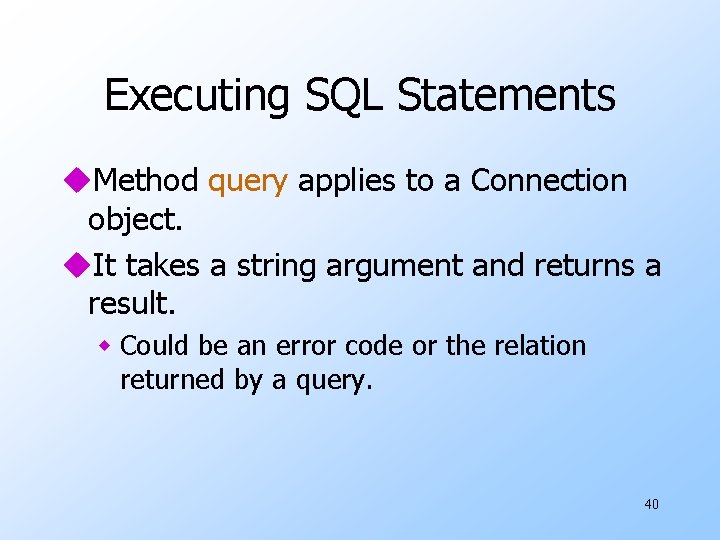
Executing SQL Statements u. Method query applies to a Connection object. u. It takes a string argument and returns a result. w Could be an error code or the relation returned by a query. 40
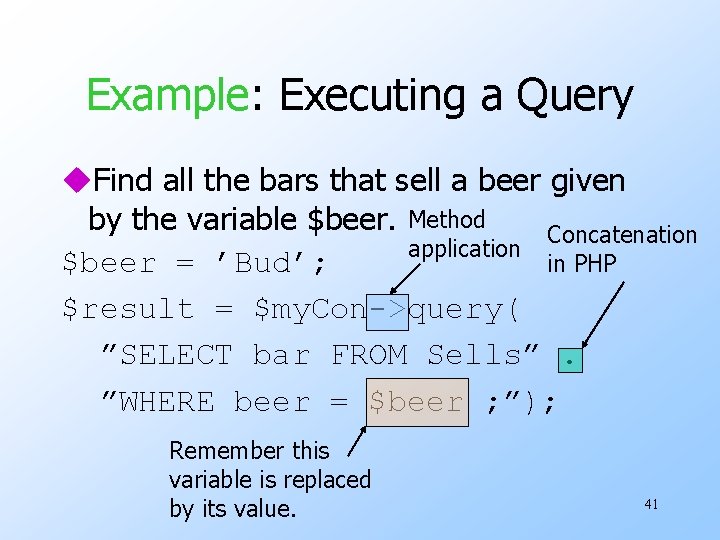
Example: Executing a Query u. Find all the bars that sell a beer given by the variable $beer. Method Concatenation application in PHP $beer = ’Bud’; $result = $my. Con->query( ”SELECT bar FROM Sells”. ”WHERE beer = $beer ; ”); Remember this variable is replaced by its value. 41
Cursors in PHP u. The result of a query is the tuples returned. u. Method fetch. Row applies to the result and returns the next tuple, or FALSE if there is none. 42
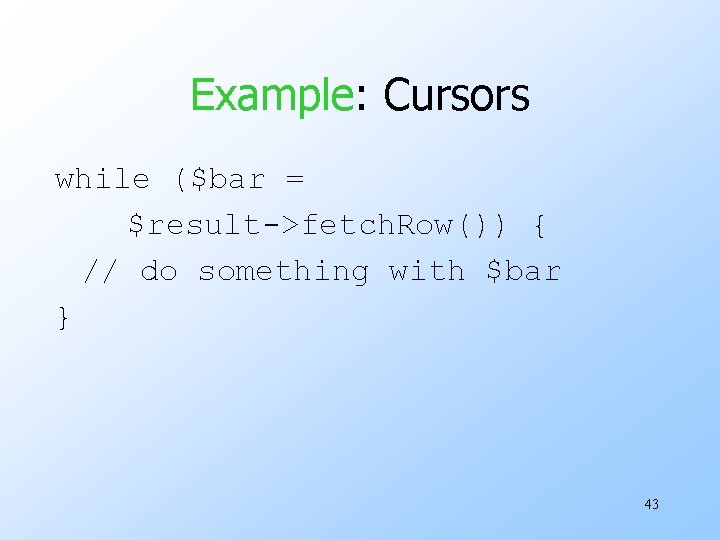
Example: Cursors while ($bar = $result->fetch. Row()) { // do something with $bar } 43
- Slides: 43