
Database Systems LECTURE 2 Summary Previous Lecture Information
Database Systems LECTURE # 2
Summary: Previous Lecture Information system Database System Development Life Cycle Database planning System definition Requirements collection and analysis (To be continued…) RAFIU. AF@GMAIL. COM MR, R
Requirements Collection and Analysis. . Ø Ø Another important activity is deciding how to manage the requirements for a database system with multiple user views Three main approaches v Centralized approach v View integration approach v Combination of both approaches (Hybrid) RAFIU. AF@GMAIL. COM MR, R
Centralized Approach Ø Ø Requirements for each user view are merged into a single set of requirements A data model is created representing all user views during the database design stage RAFIU. AF@GMAIL. COM MR, R
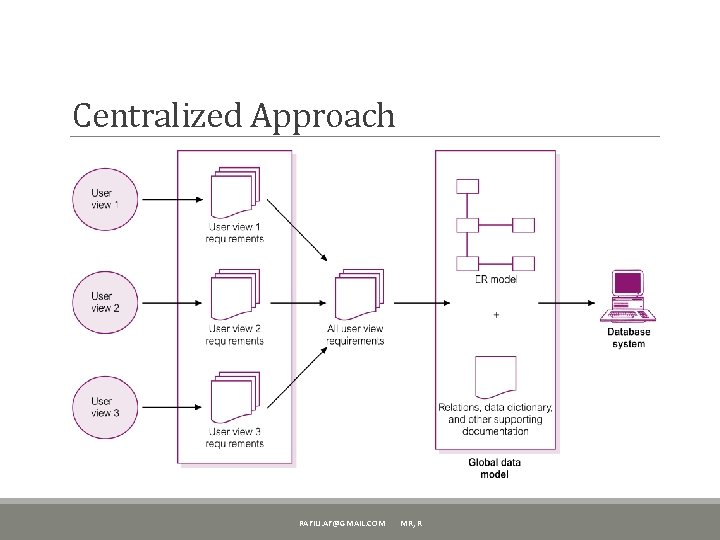
Centralized Approach RAFIU. AF@GMAIL. COM MR, R
View Integration Approach Ø Ø Requirements for each user view remain as separate lists Data models representing each user view are created and then merged later during the database design stage RAFIU. AF@GMAIL. COM MR, R
View Integration Approach. . Ø Local/Global data models v Data model representing single user view (or a subset of all user views) is called a local data model v Each model includes diagrams and documentation describing requirements for one or more but not all user views of database v Local data models are then merged at a later stage during database design to produce a global data model, which represents all user views for the database RAFIU. AF@GMAIL. COM MR, R
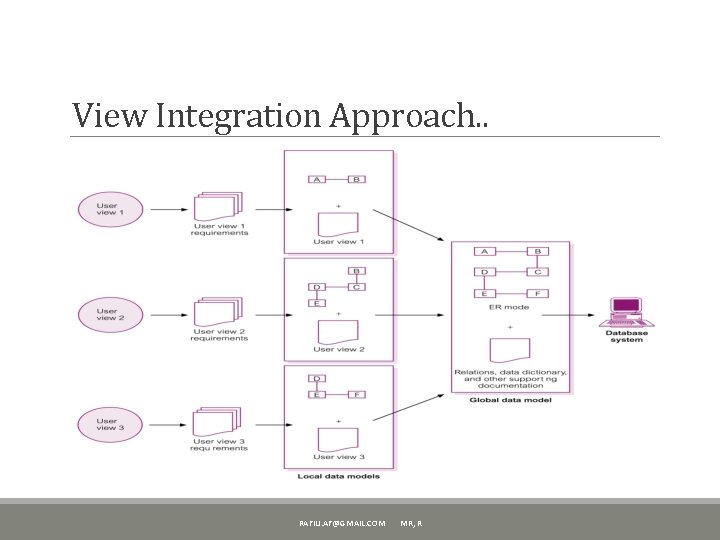
View Integration Approach. . RAFIU. AF@GMAIL. COM MR, R
Database Design Ø Ø Process of creating a design for a database that will support the enterprise’s mission statement and mission objectives for the required database system Main database design approaches include: v Top-down v Bottom-up v Inside-out v Mixed RAFIU. AF@GMAIL. COM MR, R
Data Modelling Ø Main purposes of data modeling include: v To assist in understanding the meaning (semantics) of the data v To facilitate communication about the information requirements v Building data model requires answering questions about entities, relationships, and attributes RAFIU. AF@GMAIL. COM MR, R

Phases of Database Design Ø Three phases of database design: v Conceptual database design v Logical database design v Physical database design RAFIU. AF@GMAIL. COM MR, R
Conceptual Database Design Ø Process of constructing a model of the data used in an enterprise, independent of all physical considerations v Data model is built using the information in users’ requirements specification v Conceptual data model is source of information for logical design phase RAFIU. AF@GMAIL. COM MR, R
Logical Database Design Ø Process of constructing a model of the data used in an enterprise based on a specific data model (e. g. relational), but independent of a particular DBMS and other physical considerations v Conceptual data model is refined and mapped on to a logical data model RAFIU. AF@GMAIL. COM MR, R
Physical Database Design Ø Physical database design translates the logical data model into a set of SQL statements that define the database. v Describes base relations, file organizations, and indexes used to achieve efficient access to data v Also describes any associated integrity constraints and security measures RAFIU. AF@GMAIL. COM MR, R
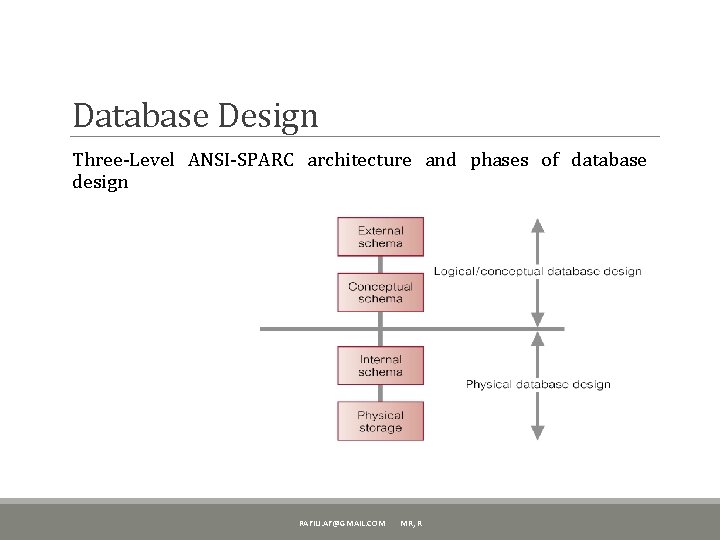
Database Design Three-Level ANSI-SPARC architecture and phases of database design RAFIU. AF@GMAIL. COM MR, R

And RAFIU. AF@GMAIL. COM MR, R
- Slides: 16