
Database Systems Course Overview Course Introduction A database
Database Systems Course Overview
Course Introduction A database is an organized collection of related data. In modern organizations databases are used to support day-to-day operations, such as personnel management, inventory control, and customer tracking. For instance, organizations such as libraries use database to keep track of their holdings and patron information while analyzing circulation data and customer profile to assess consumer demands and service quality. To provide instruction in both fundamental database principles and user-centric methodologies for effective creation of a database system, this course will focus on applications of basic database theories in the stand-alone environment of MS Access. Database Systems Seminar 2

Course Objectives Learn u u Practice u u Basic database concepts and theories. Basic data modeling principles. Database design Database implementation skills Understand u How to build database systems Database Systems Seminar 3
Course Requirements Prerequisites u u Basic computer skills Technical background is not required. Grading u u u Midterm Project (30%) Final Project (70%) Participation (Extra Credit) Database Systems Seminar 4
Course Requirements: Grading Midterm Project (30%) u DB specification consisting of · u DB Specification Template Final Project (70%) u u database objectives, business rules & E-R diagram MS Access implementation of the DB specification Sample Project Participation (Extra Credit) u e. g. , Class interactions, course feedback, etc. Database Systems Seminar 5
Course Policy This class advocates an open book policy of allowing students to consult textbooks, Internet resources, and classmates when working on assignments to facilitate learning and promote collaboration. The Honor Code is in effect. With the open book policy, it is especially important to clearly indicate in submitted work any materials used from other sources. Full citation information should be given for such sources. Students are expected to be active participant in class discussions, where they will ask questions, provide insights, and explore ideas. Database Systems Seminar 6
Course Resources Required Readings u Supplemental Readings u u u Lecture material and online contents Access 2013: The Missing Manual by Matthew Mac. Donald; 2013, Pogue Press Databases Demystified (2 nd Edition) by Andrew Oppel, March 2010, Mc. Graw-Hill Database Systems: Design, Implementation, and Management (12 th Edition) by Carlos Coronel, Steven A. Morris, Peter Rob; 2016, Cengage Learning Course Website u http: //widit 2. knu. ac. kr/~kiyang/teaching/g. DB/ Database Systems Seminar 7
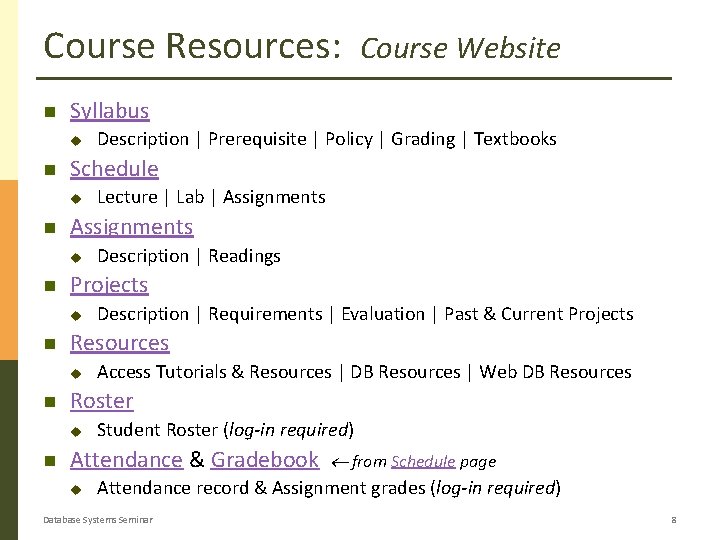
Course Resources: Syllabus u Access Tutorials & Resources | DB Resources | Web DB Resources Roster u Description | Requirements | Evaluation | Past & Current Projects Resources u Description | Readings Projects u Lecture | Lab | Assignments u Description | Prerequisite | Policy | Grading | Textbooks Schedule u Course Website Student Roster (log-in required) Attendance & Gradebook u from Schedule page Attendance record & Assignment grades (log-in required) Database Systems Seminar 8
Introduction to Database What is Database? Database란 무엇인가
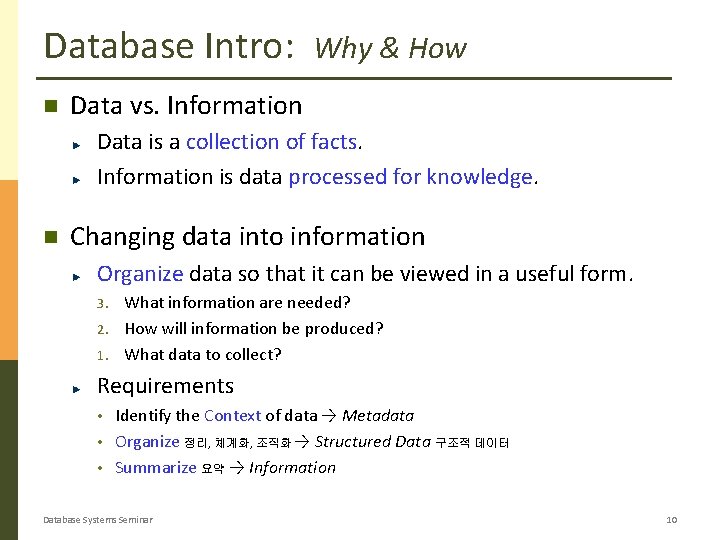
Database Intro: Why & How Data vs. Information Data is a collection of facts. Information is data processed for knowledge. Changing data into information Organize data so that it can be viewed in a useful form. What information are needed? 2. How will information be produced? 1. What data to collect? 3. Requirements Identify the Context of data → Metadata • Organize 정리, 체계화, 조직화 → Structured Data 구조적 데이터 • Summarize 요약 → Information • Database Systems Seminar 10
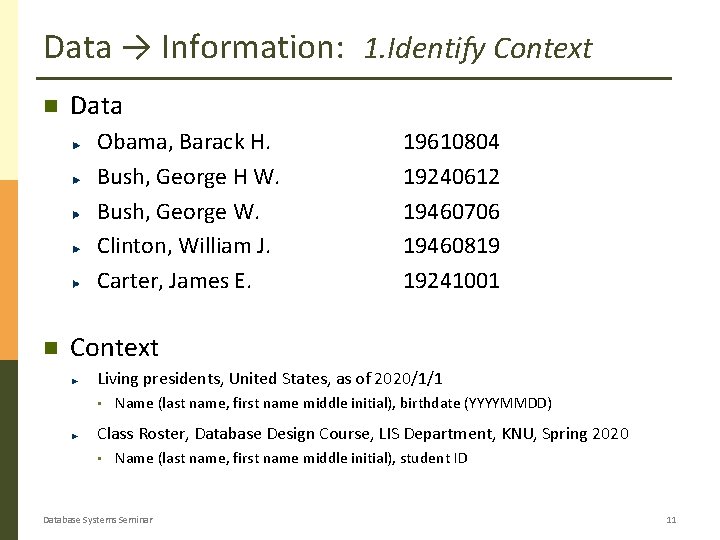
Data → Information: 1. Identify Context Data Obama, Barack H. Bush, George H W. Bush, George W. Clinton, William J. Carter, James E. 19610804 19240612 19460706 19460819 19241001 Context Living presidents, United States, as of 2020/1/1 • Name (last name, first name middle initial), birthdate (YYYYMMDD) Class Roster, Database Design Course, LIS Department, KNU, Spring 2020 • Name (last name, first name middle initial), student ID Database Systems Seminar 11
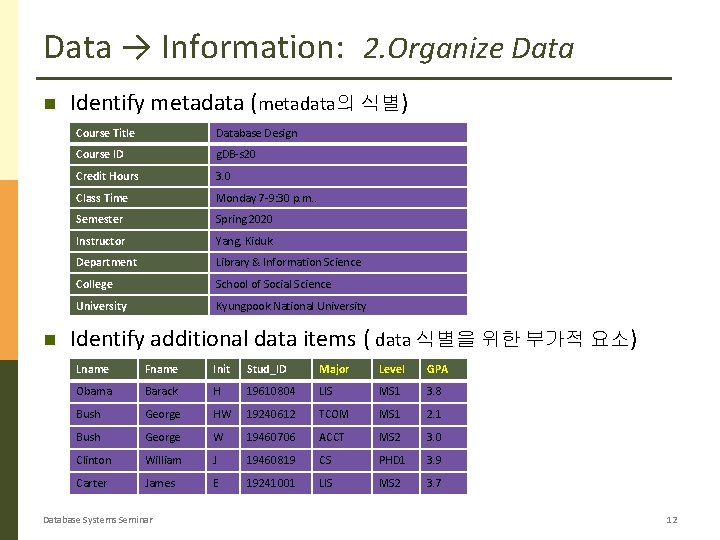
Data → Information: 2. Organize Data Identify metadata (metadata의 식별) Course Title Database Design Course ID g. DB-s 20 Credit Hours 3. 0 Class Time Monday 7 -9: 30 p. m. . Semester Spring 2020 Instructor Yang, Kiduk Department Library & Information Science College School of Social Science University Kyungpook National University Identify additional data items ( data 식별을 위한 부가적 요소) Lname Fname Init Stud_ID Major Level GPA Obama Barack H 19610804 LIS MS 1 3. 8 Bush George HW 19240612 TCOM MS 1 2. 1 Bush George W 19460706 ACCT MS 2 3. 0 Clinton William J 19460819 CS PHD 1 3. 9 Carter James E 19241001 LIS MS 2 3. 7 Database Systems Seminar 12
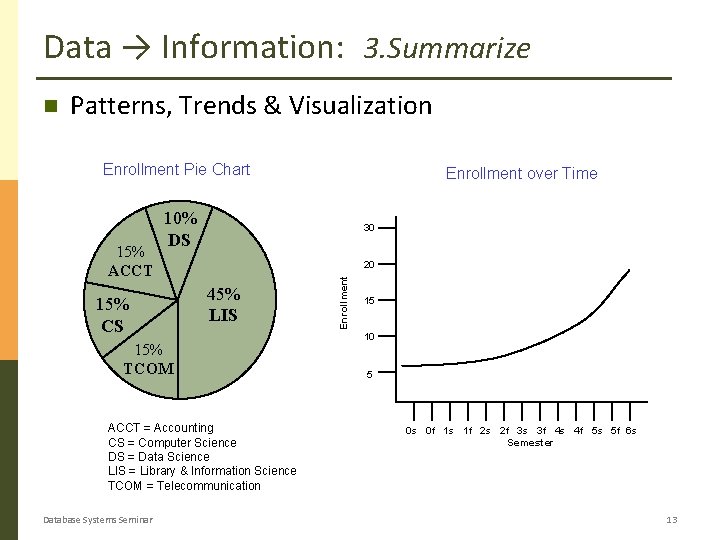
Data → Information: 3. Summarize Patterns, Trends & Visualization Enrollment Pie Chart 10% DS 15% CS 30 20 45% LIS 15% TCOM ACCT = Accounting CS = Computer Science DS = Data Science LIS = Library & Information Science TCOM = Telecommunication Database Systems Seminar Enrollment 15% ACCT Enrollment over Time 15 10 5 0 s 0 f 1 s 1 f 2 s 2 f 3 s 3 f 4 s 4 f 5 s 5 f 6 s Semester 13
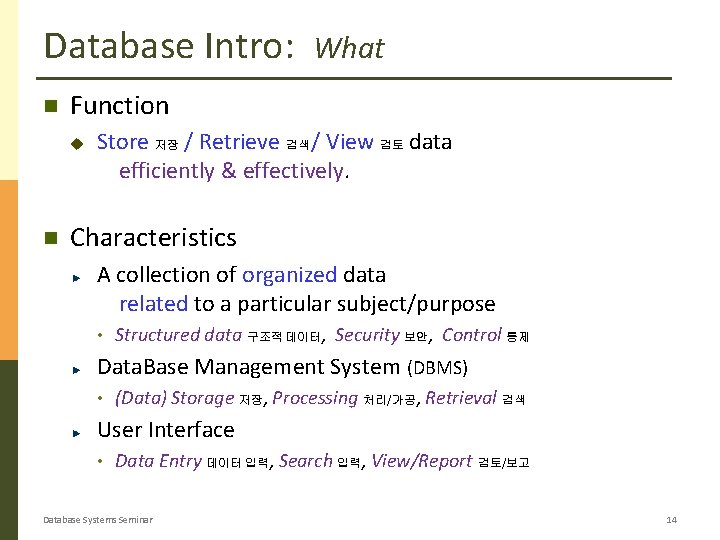
Database Intro: Function u What Store 저장 / Retrieve 검색 / View 검토 data efficiently & effectively. Characteristics A collection of organized data related to a particular subject/purpose • Structured data 구조적 데이터, Security 보안, Control 통제 Data. Base Management System (DBMS) • (Data) Storage 저장, Processing 처리/가공, Retrieval 검색 User Interface • Data Entry 데이터 입력, Search 입력, View/Report 검토/보고 Database Systems Seminar 14
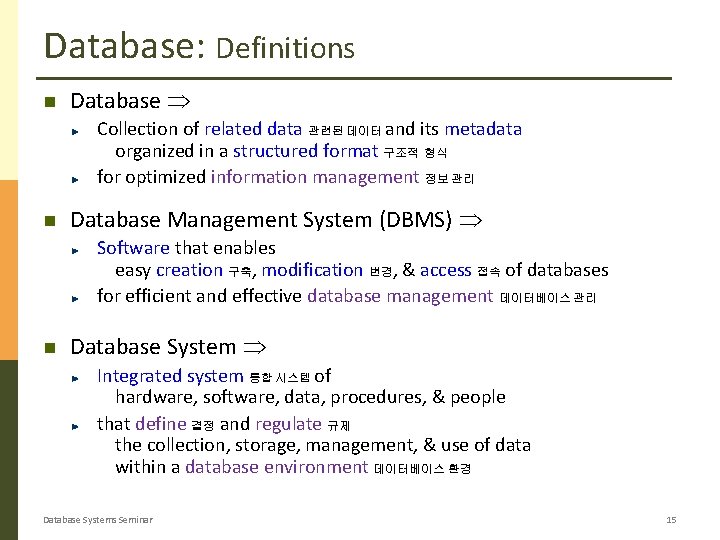
Database: Definitions Database Collection of related data 관련된 데이터 and its metadata organized in a structured format 구조적 형식 for optimized information management 정보 관리 Database Management System (DBMS) Software that enables easy creation 구축, modification 변경, & access 접속 of databases for efficient and effective database management 데이터베이스 관리 Database System Integrated system 통합 시스템 of hardware, software, data, procedures, & people that define 결정 and regulate 규제 the collection, storage, management, & use of data within a database environment 데이터베이스 환경 Database Systems Seminar 15
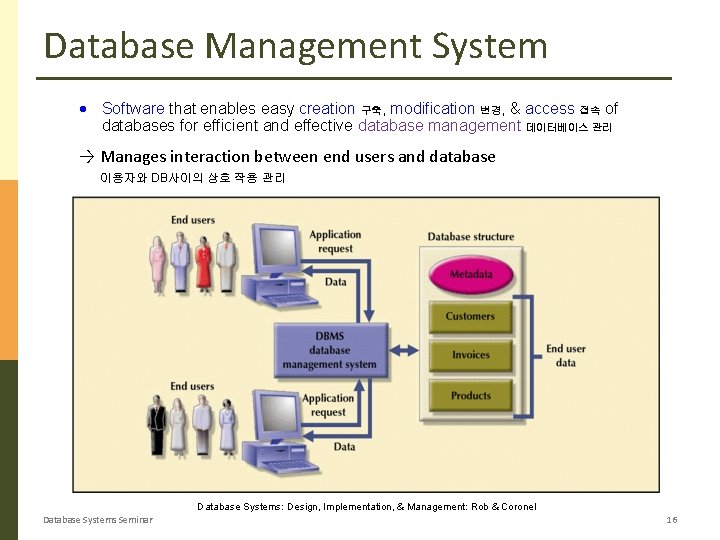
Database Management System · Software that enables easy creation 구축, modification 변경, & access 접속 of databases for efficient and effective database management 데이터베이스 관리 → Manages interaction between end users and database 이용자와 DB사이의 상호 작용 관리 Database Systems: Design, Implementation, & Management: Rob & Coronel Database Systems Seminar 16
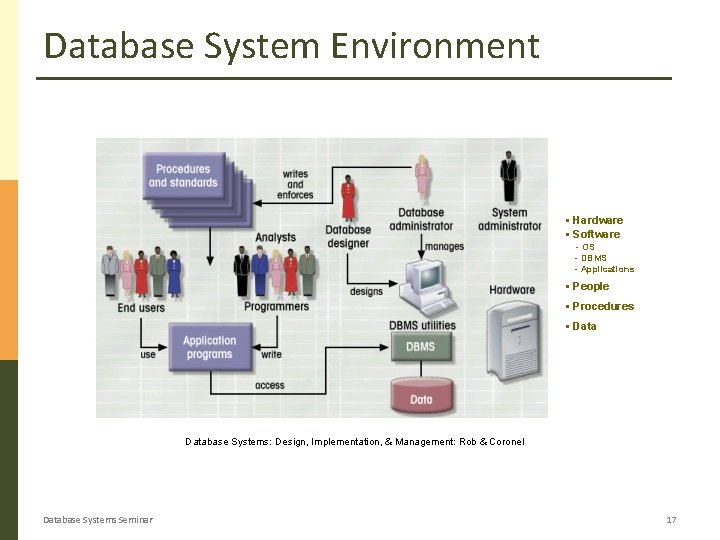
Database System Environment § Hardware § Software - OS - DBMS - Applications § People § Procedures § Database Systems: Design, Implementation, & Management: Rob & Coronel Database Systems Seminar 17
- Slides: 17