
DATABASE SYSTEM COCNEPTS AND ARCHITECTURE REPRESENTED BY RENUKA
DATABASE SYSTEM COCNEPTS AND ARCHITECTURE REPRESENTED BY RENUKA AND SUGUNA

INTRODUCTION �Earlier DBMS software package was one integrated system where large centralized mainframe computers were used. �The modern DBMS packages are modular in design, with a client/server architecture where hundreds of distributed workstations and personal computers are connected via communications network.
DATA MODELS �A datamodel is a collection of concepts that can be used to describe the structure of the data base. �It is a type of data abstraction that is used to provide conceptual representation. �It uses logical concepts that can be easily understood rather than the computer storage concepts. �A data model always hides the details of the data storage and implementation from the user.
CATAGORIES OF DATA MODELS �Data models are categorized based on the types of concepts that they provide to describe the database structure. �*high-level or conceptual data model �*low-level or physical data model �*representational or implementation data model
High level or conceptual data model �This model provides the concepts that are close to user views. The end users can understand them. It uses concepts such as entity, attributes and relationships. �An “entity” represents a real world object or concept such as an employee or a project that is stored in a database. �An “attribute” represents some property of interest that further describes an entity, such as employee’s name or salary. �A “relationship” among two or more entities represents an association among two or more entities, for example, relationship between an employee and a project.
Physical or low level model �This model provides the concepts that are close to the computer view of storage. �They are meant for computer specialists. �It describes how data is stored as files in the computer by representing information such as record formats, record orderings and access paths. �An access path is a structure that makes the search for particular database records efficient.
Representational model �This model is in between these two extremes of the pysical model and the conceptual model. �This doesnot hide all the storage details from the user and it can be implemented on a computer and hence is sometimes called “record-based data model”. �The current DBMS use representational(implementation)data models widely. �These includes the three most popular data models: �*Relational model �*Network model �*Hierarchical model
Schemas and instances �The database description is called as “database schema(meta data)”. �The database schema is defined during the database design only and it is not expected to change frequently. �Many of the data models provide the diagrammatic representation of the schema, known as the “schema diagram”. �Here, only the database structure is displayed without any actual data. �Each object in the schema is called a “schema construct”, such as student, course, section etc.
DATABASE STATES �The data contained by the database at any particular moment in time is called the state of the database or snapshot. �It is also known as current set of occurences or instances in the database. �When a new database is defined, its database schema is specified only to the DBMS. At this point of time, the database is in “empty state”with no data. �When the database is first loaded with initial data, it is said to be in the “initial state”. �Every time an update operation is performed on the database, it enters another database state. The state of the database at any instance of time is called the “current state”.
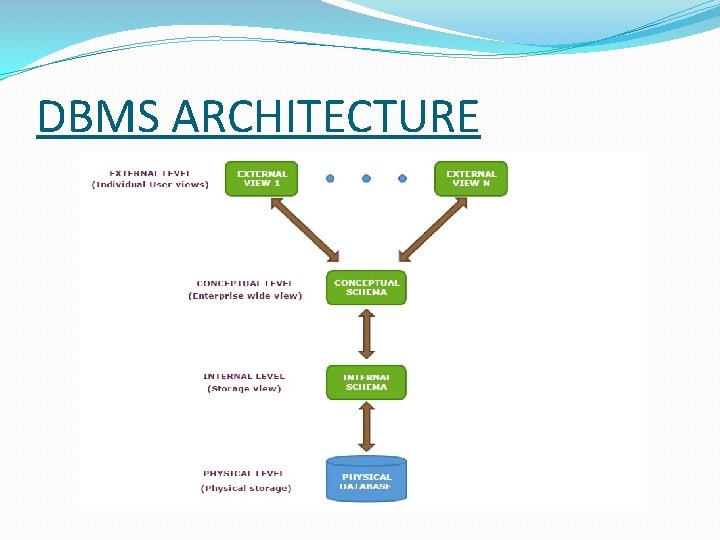
DBMS ARCHITECTURE �Dbms architecture consists of three levels known as “three schema architecture”. �It is a convenient tool with which the user can visualize the schema levels in a database system. It contains the following three schemas: �i. The internal level �ii. The conceptual level �Iii. The external level
DBMS ARCHITECTURE
MAPPING �The transformation of the requests and results between the three levels are called “maping”. �The two types of mapping are: �i. external/conceptual mapping �ii. conceptual/internal mapping
MAPPING �External/conceptual mapping: -The mapping between external and conceptual level, gives the correspondence between records and relationships of external and conceptual levels. �Conceptual/internal mapping: -The mapping between conceptual and internal levels gives the correspondence between the structure(meta data)and the size and position of the data in the stored database.
DATA INDEPENDENCE �It is defined as the capacity to change the schema at one level of the database system, without affecting the schema at the next higher level. �There are two types of data independence �i. logical data independence �ii. physical data independence
DATA INDEPENDENCE �Logical data independence: -It is the capacity to change the conceptual schema, without making any changes in external schema or application programs. �Physical data independence: -It is the capacity to change the internal schema without changing the conceptual(or externalschemas. Internal schema may have to undergo change because some physical files have to be organized, such as changing the access modes or paths for better retrieval or updates.
DATABASE LANGUAGES �The following are the languages used in DBMS. �i. data definition language(DDL) �ii. data manipulation language(DML) �iii. stored definition language(SDL) �iv. view definition language(VDL) �v. structured query language(SQL) �vi. ost language and data sub languages
Host language and data sub language �Host language is a general purpose programming language, in which either high level or low level DML commands are embedded. �The language consisting of the high level or low level DML commands is called “data sub language”. �In recent DBMS such as object-oriented systems, the host and the data sub languages typically form one integrated language such as C++.
DBMS INTERFACES �The user friendly interfaces may include the following: �i. menu based interfaces �ii. graphical interfaces �iii. forms based interfaces �iv. natural language interfaces �v. interface for parametric users �vi. interfaces for the DBA
DBMS INTERFACES �Menu based interfaces: -these interfaces present the user with a set of options called MENU through which the user can select an option to specify his needs. �Graphical interfaces: -in graphical interfaces, schema is represented diagrammatically, sometimes combined with menus. �Forms-based interfaces: -in this type, a form is displayed to the user.
DBMS INTERFACES �Natural language interfaces: -this includes commands in english or some other language and the interface tries to understand them. �Interface for parametric users: -parametric users, such as bank tellers and reservation clerks, who are using only limited operations repeatedly, have usually some function keys to repeat the requests. �Interfaces for the DBA: -most database systems contain privileged commands that can be used only by the staff of DBA.
DATABASE SYSTEM ENVIRONMENT �DBMS is a complex software system. �The database system environment consists of various types of software components that constitute a DBMS and the types of computer system software with which the �The database and DBMS catalog are usually stored on disk. �Disk management is taken care of by the operating system.
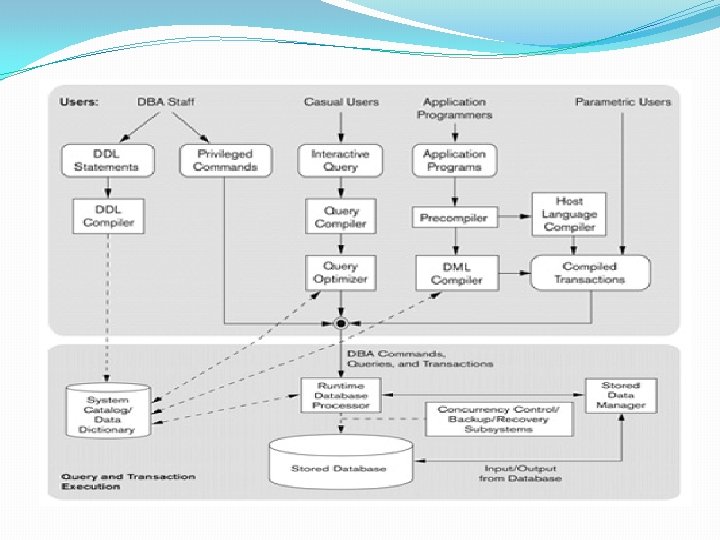
Functions of DDL compiler �The basic functions of the DDL compiler are: �i. schema definition �ii. storage structure and access method definition �iii. schema and physical organization modification �iv. granting of authorization for data access.
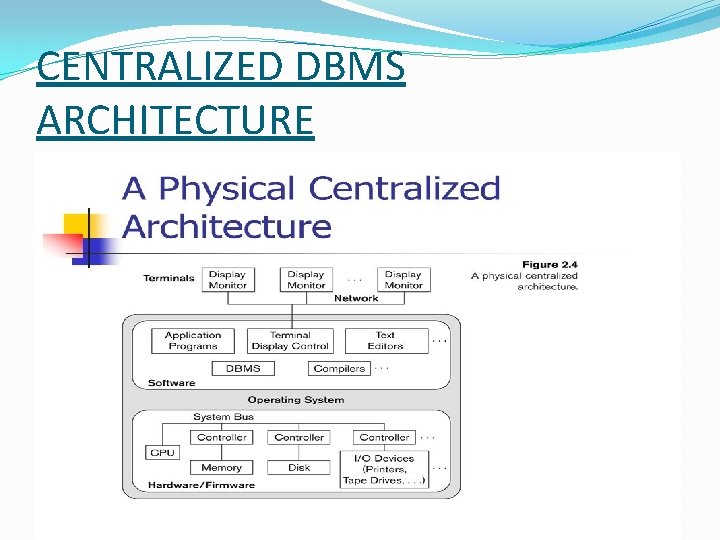
CENTRALIZED DBMS ARCHITECTURE �With the use of personal computers and work stations, the database systems were centralized in which all the DBMS functionality, application program execution and user interface processing were carried out on one machine. �In a centralized database system, always the data and the DBMS software reside only at one place or site.
CENTRALIZED DBMS ARCHITECTURE
DISTRIBUTED DBMS �But as the complexity of the database, it becomes difficult to handle the database entirely at one place. �The solution for this is to distribute the database into different sites, which are interconnected through some communication network.
ADVANTAGES OF DISTRIBUTED DBMS �Naturally distributed data �Reliability and availability �Controlled data sharing �Improved performance
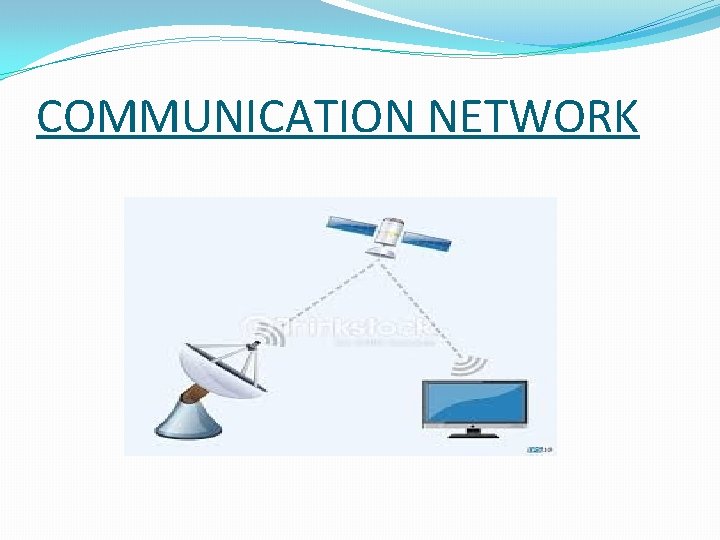
CLIENT/SERVER ARCHITECTURE �The client/server architecture was developed to deal with computing environments in which a large number of PC’s , workstations, file servers, printers, database servers, web servers and other equipment are connected via a network. �In client/server architecture, number of personal computers, work stations, servers and printers are involved.
COMMUNICATION NETWORK
COMMUNICATION NETWORK
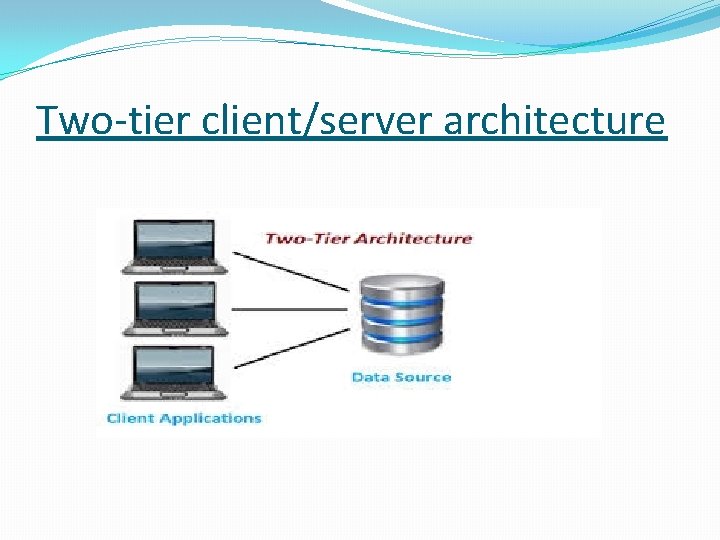
Two-tier client/server architecture �In a two-tier architecture, the software components are distributed over two systems: the client and the server. �Client: -is a user machine that provides user interface capabilities and local processing. �Server: -is a machine that can provide services to the client machines such as file access, printing, archiving, or database access.
Two-tier client/server architecture
Advantages of 2 tier architecture �Simplicity �Compatibility with existing systems
Three-tier client/server architecture �With the emergence of world wide web, many web applications use three-tier architecture. �There is an intermediate layer between the client and the database server called the application server or web server and is named according to the application.
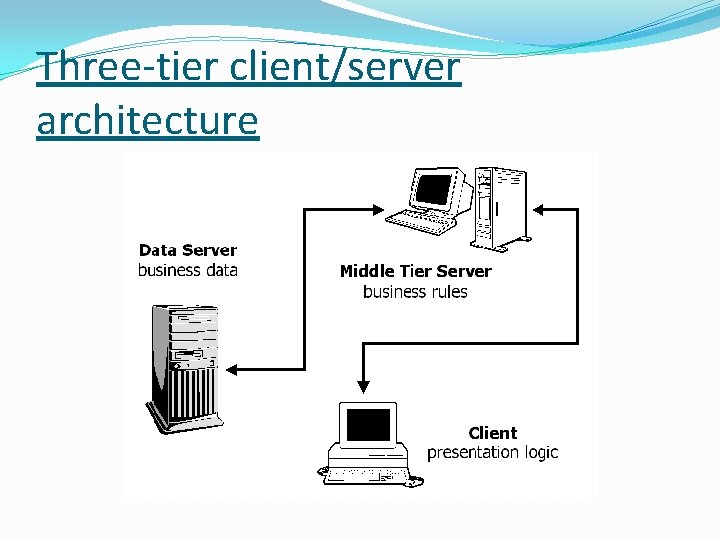
Three-tier client/server architecture
CLASSIFICATION OF DBMS �DBMS may be classified in various ways �Based on data model �Based on number of users that are supported by the system �Based on number of sites that the database is distributed �Based on the purpose �Based on cost
Based on the data models �Relational �Network �Hierarchical �Object-oriented �Object-relational
Relational model �The principles of the relational model were first outlined by Dr. E. F. codd. �The relational data model represents a database as collection of tables, where each table can be stored as a separate file.
Network model �The network data model represents data in terms of records and also 1: N relationship, called as a set type. �The network model permitted the modeling of manyto-many relationships in data.
Characteristics of network model �Data is organized into logical units called record types. �Record types can have more than one owner (each data grouping can be belong to more than one category) �There are many efficient entry points into the database.
Hierarchical data model �In a hierarchical data model, data is organized into a tree like structure. �Each hierarchy represents a number of related records. �There is a hierarchy of parent and child data segments.
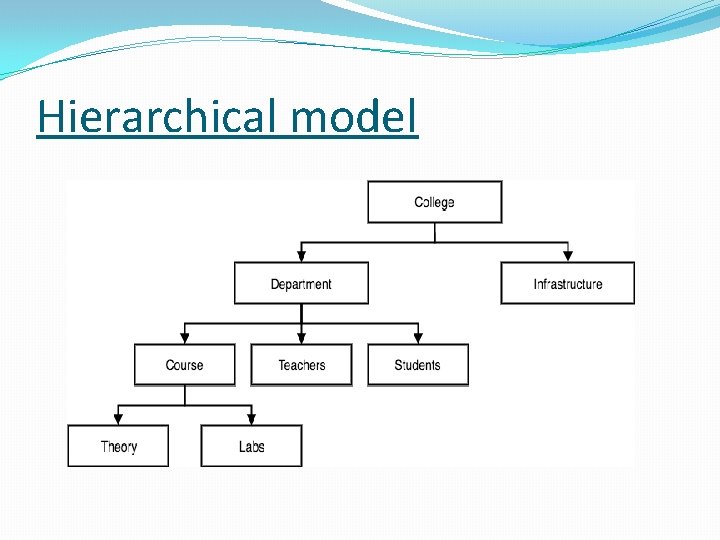
Hierarchical model
Characteristics of hierarchical data model �Data is grouped into logical units called segment types. �Segment types are linked in a parent/child hierarchy where each child segment type has only one parent segment type. �There is only one efficient entry point �Databases use physical pointers to link records.
Advantages �The structure of a hierarchical database is easy to understand. The hierarchy is based on logical relationships between parent and child segment types. �They provide very efficient high speed retrieval.
Disadvantages �They are difficult to modify as an organization’s data needs change. �It is difficult to use them to represent non-hierarchical relationships.
Object-oriented model �The object oriented model defines a database in terms of objects, their properties and their operations. �Objects of same structure belong to same class, and classes areorganized into hierarchical or acyclic graphs. �In recent days, number of commercial object oriented packages are available. �The most recently developed data model used in databases is the object oriented model.
Futures/characteristics of object oriented database model �Use relational-like linkages among tables �Support the basic elements of the object approach used in object oriented programming languages including: inheritence, use of methods, and encapsulation. �Support modularization (component based development ) reuse of components �Added complexity of objects structures
advantages �It provides higher performance management of objects, and it enables better management of the complex inter relationships between objects. �This makes object DBMSs better suited to support applications such as telecommunication service applications, world wide web document structures, design and manufacturing systems, hospital record systems, which have complex relationship between data.
Object-relational model �Object-relational database management system(ORDBMSs)add new object storage capacity to the relational systems at the core of modern information systems. �This new facilities integrate management of traditional fielded data, complex objects such as time series and geo spatial data and diverse binary media such as audio, video, images, and applets.
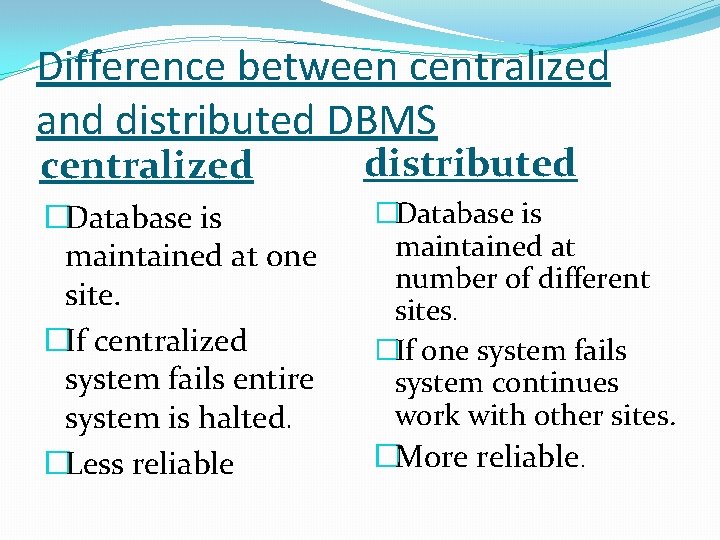
Difference between centralized and distributed DBMS centralized �Database is maintained at one site. �If centralized system fails entire system is halted. �Less reliable distributed �Database is maintained at number of different sites. �If one system fails system continues work with other sites. �More reliable.

- Slides: 52