
Database Security and Auditing Protecting Data Integrity and
Database Security and Auditing: Protecting Data Integrity and Accessibility Chapter 5 Database Application Security Models Database Security & Auditing: Protecting Data Integrity &
Objectives • Describe the different types of users in a database environment and the distinct purpose of each • Identify and explain the concepts of five security models • List the most commonly used application types Database Security & Auditing: Protecting Data Integrity & Accessibility 2
Objectives (continued) • Implement the most common application security models • Understand the use of data encryption within database applications Database Security & Auditing: Protecting Data Integrity & Accessibility 3
Types of Users • Application: – Solves a problem – Performs a specific business function • Database: collection of related data files used by an application • Application user: user within the application schema Database Security & Auditing: Protecting Data Integrity & Accessibility 4
Types of Users (continued) • Types: – Application administrator – Application owner – Application user – Database administrator – Database user – Proxy user – Schema owner – Virtual user Database Security & Auditing: Protecting Data Integrity & Accessibility 5
Security Models • Access Matrix Model: – Represents two main entities: objects and subjects: • Columns represent objects • Rows represent subjects – Objects: tables, views, procedures, database objects – Subjects: users, roles, privileges, modules – Authorization cell Database Security & Auditing: Protecting Data Integrity & Accessibility 6
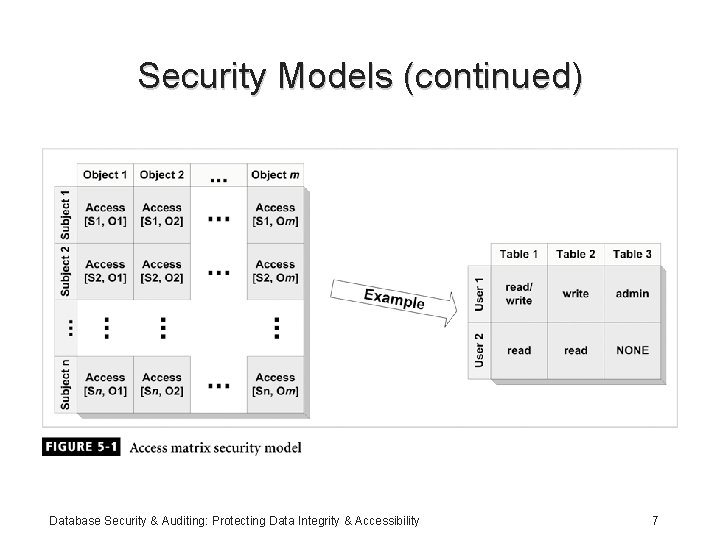
Security Models (continued) Database Security & Auditing: Protecting Data Integrity & Accessibility 7
Security Models (continued) • Access Model: – Based on the Take-Grant model – Uses objects and subjects – Specifies access modes: static and dynamic modes – Access levels: a subject has access to objects at its level and all levels below it Database Security & Auditing: Protecting Data Integrity & Accessibility 8
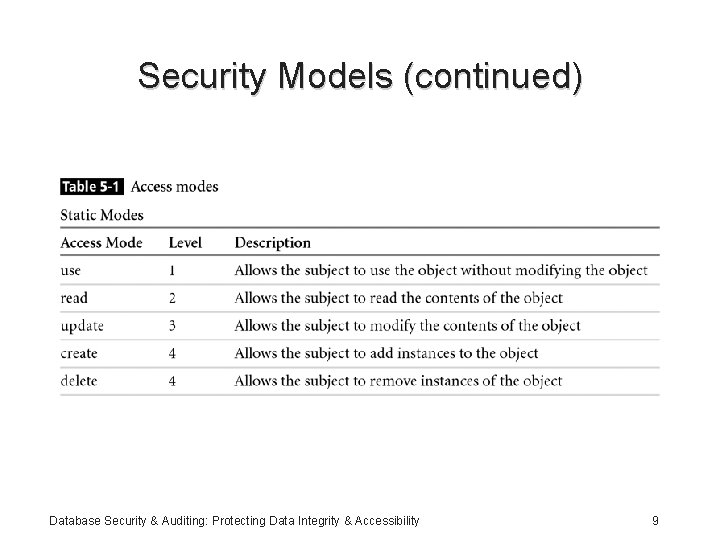
Security Models (continued) Database Security & Auditing: Protecting Data Integrity & Accessibility 9
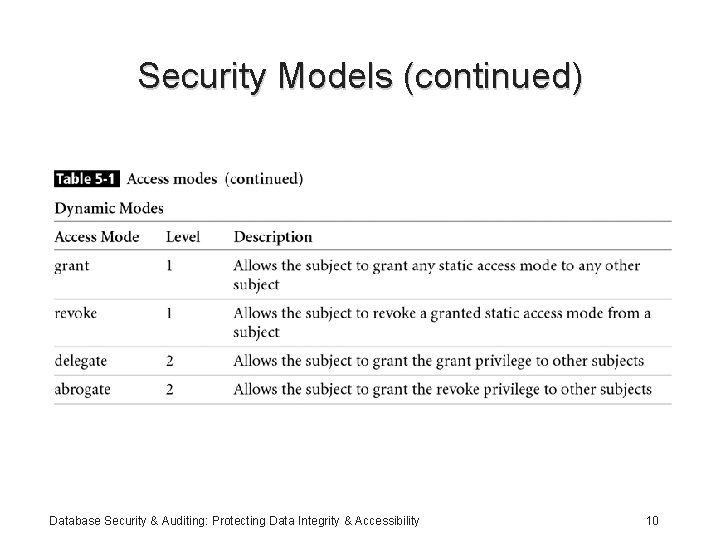
Security Models (continued) Database Security & Auditing: Protecting Data Integrity & Accessibility 10
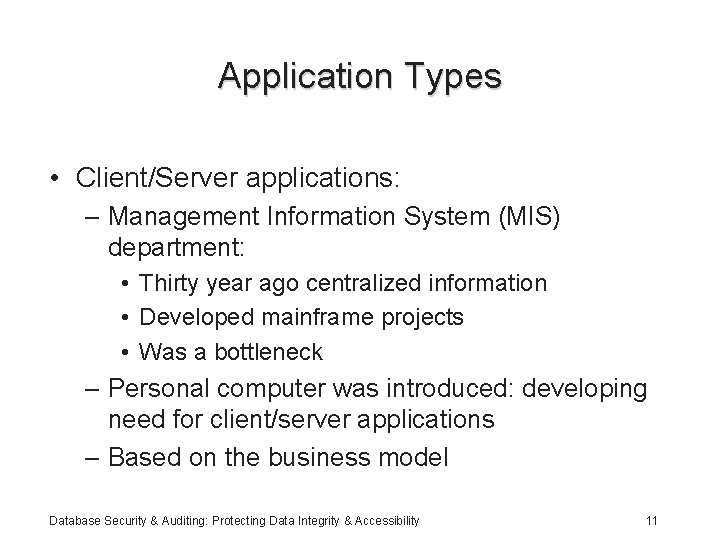
Application Types • Client/Server applications: – Management Information System (MIS) department: • Thirty year ago centralized information • Developed mainframe projects • Was a bottleneck – Personal computer was introduced: developing need for client/server applications – Based on the business model Database Security & Auditing: Protecting Data Integrity & Accessibility 11
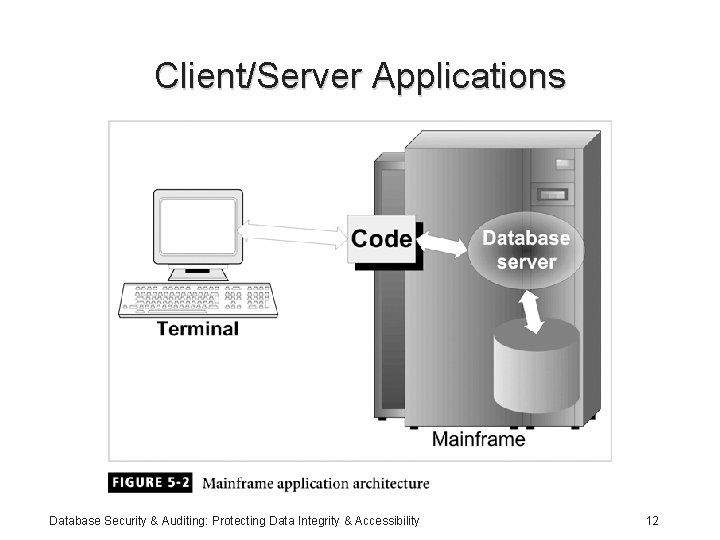
Client/Server Applications Database Security & Auditing: Protecting Data Integrity & Accessibility 12
Client/Server Applications (continued) • Provides a flexible and scalable structure • Components: – User interface – Business logic – Data access • Components usually spread out over several tiers: – Minimum two – Normally, four to five Database Security & Auditing: Protecting Data Integrity & Accessibility 13
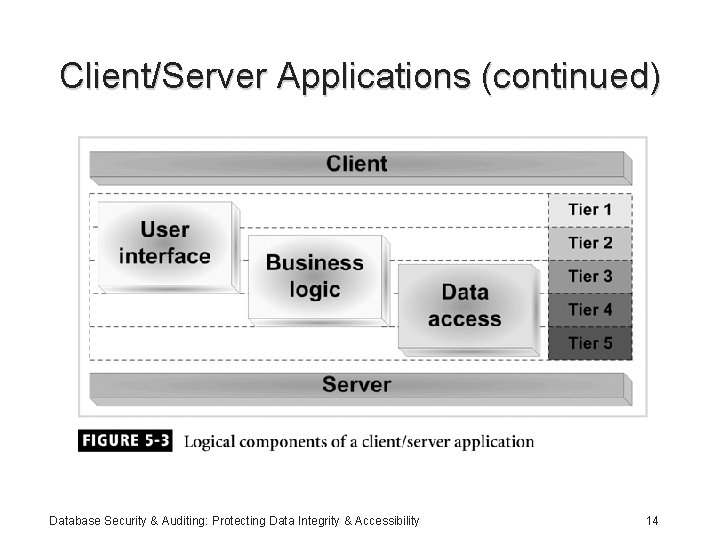
Client/Server Applications (continued) Database Security & Auditing: Protecting Data Integrity & Accessibility 14
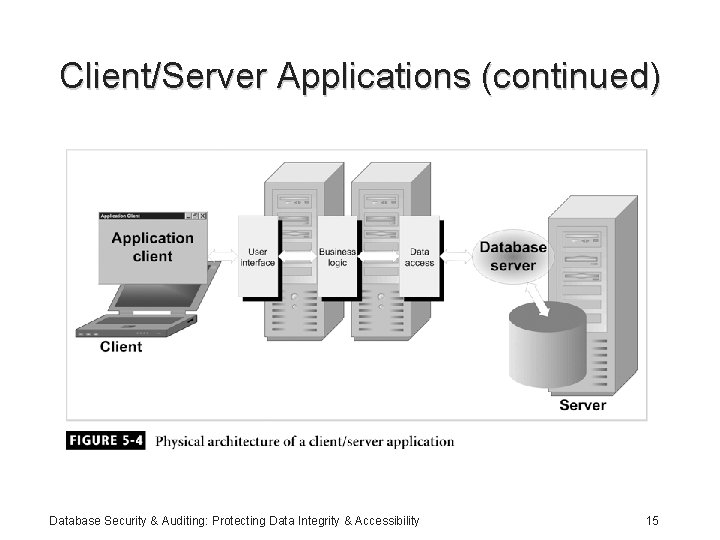
Client/Server Applications (continued) Database Security & Auditing: Protecting Data Integrity & Accessibility 15
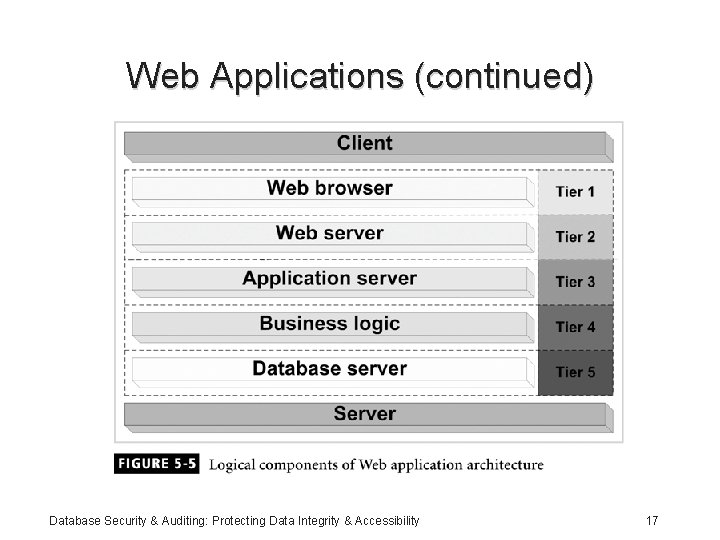
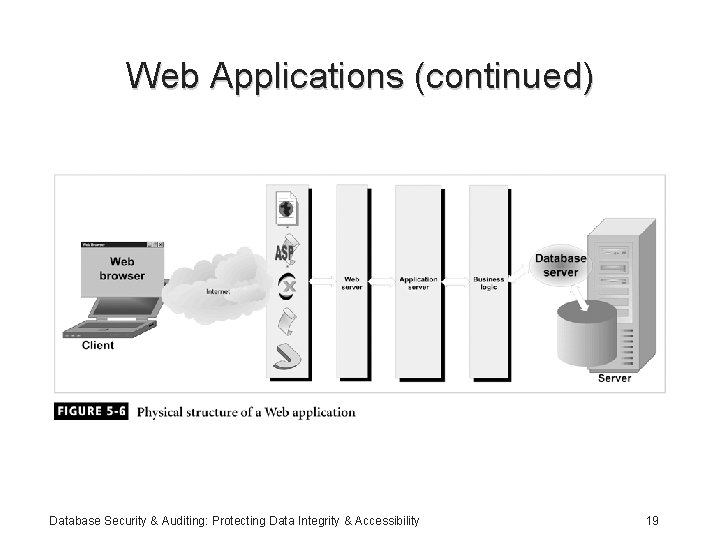
Web Applications • Evolved with the rise of dot-com and Webbased companies • Uses the Web to connect and communicate to the server • A Web application uses HTML pages created using: – Active. X – Java applets or beans – ASP (Active Server Pages) Database Security & Auditing: Protecting Data Integrity & Accessibility 16
Web Applications (continued) Database Security & Auditing: Protecting Data Integrity & Accessibility 17
Web Applications (continued) • Components: – Web browser layer – Web server layer – Application server layer – Business logic layer – Database server layer Database Security & Auditing: Protecting Data Integrity & Accessibility 18
Web Applications (continued) Database Security & Auditing: Protecting Data Integrity & Accessibility 19
Data Warehouse Applications • Used in decision-support applications • Collection of many types of data taken from a number of different databases • Typically composed of a database server • Accessed by software applications or reporting applications: online analytical processing (OLAP) Database Security & Auditing: Protecting Data Integrity & Accessibility 20
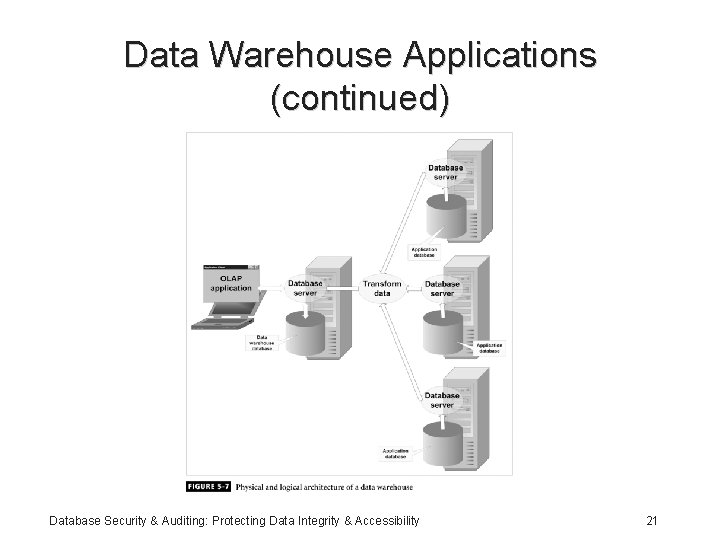
Data Warehouse Applications (continued) Database Security & Auditing: Protecting Data Integrity & Accessibility 21
Application Security Models • Models: – Database role based – Application function based – Application role and function based – Application table based Database Security & Auditing: Protecting Data Integrity & Accessibility 22
Security Model Based on Database Roles • Application authenticates application users: maintain all users in a table • Each user is assigned a role; roles have privileges assigned to them • A proxy user is needed to activate assigned roles; all roles are assigned to the proxy user • Model and privileges are database dependent Database Security & Auditing: Protecting Data Integrity & Accessibility 23
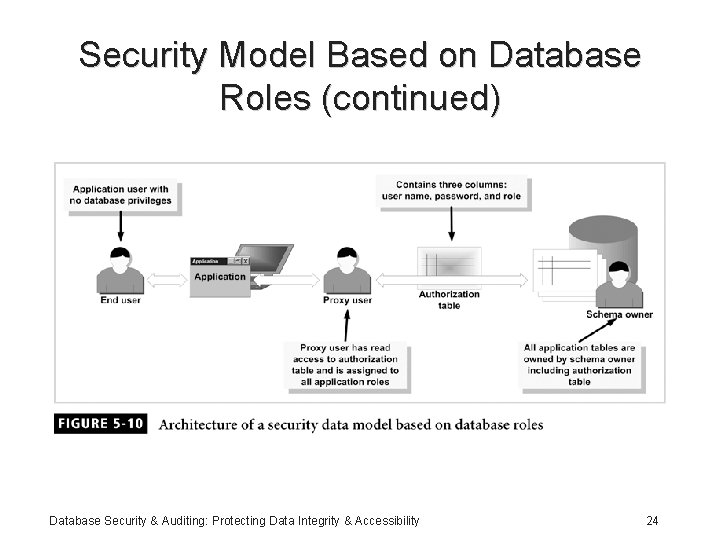
Security Model Based on Database Roles (continued) Database Security & Auditing: Protecting Data Integrity & Accessibility 24
Security Model Based on Database Roles (continued) • Implementation in Oracle: – Create users – Add content to your tables – Add a row for an application user – Look for application user’s role – Activate the role for this specific session Database Security & Auditing: Protecting Data Integrity & Accessibility 25
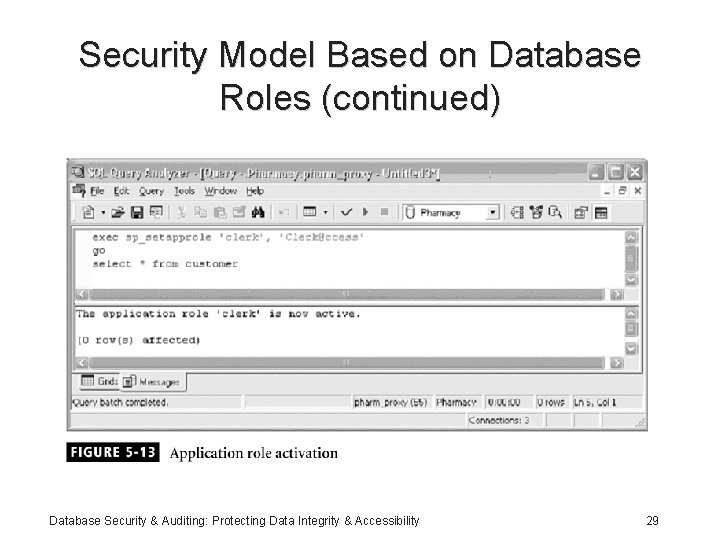
Security Model Based on Database Roles (continued) • Implementation in SQL Server: – Use application roles: • Special roles you that are activated at the time of authorization • Require a password and cannot contain members – Connect a user to the application role: overrules user’s privileges Database Security & Auditing: Protecting Data Integrity & Accessibility 26
Security Model Based on Database Roles (continued) • Implementation in SQL Server (continued): – Create and drop application roles using the command line and the Enterprise Manager: • SP_ADDAPPROLE • SP_DROPAPPROLE – You can activate application roles using SP_SETAPPROLE Database Security & Auditing: Protecting Data Integrity & Accessibility 27
Security Model Based on Database Roles (continued) • Implementation in SQL Server (continued): – Connect to database as the proxy user – Validate the user name and password – Retrieve the application role name – Activate the application role Database Security & Auditing: Protecting Data Integrity & Accessibility 28
Security Model Based on Database Roles (continued) Database Security & Auditing: Protecting Data Integrity & Accessibility 29
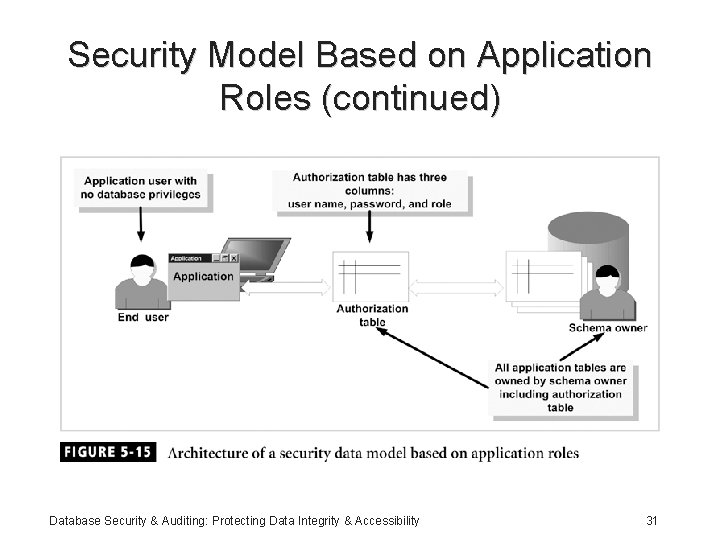
Security Model Based on Application Roles • Application roles are mapped to real business roles • Application authenticates users • Each user is assigned to an application role; application roles are provided with application privileges (read and write) Database Security & Auditing: Protecting Data Integrity & Accessibility 30
Security Model Based on Application Roles (continued) Database Security & Auditing: Protecting Data Integrity & Accessibility 31
Security Model Based on Application Roles (continued) • Implementation in SQL Server – Create a database user – Connect the application to the database using this user – Create stored procedures to perform all database operations Database Security & Auditing: Protecting Data Integrity & Accessibility 32
Security Model Based on Application Functions • Application authenticates users • Application is divided into functions • Considerations: – Isolates application security from database – Passwords must be securely encrypted – Must use a real database user – Granular privileges require more effort during implementation Database Security & Auditing: Protecting Data Integrity & Accessibility 33
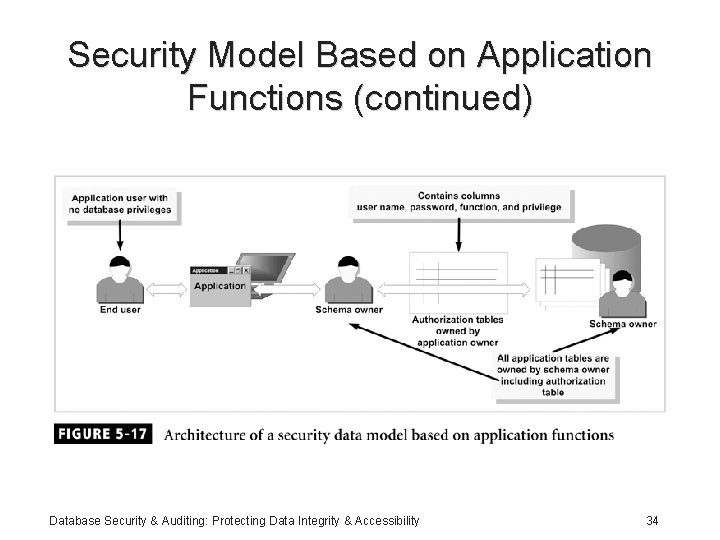
Security Model Based on Application Functions (continued) Database Security & Auditing: Protecting Data Integrity & Accessibility 34
Security Model Based on Application Roles and Functions • Combination of models • Application authenticates users • Application is divided into functions: – Roles are assigned to functions – Functions are assigned to users • Highly flexible model Database Security & Auditing: Protecting Data Integrity & Accessibility 35
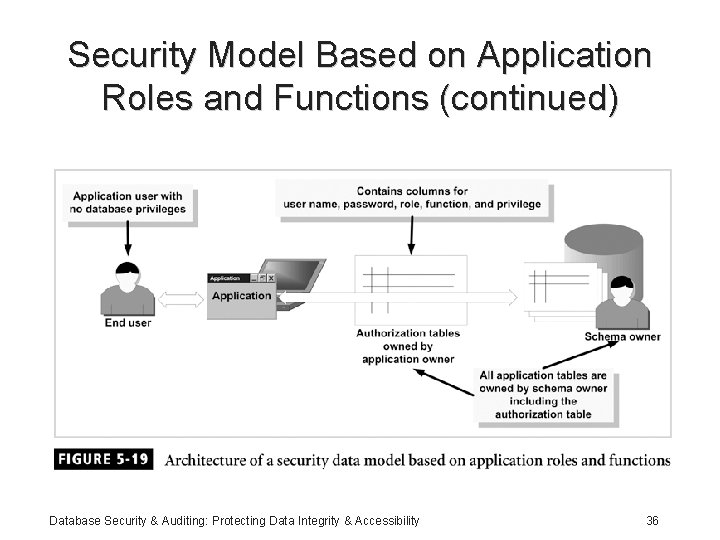
Security Model Based on Application Roles and Functions (continued) Database Security & Auditing: Protecting Data Integrity & Accessibility 36
Security Model Based on Application Tables • Depends on the application to authenticate users • Application provides privileges to the user based on tables; not on a role or a function • User is assigned access privilege to each table owned by the application owner Database Security & Auditing: Protecting Data Integrity & Accessibility 37
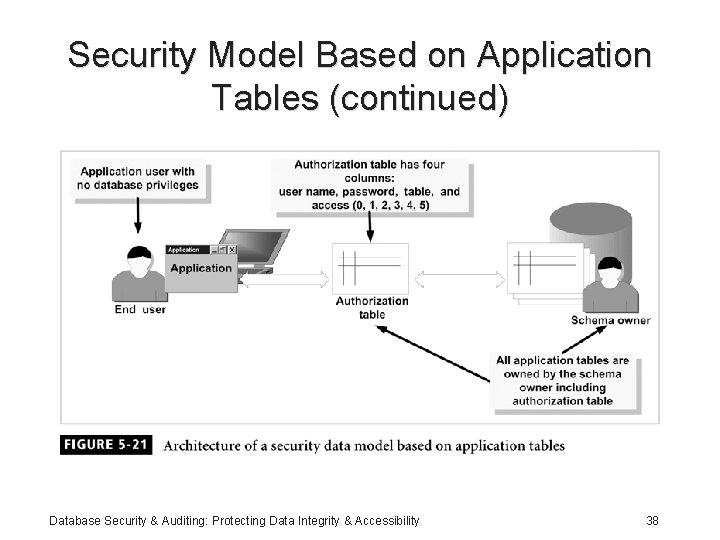
Security Model Based on Application Tables (continued) Database Security & Auditing: Protecting Data Integrity & Accessibility 38
Security Model Based on Application Tables (continued) • Implementation in SQL Server: – Grant authorization on application functions to the end user – Alter authorization table from the security model based on database roles; incorporate the table and access columns required to support model Database Security & Auditing: Protecting Data Integrity & Accessibility 39
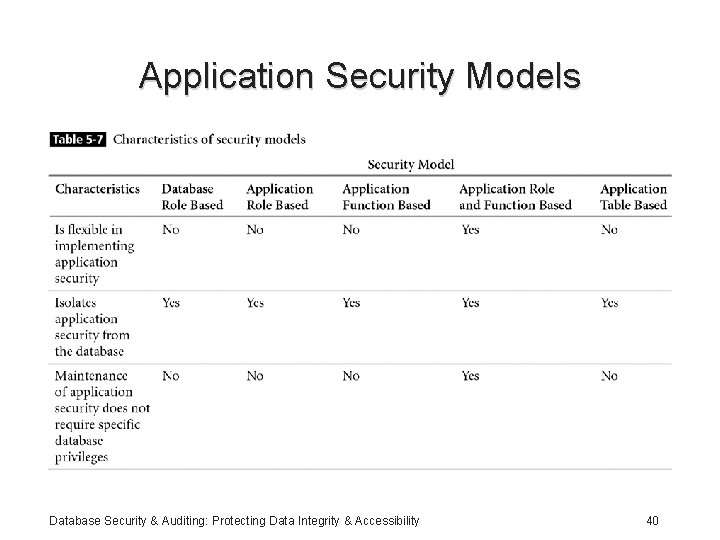
Application Security Models Database Security & Auditing: Protecting Data Integrity & Accessibility 40
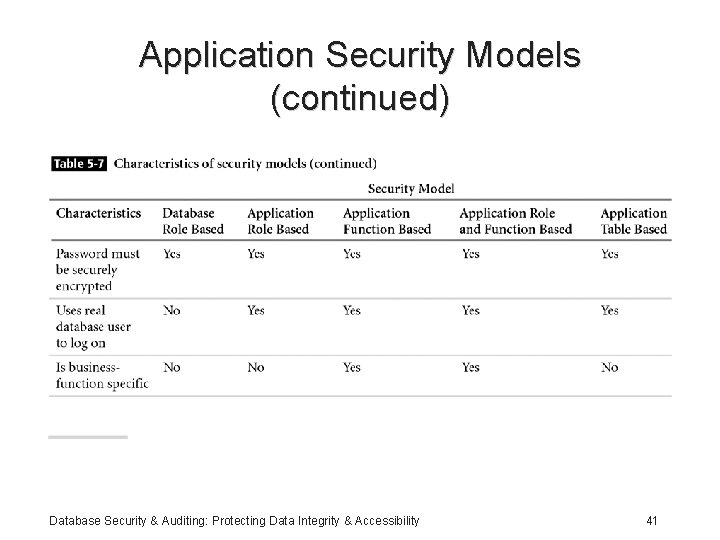
Application Security Models (continued) Database Security & Auditing: Protecting Data Integrity & Accessibility 41
Data Encryption • Passwords should be kept confidential and preferably encrypted • Passwords should be compared encrypted: – Never decrypt the data – Hash the passwords and compare the hashes Database Security & Auditing: Protecting Data Integrity & Accessibility 42
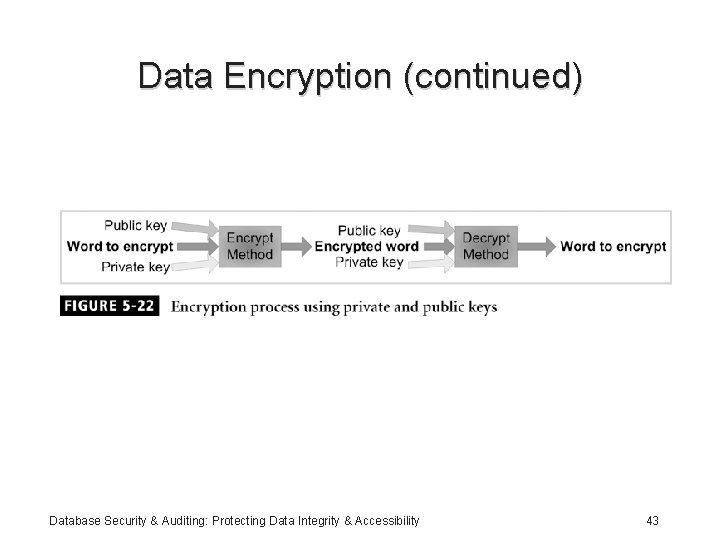
Data Encryption (continued) Database Security & Auditing: Protecting Data Integrity & Accessibility 43
Summary • An application user is simply a record created for a user within the application schema; usually does not have database privileges or roles assigned • Access matrix: – Columns represent objects – Rows represent subjects – Authorization cell • Access mode Database Security & Auditing: Protecting Data Integrity & Accessibility 44
Summary (continued) • Application types: client/server, Web, and Data Warehouse • Application security models – Database roles – Application functions – Roles and functions in the application – Application tables Database Security & Auditing: Protecting Data Integrity & Accessibility 45
- Slides: 45