
Database Normalization Housekeeping n Assignment 1 marked n
+ Database Normalization

+ Housekeeping n Assignment 1 marked n Assignment 1 & 2 solutions will be posted this morning n Quiz 1 – pick up at end of class n Quiz 2 – will mark before Friday’s class (return on Fri) n Mid-term: Monday, February 18 th n If can’t make it, or need accommodations, email me NOW n Coverage: Database design: ER diagrams, conversion to tables, normalization, relational algebra n Closed book 12/29/2021

+ Fundamentals of Database Management Systems by Mark L. Gillenson, Ph. D. University of Memphis John Wiley & Sons, Inc. Chapter 7 Logical Database Design
+ 7 -4 Chapter Objectives n Describe the data normalization process n Perform the data normalization process. n Test tables for irregularities using the data normalization process.
+ 7 -5 Logical Database Design n The process of deciding how to arrange the attributes of the entities in the business environment into database structures, such as the tables of a relational database. n The goal is to create well structured tables that properly reflect the company’s business environment.

+ 7 -6 Logical Design of Relational Database Systems n (1) The conversion of E-R diagrams into relational tables. n (2) The data normalization technique. n (3) The use of the data normalization technique to test the tables resulting from the E-R diagram conversions.
+ 7 -7 The Data Normalization Process n A methodology for organizing attributes into tables so that redundancy among the nonkey attributes is eliminated. n The output of the data normalization process is a properly structured relational database.
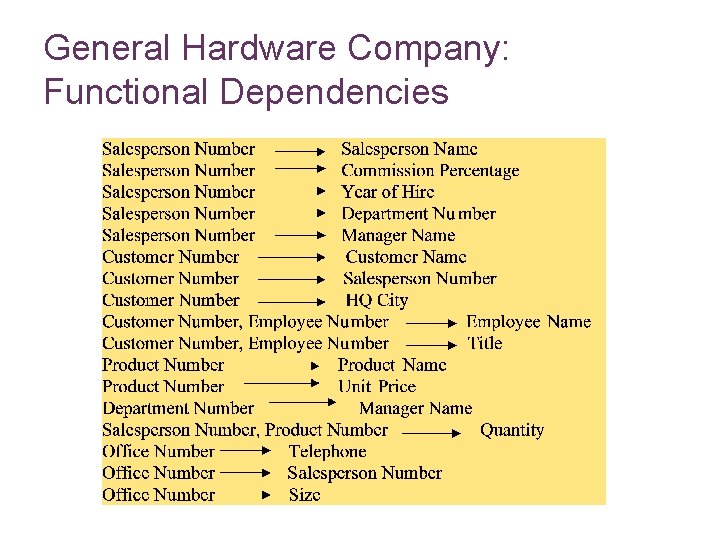
+ 7 -8 The Data Normalization Technique n Input: n all the attributes that must be incorporated into the database na list of all the defining associations between the attributes (i. e. , the functional dependencies). n a means of expressing that the value of one particular attribute is associated with a single, specific value of another attribute. n If we know that one of these attributes has a particular value, then the other attribute must have some other value.
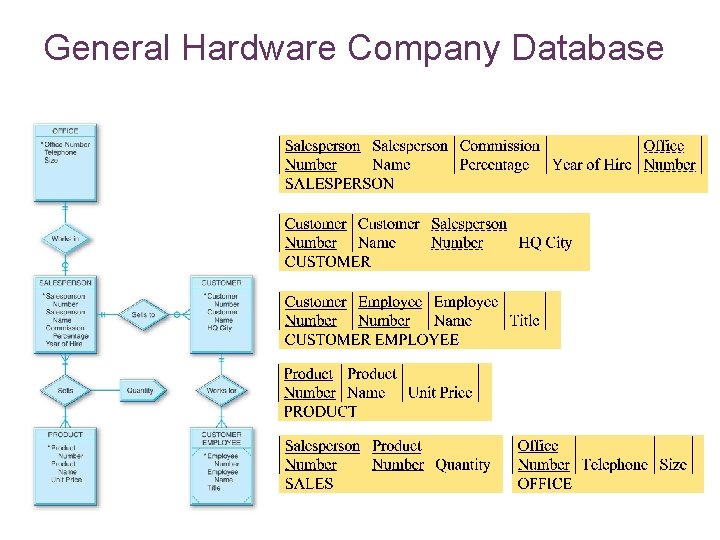
General Hardware Company Database 7 -9
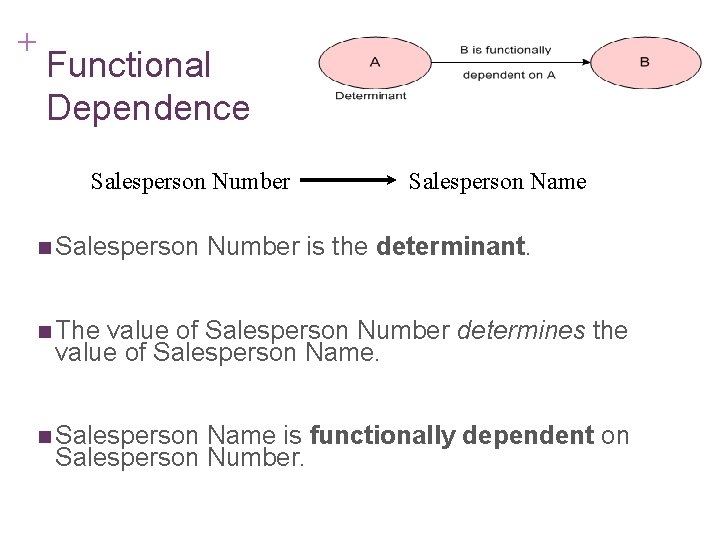
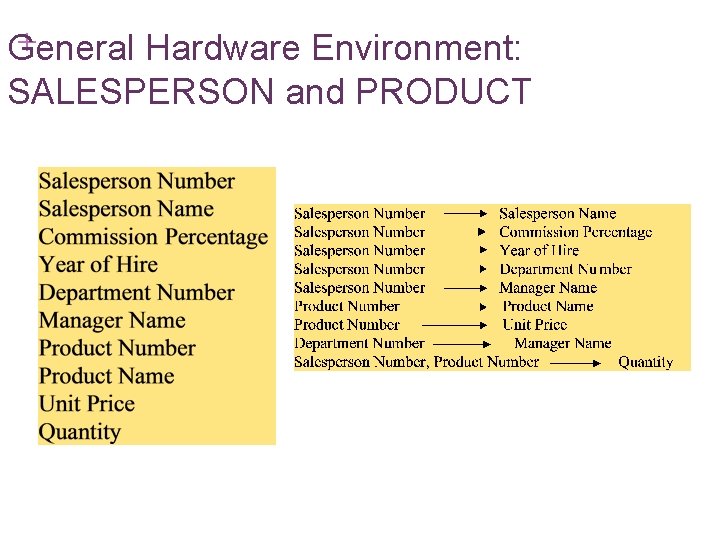
+ 7 -10 Functional Dependence Salesperson Number n Salesperson Name Number is the determinant. n The value of Salesperson Number determines the value of Salesperson Name. n Salesperson Name is functionally dependent on Salesperson Number.
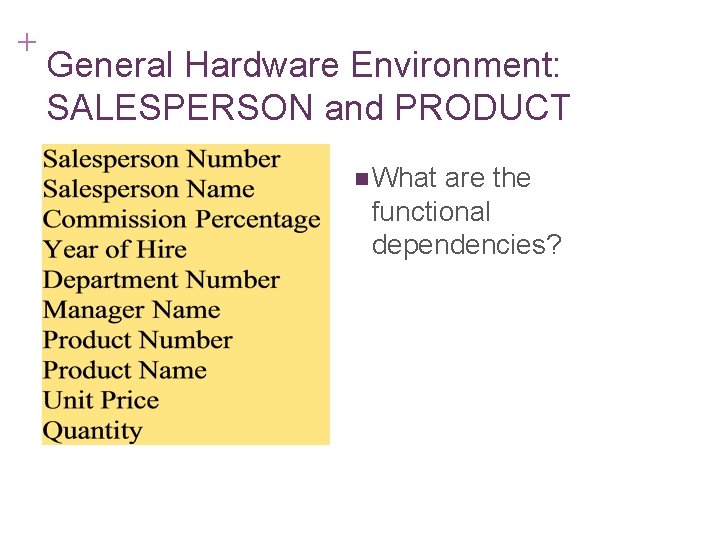
+ 7 -11 General Hardware Environment: SALESPERSON and PRODUCT n What are the functional dependencies?
+ General Hardware Environment: SALESPERSON and PRODUCT 7 -12
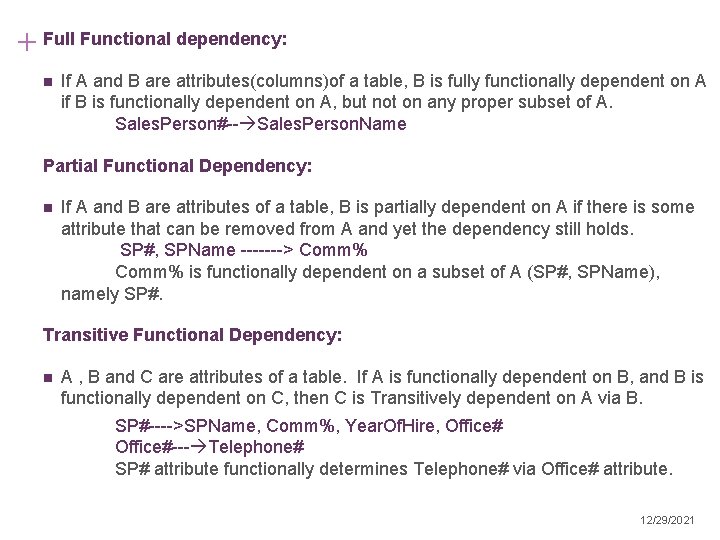
+ Full Functional dependency: n If A and B are attributes(columns)of a table, B is fully functionally dependent on A if B is functionally dependent on A, but not on any proper subset of A. Sales. Person#-- Sales. Person. Name Partial Functional Dependency: n If A and B are attributes of a table, B is partially dependent on A if there is some attribute that can be removed from A and yet the dependency still holds. SP#, SPName -------> Comm% is functionally dependent on a subset of A (SP#, SPName), namely SP#. Transitive Functional Dependency: n A , B and C are attributes of a table. If A is functionally dependent on B, and B is functionally dependent on C, then C is Transitively dependent on A via B. SP#---->SPName, Comm%, Year. Of. Hire, Office#--- Telephone# SP# attribute functionally determines Telephone# via Office# attribute. 12/29/2021
+ Steps in the Data Normalization Process 7 -14

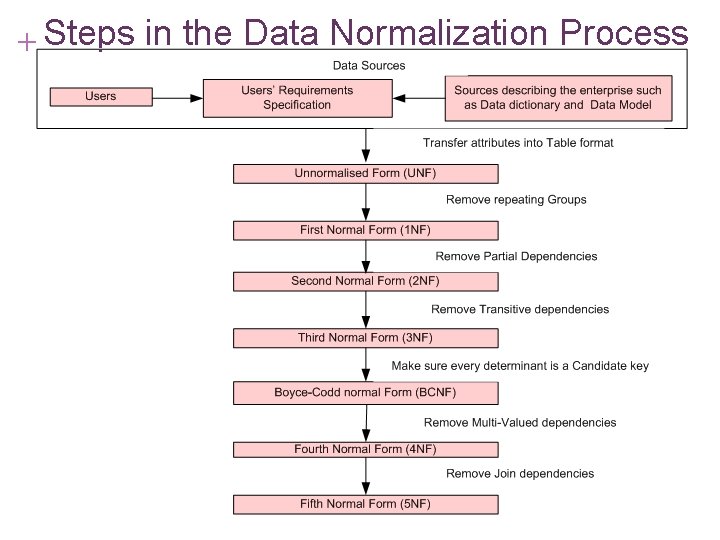
+ 7 -15 The Data Normalization Process n Once the attributes are arranged in third normal form, the group of tables that they comprise is a well-structured relational database with no data redundancy. n n Subsequently R. Boyce and E. F. Codd introduced a stronger definition of 3 NF called Boyce-Codd Normal Form(BCNF). With the exception of 1 NF, all these normal forms are based on Functional dependencies among the attributes of a table. Higher normal forms that go beyond BCNF were introduced later such as Fourth Normal Form (4 NF) and Fifth Normal Form (5 NF). However these later normal forms deal with situations that are very rare. n A group of tables is said to be in a particular normal form if every table in the group is in that normal form. n The data normalization process is progressive. n For example, if a group of tables is in second normal form, it is also in first normal form.
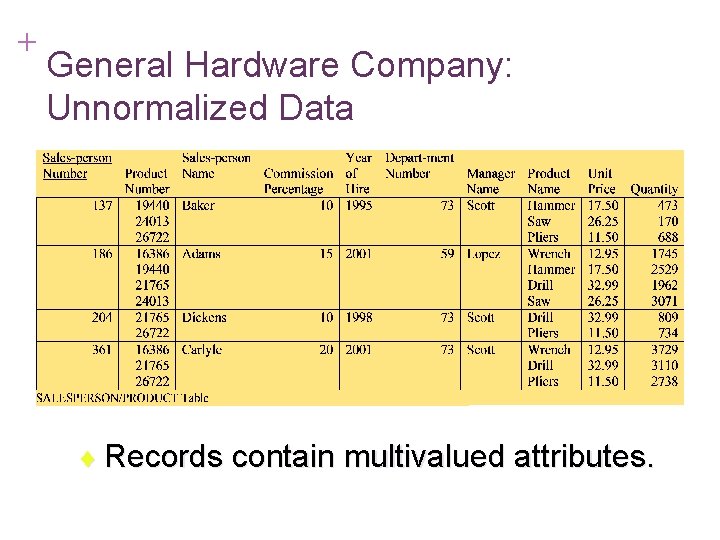
+ 7 -16 General Hardware Company: Unnormalized Data ¨ Records contain multivalued attributes.
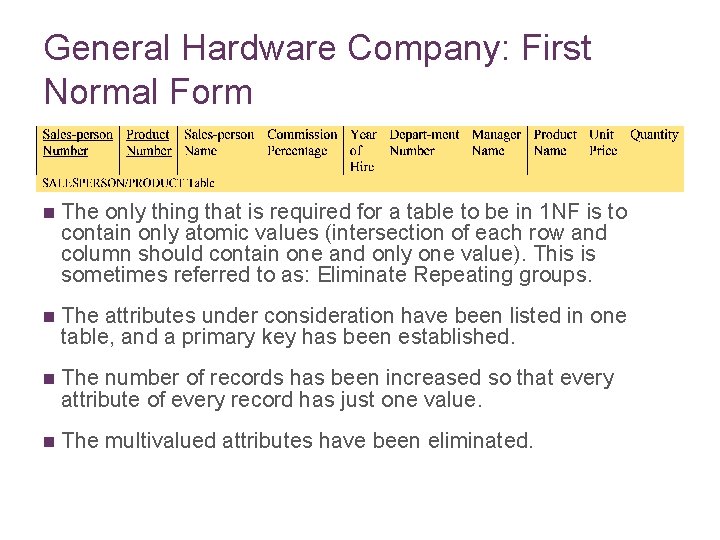
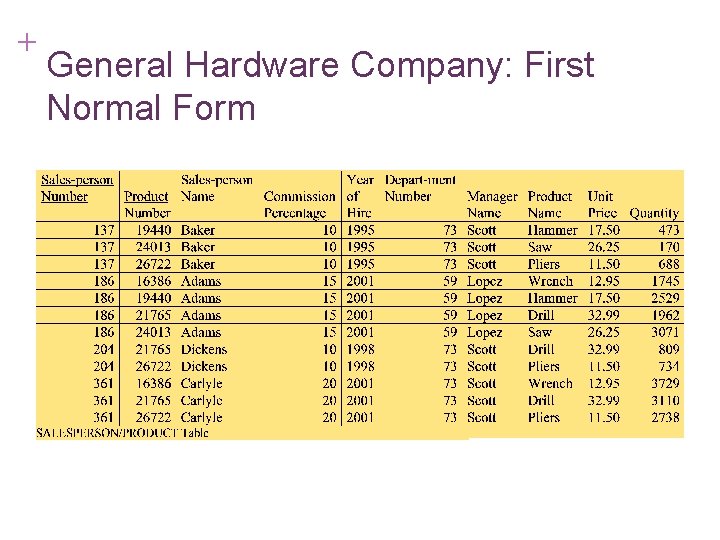
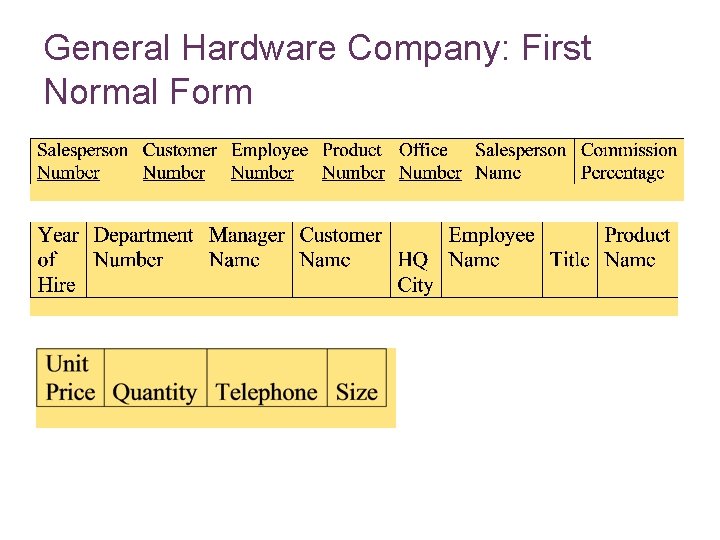
General Hardware Company: First Normal Form n The only thing that is required for a table to be in 1 NF is to contain only atomic values (intersection of each row and column should contain one and only one value). This is sometimes referred to as: Eliminate Repeating groups. n The attributes under consideration have been listed in one table, and a primary key has been established. n The number of records has been increased so that every attribute of every record has just one value. n The multivalued attributes have been eliminated. 7 -17
+ 7 -18 General Hardware Company: First Normal Form
+ 7 -19 General Hardware Company: First Normal Form n First normal form is merely a starting point in the normalization process. n First normal form contains a great deal of data redundancy. n Three records involve salesperson 137, so there are three places in which his name is listed as Baker, his commission percentage is listed as 10, and so on. n Two records involve product 19440 and this product’s name is listed twice as Hammer and its unit price is listed twice as 17. 50.
+ 7 -20 Second Normal Form n A Table is said to be in 2 NF if it is in 1 NF and there are no partial dependencies n No Partial Functional Dependencies n Every non primary key attribute of the table must be fully functionally dependent on the entire primary key of that table. n A non-key attribute cannot depend on only part of the key.
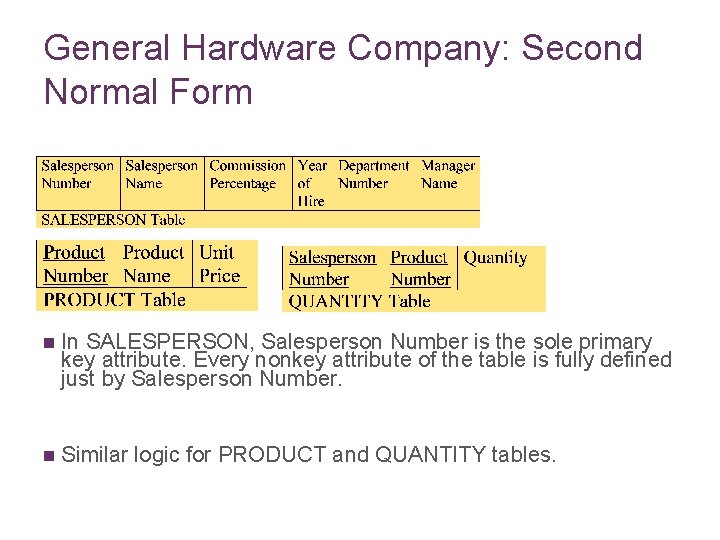
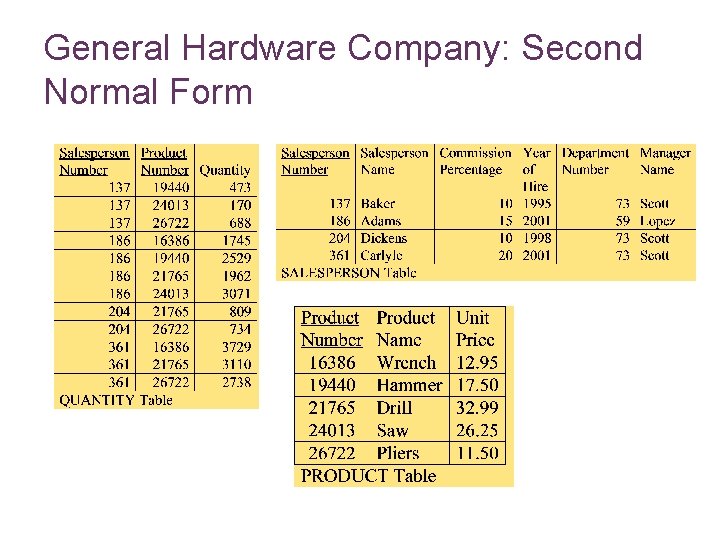
General Hardware Company: Second Normal Form n In SALESPERSON, Salesperson Number is the sole primary key attribute. Every nonkey attribute of the table is fully defined just by Salesperson Number. n Similar logic for PRODUCT and QUANTITY tables. 7 -21
General Hardware Company: Second Normal Form 7 -22
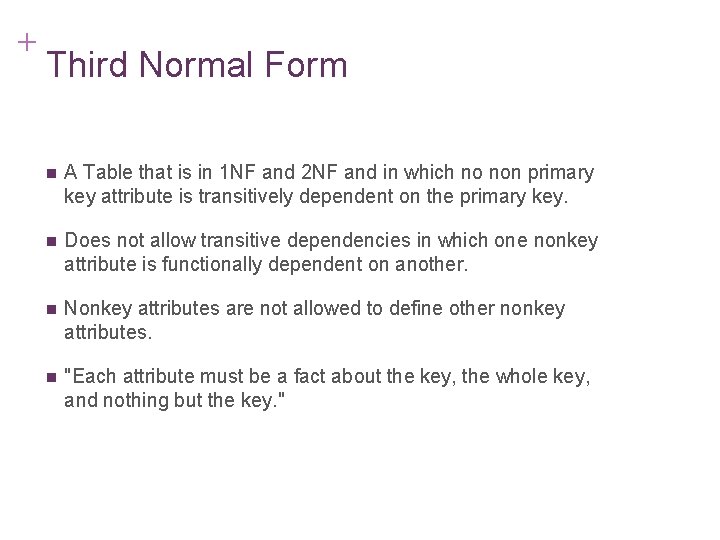
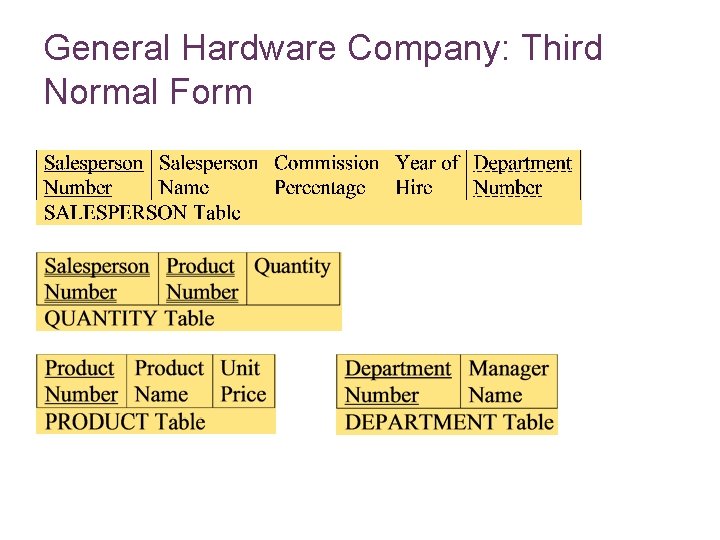
+ 7 -23 Third Normal Form n A Table that is in 1 NF and 2 NF and in which no non primary key attribute is transitively dependent on the primary key. n Does not allow transitive dependencies in which one nonkey attribute is functionally dependent on another. n Nonkey attributes are not allowed to define other nonkey attributes. n "Each attribute must be a fact about the key, the whole key, and nothing but the key. "
General Hardware Company: Third Normal Form 7 -24
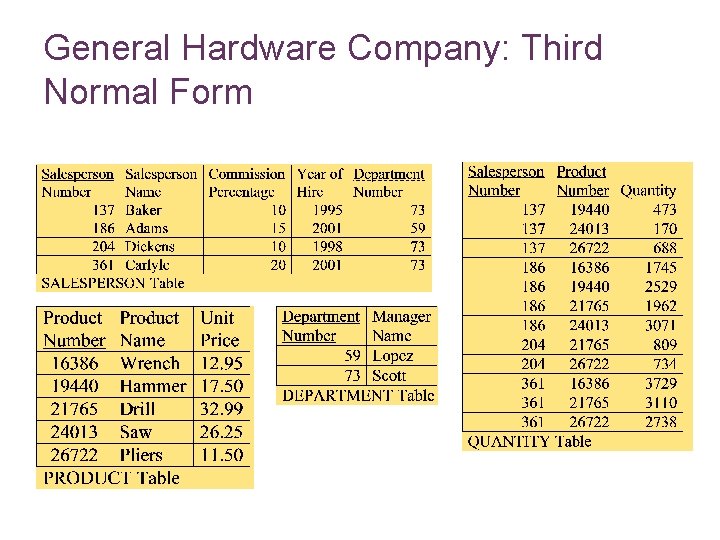
General Hardware Company: Third Normal Form 7 -25
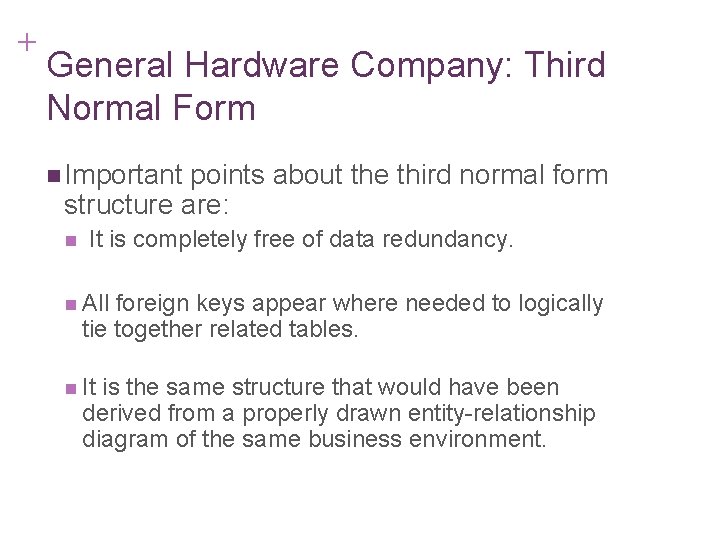
+ 7 -26 General Hardware Company: Third Normal Form n Important points about the third normal form structure are: n It is completely free of data redundancy. n All foreign keys appear where needed to logically tie together related tables. n It is the same structure that would have been derived from a properly drawn entity-relationship diagram of the same business environment.
+ Recap + clarification n 0 NF: n n n Unstructured data, can have multi-valued attributes 1 NF: n Atomic values (one per column of the record) n No duplicate rows (implies there is a key) As we move forward need to consider functional dependencies and determine candidate keys n Note: earlier slides simplified this slightly by saying choose a primary key, but normalization is actually about candidate keys n For the higher forms of normalization, we need to consider the case where there is not a single option for the primary key 12/29/2021
+ Definitions n Superkey: a combination of attributes that can be used to uniquely identify a row in a database. The trivial superkey is all attributes. n Candidate key: a minimal superkey – all attributes are necessary to uniquely identify the record n Primary key: one candidate key, arbitrarily chosen n Prime attribute: an attribute that occurs in some candidate key n Non prime attribute: an attribute that does not occur in any candidate key 12/29/2021
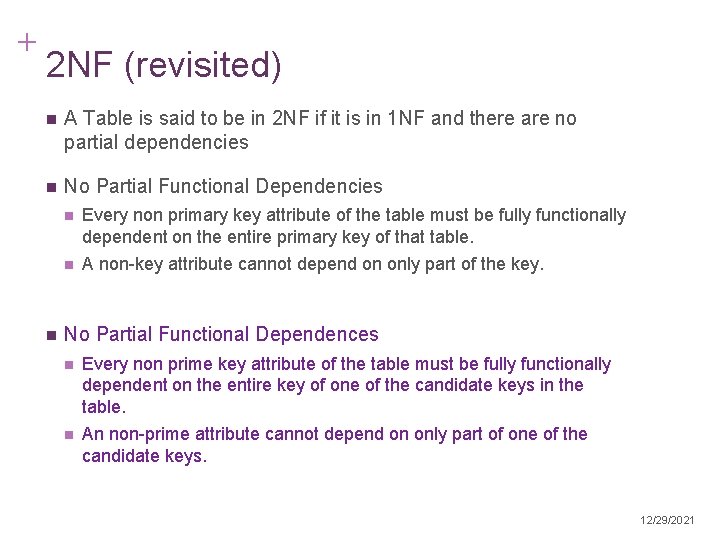
+ 2 NF (revisited) n A Table is said to be in 2 NF if it is in 1 NF and there are no partial dependencies n No Partial Functional Dependencies n n Every non primary key attribute of the table must be fully functionally dependent on the entire primary key of that table. n A non-key attribute cannot depend on only part of the key. No Partial Functional Dependences n Every non prime key attribute of the table must be fully functionally dependent on the entire key of one of the candidate keys in the table. n An non-prime attribute cannot depend on only part of one of the candidate keys. 12/29/2021
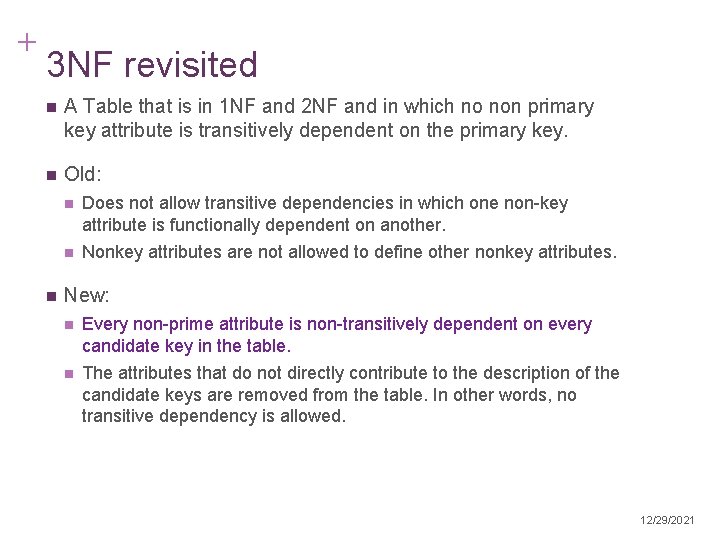
+ 3 NF revisited n A Table that is in 1 NF and 2 NF and in which no non primary key attribute is transitively dependent on the primary key. n Old: n n Does not allow transitive dependencies in which one non-key attribute is functionally dependent on another. n Nonkey attributes are not allowed to define other nonkey attributes. New: n Every non-prime attribute is non-transitively dependent on every candidate key in the table. n The attributes that do not directly contribute to the description of the candidate keys are removed from the table. In other words, no transitive dependency is allowed. 12/29/2021
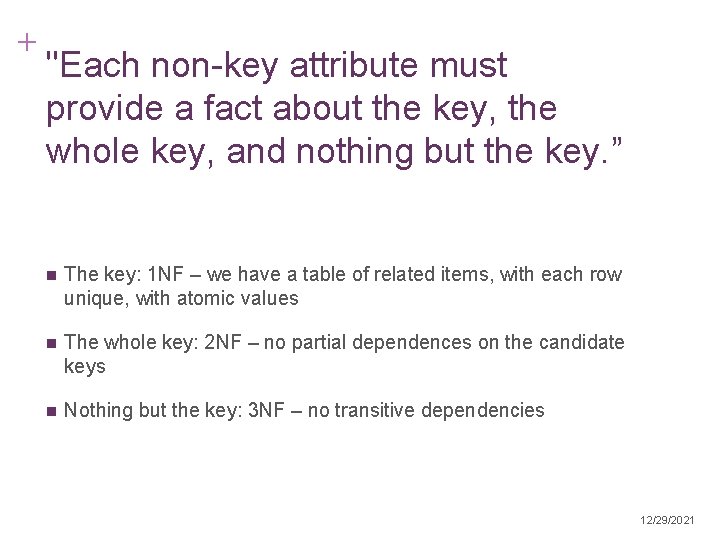
+ "Each non-key attribute must provide a fact about the key, the whole key, and nothing but the key. ” n The key: 1 NF – we have a table of related items, with each row unique, with atomic values n The whole key: 2 NF – no partial dependences on the candidate keys n Nothing but the key: 3 NF – no transitive dependencies 12/29/2021
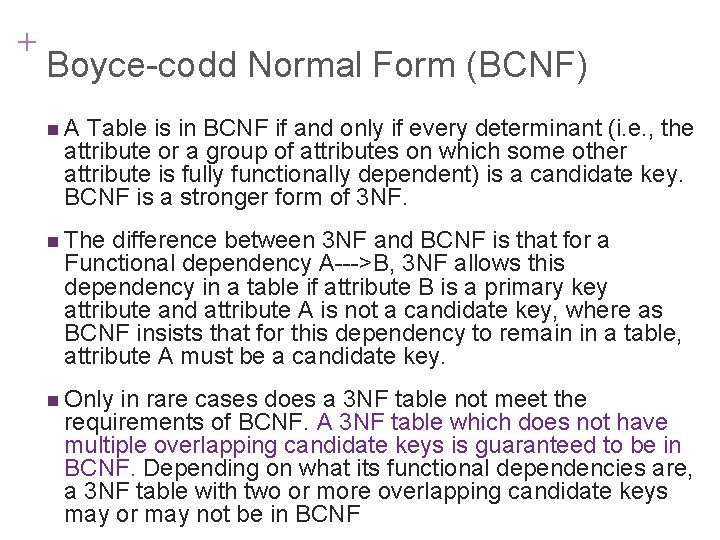
+ 7 -32 Boyce-codd Normal Form (BCNF) n. A Table is in BCNF if and only if every determinant (i. e. , the attribute or a group of attributes on which some other attribute is fully functionally dependent) is a candidate key. BCNF is a stronger form of 3 NF. n The difference between 3 NF and BCNF is that for a Functional dependency A--->B, 3 NF allows this dependency in a table if attribute B is a primary key attribute and attribute A is not a candidate key, where as BCNF insists that for this dependency to remain in a table, attribute A must be a candidate key. n Only in rare cases does a 3 NF table not meet the requirements of BCNF. A 3 NF table which does not have multiple overlapping candidate keys is guaranteed to be in BCNF. Depending on what its functional dependencies are, a 3 NF table with two or more overlapping candidate keys may or may not be in BCNF
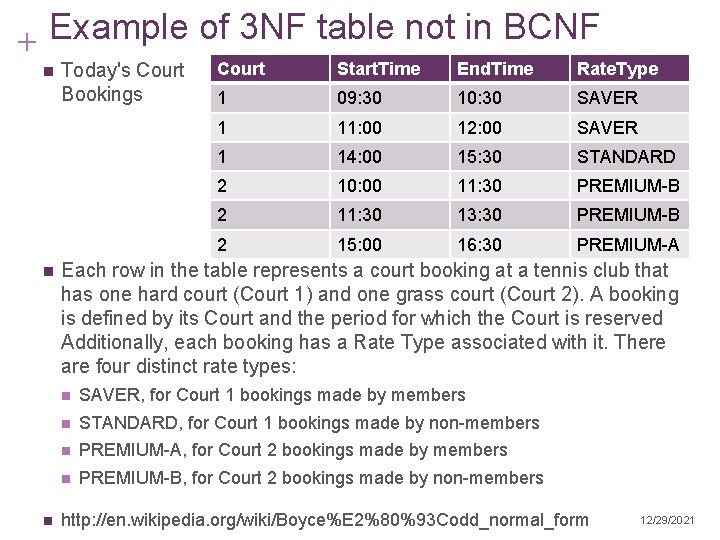
Example of 3 NF table not in BCNF + n n n Today's Court Bookings Court Start. Time End. Time Rate. Type 1 09: 30 10: 30 SAVER 1 11: 00 12: 00 SAVER 1 14: 00 15: 30 STANDARD 2 10: 00 11: 30 PREMIUM-B 2 11: 30 13: 30 PREMIUM-B 2 15: 00 16: 30 PREMIUM-A Each row in the table represents a court booking at a tennis club that has one hard court (Court 1) and one grass court (Court 2). A booking is defined by its Court and the period for which the Court is reserved Additionally, each booking has a Rate Type associated with it. There are four distinct rate types: n SAVER, for Court 1 bookings made by members n STANDARD, for Court 1 bookings made by non-members n PREMIUM-A, for Court 2 bookings made by members n PREMIUM-B, for Court 2 bookings made by non-members http: //en. wikipedia. org/wiki/Boyce%E 2%80%93 Codd_normal_form 12/29/2021
+ What is the problem? n Identify the functional dependencies n Identify the table’s super keys n Determine the candidate keys n Why isn’t the table in BCNF? n A Table is in BCNF if and only if every determinant is a candidate key. n For all functional dependencies A -> B, is A a candidate key? 12/29/2021
+ Fourth Normal Form (4 NF) n 4 NF is a stronger normal form than 3 NF/BCNF as it prevents Tables from containing nontrivial Multi-Valued Dependencies (MVDs) and hence data redundancy. n The Normalization of BCNF Tables to 4 NF involves the removal of MVDs from the Table by placing the attribute(s) in a new Table along with the copy of the determinant(s). n http: //en. wikipedia. org/wiki/Fourth_normal_form 12/29/2021
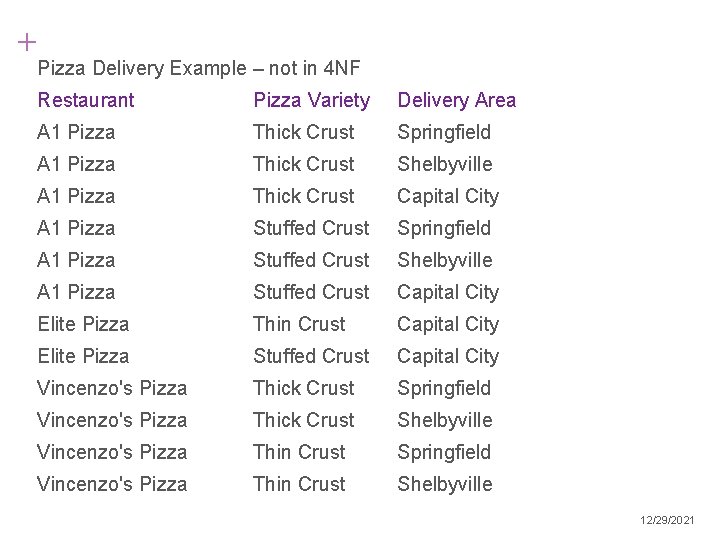
+ Pizza Delivery Example – not in 4 NF Restaurant Pizza Variety Delivery Area A 1 Pizza Thick Crust Springfield A 1 Pizza Thick Crust Shelbyville A 1 Pizza Thick Crust Capital City A 1 Pizza Stuffed Crust Springfield A 1 Pizza Stuffed Crust Shelbyville A 1 Pizza Stuffed Crust Capital City Elite Pizza Thin Crust Capital City Elite Pizza Stuffed Crust Capital City Vincenzo's Pizza Thick Crust Springfield Vincenzo's Pizza Thick Crust Shelbyville Vincenzo's Pizza Thin Crust Springfield Vincenzo's Pizza Thin Crust Shelbyville 12/29/2021
+ Fifth Normal Form (5 NF) n Also known as project-join normal form (PJ/NF) n Designed to reduce redundancy in relational databases recording multi-valued facts by isolating semantically related multiple relationships. n A table is said to be in the 5 NF if and only if every join dependency in it is implied by the candidate keys. n http: //en. wikipedia. org/wiki/Fifth_normal_form 12/29/2021
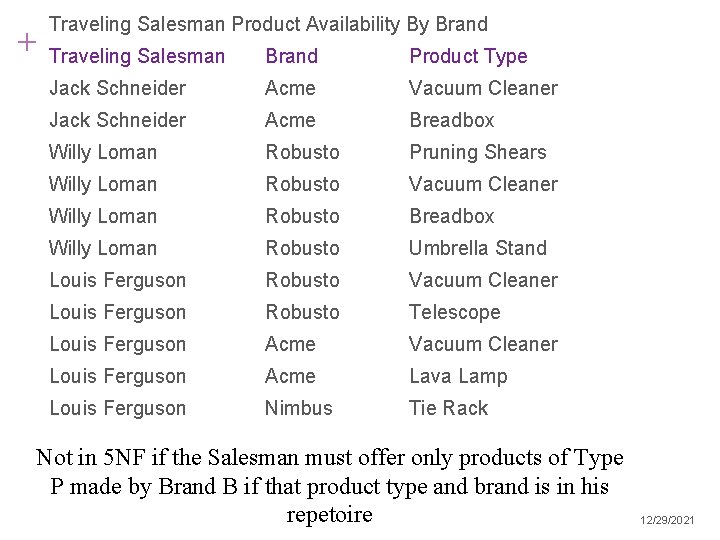
+ Traveling Salesman Product Availability By Brand Traveling Salesman Brand Product Type Jack Schneider Acme Vacuum Cleaner Jack Schneider Acme Breadbox Willy Loman Robusto Pruning Shears Willy Loman Robusto Vacuum Cleaner Willy Loman Robusto Breadbox Willy Loman Robusto Umbrella Stand Louis Ferguson Robusto Vacuum Cleaner Louis Ferguson Robusto Telescope Louis Ferguson Acme Vacuum Cleaner Louis Ferguson Acme Lava Lamp Louis Ferguson Nimbus Tie Rack Not in 5 NF if the Salesman must offer only products of Type P made by Brand B if that product type and brand is in his repetoire 12/29/2021
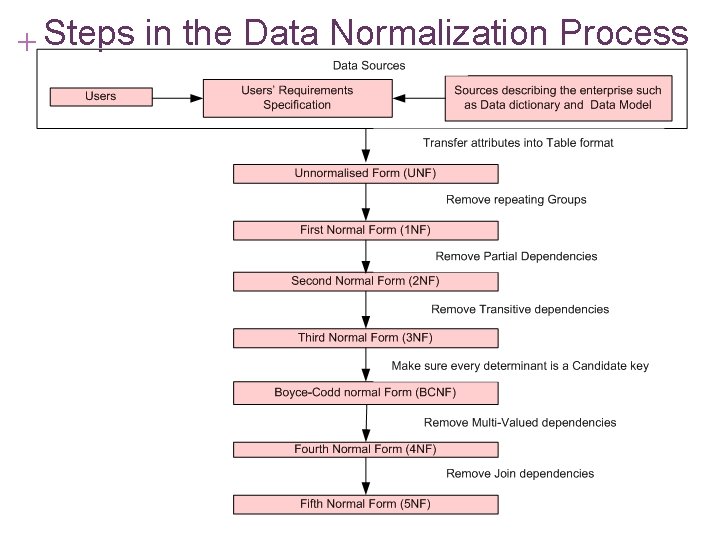
+ Steps in the Data Normalization Process 7 -39
+ Other good resources: n http: //www. informationqualitysolutions. com/Free. Stuff/rettig. Nor malization. Poster. pdf n Today’s handout includes the explanations of each normalization step for the example highlighted in the poster 12/29/2021
General Hardware Company: Functional Dependencies 7 -41
General Hardware Company: First Normal Form 7 -42
+ 7 -43 World Music Association: Functional Dependencies
+ 7 -44 Lucky Rent-A-Car: Functional Dependencies
- Slides: 44