
DATABASE MANAGEMENT SYSTEMS UNITIV PPT SLIDES Text Books
DATABASE MANAGEMENT SYSTEMS UNIT-IV PPT SLIDES Text Books: (1) DBMS by Raghu Ramakrishnan (2) DBMS by Sudarshan and Korth
INDEX UNIT-4 PPT SLIDES S. NO Module as per Session planner Lecture No PPT Slide NO ---------------------------------------------------------1. The Form of a Basic SQL Queries L 1 - 1 to L 1 - 15 2. Query operations & NESTED Queries L 2 - 1 to L 2 - 15 3. NESTED Queries L 3 - 1 to L 3 - 9 4. Aggregate Operators L 4 - 1 to L 4 - 9 5. Null Values L 5 - 1 to L 5 -9 6. Complex I. C in SQL-92 L 6 - 1 to L 6 - 8 7. Triggers and Active Databases L 7 - 1 to L 7 - 5 8. Designing Active Databases L 8 - 1 to L 8 - 10
History • IBM Sequel language developed as part of System R project at the IBM San Jose Research Laboratory • Renamed Structured Query Language (SQL) • ANSI and ISO standard SQL: – SQL-86 – SQL-89 – SQL-92 – SQL: 1999 (language name became Y 2 K compliant!) – SQL: 2003 • Commercial systems offer most, if not all, SQL-92 features, plus varying feature sets from later standards and special proprietary features. – Not all examples here may work on your particular system. Slide No: L 1 -1
Data Definition Language Allows the specification of: • The schema for each relation, including attribute types. • Integrity constraints • Authorization information for each relation. • Non-standard SQL extensions also allow specification of – The set of indices to be maintained for each relations. – The physical storage structure of each relation on disk. Slide No: L 1 -2
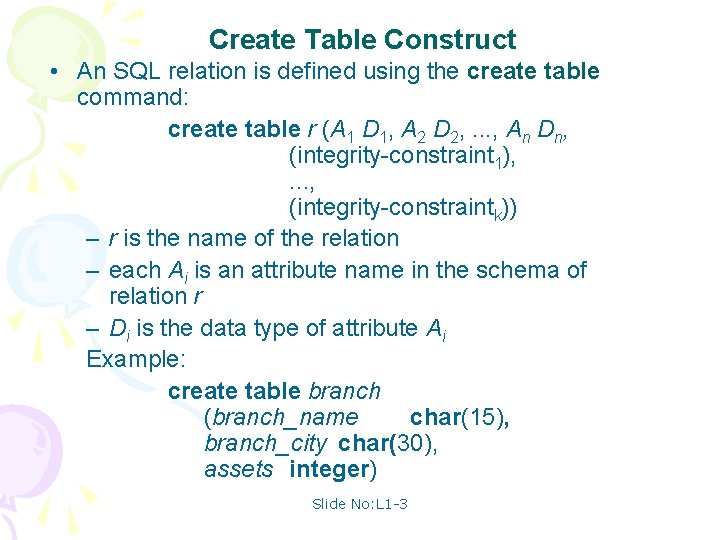
Create Table Construct • An SQL relation is defined using the create table command: create table r (A 1 D 1, A 2 D 2, . . . , An Dn, (integrity-constraint 1), . . . , (integrity-constraintk)) – r is the name of the relation – each Ai is an attribute name in the schema of relation r – Di is the data type of attribute Ai Example: create table branch (branch_name char(15), branch_city char(30), assets integer) Slide No: L 1 -3
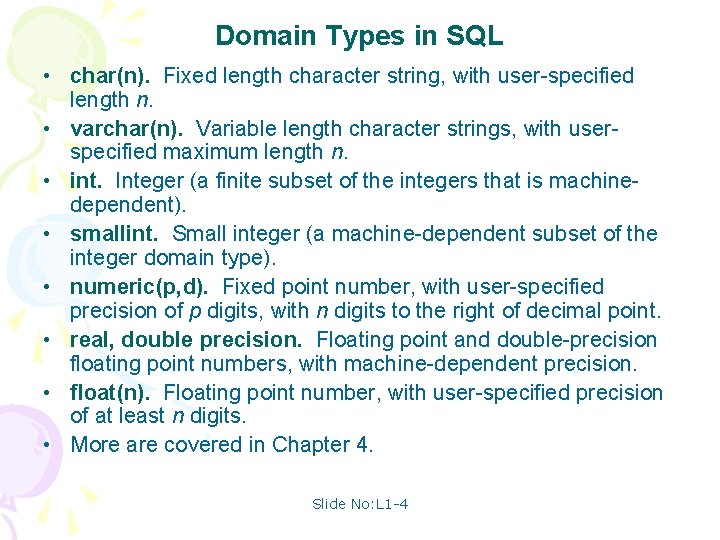
Domain Types in SQL • char(n). Fixed length character string, with user-specified length n. • varchar(n). Variable length character strings, with userspecified maximum length n. • int. Integer (a finite subset of the integers that is machinedependent). • smallint. Small integer (a machine-dependent subset of the integer domain type). • numeric(p, d). Fixed point number, with user-specified precision of p digits, with n digits to the right of decimal point. • real, double precision. Floating point and double-precision floating point numbers, with machine-dependent precision. • float(n). Floating point number, with user-specified precision of at least n digits. • More are covered in Chapter 4. Slide No: L 1 -4
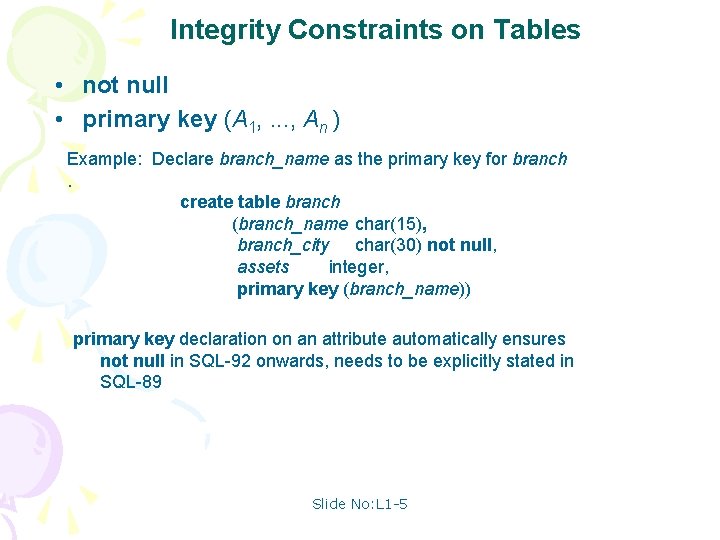
Integrity Constraints on Tables • not null • primary key (A 1, . . . , An ) Example: Declare branch_name as the primary key for branch. create table branch (branch_name char(15), branch_city char(30) not null, assets integer, primary key (branch_name)) primary key declaration on an attribute automatically ensures not null in SQL-92 onwards, needs to be explicitly stated in SQL-89 Slide No: L 1 -5
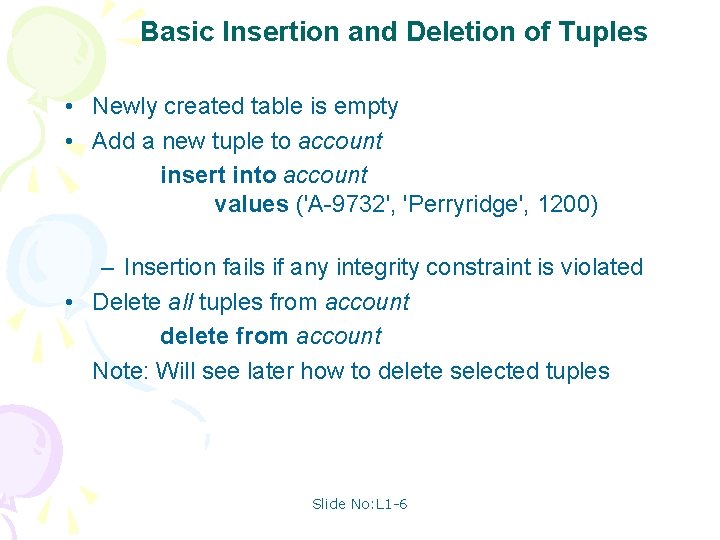
Basic Insertion and Deletion of Tuples • Newly created table is empty • Add a new tuple to account insert into account values ('A-9732', 'Perryridge', 1200) – Insertion fails if any integrity constraint is violated • Delete all tuples from account delete from account Note: Will see later how to delete selected tuples Slide No: L 1 -6
Drop and Alter Table Constructs • The drop table command deletes all information about the dropped relation from the database. • The alter table command is used to add attributes to an existing relation: alter table r add A D where A is the name of the attribute to be added to relation r and D is the domain of A. – All tuples in the relation are assigned null as the value for the new attribute. • The alter table command can also be used to drop attributes of a relation: alter table r drop A where A is the name of an attribute of relation r – Dropping of attributes not supported by many databases Slide No: L 1 -7
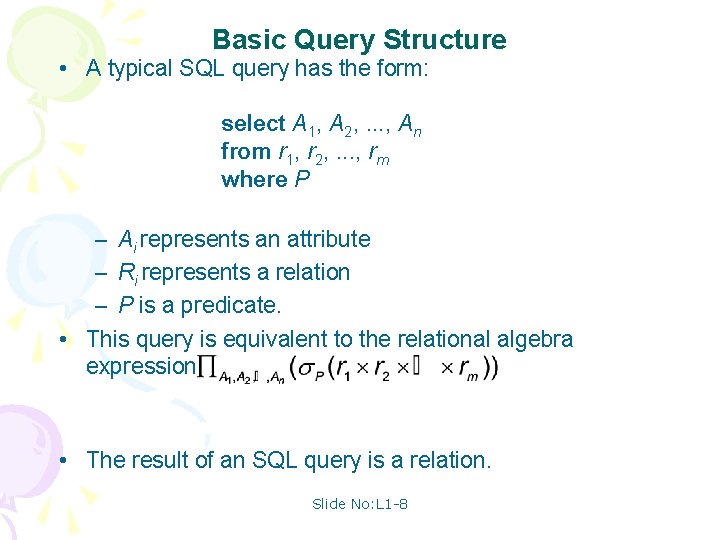
Basic Query Structure • A typical SQL query has the form: select A 1, A 2, . . . , An from r 1, r 2, . . . , rm where P – Ai represents an attribute – Ri represents a relation – P is a predicate. • This query is equivalent to the relational algebra expression. • The result of an SQL query is a relation. Slide No: L 1 -8
The select Clause • The select clause list the attributes desired in the result of a query – corresponds to the projection operation of the relational algebra • Example: find the names of all branches in the loan relation: select branch_name from loan • In the relational algebra, the query would be: � branch_name (loan) • NOTE: SQL names are case insensitive (i. e. , you may use upper- or lower-case letters. ) – E. g. Branch_Name ≡ BRANCH_NAME ≡ branch_name – Some people use upper case wherever we use bold font. Slide No: L 1 -9
The select Clause (Cont. ) • SQL allows duplicates in relations as well as in query results. • To force the elimination of duplicates, insert the keyword distinct after select. • Find the names of all branches in the loan relations, and remove duplicates select distinct branch_name from loan • The keyword all specifies that duplicates not be removed. select all branch_name from loan Slide No: L 1 -10
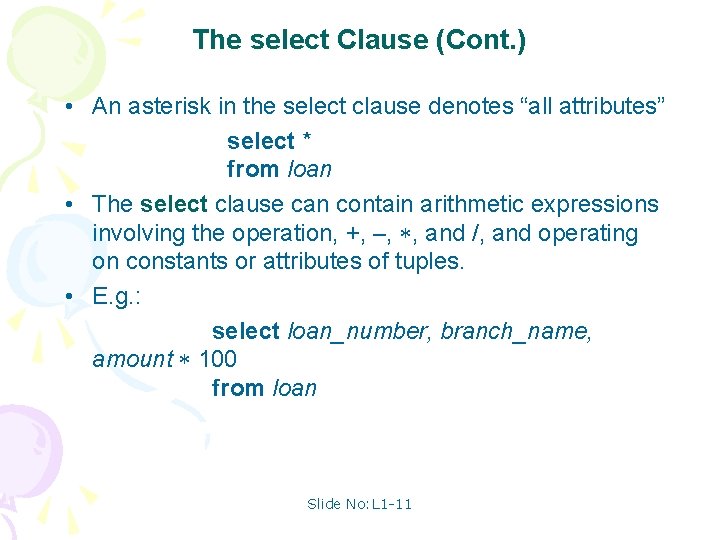
The select Clause (Cont. ) • An asterisk in the select clause denotes “all attributes” select * from loan • The select clause can contain arithmetic expressions involving the operation, +, –, , and /, and operating on constants or attributes of tuples. • E. g. : select loan_number, branch_name, amount 100 from loan Slide No: L 1 -11
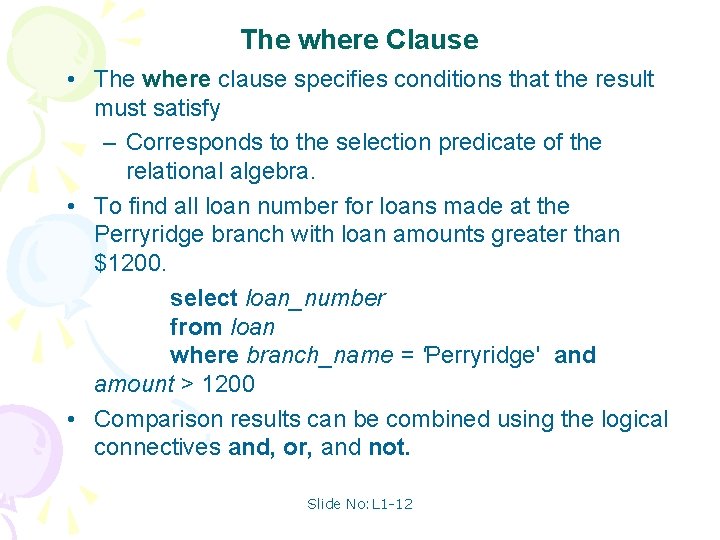
The where Clause • The where clause specifies conditions that the result must satisfy – Corresponds to the selection predicate of the relational algebra. • To find all loan number for loans made at the Perryridge branch with loan amounts greater than $1200. select loan_number from loan where branch_name = 'Perryridge' and amount > 1200 • Comparison results can be combined using the logical connectives and, or, and not. Slide No: L 1 -12
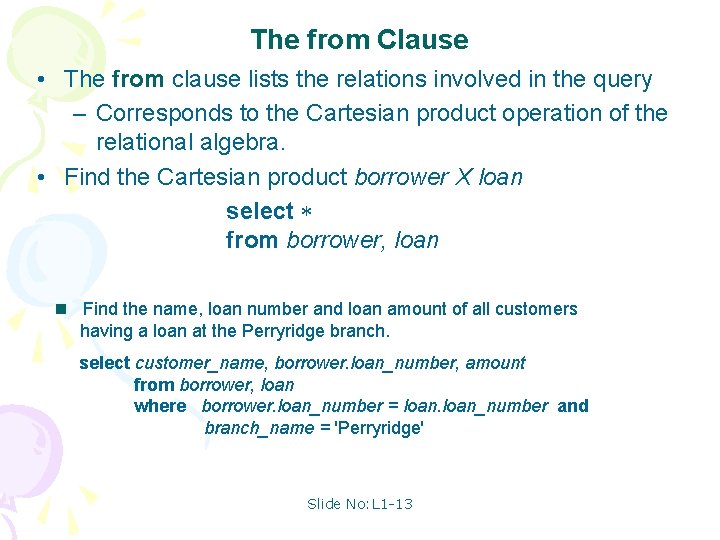
The from Clause • The from clause lists the relations involved in the query – Corresponds to the Cartesian product operation of the relational algebra. • Find the Cartesian product borrower X loan select from borrower, loan n Find the name, loan number and loan amount of all customers having a loan at the Perryridge branch. select customer_name, borrower. loan_number, amount from borrower, loan where borrower. loan_number = loan_number and branch_name = 'Perryridge' Slide No: L 1 -13
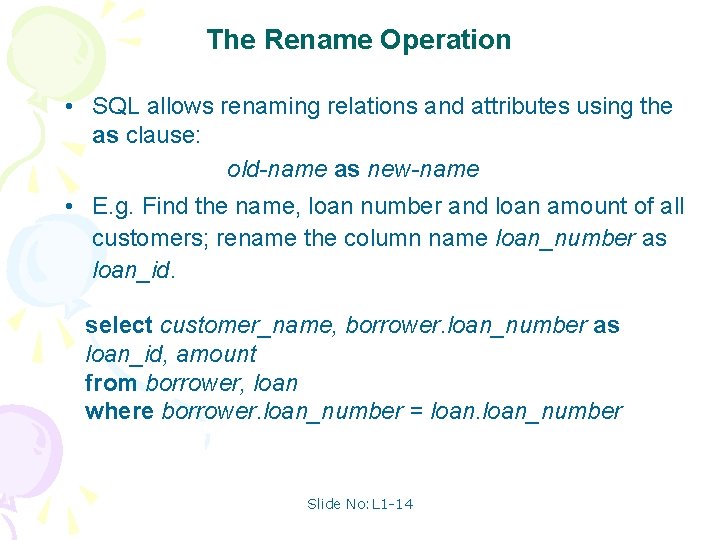
The Rename Operation • SQL allows renaming relations and attributes using the as clause: old-name as new-name • E. g. Find the name, loan number and loan amount of all customers; rename the column name loan_number as loan_id. select customer_name, borrower. loan_number as loan_id, amount from borrower, loan where borrower. loan_number = loan_number Slide No: L 1 -14
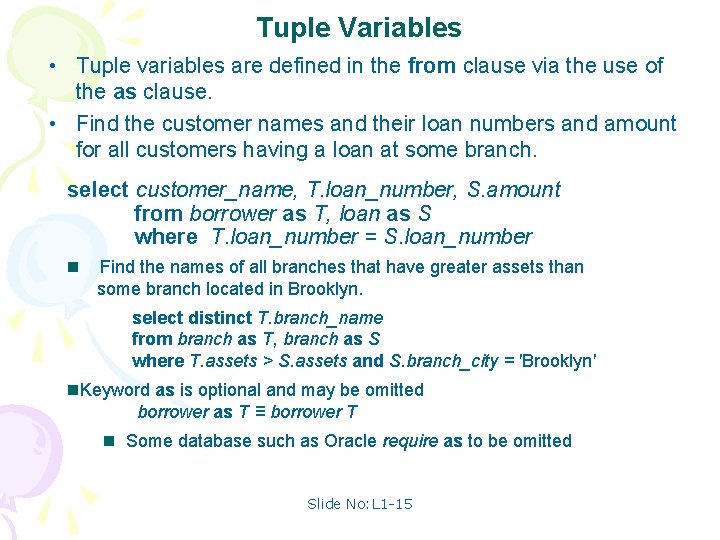
Tuple Variables • Tuple variables are defined in the from clause via the use of the as clause. • Find the customer names and their loan numbers and amount for all customers having a loan at some branch. select customer_name, T. loan_number, S. amount from borrower as T, loan as S where T. loan_number = S. loan_number n Find the names of all branches that have greater assets than some branch located in Brooklyn. select distinct T. branch_name from branch as T, branch as S where T. assets > S. assets and S. branch_city = 'Brooklyn' n. Keyword as is optional and may be omitted borrower as T ≡ borrower T n Some database such as Oracle require as to be omitted Slide No: L 1 -15
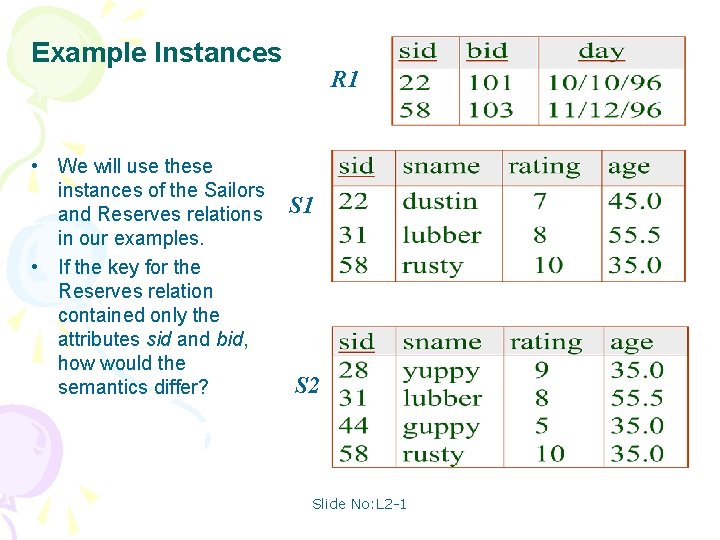
Example Instances • We will use these instances of the Sailors and Reserves relations in our examples. • If the key for the Reserves relation contained only the attributes sid and bid, how would the semantics differ? R 1 S 2 Slide No: L 2 -1
![Basic SQL Query SELECT FROM WHERE [DISTINCT] target-list relation-list qualification • relation-list A list](http://slidetodoc.com/presentation_image_h2/c0fd537bf469359405d91b8bb4338675/image-19.jpg "Basic SQL Query SELECT FROM WHERE [DISTINCT] target-list relation-list qualification • relation-list A list")
Basic SQL Query SELECT FROM WHERE [DISTINCT] target-list relation-list qualification • relation-list A list of relation names (possibly with a rangevariable after each name). • target-list A list of attributes of relations in relation-list • qualification Comparisons (Attr op const or Attr 1 op Attr 2, where op is one of ) combined using AND, OR and NOT. • DISTINCT is an optional keyword indicating that the answer should not contain duplicates. Default is that duplicates are not eliminated! Slide No: L 2 -2
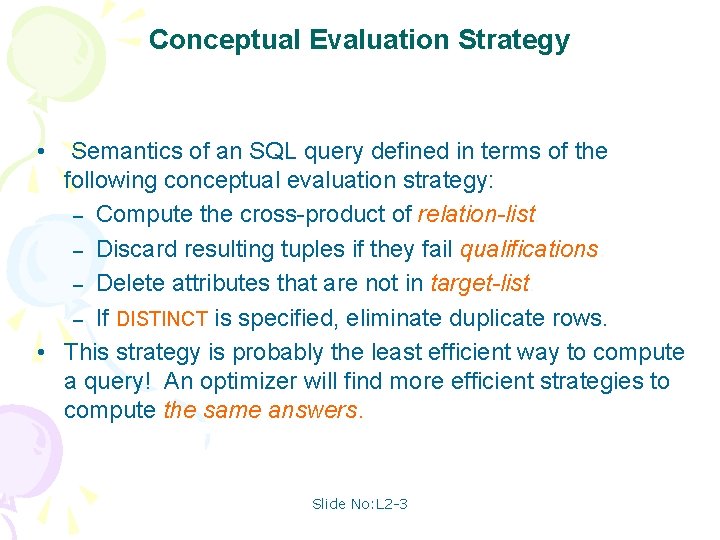
Conceptual Evaluation Strategy • Semantics of an SQL query defined in terms of the following conceptual evaluation strategy: – Compute the cross-product of relation-list. – Discard resulting tuples if they fail qualifications. – Delete attributes that are not in target-list. – If DISTINCT is specified, eliminate duplicate rows. • This strategy is probably the least efficient way to compute a query! An optimizer will find more efficient strategies to compute the same answers. Slide No: L 2 -3
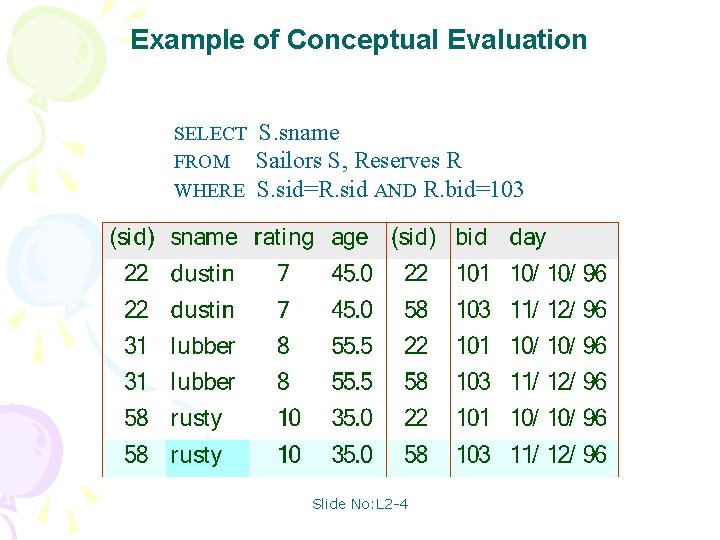
Example of Conceptual Evaluation SELECT FROM WHERE S. sname Sailors S, Reserves R S. sid=R. sid AND R. bid=103 Slide No: L 2 -4
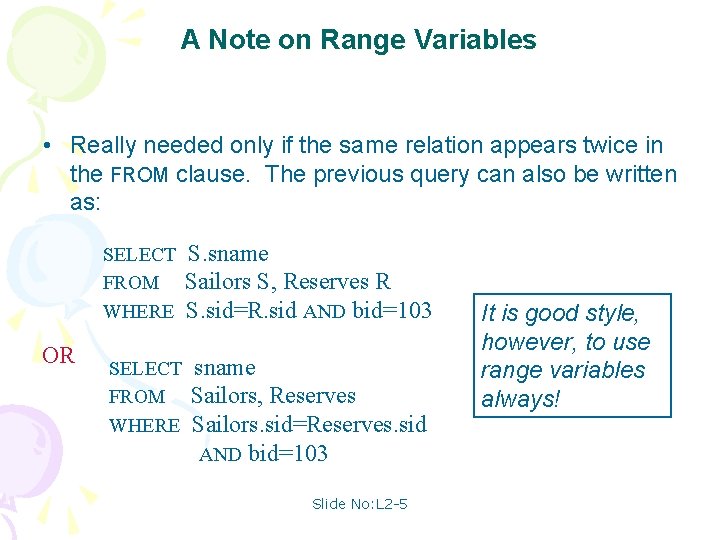
A Note on Range Variables • Really needed only if the same relation appears twice in the FROM clause. The previous query can also be written as: OR SELECT FROM WHERE S. sname Sailors S, Reserves R S. sid=R. sid AND bid=103 SELECT FROM WHERE sname Sailors, Reserves Sailors. sid=Reserves. sid AND bid=103 Slide No: L 2 -5 It is good style, however, to use range variables always!
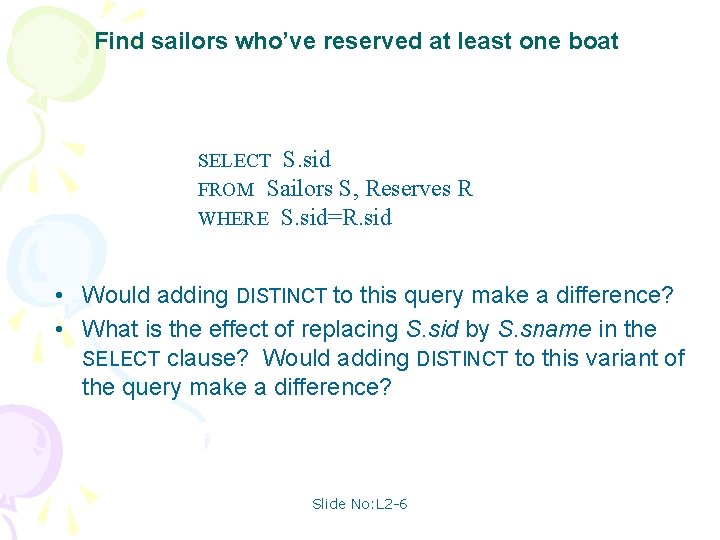
Find sailors who’ve reserved at least one boat SELECT S. sid FROM Sailors S, Reserves WHERE S. sid=R. sid R • Would adding DISTINCT to this query make a difference? • What is the effect of replacing S. sid by S. sname in the SELECT clause? Would adding DISTINCT to this variant of the query make a difference? Slide No: L 2 -6
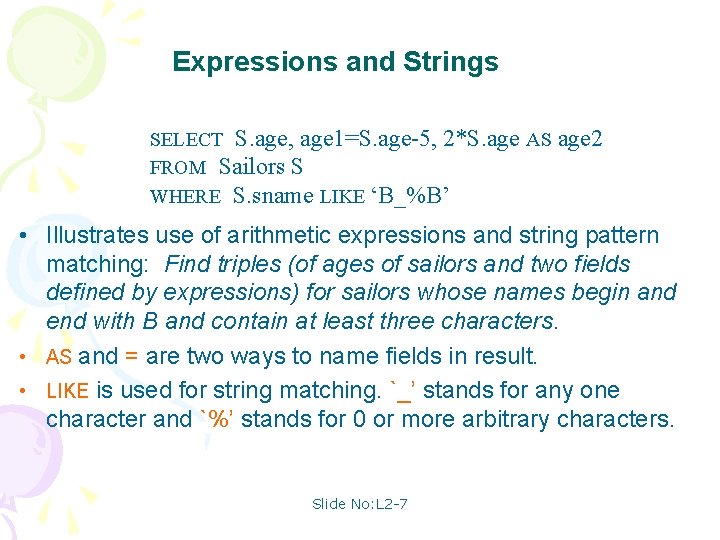
Expressions and Strings SELECT S. age, age 1=S. age-5, 2*S. age AS FROM Sailors S WHERE S. sname LIKE ‘B_%B’ age 2 • Illustrates use of arithmetic expressions and string pattern matching: Find triples (of ages of sailors and two fields defined by expressions) for sailors whose names begin and end with B and contain at least three characters. • AS and = are two ways to name fields in result. • LIKE is used for string matching. `_’ stands for any one character and `%’ stands for 0 or more arbitrary characters. Slide No: L 2 -7
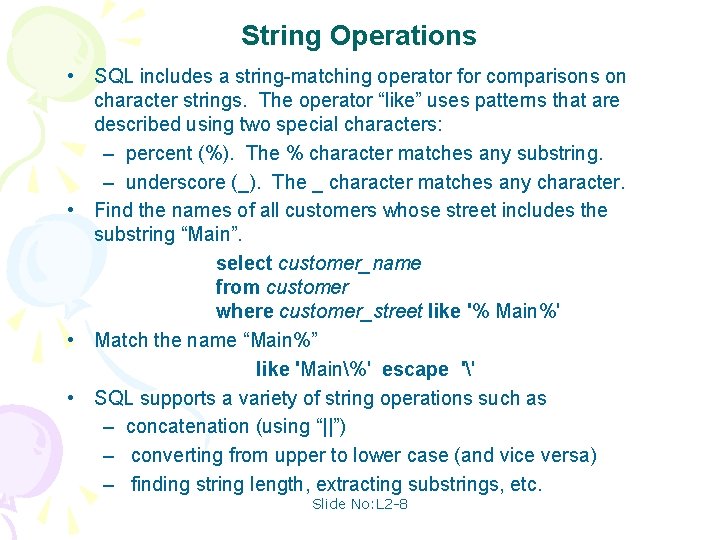
String Operations • SQL includes a string-matching operator for comparisons on character strings. The operator “like” uses patterns that are described using two special characters: – percent (%). The % character matches any substring. – underscore (_). The _ character matches any character. • Find the names of all customers whose street includes the substring “Main”. select customer_name from customer where customer_street like '% Main%' • Match the name “Main%” like 'Main%' escape '' • SQL supports a variety of string operations such as – concatenation (using “||”) – converting from upper to lower case (and vice versa) – finding string length, extracting substrings, etc. Slide No: L 2 -8
Ordering the Display of Tuples • List in alphabetic order the names of all customers having a loan in Perryridge branch select distinct customer_name from borrower, loan where borrower loan_number = loan_number and branch_name = 'Perryridge' order by customer_name • We may specify desc for descending order or asc for ascending order, for each attribute; ascending order is the default. – Example: order by customer_name desc Slide No: L 2 -9
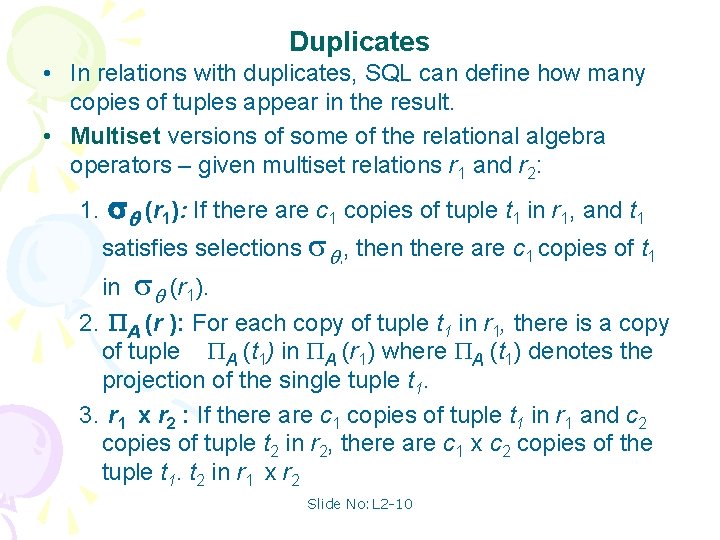
Duplicates • In relations with duplicates, SQL can define how many copies of tuples appear in the result. • Multiset versions of some of the relational algebra operators – given multiset relations r 1 and r 2: 1. (r 1): If there are c 1 copies of tuple t 1 in r 1, and t 1 satisfies selections , , then there are c 1 copies of t 1 in (r 1). 2. A (r ): For each copy of tuple t 1 in r 1, there is a copy of tuple A (t 1) in A (r 1) where A (t 1) denotes the projection of the single tuple t 1. 3. r 1 x r 2 : If there are c 1 copies of tuple t 1 in r 1 and c 2 copies of tuple t 2 in r 2, there are c 1 x c 2 copies of the tuple t 1. t 2 in r 1 x r 2 Slide No: L 2 -10
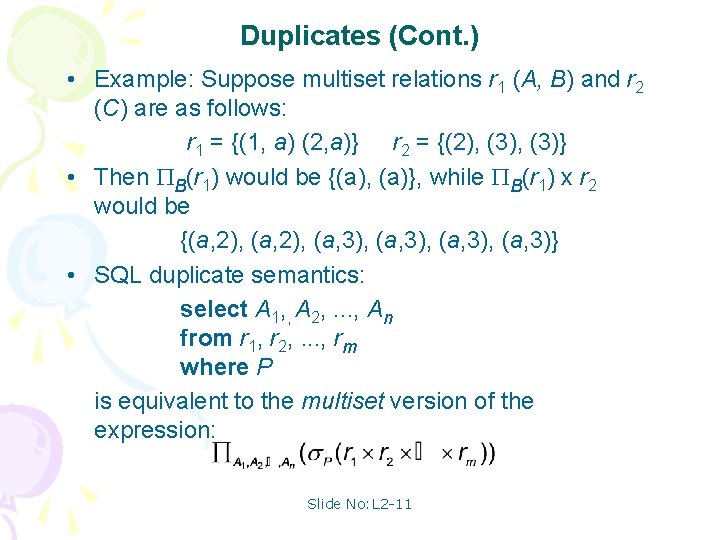
Duplicates (Cont. ) • Example: Suppose multiset relations r 1 (A, B) and r 2 (C) are as follows: r 1 = {(1, a) (2, a)} r 2 = {(2), (3)} • Then B(r 1) would be {(a), (a)}, while B(r 1) x r 2 would be {(a, 2), (a, 3), (a, 3)} • SQL duplicate semantics: select A 1, , A 2, . . . , An from r 1, r 2, . . . , rm where P is equivalent to the multiset version of the expression: Slide No: L 2 -11
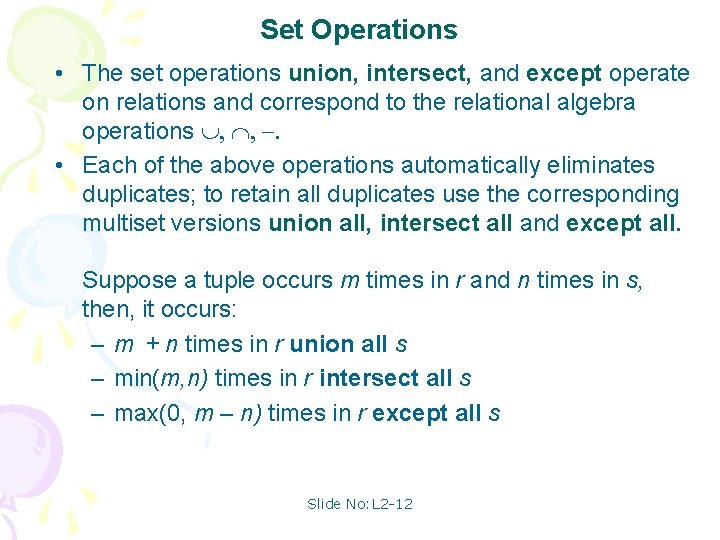
Set Operations • The set operations union, intersect, and except operate on relations and correspond to the relational algebra operations • Each of the above operations automatically eliminates duplicates; to retain all duplicates use the corresponding multiset versions union all, intersect all and except all. Suppose a tuple occurs m times in r and n times in s, then, it occurs: – m + n times in r union all s – min(m, n) times in r intersect all s – max(0, m – n) times in r except all s Slide No: L 2 -12
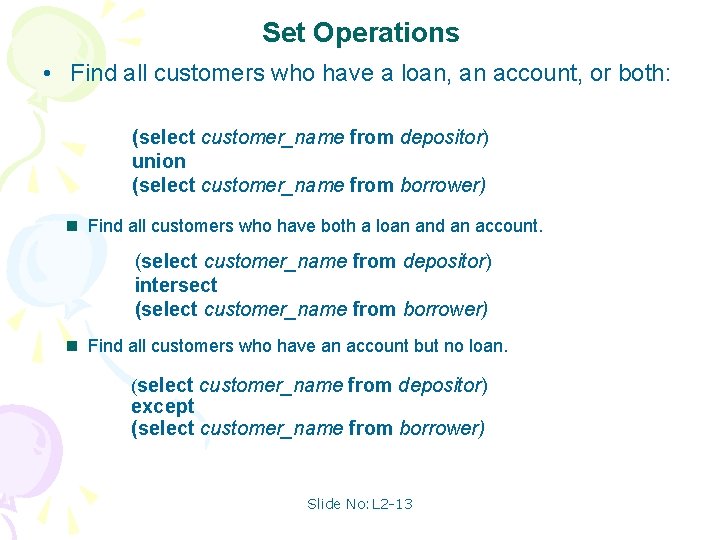
Set Operations • Find all customers who have a loan, an account, or both: (select customer_name from depositor) union (select customer_name from borrower) n Find all customers who have both a loan and an account. (select customer_name from depositor) intersect (select customer_name from borrower) n Find all customers who have an account but no loan. (select customer_name from depositor) except (select customer_name from borrower) Slide No: L 2 -13
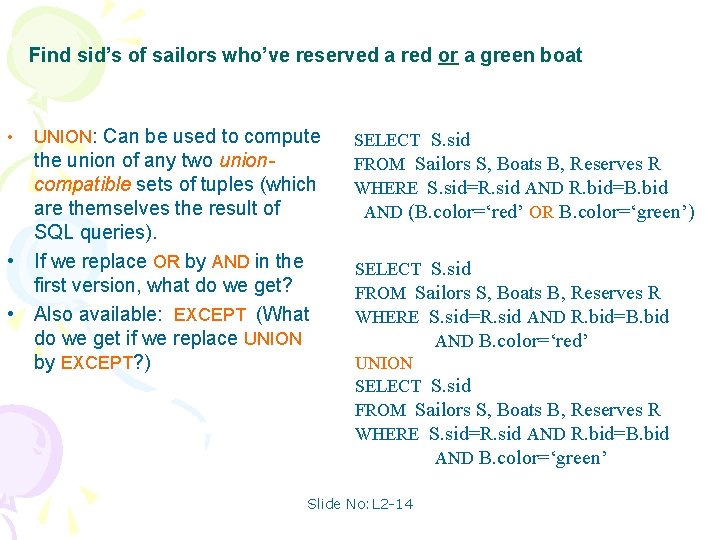
Find sid’s of sailors who’ve reserved a red or a green boat • UNION: Can be used to compute the union of any two unioncompatible sets of tuples (which are themselves the result of SQL queries). • If we replace OR by AND in the first version, what do we get? • Also available: EXCEPT (What do we get if we replace UNION by EXCEPT? ) SELECT S. sid FROM Sailors S, Boats B, Reserves R WHERE S. sid=R. sid AND R. bid=B. bid AND (B. color=‘red’ OR B. color=‘green’) SELECT S. sid FROM Sailors S, Boats B, Reserves R WHERE S. sid=R. sid AND R. bid=B. bid AND B. color=‘red’ UNION SELECT S. sid FROM Sailors S, Boats B, Reserves R WHERE S. sid=R. sid AND R. bid=B. bid AND B. color=‘green’ Slide No: L 2 -14
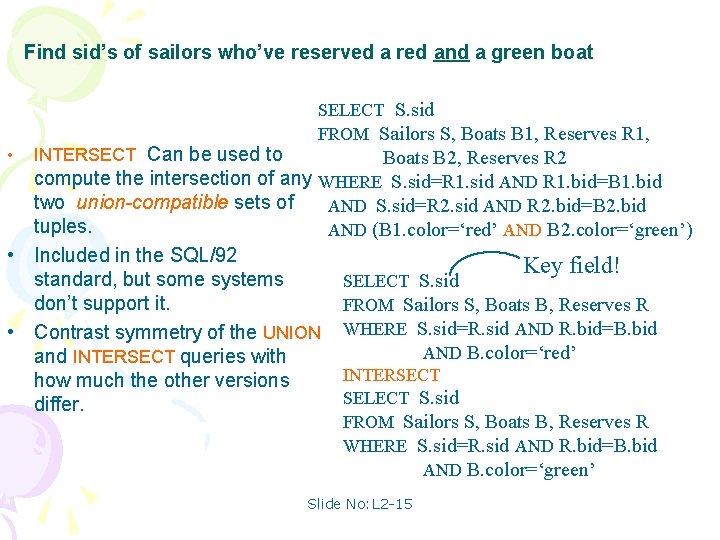
Find sid’s of sailors who’ve reserved a red and a green boat • INTERSECT: Can be used to SELECT S. sid FROM Sailors S, Boats B 1, Reserves R 1, Boats B 2, Reserves R 2 compute the intersection of any WHERE S. sid=R 1. sid AND R 1. bid=B 1. bid two union-compatible sets of AND S. sid=R 2. sid AND R 2. bid=B 2. bid tuples. AND (B 1. color=‘red’ AND B 2. color=‘green’) • Included in the SQL/92 Key field! standard, but some systems SELECT S. sid don’t support it. FROM Sailors S, Boats B, Reserves R • Contrast symmetry of the UNION WHERE S. sid=R. sid AND R. bid=B. bid AND B. color=‘red’ and INTERSECT queries with INTERSECT how much the other versions SELECT S. sid differ. FROM Sailors S, Boats B, Reserves R WHERE S. sid=R. sid AND R. bid=B. bid AND B. color=‘green’ Slide No: L 2 -15
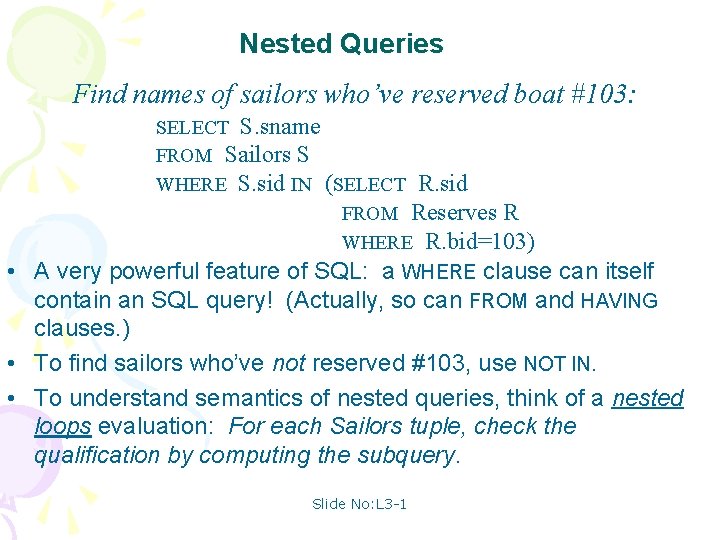
Nested Queries Find names of sailors who’ve reserved boat #103: SELECT S. sname FROM Sailors S WHERE S. sid IN (SELECT R. sid FROM Reserves R WHERE R. bid=103) • A very powerful feature of SQL: a WHERE clause can itself contain an SQL query! (Actually, so can FROM and HAVING clauses. ) • To find sailors who’ve not reserved #103, use NOT IN. • To understand semantics of nested queries, think of a nested loops evaluation: For each Sailors tuple, check the qualification by computing the subquery. Slide No: L 3 -1
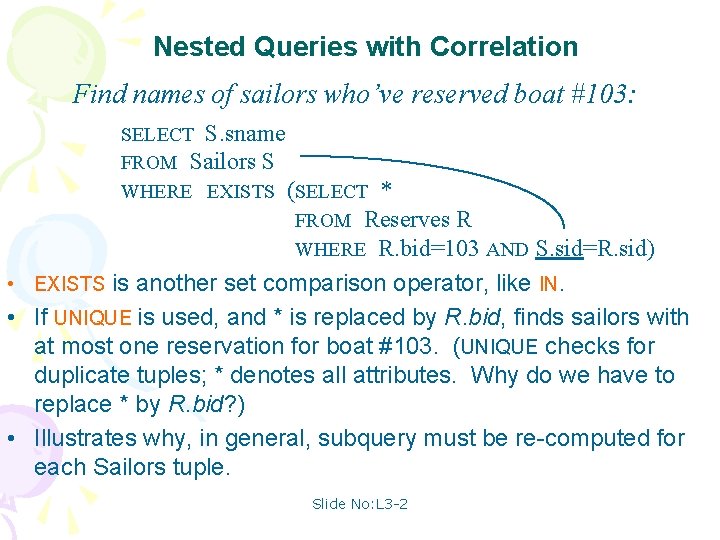
Nested Queries with Correlation Find names of sailors who’ve reserved boat #103: SELECT S. sname FROM Sailors S WHERE EXISTS (SELECT * FROM Reserves R WHERE R. bid=103 AND S. sid=R. sid) • EXISTS is another set comparison operator, like IN. • If UNIQUE is used, and * is replaced by R. bid, finds sailors with at most one reservation for boat #103. (UNIQUE checks for duplicate tuples; * denotes all attributes. Why do we have to replace * by R. bid? ) • Illustrates why, in general, subquery must be re-computed for each Sailors tuple. Slide No: L 3 -2
Aggregate Functions • These functions operate on the multiset of values of a column of a relation, and return a value avg: average value min: minimum value max: maximum value sum: sum of values count: number of values Slide No: L 3 -3
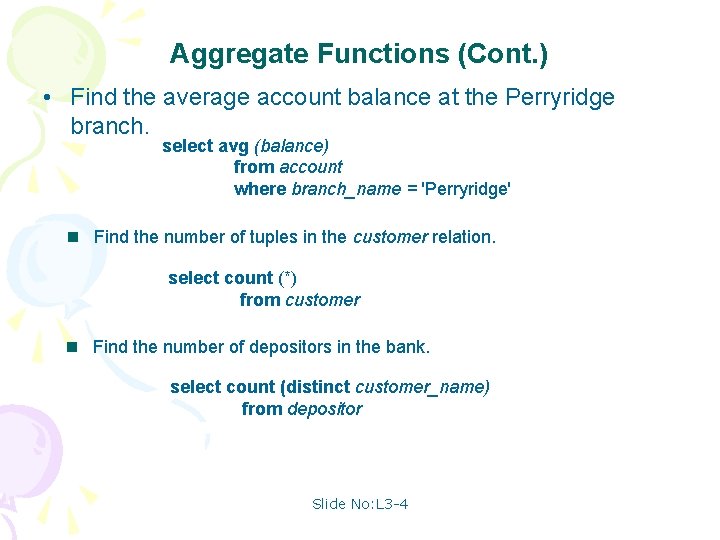
Aggregate Functions (Cont. ) • Find the average account balance at the Perryridge branch. select avg (balance) from account where branch_name = 'Perryridge' n Find the number of tuples in the customer relation. select count (*) from customer n Find the number of depositors in the bank. select count (distinct customer_name) from depositor Slide No: L 3 -4
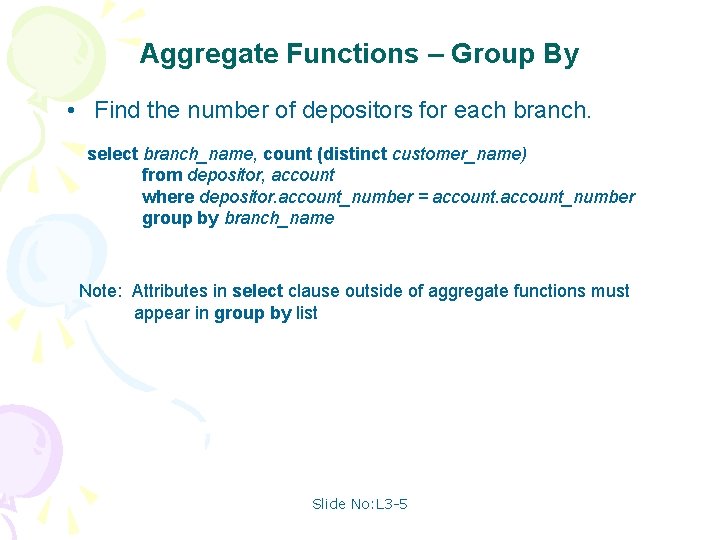
Aggregate Functions – Group By • Find the number of depositors for each branch. select branch_name, count (distinct customer_name) from depositor, account where depositor. account_number = account_number group by branch_name Note: Attributes in select clause outside of aggregate functions must appear in group by list Slide No: L 3 -5
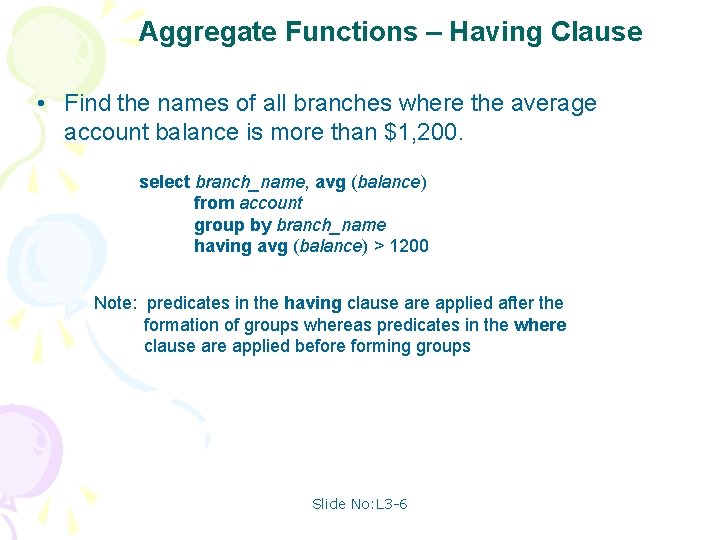
Aggregate Functions – Having Clause • Find the names of all branches where the average account balance is more than $1, 200. select branch_name, avg (balance) from account group by branch_name having avg (balance) > 1200 Note: predicates in the having clause are applied after the formation of groups whereas predicates in the where clause are applied before forming groups Slide No: L 3 -6
Nested Subqueries • SQL provides a mechanism for the nesting of subqueries. • A subquery is a select-from-where expression that is nested within another query. • A common use of subqueries is to perform tests for set membership, set comparisons, and set cardinality. Slide No: L 3 -7
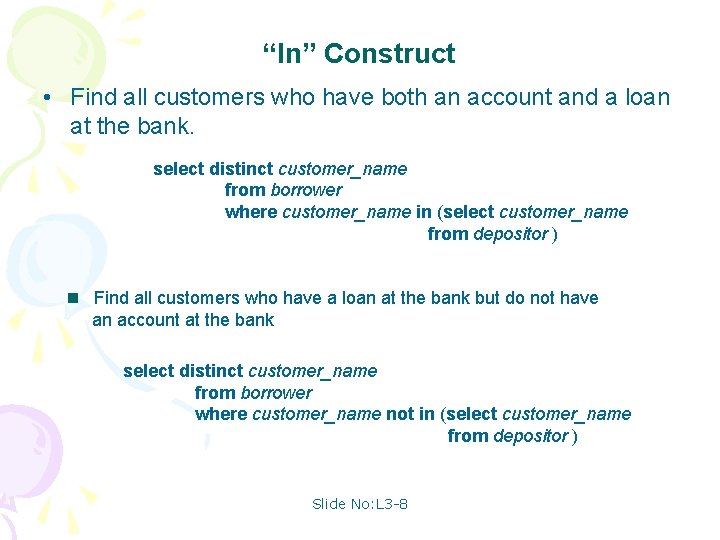
“In” Construct • Find all customers who have both an account and a loan at the bank. select distinct customer_name from borrower where customer_name in (select customer_name from depositor ) n Find all customers who have a loan at the bank but do not have an account at the bank select distinct customer_name from borrower where customer_name not in (select customer_name from depositor ) Slide No: L 3 -8
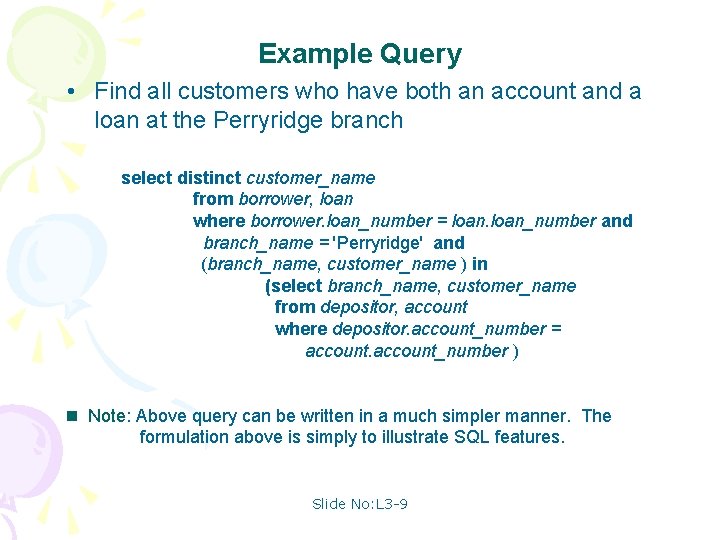
Example Query • Find all customers who have both an account and a loan at the Perryridge branch select distinct customer_name from borrower, loan where borrower. loan_number = loan_number and branch_name = 'Perryridge' and (branch_name, customer_name ) in (select branch_name, customer_name from depositor, account where depositor. account_number = account_number ) n Note: Above query can be written in a much simpler manner. The formulation above is simply to illustrate SQL features. Slide No: L 3 -9
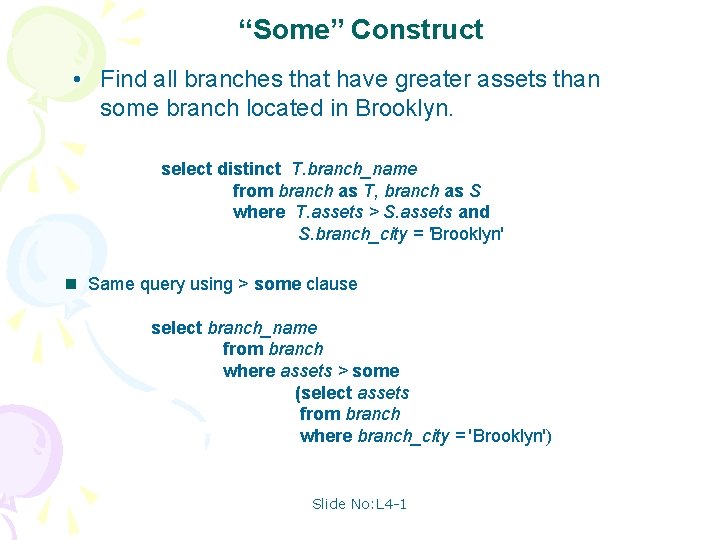
“Some” Construct • Find all branches that have greater assets than some branch located in Brooklyn. select distinct T. branch_name from branch as T, branch as S where T. assets > S. assets and S. branch_city = 'Brooklyn' n Same query using > some clause select branch_name from branch where assets > some (select assets from branch where branch_city = 'Brooklyn') Slide No: L 4 -1
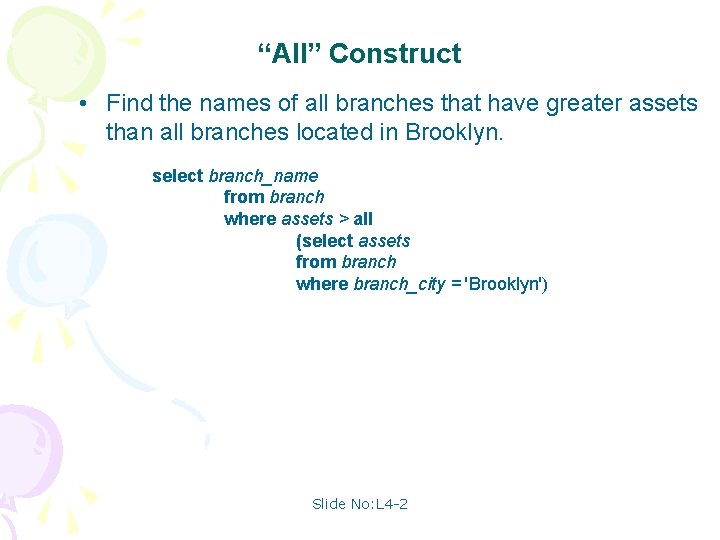
“All” Construct • Find the names of all branches that have greater assets than all branches located in Brooklyn. select branch_name from branch where assets > all (select assets from branch where branch_city = 'Brooklyn') Slide No: L 4 -2
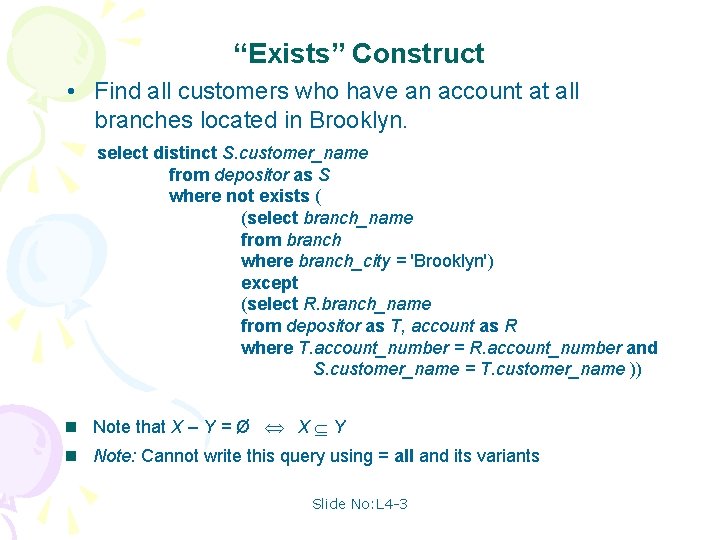
“Exists” Construct • Find all customers who have an account at all branches located in Brooklyn. select distinct S. customer_name from depositor as S where not exists ( (select branch_name from branch where branch_city = 'Brooklyn') except (select R. branch_name from depositor as T, account as R where T. account_number = R. account_number and S. customer_name = T. customer_name )) n Note that X – Y = Ø X Y n Note: Cannot write this query using = all and its variants Slide No: L 4 -3
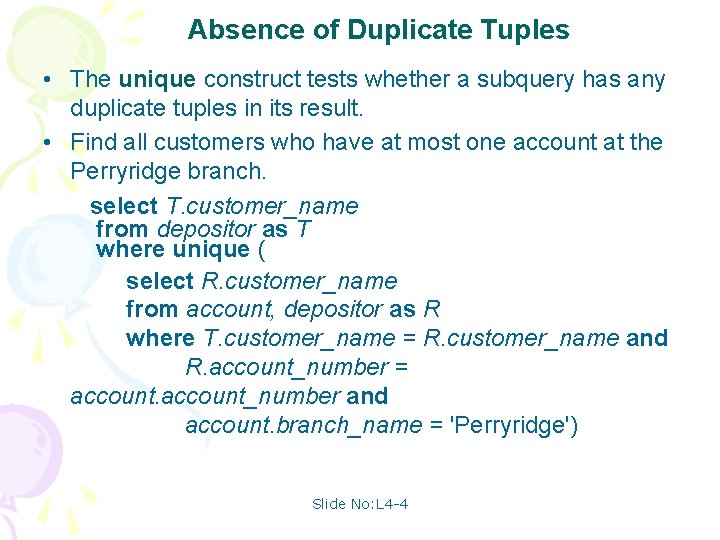
Absence of Duplicate Tuples • The unique construct tests whether a subquery has any duplicate tuples in its result. • Find all customers who have at most one account at the Perryridge branch. select T. customer_name from depositor as T where unique ( select R. customer_name from account, depositor as R where T. customer_name = R. customer_name and R. account_number = account_number and account. branch_name = 'Perryridge') Slide No: L 4 -4
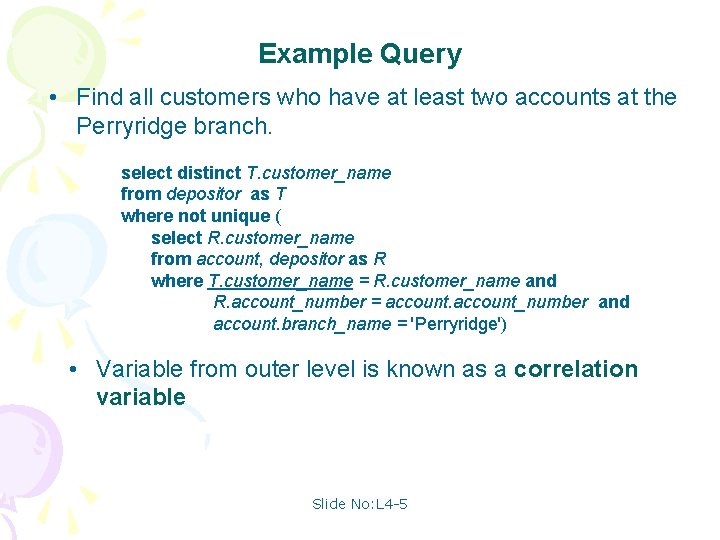
Example Query • Find all customers who have at least two accounts at the Perryridge branch. select distinct T. customer_name from depositor as T where not unique ( select R. customer_name from account, depositor as R where T. customer_name = R. customer_name and R. account_number = account_number and account. branch_name = 'Perryridge') • Variable from outer level is known as a correlation variable Slide No: L 4 -5
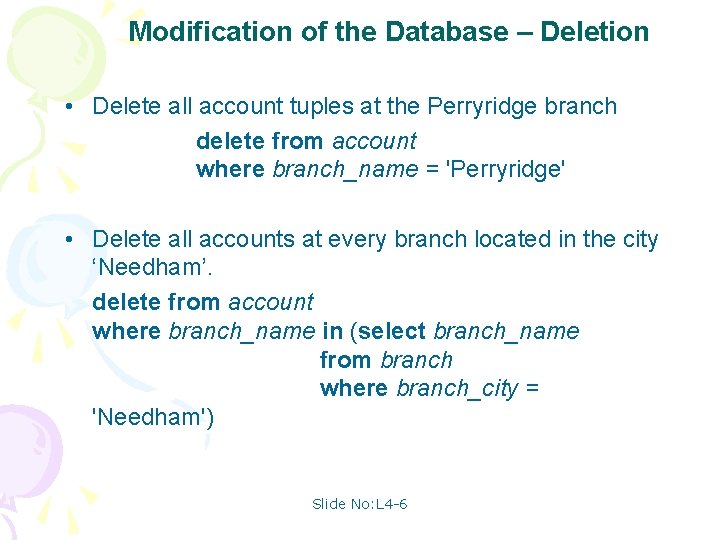
Modification of the Database – Deletion • Delete all account tuples at the Perryridge branch delete from account where branch_name = 'Perryridge' • Delete all accounts at every branch located in the city ‘Needham’. delete from account where branch_name in (select branch_name from branch where branch_city = 'Needham') Slide No: L 4 -6
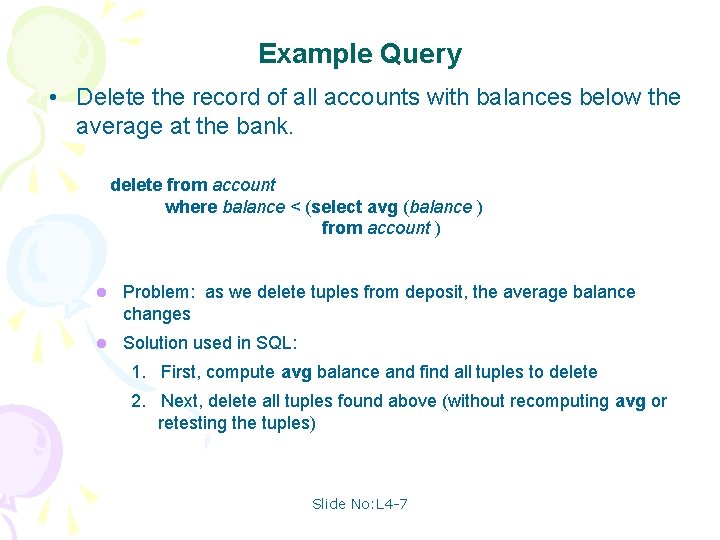
Example Query • Delete the record of all accounts with balances below the average at the bank. delete from account where balance < (select avg (balance ) from account ) l Problem: as we delete tuples from deposit, the average balance changes l Solution used in SQL: 1. First, compute avg balance and find all tuples to delete 2. Next, delete all tuples found above (without recomputing avg or retesting the tuples) Slide No: L 4 -7
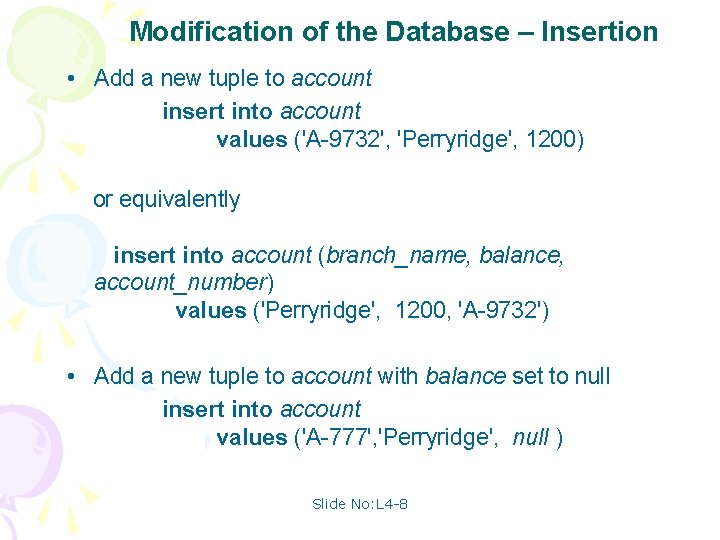
Modification of the Database – Insertion • Add a new tuple to account insert into account values ('A-9732', 'Perryridge', 1200) or equivalently insert into account (branch_name, balance, account_number) values ('Perryridge', 1200, 'A-9732') • Add a new tuple to account with balance set to null insert into account values ('A-777', 'Perryridge', null ) Slide No: L 4 -8
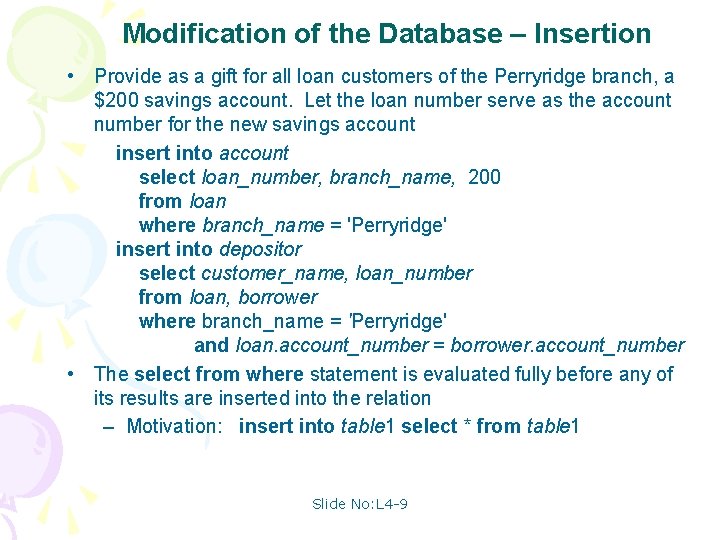
Modification of the Database – Insertion • Provide as a gift for all loan customers of the Perryridge branch, a $200 savings account. Let the loan number serve as the account number for the new savings account insert into account select loan_number, branch_name, 200 from loan where branch_name = 'Perryridge' insert into depositor select customer_name, loan_number from loan, borrower where branch_name = 'Perryridge' and loan. account_number = borrower. account_number • The select from where statement is evaluated fully before any of its results are inserted into the relation – Motivation: insert into table 1 select * from table 1 Slide No: L 4 -9
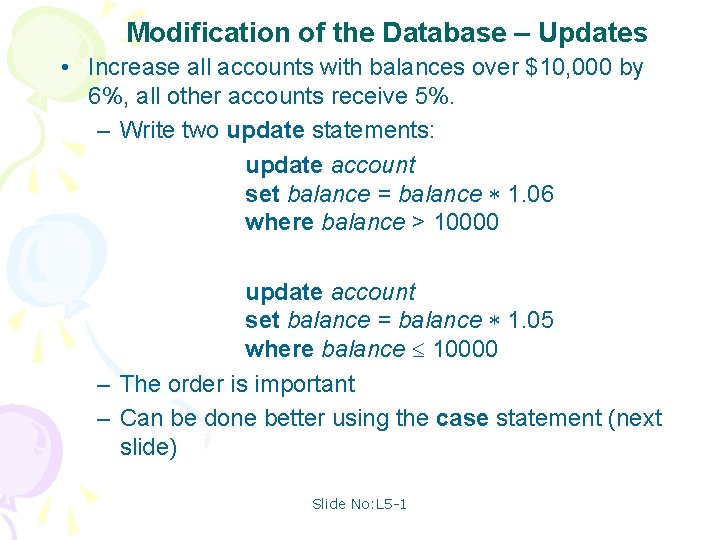
Modification of the Database – Updates • Increase all accounts with balances over $10, 000 by 6%, all other accounts receive 5%. – Write two update statements: update account set balance = balance 1. 06 where balance > 10000 update account set balance = balance 1. 05 where balance 10000 – The order is important – Can be done better using the case statement (next slide) Slide No: L 5 -1
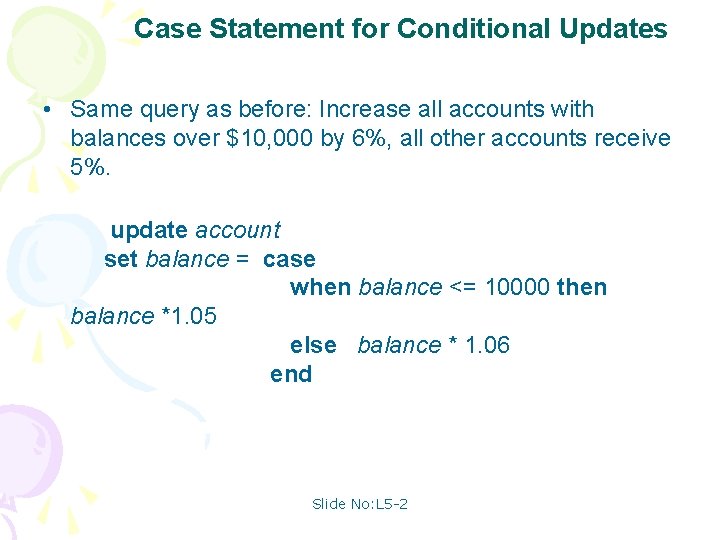
Case Statement for Conditional Updates • Same query as before: Increase all accounts with balances over $10, 000 by 6%, all other accounts receive 5%. update account set balance = case when balance <= 10000 then balance *1. 05 else balance * 1. 06 end Slide No: L 5 -2
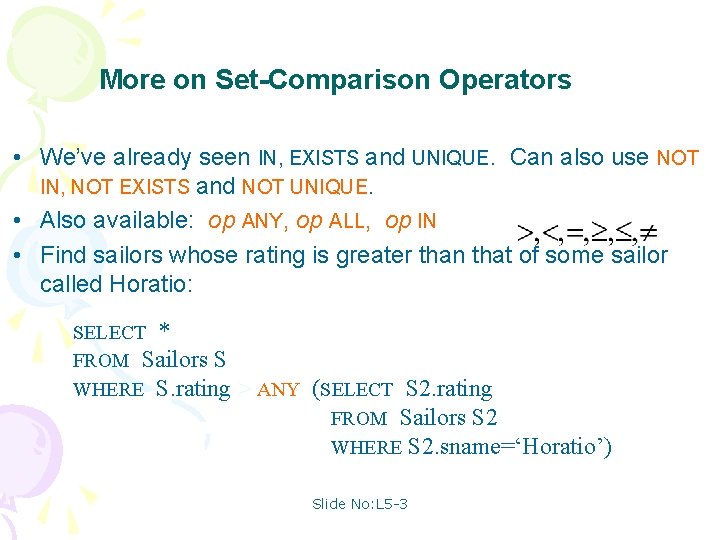
More on Set-Comparison Operators • We’ve already seen IN, EXISTS and UNIQUE. Can also use NOT IN, NOT EXISTS and NOT UNIQUE. • Also available: op ANY, op ALL, op IN • Find sailors whose rating is greater than that of some sailor called Horatio: SELECT * FROM Sailors S WHERE S. rating > ANY (SELECT S 2. rating FROM Sailors S 2 WHERE S 2. sname=‘Horatio’) Slide No: L 5 -3
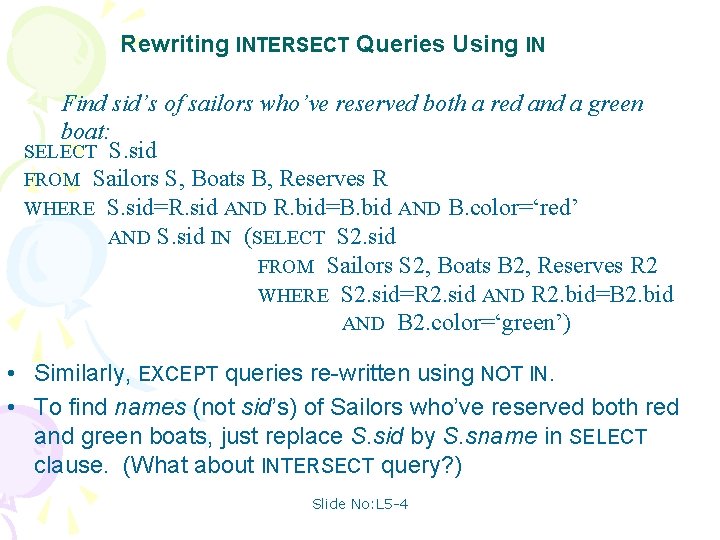
Rewriting INTERSECT Queries Using IN Find sid’s of sailors who’ve reserved both a red and a green boat: SELECT S. sid FROM Sailors S, Boats B, Reserves R WHERE S. sid=R. sid AND R. bid=B. bid AND B. color=‘red’ AND S. sid IN (SELECT S 2. sid FROM Sailors S 2, Boats B 2, Reserves R 2 WHERE S 2. sid=R 2. sid AND R 2. bid=B 2. bid AND B 2. color=‘green’) • Similarly, EXCEPT queries re-written using NOT IN. • To find names (not sid’s) of Sailors who’ve reserved both red and green boats, just replace S. sid by S. sname in SELECT clause. (What about INTERSECT query? ) Slide No: L 5 -4
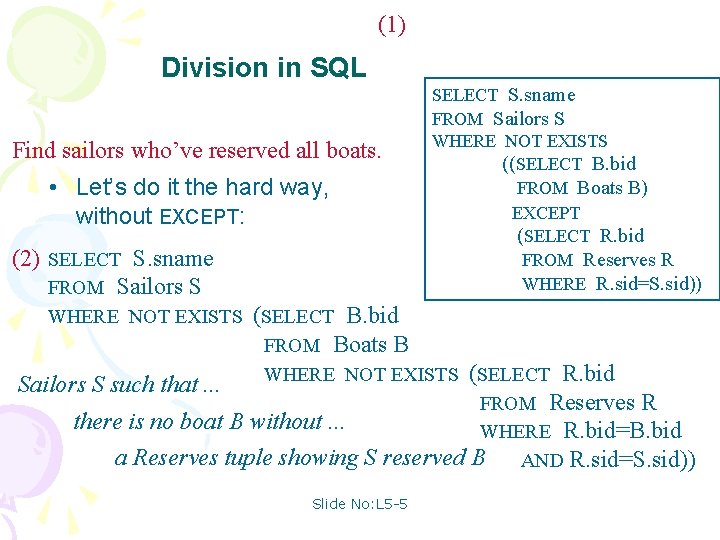
(1) Division in SQL Find sailors who’ve reserved all boats. • Let’s do it the hard way, without EXCEPT: (2) SELECT S. sname FROM Sailors S WHERE NOT EXISTS ((SELECT B. bid FROM Boats B) EXCEPT (SELECT R. bid FROM Reserves R WHERE R. sid=S. sid)) WHERE NOT EXISTS (SELECT B. bid FROM Boats B WHERE NOT EXISTS (SELECT R. bid Sailors S such that. . . FROM Reserves R there is no boat B without. . . WHERE R. bid=B. bid a Reserves tuple showing S reserved B AND R. sid=S. sid)) Slide No: L 5 -5
![• COUNT (*) Aggregate Operators COUNT ( [DISTINCT] A) SUM ( [DISTINCT] A)](http://slidetodoc.com/presentation_image_h2/c0fd537bf469359405d91b8bb4338675/image-56.jpg "• COUNT (*) Aggregate Operators COUNT ( [DISTINCT] A) SUM ( [DISTINCT] A)")
• COUNT (*) Aggregate Operators COUNT ( [DISTINCT] A) SUM ( [DISTINCT] A) AVG ( [DISTINCT] A) Significant extension of relational MAX (A) algebra. MIN (A) SELECT COUNT (*) FROM Sailors S SELECT AVG (S. age) FROM Sailors S WHERE S. rating=10 single column SELECT S. sname FROM Sailors S WHERE S. rating= (SELECT MAX(S 2. rating) FROM Sailors S 2) SELECT COUNT (DISTINCT FROM Sailors S WHERE S. sname=‘Bob’ S. rating) SELECT AVG ( DISTINCT S. age) FROM Sailors S WHERE S. rating=10 Slide No: L 5 -6
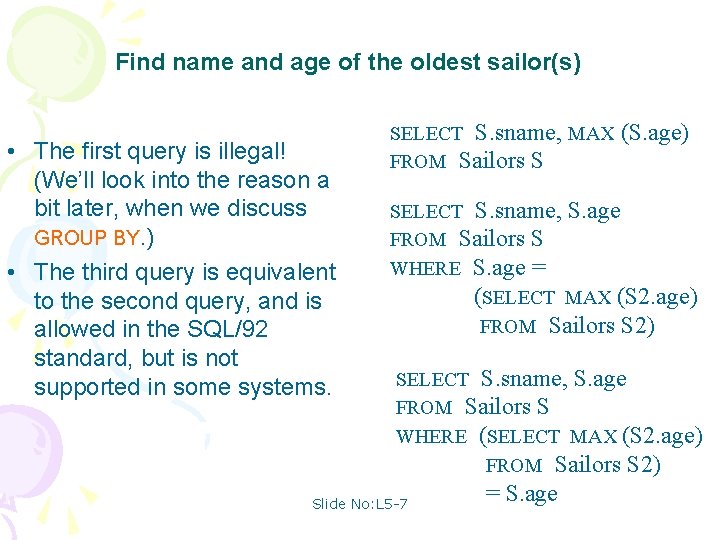
Find name and age of the oldest sailor(s) • The first query is illegal! (We’ll look into the reason a bit later, when we discuss GROUP BY. ) • The third query is equivalent to the second query, and is allowed in the SQL/92 standard, but is not supported in some systems. SELECT S. sname, MAX FROM Sailors S (S. age) SELECT S. sname, S. age FROM Sailors S WHERE S. age = (SELECT MAX (S 2. age) FROM Sailors S 2) SELECT S. sname, S. age FROM Sailors S WHERE (SELECT MAX (S 2. age) FROM Sailors S 2) Slide No: L 5 -7 = S. age
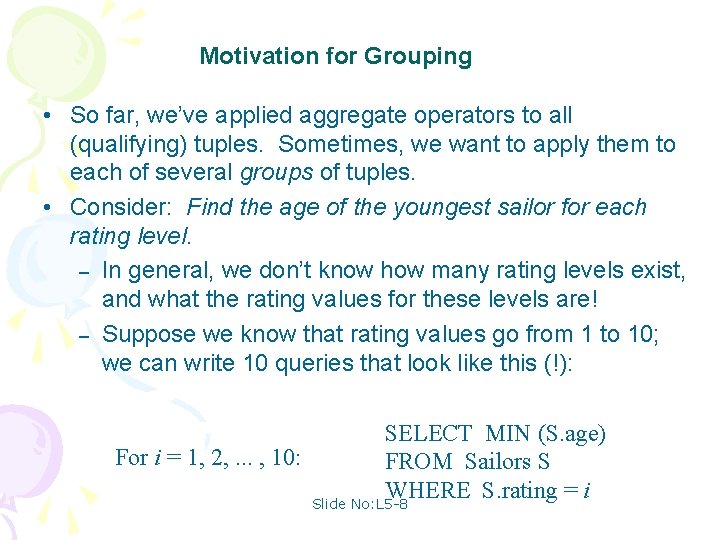
Motivation for Grouping • So far, we’ve applied aggregate operators to all (qualifying) tuples. Sometimes, we want to apply them to each of several groups of tuples. • Consider: Find the age of the youngest sailor for each rating level. – In general, we don’t know how many rating levels exist, and what the rating values for these levels are! – Suppose we know that rating values go from 1 to 10; we can write 10 queries that look like this (!): SELECT MIN (S. age) For i = 1, 2, . . . , 10: FROM Sailors S WHERE S. rating = i Slide No: L 5 -8
![Queries With GROUP BY and HAVING SELECT [DISTINCT] target-list FROM relation-list WHERE qualification GROUP](http://slidetodoc.com/presentation_image_h2/c0fd537bf469359405d91b8bb4338675/image-59.jpg "Queries With GROUP BY and HAVING SELECT [DISTINCT] target-list FROM relation-list WHERE qualification GROUP")
Queries With GROUP BY and HAVING SELECT [DISTINCT] target-list FROM relation-list WHERE qualification GROUP BY grouping-list HAVING group-qualification • The target-list contains (i) attribute names (ii) terms with aggregate operations (e. g. , MIN (S. age)). – The attribute list (i) must be a subset of grouping-list. Intuitively, each answer tuple corresponds to a group, and these attributes must have a single value per group. (A group is a set of tuples that have the same value for all attributes in grouping-list. ) Slide No: L 5 -9
Conceptual Evaluation • The cross-product of relation-list is computed, tuples that fail qualification are discarded, `unnecessary’ fields are deleted, and the remaining tuples are partitioned into groups by the value of attributes in grouping-list. • The group-qualification is then applied to eliminate some groups. Expressions in group-qualification must have a single value per group! – In effect, an attribute in group-qualification that is not an argument of an aggregate op also appears in grouping-list. (SQL does not exploit primary key semantics here!) • One answer tuple is generated per qualifying group. Slide No: L 6 -1
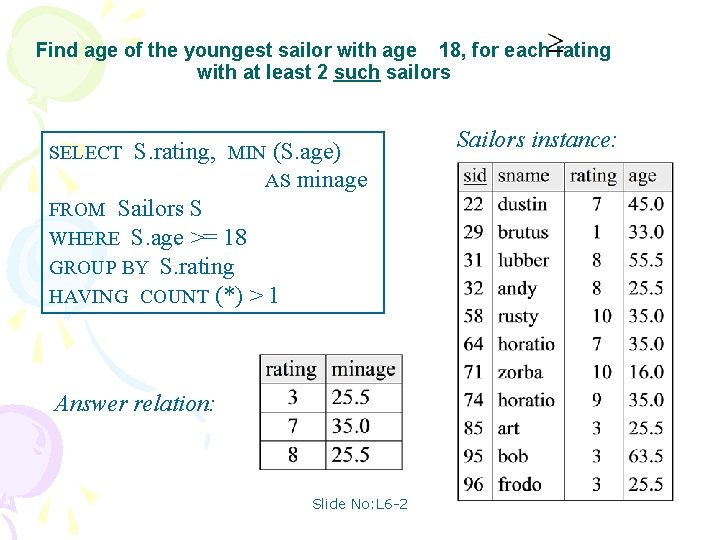
Find age of the youngest sailor with age 18, for each rating with at least 2 such sailors S. rating, MIN (S. age) AS minage FROM Sailors S WHERE S. age >= 18 GROUP BY S. rating HAVING COUNT (*) > 1 SELECT Answer relation: Slide No: L 6 -2 Sailors instance:
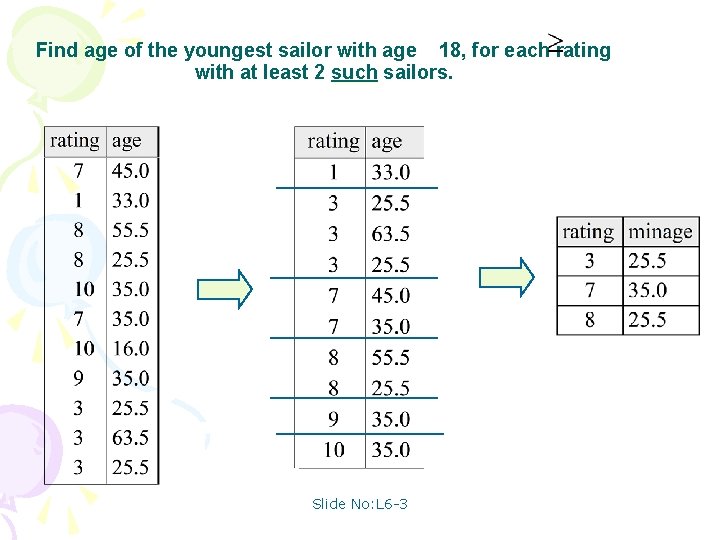
Find age of the youngest sailor with age 18, for each rating with at least 2 such sailors. Slide No: L 6 -3
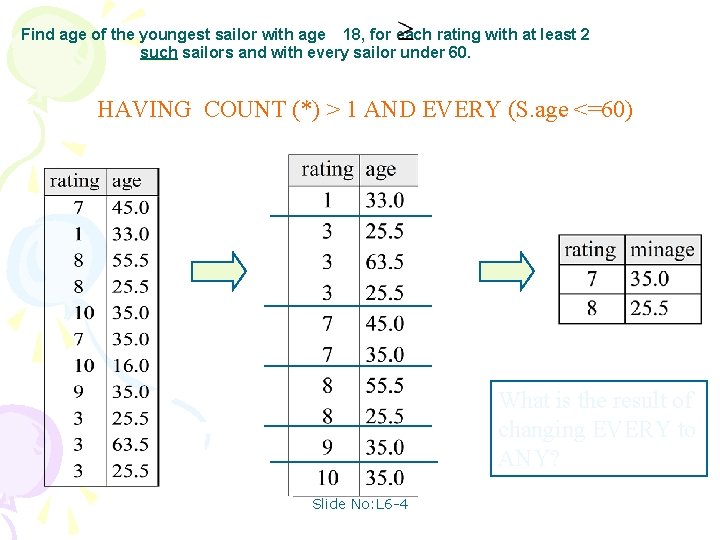
Find age of the youngest sailor with age 18, for each rating with at least 2 such sailors and with every sailor under 60. HAVING COUNT (*) > 1 AND EVERY (S. age <=60) What is the result of changing EVERY to ANY? Slide No: L 6 -4
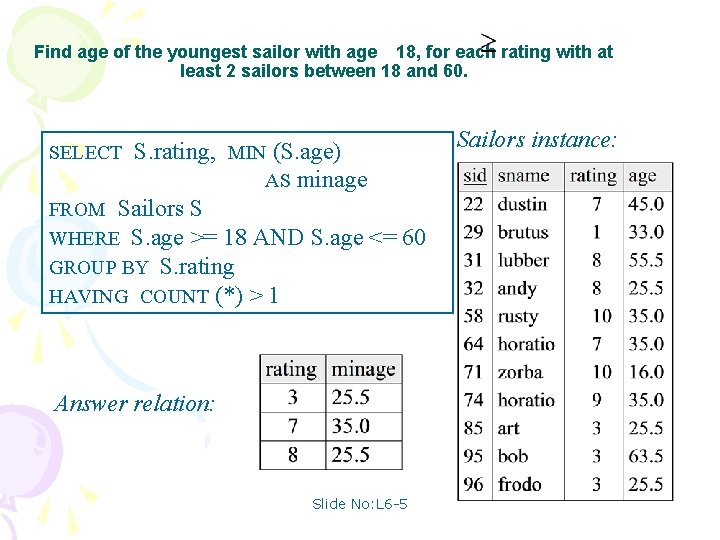
Find age of the youngest sailor with age 18, for each rating with at least 2 sailors between 18 and 60. S. rating, MIN (S. age) AS minage FROM Sailors S WHERE S. age >= 18 AND S. age <= 60 GROUP BY S. rating HAVING COUNT (*) > 1 SELECT Answer relation: Slide No: L 6 -5 Sailors instance:
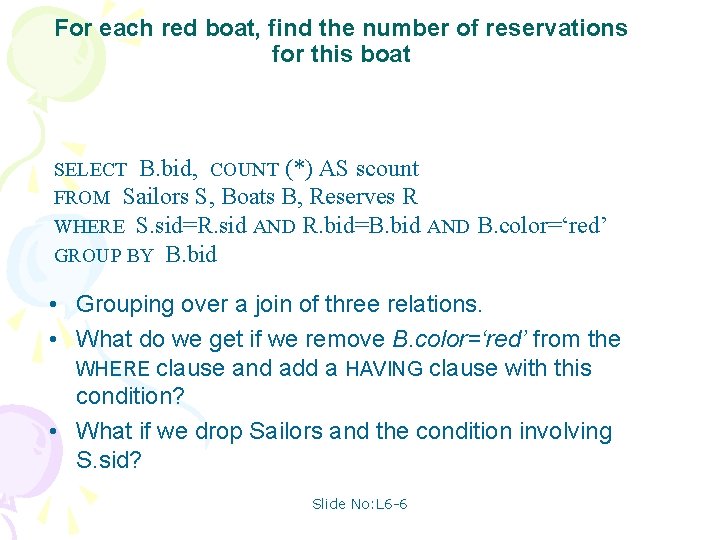
For each red boat, find the number of reservations for this boat SELECT B. bid, COUNT (*) AS scount FROM Sailors S, Boats B, Reserves R WHERE S. sid=R. sid AND R. bid=B. bid AND GROUP BY B. bid B. color=‘red’ • Grouping over a join of three relations. • What do we get if we remove B. color=‘red’ from the WHERE clause and add a HAVING clause with this condition? • What if we drop Sailors and the condition involving S. sid? Slide No: L 6 -6
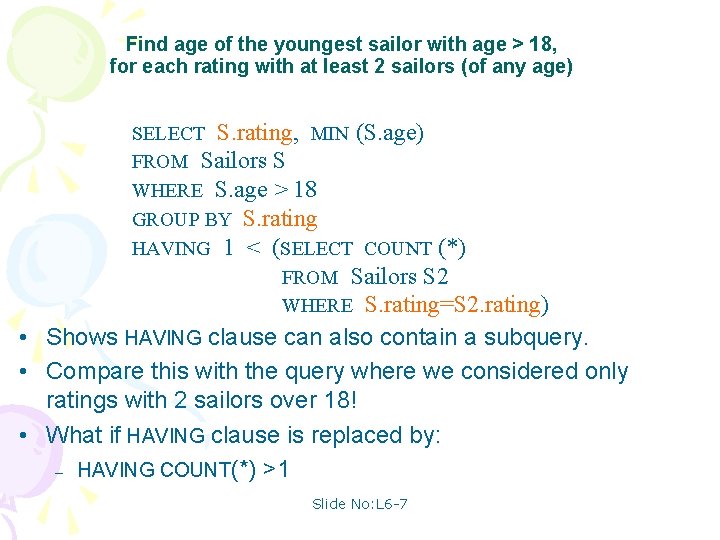
Find age of the youngest sailor with age > 18, for each rating with at least 2 sailors (of any age) SELECT S. rating, MIN (S. age) FROM Sailors S WHERE S. age > 18 GROUP BY S. rating HAVING 1 < (SELECT COUNT (*) FROM Sailors S 2 WHERE S. rating=S 2. rating) • Shows HAVING clause can also contain a subquery. • Compare this with the query where we considered only ratings with 2 sailors over 18! • What if HAVING clause is replaced by: – HAVING COUNT(*) >1 Slide No: L 6 -7
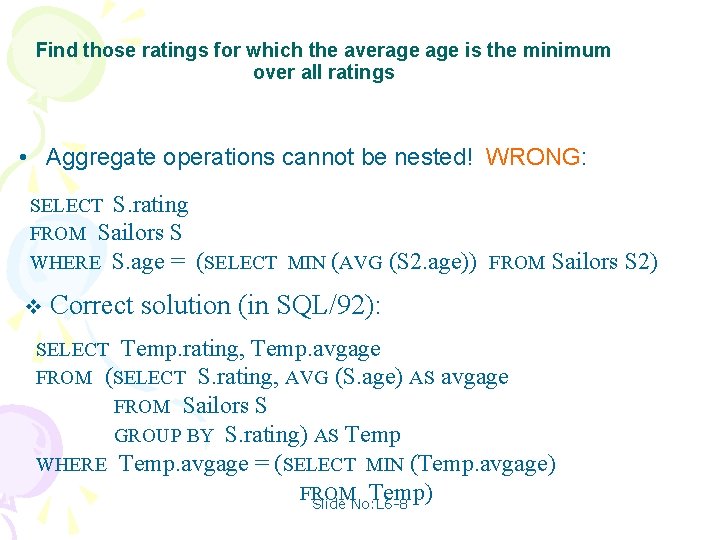
Find those ratings for which the average is the minimum over all ratings • Aggregate operations cannot be nested! WRONG: SELECT S. rating FROM Sailors S WHERE S. age = (SELECT MIN (AVG v (S 2. age)) FROM Sailors S 2) Correct solution (in SQL/92): SELECT Temp. rating, Temp. avgage FROM (SELECT S. rating, AVG (S. age) AS avgage FROM Sailors S GROUP BY S. rating) AS Temp WHERE Temp. avgage = (SELECT MIN (Temp. avgage) FROM Temp) Slide No: L 6 -8
Null Values • Field values in a tuple are sometimes unknown (e. g. , a rating has not been assigned) or inapplicable (e. g. , no spouse’s name). – SQL provides a special value null for such situations. • The presence of null complicates many issues. E. g. : – Special operators needed to check if value is/is not null. – Is rating>8 true or false when rating is equal to null? What about AND, OR and NOT connectives? – We need a 3 -valued logic (true, false and unknown). – Meaning of constructs must be defined carefully. (e. g. , WHERE clause eliminates rows that don’t evaluate to true. ) – New operators (in particular, outer joins) possible/needed. Slide No: L 7 -1
Null Values • It is possible for tuples to have a null value, denoted by null, for some of their attributes • null signifies an unknown value or that a value does not exist. • The predicate is null can be used to check for null values. – Example: Find all loan number which appear in the loan relation with null values for amount. select loan_number from loan where amount is null • The result of any arithmetic expression involving null is null – Example: 5 + null returns null • However, aggregate functions simply ignore nulls – More on next slide Slide No: L 7 -2
Null Values and Three Valued Logic • Any comparison with null returns unknown – Example: 5 < null or null <> null or null = null • Three-valued logic using the truth value unknown: – OR: (unknown or true) = true, (unknown or false) = unknown (unknown or unknown) = unknown – AND: (true and unknown) = unknown, (false and unknown) = false, (unknown and unknown) = unknown – NOT: (not unknown) = unknown – “P is unknown” evaluates to true if predicate P evaluates to unknown • Result of where clause predicate is treated as false if it evaluates to unknown Slide No: L 7 -3
Null Values and Aggregates • Total all loan amounts select sum (amount ) from loan – Above statement ignores null amounts – Result is null if there is no non-null amount • All aggregate operations except count(*) ignore tuples with null values on the aggregated attributes. Slide No: L 7 -4
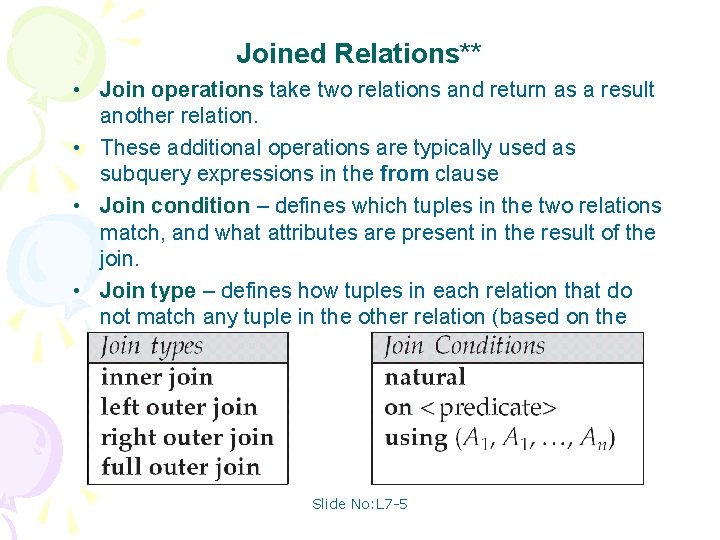
Joined Relations** • Join operations take two relations and return as a result another relation. • These additional operations are typically used as subquery expressions in the from clause • Join condition – defines which tuples in the two relations match, and what attributes are present in the result of the join. • Join type – defines how tuples in each relation that do not match any tuple in the other relation (based on the join condition) are treated. Slide No: L 7 -5
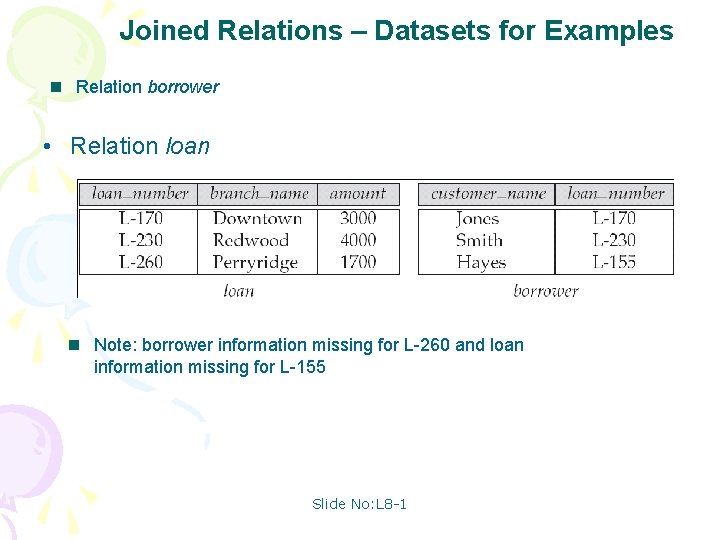
Joined Relations – Datasets for Examples n Relation borrower • Relation loan n Note: borrower information missing for L-260 and loan information missing for L-155 Slide No: L 8 -1
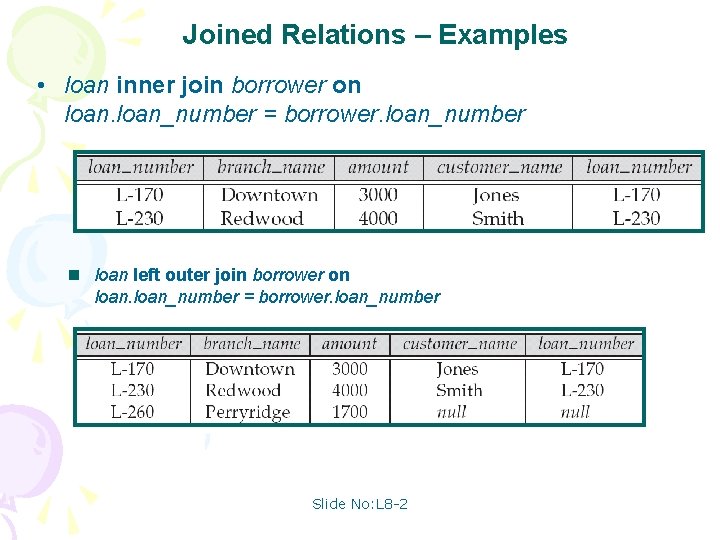
Joined Relations – Examples • loan inner join borrower on loan_number = borrower. loan_number n loan left outer join borrower on loan_number = borrower. loan_number Slide No: L 8 -2
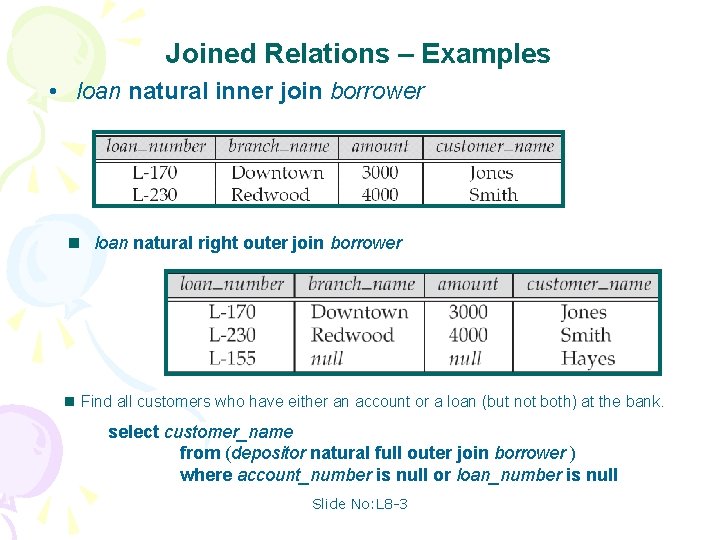
Joined Relations – Examples • loan natural inner join borrower n loan natural right outer join borrower n Find all customers who have either an account or a loan (but not both) at the bank. select customer_name from (depositor natural full outer join borrower ) where account_number is null or loan_number is null Slide No: L 8 -3
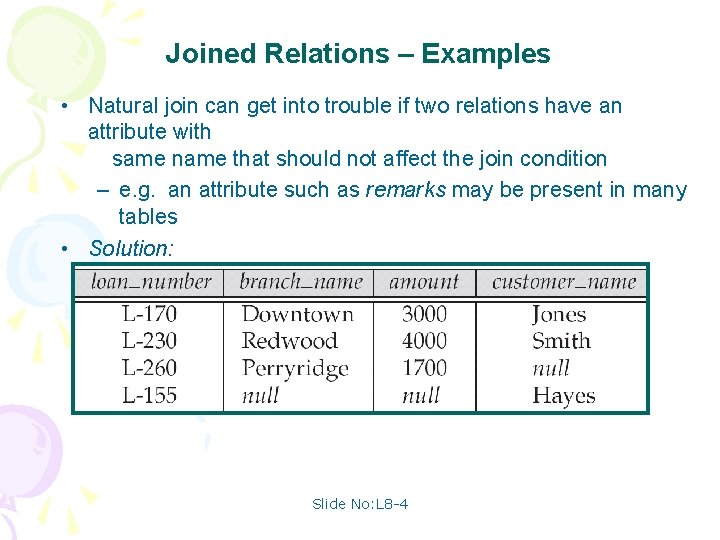
Joined Relations – Examples • Natural join can get into trouble if two relations have an attribute with same name that should not affect the join condition – e. g. an attribute such as remarks may be present in many tables • Solution: – loan full outer join borrower using (loan_number) Slide No: L 8 -4
Derived Relations • SQL allows a subquery expression to be used in the from clause • Find the average account balance of those branches where the average account balance is greater than $1200. select branch_name, avg_balance from (select branch_name, avg (balance) from account group by branch_name ) as branch_avg ( branch_name, avg_balance ) where avg_balance > 1200 Note that we do not need to use the having clause, since we compute the temporary (view) relation branch_avg in the from clause, and the attributes of branch_avg can be used directly in the where clause. Slide No: L 8 -5
Integrity Constraints (Review) • An IC describes conditions that every legal instance of a relation must satisfy. – Inserts/deletes/updates that violate IC’s are disallowed. – Can be used to ensure application semantics (e. g. , sid is a key), or prevent inconsistencies (e. g. , sname has to be a string, age must be < 200) • Types of IC’s: Domain constraints, primary key constraints, foreign key constraints, general constraints. – Domain constraints: Field values must be of right type. Always enforced. Slide No: L 8 -6
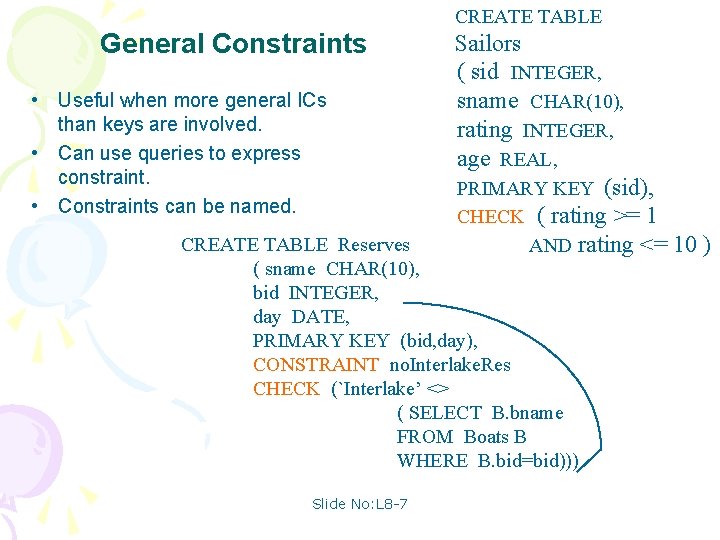
CREATE TABLE General Constraints • Useful when more general ICs than keys are involved. • Can use queries to express constraint. • Constraints can be named. Sailors ( sid INTEGER, sname CHAR(10), rating INTEGER, age REAL, PRIMARY KEY (sid), CHECK ( rating >= 1 AND rating <= 10 ) CREATE TABLE Reserves ( sname CHAR(10), bid INTEGER, day DATE, PRIMARY KEY (bid, day), CONSTRAINT no. Interlake. Res CHECK (`Interlake’ <> ( SELECT B. bname FROM Boats B WHERE B. bid=bid))) Slide No: L 8 -7
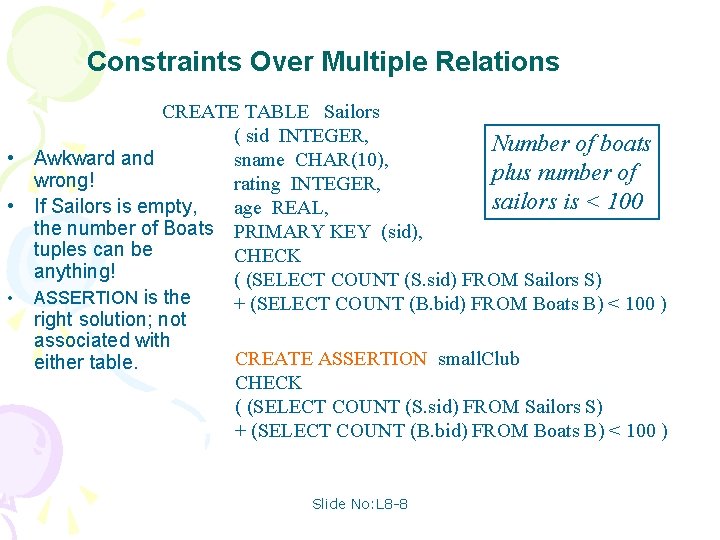
Constraints Over Multiple Relations CREATE TABLE Sailors ( sid INTEGER, Number of boats • Awkward and sname CHAR(10), plus number of wrong! rating INTEGER, sailors is < 100 • If Sailors is empty, age REAL, the number of Boats PRIMARY KEY (sid), tuples can be CHECK anything! ( (SELECT COUNT (S. sid) FROM Sailors S) • ASSERTION is the + (SELECT COUNT (B. bid) FROM Boats B) < 100 ) right solution; not associated with CREATE ASSERTION small. Club either table. CHECK ( (SELECT COUNT (S. sid) FROM Sailors S) + (SELECT COUNT (B. bid) FROM Boats B) < 100 ) Slide No: L 8 -8
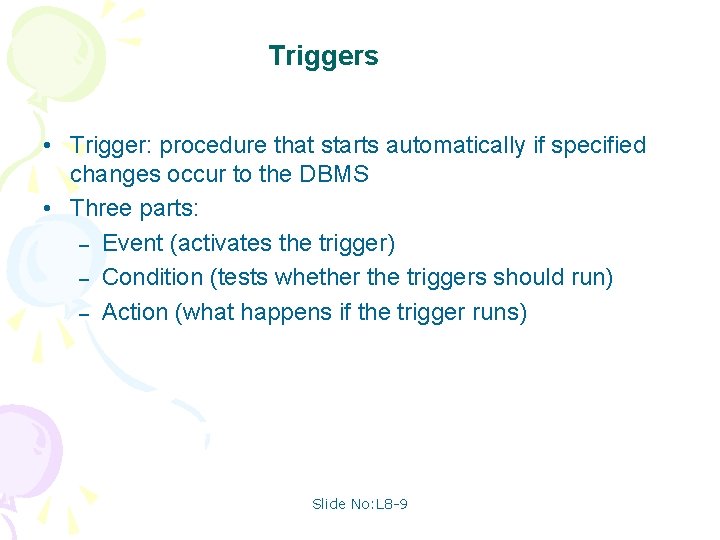
Triggers • Trigger: procedure that starts automatically if specified changes occur to the DBMS • Three parts: – Event (activates the trigger) – Condition (tests whether the triggers should run) – Action (what happens if the trigger runs) Slide No: L 8 -9
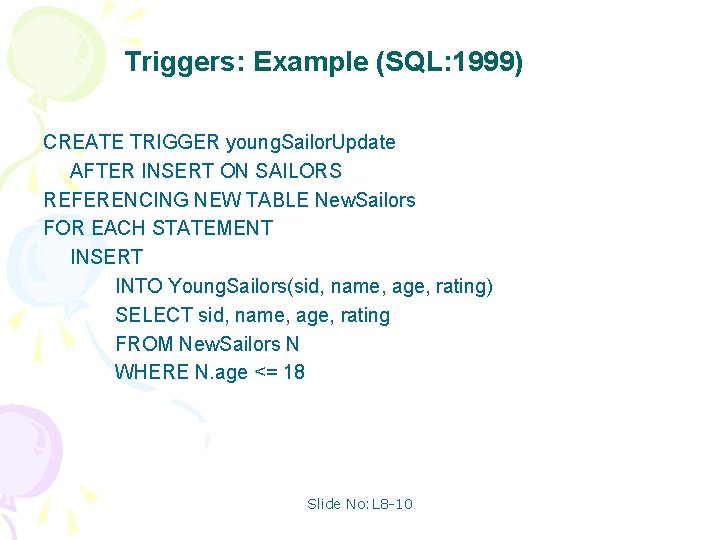
Triggers: Example (SQL: 1999) CREATE TRIGGER young. Sailor. Update AFTER INSERT ON SAILORS REFERENCING NEW TABLE New. Sailors FOR EACH STATEMENT INSERT INTO Young. Sailors(sid, name, age, rating) SELECT sid, name, age, rating FROM New. Sailors N WHERE N. age <= 18 Slide No: L 8 -10
- Slides: 82