
Database Management Systems Syllabus Instructor Vinnie Costa vcostaoptonline
Database Management Systems Syllabus Instructor: Vinnie Costa vcosta@optonline. net CSC 056 -Z 1 – Database Management Systems – Vinnie Costa – Hofstra University 1
Course Description v This course is designed to provide individuals with an introduction to database concepts and the relational database model. Topics include SQL, normalization, design methodology, DBMS functions, database administration, and other database management approaches, such as client/server databases, object oriented databases, and data warehouses. At the completion of this course, students should be able to understand a user's database requirements and translate those into a valid database design. The emphasis will be on application development rather than system fundamentals. v Prerequisites: None CSC 056 -Z 1 – Database Management Systems – Vinnie Costa – Hofstra University 2
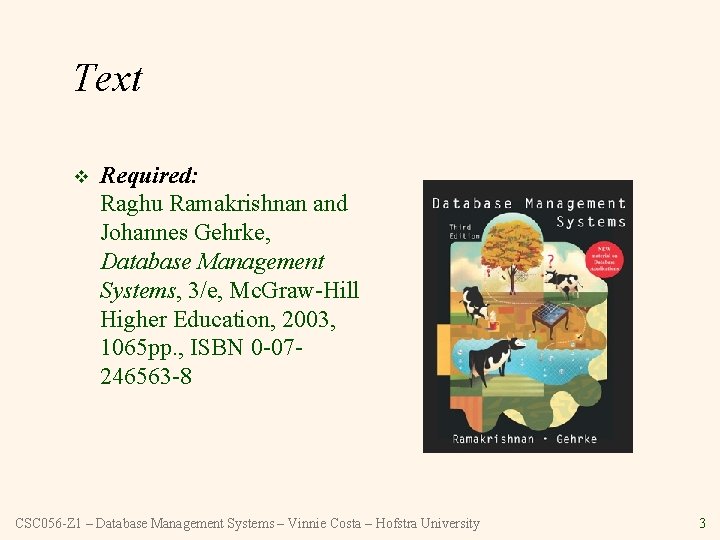
Text v Required: Raghu Ramakrishnan and Johannes Gehrke, Database Management Systems, 3/e, Mc. Graw-Hill Higher Education, 2003, 1065 pp. , ISBN 0 -07246563 -8 CSC 056 -Z 1 – Database Management Systems – Vinnie Costa – Hofstra University 3

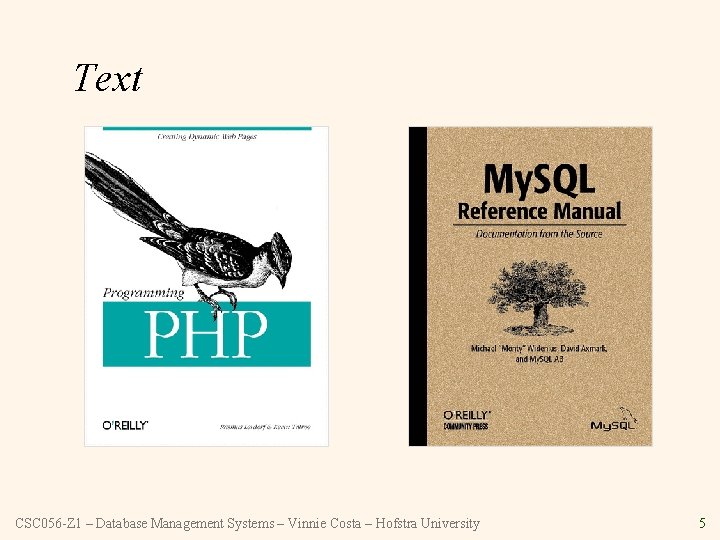
Text v Reference: Rasmus Lerdorf and Kevin Tatroe, Programming PHP, O'Reilly & Associates, Inc. , 2002 Michael “Monty” Widenius, David Axmark, and My. SQL AB, My. SQL Reference Manual, O'Reilly & Associates, Inc. , 2002 CSC 056 -Z 1 – Database Management Systems – Vinnie Costa – Hofstra University 4
Text CSC 056 -Z 1 – Database Management Systems – Vinnie Costa – Hofstra University 5
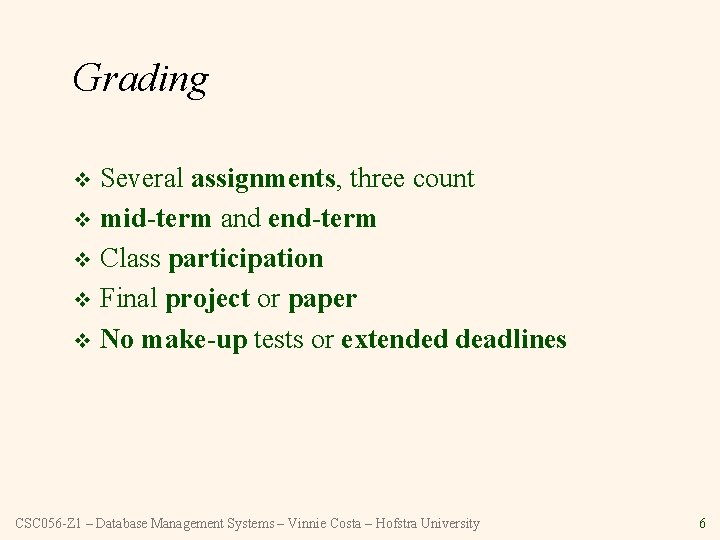
Grading Several assignments, three count v mid-term and end-term v Class participation v Final project or paper v No make-up tests or extended deadlines v CSC 056 -Z 1 – Database Management Systems – Vinnie Costa – Hofstra University 6
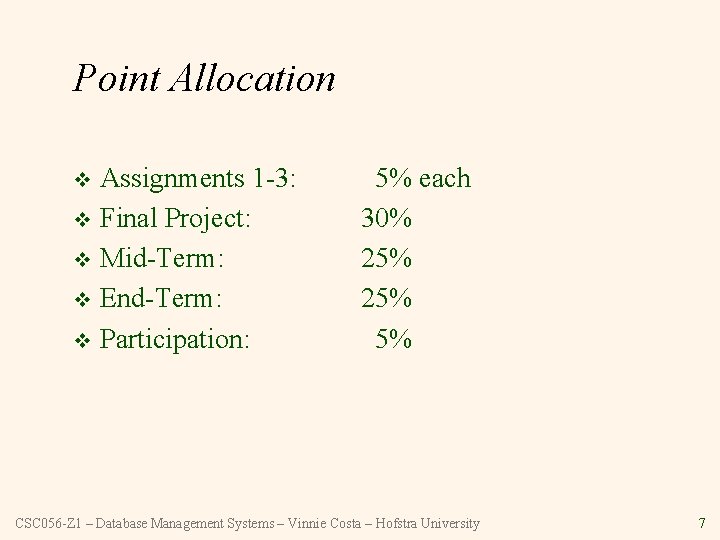
Point Allocation Assignments 1 -3: v Final Project: v Mid-Term: v End-Term: v Participation: v 5% each 30% 25% 5% CSC 056 -Z 1 – Database Management Systems – Vinnie Costa – Hofstra University 7
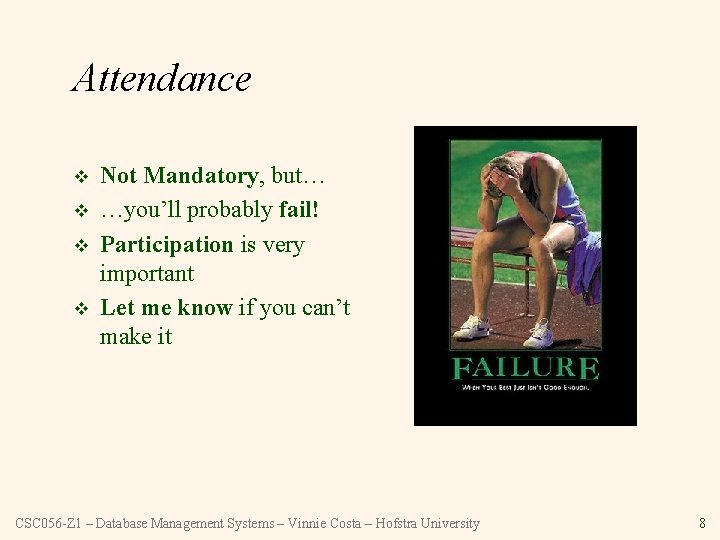
Attendance v v Not Mandatory, but… …you’ll probably fail! Participation is very important Let me know if you can’t make it CSC 056 -Z 1 – Database Management Systems – Vinnie Costa – Hofstra University 8
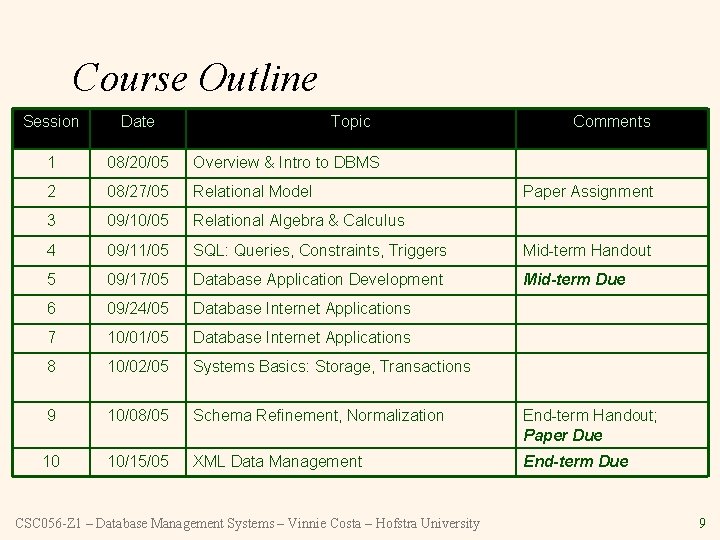
Course Outline Session Date Topic 1 08/20/05 Overview & Intro to DBMS 2 08/27/05 Relational Model 3 09/10/05 Relational Algebra & Calculus 4 09/11/05 SQL: Queries, Constraints, Triggers Mid-term Handout 5 09/17/05 Database Application Development Mid-term Due 6 09/24/05 Database Internet Applications 7 10/01/05 Database Internet Applications 8 10/02/05 Systems Basics: Storage, Transactions 9 10/08/05 Schema Refinement, Normalization End-term Handout; Paper Due 10 10/15/05 XML Data Management End-term Due CSC 056 -Z 1 – Database Management Systems – Vinnie Costa – Hofstra University Comments Paper Assignment 9
Slides, Links & News v http: //www. cs. hofstra. edu/~cscvjc/Fall 05 v Check frequently!!! v E-Mail v Jabber – vcosta@jabber. org CSC 056 -Z 1 – Database Management Systems – Vinnie Costa – Hofstra University 10
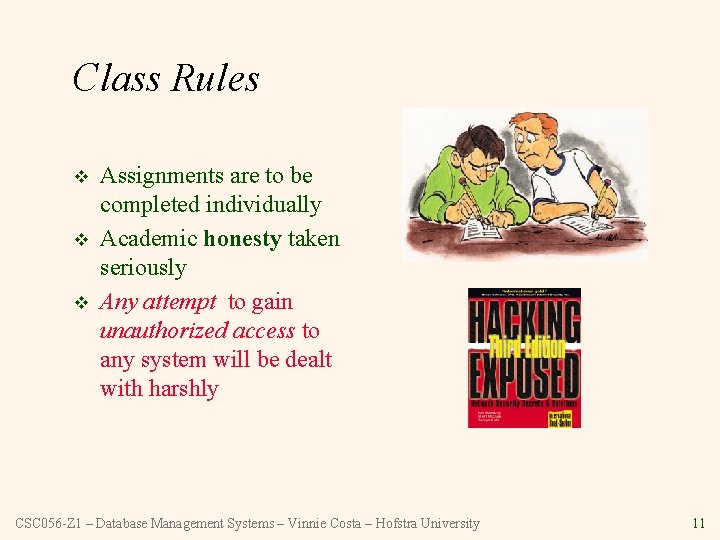
Class Rules v v v Assignments are to be completed individually Academic honesty taken seriously Any attempt to gain unauthorized access to any system will be dealt with harshly CSC 056 -Z 1 – Database Management Systems – Vinnie Costa – Hofstra University 11
Database Management Systems Chapter 1 Instructor: Vinnie Costa vcosta@optonline. net CSC 056 -Z 1 – Database Management Systems – Vinnie Costa – Hofstra University 12
What Is a DBMS? A very large, integrated collection of data. v Models real-world enterprise. v § § v Entities (e. g. , students, courses) Relationships (e. g. , Madonna is taking CS 564) A Database Management System (DBMS) is a software package designed to store and manage databases. CSC 056 -Z 1 – Database Management Systems – Vinnie Costa – Hofstra University 13
Files vs. DBMS Application must stage large datasets between main memory and secondary storage (e. g. , buffering, page-oriented access, 32 -bit addressing, etc. ) v Special code for different queries v Must protect data from inconsistency due to multiple concurrent users v Crash recovery v Security and access control v CSC 056 -Z 1 – Database Management Systems – Vinnie Costa – Hofstra University 14
Why Use a DBMS? Data independence and efficient access. v Reduced application development time. v Data integrity and security. v Uniform data administration. v Concurrent access, recovery from crashes. v CSC 056 -Z 1 – Database Management Systems – Vinnie Costa – Hofstra University 15
Why Study Databases? ? v Shift from computation to information § § v at the “low end”: scramble to webspace (a mess!) at the “high end”: scientific applications Datasets increasing in diversity and volume. § § v ? Digital libraries, interactive video, Human Genome project, EOS project. . . need for DBMS exploding DBMS encompasses most of CS § OS, languages, theory, AI, multimedia, logic CSC 056 -Z 1 – Database Management Systems – Vinnie Costa – Hofstra University 16
Data Models A data model is a collection of concepts for describing data. v A schema is a description of a particular collection of data, using the a given data model. v The relational model of data is the most widely used model today. v § § Main concept: relation, basically a table with rows and columns. Every relation has a schema, which describes the columns, or fields. CSC 056 -Z 1 – Database Management Systems – Vinnie Costa – Hofstra University 17
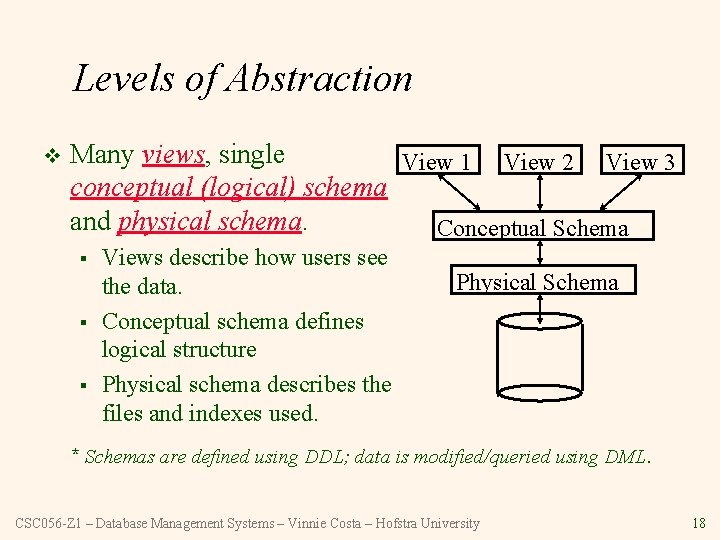
Levels of Abstraction v Many views, single View 1 View 2 View 3 conceptual (logical) schema and physical schema. Conceptual Schema § § § Views describe how users see the data. Conceptual schema defines logical structure Physical schema describes the files and indexes used. Physical Schema * Schemas are defined using DDL; data is modified/queried using DML. CSC 056 -Z 1 – Database Management Systems – Vinnie Costa – Hofstra University 18
Example: University Database v Conceptual schema: § § § v Physical schema: § § v Students(sid: string, name: string, login: string, age: integer, gpa: real) Courses(cid: string, cname: string, credits: integer) Enrolled(sid: string, cid: string, grade: string) Relations stored as unordered files. Index on first column of Students. External Schema (View): § Course_info(cid: string, enrollment: integer) CSC 056 -Z 1 – Database Management Systems – Vinnie Costa – Hofstra University 19
Data Independence * Applications insulated from how data is structured and stored. v Logical data independence: Protection from changes in logical structure of data. v Physical data independence: Protection from changes in physical structure of data. v * One of the most important benefits of using a DBMS! CSC 056 -Z 1 – Database Management Systems – Vinnie Costa – Hofstra University 20
Concurrency Control v Concurrent execution of user programs essential for good DBMS performance. § is Because disk accesses are frequent, and relatively slow, it is important to keep the cpu humming by working on several user programs concurrently. Interleaving actions of different user programs can lead to inconsistency: e. g. , check is cleared while account balance is being computed. v DBMS ensures such problems don’t arise: users can pretend they are using a single-user system. v CSC 056 -Z 1 – Database Management Systems – Vinnie Costa – Hofstra University 21
Transaction: An Execution of a DB Program Key concept is transaction, which is an atomic sequence of database actions (reads/writes). v Each transaction, executed completely, must leave the DB in a consistent state if DB is consistent when the transaction begins. v § § § Users can specify some simple integrity constraints on the data, and the DBMS will enforce these constraints. Beyond this, the DBMS does not really understand the semantics of the data. (e. g. , it does not understand how the interest on a bank account is computed). Thus, ensuring that a transaction (run alone) preserves consistency is ultimately the user’s responsibility! CSC 056 -Z 1 – Database Management Systems – Vinnie Costa – Hofstra University 22
Scheduling Concurrent Transactions v DBMS ensures that execution of {T 1, . . . , Tn} is equivalent to some serial execution T 1’. . . Tn’. § § § Before reading/writing an object, a transaction requests a lock on the object, and waits till the DBMS gives it the lock. All locks are released at the end of the transaction. (Strict 2 PL locking protocol. ) Idea: If an action of Ti (say, writing X) affects Tj (which perhaps reads X), one of them, say Ti, will obtain the lock on X first and Tj is forced to wait until Ti completes; this effectively orders the transactions. What if Tj already has a lock on Y and Ti later requests a lock on Y? (Deadlock!) Ti or Tj is aborted and restarted! CSC 056 -Z 1 – Database Management Systems – Vinnie Costa – Hofstra University 23
Ensuring Atomicity DBMS ensures atomicity (all-or-nothing property) even if system crashes in the middle of a Xact. v Idea: Keep a log (history) of all actions carried out by the DBMS while executing a set of Xacts: v § § Before a change is made to the database, the corresponding log entry is forced to a safe location. (WAL protocol; OS support for this is often inadequate. ) After a crash, the effects of partially executed transactions are undone using the log. (Thanks to WAL, if log entry wasn’t saved before the crash, corresponding change was not applied to database!) CSC 056 -Z 1 – Database Management Systems – Vinnie Costa – Hofstra University 24
The Log v The following actions are recorded in the log: § Ti writes an object: The old value and the new value. • Log record must go to disk before the changed page! § Ti commits/aborts: A log record indicating this action. Log records chained together by Xact id, so it’s easy to undo a specific Xact (e. g. , to resolve a deadlock). v Log is often duplexed and archived on “stable” storage. v All log related activities (and in fact, all CC related activities such as lock/unlock, dealing with deadlocks etc. ) are handled transparently by the DBMS. v CSC 056 -Z 1 – Database Management Systems – Vinnie Costa – Hofstra University 25
Databases make these folks happy. . . End users and DBMS vendors v DB application programmers v § v E. g. , smart webmasters Database administrator (DBA) § § Designs logical /physical schemas Handles security and authorization Data availability, crash recovery Database tuning as needs evolve Must understand how a DBMS works! CSC 056 -Z 1 – Database Management Systems – Vinnie Costa – Hofstra University 26
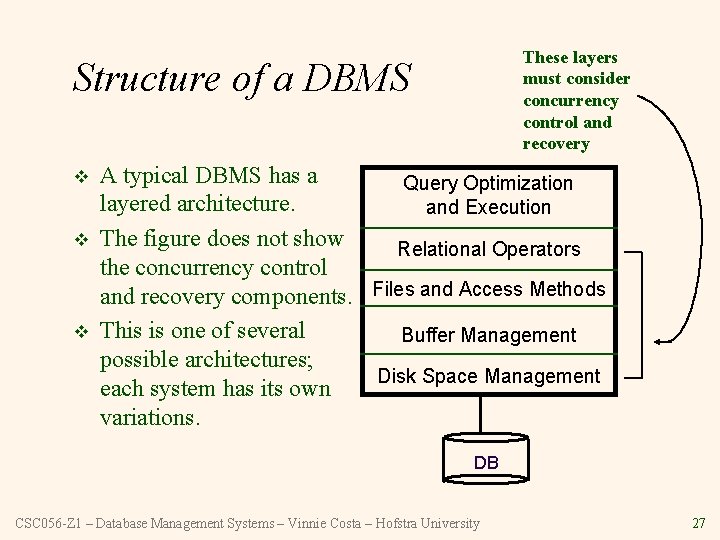
These layers must consider concurrency control and recovery Structure of a DBMS v v v A typical DBMS has a Query Optimization layered architecture. and Execution The figure does not show Relational Operators the concurrency control and recovery components. Files and Access Methods This is one of several Buffer Management possible architectures; Disk Space Management each system has its own variations. DB CSC 056 -Z 1 – Database Management Systems – Vinnie Costa – Hofstra University 27
Structure of a DBMS p 20, Figure 1. 3 – detailed diagram v n-tiered architecture v Virtualization, GRIDs v Proprietary vs Open v Licensing Costs v CSC 056 -Z 1 – Database Management Systems – Vinnie Costa – Hofstra University 28
Summary DBMS used to maintain, query large datasets. v Benefits include recovery from system crashes, concurrent access, quick application development, data integrity and security. v Levels of abstraction give data independence. v A DBMS typically has a layered architecture. v DBAs hold responsible jobs and are well-paid! v DBMS R&D is one of the broadest, most exciting areas in CS. v CSC 056 -Z 1 – Database Management Systems – Vinnie Costa – Hofstra University 29
Useful Websites v http: //www. oracle. com/ v http: //www. mysql. com/ v http: //www. cs. wisc. edu/~dbbook/ CSC 056 -Z 1 – Database Management Systems – Vinnie Costa – Hofstra University 30
Beyond Relational Datbases http: //www. acmqueue. org/modules. php? name=Co ntent&pa=showpage&pid=299 v Margo Seltzer, Sleepy. Cat v ACM Queue vol. 3, no. 3 - April 2005 v CSC 056 -Z 1 – Database Management Systems – Vinnie Costa – Hofstra University 31
Homework Read Chapter One v Exercises pp. 23 -24: 1. 1, 1. 4, 1. 6, 1. 9 v Read Beyond Relational Databases v CSC 056 -Z 1 – Database Management Systems – Vinnie Costa – Hofstra University 32
The Entity-Relationship Model Chapter 2 CSC 056 -Z 1 – Database Management Systems – Vinnie Costa – Hofstra University 33
Overview of Database Design v Conceptual design: (ER Model is used at this stage. ) § § § What are the entities and relationships in the enterprise? What information about these entities and relationships should we store in the database? What are the integrity constraints or business rules that hold? A database `schema’ in the ER Model can be represented pictorially (ER diagrams). Can map an ER diagram into a relational schema. CSC 056 -Z 1 – Database Management Systems – Vinnie Costa – Hofstra University 34
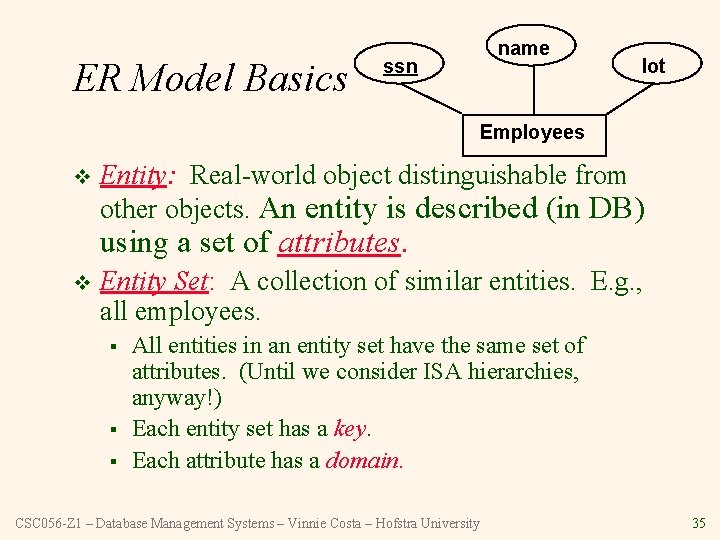
ER Model Basics name ssn lot Employees v Entity: Real-world object distinguishable from other objects. An entity is described (in DB) using a set of attributes. v Entity Set: A collection of similar entities. E. g. , all employees. § § § All entities in an entity set have the same set of attributes. (Until we consider ISA hierarchies, anyway!) Each entity set has a key. Each attribute has a domain. CSC 056 -Z 1 – Database Management Systems – Vinnie Costa – Hofstra University 35
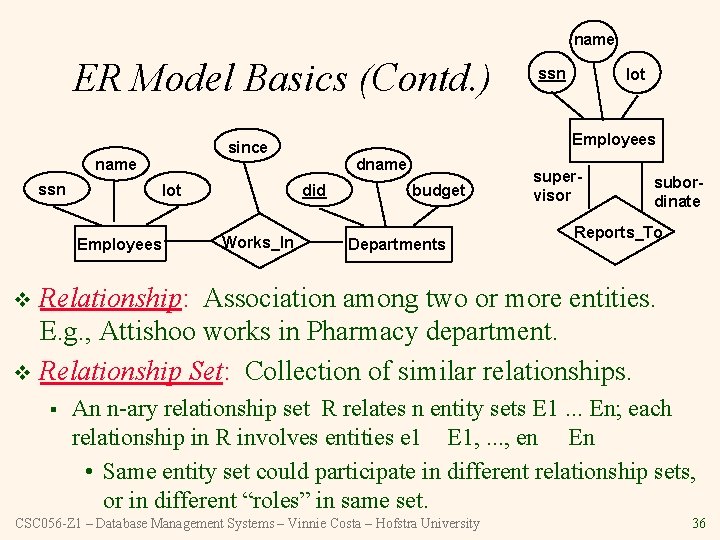
name ER Model Basics (Contd. ) ssn lot Employees dname did Works_In lot Employees since name ssn budget Departments supervisor subordinate Reports_To Relationship: Association among two or more entities. E. g. , Attishoo works in Pharmacy department. v Relationship Set: Collection of similar relationships. v § An n-ary relationship set R relates n entity sets E 1. . . En; each relationship in R involves entities e 1 E 1, . . . , en En • Same entity set could participate in different relationship sets, or in different “roles” in same set. CSC 056 -Z 1 – Database Management Systems – Vinnie Costa – Hofstra University 36
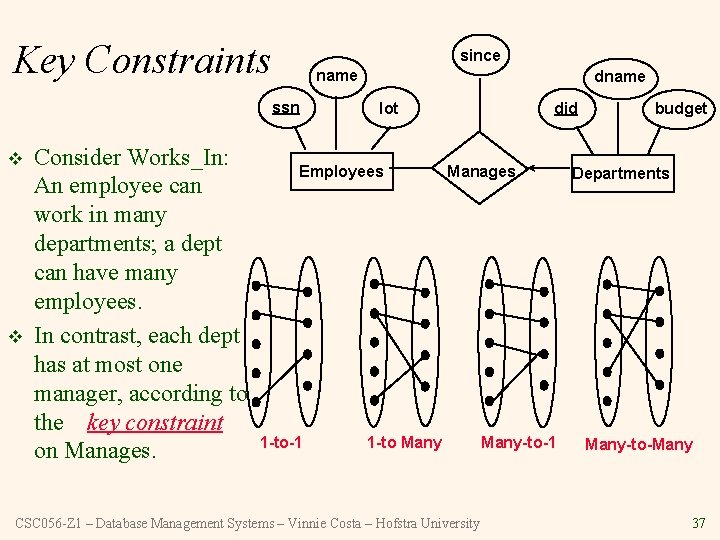
Key Constraints since name ssn v v Consider Works_In: An employee can work in many departments; a dept can have many employees. In contrast, each dept has at most one manager, according to the key constraint on Manages. dname lot Employees 1 -to-1 did Manages 1 -to Many CSC 056 -Z 1 – Database Management Systems – Vinnie Costa – Hofstra University Many-to-1 budget Departments Many-to-Many 37
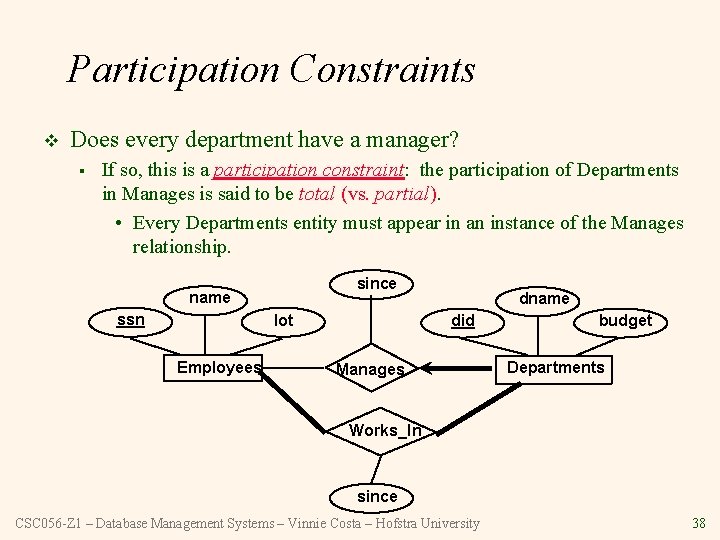
Participation Constraints v Does every department have a manager? § If so, this is a participation constraint: the participation of Departments in Manages is said to be total (vs. partial). • Every Departments entity must appear in an instance of the Manages relationship. since name ssn did lot Employees dname Manages budget Departments Works_In since CSC 056 -Z 1 – Database Management Systems – Vinnie Costa – Hofstra University 38
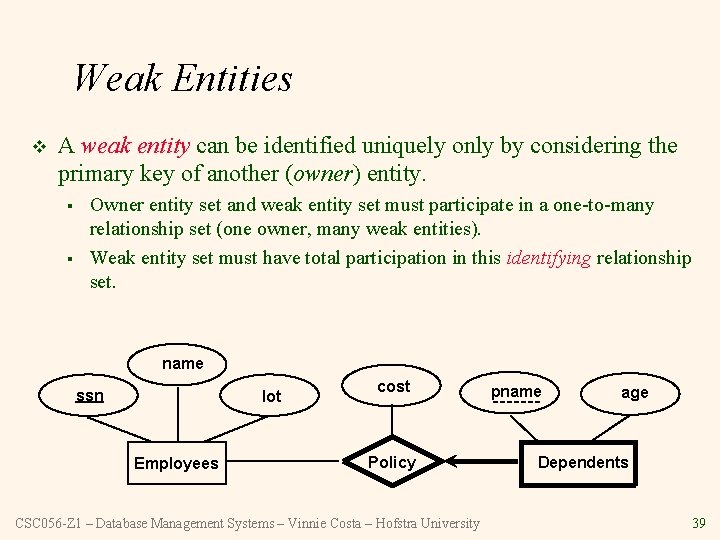
Weak Entities v A weak entity can be identified uniquely only by considering the primary key of another (owner) entity. § § Owner entity set and weak entity set must participate in a one-to-many relationship set (one owner, many weak entities). Weak entity set must have total participation in this identifying relationship set. name ssn lot Employees cost Policy CSC 056 -Z 1 – Database Management Systems – Vinnie Costa – Hofstra University pname age Dependents 39
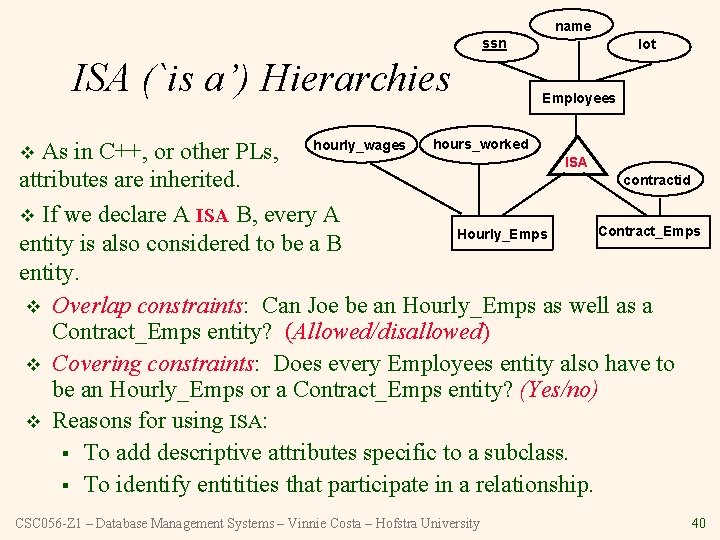
name ssn ISA (`is a’) Hierarchies lot Employees As in C++, or other PLs, hourly_wages hours_worked ISA contractid attributes are inherited. v If we declare A ISA B, every A Contract_Emps Hourly_Emps entity is also considered to be a B entity. v Overlap constraints: Can Joe be an Hourly_Emps as well as a Contract_Emps entity? (Allowed/disallowed) v Covering constraints: Does every Employees entity also have to be an Hourly_Emps or a Contract_Emps entity? (Yes/no) v Reasons for using ISA: § To add descriptive attributes specific to a subclass. § To identify entitities that participate in a relationship. v CSC 056 -Z 1 – Database Management Systems – Vinnie Costa – Hofstra University 40
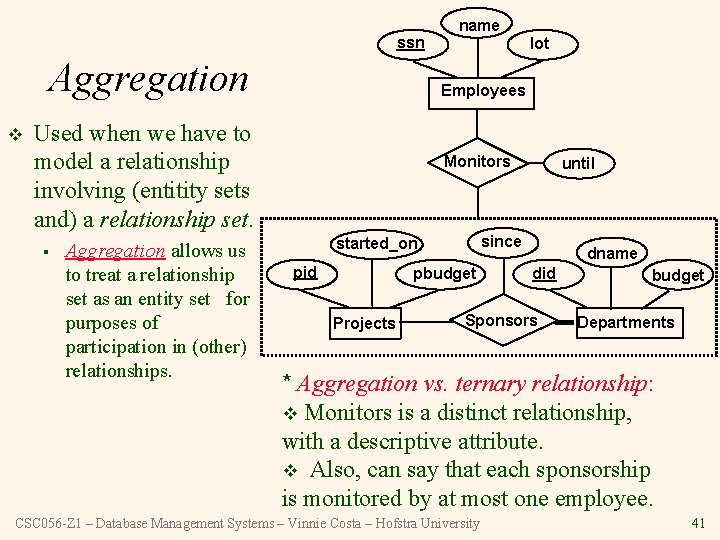
ssn Aggregation v Aggregation allows us to treat a relationship set as an entity set for purposes of participation in (other) relationships. lot Employees Used when we have to model a relationship involving (entitity sets and) a relationship set. § name Monitors since started_on pid pbudget Projects until dname did Sponsors budget Departments * Aggregation vs. ternary relationship: v Monitors is a distinct relationship, with a descriptive attribute. v Also, can say that each sponsorship is monitored by at most one employee. CSC 056 -Z 1 – Database Management Systems – Vinnie Costa – Hofstra University 41
Conceptual Design Using the ER Model v Design choices: § § § v Should a concept be modeled as an entity or an attribute? Should a concept be modeled as an entity or a relationship? Identifying relationships: Binary or ternary? Aggregation? Constraints in the ER Model: § § A lot of data semantics can (and should) be captured. But some constraints cannot be captured in ER diagrams. CSC 056 -Z 1 – Database Management Systems – Vinnie Costa – Hofstra University 42
Entity vs. Attribute Should address be an attribute of Employees or an entity (connected to Employees by a relationship)? v Depends upon the use we want to make of address information, and the semantics of the data: v • If we have several addresses per employee, address must be an entity (since attributes cannot be set-valued). • If the structure (city, street, etc. ) is important, e. g. , we want to retrieve employees in a given city, address must be modeled as an entity (since attribute values are atomic). CSC 056 -Z 1 – Database Management Systems – Vinnie Costa – Hofstra University 43
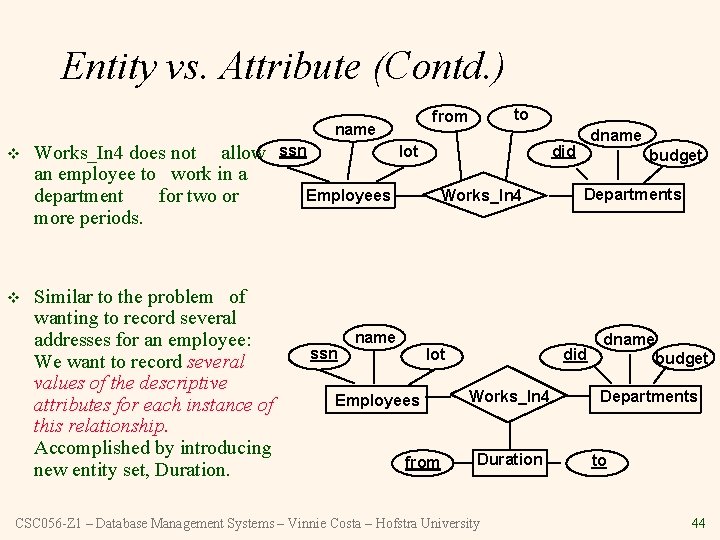
Entity vs. Attribute (Contd. ) v v Works_In 4 does not allow an employee to work in a department for two or more periods. Similar to the problem of wanting to record several addresses for an employee: We want to record several values of the descriptive attributes for each instance of this relationship. Accomplished by introducing new entity set, Duration. ssn to from name lot did Works_In 4 Employees ssn name dname lot Employees from budget Departments did Works_In 4 Duration CSC 056 -Z 1 – Database Management Systems – Vinnie Costa – Hofstra University dname budget Departments to 44
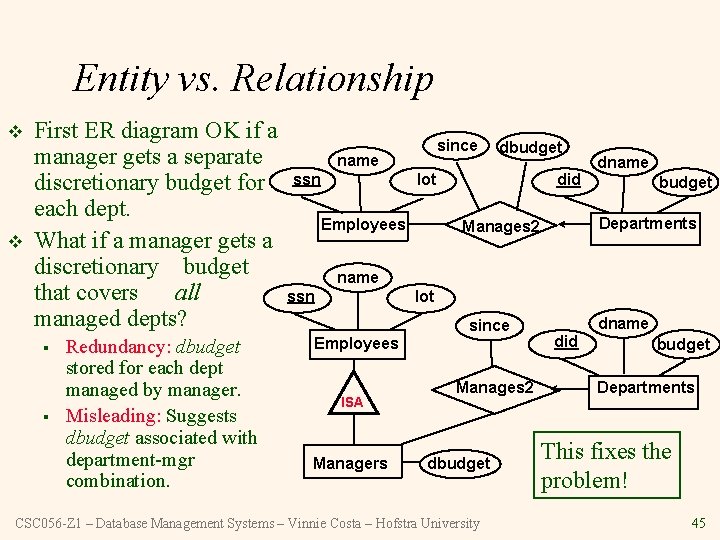
Entity vs. Relationship v v First ER diagram OK if a manager gets a separate discretionary budget for each dept. What if a manager gets a discretionary budget that covers all managed depts? § § Redundancy: dbudget stored for each dept managed by manager. Misleading: Suggests dbudget associated with department-mgr combination. since name ssn dbudget lot Employees did dname budget Departments Manages 2 name ssn lot since Employees ISA Managers Manages 2 dbudget CSC 056 -Z 1 – Database Management Systems – Vinnie Costa – Hofstra University dname did budget Departments This fixes the problem! 45
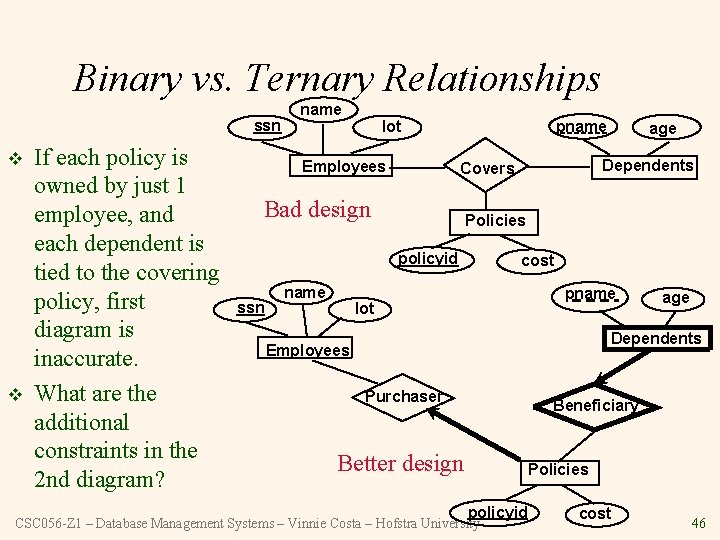
Binary vs. Ternary Relationships ssn v v If each policy is owned by just 1 employee, and each dependent is tied to the covering policy, first diagram is inaccurate. What are the additional constraints in the 2 nd diagram? name pname lot Employees Policies policyid ssn name Dependents Covers Bad design age cost pname lot age Dependents Employees Purchaser Beneficiary Better design Policies policyid CSC 056 -Z 1 – Database Management Systems – Vinnie Costa – Hofstra University cost 46
Binary vs. Ternary Relationships (Contd. ) Previous example illustrated a case when two binary relationships were better than one ternary relationship. v An example in the other direction: a ternary relation Contracts relates entity sets Parts, Departments and Suppliers, and has descriptive attribute qty. No combination of binary relationships is an adequate substitute: v § § S “can-supply” P, D “needs” P, and D “deals-with” S does not imply that D has agreed to buy P from S. How do we record qty? CSC 056 -Z 1 – Database Management Systems – Vinnie Costa – Hofstra University 47
Summary of Conceptual Design v Conceptual design follows requirements analysis, § v Yields a high-level description of data to be stored ER model popular for conceptual design § Constructs are expressive, close to the way people think about their applications. Basic constructs: entities, relationships, and attributes (of entities and relationships). v Some additional constructs: weak entities, ISA hierarchies, and aggregation. v Note: There are many variations on ER model. v CSC 056 -Z 1 – Database Management Systems – Vinnie Costa – Hofstra University 48
Summary of ER (Contd. ) v Several kinds of integrity constraints can be expressed in the ER model: key constraints, participation constraints, and overlap/covering constraints for ISA hierarchies. Some foreign key constraints are also implicit in the definition of a relationship set. § § Some constraints (notably, functional dependencies) cannot be expressed in the ER model. Constraints play an important role in determining the best database design for an enterprise. CSC 056 -Z 1 – Database Management Systems – Vinnie Costa – Hofstra University 49
Summary of ER (Contd. ) v ER design is subjective. There are often many ways to model a given scenario! Analyzing alternatives can be tricky, especially for a large enterprise. Common choices include: § v Entity vs. attribute, entity vs. relationship, binary or n-ary relationship, whether or not to use ISA hierarchies, and whether or not to use aggregation. Ensuring good database design: resulting relational schema should be analyzed and refined further. FD information and normalization techniques are especially useful. CSC 056 -Z 1 – Database Management Systems – Vinnie Costa – Hofstra University 50
Useful Websites v http: //www. omg. org/ CSC 056 -Z 1 – Database Management Systems – Vinnie Costa – Hofstra University 51
Homework Read Chapter Two v Exercises p. 52: 2. 1, 2. 2 v CSC 056 -Z 1 – Database Management Systems – Vinnie Costa – Hofstra University 52
- Slides: 52