
Database Management Systems Session 3 Instructor Vinnie Costa
Database Management Systems Session 3 Instructor: Vinnie Costa vcosta@optonline. net CSC 056 -Z 1 – Database Management Systems – Vinnie Costa – Hofstra University 1
The Entity-Relationship Model Chapter 2 - Redux CSC 056 -Z 1 – Database Management Systems – Vinnie Costa – Hofstra University 2
How To Design A Database - In Six “Easy” Steps! 1. 2. 3. 4. 5. 6. Requirements Analysis Conceptual Database Design Logical Design Schema Refinement Physical Database Design Application And Security Design CSC 056 -Z 1 – Database Management Systems – Vinnie Costa – Hofstra University 3
Requirements Analysis u This is the most difficult step u Source of most problems u What does the user want? u Discussions, study of current environment, expectations (need to be managed), history, resources available, etc. u Elicitation Methodologies u Bit of an art form CSC 056 -Z 1 – Database Management Systems – Vinnie Costa – Hofstra University 4
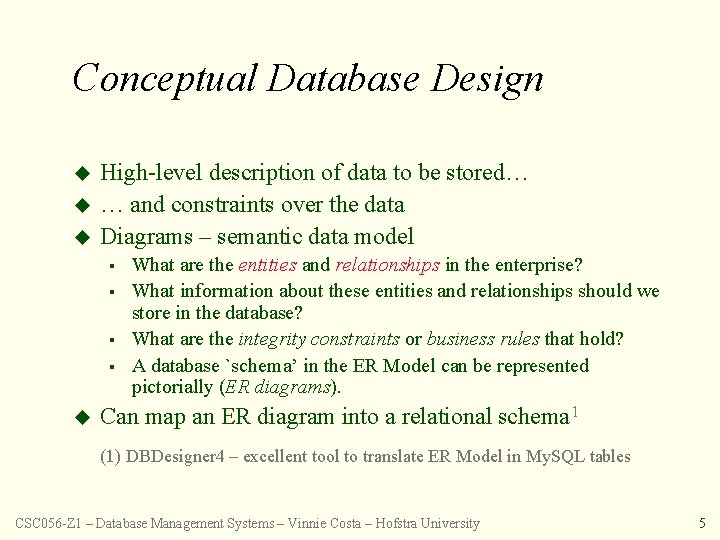
Conceptual Database Design u u u High-level description of data to be stored… … and constraints over the data Diagrams – semantic data model § § u What are the entities and relationships in the enterprise? What information about these entities and relationships should we store in the database? What are the integrity constraints or business rules that hold? A database `schema’ in the ER Model can be represented pictorially (ER diagrams). Can map an ER diagram into a relational schema 1 (1) DBDesigner 4 – excellent tool to translate ER Model in My. SQL tables CSC 056 -Z 1 – Database Management Systems – Vinnie Costa – Hofstra University 5
Logical Database Design u Choose a DBMS – we use Relational Only u Convert the ER schema into a relational database schema u Result is a conceptual schema also called the logical schema CSC 056 -Z 1 – Database Management Systems – Vinnie Costa – Hofstra University 6
The “Systems” Steps u Schema Refinement – identify problems and refine the schema – eliminate redundancy through normalization u Physical Database Design – workload analysis, scaling, indexing and clustering of tables, database tuning u Application and Security Design – the “big” picture in design, workflow, role based security, transparency CSC 056 -Z 1 – Database Management Systems – Vinnie Costa – Hofstra University 7
ER Model Basics u Entity: Real-world object distinguishable from other objects. An entity is described (in DB) using a set of attributes. u Entity Set: A collection of similar entities. E. g. , all employees. § § § All entities in an entity set have the same set of attributes. Each entity set has a key. Each attribute has a domain. CSC 056 -Z 1 – Database Management Systems – Vinnie Costa – Hofstra University 8
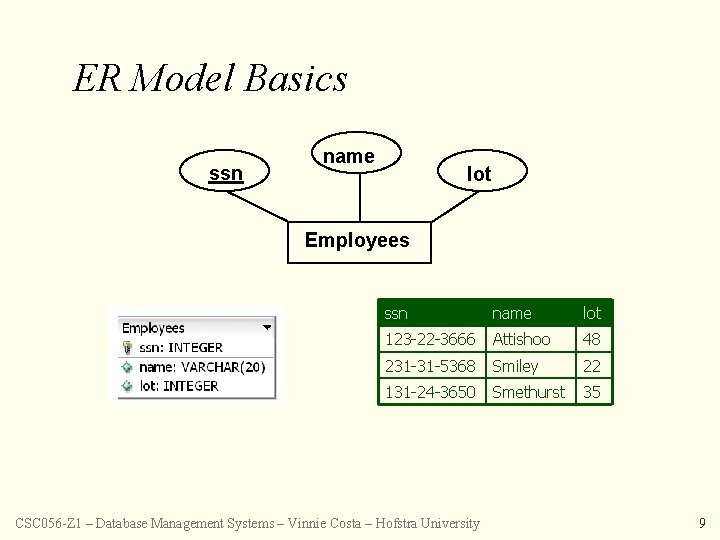
ER Model Basics ssn name lot Employees ssn name lot 123 -22 -3666 Attishoo 48 231 -31 -5368 Smiley 22 131 -24 -3650 Smethurst 35 CSC 056 -Z 1 – Database Management Systems – Vinnie Costa – Hofstra University 9
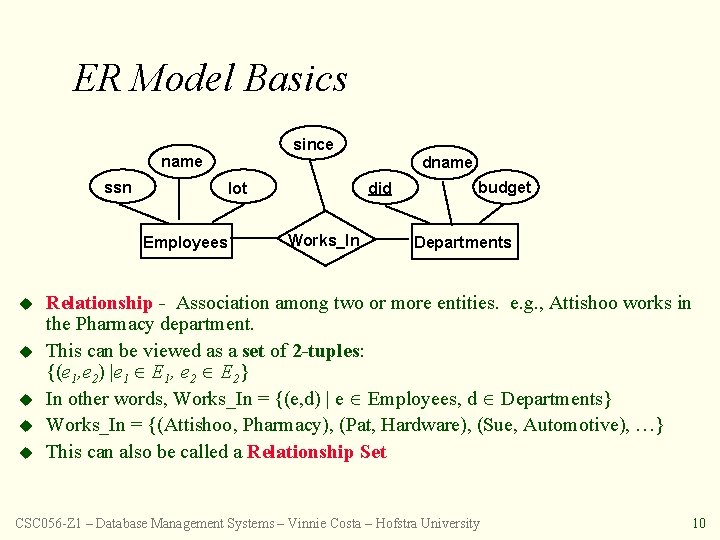
ER Model Basics since name ssn lot Employees u u u dname did Works_In budget Departments Relationship - Association among two or more entities. e. g. , Attishoo works in the Pharmacy department. This can be viewed as a set of 2 -tuples: {(e 1, e 2) |e 1 E 1, e 2 E 2} In other words, Works_In = {(e, d) | e Employees, d Departments} Works_In = {(Attishoo, Pharmacy), (Pat, Hardware), (Sue, Automotive), …} This can also be called a Relationship Set CSC 056 -Z 1 – Database Management Systems – Vinnie Costa – Hofstra University 10
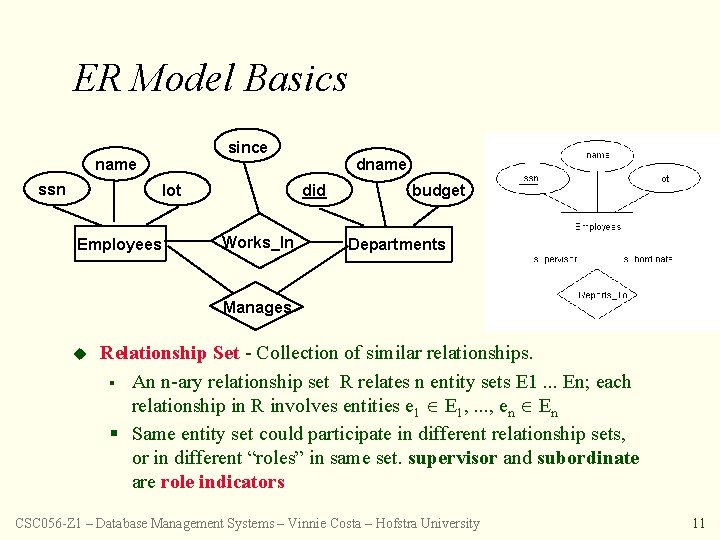
ER Model Basics since name ssn lot Employees dname did Works_In budget Departments Manages u Relationship Set - Collection of similar relationships. § An n-ary relationship set R relates n entity sets E 1. . . En; each relationship in R involves entities e 1 E 1, . . . , en En § Same entity set could participate in different relationship sets, or in different “roles” in same set. supervisor and subordinate are role indicators CSC 056 -Z 1 – Database Management Systems – Vinnie Costa – Hofstra University 11
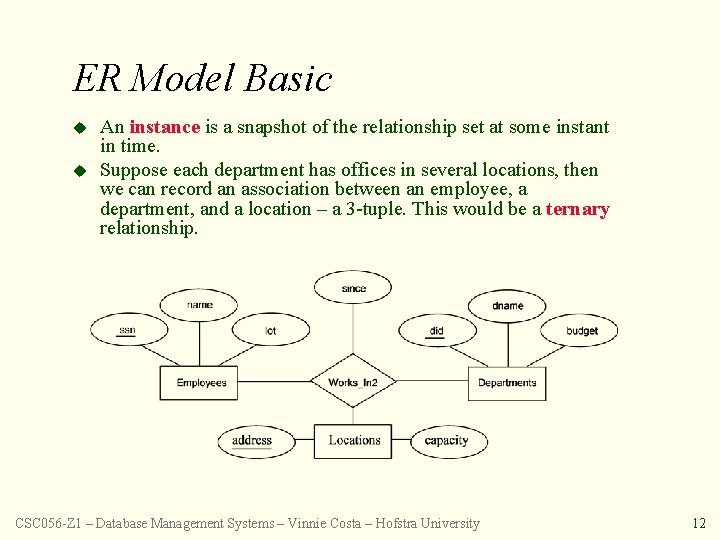
ER Model Basic u u An instance is a snapshot of the relationship set at some instant in time. Suppose each department has offices in several locations, then we can record an association between an employee, a department, and a location – a 3 -tuple. This would be a ternary relationship. CSC 056 -Z 1 – Database Management Systems – Vinnie Costa – Hofstra University 12
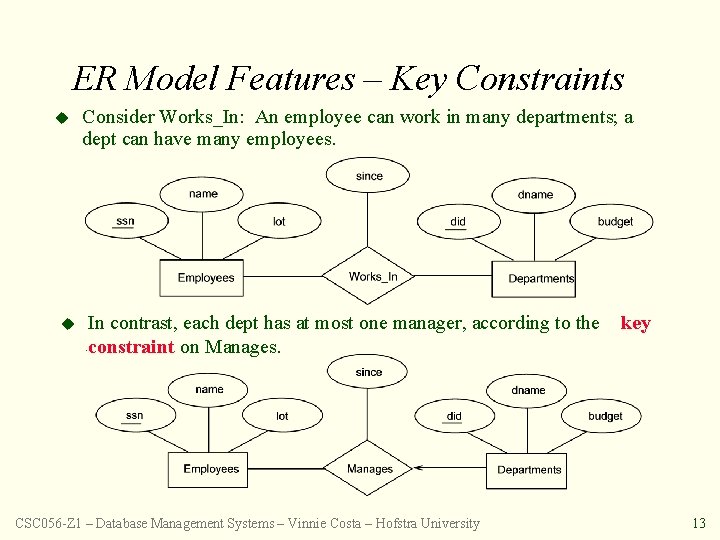
ER Model Features – Key Constraints u u Consider Works_In: An employee can work in many departments; a dept can have many employees. In contrast, each dept has at most one manager, according to the key constraint on Manages. CSC 056 -Z 1 – Database Management Systems – Vinnie Costa – Hofstra University 13
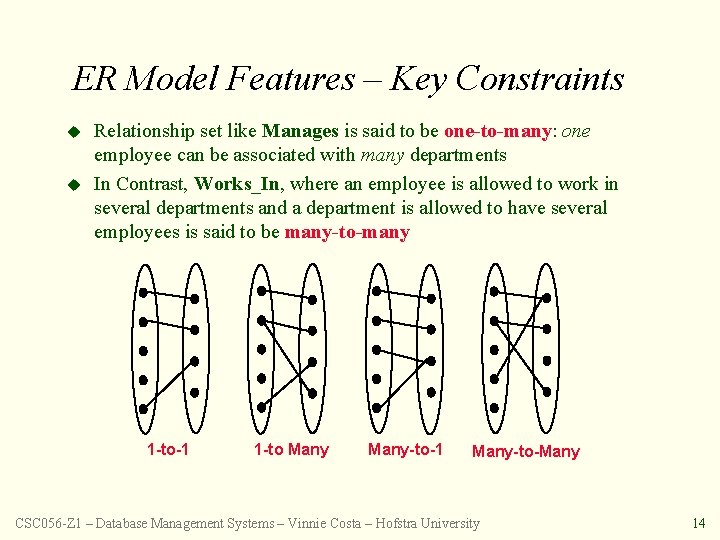
ER Model Features – Key Constraints u u Relationship set like Manages is said to be one-to-many: one employee can be associated with many departments In Contrast, Works_In, where an employee is allowed to work in several departments and a department is allowed to have several employees is said to be many-to-many 1 -to-1 1 -to Many-to-1 Many-to-Many CSC 056 -Z 1 – Database Management Systems – Vinnie Costa – Hofstra University 14
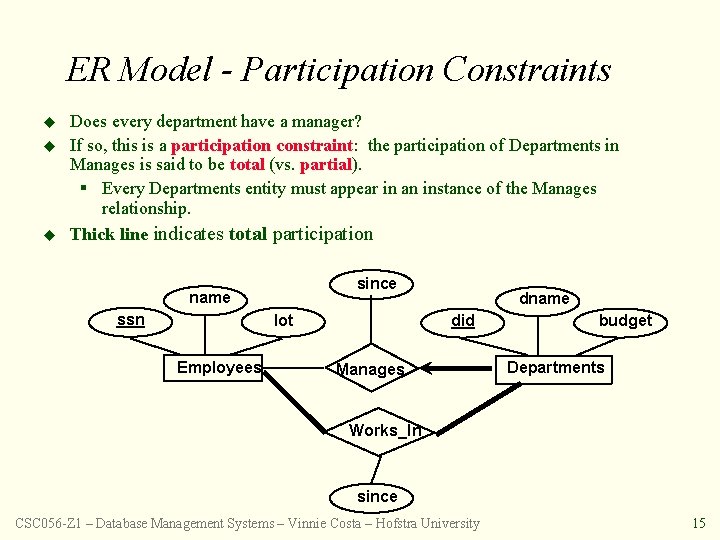
ER Model - Participation Constraints u u u Does every department have a manager? If so, this is a participation constraint: the participation of Departments in Manages is said to be total (vs. partial). § Every Departments entity must appear in an instance of the Manages relationship. Thick line indicates total participation since name ssn did lot Employees dname Manages budget Departments Works_In since CSC 056 -Z 1 – Database Management Systems – Vinnie Costa – Hofstra University 15
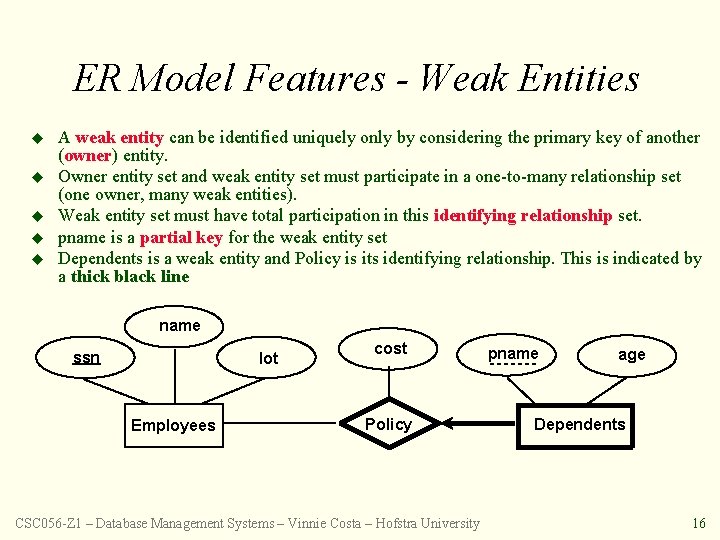
ER Model Features - Weak Entities u u u A weak entity can be identified uniquely only by considering the primary key of another (owner) entity. Owner entity set and weak entity set must participate in a one-to-many relationship set (one owner, many weak entities). Weak entity set must have total participation in this identifying relationship set. pname is a partial key for the weak entity set Dependents is a weak entity and Policy is its identifying relationship. This is indicated by a thick black line name ssn lot Employees cost Policy CSC 056 -Z 1 – Database Management Systems – Vinnie Costa – Hofstra University pname age Dependents 16
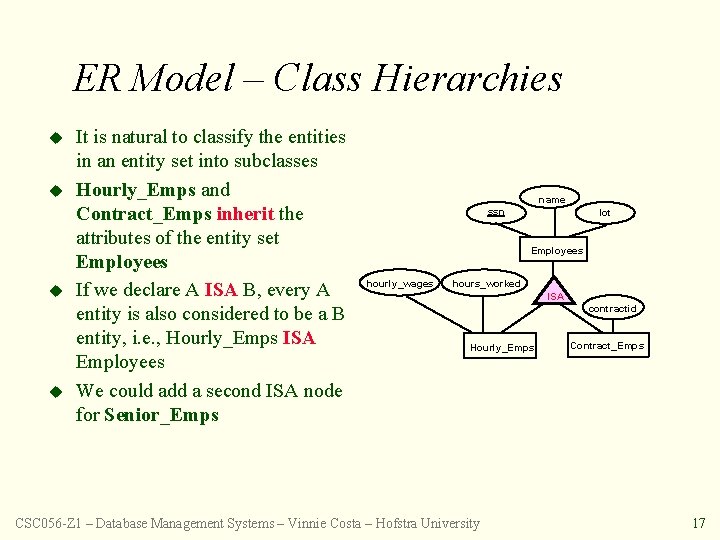
ER Model – Class Hierarchies u u It is natural to classify the entities in an entity set into subclasses Hourly_Emps and Contract_Emps inherit the attributes of the entity set Employees If we declare A ISA B, every A entity is also considered to be a B entity, i. e. , Hourly_Emps ISA Employees We could add a second ISA node for Senior_Emps name ssn lot Employees hourly_wages hours_worked ISA contractid Hourly_Emps CSC 056 -Z 1 – Database Management Systems – Vinnie Costa – Hofstra University Contract_Emps 17
ER Model – Class Hierarchies Two ways to view class hierarchies: u Employees is specialized into subclasses – identify subsets of an entity set (the superclass) that share some distinguishing characteristic (topdown) u Hourly_Emps and Contract_Emps are generalized by Employee – create new entity that has common characteristics of the subclasses (bottom-up) Two kinds of constraint: u Overlap – do two subclasses contain the same entity? Assume no, otherwise write ‘___ OVERLAPS ___’ u Covering – do the entities in the subclasses collectively include all the entities in the superclass? Assume no, otherwise write ‘___ AND ___ COVER ___’ CSC 056 -Z 1 – Database Management Systems – Vinnie Costa – Hofstra University 18
ER Model - Aggregation u u Used when we have to model a relationship involving entitity sets and a relationship set (instead of another entityset). Aggregation allows us to treat a relationship set as an entity set for purposes of participation in (other) relationships. Used to express a relationship among relationships Aggregation vs. ternary relationship: Could we make Sponsors a ternary relationship? § Monitors is a distinct relationship, with a descriptive attribute (until) and Sponsors has a unique attribute (since) § Also, we can say that each sponsorship is monitored by at most one employee CSC 056 -Z 1 – Database Management Systems – Vinnie Costa – Hofstra University 19
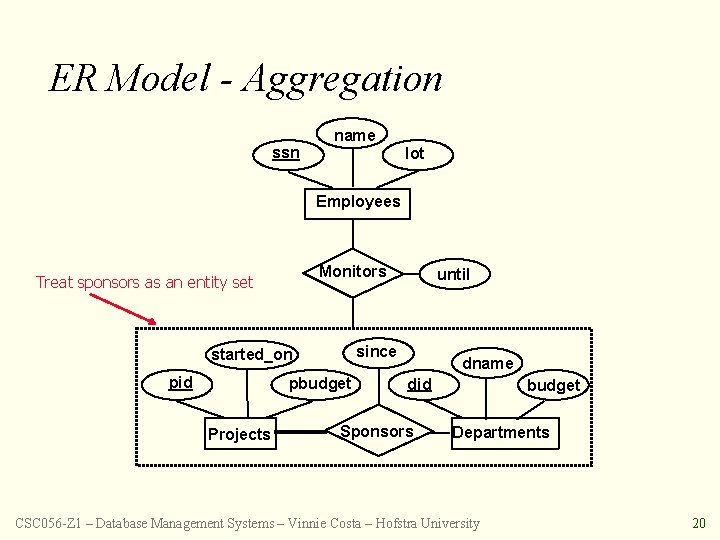
ER Model - Aggregation ssn name lot Employees Monitors Treat sponsors as an entity set since started_on pid pbudget Projects until dname did Sponsors budget Departments CSC 056 -Z 1 – Database Management Systems – Vinnie Costa – Hofstra University 20
Conceptual Design Using the ER Model u u Design choices: § Should a concept be modeled as an entity or an attribute? § Should a concept be modeled as an entity or a relationship? § Identifying relationships: Binary or ternary? Aggregation? Constraints in the ER Model: § A lot of data semantics can (and should) be captured. § But some constraints cannot be captured in ER diagrams. CSC 056 -Z 1 – Database Management Systems – Vinnie Costa – Hofstra University 21
Entity vs. Attribute u u Should address be an attribute of Employees or an entity (connected to Employees by a relationship)? Depends upon the use we want to make of address information, and the semantics of the data: § If we have several addresses per employee, address must be an entity § If the structure (city, street, etc. ) is important, e. g. , we want to retrieve employees in a given city, address must be modeled as an entity (since attribute values are atomic). CSC 056 -Z 1 – Database Management Systems – Vinnie Costa – Hofstra University 22
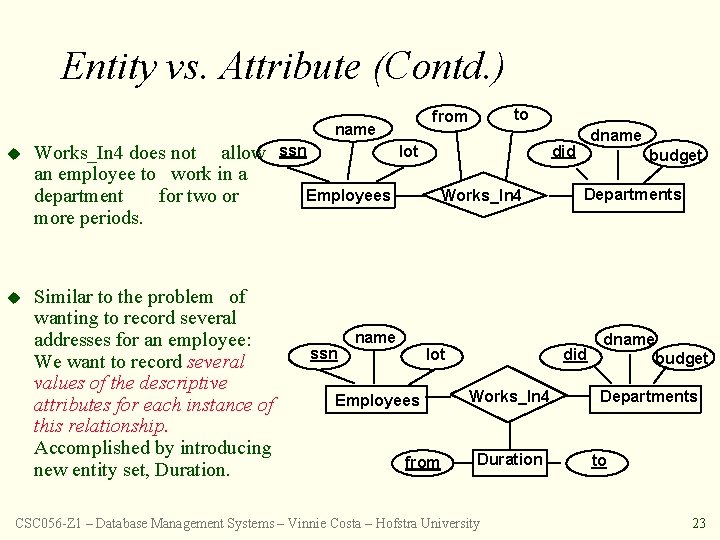
Entity vs. Attribute (Contd. ) u u Works_In 4 does not allow an employee to work in a department for two or more periods. Similar to the problem of wanting to record several addresses for an employee: We want to record several values of the descriptive attributes for each instance of this relationship. Accomplished by introducing new entity set, Duration. ssn to from name lot did Works_In 4 Employees ssn name dname lot Employees from budget Departments did Works_In 4 Duration CSC 056 -Z 1 – Database Management Systems – Vinnie Costa – Hofstra University dname budget Departments to 23
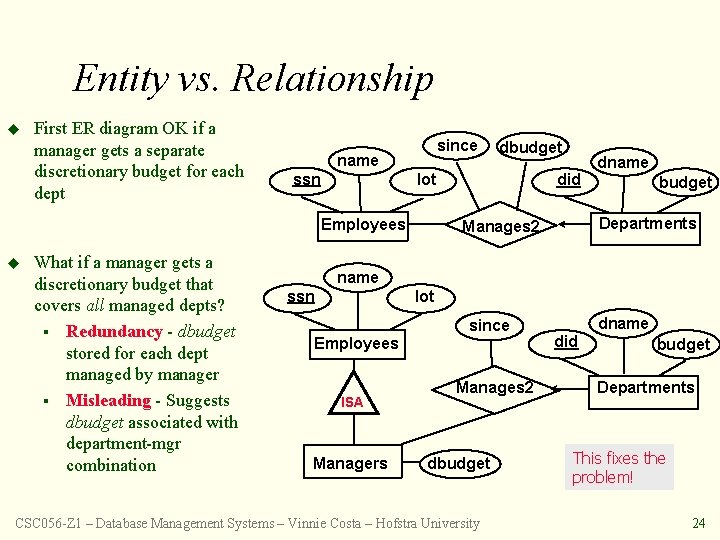
Entity vs. Relationship u First ER diagram OK if a manager gets a separate discretionary budget for each dept since name ssn lot Employees u What if a manager gets a discretionary budget that covers all managed depts? § Redundancy - dbudget stored for each dept managed by manager § Misleading - Suggests dbudget associated with department-mgr combination dbudget did dname budget Departments Manages 2 name ssn lot since Employees ISA Managers Manages 2 dbudget CSC 056 -Z 1 – Database Management Systems – Vinnie Costa – Hofstra University dname did budget Departments This fixes the problem! 24
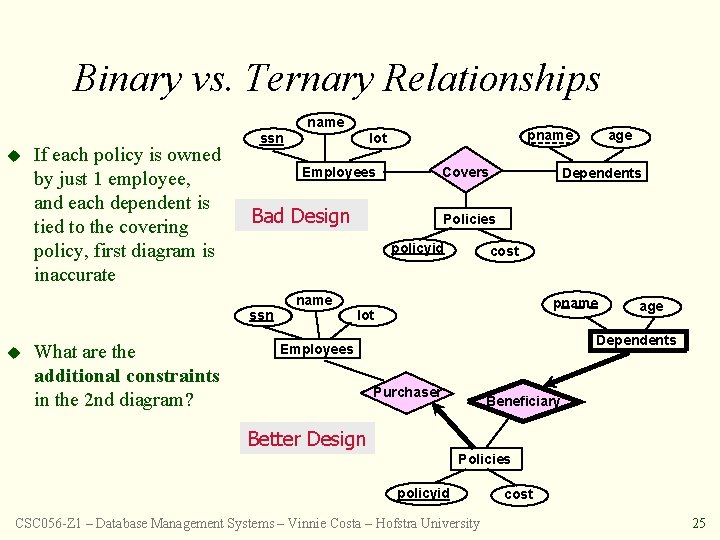
Binary vs. Ternary Relationships name u If each policy is owned by just 1 employee, and each dependent is tied to the covering policy, first diagram is inaccurate Employees What are the additional constraints in the 2 nd diagram? Covers Bad Design name age Dependents Policies policyid ssn u pname lot ssn cost pname lot age Dependents Employees Purchaser Beneficiary Better Design Policies policyid CSC 056 -Z 1 – Database Management Systems – Vinnie Costa – Hofstra University cost 25
Binary vs. Ternary Relationships (Contd. ) u Previous example illustrated a case when two binary relationships were better than one ternary relationship u An example in the other direction: a ternary relation Contracts relates entity sets Parts, Departments and Suppliers, and has descriptive attribute qty. No combination of binary relationships is an adequate substitute: § S “can-supply” P, D “needs” P, and D “deals-with” S does not imply that D has agreed to buy P from S. § How do we record qty? CSC 056 -Z 1 – Database Management Systems – Vinnie Costa – Hofstra University 26
Summary of Conceptual Design u Conceptual design follows requirements analysis, § Yields a high-level description of data to be stored u ER model popular for conceptual design § Constructs are expressive, close to the way people think about their applications u Basic constructs: entities, relationships, and attributes (of entities and relationships) u Some additional constructs: weak entities, ISA hierarchies, and aggregation u Note: There are many variations on ER model. CSC 056 -Z 1 – Database Management Systems – Vinnie Costa – Hofstra University 27
Summary of ER (Contd. ) u Several kinds of integrity constraints can be expressed in the ER model: key constraints, participation constraints, and overlap/covering constraints for ISA hierarchies. Some foreign key constraints are also implicit in the definition of a relationship set u Some constraints (notably, functional dependencies) cannot be expressed in the ER model u Constraints play an important role in determining the best database design for an enterprise CSC 056 -Z 1 – Database Management Systems – Vinnie Costa – Hofstra University 28
Summary of ER (Contd. ) u ER design is subjective. There are often many ways to model a given scenario! Analyzing alternatives can be tricky, especially for a large enterprise. Common choices include: § Entity vs. attribute, entity vs. relationship, binary or n-ary relationship, whether or not to use ISA hierarchies, and whether or not to use aggregation u To ensure good database design: resulting relational schema should be analyzed and refined further. FD information and normalization techniques are especially useful CSC 056 -Z 1 – Database Management Systems – Vinnie Costa – Hofstra University 29
Useful Websites u http: //www. omg. org/ - information about UML u Edgar (Ted) Codd – biographical sketch u Modeling Tools – good list of available tools – checkout: DIA, ERwin, DBDesigner 4, Smart. Draw CSC 056 -Z 1 – Database Management Systems – Vinnie Costa – Hofstra University 30
Homework u Read Chapter Two u Exercises p. 52: 2. 1, 2. 2 (1 -5) CSC 056 -Z 1 – Database Management Systems – Vinnie Costa – Hofstra University 31
Exercise 2. 1 u Explain the following terms briefly: attribute, domain, entity, relationship, entity set, relationship set, one-tomany relationship, many-to-many relationship, participation constraint, overlap constraint, covering constraint, weak entity set, aggregation, and role indicator. CSC 056 -Z 1 – Database Management Systems – Vinnie Costa – Hofstra University 32
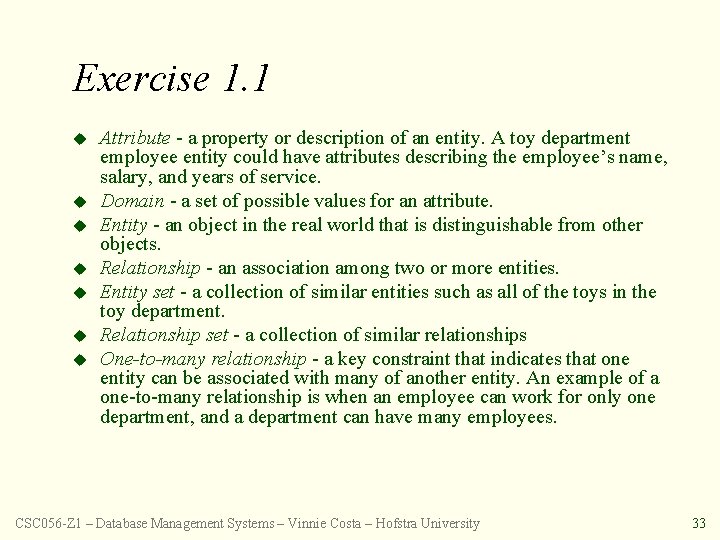
Exercise 1. 1 u u u u Attribute - a property or description of an entity. A toy department employee entity could have attributes describing the employee’s name, salary, and years of service. Domain - a set of possible values for an attribute. Entity - an object in the real world that is distinguishable from other objects. Relationship - an association among two or more entities. Entity set - a collection of similar entities such as all of the toys in the toy department. Relationship set - a collection of similar relationships One-to-many relationship - a key constraint that indicates that one entity can be associated with many of another entity. An example of a one-to-many relationship is when an employee can work for only one department, and a department can have many employees. CSC 056 -Z 1 – Database Management Systems – Vinnie Costa – Hofstra University 33
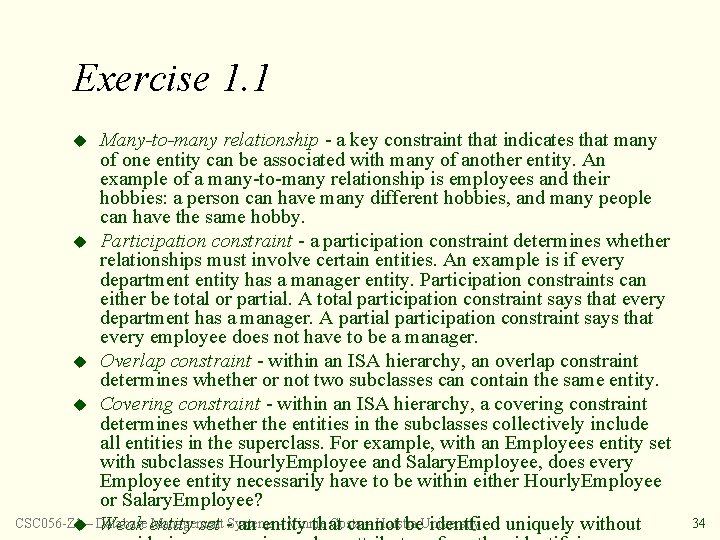
Exercise 1. 1 Many-to-many relationship - a key constraint that indicates that many of one entity can be associated with many of another entity. An example of a many-to-many relationship is employees and their hobbies: a person can have many different hobbies, and many people can have the same hobby. u Participation constraint - a participation constraint determines whether relationships must involve certain entities. An example is if every department entity has a manager entity. Participation constraints can either be total or partial. A total participation constraint says that every department has a manager. A partial participation constraint says that every employee does not have to be a manager. u Overlap constraint - within an ISA hierarchy, an overlap constraint determines whether or not two subclasses can contain the same entity. u Covering constraint - within an ISA hierarchy, a covering constraint determines whether the entities in the subclasses collectively include all entities in the superclass. For example, with an Employees entity set with subclasses Hourly. Employee and Salary. Employee, does every Employee entity necessarily have to be within either Hourly. Employee or Salary. Employee? CSC 056 -Z 1 – Database Management Systems – Vinnie Costa – Hofstra University u Weak entity set - an entity that cannot be identfied uniquely without u 34
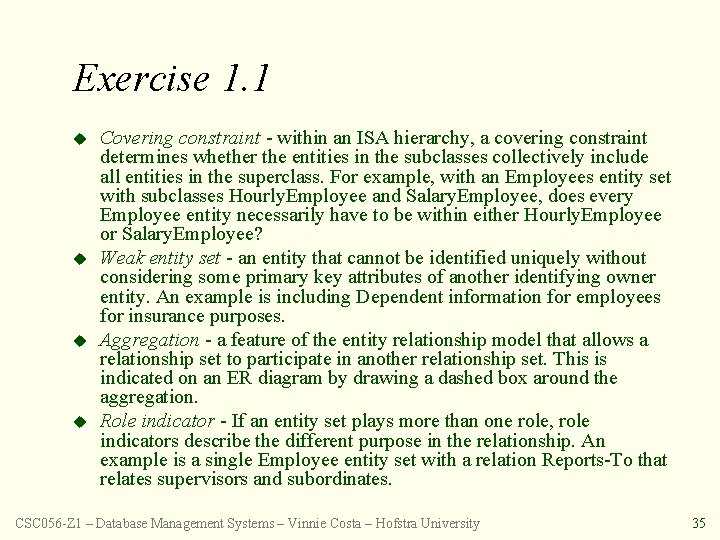
Exercise 1. 1 u u Covering constraint - within an ISA hierarchy, a covering constraint determines whether the entities in the subclasses collectively include all entities in the superclass. For example, with an Employees entity set with subclasses Hourly. Employee and Salary. Employee, does every Employee entity necessarily have to be within either Hourly. Employee or Salary. Employee? Weak entity set - an entity that cannot be identified uniquely without considering some primary key attributes of another identifying owner entity. An example is including Dependent information for employees for insurance purposes. Aggregation - a feature of the entity relationship model that allows a relationship set to participate in another relationship set. This is indicated on an ER diagram by drawing a dashed box around the aggregation. Role indicator - If an entity set plays more than one role, role indicators describe the different purpose in the relationship. An example is a single Employee entity set with a relation Reports-To that relates supervisors and subordinates. CSC 056 -Z 1 – Database Management Systems – Vinnie Costa – Hofstra University 35
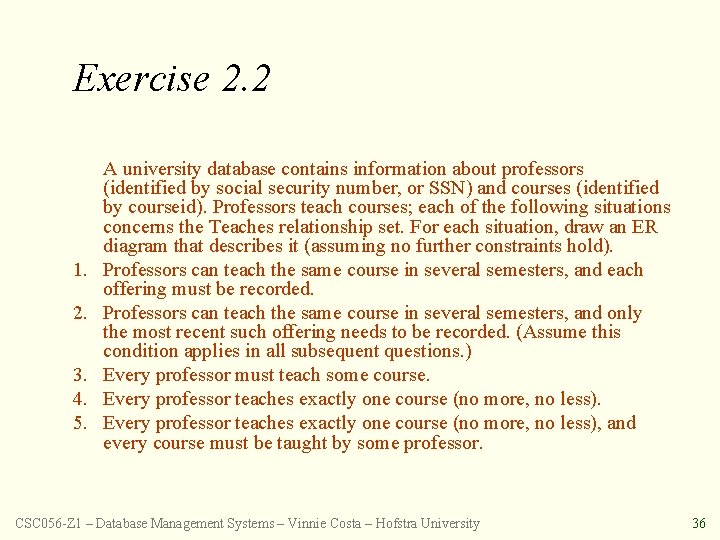
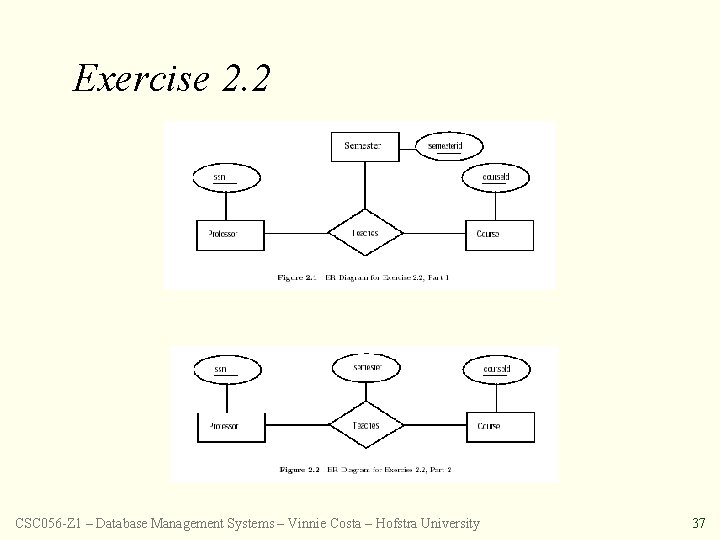
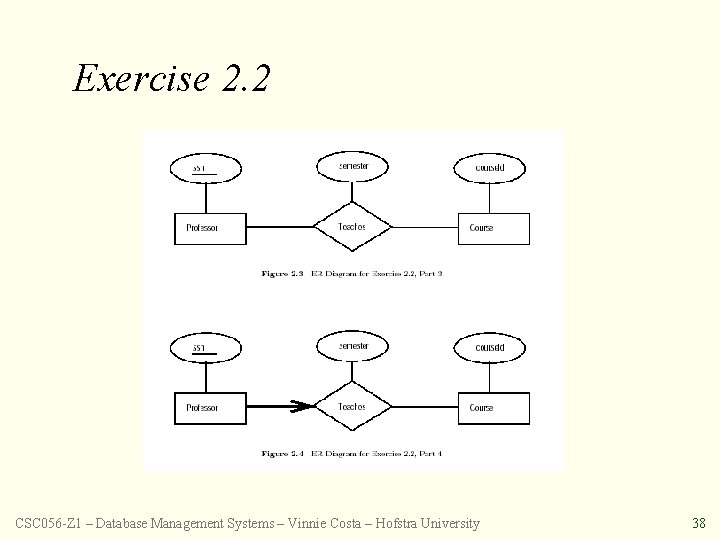
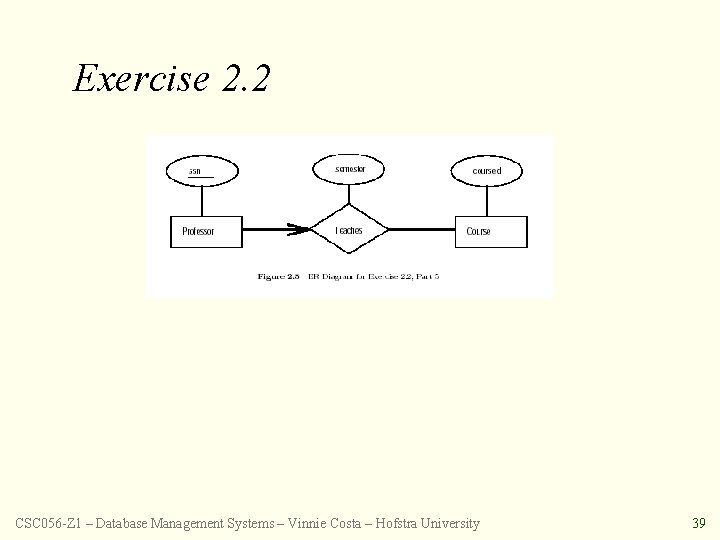
Exercise 2. 2 1. 2. 3. 4. 5. A university database contains information about professors (identified by social security number, or SSN) and courses (identified by courseid). Professors teach courses; each of the following situations concerns the Teaches relationship set. For each situation, draw an ER diagram that describes it (assuming no further constraints hold). Professors can teach the same course in several semesters, and each offering must be recorded. Professors can teach the same course in several semesters, and only the most recent such offering needs to be recorded. (Assume this condition applies in all subsequent questions. ) Every professor must teach some course. Every professor teaches exactly one course (no more, no less), and every course must be taught by some professor. CSC 056 -Z 1 – Database Management Systems – Vinnie Costa – Hofstra University 36
Exercise 2. 2 CSC 056 -Z 1 – Database Management Systems – Vinnie Costa – Hofstra University 37
Exercise 2. 2 CSC 056 -Z 1 – Database Management Systems – Vinnie Costa – Hofstra University 38
Exercise 2. 2 CSC 056 -Z 1 – Database Management Systems – Vinnie Costa – Hofstra University 39
Term Paper u Due Saturday, Oct 8 u Should be about 3 -4 pages (9 or 10 font) u This should be an opportunity to explore a selected area u Please submit your topics!!! CSC 056 -Z 1 – Database Management Systems – Vinnie Costa – Hofstra University 40
Practicum u Install Apache u Install Nvu u …on our way to WAMP!!! CSC 056 -Z 1 – Database Management Systems – Vinnie Costa – Hofstra University 41
Apache u u httpd. apache. org u The Apache HTTP Server Project is an effort to develop and maintain an open-source HTTP server for modern operating systems including UNIX and Windows NT. The goal of this project is to provide a secure, efficient and extensible server that provides HTTP services in sync with the current HTTP standards. u Apache has been the most popular web server on the Internet since April of 1996. More than 68% of the web sites on the Internet are using Apache, thus making it more widely used than all other web servers combined. CSC 056 -Z 1 – Database Management Systems – Vinnie Costa – Hofstra University 42
Install Apache u u u http: //httpd. apache. org/docs/2. 0/platform/windows. html Installing apache is easy if you download the Microsoft Installer (. msi ) package. Just double click on the icon to run the installation wizard. Click next until you see the Server Information window. You can enter localhost for both the Network Domain and Server Name. As for the administrator's email address you can enter anything you want. If using Windows XP, installed Apache as Service so every time I start Windows Apache is automatically started. CSC 056 -Z 1 – Database Management Systems – Vinnie Costa – Hofstra University 43
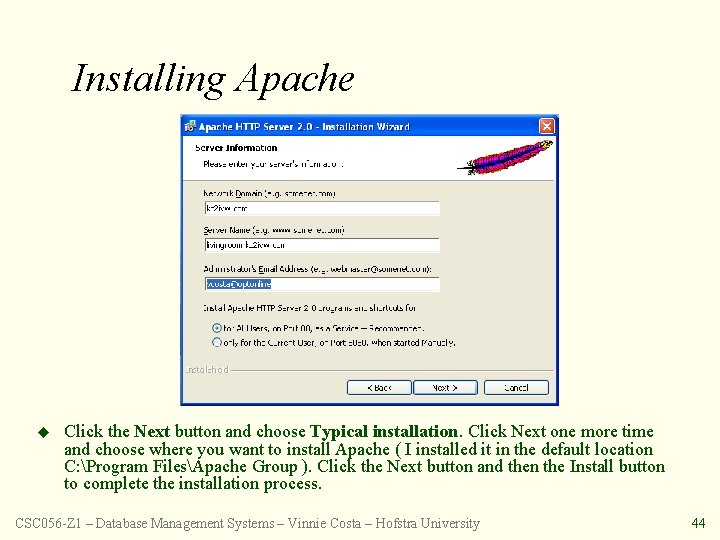
Installing Apache u Click the Next button and choose Typical installation. Click Next one more time and choose where you want to install Apache ( I installed it in the default location C: Program FilesApache Group ). Click the Next button and then the Install button to complete the installation process. CSC 056 -Z 1 – Database Management Systems – Vinnie Costa – Hofstra University 44
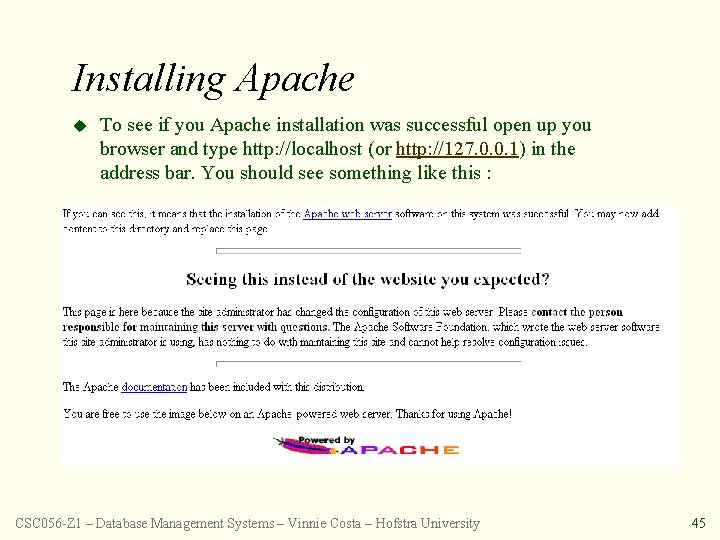
Installing Apache u To see if you Apache installation was successful open up you browser and type http: //localhost (or http: //127. 0. 0. 1) in the address bar. You should see something like this : CSC 056 -Z 1 – Database Management Systems – Vinnie Costa – Hofstra University 45
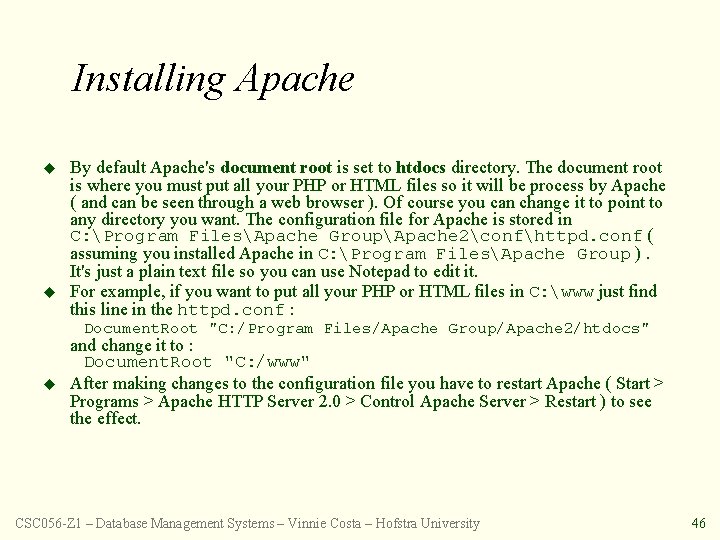
Installing Apache u u u By default Apache's document root is set to htdocs directory. The document root is where you must put all your PHP or HTML files so it will be process by Apache ( and can be seen through a web browser ). Of course you can change it to point to any directory you want. The configuration file for Apache is stored in C: Program FilesApache GroupApache 2confhttpd. conf ( assuming you installed Apache in C: Program FilesApache Group ). It's just a plain text file so you can use Notepad to edit it. For example, if you want to put all your PHP or HTML files in C: www just find this line in the httpd. conf : Document. Root "C: /Program Files/Apache Group/Apache 2/htdocs" and change it to : Document. Root "C: /www" After making changes to the configuration file you have to restart Apache ( Start > Programs > Apache HTTP Server 2. 0 > Control Apache Server > Restart ) to see the effect. CSC 056 -Z 1 – Database Management Systems – Vinnie Costa – Hofstra University 46
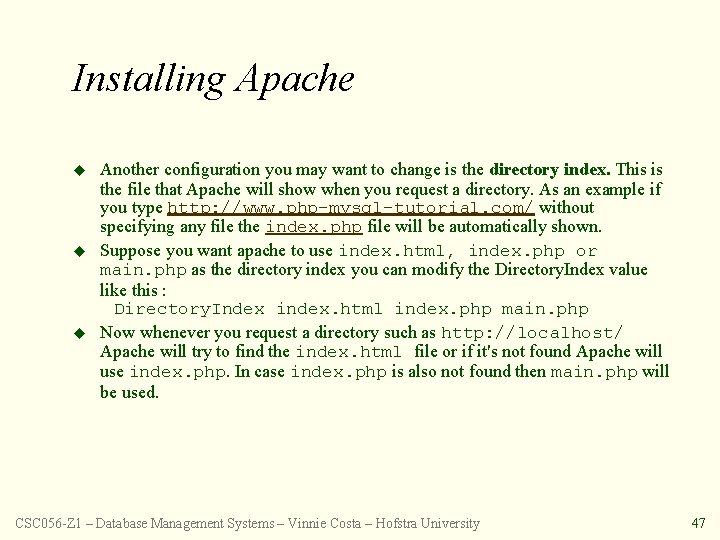
Installing Apache u u u Another configuration you may want to change is the directory index. This is the file that Apache will show when you request a directory. As an example if you type http: //www. php-mysql-tutorial. com/ without specifying any file the index. php file will be automatically shown. Suppose you want apache to use index. html, index. php or main. php as the directory index you can modify the Directory. Index value like this : Directory. Index index. html index. php main. php Now whenever you request a directory such as http: //localhost/ Apache will try to find the index. html file or if it's not found Apache will use index. php. In case index. php is also not found then main. php will be used. CSC 056 -Z 1 – Database Management Systems – Vinnie Costa – Hofstra University 47
Installing Nvu u www. nvu. com/ u A complete Web Authoring System for Linux Desktop users as well as Microsoft Windows and Macintosh users to rival programs like Front. Page and Dreamweaver. u Nvu (pronounced N-view, for a "new view") makes managing a web site a snap. Now anyone can create web pages and manage a website with no technical expertise or knowledge of HTML. CSC 056 -Z 1 – Database Management Systems – Vinnie Costa – Hofstra University 48
Make A Home Page u Create an index. html page with Nvu u Copy C: Program FilesApache GroupApache 2htdocs to old_htdocs u Put the index. html into htdocs u Test with http: //localhost or http: //127. 0. 0. 1 u Explore Cascading Style Sheets (CSS) CSC 056 -Z 1 – Database Management Systems – Vinnie Costa – Hofstra University 49
Useful Websites u www. w 3. org/Style/CSS/ - the authoritative source u http: //www. w 3. org/Style/Examples/011/firstcss – Starting with HTML + CSS – good beginners guide u www. csszengarden. com – A demonstration of what can be accomplished visually through CSSbased design CSC 056 -Z 1 – Database Management Systems – Vinnie Costa – Hofstra University 50
Homework u Install Apache On Your System u Install Nvu u Create your own home page u Play with HTML u Play with CSS u Play, play, … CSC 056 -Z 1 – Database Management Systems – Vinnie Costa – Hofstra University 51
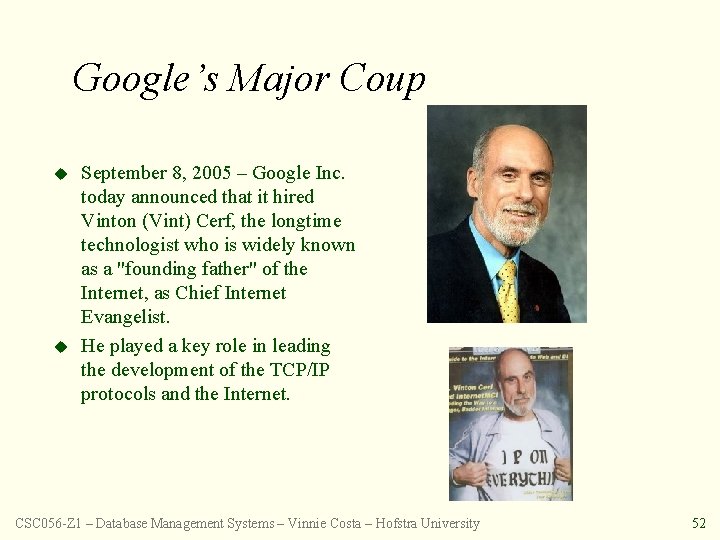
Google’s Major Coup u u September 8, 2005 – Google Inc. today announced that it hired Vinton (Vint) Cerf, the longtime technologist who is widely known as a "founding father" of the Internet, as Chief Internet Evangelist. He played a key role in leading the development of the TCP/IP protocols and the Internet. CSC 056 -Z 1 – Database Management Systems – Vinnie Costa – Hofstra University 52
Side Effects http: //www. thinkgeek. com/tshirts/ CSC 056 -Z 1 – Database Management Systems – Vinnie Costa – Hofstra University 53
The Relational Model Chapter 3 CSC 056 -Z 1 – Database Management Systems – Vinnie Costa – Hofstra University 54
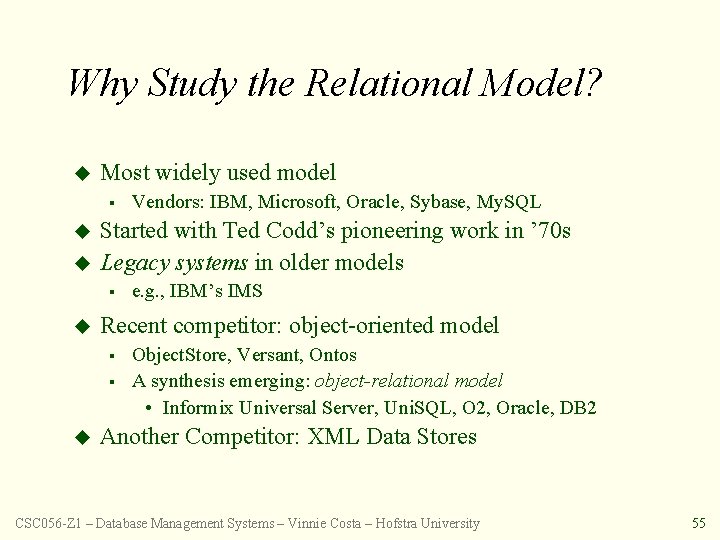
Why Study the Relational Model? u Most widely used model § u u Started with Ted Codd’s pioneering work in ’ 70 s Legacy systems in older models § u e. g. , IBM’s IMS Recent competitor: object-oriented model § § u Vendors: IBM, Microsoft, Oracle, Sybase, My. SQL Object. Store, Versant, Ontos A synthesis emerging: object-relational model • Informix Universal Server, Uni. SQL, O 2, Oracle, DB 2 Another Competitor: XML Data Stores CSC 056 -Z 1 – Database Management Systems – Vinnie Costa – Hofstra University 55
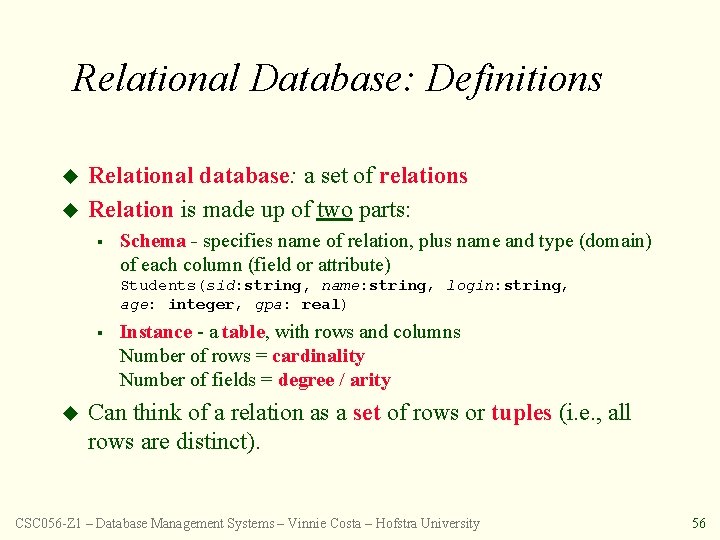
Relational Database: Definitions u u Relational database: a set of relations Relation is made up of two parts: § Schema - specifies name of relation, plus name and type (domain) of each column (field or attribute) Students(sid: string, name: string, login: string, age: integer, gpa: real) § u Instance - a table, with rows and columns Number of rows = cardinality Number of fields = degree / arity Can think of a relation as a set of rows or tuples (i. e. , all rows are distinct). CSC 056 -Z 1 – Database Management Systems – Vinnie Costa – Hofstra University 56
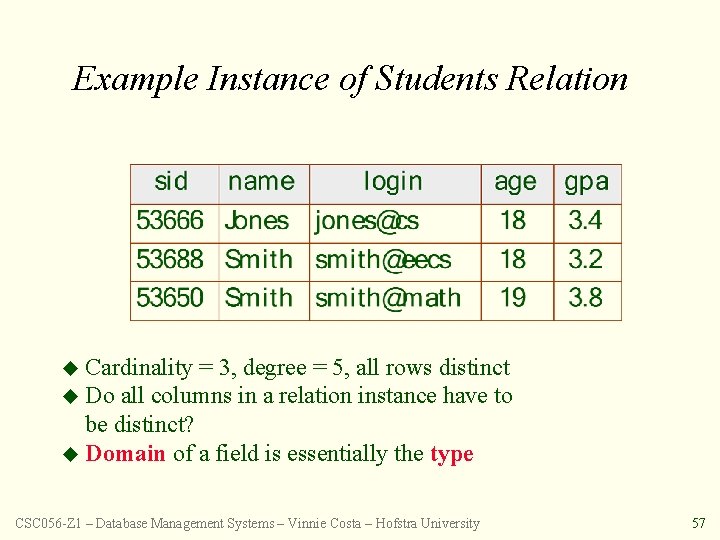
Example Instance of Students Relation u Cardinality = 3, degree = 5, all rows distinct u Do all columns in a relation instance have to be distinct? u Domain of a field is essentially the type CSC 056 -Z 1 – Database Management Systems – Vinnie Costa – Hofstra University 57
Relational Query Languages u A major strength of the relational model: supports simple, powerful querying of data. u Queries can be written intuitively, and the DBMS is responsible for efficient evaluation. § § The key: precise semantics for relational queries. Allows the optimizer to extensively re-order operations, and still ensure that the answer does not change. CSC 056 -Z 1 – Database Management Systems – Vinnie Costa – Hofstra University 58
The SQL Query Language u Developed by IBM (system R) in the 1970 s u Need for a standard since it is used by many vendors u Standards: § § SQL-86 SQL-89 (minor revision) SQL-92 (major revision) SQL-99 (major extensions, current standard) CSC 056 -Z 1 – Database Management Systems – Vinnie Costa – Hofstra University 59
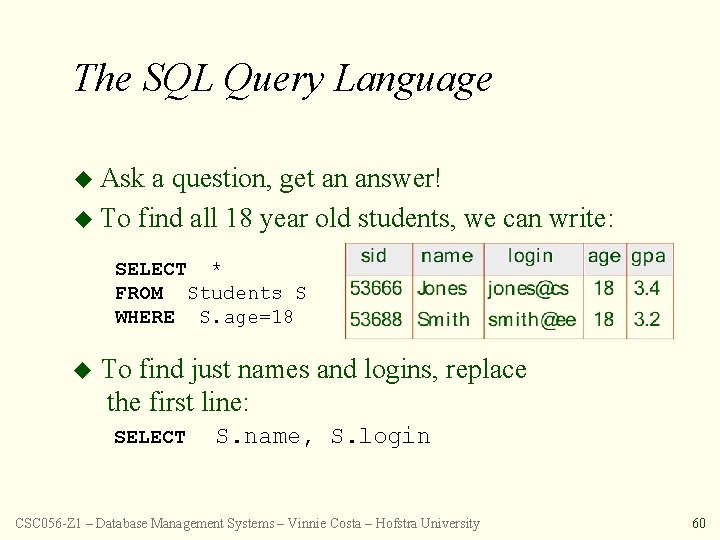
The SQL Query Language u Ask a question, get an answer! u To find all 18 year old students, we can write: SELECT * FROM Students S WHERE S. age=18 u To find just names and logins, replace the first line: SELECT S. name, S. login CSC 056 -Z 1 – Database Management Systems – Vinnie Costa – Hofstra University 60
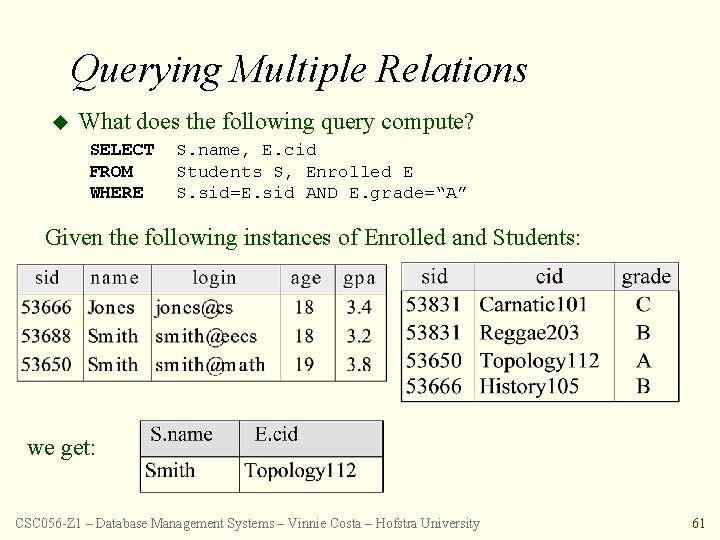
Querying Multiple Relations u What does the following query compute? SELECT FROM WHERE S. name, E. cid Students S, Enrolled E S. sid=E. sid AND E. grade=“A” Given the following instances of Enrolled and Students: we get: CSC 056 -Z 1 – Database Management Systems – Vinnie Costa – Hofstra University 61
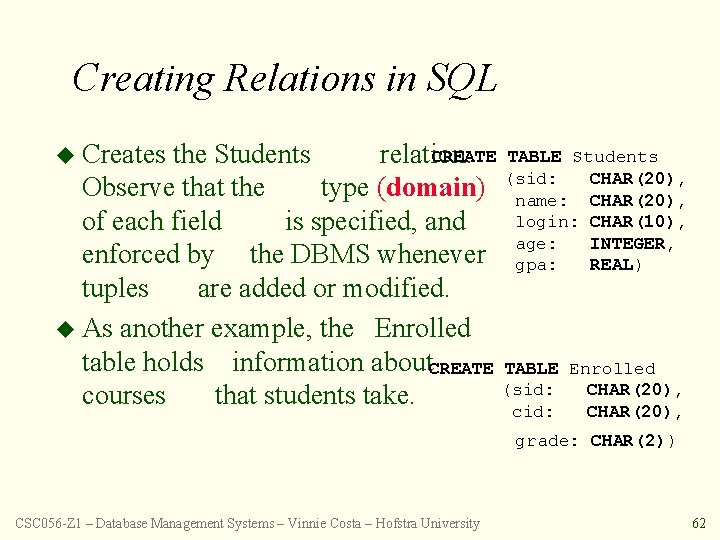
Creating Relations in SQL CREATE TABLE Students u Creates the Students relation. (sid: Observe that the type (domain) name: of each field is specified, and login: age: enforced by the DBMS whenever gpa: tuples are added or modified. u As another example, the Enrolled table holds information about CREATE TABLE (sid: courses that students take. cid: CHAR(20), CHAR(10), INTEGER, REAL) Enrolled CHAR(20), grade: CHAR(2)) CSC 056 -Z 1 – Database Management Systems – Vinnie Costa – Hofstra University 62
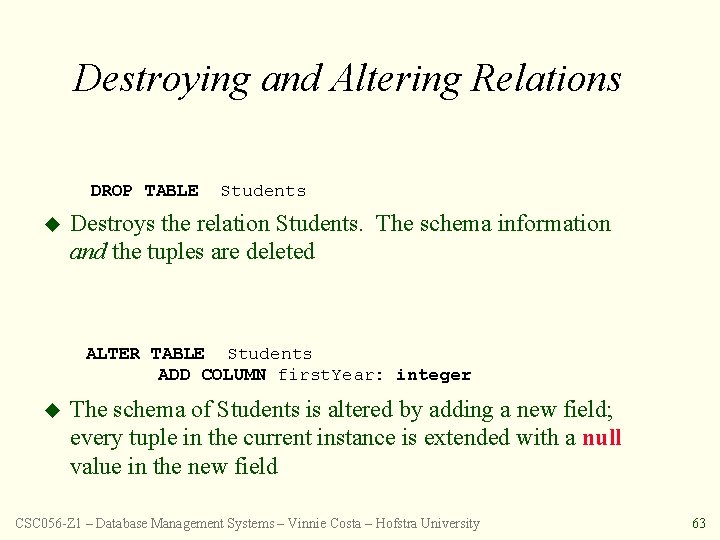
Destroying and Altering Relations DROP TABLE u Students Destroys the relation Students. The schema information and the tuples are deleted ALTER TABLE Students ADD COLUMN first. Year: integer u The schema of Students is altered by adding a new field; every tuple in the current instance is extended with a null value in the new field CSC 056 -Z 1 – Database Management Systems – Vinnie Costa – Hofstra University 63
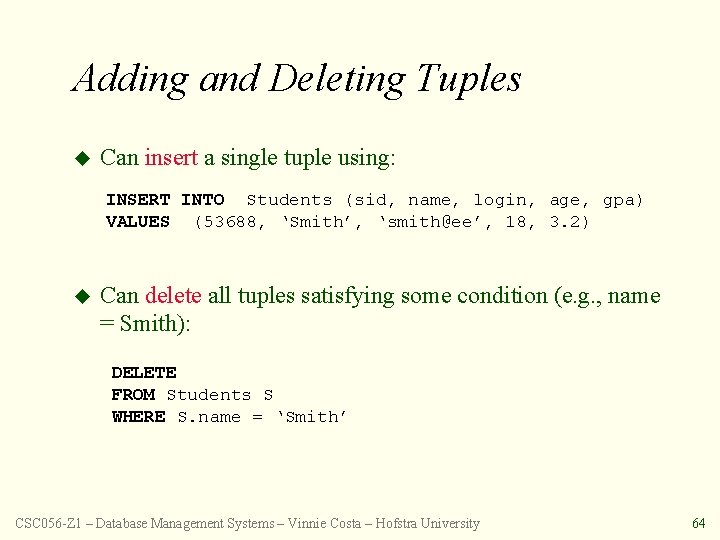
Adding and Deleting Tuples u Can insert a single tuple using: INSERT INTO Students (sid, name, login, age, gpa) VALUES (53688, ‘Smith’, ‘smith@ee’, 18, 3. 2) u Can delete all tuples satisfying some condition (e. g. , name = Smith): DELETE FROM Students S WHERE S. name = ‘Smith’ CSC 056 -Z 1 – Database Management Systems – Vinnie Costa – Hofstra University 64
Integrity Constraints (ICs) u u u IC - condition that must be true for any instance of the database; e. g. , domain constraints. § ICs are specified when schema is defined. § ICs are checked when relations are modified. A legal instance of a relation is one that satisfies all specified ICs. § DBMS should not allow illegal instances. If the DBMS checks ICs, stored data is more faithful to realworld meaning. § Avoids data entry errors, too! CSC 056 -Z 1 – Database Management Systems – Vinnie Costa – Hofstra University 65
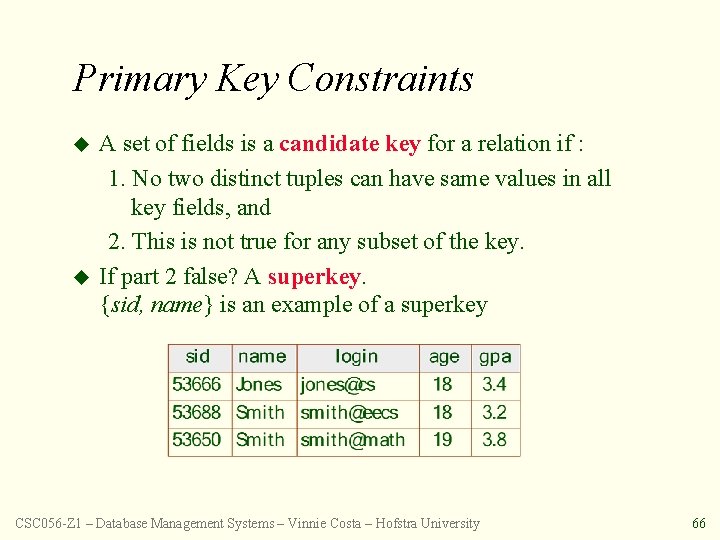
Primary Key Constraints u u A set of fields is a candidate key for a relation if : 1. No two distinct tuples can have same values in all key fields, and 2. This is not true for any subset of the key. If part 2 false? A superkey. {sid, name} is an example of a superkey CSC 056 -Z 1 – Database Management Systems – Vinnie Costa – Hofstra University 66
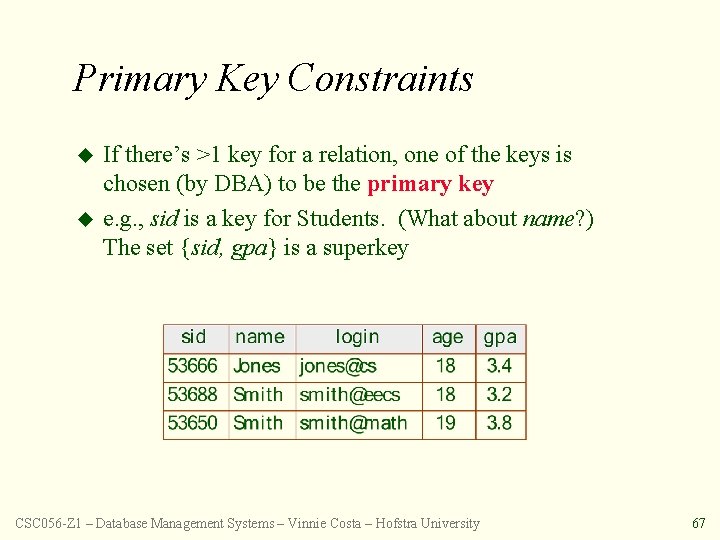
Primary Key Constraints u u If there’s >1 key for a relation, one of the keys is chosen (by DBA) to be the primary key e. g. , sid is a key for Students. (What about name? ) The set {sid, gpa} is a superkey CSC 056 -Z 1 – Database Management Systems – Vinnie Costa – Hofstra University 67
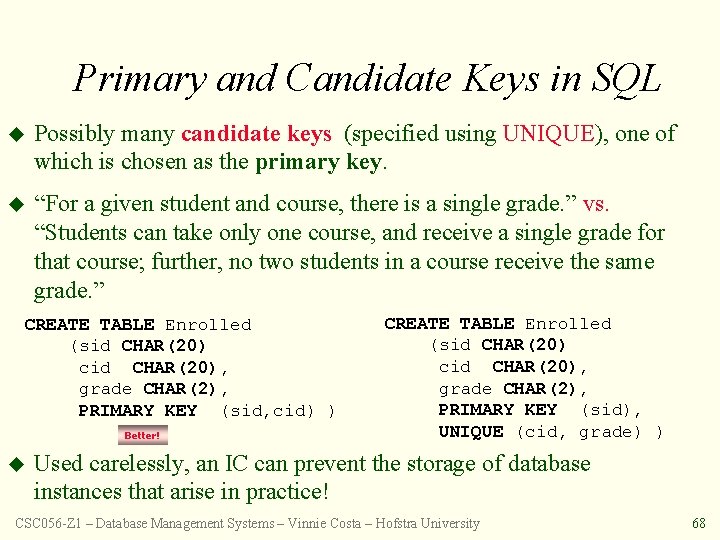
Primary and Candidate Keys in SQL u Possibly many candidate keys (specified using UNIQUE), one of which is chosen as the primary key. u “For a given student and course, there is a single grade. ” vs. “Students can take only one course, and receive a single grade for that course; further, no two students in a course receive the same grade. ” CREATE TABLE Enrolled (sid CHAR(20) cid CHAR(20), grade CHAR(2), PRIMARY KEY (sid, cid) ) Better! u CREATE TABLE Enrolled (sid CHAR(20) cid CHAR(20), grade CHAR(2), PRIMARY KEY (sid), UNIQUE (cid, grade) ) Used carelessly, an IC can prevent the storage of database instances that arise in practice! CSC 056 -Z 1 – Database Management Systems – Vinnie Costa – Hofstra University 68
Foreign Keys, Referential Integrity u Foreign key - Set of fields in one relation that is used to refer to a tuple in another relation. (Must correspond to primary key of the second relation. ) Like a logical pointer. u e. g. sid is a foreign key referring to Students: § Enrolled(sid: string, cid: string, grade: string) § If all foreign key constraints are enforced, referential integrity is achieved, i. e. , no dangling references. u Can you name a data model w/o referential integrity? … …Links in HTML! u CSC 056 -Z 1 – Database Management Systems – Vinnie Costa – Hofstra University 69
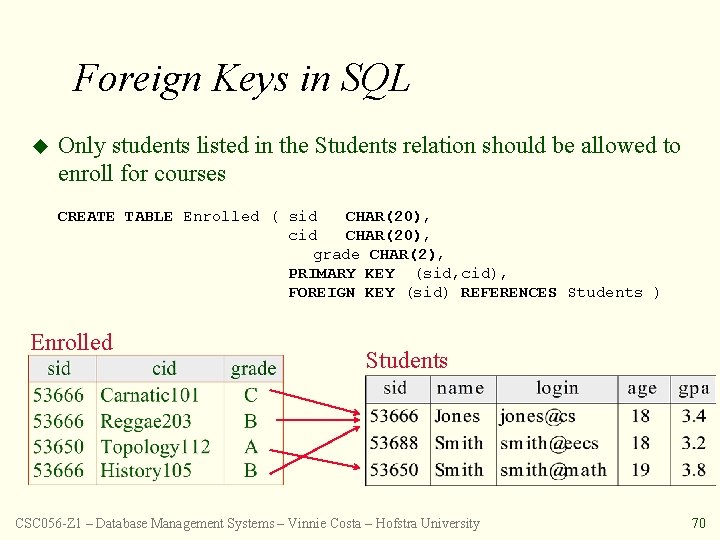
Foreign Keys in SQL u Only students listed in the Students relation should be allowed to enroll for courses CREATE TABLE Enrolled ( sid CHAR(20), cid CHAR(20), grade CHAR(2), PRIMARY KEY (sid, cid), FOREIGN KEY (sid) REFERENCES Students ) Enrolled Students CSC 056 -Z 1 – Database Management Systems – Vinnie Costa – Hofstra University 70
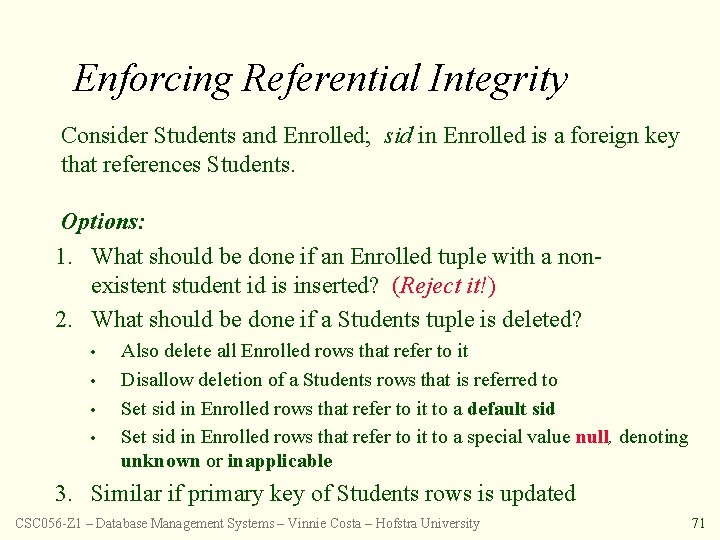
Enforcing Referential Integrity Consider Students and Enrolled; sid in Enrolled is a foreign key that references Students. Options: 1. What should be done if an Enrolled tuple with a nonexistent student id is inserted? (Reject it!) 2. What should be done if a Students tuple is deleted? • • Also delete all Enrolled rows that refer to it Disallow deletion of a Students rows that is referred to Set sid in Enrolled rows that refer to it to a default sid Set sid in Enrolled rows that refer to it to a special value null, denoting unknown or inapplicable 3. Similar if primary key of Students rows is updated CSC 056 -Z 1 – Database Management Systems – Vinnie Costa – Hofstra University 71
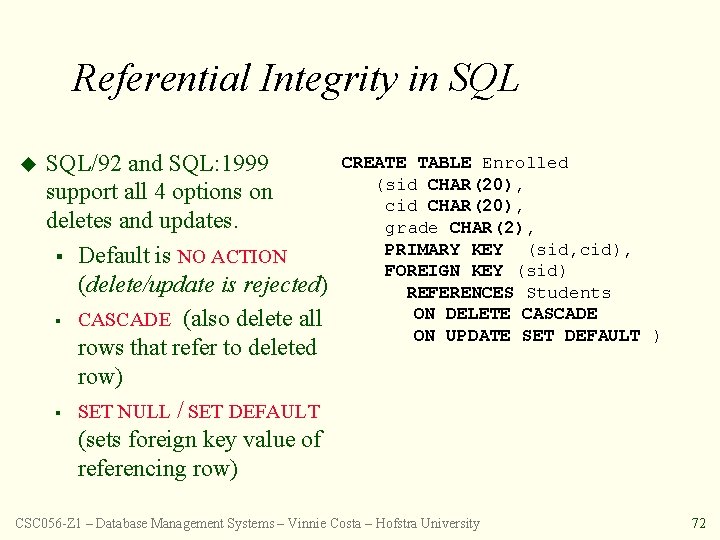
Referential Integrity in SQL u SQL/92 and SQL: 1999 support all 4 options on deletes and updates. § Default is NO ACTION (delete/update is rejected) § CASCADE (also delete all rows that refer to deleted row) § SET NULL / SET DEFAULT (sets foreign key value of referencing row) CREATE TABLE Enrolled (sid CHAR(20), cid CHAR(20), grade CHAR(2), PRIMARY KEY (sid, cid), FOREIGN KEY (sid) REFERENCES Students ON DELETE CASCADE ON UPDATE SET DEFAULT ) CSC 056 -Z 1 – Database Management Systems – Vinnie Costa – Hofstra University 72
Where do ICs Come From? u ICs are based upon the semantics of the real-world enterprise that is being described in the database relations. u We can check a database instance to see if an IC is violated, but we can NEVER infer that an IC is true by looking at an instance. § § u An IC is a statement about all possible instances! From example, we know name is not a key, but the assertion that sid is a key is given to us. Key and foreign key ICs are the most common; more general ICs supported too. CSC 056 -Z 1 – Database Management Systems – Vinnie Costa – Hofstra University 73
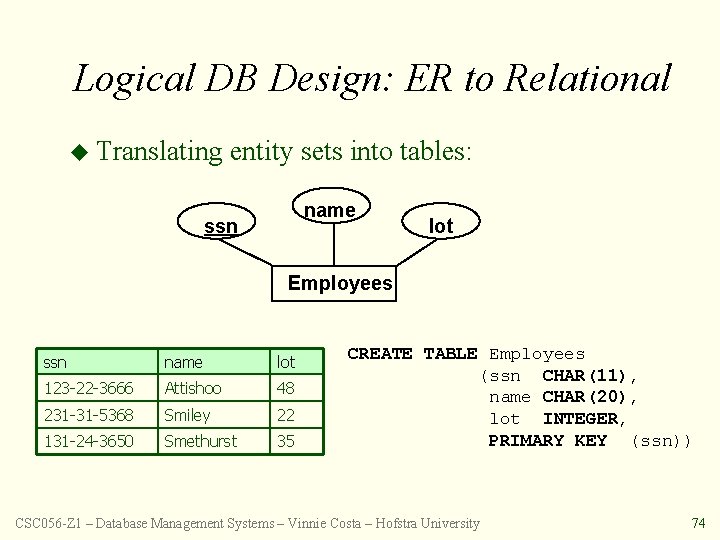
Logical DB Design: ER to Relational u Translating entity sets into tables: name ssn lot Employees ssn name lot 123 -22 -3666 Attishoo 48 231 -31 -5368 Smiley 22 131 -24 -3650 Smethurst 35 CREATE TABLE Employees (ssn CHAR(11), name CHAR(20), lot INTEGER, PRIMARY KEY (ssn)) CSC 056 -Z 1 – Database Management Systems – Vinnie Costa – Hofstra University 74
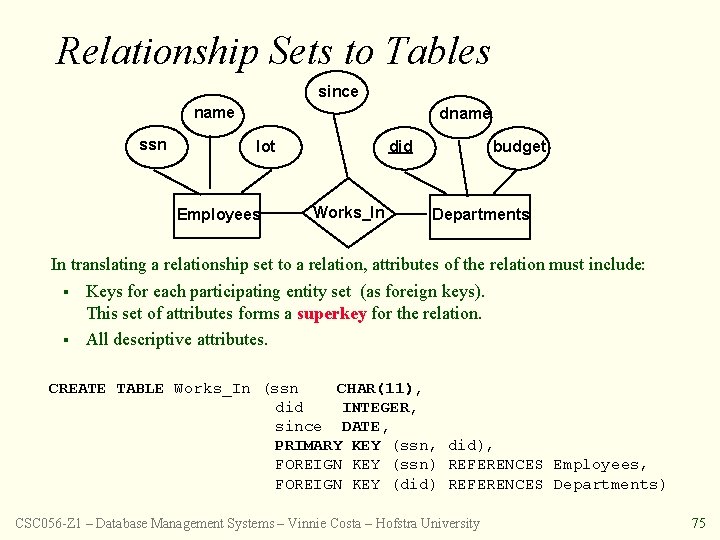
Relationship Sets to Tables since name ssn dname lot Employees budget did Works_In Departments In translating a relationship set to a relation, attributes of the relation must include: § § Keys for each participating entity set (as foreign keys). This set of attributes forms a superkey for the relation. All descriptive attributes. CREATE TABLE Works_In (ssn CHAR(11), did INTEGER, since DATE, PRIMARY KEY (ssn, did), FOREIGN KEY (ssn) REFERENCES Employees, FOREIGN KEY (did) REFERENCES Departments) CSC 056 -Z 1 – Database Management Systems – Vinnie Costa – Hofstra University 75
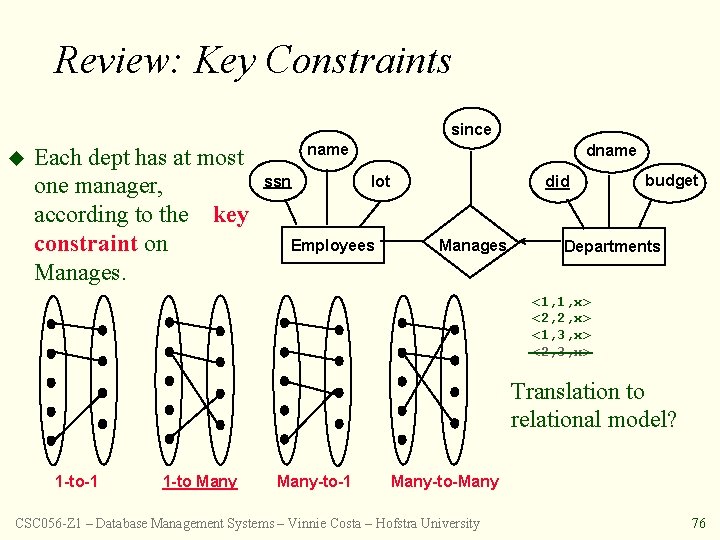
Review: Key Constraints since u Each dept has at most one manager, according to the key constraint on Manages. name ssn dname lot Employees did Manages budget Departments <1, 1, x> <2, 2, x> <1, 3, x> <2, 3, x> Translation to relational model? 1 -to-1 1 -to Many-to-1 Many-to-Many CSC 056 -Z 1 – Database Management Systems – Vinnie Costa – Hofstra University 76
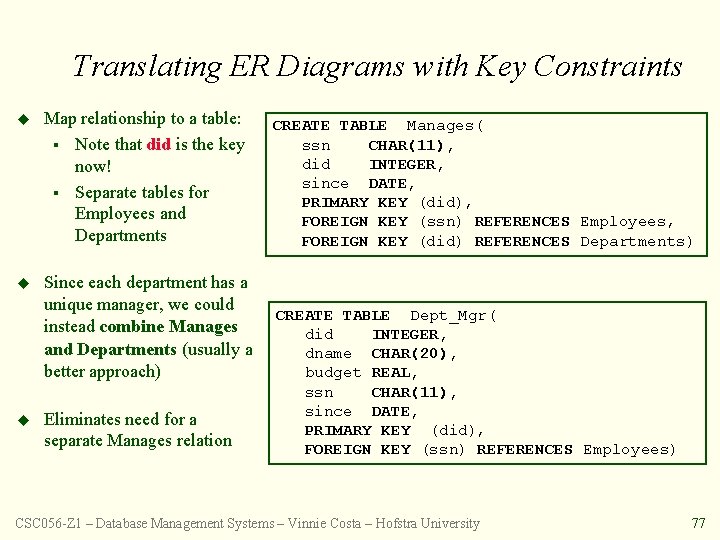
Translating ER Diagrams with Key Constraints u Map relationship to a table: § Note that did is the key now! § Separate tables for Employees and Departments u Since each department has a unique manager, we could instead combine Manages and Departments (usually a better approach) u Eliminates need for a separate Manages relation CREATE TABLE Manages( ssn CHAR(11), did INTEGER, since DATE, PRIMARY KEY (did), FOREIGN KEY (ssn) REFERENCES Employees, FOREIGN KEY (did) REFERENCES Departments) CREATE TABLE Dept_Mgr( did INTEGER, dname CHAR(20), budget REAL, ssn CHAR(11), since DATE, PRIMARY KEY (did), FOREIGN KEY (ssn) REFERENCES Employees) CSC 056 -Z 1 – Database Management Systems – Vinnie Costa – Hofstra University 77
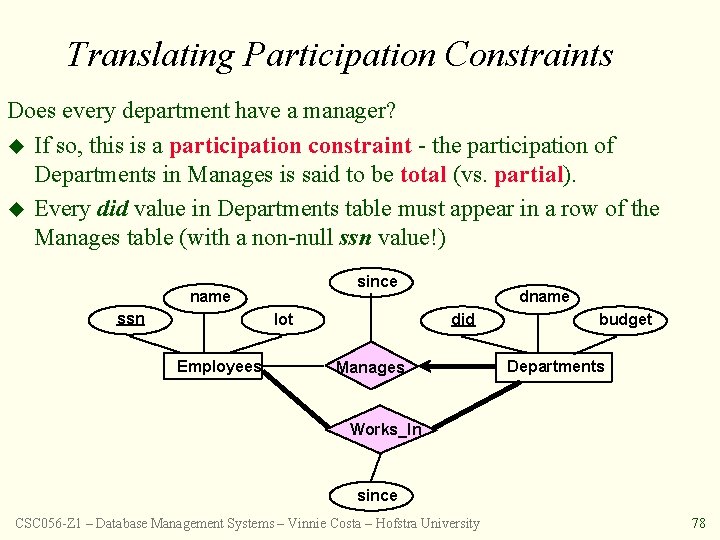
Translating Participation Constraints Does every department have a manager? u If so, this is a participation constraint - the participation of Departments in Manages is said to be total (vs. partial). u Every did value in Departments table must appear in a row of the Manages table (with a non-null ssn value!) since name ssn did lot Employees dname Manages budget Departments Works_In since CSC 056 -Z 1 – Database Management Systems – Vinnie Costa – Hofstra University 78
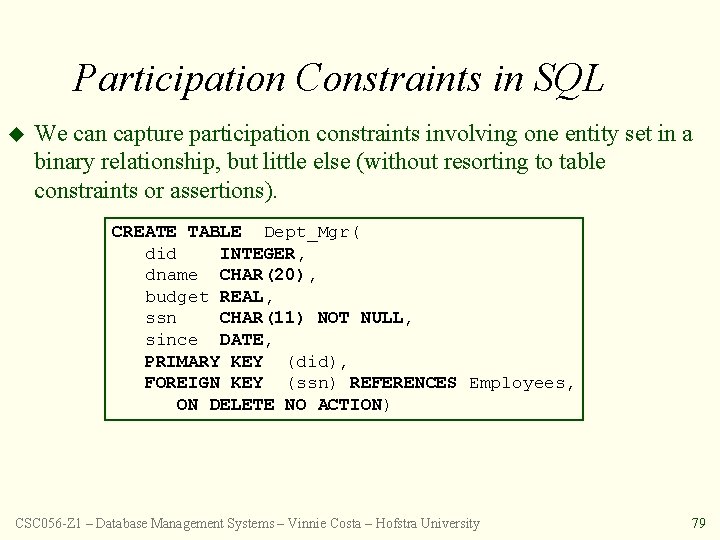
Participation Constraints in SQL u We can capture participation constraints involving one entity set in a binary relationship, but little else (without resorting to table constraints or assertions). CREATE TABLE Dept_Mgr( did INTEGER, dname CHAR(20), budget REAL, ssn CHAR(11) NOT NULL, since DATE, PRIMARY KEY (did), FOREIGN KEY (ssn) REFERENCES Employees, ON DELETE NO ACTION) CSC 056 -Z 1 – Database Management Systems – Vinnie Costa – Hofstra University 79
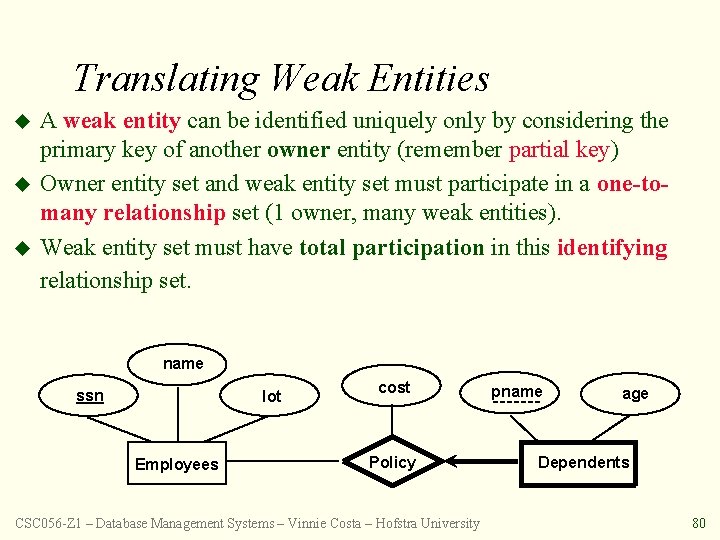
Translating Weak Entities u u u A weak entity can be identified uniquely only by considering the primary key of another owner entity (remember partial key) Owner entity set and weak entity set must participate in a one-tomany relationship set (1 owner, many weak entities). Weak entity set must have total participation in this identifying relationship set. name ssn lot Employees cost Policy CSC 056 -Z 1 – Database Management Systems – Vinnie Costa – Hofstra University pname age Dependents 80
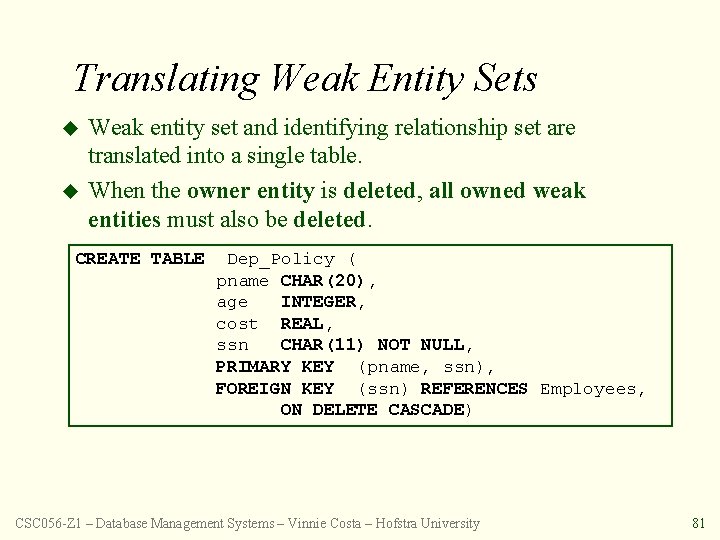
Translating Weak Entity Sets u u Weak entity set and identifying relationship set are translated into a single table. When the owner entity is deleted, all owned weak entities must also be deleted. CREATE TABLE Dep_Policy ( pname CHAR(20), age INTEGER, cost REAL, ssn CHAR(11) NOT NULL, PRIMARY KEY (pname, ssn), FOREIGN KEY (ssn) REFERENCES Employees, ON DELETE CASCADE) CSC 056 -Z 1 – Database Management Systems – Vinnie Costa – Hofstra University 81
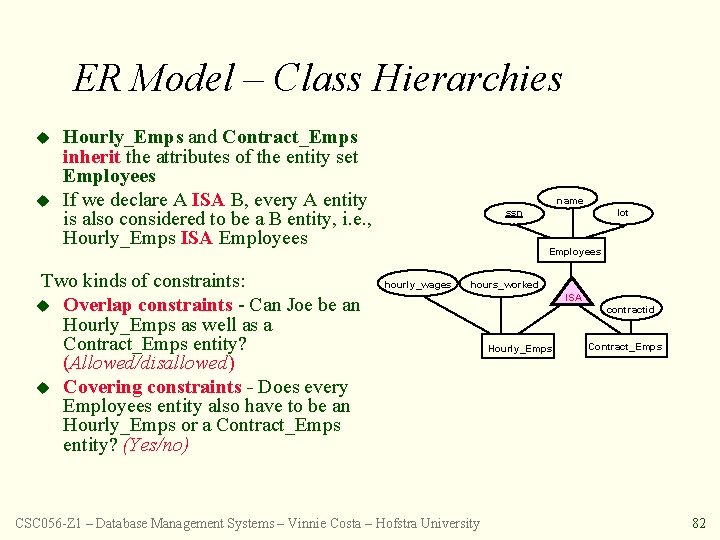
ER Model – Class Hierarchies u u Hourly_Emps and Contract_Emps inherit the attributes of the entity set Employees If we declare A ISA B, every A entity is also considered to be a B entity, i. e. , Hourly_Emps ISA Employees Two kinds of constraints: u Overlap constraints - Can Joe be an Hourly_Emps as well as a Contract_Emps entity? (Allowed/disallowed) u Covering constraints - Does every Employees entity also have to be an Hourly_Emps or a Contract_Emps entity? (Yes/no) name ssn lot Employees hourly_wages hours_worked CSC 056 -Z 1 – Database Management Systems – Vinnie Costa – Hofstra University ISA contractid Hourly_Emps Contract_Emps 82
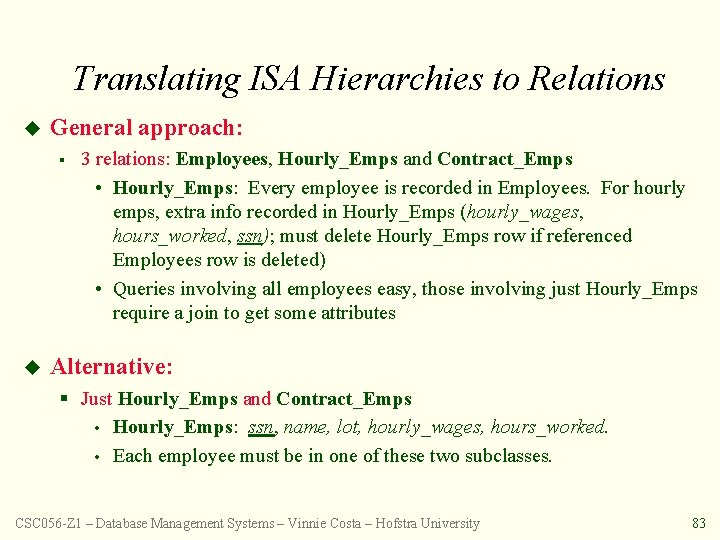
Translating ISA Hierarchies to Relations u General approach: § u 3 relations: Employees, Hourly_Emps and Contract_Emps • Hourly_Emps: Every employee is recorded in Employees. For hourly emps, extra info recorded in Hourly_Emps (hourly_wages, hours_worked, ssn); must delete Hourly_Emps row if referenced Employees row is deleted) • Queries involving all employees easy, those involving just Hourly_Emps require a join to get some attributes Alternative: § Just Hourly_Emps and Contract_Emps • Hourly_Emps: ssn, name, lot, hourly_wages, hours_worked. • Each employee must be in one of these two subclasses. CSC 056 -Z 1 – Database Management Systems – Vinnie Costa – Hofstra University 83
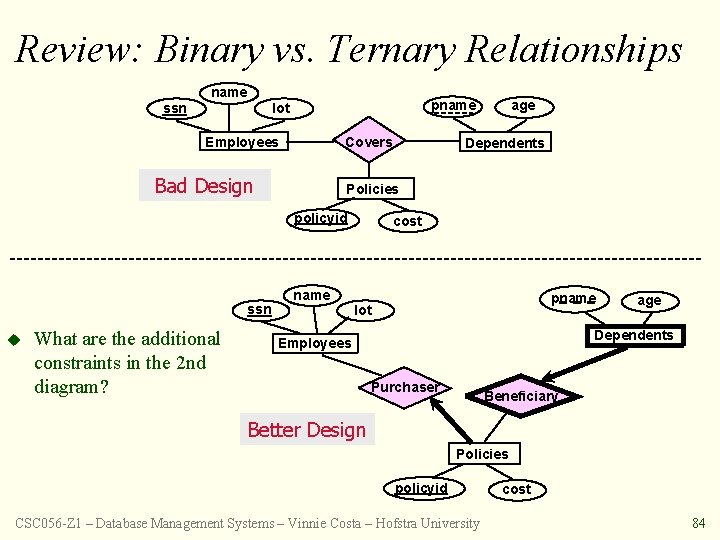
Review: Binary vs. Ternary Relationships name pname lot ssn Covers Employees Bad Design u What are the additional constraints in the 2 nd diagram? Dependents Policies policyid ssn age name cost pname lot age Dependents Employees Purchaser Beneficiary Better Design Policies policyid CSC 056 -Z 1 – Database Management Systems – Vinnie Costa – Hofstra University cost 84
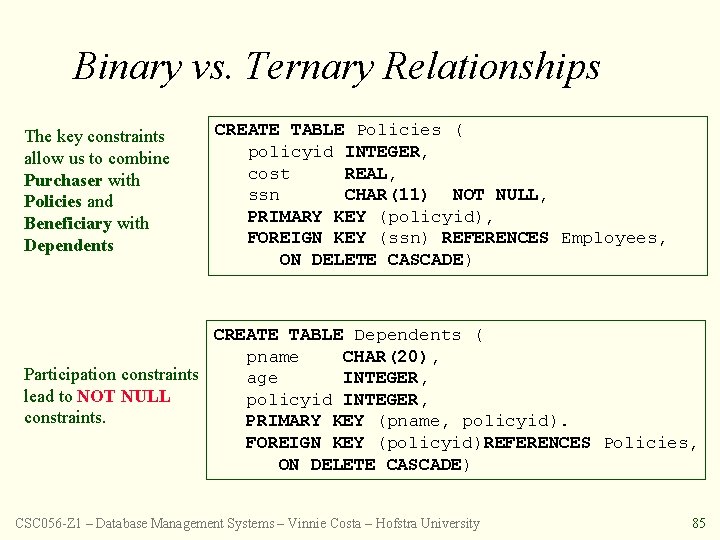
Binary vs. Ternary Relationships The key constraints allow us to combine Purchaser with Policies and Beneficiary with Dependents CREATE TABLE Policies ( policyid INTEGER, cost REAL, ssn CHAR(11) NOT NULL, PRIMARY KEY (policyid), FOREIGN KEY (ssn) REFERENCES Employees, ON DELETE CASCADE) CREATE TABLE Dependents ( pname CHAR(20), Participation constraints age INTEGER, lead to NOT NULL policyid INTEGER, constraints. PRIMARY KEY (pname, policyid). FOREIGN KEY (policyid)REFERENCES Policies, ON DELETE CASCADE) CSC 056 -Z 1 – Database Management Systems – Vinnie Costa – Hofstra University 85
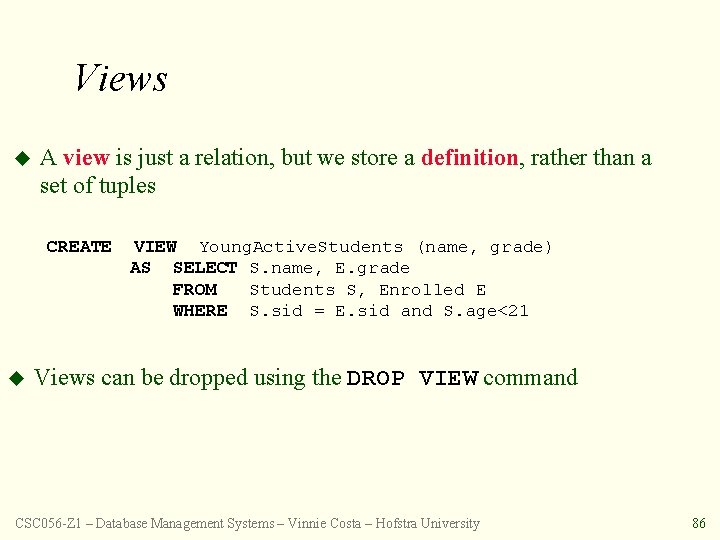
Views u A view is just a relation, but we store a definition, rather than a set of tuples CREATE u VIEW Young. Active. Students (name, grade) AS SELECT S. name, E. grade FROM Students S, Enrolled E WHERE S. sid = E. sid and S. age<21 Views can be dropped using the DROP VIEW command CSC 056 -Z 1 – Database Management Systems – Vinnie Costa – Hofstra University 86
Views and Security u Views can be used to present necessary information (or a summary), while hiding details in underlying relation(s) u Given Young. Students, but not Students or Enrolled, we can find students s who have are enrolled, but not the cid’s of the courses they are enrolled in CSC 056 -Z 1 – Database Management Systems – Vinnie Costa – Hofstra University 87
Relational Model: Summary u u u A tabular representation of data Simple and intuitive, currently the most widely used Integrity constraints can be specified by the DBA, based on application semantics. DBMS checks for violations. • Two important ICs: primary and foreign keys • In addition, we always have domain constraints Powerful and natural query languages exist Rules (and tools) to translate ER to relational model CSC 056 -Z 1 – Database Management Systems – Vinnie Costa – Hofstra University 88
PHP u u www. php. net u PHP is a popular open-source, reflective programming language used mainly for developing server-side applications and dynamic web content. It was originally developed in 1994 and PHP stood for "Personal Home Page". In 2000 the Zend Engine was added and now the official meaning is the recursive acronym "PHP Hypertext Preprocessor". u PHP is currently one of the most popular server-side scripting systems on the Web. It has been widely adopted since the release of version 4. On the desktop it has been favored by some new programmers as a rapid prototyping environment. CSC 056 -Z 1 – Database Management Systems – Vinnie Costa – Hofstra University 89
Installing PHP u u u www. php. net/downloads. php#v 4 We want to install PHP 4. 4. 0 and use the ZIP package Extract the PHP package (PHP 4. 4. 0 zip package ). Extract the package in the directory where Apache was installed ( C: Program FilesApache GroupApache 2 ). Change the newly created directory name to php ( just to make it shorter ). Then copy the file php. ini-dist in PHP directory to you windows directory ( C: Windows or C: Winnt depends on where you installed Windows ) and rename the file to php. ini. This is the PHP configuration file and we'll take a look what's in it later on. Next, move the php 4 ts. dll file from the newly created php directory into the sapi subdirectory. CSC 056 -Z 1 – Database Management Systems – Vinnie Costa – Hofstra University 90
Installing PHP u u u Apache doesn't know that you just installed PHP. We need to tell Apache about PHP and where to find it. Open the Apache configuration file in C: Program FilesApache GroupApache 2confhttpd. conf and add the following three lines : Load. Module php 4_module php/sapi/php 4 apache 2. dll Add. Type application/x-httpd-php. php Add. Type application/x-httpd-php-source. phps The first line tells Apache where to load the dll required to execute PHP and the second line means that every file that ends with. php should be processed as a PHP file. The third line is added so that you can view your php file source code in the browser window. Now restart Apache for the changes to take effect ( Start > Programs > Apache HTTP Server 2. 0. 50 > Control Apache Server > Restart ). CSC 056 -Z 1 – Database Management Systems – Vinnie Costa – Hofstra University 91
Installing PHP u u u Now we want to test PHP to verify our installation. Create a new file using Nvu, name it hello. php, and put it in document root directory ( C: Program FilesApache GroupApache 2htdocs ). The content of this file should be: <? php echo 'Hello World!'; ? > (Note: Nvu will do the php encapsulation for you) Type http: //localhost/hello. php on your browser's address bar and if everything works well you should see the traditional “Hello World!” display in your browser. Another common test is to create a new file named test. php and put it in document root directory The content of this file is: <? phpinfo(); ? > CSC 056 -Z 1 – Database Management Systems – Vinnie Costa – Hofstra University 92
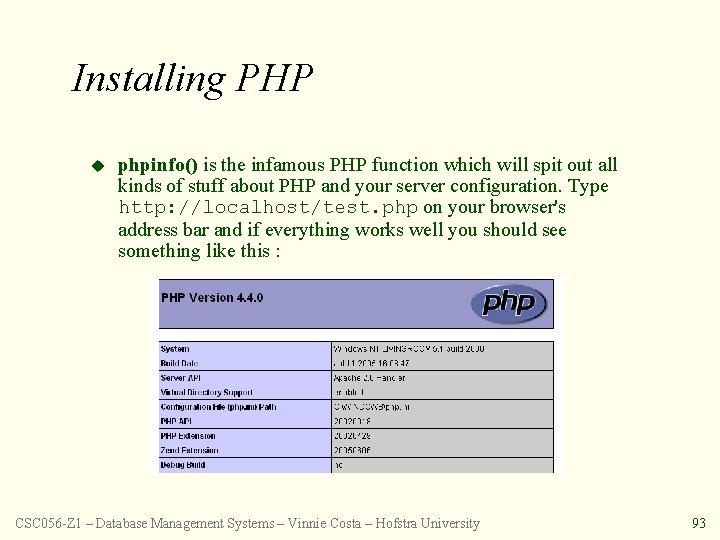
Installing PHP u phpinfo() is the infamous PHP function which will spit out all kinds of stuff about PHP and your server configuration. Type http: //localhost/test. php on your browser's address bar and if everything works well you should see something like this : CSC 056 -Z 1 – Database Management Systems – Vinnie Costa – Hofstra University 93
My. SQL u u www. mysql. com u dev. mysql. com/doc/ - My. SQL Reference Manual u My. SQL is a multithreaded, multi-user, SQL (Structured Query Language) Database Management System (DBMS) with an estimated six million installations. My. SQL is open source software available either under the GNU General Public License (GPL) or under other licenses when the GPL is inapplicable to the intended use. 1 u Unlike projects such as Apache, where the software is developed by a public community, and is essentially not owned by anyone, My. SQL is owned and sponsored by a single for-profit firm, the Swedish company My. SQL AB. The company develops and maintains the system, selling support and service contracts, as well as commercially-licensed copies of My. SQL, and employing people all over the world who work together via the Internet. Two Swedes and a Finn founded My. SQL AB: David Axmark, Allan Larsson and Michael "Monty" Widenius. 2 (1) - en. wikipedia. org/wiki/My. SQL (2) – Wiki. Pedia is based on My. SQL. There are more than 200 million queries and 1. 2 million updates per day with peak loads of 11, 000 queries per second CSC 056 -Z 1 – Database Management Systems – Vinnie Costa – Hofstra University 94
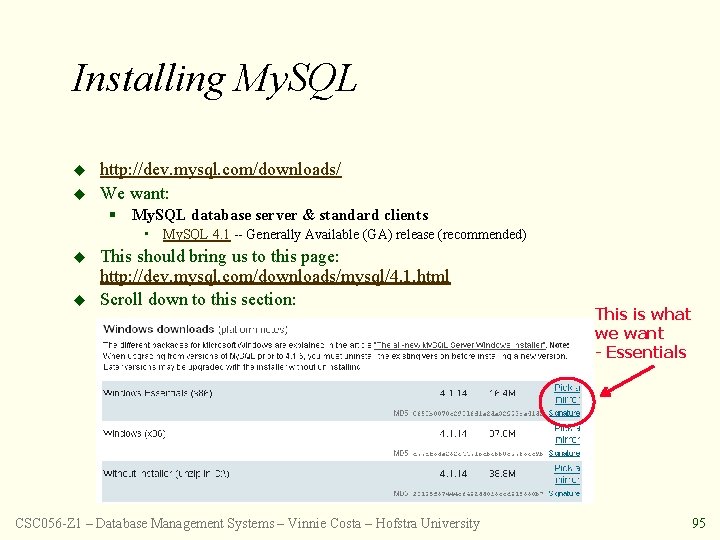
Installing My. SQL u u http: //dev. mysql. com/downloads/ We want: § My. SQL database server & standard clients • My. SQL 4. 1 -- Generally Available (GA) release (recommended) u u This should bring us to this page: http: //dev. mysql. com/downloads/mysql/4. 1. html Scroll down to this section: CSC 056 -Z 1 – Database Management Systems – Vinnie Costa – Hofstra University This is what we want - Essentials 95
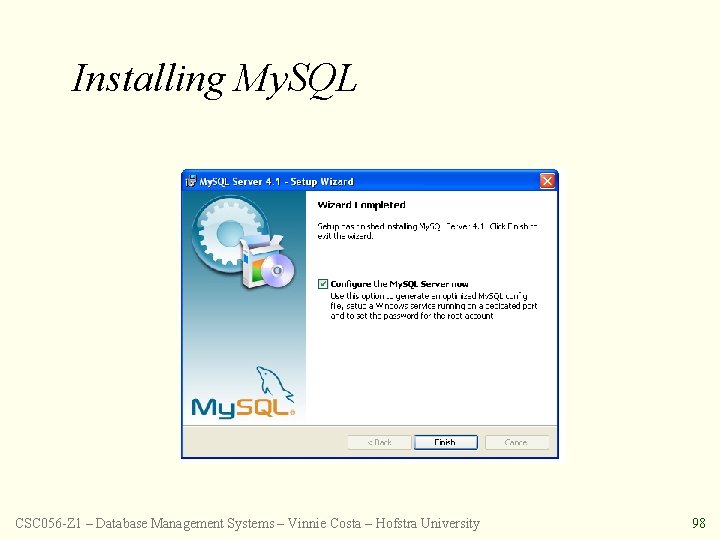
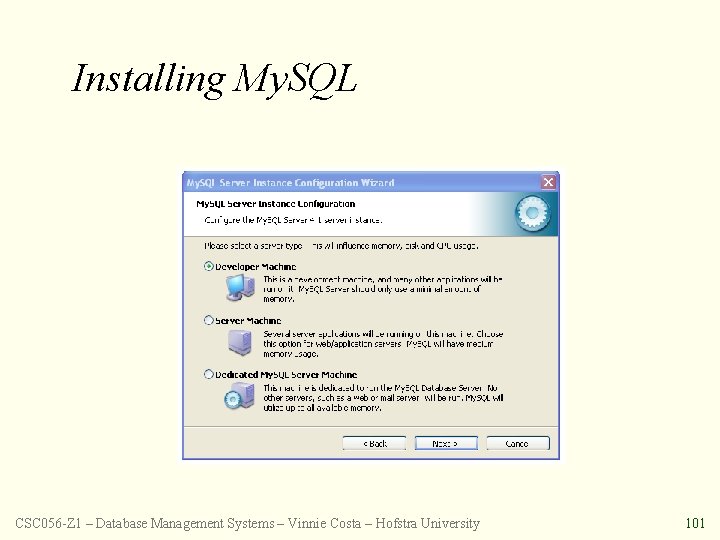
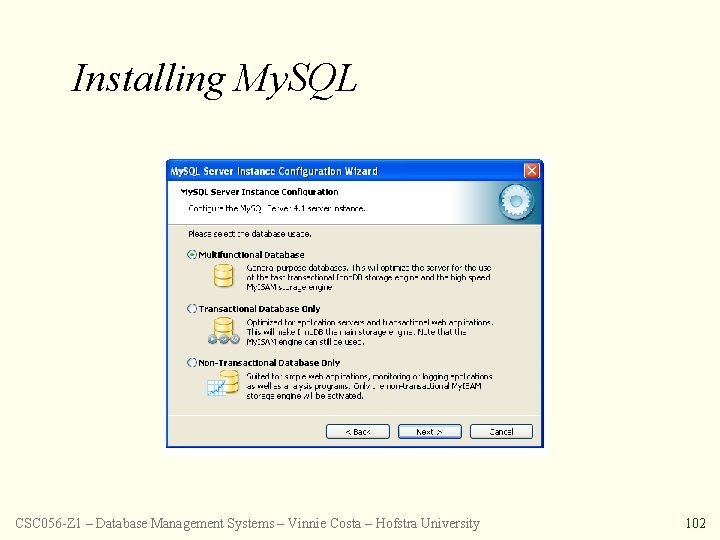
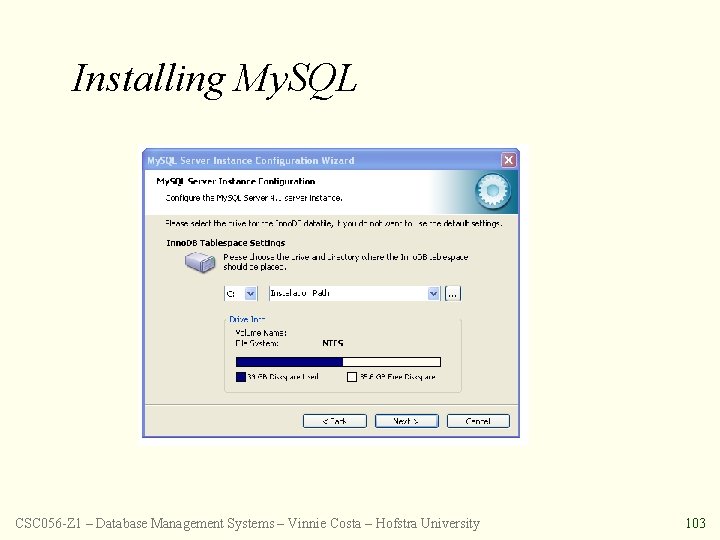
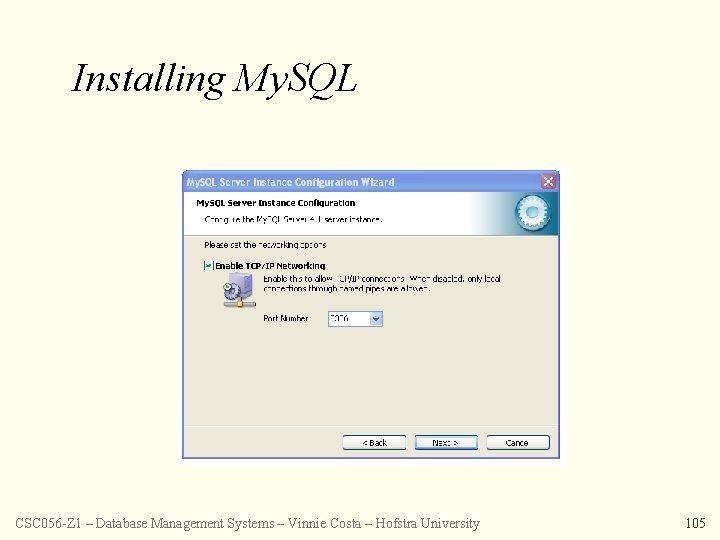
Installing My. SQL u u u We will be downloading: mysql-essential-4. 1. 14 -win 32. msi Fill in the form if you want and go to the closest US mirror. The download will take a few minutes. When finished, you should have the. msi file on your desktop. Double-Click the newly downloaded. msi file Accept the typical installation You’ll be prompted to create a My. SQL account (recommended) – monthly newsletter - save this info When the install finishes you’ll get a configuration option window. Be sure it is checked. CSC 056 -Z 1 – Database Management Systems – Vinnie Costa – Hofstra University 96
Installing My. SQL u u u We will be downloading: mysql-essential-4. 1. 14 -win 32. msi Fill in the form if you want and go to the closest US mirror. The download will take a few minutes. When finished, you should have the. msi file on your desktop. Double-Click the newly downloaded. msi file Accept the typical installation You’ll be prompted to create a My. SQL account (recommended) – monthly newsletter - save this info When the install finishes you’ll get a configuration option window. Be sure it is checked. CSC 056 -Z 1 – Database Management Systems – Vinnie Costa – Hofstra University 97
Installing My. SQL CSC 056 -Z 1 – Database Management Systems – Vinnie Costa – Hofstra University 98
Installing My. SQL CSC 056 -Z 1 – Database Management Systems – Vinnie Costa – Hofstra University 99
Installing My. SQL CSC 056 -Z 1 – Database Management Systems – Vinnie Costa – Hofstra University 100
Installing My. SQL CSC 056 -Z 1 – Database Management Systems – Vinnie Costa – Hofstra University 101
Installing My. SQL CSC 056 -Z 1 – Database Management Systems – Vinnie Costa – Hofstra University 102
Installing My. SQL CSC 056 -Z 1 – Database Management Systems – Vinnie Costa – Hofstra University 103

Installing My. SQL CSC 056 -Z 1 – Database Management Systems – Vinnie Costa – Hofstra University 104
Installing My. SQL CSC 056 -Z 1 – Database Management Systems – Vinnie Costa – Hofstra University 105
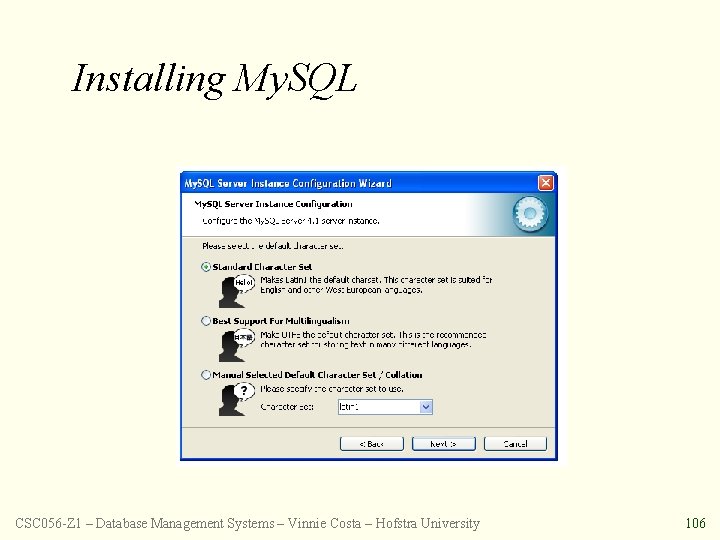
Installing My. SQL CSC 056 -Z 1 – Database Management Systems – Vinnie Costa – Hofstra University 106
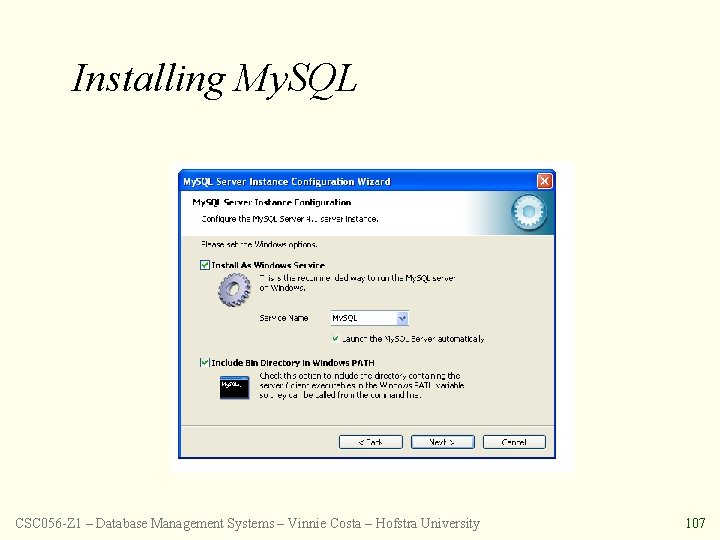
Installing My. SQL CSC 056 -Z 1 – Database Management Systems – Vinnie Costa – Hofstra University 107
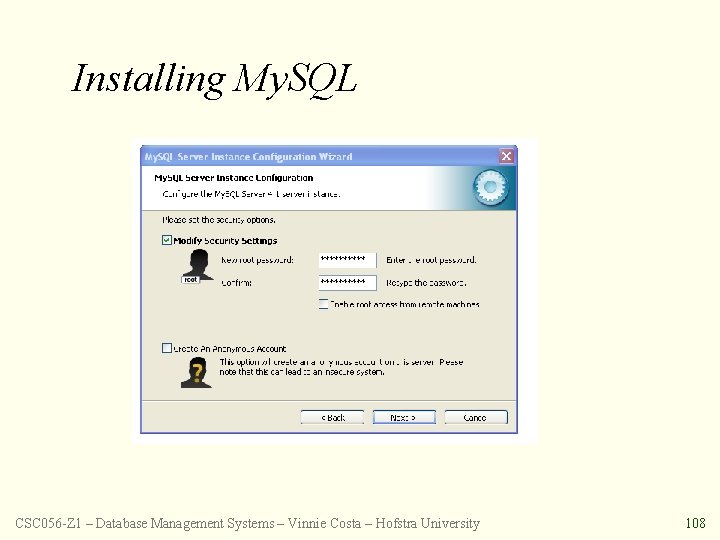
Installing My. SQL CSC 056 -Z 1 – Database Management Systems – Vinnie Costa – Hofstra University 108
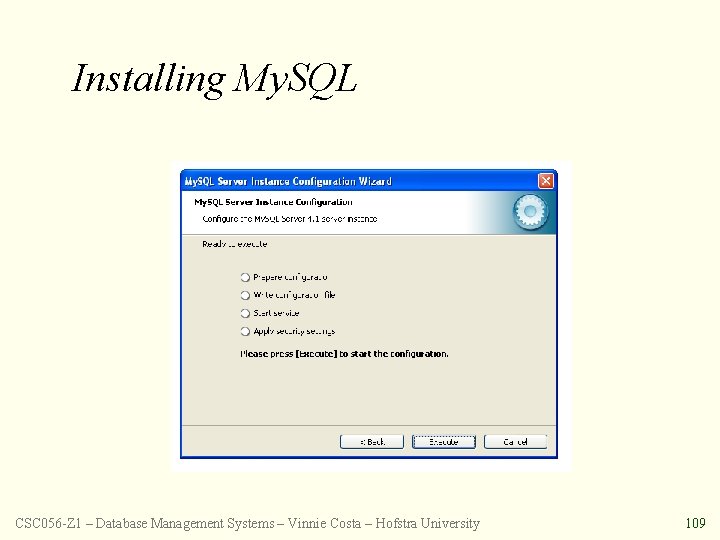
Installing My. SQL CSC 056 -Z 1 – Database Management Systems – Vinnie Costa – Hofstra University 109
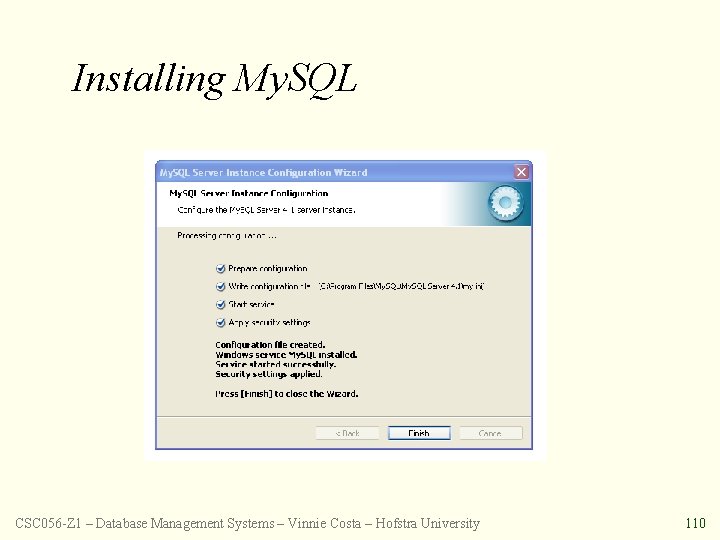
Installing My. SQL CSC 056 -Z 1 – Database Management Systems – Vinnie Costa – Hofstra University 110
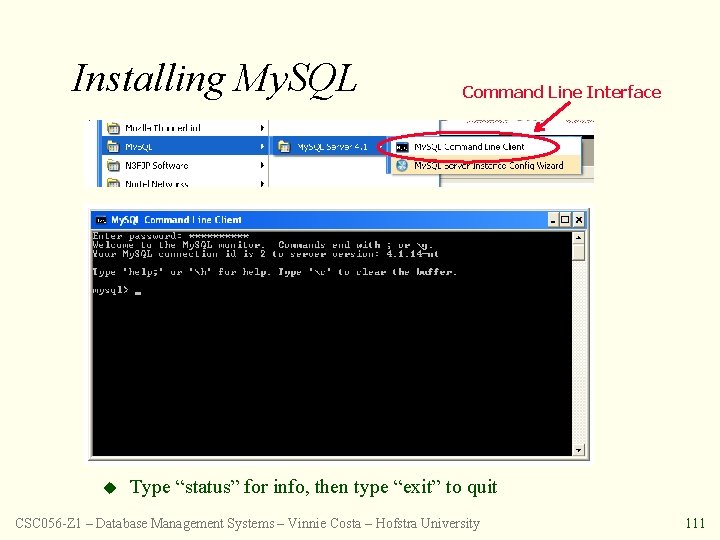
Installing My. SQL u Command Line Interface Type “status” for info, then type “exit” to quit CSC 056 -Z 1 – Database Management Systems – Vinnie Costa – Hofstra University 111
Configuring PHP u PHP stores all kinds of configuration information into a file called php. ini. Recall that we moved this to the C: Windows directory. u For now, we do not needed to alter this file. If you are interested in the systems side of DBMS, then read this file carefully. The following two slides are for reference only! u u CSC 056 -Z 1 – Database Management Systems – Vinnie Costa – Hofstra University 112
Configuring PHP u u u error_reporting and display_errors – the default values that come with the installation are fine for development. When you go to production you’ll want to change to: error_reporting = E_NONE display_errors = Off This is because in a production environment you don’t want too much detail about your errors because it may reveal security error. register_globals – this value should be set to Off, which is the default, otherwise it exposes possible security problems. session. save_path – If you use sessions, something you may want to do as an advanced function, but now, then this configuration tells PHP where to save the session data. You will need to set this value to an existing directory or you will not be able to use session. In Windows you can set this value as session. save_path = C: WINDOWSTemp CSC 056 -Z 1 – Database Management Systems – Vinnie Costa – Hofstra University 113
Configuring PHP u extension – PHP 4 comes with many extensions such as Java, SSL, LDAP, Oracle, etc. These are not turned on automatically. If you need to use the extension, first you need to specify the location of the extensions and then uncomment the extension you want. For Windows you will need to uncomment the extension you want to use. In php. ini a comment is started using a semicolon (; ). As an example if you want to use Open. SSL, then you must remove the semicolon at the beginning of ; ; extension=php_openssl. dll to extension=php_openssl. dll u Note: My. SQL and ODBC support is now built in, so no dll is needed for it. max_execution_time – the default is 30 seconds CSC 056 -Z 1 – Database Management Systems – Vinnie Costa – Hofstra University 114
WAMP Install Completed u That’s it! u You have finish installing and configuring Apache, My. SQL and PHP on Windows u Now we are ready to create, modify, and query tables using SQL under the Relational Model CSC 056 -Z 1 – Database Management Systems – Vinnie Costa – Hofstra University 115
Playing With My. SQL u Create Database u Create, Modify, Delete Tables and Rows u Delete Database CSC 056 -Z 1 – Database Management Systems – Vinnie Costa – Hofstra University 116
Homework u Install PHP On Your System u Install My. SQL u Create, Delete, Modify Tables u Insert, Modify, Delete Data Into Tables u Play with My. SQL CSC 056 -Z 1 – Database Management Systems – Vinnie Costa – Hofstra University 117
Homework u Read Chapter Three u No exercises for next class; Mid. Term instead CSC 056 -Z 1 – Database Management Systems – Vinnie Costa – Hofstra University 118
Mid. Term Exam u Due next class September 17 u No late submissions CSC 056 -Z 1 – Database Management Systems – Vinnie Costa – Hofstra University 119
- Slides: 119