
Database Management Systems CS 564 Fall 2017 Lecture

Database Management Systems (CS 564) Fall 2017 Lecture 18
Indexing: Faster Access to Data for a Price Use responsibly! CS 564 (Fall'17) 2
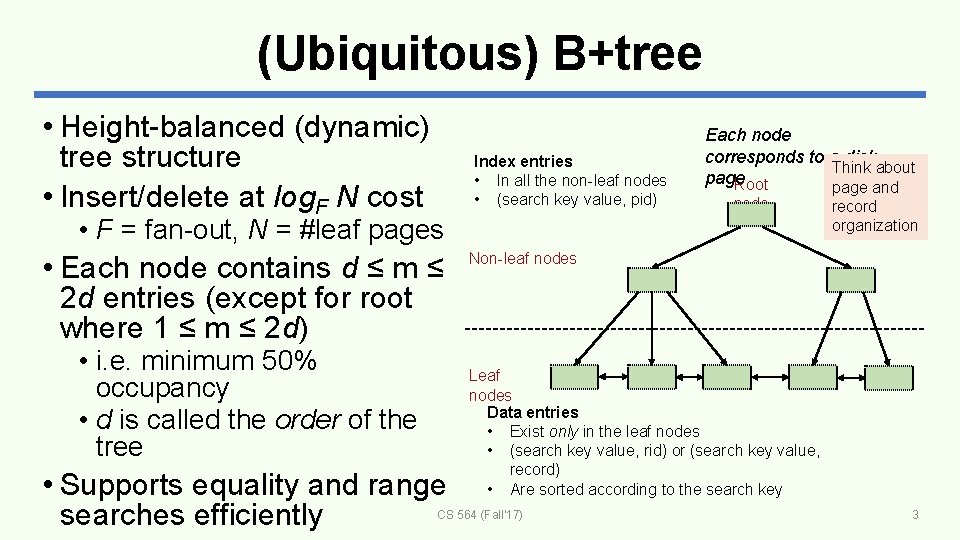
(Ubiquitous) B+tree • Height-balanced (dynamic) tree structure • Insert/delete at log. F N cost Index entries • In all the non-leaf nodes • (search key value, pid) Each node corresponds to a disk Think about page Root page and node • F = fan-out, N = #leaf pages • Each node contains d ≤ m ≤ 2 d entries (except for root where 1 ≤ m ≤ 2 d) • i. e. minimum 50% occupancy • d is called the order of the tree • Supports equality and range searches efficiently record organization Non-leaf nodes Leaf nodes Data entries • Exist only in the leaf nodes • (search key value, rid) or (search key value, record) • Are sorted according to the search key CS 564 (Fall'17) 3
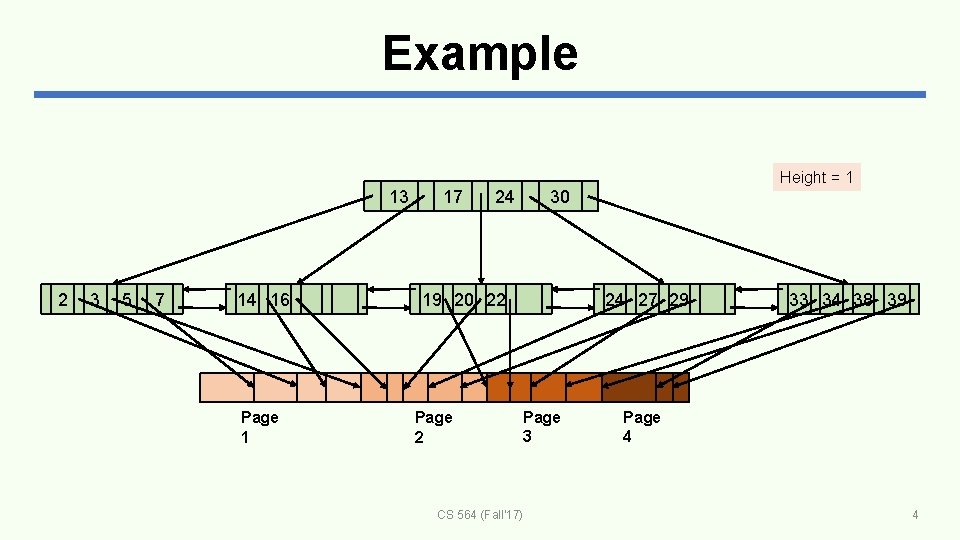
Example Height = 1 13 2 3 5 7 14 16 Page 1 17 24 30 19 20 22 Page 2 24 27 29 Page 3 CS 564 (Fall'17) 33 34 38 39 Page 4 4
Review Exercise • Assume a file which has 950, 000 records • Say we index this file using a B+ tree • In this particular B+ tree, the average page has an occupancy of 100 pointers (i. e. the tree's average branching factor is 100) • Assume further that the amount of memory set aside for storing the index is 150 blocks, and that all 950000 records of the above file reside on disk • No duplicate search key exists • Given a search key K, compute the minimal number of disk I/O needed to retrieve the record with that search key CS 564 (Fall'17) 5
Review Exercise Answer • Assume each leaf node points to data records • i. e. leaf nodes do not contain data records • We have 950, 000 records, so need 950, 000 pointers from leaf nodes • Each leaf node can point to 100 records, so need 9, 500 leaf nodes • Hence tree has three levels: root at level 0, 100 nodes at level 1, 10000 nodes at level 2 • Have 150 memory pages for index, so can store root node + all of level 1 and some of level 2 • Thus minimum cost is 1 CS 564 (Fall'17) 6

Hash(-based) Indexes • Best for equality searches • Don’t support range searches • Different flavors • Static hashing • Dynamic hashing • Extendible hashing • Linear hashing CS 564 (Fall'17) 7
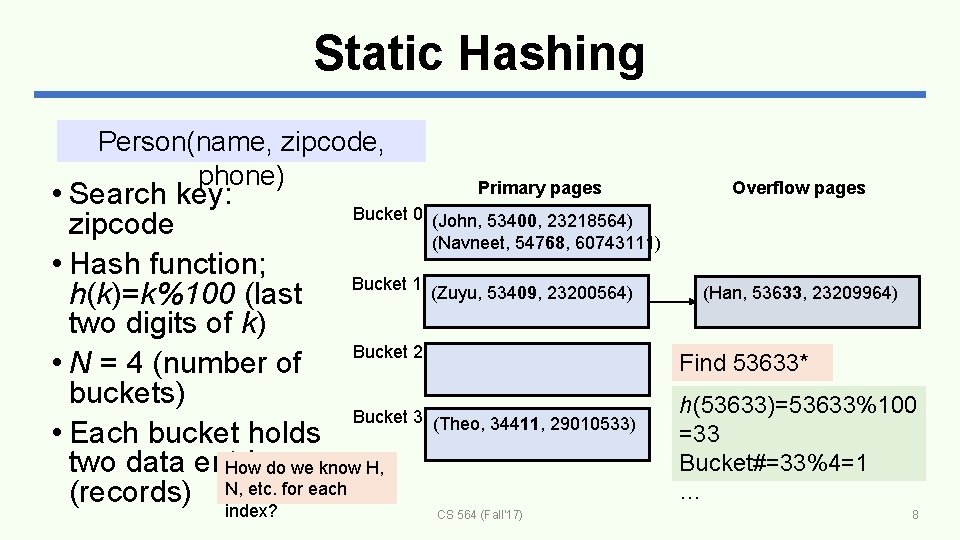
Static Hashing Person(name, zipcode, phone) Primary pages • Search key: Bucket 0 (John, 53400, 23218564) zipcode (Navneet, 54768, 60743111) • Hash function; Bucket 1 (Zuyu, 53409, 23200564) h(k)=k%100 (last two digits of k) Bucket 2 • N = 4 (number of buckets) Bucket 3 (Theo, 34411, 29010533) • Each bucket holds two data entries How do we know H, etc. for each (records) N, index? CS 564 (Fall'17) Overflow pages (Han, 53633, 23209964) Find 53633* h(53633)=53633%100 =33 Bucket#=33%4=1 … 8
Static Hashing (Cont. ) • A hash index is a collection of buckets • A specific bucket consists of a primary page and possibly some overflow pages • Number of primary bucket pages is fixed, they’re allocated sequentially, never de-allocated • Overflow pages are allocated (and de-allocated) if needed • Each bucket contains zero or more data entries • To find the bucket for each record, we use a hash function h applied on the search key k • N = number of buckets • h(k) mod N = bucket in which the data entry belongs • e. g. h(k) = a * k + b, where a and b constant • Records with different search key may belong in the same bucket CS 564 (Fall'17) 9
Operations on Static Hash Indexes • Equality search • Apply the hash function on the search key value to locate the appropriate bucket • Search through the primary page (and possibly overflow pages if they exist) to find the matching record(s) • Deletion • Find the appropriate bucket, delete the record • Possibly delete the overflow page • Insertion • Find the appropriate bucket, insert the record • If there is no space, create a new overflow page CS 564 (Fall'17) 10
Hash Functions • A good hash function is uniform; i. e. each bucket is assigned the same number of search key values (or records) • A bad hash function maps all search key values to the same bucket • Examples of good hash functions: Example of hash • h(k) = a * k + b, where a and b are constantsbad functions? • h(k) = (a * k + b) % p where p is a prime number CS 564 (Fall'17) 11
Static Hashing Problems • Fixed number of buckets in the index, hence • If the database grows, the number of buckets will be too small • Long overflow chains can degrade performance (why? ) • If the database shrinks, space is wasted • Reorganizing the index is expensive and can block query execution • Fix: dynamic hashing (e. g. extendible and linear hashing) CS 564 (Fall'17) 12
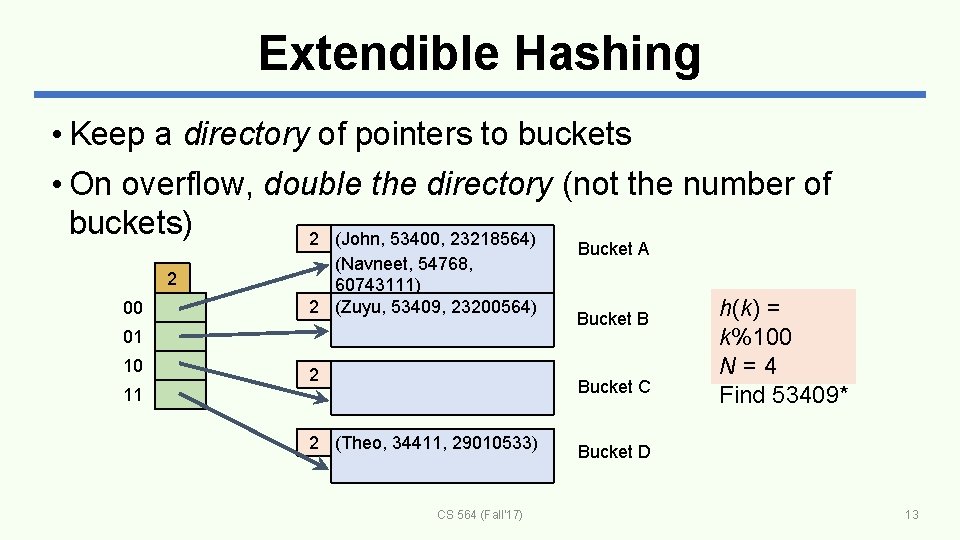
Extendible Hashing • Keep a directory of pointers to buckets • On overflow, double the directory (not the number of buckets) 2 (John, 53400, 23218564) 2 00 (Navneet, 54768, 60743111) 2 (Zuyu, 53409, 23200564) 01 10 2 Bucket A Bucket B Bucket C 11 2 (Theo, 34411, 29010533) CS 564 (Fall'17) h(k) = k%100 N=4 Find 53409* Bucket D 13
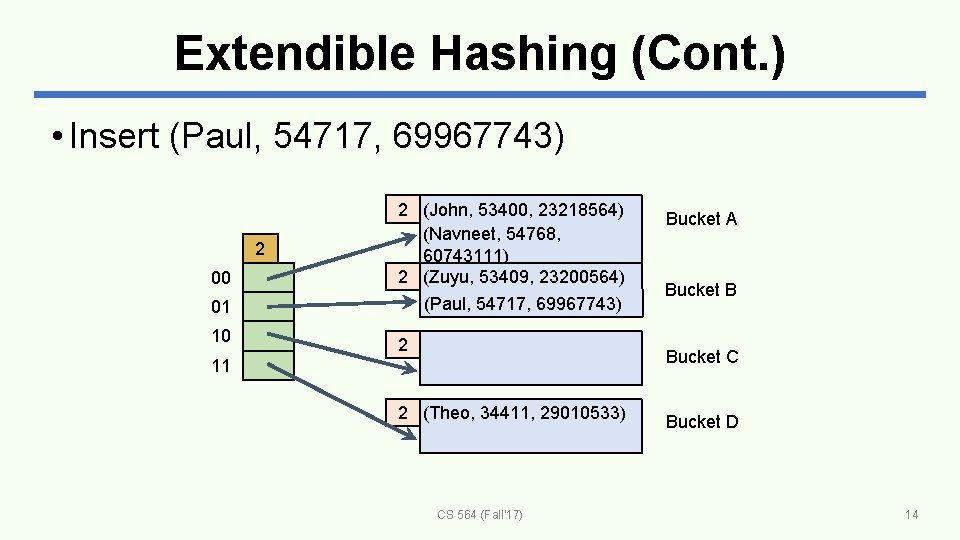
Extendible Hashing (Cont. ) • Insert (Paul, 54717, 69967743) 01 2 (John, 53400, 23218564) (Navneet, 54768, 60743111) 2 (Zuyu, 53409, 23200564) (Paul, 54717, 69967743) 10 2 2 00 Bucket A Bucket B Bucket C 11 2 (Theo, 34411, 29010533) CS 564 (Fall'17) Bucket D 14
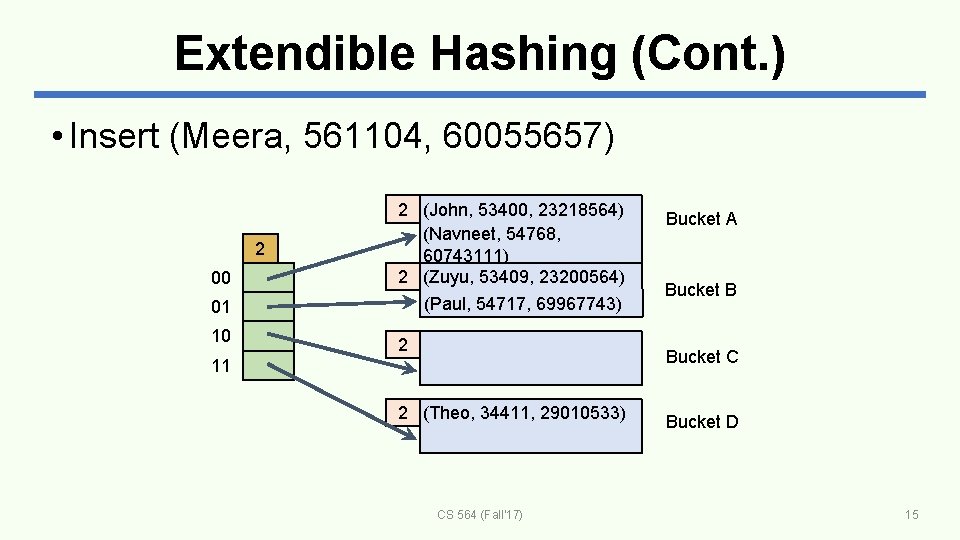
Extendible Hashing (Cont. ) • Insert (Meera, 561104, 60055657) 01 2 (John, 53400, 23218564) (Navneet, 54768, 60743111) 2 (Zuyu, 53409, 23200564) (Paul, 54717, 69967743) 10 2 2 00 Bucket A Bucket B Bucket C 11 2 (Theo, 34411, 29010533) CS 564 (Fall'17) Bucket D 15
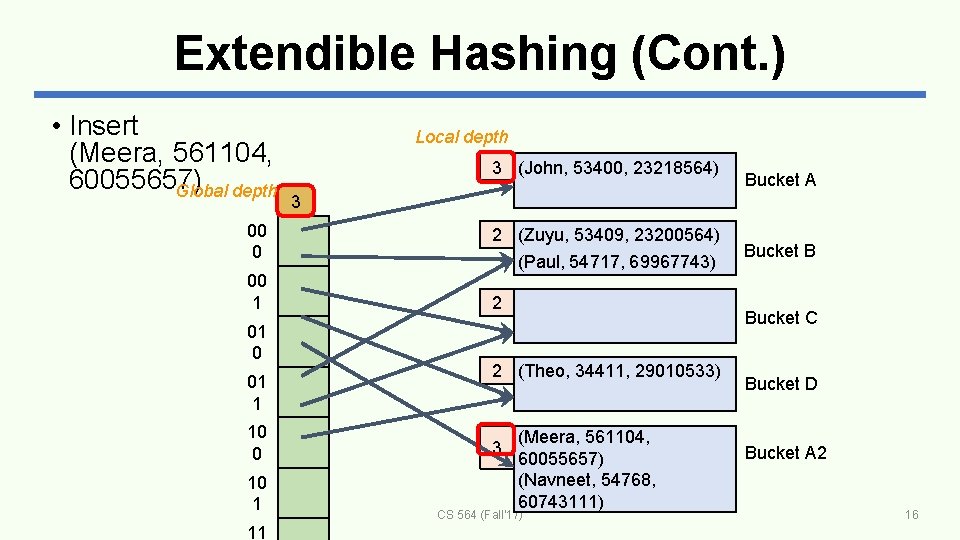
Extendible Hashing (Cont. ) • Insert (Meera, 561104, 60055657) Global depth 00 0 00 1 01 0 01 1 10 0 10 1 11 Local depth 3 (John, 53400, 23218564) Bucket A 3 2 (Zuyu, 53409, 23200564) (Paul, 54717, 69967743) 2 Bucket C 2 (Theo, 34411, 29010533) 3 Bucket B (Meera, 561104, 60055657) (Navneet, 54768, 60743111) CS 564 (Fall'17) Bucket D Bucket A 2 16
Pros and Cons of Extendible Hashing • Benefits: • Directory is much smaller than the entire index file • Only one page of data entries is split • Drawbacks: • Need overflow pages if we have key collision, i. e. , multiple data entries can have the same hash value CS 564 (Fall'17) 17
Operations on Extendible Hashing • Search • Apply hash function h(k) • Take last global depth # bits of h(k), … • Insert • Find the target bucket • If the bucket has space, insert, done! • If the bucket if full, split it, re-distribute • If necessary, double the directory CS 564 (Fall'17) 18
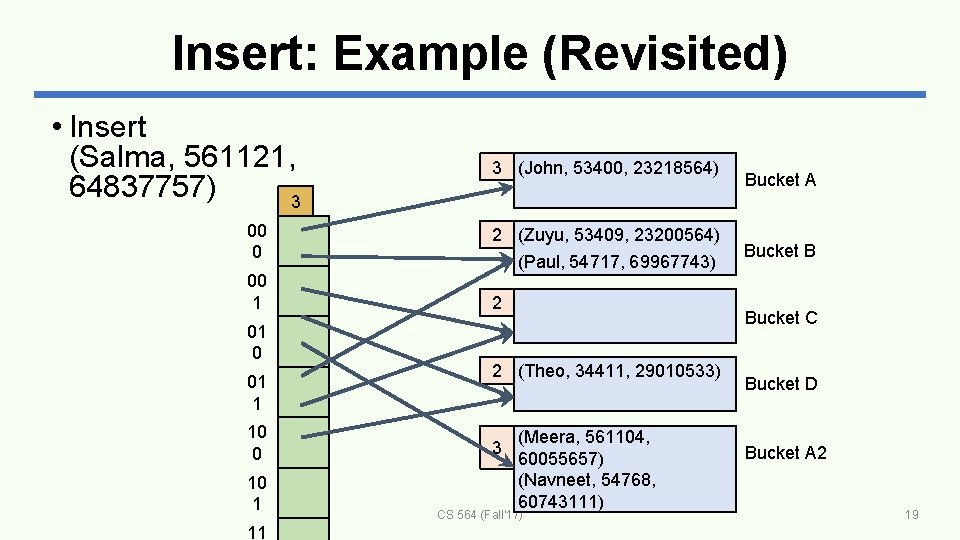
Insert: Example (Revisited) • Insert (Salma, 561121, 64837757) 3 00 0 00 1 01 0 01 1 10 0 10 1 11 3 (John, 53400, 23218564) 2 (Zuyu, 53409, 23200564) (Paul, 54717, 69967743) 2 Bucket B Bucket C 2 (Theo, 34411, 29010533) 3 Bucket A (Meera, 561104, 60055657) (Navneet, 54768, 60743111) CS 564 (Fall'17) Bucket D Bucket A 2 19
Operations on Extendible Hashing (Cont. ) • Delete • Locate the bucket of the record and remove it • If the bucket becomes empty, remove it (and update the directory) • Two buckets can also be coalesced together if the sum of the entries fit in a single bucket • Decreasing the size of the directory can also be done, but it is expensive CS 564 (Fall'17) 20
Operations on Extendible Hashing (Cont. ) • How many disk accesses for equality search? • One if directory fits in memory, else two • Directory grows in spurts • If the distribution of hash values is skewed, the directory can grow very large Can you think of an example where the directory suddenly grows? CS 564 (Fall'17) 21
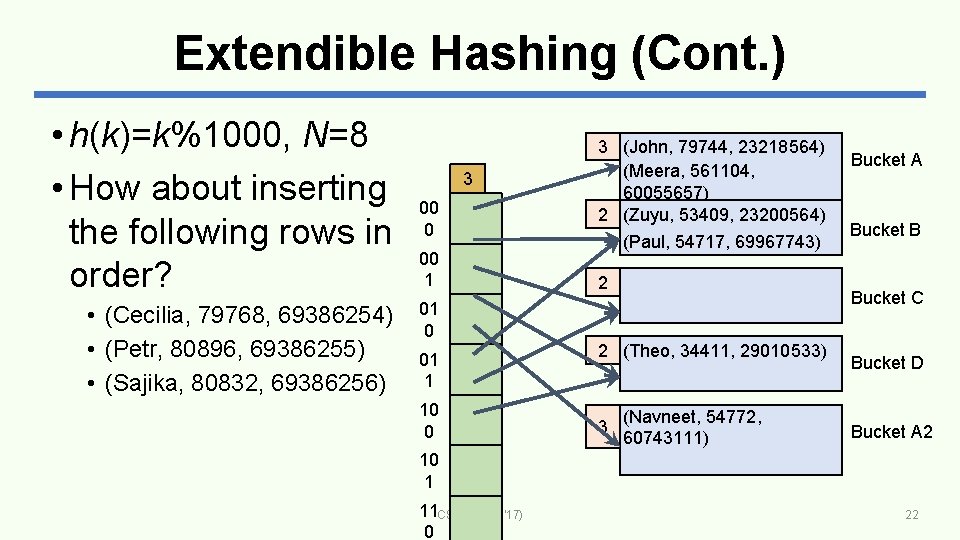
Extendible Hashing (Cont. ) • h(k)=k%1000, N=8 • How about inserting the following rows in order? • (Cecilia, 79768, 69386254) • (Petr, 80896, 69386255) • (Sajika, 80832, 69386256) 3 00 0 00 1 01 0 01 1 10 0 3 (John, 79744, 23218564) (Meera, 561104, 60055657) 2 (Zuyu, 53409, 23200564) (Paul, 54717, 69967743) 2 Bucket B Bucket C 2 (Theo, 34411, 29010533) 3 Bucket A (Navneet, 54772, 60743111) Bucket D Bucket A 2 10 1 11 CS 564 (Fall'17) 0 22
Recap • Hash indexes • Efficient equality search • Static hashing • Simple, limited • Dynamic hashing • Example: extendible hashing CS 564 (Fall'17) 23
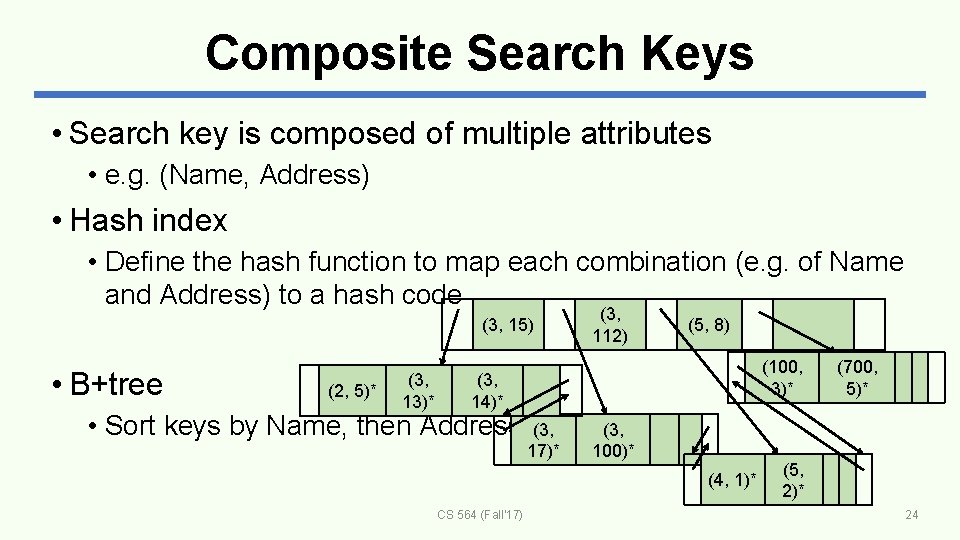
Composite Search Keys • Search key is composed of multiple attributes • e. g. (Name, Address) • Hash index • Define the hash function to map each combination (e. g. of Name and Address) to a hash code (3, 15) • B+tree (2, 5)* (3, 13)* (3, 112) (5, 8) (100, 3)* (3, 14)* • Sort keys by Name, then Address (3, 17)* (3, 100)* (4, 1)* CS 564 (Fall'17) (700, 5)* (5, 2)* 24
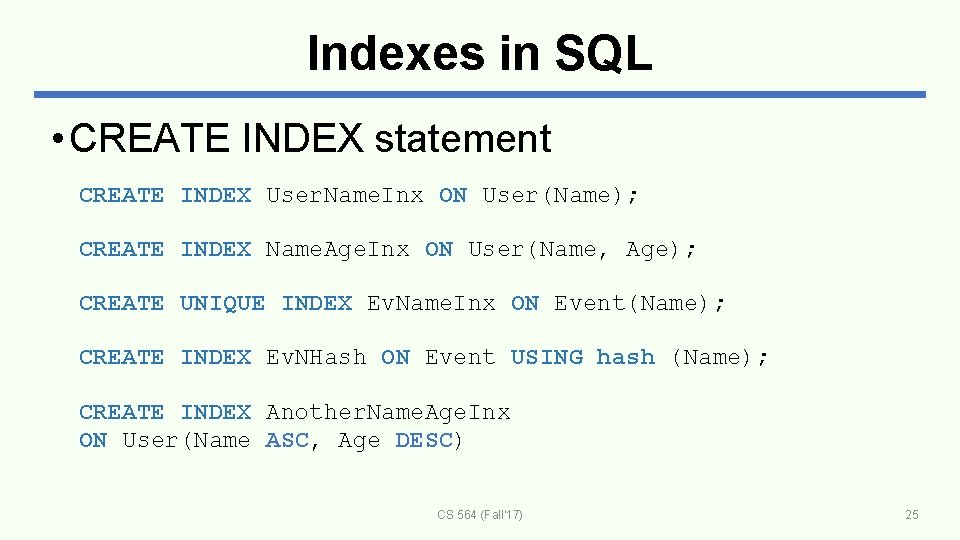
Indexes in SQL • CREATE INDEX statement CREATE INDEX User. Name. Inx ON User(Name); CREATE INDEX Name. Age. Inx ON User(Name, Age); CREATE UNIQUE INDEX Ev. Name. Inx ON Event(Name); CREATE INDEX Ev. NHash ON Event USING hash (Name); CREATE INDEX Another. Name. Age. Inx ON User(Name ASC, Age DESC) CS 564 (Fall'17) 25
Classification of Indexes • A table can have multiple indexes • Primary vs secondary • Clustered vs unclustered • Primary index: if the search key of the index contains the primary key of the table • Secondary index: any other index that is not a primary index • Unique index: if the search key contains a candidate key CS 564 (Fall'17) 26
Classification of Indexes (Cont. ) • Clustered index: if the order of records (in the data file) is the same or “close to” the order of data entries in the index • If k* is the actual record, then the index is clustered • A table can be clustered on at most one search key • Data retrieval cost varies significantly depending on whether or not the index/table is clustered CS 564 (Fall'17) 27
Next Up External Sorting Questions? CS 564 (Fall'17) 28
- Slides: 28