
Database Management Systems CS 564 Fall 2017 Lecture
Database Management Systems (CS 564) Fall 2017 Lecture 1
Introduction So you ask “why”? CS 564 (Fall'17) 2
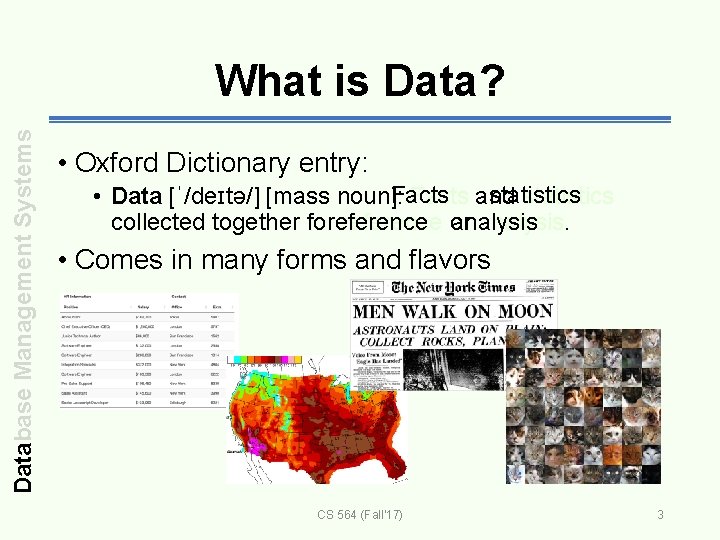
Database Management Systems What is Data? • Oxford Dictionary entry: statistics Facts • Data [ˈ/deɪtə/] [mass noun]: Facts and statistics collected together for reference or analysis. collected reference analysis • Comes in many forms and flavors CS 564 (Fall'17) 3
Database Management Systems Data is Important! “Data is the future. ” - Chris’ cab driver in Pittsburgh • It is everywhere: • Scientific discoveries • Online services (social networks, online retailers) • Decision making CS 564 (Fall'17) 4
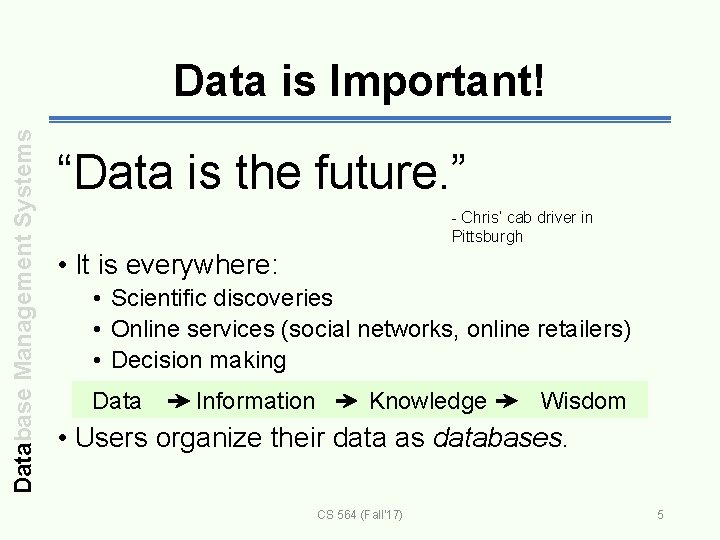
Database Management Systems Data is Important! “Data is the future. ” - Chris’ cab driver in Pittsburgh • It is everywhere: • Scientific discoveries • Online services (social networks, online retailers) • Decision making Data Information Knowledge Wisdom • Users organize their data as databases. CS 564 (Fall'17) 5
Database Management Systems Database • A logically coherent collection of related data, representing some aspect(s) of the real world • Designed, built, and populated with data • for a specific purpose • for an intended group of users and • for some preconceived applications in which these users are interested CS 564 (Fall'17) 6

Database Management Systems Sample Database Student SID 17 8 Name Smith Brown Age 21 24 Grade. Report Major CS MATH SID 17 17 8 8 Course CID CS 564 Name Database Management Systems MATH 240 Discrete Mathematics CS 367 Intro to Data Structures CS 764 Adv. Database Management Credits Department 3 CS 4 3 3 MATH CS CS Sec. ID 30098 40026 1005 40026 20006 30098 Prerequisite CID Section Sec. ID 30098 40026 1005 30451 20006 CID MATH 240 CS 367 CS 764 CS 564 Semester Fall Spring Year 2017 2016 2004 2017 2001 Instructor Euclid Dijkstra Gauss Patel Codd Grade A AB A C A B CS 564 CS 764 CS 564 Prereq. ID CS 367 CS 564 MATH 240 Users: students, staff, HR Applications: My. UW, Payroll CS 564 (Fall'17) 7
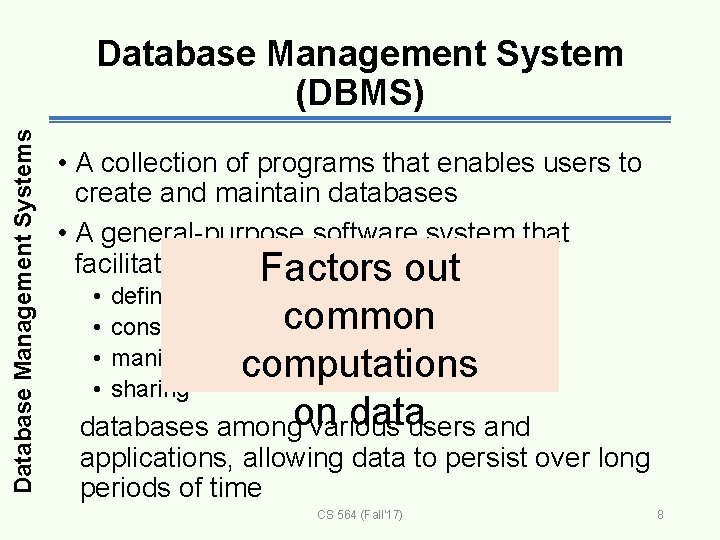
Database Management Systems Database Management System (DBMS) • A collection of programs that enables users to create and maintain databases • A general-purpose software system that facilitates the processes of Factors out • • defining constructing manipulating, and sharing common computations on databases among various users and applications, allowing data to persist over long periods of time CS 564 (Fall'17) 8
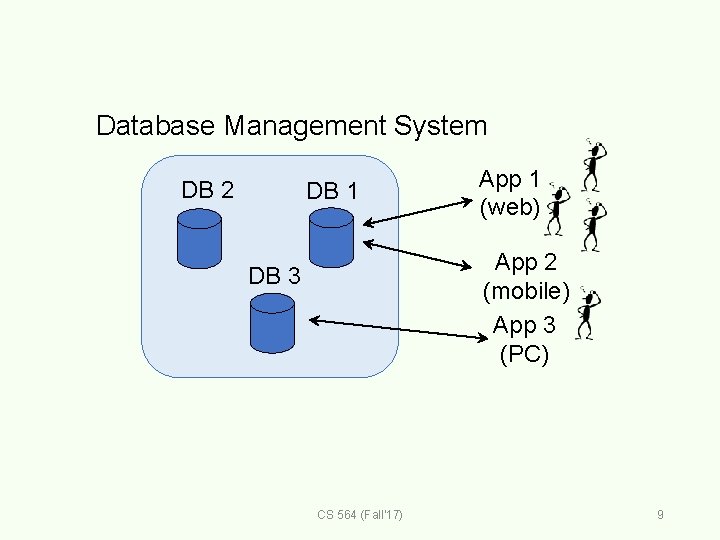
Database Management System DB 2 DB 1 App 1 (web) App 2 (mobile) App 3 (PC) DB 3 CS 564 (Fall'17) 9
Examples of DBMSs • SQL Server, Microsoft Access (Microsoft) • DB 2 (IBM) • Oracle • My. SQL, Postgre. SQL, SQLite CS 564 (Fall'17) 10
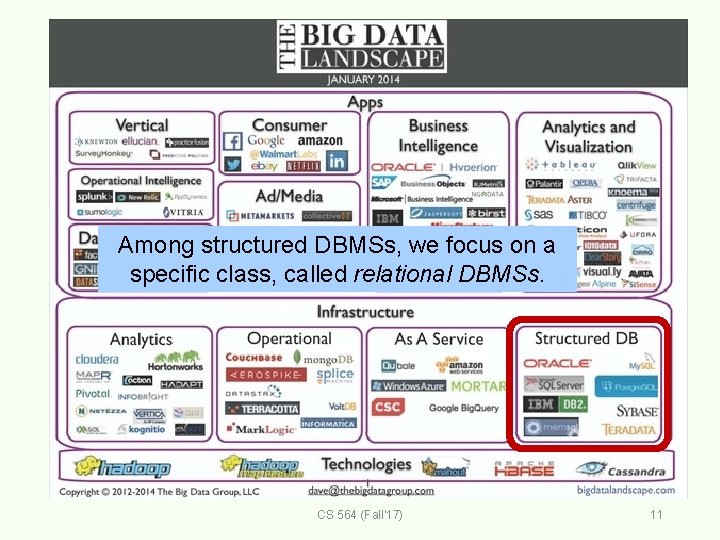
Among structured DBMSs, we focus on a specific class, called relational DBMSs. CS 564 (Fall'17) 11
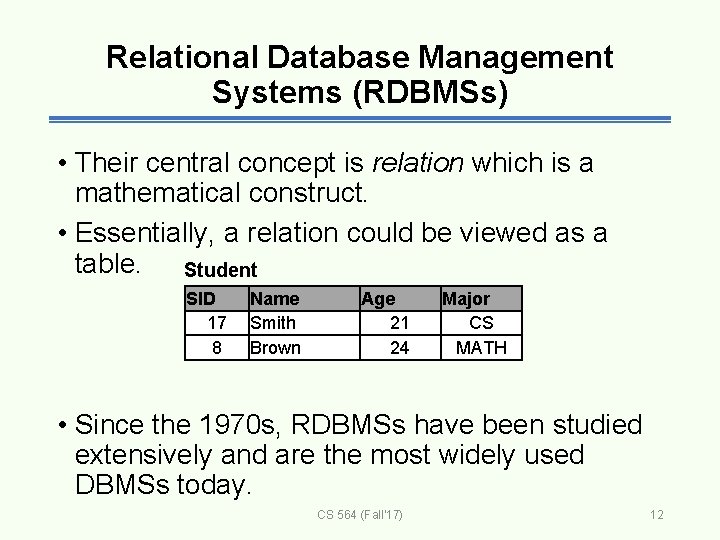
Relational Database Management Systems (RDBMSs) • Their central concept is relation which is a mathematical construct. • Essentially, a relation could be viewed as a table. Student SID 17 8 Name Smith Brown Age 21 24 Major CS MATH • Since the 1970 s, RDBMSs have been studied extensively and are the most widely used DBMSs today. CS 564 (Fall'17) 12
This Class • We will learn • • how to design a relational database how to store it in an RDBMS how to use an RDBMS some of the internals of RDBMSs • We will NOT cover • gory details on how a DBMS works (take CS 764!) • newer types of data and how to manage them (take CS 774!) • theory behind databases (take CS 784!) • how to be a DBA or how to tune Oracle 12 g CS 564 (Fall'17) 13
Course Logistics Or how to thrive in this noble effort CS 564 (Fall'17) 14
Course Prerequisites • Data structures and algorithm background necessary • CS 367 is a must • For the projects • Programming-heavy • C++ will be used for the database internals CS 564 (Fall'17) 15
Course Format • Lectures: Wed + Fri, 2: 30 -3: 45 PM • Slides will be posted on the course web site (https: //adelaneh. github. io/cs 564_fall 17) • Acknowledging great notes of An. Hai Doan, Paris Koutris, Christopher Re and Arun Kumar • Project: groups of three people • Multiple stages, submit some work at the end of each stage, might have a final demo • Exams: midterm and final CS 564 (Fall'17) 16
Course Staff • Lecturer: Adel Ardalan (adel@cs. wisc. edu) • Office hours • Time: Mon 2: 30 -3: 30 PM and Wed 4: 00 -5: 00 PM • Place: my office (room 4351, CS building) • TAs: • Nafisah Islam (nafisah@cs. wisc. edu) • Office hours: see course website • Varun Naik (vnaik@wisc. edu) • Office hours: see course website CS 564 (Fall'17) 17
About Me • Education • Undergrad: University of Tehran, Iran • Grad: UW-Madison • Research interests • Data integration, cleaning and analytics • Computational methods in healthcare, neuroscience and climatology • http: //cs. wisc. edu/~adel CS 564 (Fall'17) 18

CS 564 (Fall'17) 19
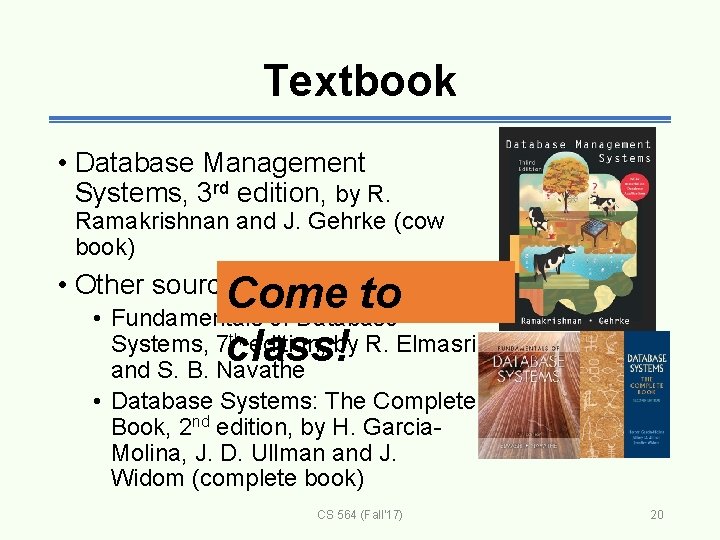
Textbook • Database Management Systems, 3 rd edition, by R. Ramakrishnan and J. Gehrke (cow book) • Other sources Come to • Fundamentals of Database Systems, 7 class! edition, by R. Elmasri and S. B. Navathe th • Database Systems: The Complete Book, 2 nd edition, by H. Garcia. Molina, J. D. Ullman and J. Widom (complete book) CS 564 (Fall'17) 20
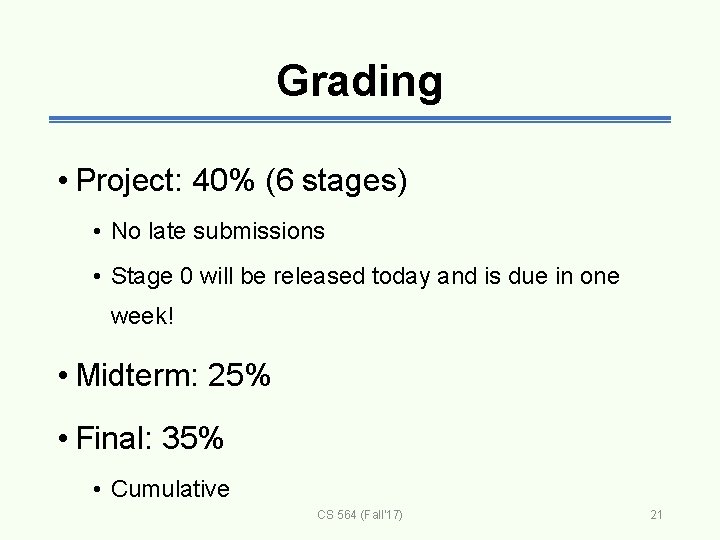
Grading • Project: 40% (6 stages) • No late submissions • Stage 0 will be released today and is due in one week! • Midterm: 25% • Final: 35% • Cumulative CS 564 (Fall'17) 21
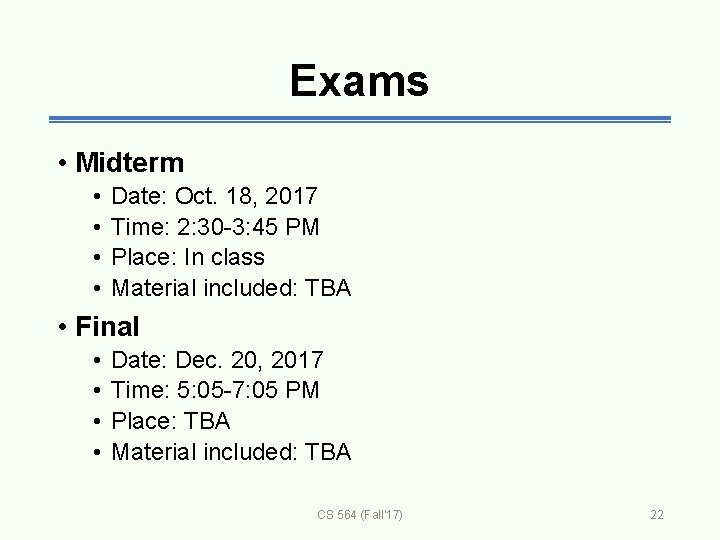
Exams • Midterm • • Date: Oct. 18, 2017 Time: 2: 30 -3: 45 PM Place: In class Material included: TBA • Final • • Date: Dec. 20, 2017 Time: 5: 05 -7: 05 PM Place: TBA Material included: TBA CS 564 (Fall'17) 22
Communication • Course web site • https: //adelaneh. github. io/cs 564_fall 17 • All the logistics information, lecture slides, up-todate announcements and deadlines, and more! • Check the web site at least once a week! • Mailing list • compsci 564 -2 -f 17@lists. wisc. edu • Piazza • Find “CS 564 -002: Database Management Systems” • Canvas • To submit project work CS 564 (Fall'17) 23
Communication (Cont. ) • Participate in class discussions and use the Piazza page • Do not use email as primary communication mechanism for doubts/questions; instead post on Piazza or come to office hours • If you definitely have to email, then use “[CS 564]” as subject prefix for all emails to me/TAs • Rein in your social media activities during lectures CS 564 (Fall'17) 24
Policy on Asking Questions • There are no stupid/trivial/unimportant questions! • So 1. Raise your hand ask questions in class 2. If you are still confused or not convinced, then study the material and ask again, from your classmates, TAs or me (in that order) on Piazza 3. If still not there, read additional material and ask for references. There are very resourceful and knowledgeable faculty and grad students in this department and around the globe! • Do NOT give up! CS 564 (Fall'17) 25
Code of Academic Conduct • Your responsibility to read it and oblige by it • https: //docs. legis. wisconsin. gov/code/admin_code/u ws/14. pdf • Alright, now back to the fun stuff! CS 564 (Fall'17) 26
Course Overview Decades of research and development on fast-forward CS 564 (Fall'17) 27
Why Databases? • Example application: sort a list of 1000 numbers • e. g. 25, 3, 4, 1, 90, 2334, -1, 2, 3, … • Simple solution: • Write a program to sort a list of numbers and store the program in a file (e. g. in Python) • Store the list of 1000 numbers (i. e. the data) in another file • Load the program and the data into memory • Run the program on the data Basically using file systems for data management CS 564 (Fall'17) 28
Why Databases? (Cont. ) • But what if: • we want to sort a billion numbers? • many users want to sort the same list of numbers? • some users should not see the numbers other users sort? • Databases and our questions about them are often more complicated than a list of numbers and simple sorting • DBMSs take care of the above issues and many more CS 564 (Fall'17) 29
What Can a DBMS Do? (Abbr. ) • Storage management • Schema management • Query and update data • Concurrency control • Crash recovery CS 564 (Fall'17) 30
Storage Management • Data outlives applications. What? !! • Persistent data: data stored for a long period of time • On tape, HDD or SSD • Large amounts of data (100 s of GB or TB) • Manages the storage hierarchy (e. g. disk/RAM/cache) • User authorization • Who can access which data? • Protection from system crashes CS 564 (Fall'17) 31
How to Describe Data • Data model: a collection of concepts for describing data • Relational data model is the most widely used today • Main concepts: relation, tuple, attribute, domain • Schema: a description of a particular collection of data, using the given data model • e. g. every relation in a relational data model has a schema describing types, etc. CS 564 (Fall'17) 32
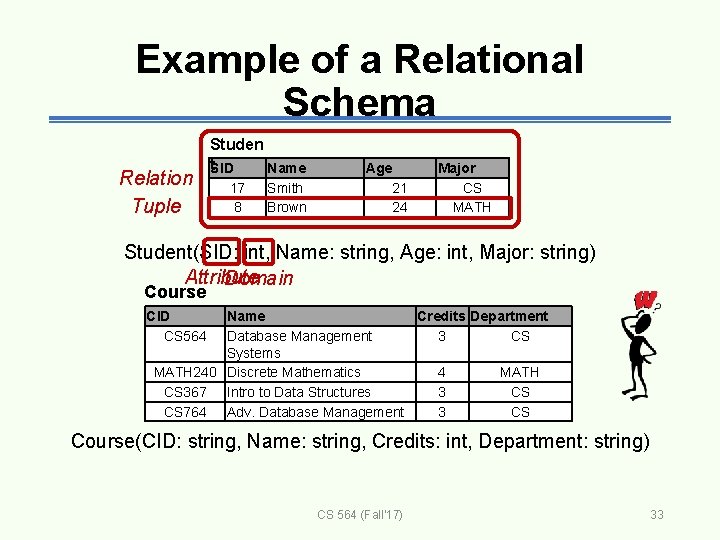
Example of a Relational Schema Relation Tuple Studen t. SID Name 17 8 Smith Brown Age 21 24 Major CS MATH Student(SID: int, Name: string, Age: int, Major: string) Attribute Domain Course CID CS 564 Name Credits Department Database Management 3 CS Systems MATH 240 Discrete Mathematics 4 MATH CS 367 Intro to Data Structures 3 CS CS 764 Adv. Database Management 3 CS Course(CID: string, Name: string, Credits: int, Department: string) CS 564 (Fall'17) 33
Schema Management • Describing the data by defining relations, etc. • Changing the schema • e. g. need to add Date. Of. Birth to the Student table CS 564 (Fall'17) 34
Data Independence • One of the most important reasons to use DBMSs • Applications do not change when the underlying structure or storage changes • Physical data independence: protection from physical layout changes • e. g. moving the data from disk to SSD • Logical data independence: protection from changes in the logical structure of the data • e. g. adding a new attribute to a table CS 564 (Fall'17) 35
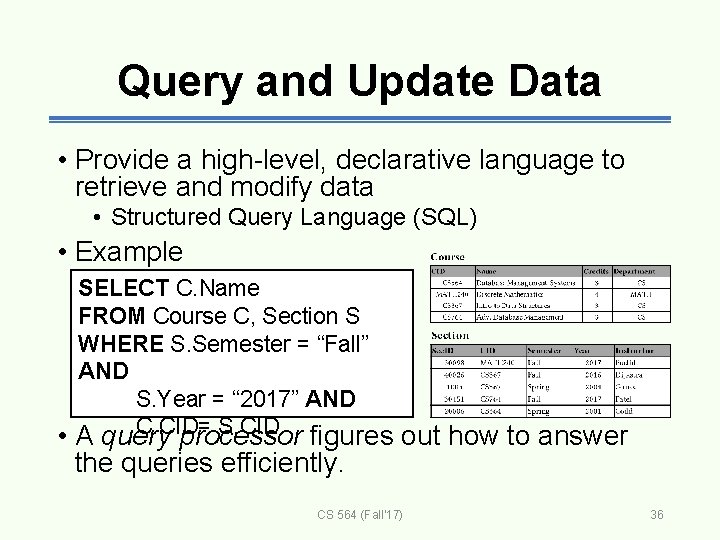
Query and Update Data • Provide a high-level, declarative language to retrieve and modify data • Structured Query Language (SQL) • Example • SELECT C. Name FROM Course C, Section S WHERE S. Semester = “Fall” AND S. Year = “ 2017” AND C. CID= S. CID A query processor figures out how to answer the queries efficiently. CS 564 (Fall'17) 36
Query Processor • Has two essential components: • Query optimizer: finds the best imperative execution plan for a given query • Query executor: executes the query execution plan as efficiently as possible CS 564 (Fall'17) 37
Concurrency Control • Suppose 1000 s of students and staff want to query and update the data at the same time • Concurrency can lead to update problems • e. g. a TA enters the wrong grade and before he or she corrects it, the student reads the grade and freaks out! • DBMSs use transaction and enforce ACID properties. • • Atomicity: all or nothing transactions Consistency: from one valid state to another Isolation: transactions are independent Durability: committed data is never lost CS 564 (Fall'17) 38
Crash Recovery • How do we make sure no data is lost after the system has crashed? • e. g. disk failure or power failure • DBMSs use mechanisms such as logging and checkpoints. CS 564 (Fall'17) 39
DBMSs Rock! • Automate a lot of boring operations on data • Don’t have to program over and over • Can write complex data manipulations in just a few lines • Make execution very fast • Scales up to very large data sets • Make concurrent access/modification possible • Many users can use the data at the same time CS 564 (Fall'17) 40
Who is Involved? • DB application developer: writes programs that query and modify data • DB designer: establishes schema • DB administrator: loads data, tunes system, keeps the system running • Data analyst: does data mining, data integration • DBMS implementer: builds the DBMS CS 564 (Fall'17) 41
Recommended Read • Chapter 1 of the complete book CS 564 (Fall'17) 42
Next Up Entity-Relationship Model for Conceptual Design Questions? CS 564 (Fall'17) 43
- Slides: 43