
Database Design Why do we need it Agree
Database Design • Why do we need it? – Agree on structure of the database before deciding on a particular implementation. • Consider issues such as: – What entities to model – How entities are related – What constraints exist in the domain – How to achieve good designs
Database Design Formalisms • Object Definition Language (ODL): – Closer in spirit to object-oriented models • Entity/Relationship model (E/R): – More relational in nature. • Both can be translated (semi-automatically) to relational schemas (with varying amount of pain). • ODL to OO-schema: direct transformation (C++ or Smalltalk based system).
Object Definition Language • Is part of ODMG, which also gave us OQL. • Resembles C++ (and Smalltalk). • Basic design paradigm in ODL: – Model objects and their properties. • For abstraction purposes: – Group objects into classes. • What qualifies as a good class? – Objects should have common properties.
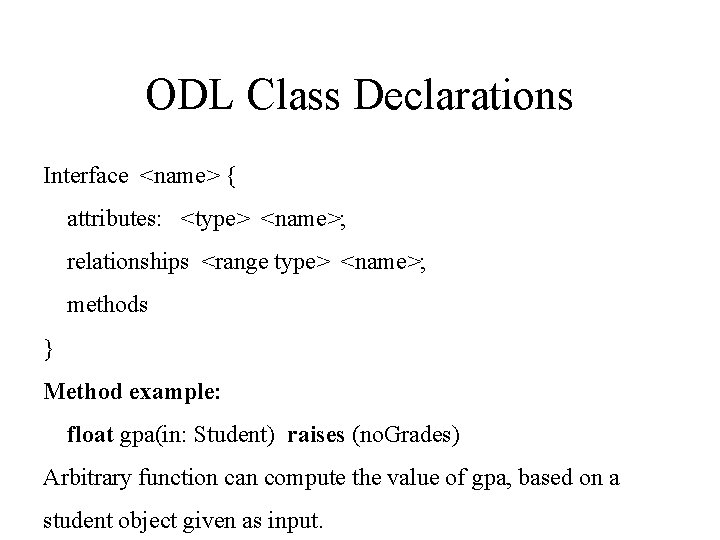
ODL Class Declarations Interface <name> { attributes: <type> <name>; relationships <range type> <name>; methods } Method example: float gpa(in: Student) raises (no. Grades) Arbitrary function can compute the value of gpa, based on a student object given as input.
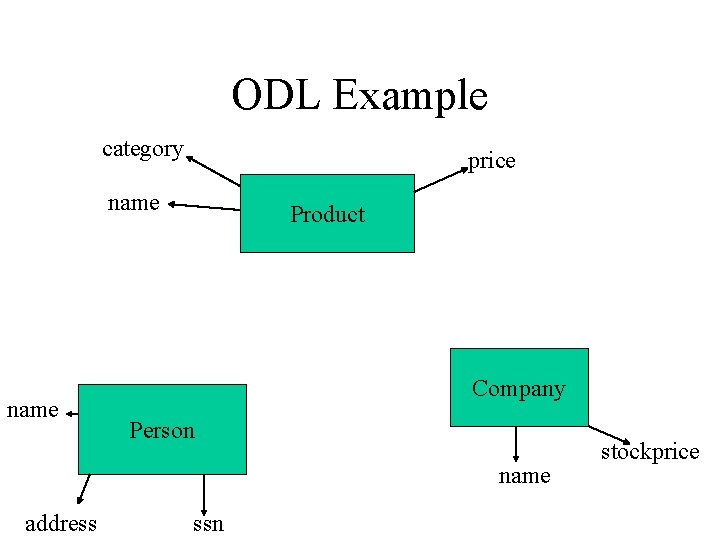
ODL Example category price name Product Company Person name address ssn stockprice

ODL Declarations Interface Product { attribute string name; attribute float price; attribute enum Categories {electronics, communications, sports …} category } Interface Company { attribute string name; attribute float stockprice; } Interface Person { attribute integer ssn; attribute string name; attribute Struct Address {string street, string city} address; }
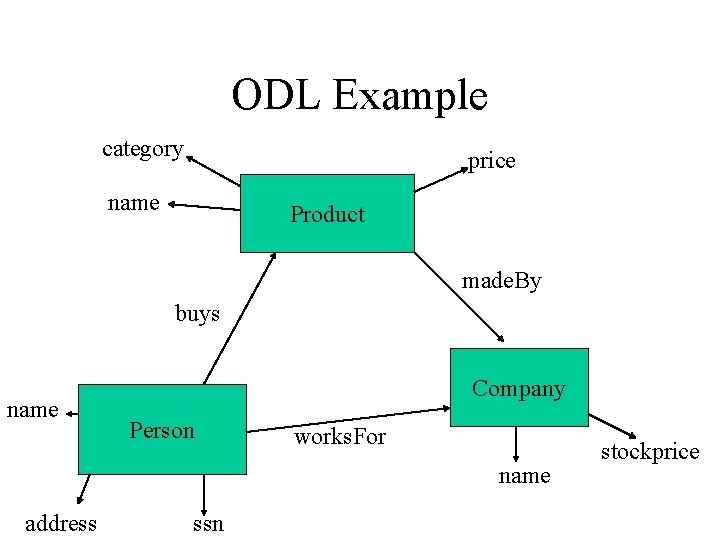
ODL Example category price name Product made. By buys name Company Person works. For name address ssn stockprice
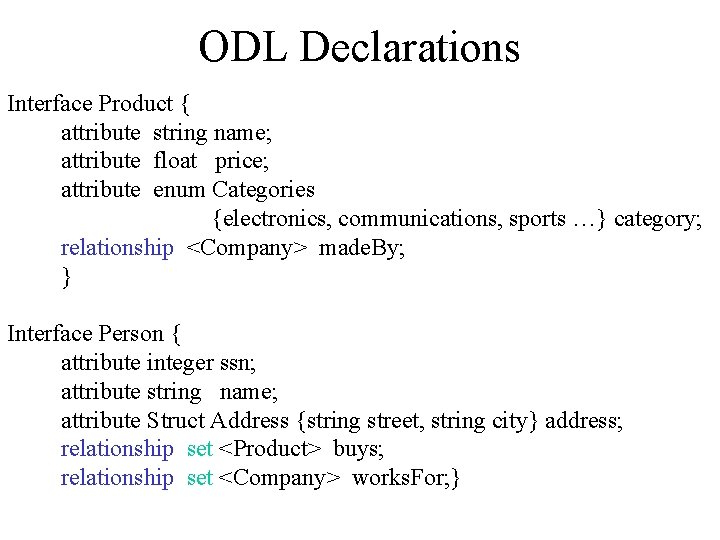
ODL Declarations Interface Product { attribute string name; attribute float price; attribute enum Categories {electronics, communications, sports …} category; relationship <Company> made. By; } Interface Person { attribute integer ssn; attribute string name; attribute Struct Address {string street, string city} address; relationship set <Product> buys; relationship set <Company> works. For; }
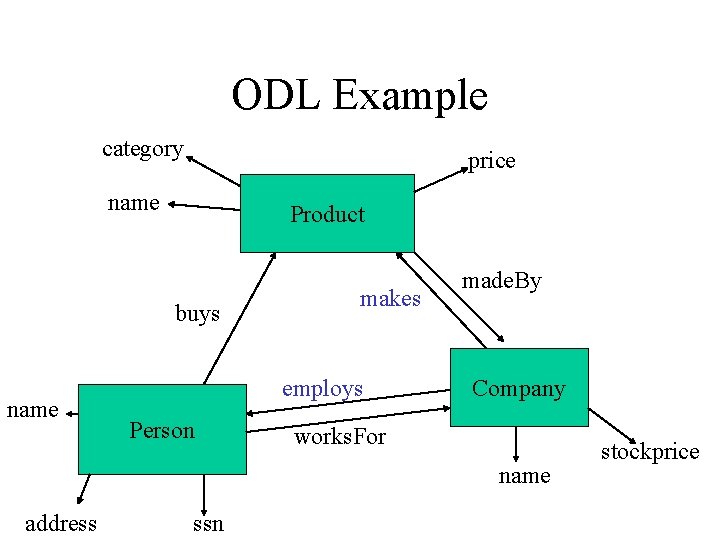
ODL Example category price name Product buys name makes employs Person made. By Company works. For name address ssn stockprice
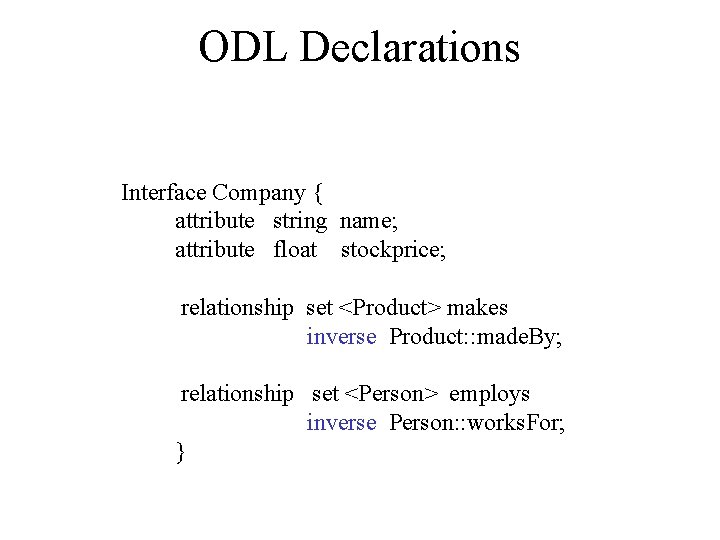
ODL Declarations Interface Company { attribute string name; attribute float stockprice; relationship set <Product> makes inverse Product: : made. By; relationship set <Person> employs inverse Person: : works. For; }
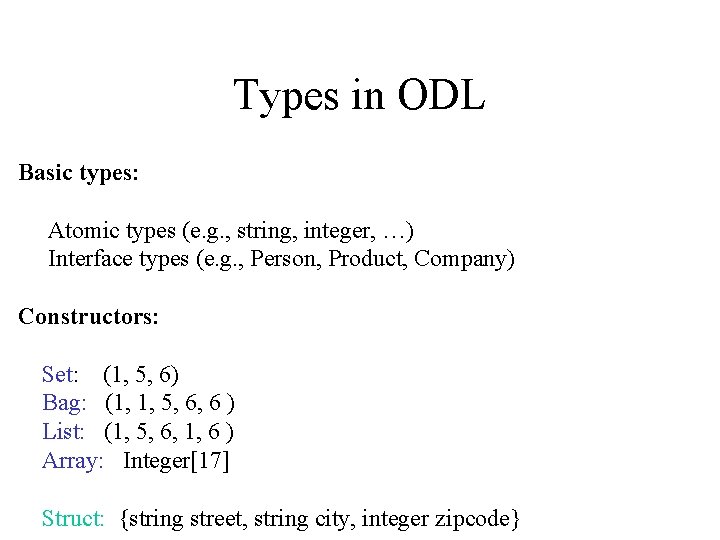
Types in ODL Basic types: Atomic types (e. g. , string, integer, …) Interface types (e. g. , Person, Product, Company) Constructors: Set: (1, 5, 6) Bag: (1, 1, 5, 6, 6 ) List: (1, 5, 6, 1, 6 ) Array: Integer[17] Struct: {string street, string city, integer zipcode}
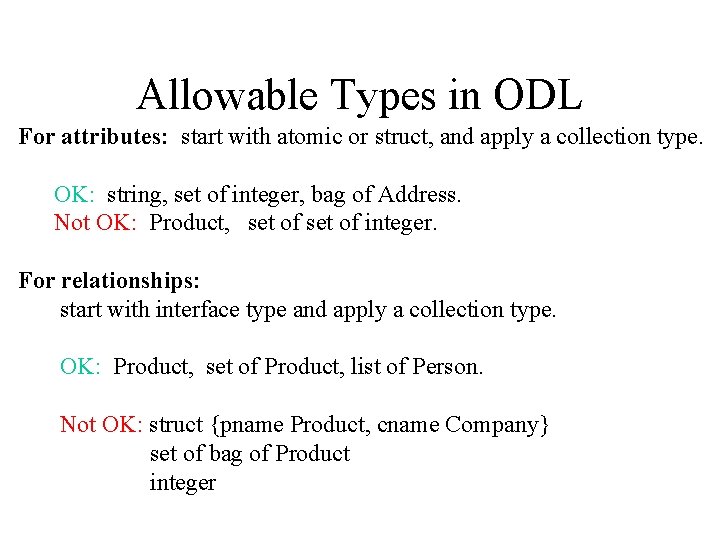
Allowable Types in ODL For attributes: start with atomic or struct, and apply a collection type. OK: string, set of integer, bag of Address. Not OK: Product, set of integer. For relationships: start with interface type and apply a collection type. OK: Product, set of Product, list of Person. Not OK: struct {pname Product, cname Company} set of bag of Product integer
- Slides: 12