
Database Design Sept 27 2000 Outline ODL Object
Database Design Sept. 27, 2000

Outline • ODL - Object Definition Language (2. 1) • E/R - Entity relationship diagrams (2. 2) • Design Principles (2. 3)
Database Design • Why do we need it? – Agree on structure of the database before deciding on a particular implementation. • Consider issues such as: – What entities to model – How entities are related – What constraints exist in the domain – How to achieve good designs

Database Design Formalisms 1. Object Definition Language (ODL): – Closer in spirit to object-oriented models 2. Entity/Relationship model (E/R): – More relational in nature. • Both can be translated (semi-automatically) to relational schemas • ODL to OO-schema: direct transformation (C++ or Smalltalk based system).
1. Object Definition Language • ODL is part of ODMG • superset of Corba’s IDL • Resembles C++ (and Smalltalk).
• Basic design paradigm in ODL: – Model objects and their properties. • For abstraction purposes: – Group objects into classes. • What qualifies as a good class? – Objects should have common properties.
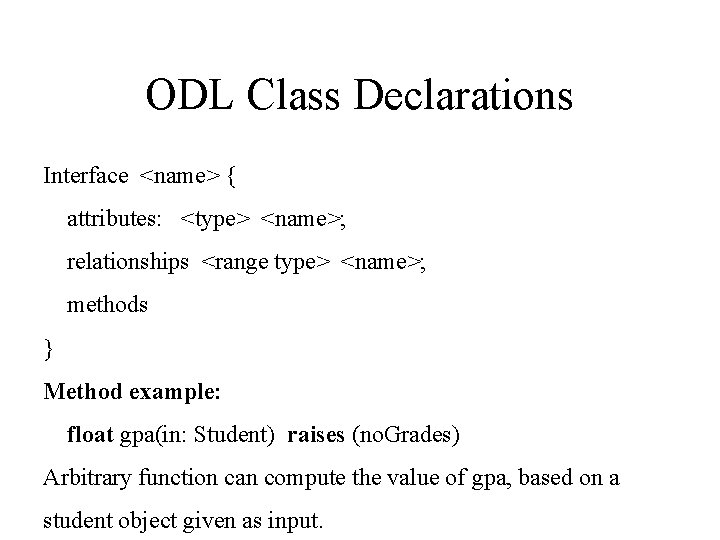
ODL Class Declarations Interface <name> { attributes: <type> <name>; relationships <range type> <name>; methods } Method example: float gpa(in: Student) raises (no. Grades) Arbitrary function can compute the value of gpa, based on a student object given as input.
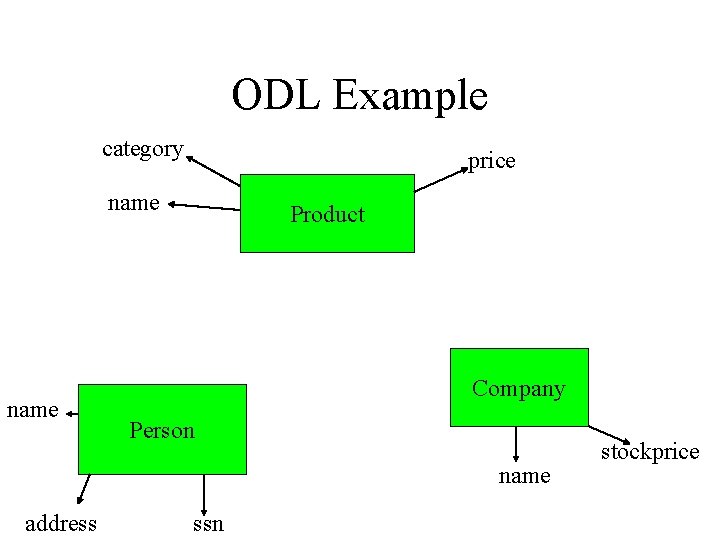
ODL Example category price name Product Company Person name address ssn stockprice
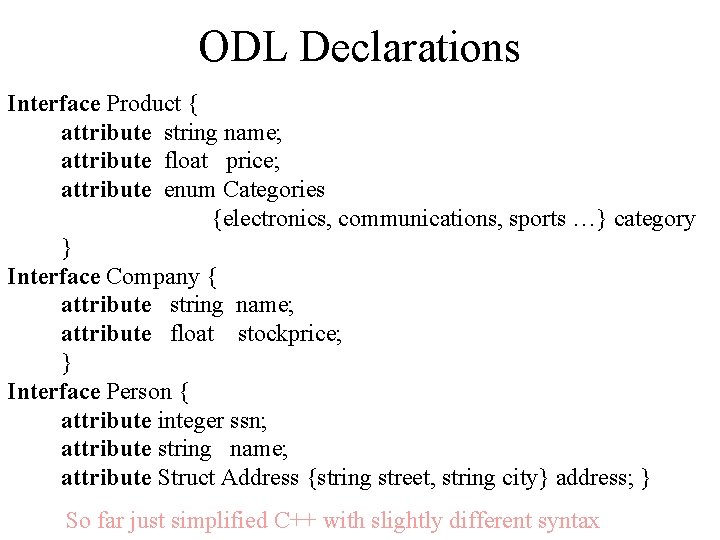
ODL Declarations Interface Product { attribute string name; attribute float price; attribute enum Categories {electronics, communications, sports …} category } Interface Company { attribute string name; attribute float stockprice; } Interface Person { attribute integer ssn; attribute string name; attribute Struct Address {string street, string city} address; } So far just simplified C++ with slightly different syntax
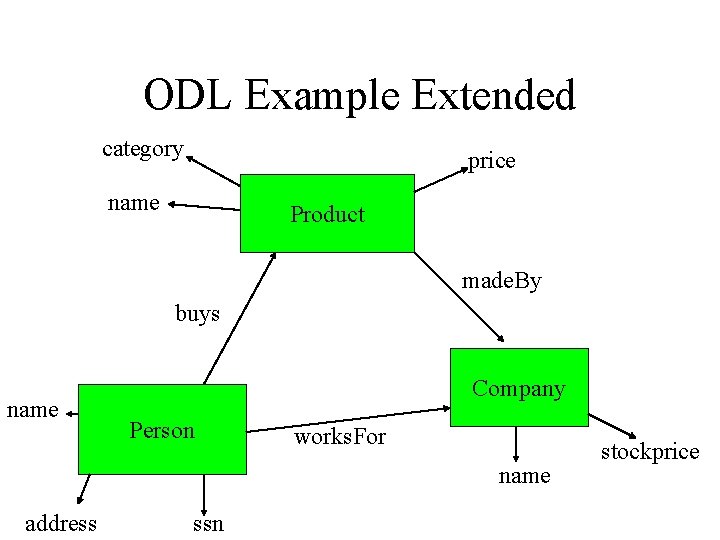
ODL Example Extended category price name Product made. By buys name Company Person works. For name address ssn stockprice
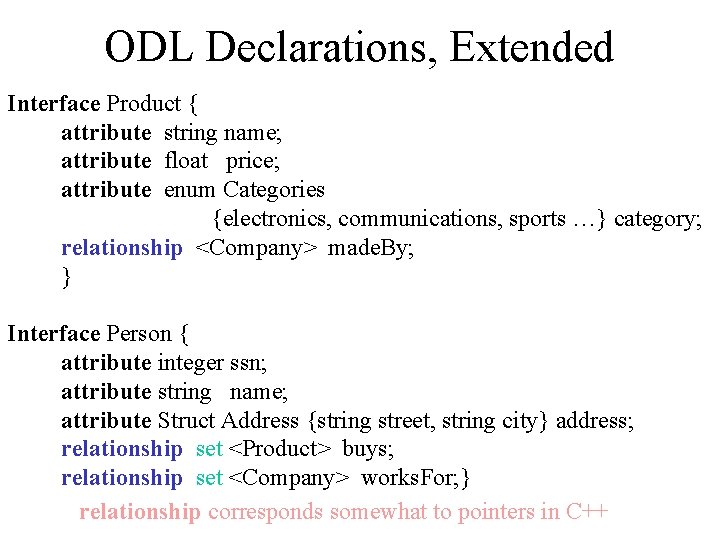
ODL Declarations, Extended Interface Product { attribute string name; attribute float price; attribute enum Categories {electronics, communications, sports …} category; relationship <Company> made. By; } Interface Person { attribute integer ssn; attribute string name; attribute Struct Address {string street, string city} address; relationship set <Product> buys; relationship set <Company> works. For; } relationship corresponds somewhat to pointers in C++
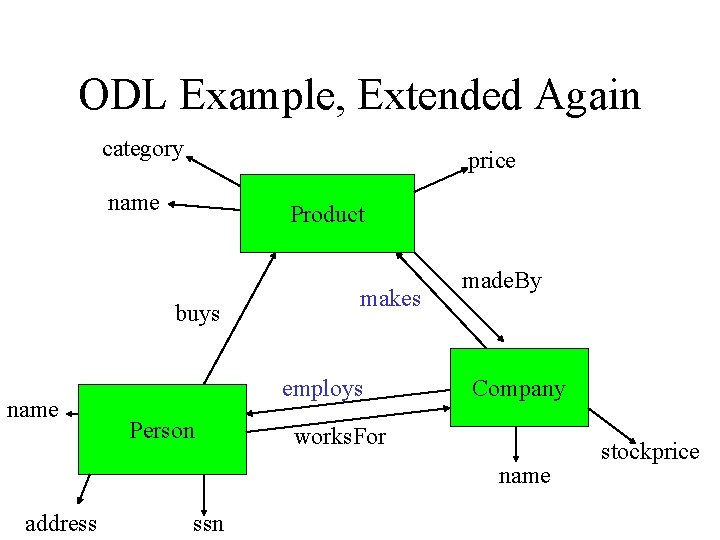
ODL Example, Extended Again category price name Product buys name makes employs Person made. By Company works. For name address ssn stockprice
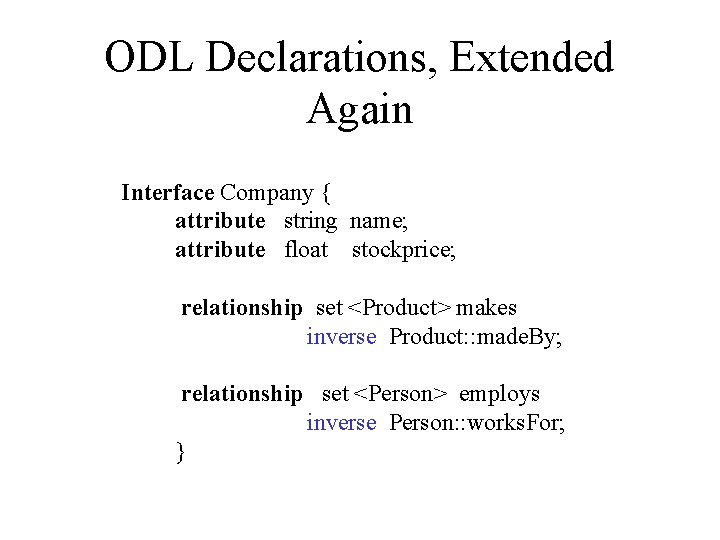
ODL Declarations, Extended Again Interface Company { attribute string name; attribute float stockprice; relationship set <Product> makes inverse Product: : made. By; relationship set <Person> employs inverse Person: : works. For; }
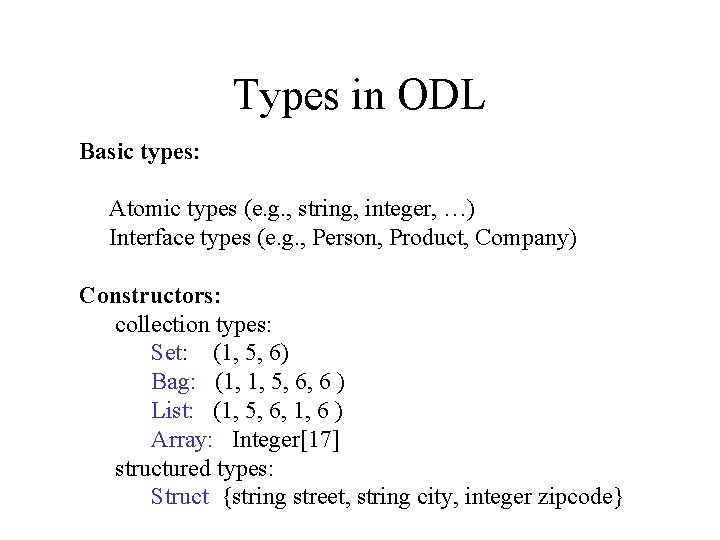
Types in ODL Basic types: Atomic types (e. g. , string, integer, …) Interface types (e. g. , Person, Product, Company) Constructors: collection types: Set: (1, 5, 6) Bag: (1, 1, 5, 6, 6 ) List: (1, 5, 6, 1, 6 ) Array: Integer[17] structured types: Struct {string street, string city, integer zipcode}
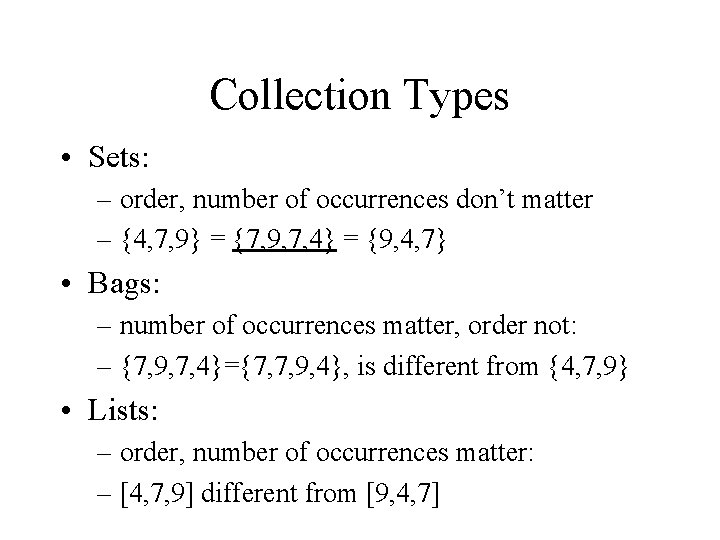
Collection Types • Sets: – order, number of occurrences don’t matter – {4, 7, 9} = {7, 9, 7, 4} = {9, 4, 7} • Bags: – number of occurrences matter, order not: – {7, 9, 7, 4}={7, 7, 9, 4}, is different from {4, 7, 9} • Lists: – order, number of occurrences matter: – [4, 7, 9] different from [9, 4, 7]
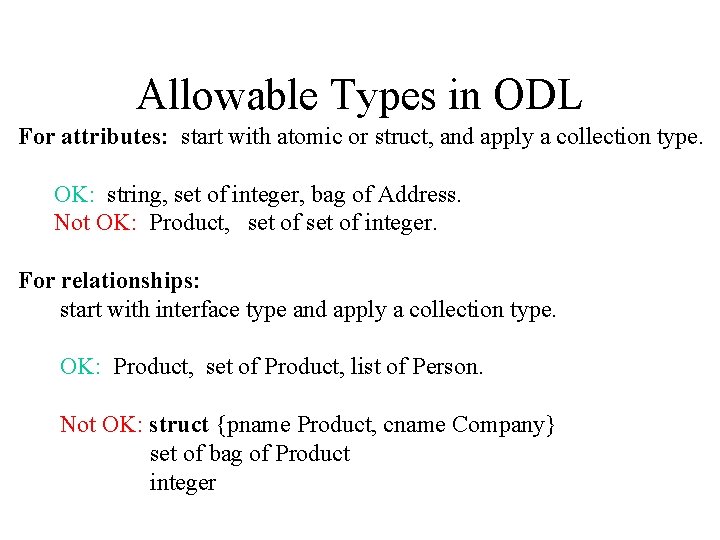
Allowable Types in ODL For attributes: start with atomic or struct, and apply a collection type. OK: string, set of integer, bag of Address. Not OK: Product, set of integer. For relationships: start with interface type and apply a collection type. OK: Product, set of Product, list of Person. Not OK: struct {pname Product, cname Company} set of bag of Product integer
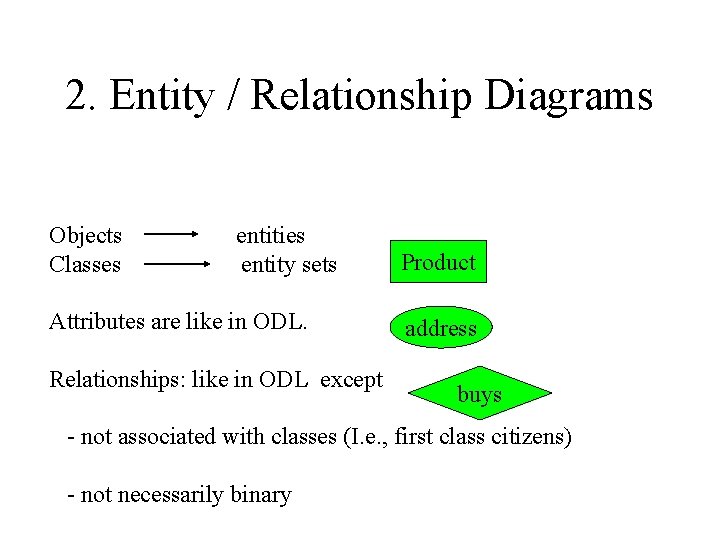
2. Entity / Relationship Diagrams Objects Classes entities entity sets Attributes are like in ODL. Relationships: like in ODL except Product address buys - not associated with classes (I. e. , first class citizens) - not necessarily binary
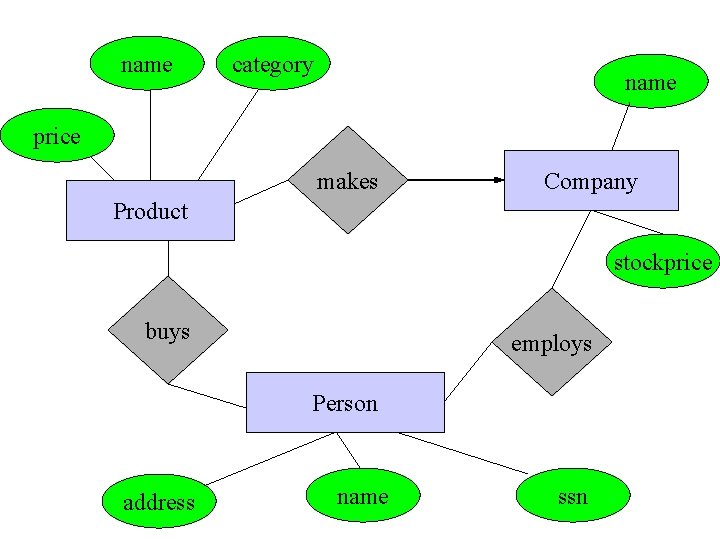
name category name price makes Company Product stockprice buys employs Person address name ssn
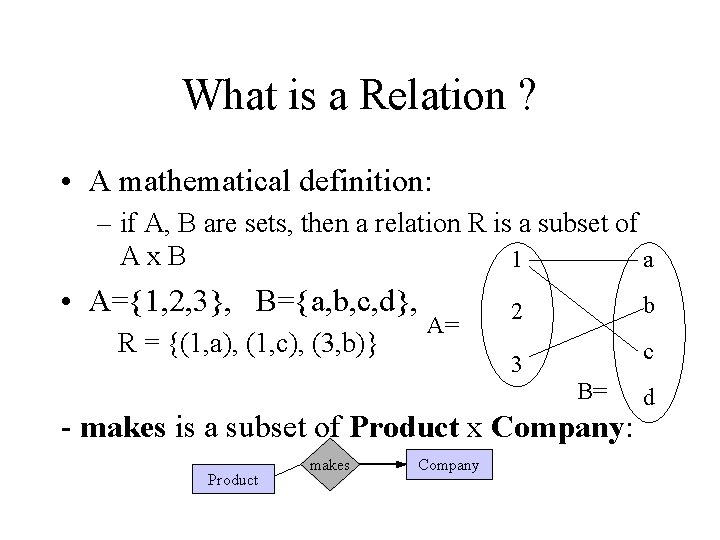
What is a Relation ? • A mathematical definition: – if A, B are sets, then a relation R is a subset of Ax. B 1 a • A={1, 2, 3}, B={a, b, c, d}, R = {(1, a), (1, c), (3, b)} A= b 2 c 3 B= - makes is a subset of Product x Company: Product makes Company d
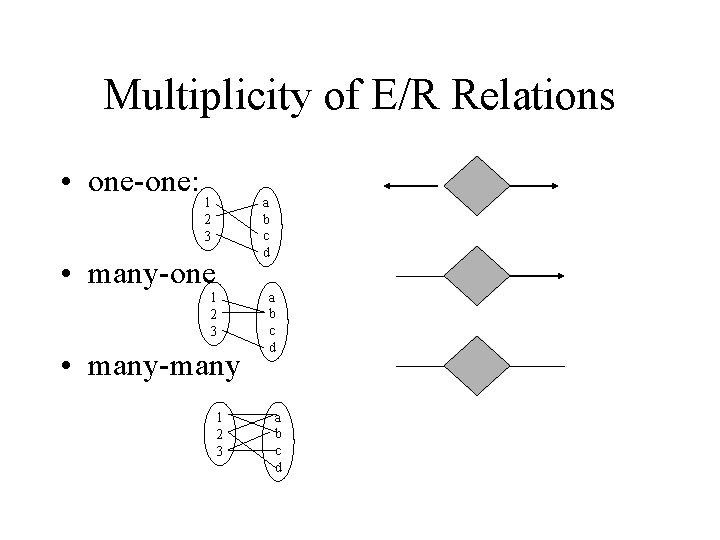
Multiplicity of E/R Relations • one-one: a b c d 1 2 3 • many-one 1 2 3 • many-many 1 2 3 a b c d
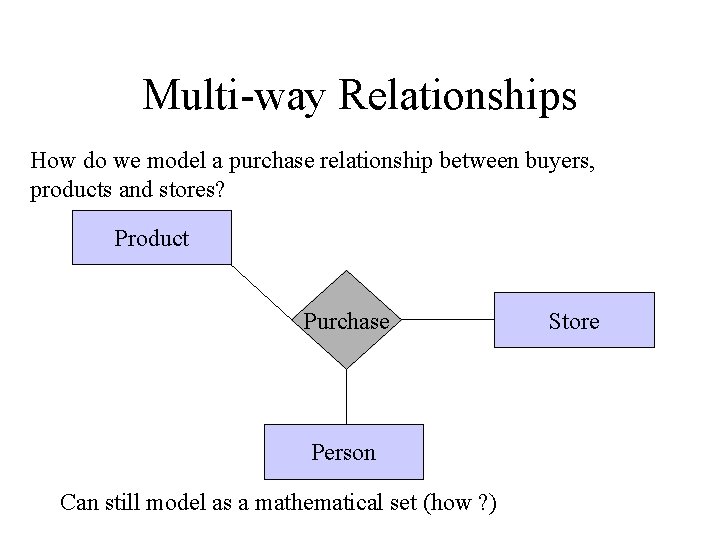
Multi-way Relationships How do we model a purchase relationship between buyers, products and stores? Product Purchase Person Can still model as a mathematical set (how ? ) Store
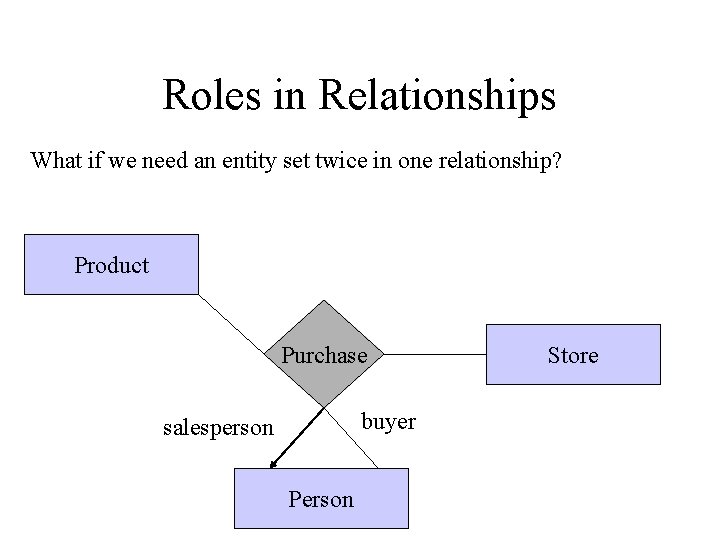
Roles in Relationships What if we need an entity set twice in one relationship? Product Purchase buyer salesperson Person Store
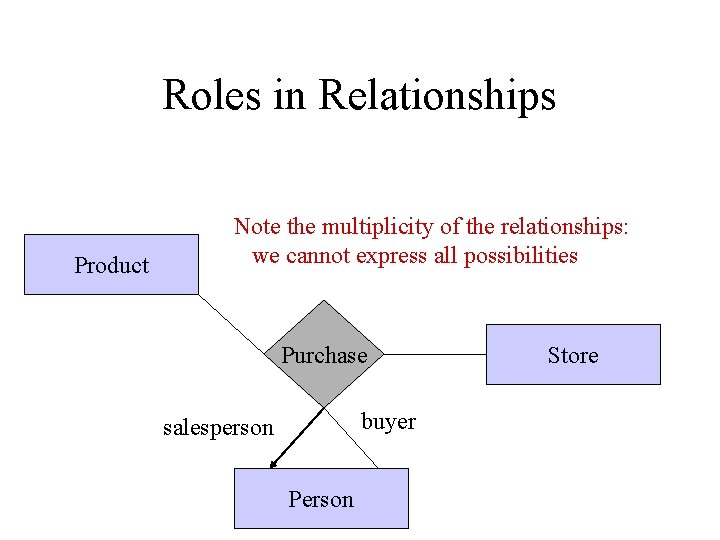
Roles in Relationships Product Note the multiplicity of the relationships: we cannot express all possibilities Purchase buyer salesperson Person Store
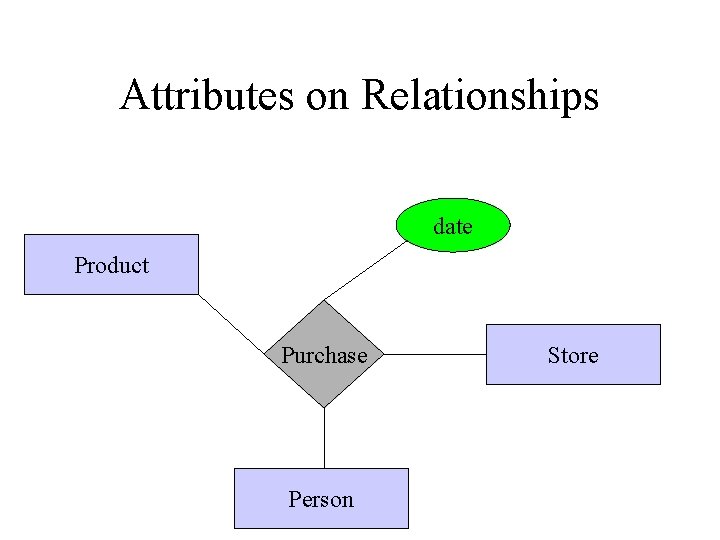
Attributes on Relationships date Product Purchase Person Store
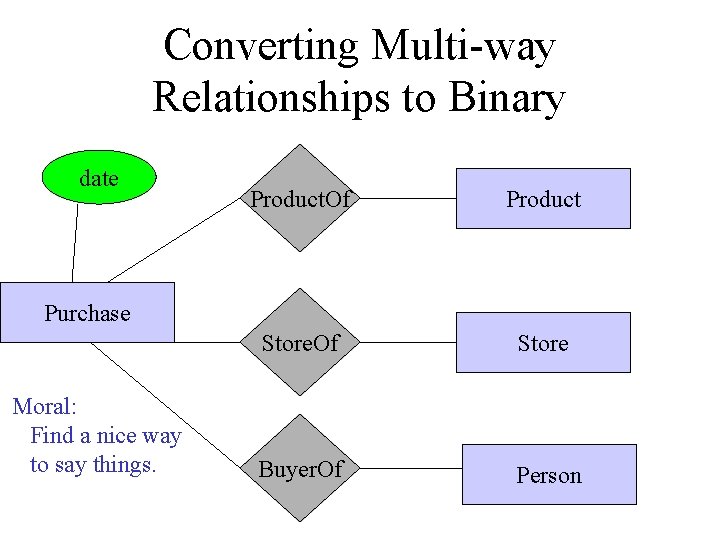
Converting Multi-way Relationships to Binary date Product. Of Product Store. Of Store Buyer. Of Person Purchase Moral: Find a nice way to say things.
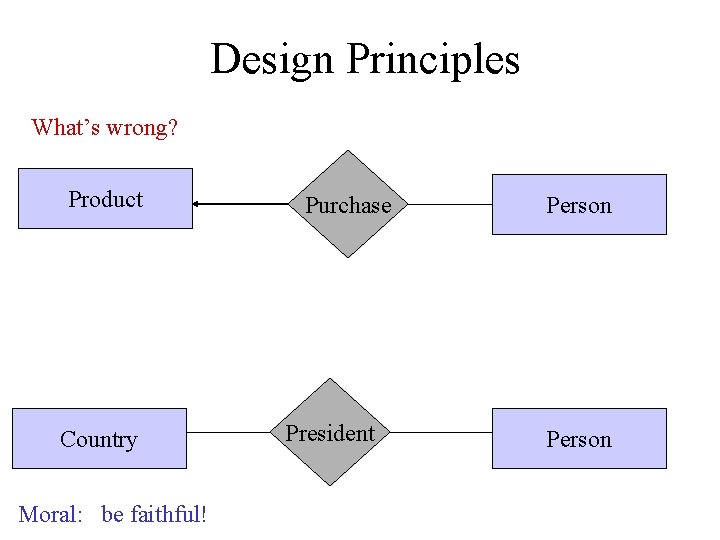
Design Principles What’s wrong? Product Country Moral: be faithful! Purchase President Person
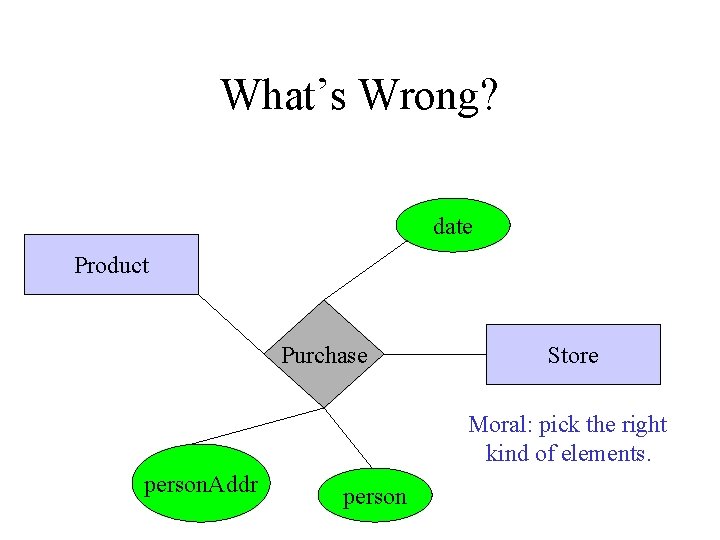
What’s Wrong? date Product Purchase Store Moral: pick the right kind of elements. person. Addr person
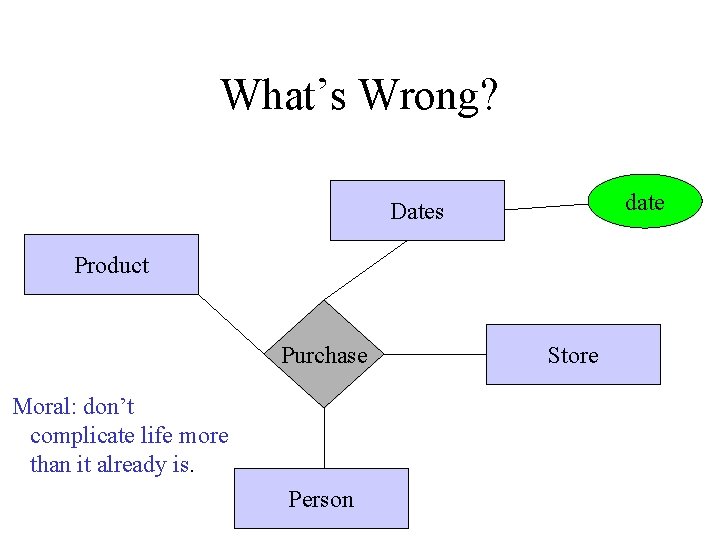
What’s Wrong? date Dates Product Purchase Moral: don’t complicate life more than it already is. Person Store
- Slides: 28