
Database Design Normalization and Access DB Creation University
Database Design: Normalization and Access DB Creation University of California, Berkeley School of Information Management and Systems SIMS 257: Database Management IS 257 – Spring 2004. 02. 05 - SLIDE 1
Lecture Outline • Review – Database Design -- Object-Oriented Modeling • Logical Design for the Diveshop database • Normalization • Access Database Creation IS 257 – Spring 2004. 02. 05 - SLIDE 2

Lecture Outline • Review – Database Design -- Object-Oriented Modeling • Logical Design for the Diveshop database • Normalization • Access Database Creation IS 257 – Spring 2004. 02. 05 - SLIDE 3

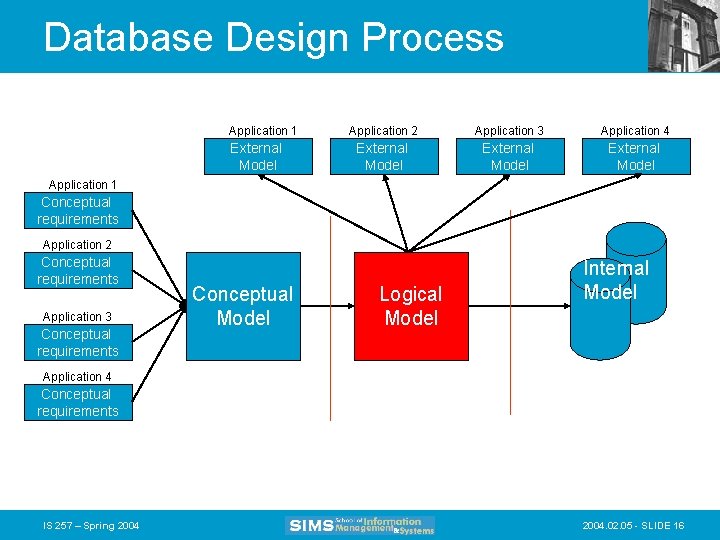
Database Design Process Application 1 External Model Application 2 Application 3 Application 4 External Model Application 1 Conceptual requirements Application 2 Conceptual requirements Application 3 Conceptual requirements Conceptual Model Logical Model Internal Model Application 4 Conceptual requirements IS 257 – Spring 2004. 02. 05 - SLIDE 4
Object-Oriented Modeling • Becoming increasingly important as – Object-Oriented and Object-Relational DBMS continue to proliferate – Databases become more complex and have more complex relationships than are easily captured in ER or EER diagrams • (Most UML examples based on Mc. Fadden, “Modern Database Management”, 5 th edition) IS 257 – Spring 2004. 02. 05 - SLIDE 5
Class Diagrams • A class diagram is a diagram that shows a set of classes, interfaces, and/or collaborations and the relationships among these elements. IS 257 – Spring 2004. 02. 05 - SLIDE 6
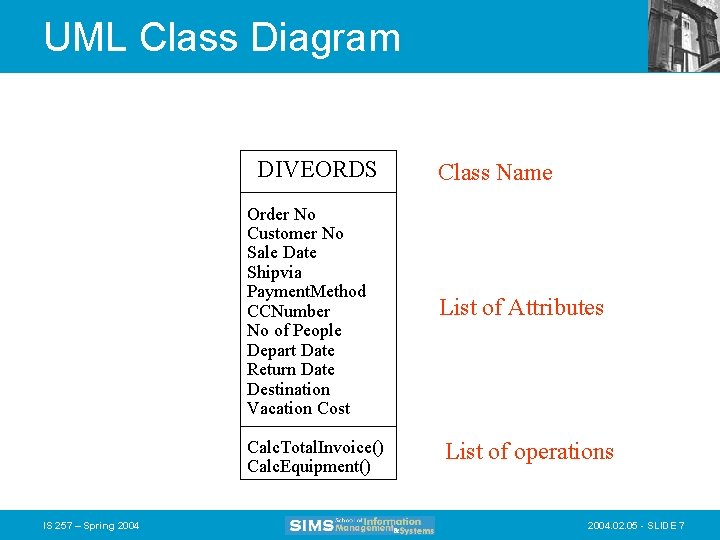
UML Class Diagram DIVEORDS Order No Customer No Sale Date Shipvia Payment. Method CCNumber No of People Depart Date Return Date Destination Vacation Cost Calc. Total. Invoice() Calc. Equipment() IS 257 – Spring 2004 Class Name List of Attributes List of operations 2004. 02. 05 - SLIDE 7
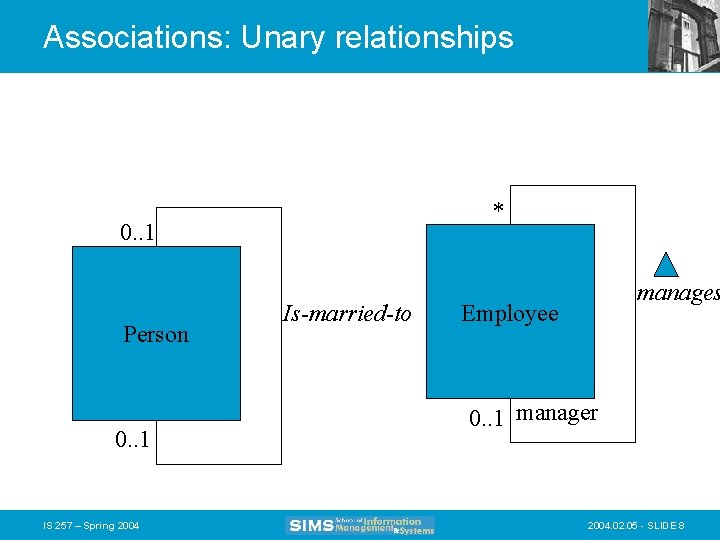
Associations: Unary relationships * 0. . 1 Person 0. . 1 IS 257 – Spring 2004 Is-married-to manages Employee 0. . 1 manager 2004. 02. 05 - SLIDE 8
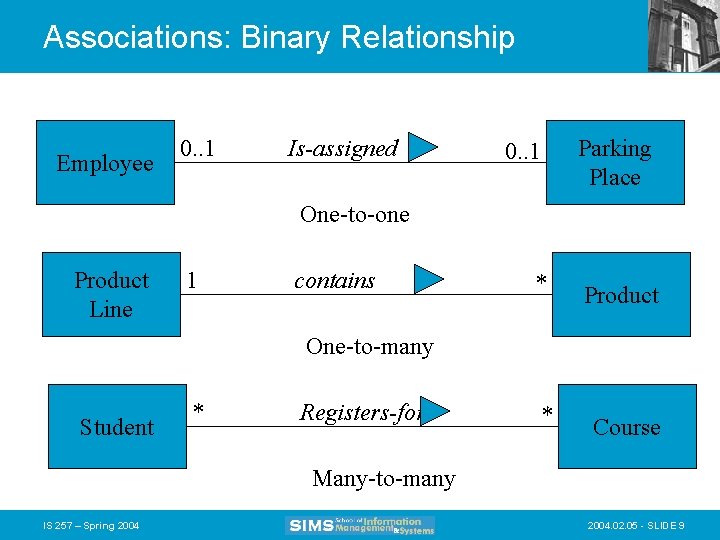
Associations: Binary Relationship Employee 0. . 1 Is-assigned Parking Place 0. . 1 One-to-one Product Line 1 contains * Product One-to-many Student * Registers-for * Course Many-to-many IS 257 – Spring 2004. 02. 05 - SLIDE 9
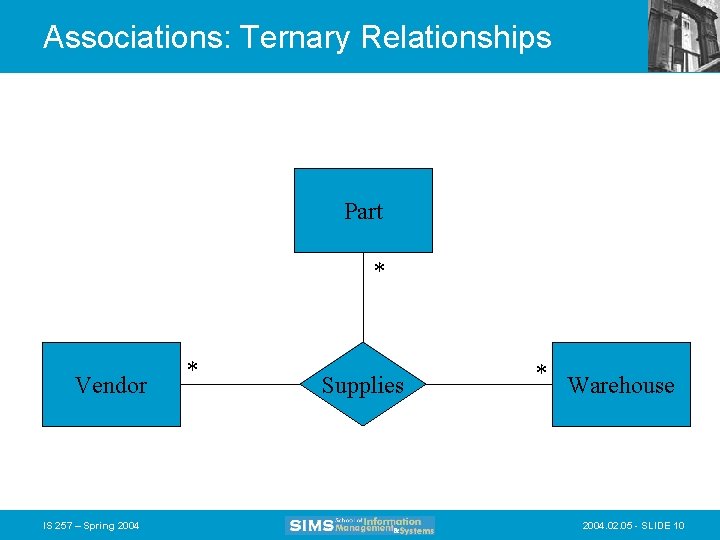
Associations: Ternary Relationships Part * Vendor IS 257 – Spring 2004 * Supplies * Warehouse 2004. 02. 05 - SLIDE 10
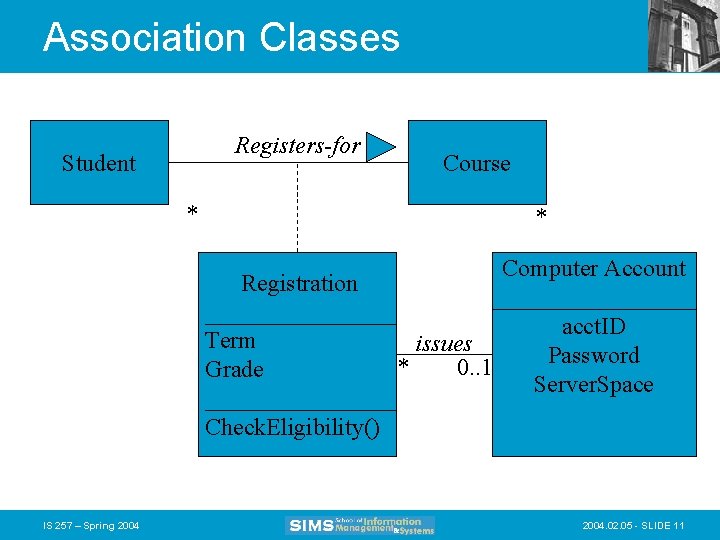
Association Classes Registers-for Student * Course * Computer Account Registration _________ acct. ID Term issues Password * 0. . 1 Grade Server. Space ________ Check. Eligibility() IS 257 – Spring 2004. 02. 05 - SLIDE 11
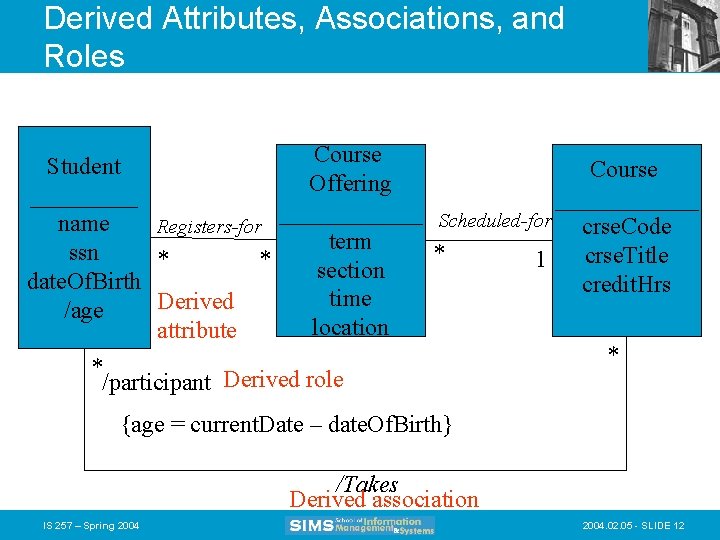
Derived Attributes, Associations, and Roles Course Student Course Offering ____________ Scheduled-for name Registers-for crse. Code term ssn * crse. Title * * 1 section date. Of. Birth credit. Hrs time Derived /age location attribute * * /participant Derived role {age = current. Date – date. Of. Birth} /Takes Derived association IS 257 – Spring 2004. 02. 05 - SLIDE 12
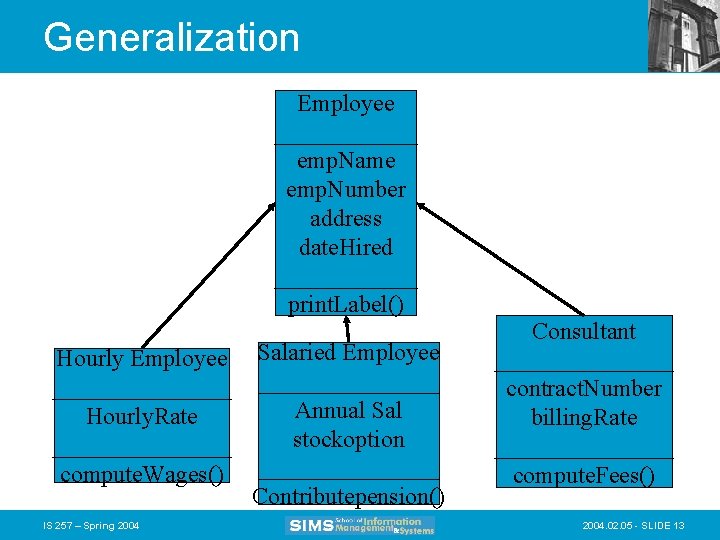
Generalization Employee ______ emp. Name emp. Number address date. Hired ______ print. Label() Hourly Employee ________ Hourly. Rate ________ compute. Wages() IS 257 – Spring 2004 Salaried Employee ________ Annual Sal stockoption ________ Contributepension() Consultant ________ contract. Number billing. Rate ________ compute. Fees() 2004. 02. 05 - SLIDE 13
Other Diagramming methods • SOM (Semantic Object Model) • Object Definition Language (ODL) – Not really diagramming • Access relationships display • Hybrids IS 257 – Spring 2004. 02. 05 - SLIDE 14
Lecture Outline • Review – Database Design -- Object-Oriented Modeling • Logical Design for the Diveshop database • Normalization • Access Database Creation IS 257 – Spring 2004. 02. 05 - SLIDE 15
Database Design Process Application 1 External Model Application 2 Application 3 Application 4 External Model Application 1 Conceptual requirements Application 2 Conceptual requirements Application 3 Conceptual requirements Conceptual Model Logical Model Internal Model Application 4 Conceptual requirements IS 257 – Spring 2004. 02. 05 - SLIDE 16
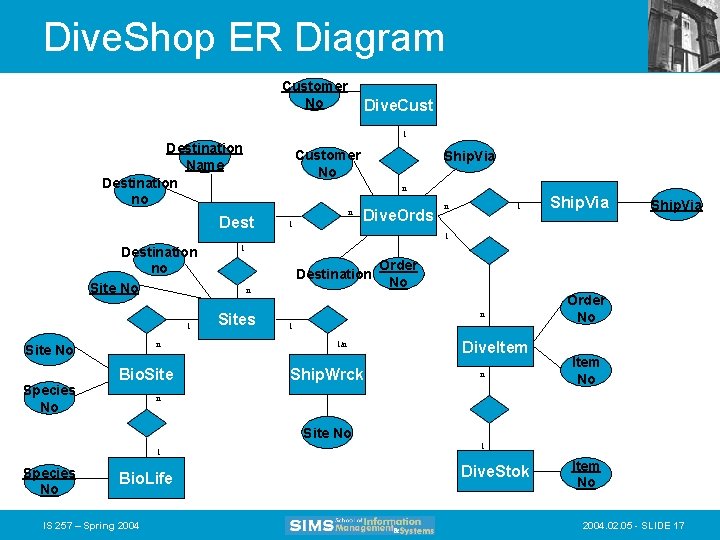
Dive. Shop ER Diagram Customer No Dive. Cust 1 Destination Name Destination no Customer No Ship. Via n Dest n 1 Dive. Ords n 1 Ship. Via 1 Destination no Site No 1 n Site No Species No Bio. Site 1 Destination n Sites Order No n 1 1/n Ship. Wrck Dive. Item n Order No Item No n Site No 1 Species No Bio. Life IS 257 – Spring 2004 1 Dive. Stok Item No 2004. 02. 05 - SLIDE 17
Logical Design: Mapping to a Relational Model • Each entity in the ER Diagram becomes a relation. • A properly normalized ER diagram will indicate where intersection relations for many-to-many mappings are needed. • Relationships are indicated by common columns (or domains) in tables that are related. • We will examine the tables for the Diveshop derived from the ER diagram IS 257 – Spring 2004. 02. 05 - SLIDE 18
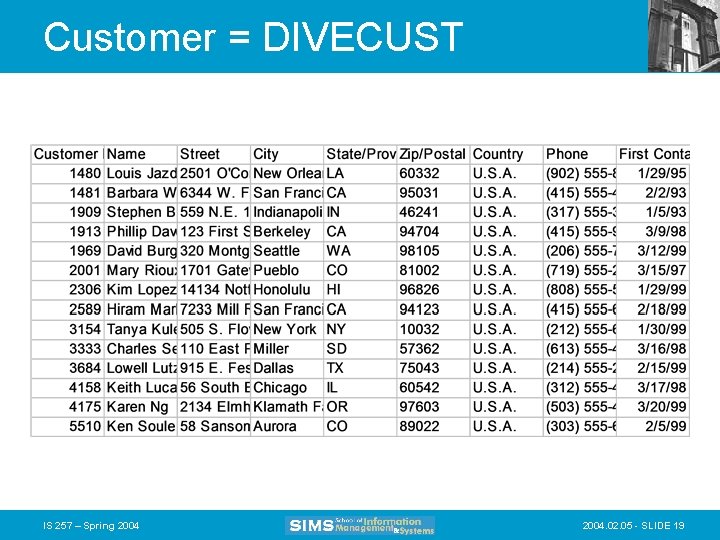
Customer = DIVECUST IS 257 – Spring 2004. 02. 05 - SLIDE 19
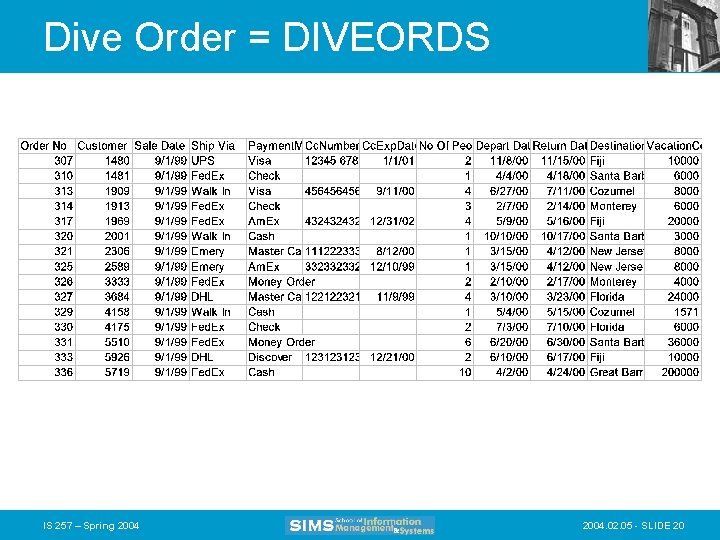
Dive Order = DIVEORDS IS 257 – Spring 2004. 02. 05 - SLIDE 20
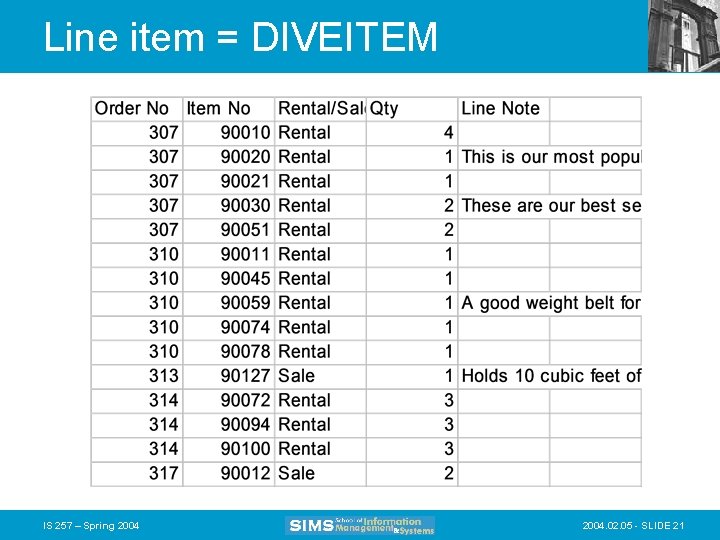
Line item = DIVEITEM IS 257 – Spring 2004. 02. 05 - SLIDE 21
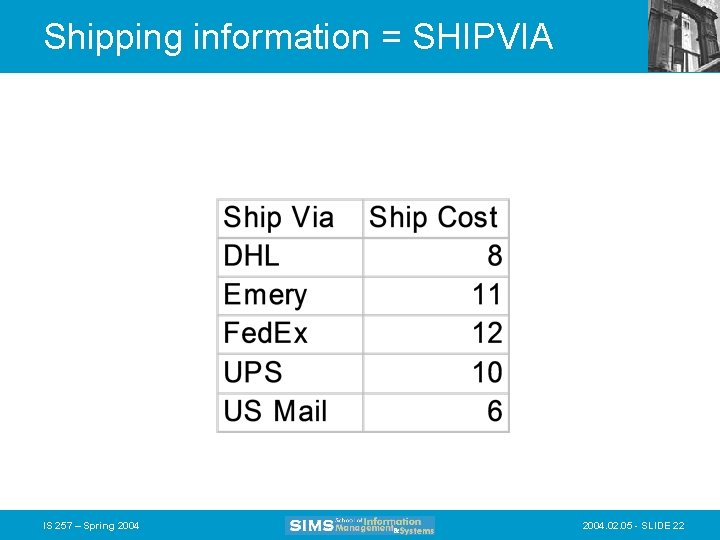
Shipping information = SHIPVIA IS 257 – Spring 2004. 02. 05 - SLIDE 22
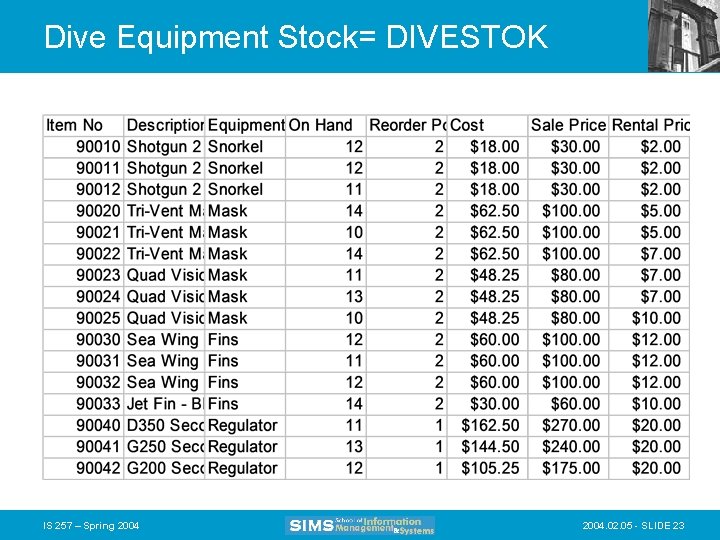
Dive Equipment Stock= DIVESTOK IS 257 – Spring 2004. 02. 05 - SLIDE 23
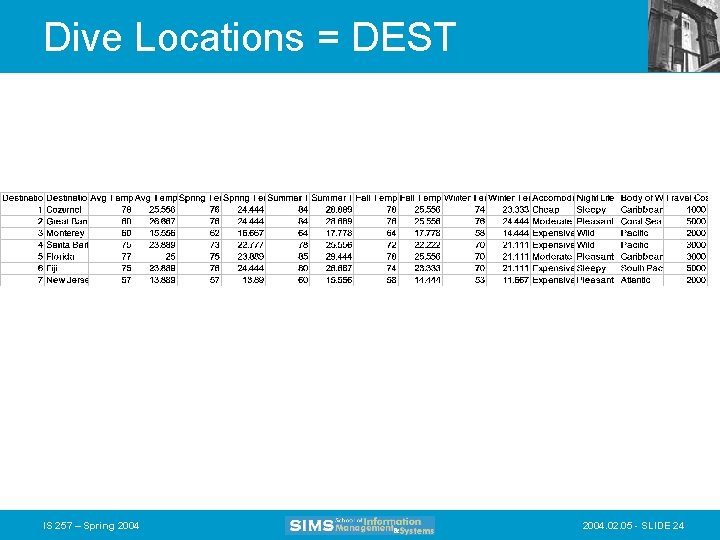
Dive Locations = DEST IS 257 – Spring 2004. 02. 05 - SLIDE 24
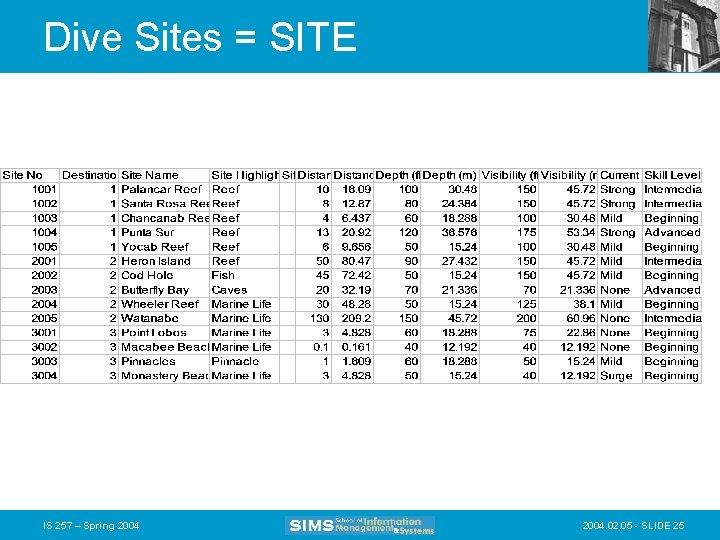
Dive Sites = SITE IS 257 – Spring 2004. 02. 05 - SLIDE 25
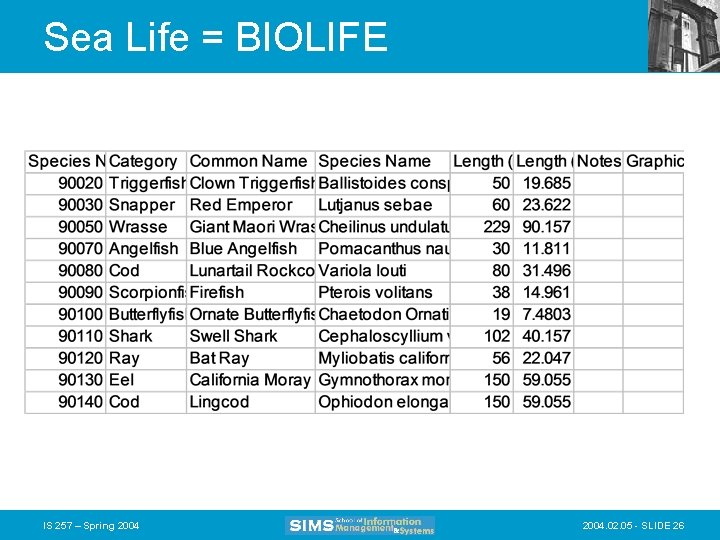
Sea Life = BIOLIFE IS 257 – Spring 2004. 02. 05 - SLIDE 26
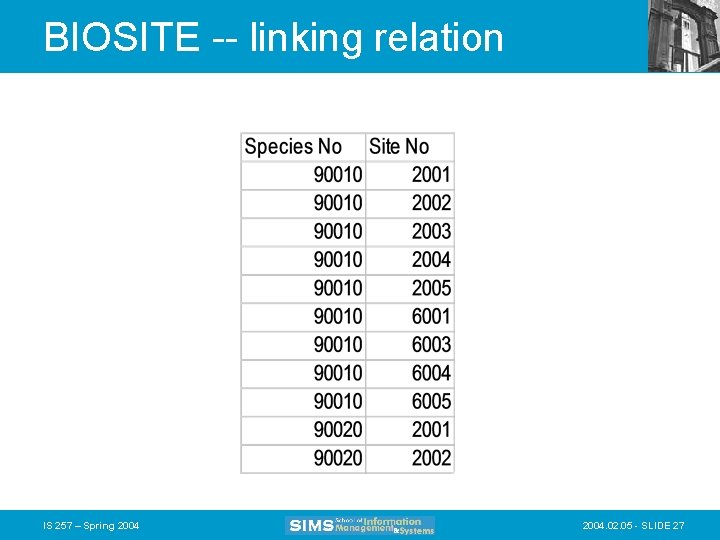
BIOSITE -- linking relation IS 257 – Spring 2004. 02. 05 - SLIDE 27
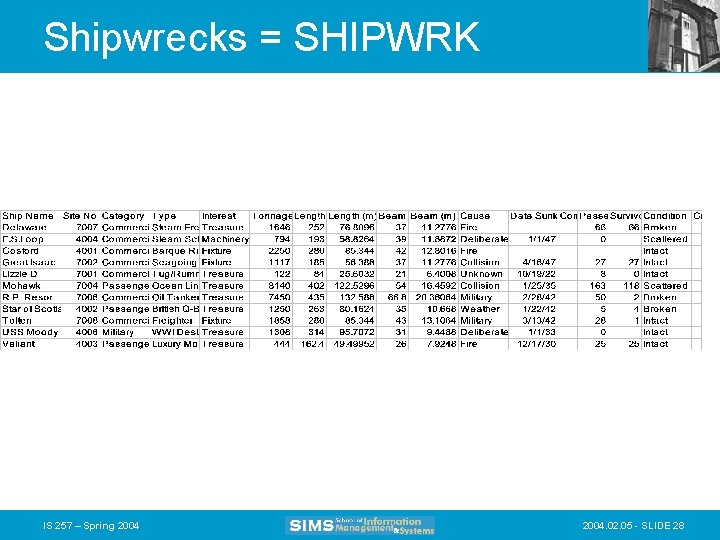
Shipwrecks = SHIPWRK IS 257 – Spring 2004. 02. 05 - SLIDE 28
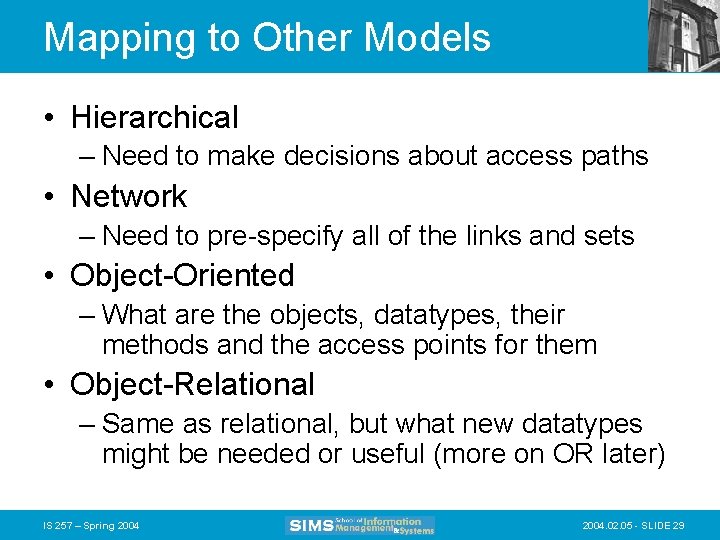
Mapping to Other Models • Hierarchical – Need to make decisions about access paths • Network – Need to pre-specify all of the links and sets • Object-Oriented – What are the objects, datatypes, their methods and the access points for them • Object-Relational – Same as relational, but what new datatypes might be needed or useful (more on OR later) IS 257 – Spring 2004. 02. 05 - SLIDE 29
Lecture Outline • Review – Database Design cont. Object-Oriented Modeling • Logical Design for the Diveshop database • Normalization • Access Database Creation IS 257 – Spring 2004. 02. 05 - SLIDE 30
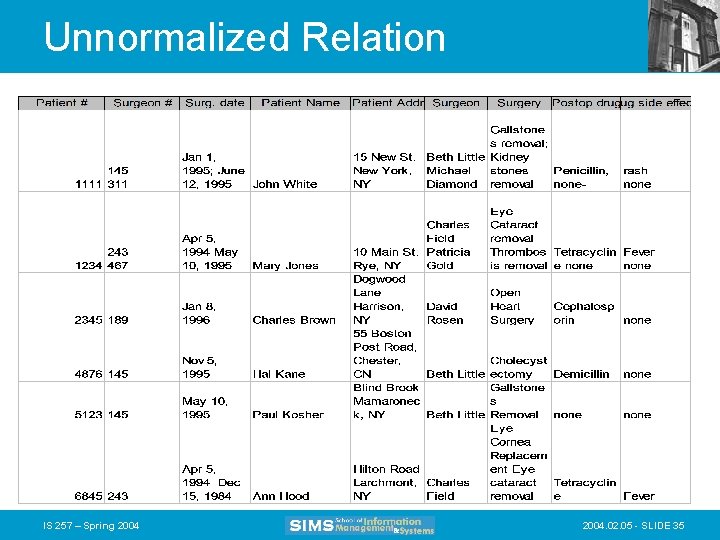
Normalization • Normalization theory is based on the observation that relations with certain properties are more effective in inserting, updating and deleting data than other sets of relations containing the same data • Normalization is a multi-step process beginning with an “unnormalized” relation – Hospital example from Atre, S. Data Base: Structured Techniques for Design, Performance, and Management. IS 257 – Spring 2004. 02. 05 - SLIDE 31
Normal Forms • • • First Normal Form (1 NF) Second Normal Form (2 NF) Third Normal Form (3 NF) Boyce-Codd Normal Form (BCNF) Fourth Normal Form (4 NF) Fifth Normal Form (5 NF) IS 257 – Spring 2004. 02. 05 - SLIDE 32
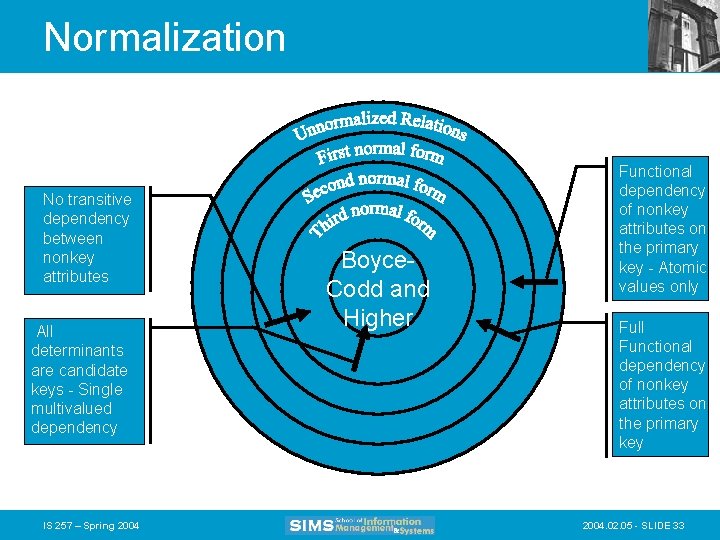
Normalization No transitive dependency between nonkey attributes All determinants are candidate keys - Single multivalued dependency IS 257 – Spring 2004 Boyce. Codd and Higher Functional dependency of nonkey attributes on the primary key - Atomic values only Full Functional dependency of nonkey attributes on the primary key 2004. 02. 05 - SLIDE 33
Unnormalized Relations • First step in normalization is to convert the data into a two-dimensional table • In unnormalized relations data can repeat within a column IS 257 – Spring 2004. 02. 05 - SLIDE 34
Unnormalized Relation IS 257 – Spring 2004. 02. 05 - SLIDE 35
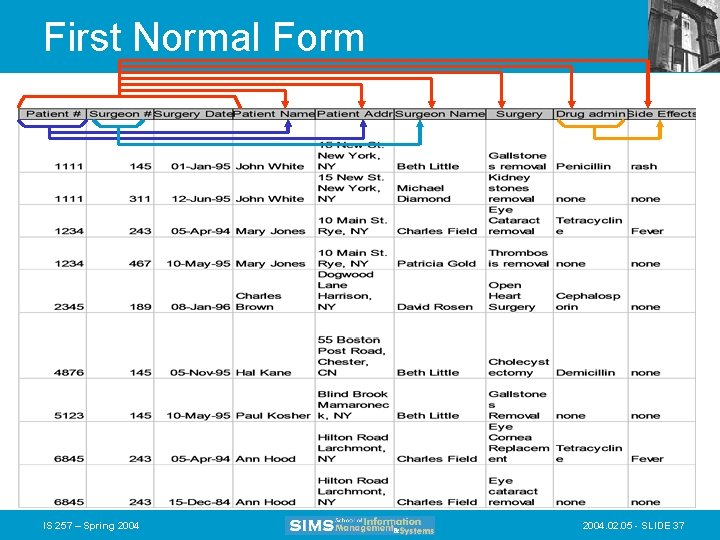
First Normal Form • To move to First Normal Form a relation must contain only atomic values at each row and column. – No repeating groups – A column or set of columns is called a Candidate Key when its values can uniquely identify the row in the relation. IS 257 – Spring 2004. 02. 05 - SLIDE 36
First Normal Form IS 257 – Spring 2004. 02. 05 - SLIDE 37
1 NF Storage Anomalies • Insertion: A new patient has not yet undergone surgery -- hence no surgeon # -- Since surgeon # is part of the key we can’t insert. • Insertion: If a surgeon is newly hired and hasn’t operated yet -- there will be no way to include that person in the database. • Update: If a patient comes in for a new procedure, and has moved, we need to change multiple address entries. • Deletion (type 1): Deleting a patient record may also delete all info about a surgeon. • Deletion (type 2): When there are functional dependencies (like side effects and drug) changing one item eliminates other information. IS 257 – Spring 2004. 02. 05 - SLIDE 38
Second Normal Form • A relation is said to be in Second Normal Form when every nonkey attribute is fully functionally dependent on the primary key. – That is, every nonkey attribute needs the full primary key for unique identification IS 257 – Spring 2004. 02. 05 - SLIDE 39
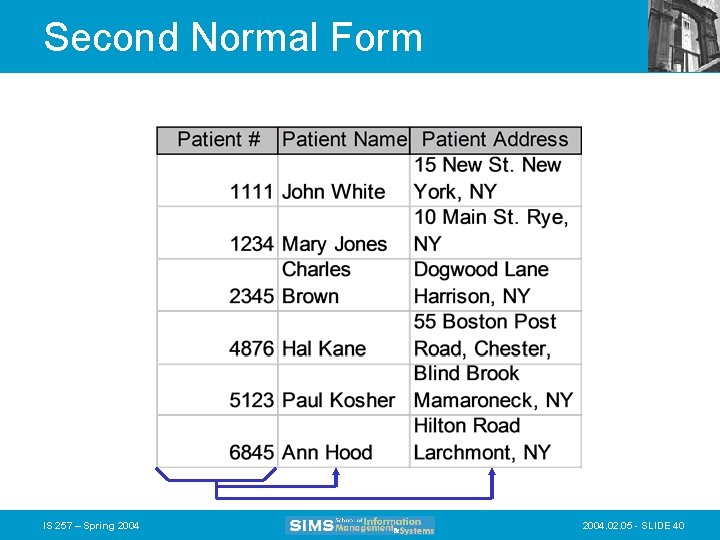
Second Normal Form IS 257 – Spring 2004. 02. 05 - SLIDE 40
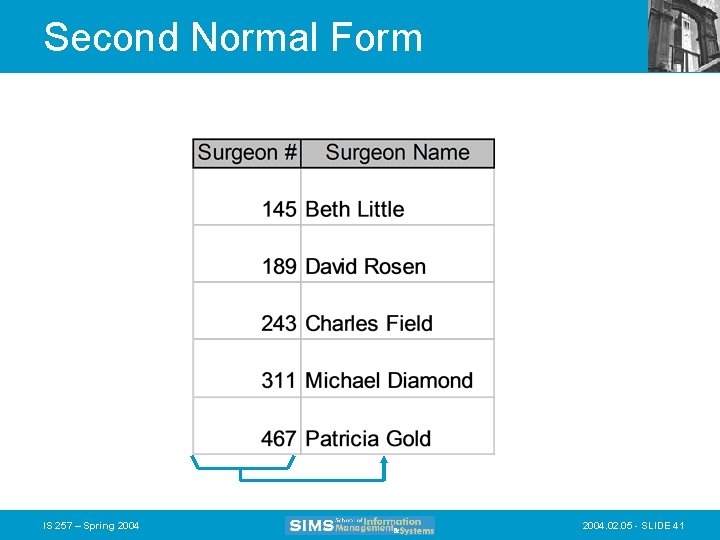
Second Normal Form IS 257 – Spring 2004. 02. 05 - SLIDE 41
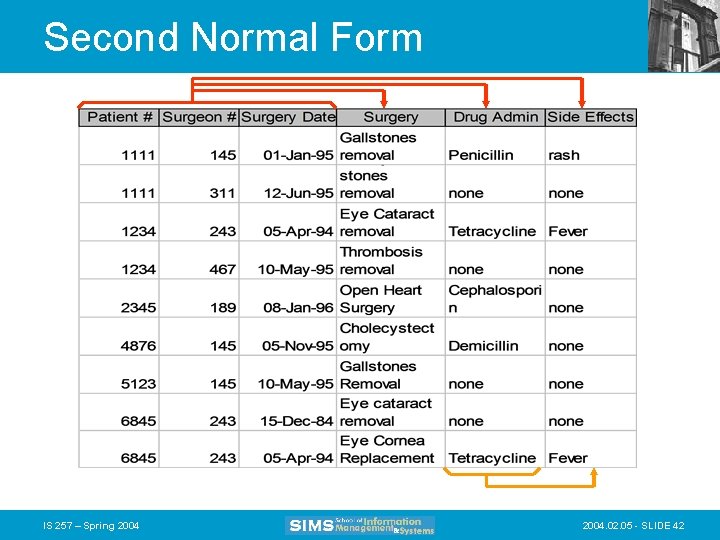
Second Normal Form IS 257 – Spring 2004. 02. 05 - SLIDE 42
1 NF Storage Anomalies Removed • Insertion: Can now enter new patients without surgery. • Insertion: Can now enter Surgeons who haven’t operated. • Deletion (type 1): If Charles Brown dies the corresponding tuples from Patient and Surgery tables can be deleted without losing information on David Rosen. • Update: If John White comes in for third time, and has moved, we only need to change the Patient table IS 257 – Spring 2004. 02. 05 - SLIDE 43
2 NF Storage Anomalies • Insertion: Cannot enter the fact that a particular drug has a particular side effect unless it is given to a patient. • Deletion: If John White receives some other drug because of the penicillin rash, and a new drug and side effect are entered, we lose the information that penicillin cause a rash • Update: If drug side effects change (a new formula) we have to update multiple occurrences of side effects. IS 257 – Spring 2004. 02. 05 - SLIDE 44
Third Normal Form • A relation is said to be in Third Normal Form if there is no transitive functional dependency between nonkey attributes – When one nonkey attribute can be determined with one or more nonkey attributes there is said to be a transitive functional dependency. • The side effect column in the Surgery table is determined by the drug administered – Side effect is transitively functionally dependent on drug so Surgery is not 3 NF IS 257 – Spring 2004. 02. 05 - SLIDE 45
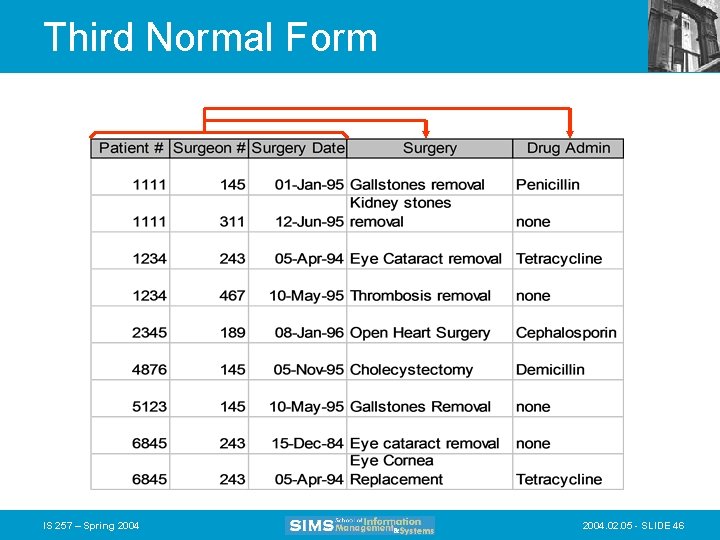
Third Normal Form IS 257 – Spring 2004. 02. 05 - SLIDE 46
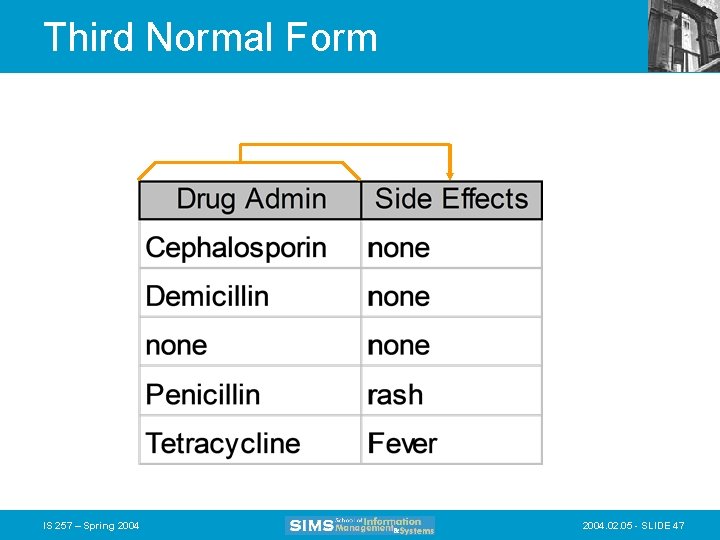
Third Normal Form IS 257 – Spring 2004. 02. 05 - SLIDE 47
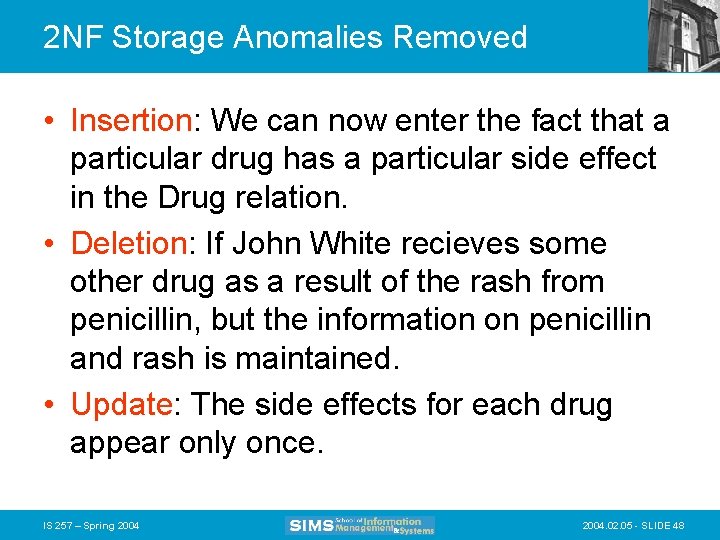
2 NF Storage Anomalies Removed • Insertion: We can now enter the fact that a particular drug has a particular side effect in the Drug relation. • Deletion: If John White recieves some other drug as a result of the rash from penicillin, but the information on penicillin and rash is maintained. • Update: The side effects for each drug appear only once. IS 257 – Spring 2004. 02. 05 - SLIDE 48
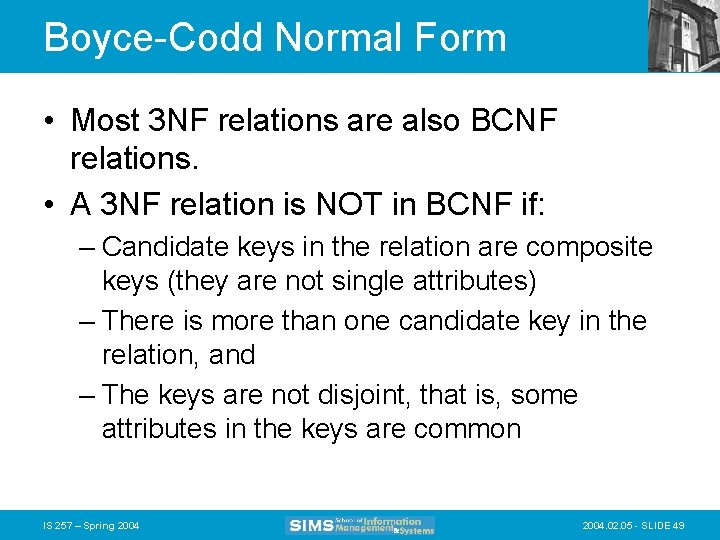
Boyce-Codd Normal Form • Most 3 NF relations are also BCNF relations. • A 3 NF relation is NOT in BCNF if: – Candidate keys in the relation are composite keys (they are not single attributes) – There is more than one candidate key in the relation, and – The keys are not disjoint, that is, some attributes in the keys are common IS 257 – Spring 2004. 02. 05 - SLIDE 49
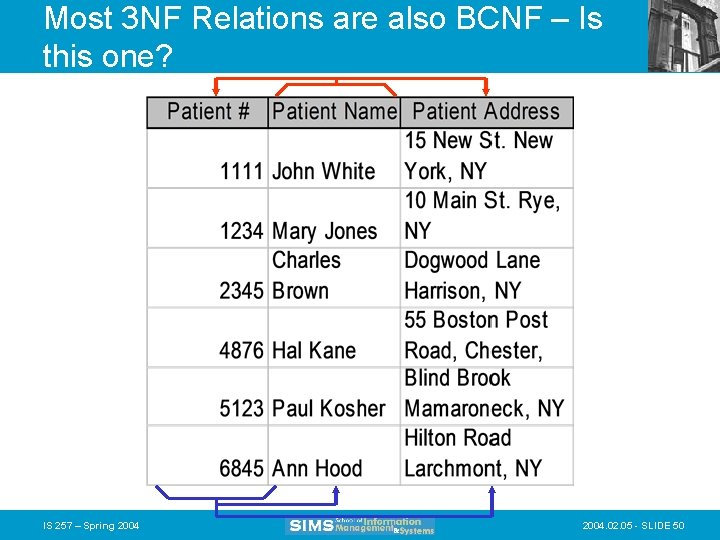
Most 3 NF Relations are also BCNF – Is this one? IS 257 – Spring 2004. 02. 05 - SLIDE 50
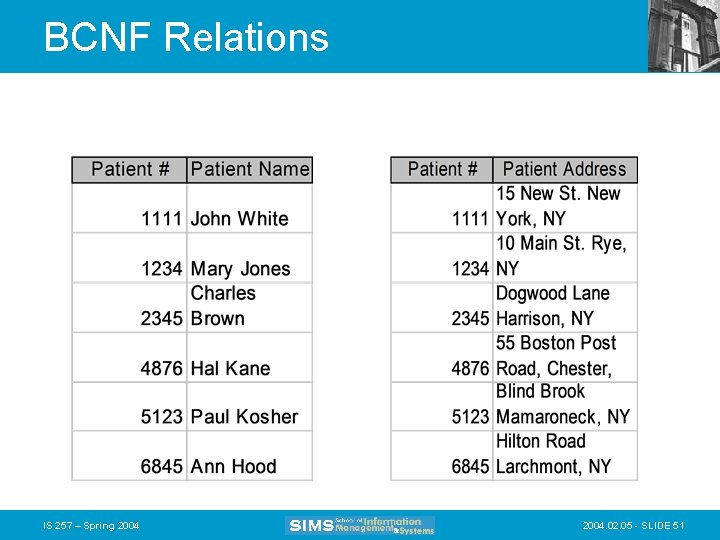
BCNF Relations IS 257 – Spring 2004. 02. 05 - SLIDE 51
Fourth Normal Form • Any relation is in Fourth Normal Form if it is BCNF and any multivalued dependencies are trivial • Eliminate non-trivial multivalued dependencies by projecting into simpler tables IS 257 – Spring 2004. 02. 05 - SLIDE 52
Fifth Normal Form • A relation is in 5 NF if every join dependency in the relation is implied by the keys of the relation • Implies that relations that have been decomposed in previous NF can be recombined via natural joins to recreate the original relation. IS 257 – Spring 2004. 02. 05 - SLIDE 53
Effectiveness and Efficiency Issues for DBMS • Focus on the relational model • Any column in a relational database can be searched for values. • To improve efficiency indexes using storage structures such as BTrees and Hashing are used • But many useful functions are not indexable and require complete scans of the database IS 257 – Spring 2004. 02. 05 - SLIDE 54
Example: Text Fields • In conventional RDBMS, when a text field is indexed, only exact matching of the text field contents (or Greater-than and Lessthan). – Can search for individual words using pattern matching, but a full scan is required. • Text searching is still done best (and fastest) by specialized text search programs (Search Engines) that we will look at more later. IS 257 – Spring 2004. 02. 05 - SLIDE 55
Normalizing to death • Normalization splits database information across multiple tables. • To retrieve complete information from a normalized database, the JOIN operation must be used. • JOIN tends to be expensive in terms of processing time, and very large joins are very expensive. IS 257 – Spring 2004. 02. 05 - SLIDE 56
Advantages of RDBMS • Possible to design complex data storage and retrieval systems with ease (and without conventional programming). • Support for ACID transactions – Atomic – Consistent – Independent – Durable IS 257 – Spring 2004. 02. 05 - SLIDE 57
Advantages of RDBMS • Support for very large databases • Automatic optimization of searching (when possible) • RDBMS have a simple view of the database that conforms to much of the data used in businesses. • Standard query language (SQL) IS 257 – Spring 2004. 02. 05 - SLIDE 58
Disadvantages of RDBMS • Until recently, no real support for complex objects such as documents, video, images, spatial or time-series data. (ORDBMS add support for these). • Often poor support for storage of complex objects from OOP languages (Disassembling the car to park it in the garage) • Still no efficient and effective integrated support for things like text searching within fields. IS 257 – Spring 2004. 02. 05 - SLIDE 59
Lecture Outline • Review – Database Design -- Object-Oriented Modeling • Logical Design for the Diveshop database • Normalization • Access Database Creation IS 257 – Spring 2004. 02. 05 - SLIDE 60
Database Creation in Access • Simplest to use a design view – wizards are available, but less flexible • Need to watch the default values • Helps to know what the primary key is, or if one is to be created automatically – Automatic creation is more complex in other RDBMS and ORDBMS • Need to make decision about the physical storage of the data IS 257 – Spring 2004. 02. 05 - SLIDE 61
Database Creation in Access • Some Simple Examples IS 257 – Spring 2004. 02. 05 - SLIDE 62
Next Week • More Database Design • Expanding and redesigning Dive. Shop IS 257 – Spring 2004. 02. 05 - SLIDE 63
- Slides: 63