
Database Design Logical Model and Normalization University of
Database Design: Logical Model and Normalization University of California, Berkeley School of Information Management and Systems SIMS 202: Information Organization and Retrieval 9/9/1999 Information Organization and Retrieval
Review • Database Design Process • Dive. Shop Conceptual design and ER Diagrams 9/9/1999 Information Organization and Retrieval
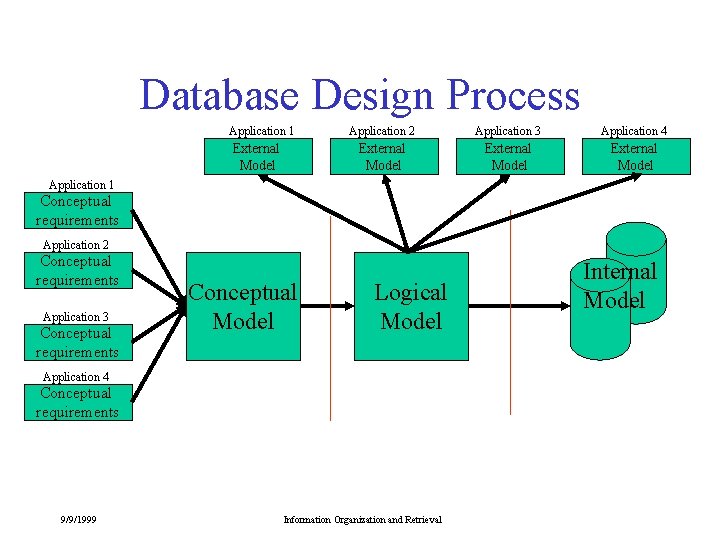
Database Design Process Application 1 External Model Application 2 Application 3 Application 4 External Model Application 1 Conceptual requirements Application 2 Conceptual requirements Application 3 Conceptual requirements Conceptual Model Logical Model Application 4 Conceptual requirements 9/9/1999 Information Organization and Retrieval Internal Model
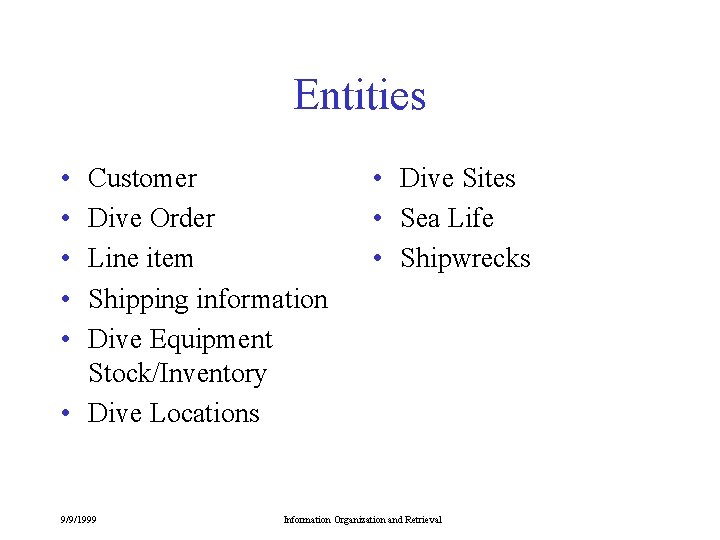
Entities • • • Customer Dive Order Line item Shipping information Dive Equipment Stock/Inventory • Dive Locations 9/9/1999 • Dive Sites • Sea Life • Shipwrecks Information Organization and Retrieval
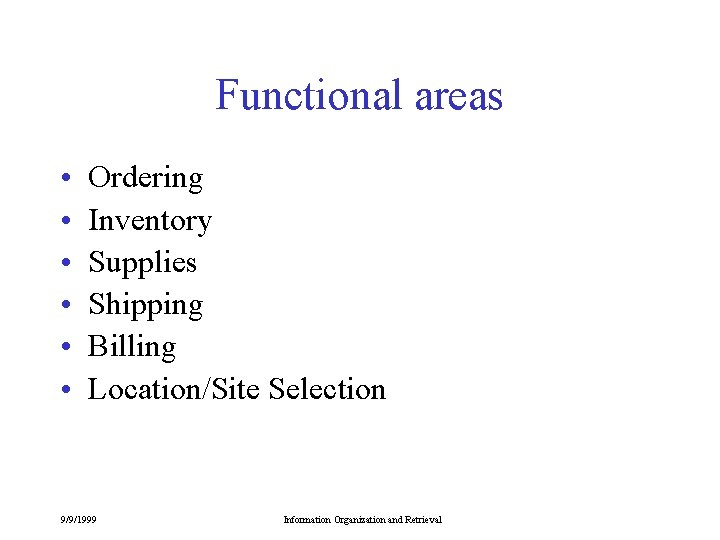
Functional areas • • • Ordering Inventory Supplies Shipping Billing Location/Site Selection 9/9/1999 Information Organization and Retrieval
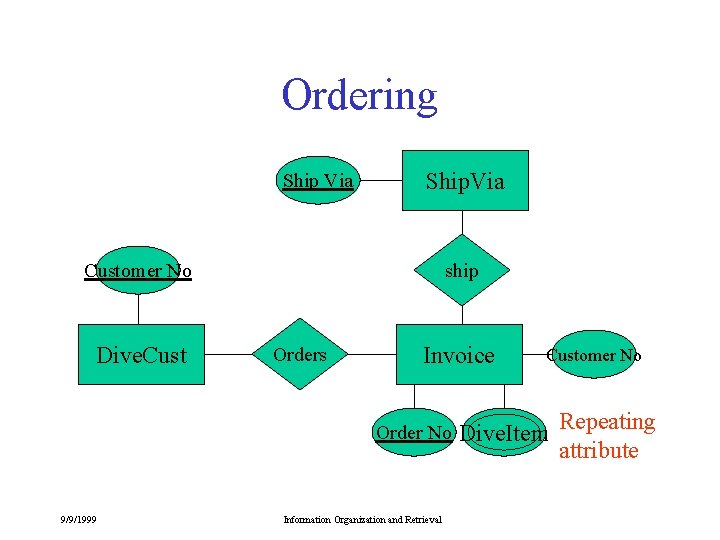
Ordering Ship Via Ship. Via Customer No Dive. Cust ship Orders Invoice Order No 9/9/1999 Information Organization and Retrieval Customer No Dive. Item Repeating attribute
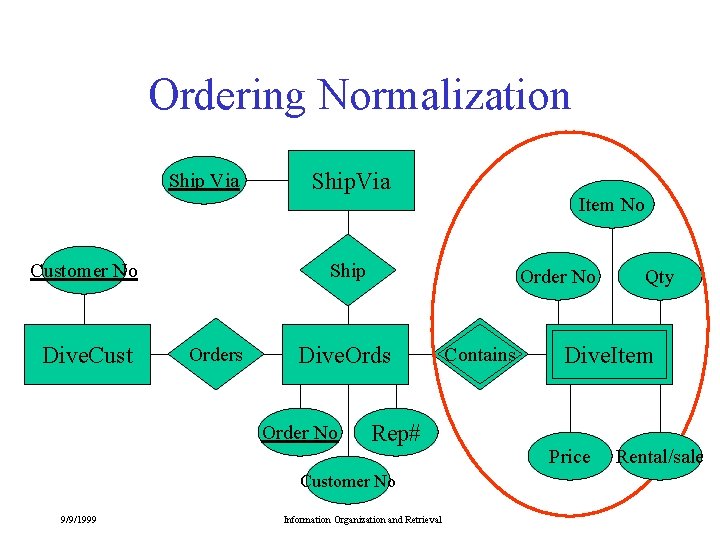
Ordering Normalization Ship Via Customer No Dive. Cust Ship. Via Ship Orders Order No Dive. Ords Order No Rep# Customer No 9/9/1999 Item No Information Organization and Retrieval Contains Qty Dive. Item Price Rental/sale
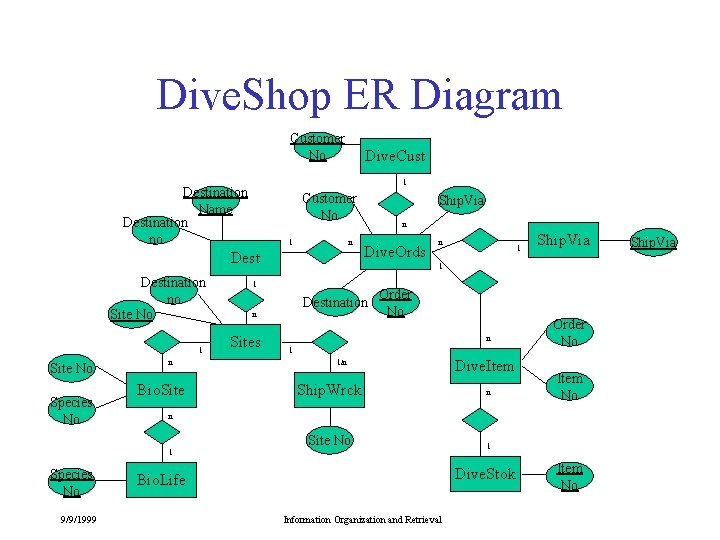
Dive. Shop ER Diagram Customer No Dive. Cust 1 Destination Name Destination no Customer No 1 n Destination no Site No 1 Site No Species No n Bio. Site Ship. Via n Dive. Ords Destination n Order No n 1 1/n 9/9/1999 Dive. Item Ship. Wrck n Ship. Via Site No 1 Order No Item No n 1 Species No 1 1 1 Sites n Dive. Stok Bio. Life Information Organization and Retrieval Item No Ship. Via

Logical Design: Mapping to a Relational Model • Each entity in the ER Diagram becomes a relation. • A properly normalized ER diagram will indicate where intersection relations for many-to-many mappings are needed. • Relationships are indicated by common columns (or domains) in tables that are related. • We will examine the tables for the Diveshop derived from the ER diagram 9/9/1999 Information Organization and Retrieval
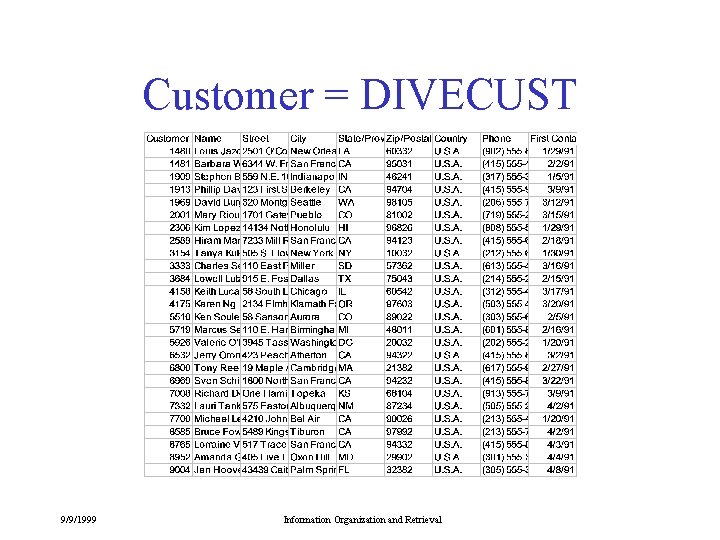
Customer = DIVECUST 9/9/1999 Information Organization and Retrieval
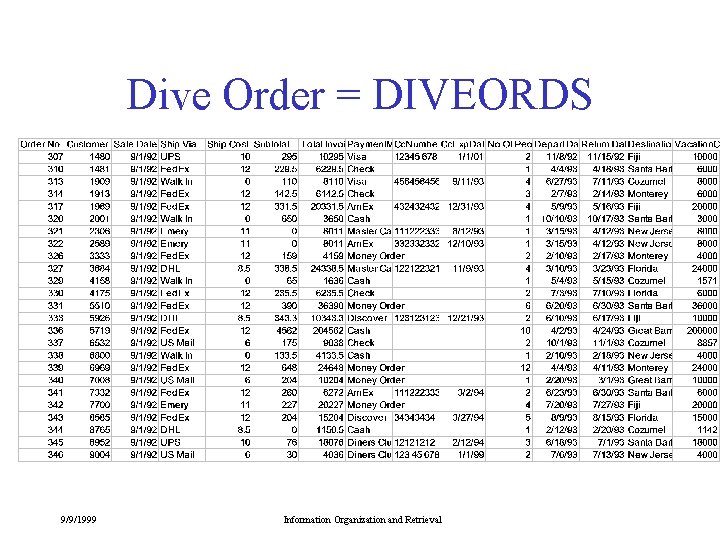
Dive Order = DIVEORDS 9/9/1999 Information Organization and Retrieval
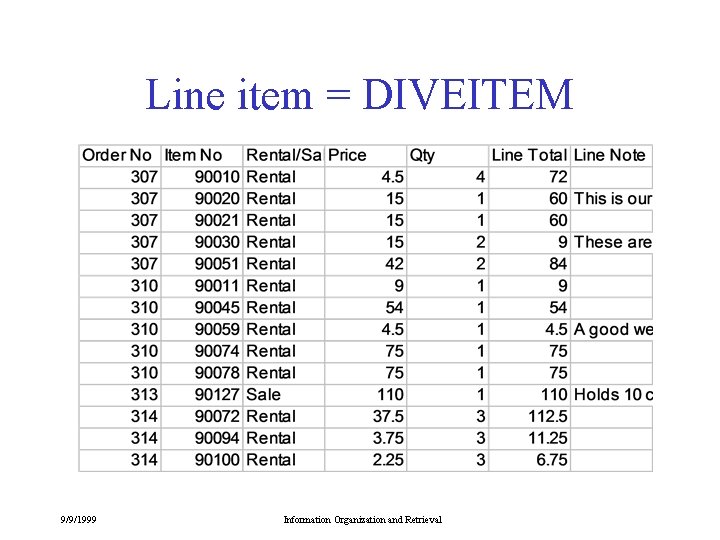
Line item = DIVEITEM 9/9/1999 Information Organization and Retrieval
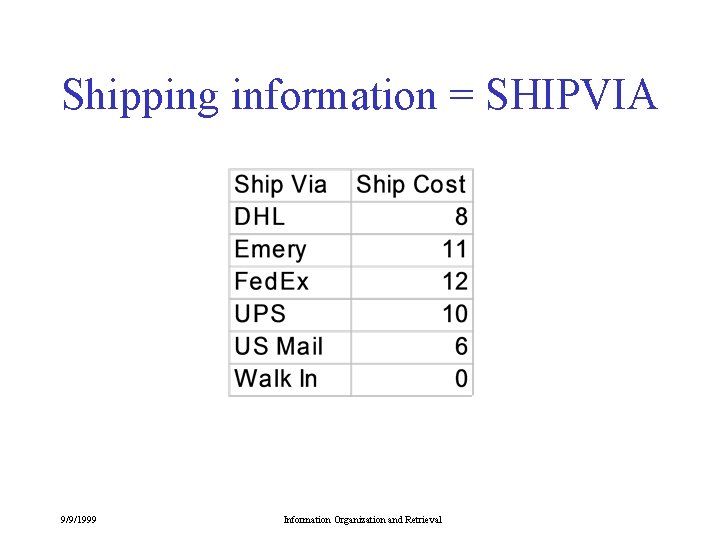
Shipping information = SHIPVIA 9/9/1999 Information Organization and Retrieval

Dive Equipment Stock/Inventory = DIVESTOK 9/9/1999 Information Organization and Retrieval
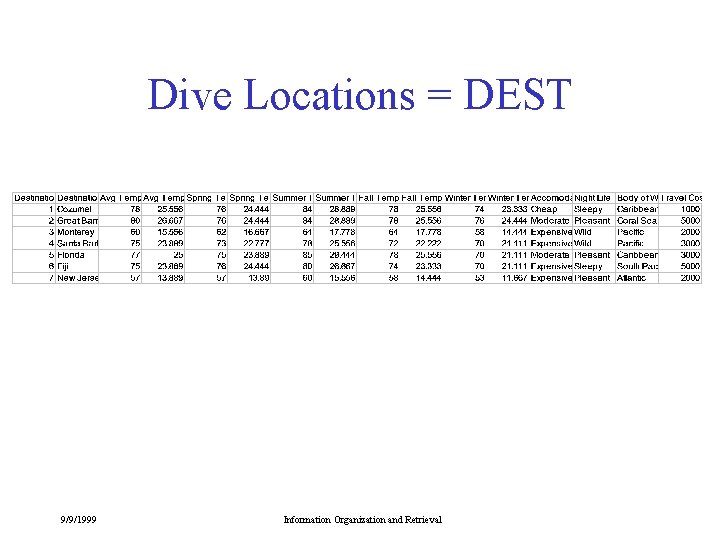
Dive Locations = DEST 9/9/1999 Information Organization and Retrieval
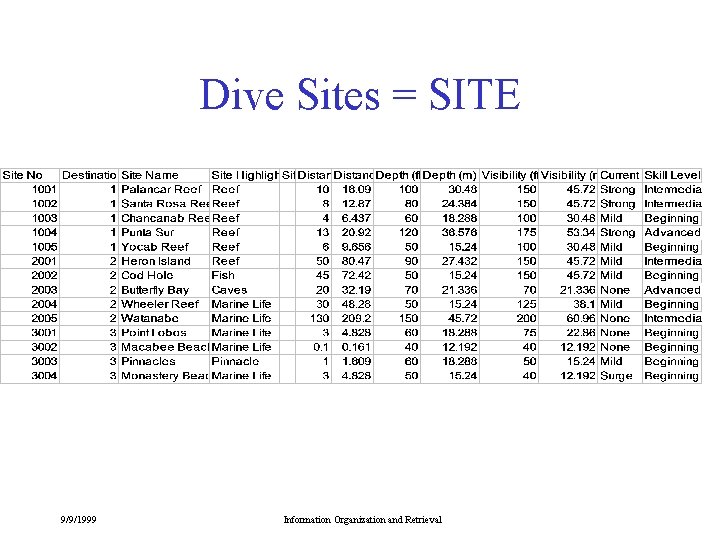
Dive Sites = SITE 9/9/1999 Information Organization and Retrieval
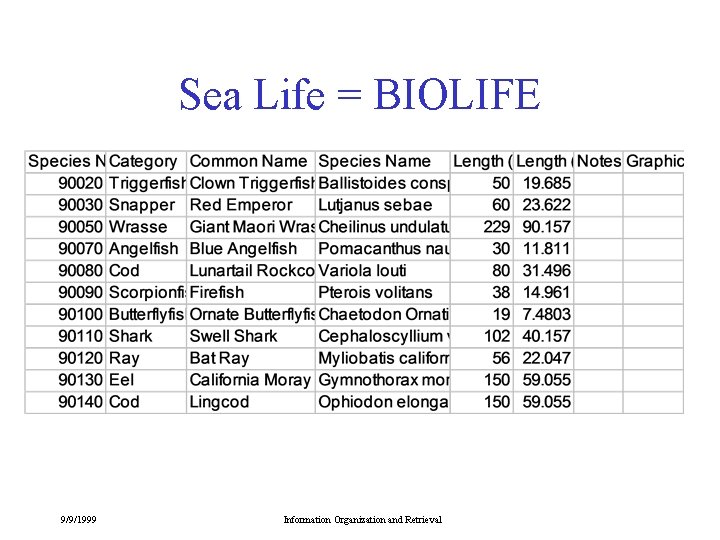
Sea Life = BIOLIFE 9/9/1999 Information Organization and Retrieval
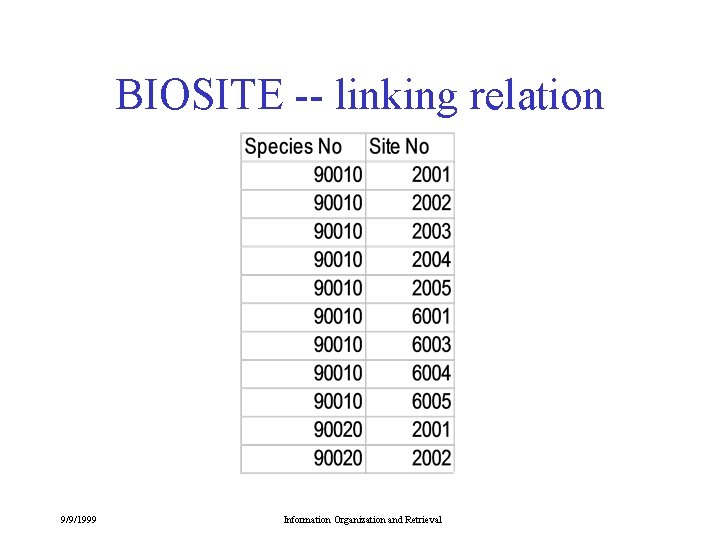
BIOSITE -- linking relation 9/9/1999 Information Organization and Retrieval
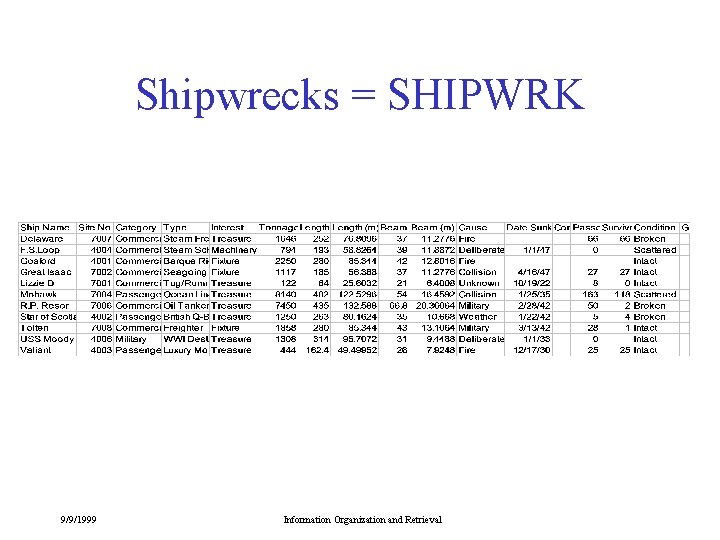
Shipwrecks = SHIPWRK 9/9/1999 Information Organization and Retrieval
Normalization • Normalization theory is based on the observation that relations with certain properties are more effective in inserting, updating and deleting data than other sets of relations containing the same data • Normalization is a multi-step process beginning with an “unnormalized” relation – Hospital example from Atre, S. Data Base: Structured Techniques for Design, Performance, and Management. 9/9/1999 Information Organization and Retrieval
Normal Forms • • • First Normal Form (1 NF) Second Normal Form (2 NF) Third Normal Form (3 NF) Boyce-Codd Normal Form (BCNF) Fourth Normal Form (4 NF) Fifth Normal Form (5 NF) 9/9/1999 Information Organization and Retrieval
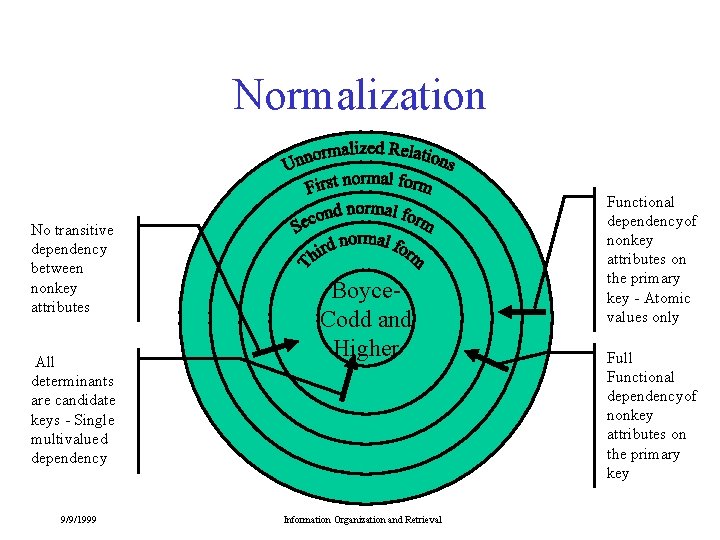
Normalization No transitive dependency between nonkey attributes All determinants are candidate keys - Single multivalued dependency 9/9/1999 Boyce. Codd and Higher Information Organization and Retrieval Functional dependencyof nonkey attributes on the primary key - Atomic values only Full Functional dependencyof nonkey attributes on the primary key
Unnormalized Relations • First step in normalization is to convert the data into a two-dimensional table • In unnormalized relations data can repeat within a column 9/9/1999 Information Organization and Retrieval
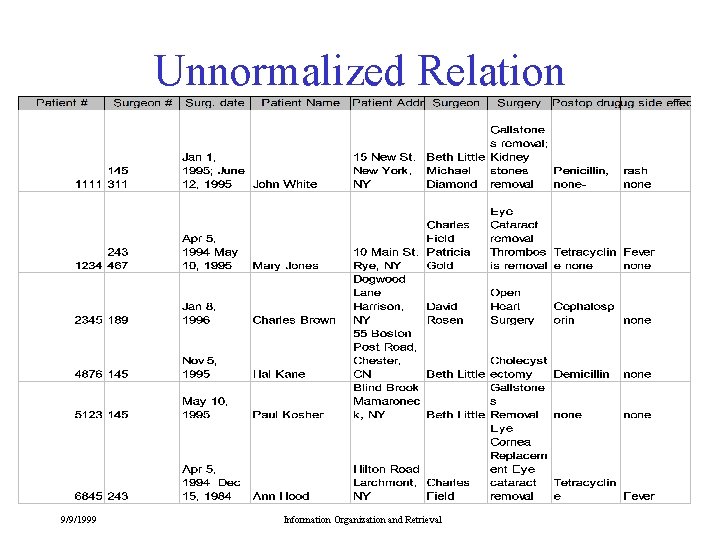
Unnormalized Relation 9/9/1999 Information Organization and Retrieval
First Normal Form • To move to First Normal Form a relation must contain only atomic values at each row and column. – No repeating groups – A column or set of columns is called a Candidate Key when its values can uniquely identify the row in the relation. 9/9/1999 Information Organization and Retrieval
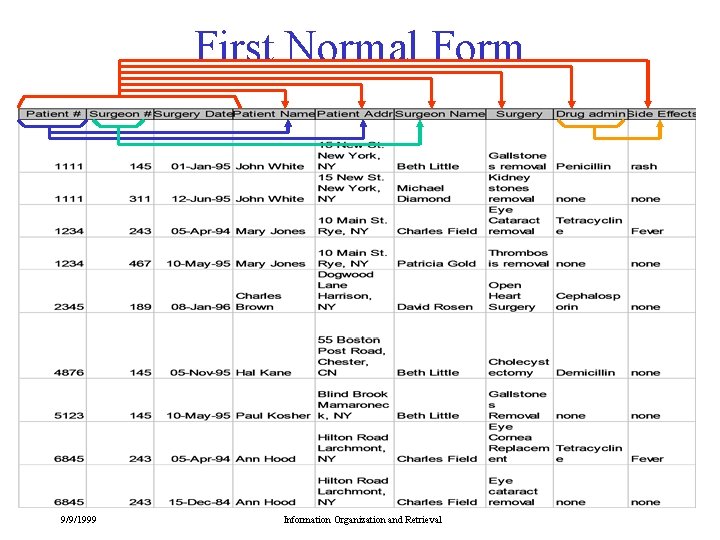
First Normal Form 9/9/1999 Information Organization and Retrieval
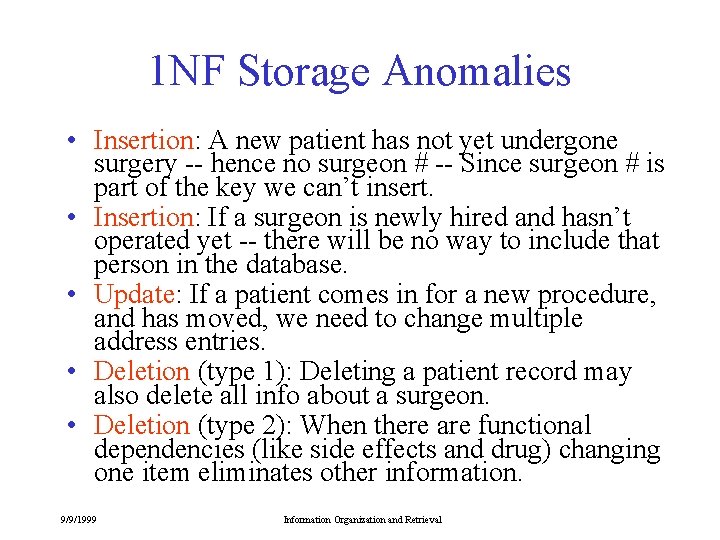
1 NF Storage Anomalies • Insertion: A new patient has not yet undergone surgery -- hence no surgeon # -- Since surgeon # is part of the key we can’t insert. • Insertion: If a surgeon is newly hired and hasn’t operated yet -- there will be no way to include that person in the database. • Update: If a patient comes in for a new procedure, and has moved, we need to change multiple address entries. • Deletion (type 1): Deleting a patient record may also delete all info about a surgeon. • Deletion (type 2): When there are functional dependencies (like side effects and drug) changing one item eliminates other information. 9/9/1999 Information Organization and Retrieval
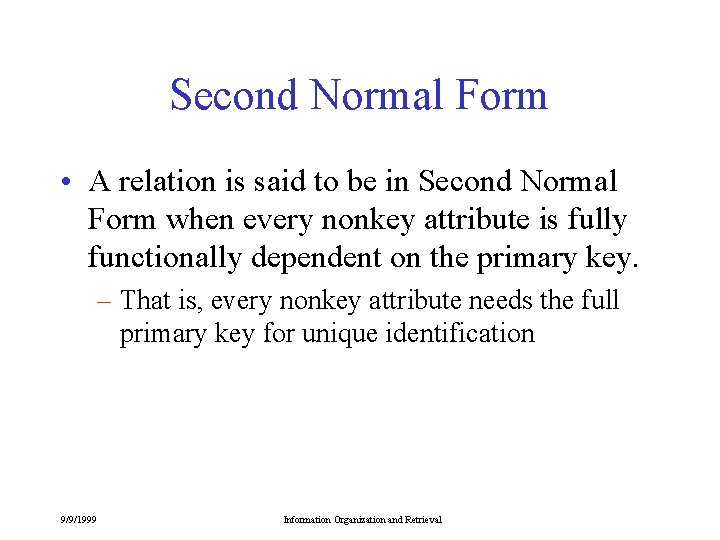
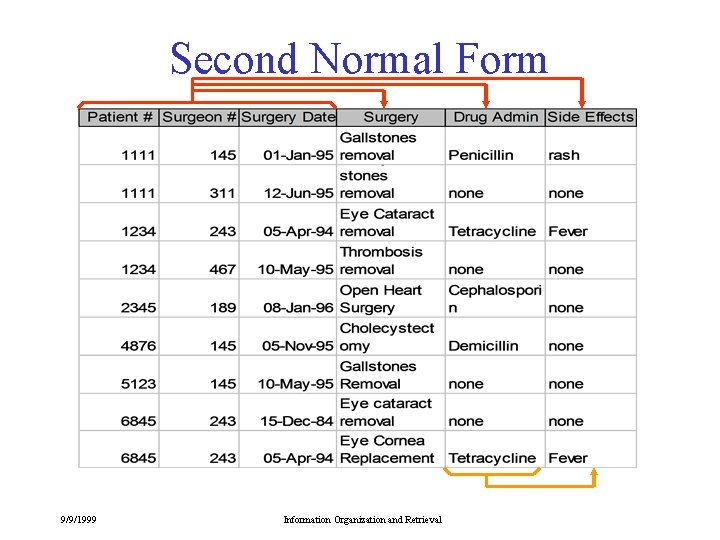
Second Normal Form • A relation is said to be in Second Normal Form when every nonkey attribute is fully functionally dependent on the primary key. – That is, every nonkey attribute needs the full primary key for unique identification 9/9/1999 Information Organization and Retrieval
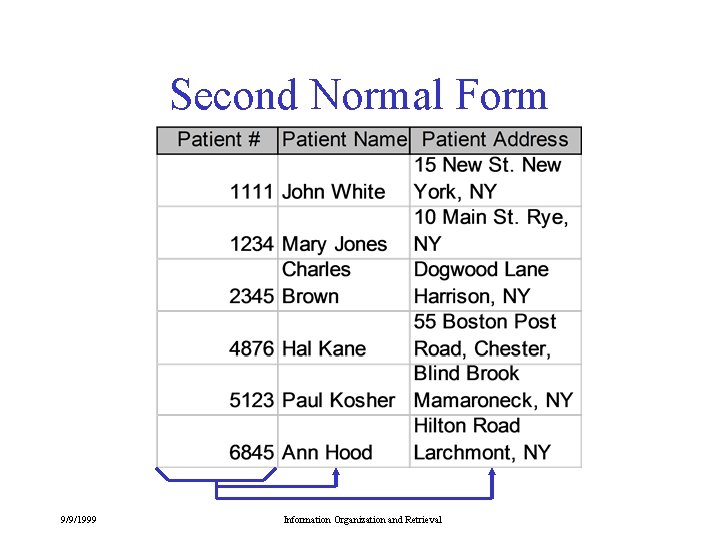
Second Normal Form 9/9/1999 Information Organization and Retrieval
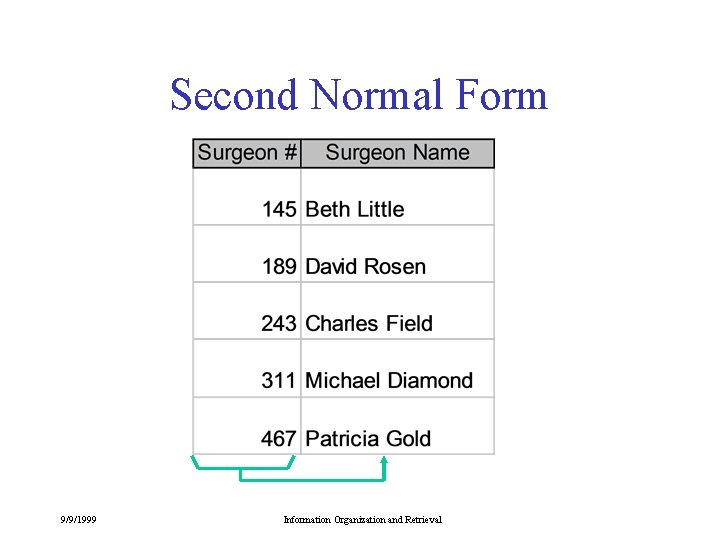
Second Normal Form 9/9/1999 Information Organization and Retrieval
Second Normal Form 9/9/1999 Information Organization and Retrieval
1 NF Storage Anomalies Removed • Insertion: Can now enter new patients without surgery. • Insertion: Can now enter Surgeons who haven’t operated. • Deletion (type 1): If Charles Brown dies the corresponding tuples from Patient and Surgery tables can be deleted without losing information on David Rosen. • Update: If John White comes in for third time, and has moved, we only need to change the Patient table 9/9/1999 Information Organization and Retrieval

2 NF Storage Anomalies • Insertion: Cannot enter the fact that a particular drug has a particular side effect unless it is given to a patient. • Deletion: If John White receives some other drug because of the penicillin rash, and a new drug and side effect are entered, we lose the information that penicillin cause a rash • Update: If drug side effects change (a new formula) we have to update multiple occurrences of side effects. 9/9/1999 Information Organization and Retrieval

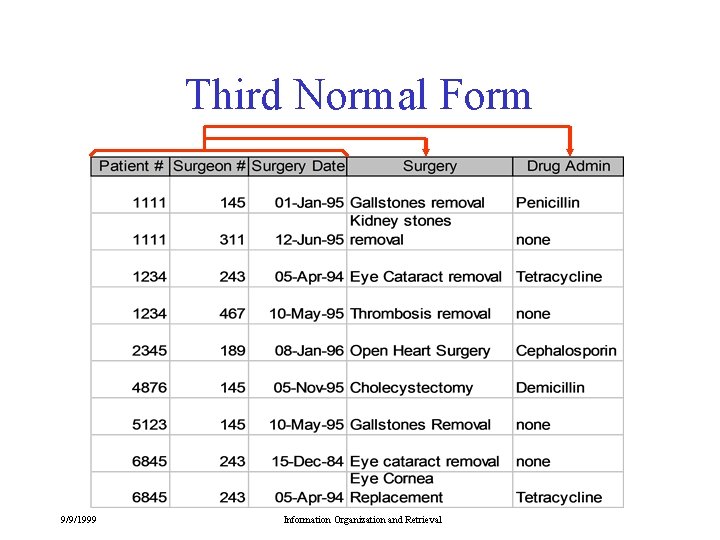
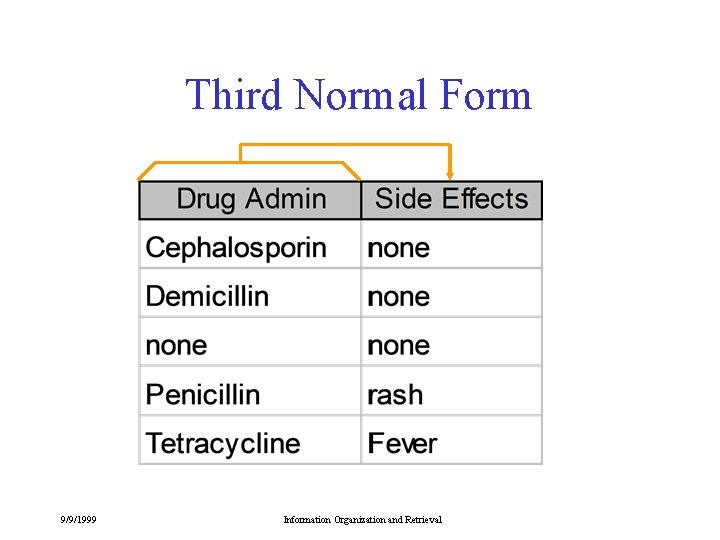
Third Normal Form • A relation is said to be in Third Normal Form if there is no transitive functional dependency between nonkey attributes – When one nonkey attribute can be determined with one or more nonkey attributes there is said to be a transitive functional dependency. • The side effect column in the Surgery table is determined by the drug administered – Side effect is transitively functionally dependent on drug so Surgery is not 3 NF 9/9/1999 Information Organization and Retrieval
Third Normal Form 9/9/1999 Information Organization and Retrieval
Third Normal Form 9/9/1999 Information Organization and Retrieval
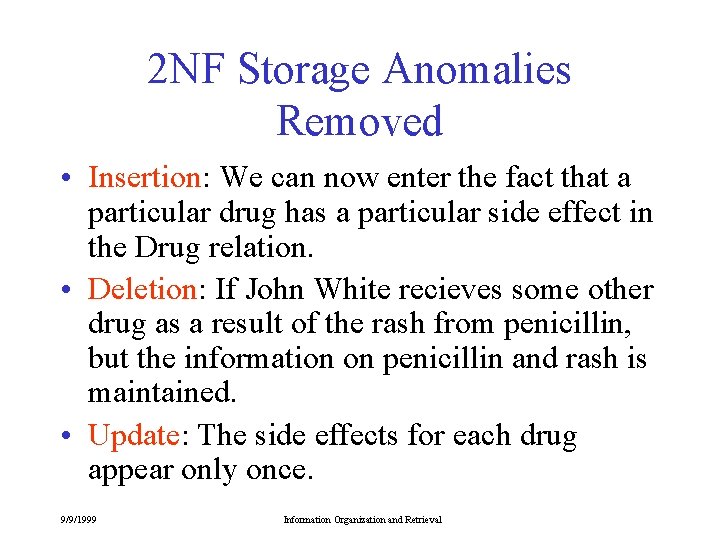
2 NF Storage Anomalies Removed • Insertion: We can now enter the fact that a particular drug has a particular side effect in the Drug relation. • Deletion: If John White recieves some other drug as a result of the rash from penicillin, but the information on penicillin and rash is maintained. • Update: The side effects for each drug appear only once. 9/9/1999 Information Organization and Retrieval
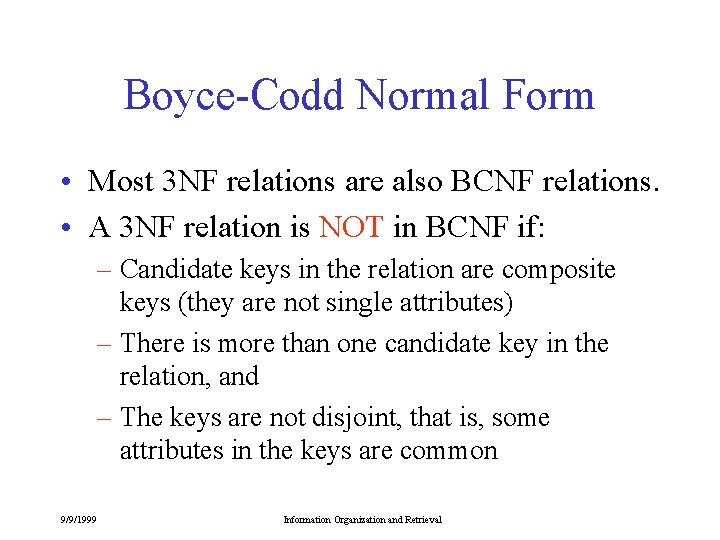
Boyce-Codd Normal Form • Most 3 NF relations are also BCNF relations. • A 3 NF relation is NOT in BCNF if: – Candidate keys in the relation are composite keys (they are not single attributes) – There is more than one candidate key in the relation, and – The keys are not disjoint, that is, some attributes in the keys are common 9/9/1999 Information Organization and Retrieval
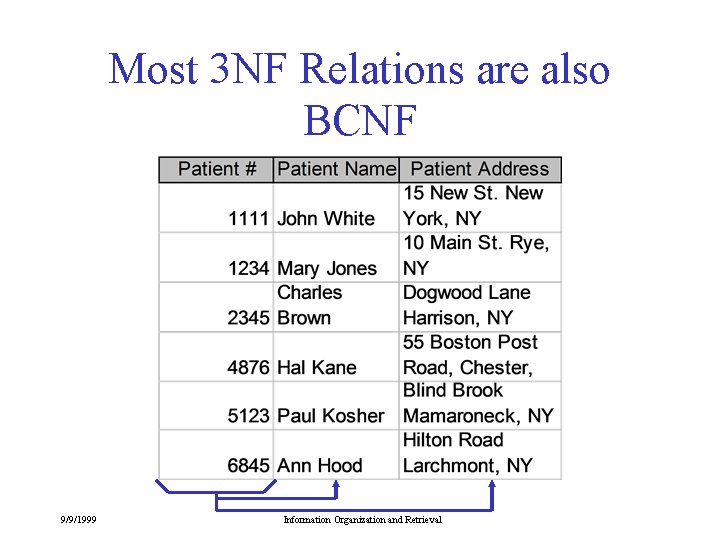
Most 3 NF Relations are also BCNF 9/9/1999 Information Organization and Retrieval
- Slides: 39