
Database Design for Superconducting Magnets CERN Summer Student
Database Design for Superconducting Magnets CERN Summer Student 2006 Tae-Joon Cho (Cambridge) Under supervision of Dr. Walter Scandale (CERN) Emanuele Laface (CERN) 16 August 2006
Database design for superconducting magnets Contents • • Magnets and Magnetic Field B Superconductors Parameters Database survey and Collaborations Conclusions Bibliography (History) Development of Superconductivity
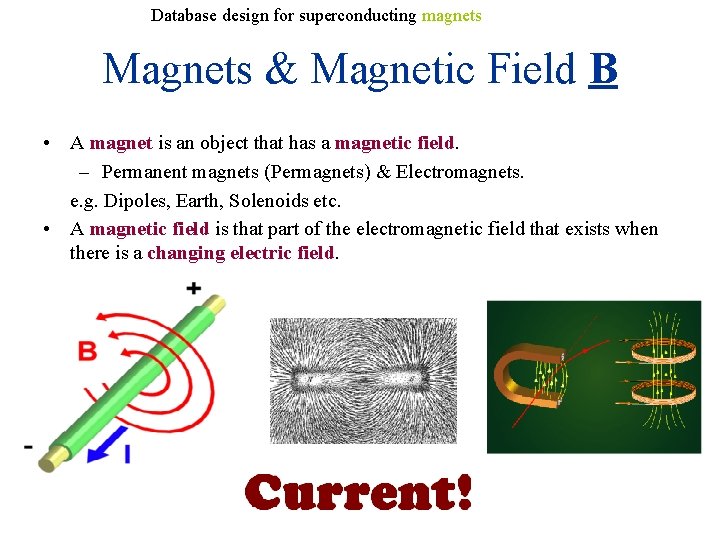
Database design for superconducting magnets Magnets & Magnetic Field B • A magnet is an object that has a magnetic field. – Permanent magnets (Permagnets) & Electromagnets. e. g. Dipoles, Earth, Solenoids etc. • A magnetic field is that part of the electromagnetic field that exists when there is a changing electric field.
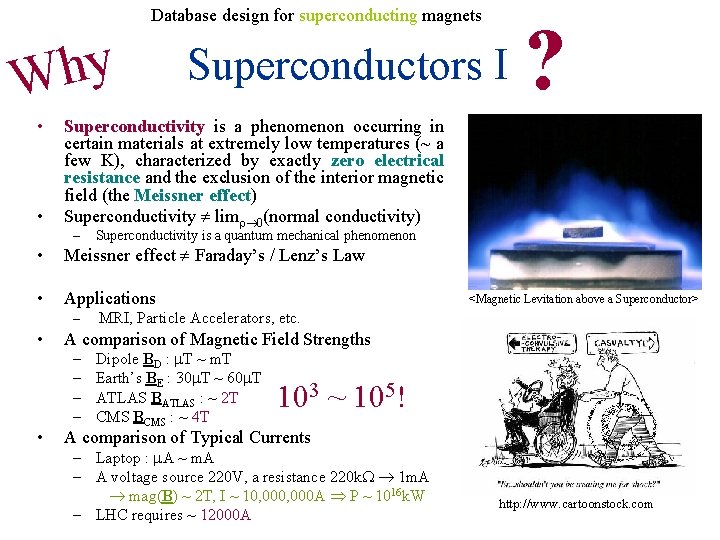
Database design for superconducting magnets y h W • • Superconductors I Superconductivity is a phenomenon occurring in certain materials at extremely low temperatures (~ a few K), characterized by exactly zero electrical resistance and the exclusion of the interior magnetic field (the Meissner effect) Superconductivity lim 0(normal conductivity) – Superconductivity is a quantum mechanical phenomenon • Meissner effect Faraday’s / Lenz’s Law • Applications – • <Magnetic Levitation above a Superconductor> MRI, Particle Accelerators, etc. A comparison of Magnetic Field Strengths – – • ? Dipole BD : T ~ m. T Earth’s BE : 30 T ~ 60 T ATLAS BATLAS : ~ 2 T CMS BCMS : ~ 4 T 103 ~ 105! A comparison of Typical Currents – Laptop : A ~ m. A – A voltage source 220 V, a resistance 220 k 1 m. A mag(B) ~ 2 T, I ~ 10, 000 A P ~ 1016 k. W – LHC requires ~ 12000 A http: //www. cartoonstock. com
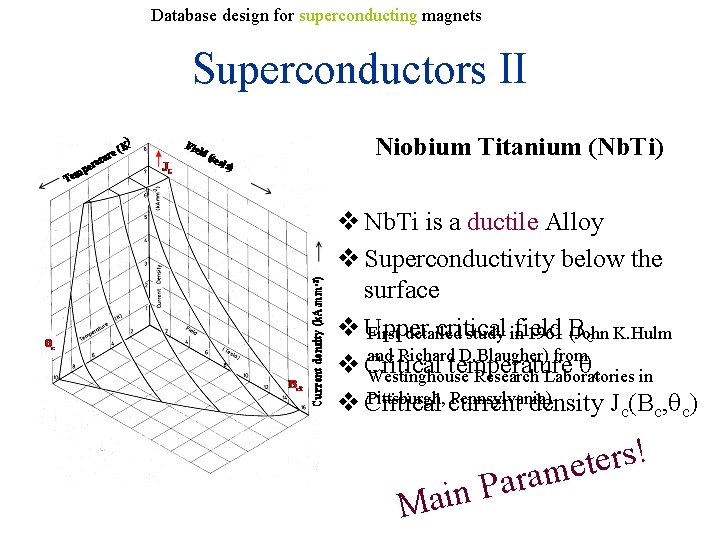
Database design for superconducting magnets Superconductors II Niobium Titanium (Nb. Ti) v Nb. Ti is a ductile Alloy v Superconductivity below the surface v Upper critical field First detailed study in 1961 B (John c K. Hulm and Richard D. Blaugher) from v Critical temperature c in Westinghouse Research Laboratories Pittsburgh, current Pennsylvania) v Critical density Jc(Bc, c) a P n i Ma ! s r e t rame
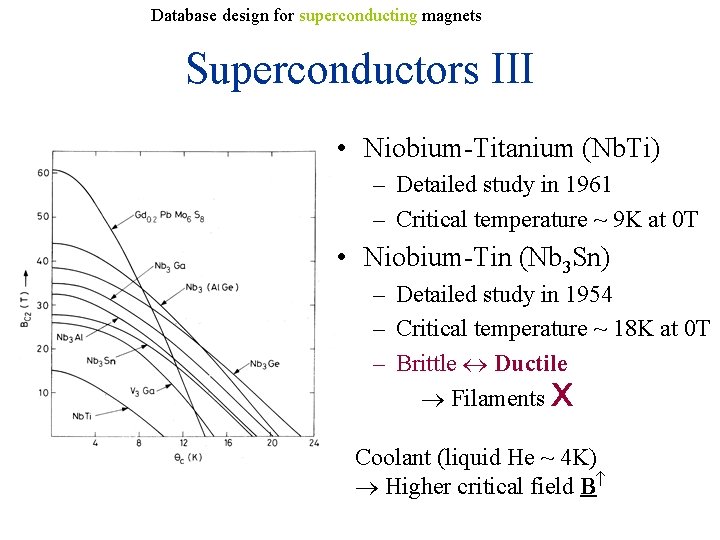
Database design for superconducting magnets Superconductors III • Niobium-Titanium (Nb. Ti) – Detailed study in 1961 – Critical temperature ~ 9 K at 0 T • Niobium-Tin (Nb 3 Sn) – Detailed study in 1954 – Critical temperature ~ 18 K at 0 T – Brittle Ductile Filaments x Coolant (liquid He ~ 4 K) Higher critical field B
Database design for superconducting magnets Parameters • • • Critical temperature c Upper critical field Bc Critical current density Jc (Bc, c) Ductility Phase transitions Mechanical/Physical/Chemical properties More than 100 parameters

Database design for superconducting magnets Database Survey http: //sdb. web. cern. ch/sdb/ 8
Database design for superconducting magnets Collaborations • LHC at CERN • Tevatron at Fermi. Lab • HERA (Hadron-Electron Ring Accelerator) in Hamburg, Germany • FAIR at GSI in Frankfurt, Germany • ITER (International Thermonuclear Experimental Reactor) in France • J-PARC (Japan Proton Accelerator Research Complex) at KEK in Japan • KEKB (Electron-positron colliding-beam accelerator) in Tsukuba Campus at KEK in Japan • ILC (International Linear Collider project) at KEK in Japan 9
Database design for superconducting magnets Conclusions • • Increasing demand on superconductors More theoretical & experimental developments R&D on Permanent magets Recognition of main parameters Inter-relations of those parameters Collaborations User friendly Database (Oracle SQL)
Database design for superconducting magnets Thank you for your attention! ?
Database design for superconducting magnets Bibliography • Superconducting Magnets – Chapter 12 & 13 – Martin N. Wilson (Oxford University Press) • Practical Low-Temperature Superconductors for Electromagnets – A. Devred (CERN Report 2004) • Superconducting magnet technology for particle accelerators and detectors – T. Taylor (CERN Summer Student Lecture, 14 July 2006) • Wikipedia (http: //www. wikipedia. org/) http: //sdb. web. cern. ch/sdb/
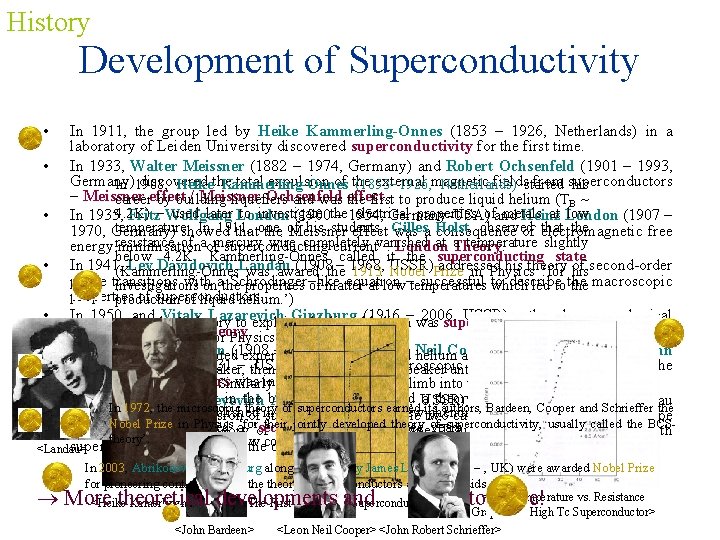
History Development of Superconductivity In 1911, the group led by Heike Kammerling-Onnes (1853 1926, Netherlands) in a laboratory of Leiden University discovered superconductivity for the first time. • In 1933, Walter Meissner (1882 1974, Germany) and Robert Ochsenfeld (1901 1993, Germany) discovered total expulsion of the external magnetic fieldsstarted from superconductors In 1908, Heikethe Kammerling-Onnes (1853 1926, Netherlands) his Meissner / Meissner-Ochsenfeld careereffect by building liquefiers and was effect. the first to produce liquid helium (TB ~ 4. 2 K) used later London to investigate electrical properties ofand metals at London low • In 1935, Fritz Wolfgang (1900 the 1954, Germany-USA) Heinz (1907 temperature. In 1911, his students, observed that the 1970, Germany) showed thatone the of Meissner effect Gilles was a Holst, consequence of electromagnetic free resistance of a mercury wire completely vanished at a temperature slightly energy minimisation of superconducting current London Theory. below 4. 2 K. Kammerling-Onnes called it the superconducting state. • In 1941, (Kammerling-Onnes Lev Davidovich Landau (1908 the 1968, addressed his theory of second-order was awared 1913 USSR) Nobel Prize in Physics ‘for his phase transitions with Schrodinger like equation successful to describe investigations onathe properties of matter at low temperatures which led to the macroscopic properties of superconductors. production of liquid helium. ’) • In 1950, and Vitaly Lazarevich 2006, USSR) earned the phenomenological Landau’s theory to explain. Ginzburg why liquid(1916 helium was super-fluid him the 1962 Ginzburg-Landau Theory. Nobel Prize for Physics. • In 1957, John 1991, USA), Cooper , USA) and It had. Bardeen been noted(1908 experimentally that if Leon liquid Neil helium at these(1930 low temperatures was. John Robert Schrieffer , USA) published microscopic theory of superconductivity, placed in a(1931 beaker, then it climbed outthe of the beaker until the level outside was equal the concept ofto. Cooper pairs was introduced. that inside. Similarly liquid helium would climb into the beaker if the level outside exceeded that in the beaker. Landau devised a theoryshowed to explain such behaviour • In 1957, Alexei Alexeyevich Abrikosov (1928 , USSR) that Ginzburg-Landau In 1972, the microscopic theory of superconductors earned its authors, Bardeen, Cooper and Schrieffer the whichthe wasdivision published 1941. It predicted a new phenomenon, a temperature theory. Nobel predicts of in superconductors into the two categoriesnamely nowusually referred to as Type Prize in Physics ‘for their jointly developed theory of superconductivity, called the BCSwave a "second sound", andofthree years later experimental evidence I and theory’. Type II described theory of the mixed state type-II superconductors by analogy with produced in Moscow confirmed the existence of "second sound". superfluidity in helium and the concept of magnetic vortices / fluxoids was introduced. <Landau> • In 2003, Abrikosov and Ginzburg alongside Anthony James Legget (1938 , UK) were awarded Nobel Prize for pioneering contributions to theory of superconductors and superfluids. More theoretical developments <Heike Kamerlingh Onnes> <The First Measure ofand Superconductivity> <John Bardeen> <First Temperature vs. Resistance to come! Graph for a High Tc Superconductor> <Leon Neil Cooper> <John Robert Schrieffer>
- Slides: 13