
Database Design Database Design The process of creating
Database Design
Database Design • The process of creating a design that will support the enterprise’s mission statement and mission objectives for the required database system.
Approaches to Database Design • Bottom-up • Comparatively small number of attributes (properties of entities and relationships) • Top-Down • For comparatively complex databases (contain hundreds to thousands of attributes) • Entity-Relationship (ER) model, beginning with the identification of entities and relationships between the entities, which are of interest to the organization • To gain a data model
Data Modeling • To assist in the understanding of the meaning (semantics) of the data • To facilitate communication about the information requirements. • Data model requires answering questions about entities, relationships, and attributes • We Understand: • Each user’s perspective of the data; • The nature of the data itself, independent of its physical representations; • The use of data across user views.

Criteria for data models • Table 10. 2 The criteria to produce an optimal data model. • Structural validity Consistency with the way the enterprise defines and organizes information. • Simplicity Ease of understanding by IS professionals and nontechnical users. • Expressibility Ability to distinguish between different data, relationships between data, and constraints. • Nonredundancy Exclusion of extraneous information; in particular, the representation of any one piece of information exactly once. • Shareability Not specific to any particular application or technology and thereby usable by many. • Extensibility Ability to evolve to support new requirements with minimal effect on existing users. • Integrity Consistency with the way the enterprise uses and manages information. • Diagrammatic representation Ability to represent a model using an easily understood diagrammatic notation.

Phases of Database Design • Conceptual database design • Logical database design • Physical database design
Conceptual database design • The process of constructing a model of the data used in an enterprise, independent of all physical considerations. • Data model is built using the information documented in the users’ requirements specification • independent of implementation details such as: • The target DBMS software, • application programs, programming languages, hardware platform, • or any other physical considerations
Continue…. • Throughout the process of developing a conceptual data model: • The model is tested and validated against the users’ requirements • The conceptual data model of the enterprise is a source of information for the next phase, • Logical database design.
Logical database design • The process of constructing a model of the data used in an enterprise based on a specific data model, but independent of a particular DBMS and other physical considerations. • The logical data model is based on the target data model for the database (for example, the relational data model). • Logical model is derived knowing the underlying data model of the target DBMS • we ignore any physical details, such as storage structures or indexes.
Continue……. . • The model is tested and validated against the users’ requirements • The technique of normalization is used to test the correctness of a logical data model • Normalization ensures that data model do not display data redundancy • The logical data model should support the transactions specified by the users. • It also critical for future changes to application programs or data to be accurately and efficiently represented by the database
Physical database design The process of producing a description of the: • Implementation of the database on secondary storage; • The base relations, • File organizations, • indexes used to achieve efficient access to the data, • Any associated integrity constraints and • security measures.
Continue… • Identify the target DBMS • Creating a set of relational tables and the constraints on these tables • Identifying the specific storage structures and access methods for the data to achieve an optimum performance for the database system; • Designing security protection for the system.
• Conceptual and logical database design for larger systems should be separated from physical design for three main reasons: • It deals with a different subject matter—the what, not the how; • It is performed at a different time—the what must be understood before the how can be determined; • It requires different skills, which are often found in different people.
• Database design is an iterative process that has a starting point and an almost endless procession of refinements.

Approaches to database design • Bottom-up • Normalization • Top-down. • ER Model
Top down approach • Understanding the system by three stakeholders • Designers • Developers • End users • Model of non-technical and free of ambiguity • Identification of important data that is called entity and relationship • Diagrammatic notation language • Unified modeling language (UML)
ER Model/ER Diagram (Entity Relationship) • An Entity Relationship (ER) Diagram is a type of flowchart that illustrates how “entities” such as people, objects or concepts relate to each other within a system. • Used to design or debug relational databases. • Rectangles, diamonds, ovals and connecting lines to depict the interconnectedness of entities, relationships and their attributes.
Entity • A definable thing—such as a person, object, concept —that can have data stored about it. Think of entities as nouns. Examples: a customer, student, car or product. Typically shown as a rectangle • Entity type: A group of definable things, such as students or athletes, whereas the entity would be the specific student or athlete. Other examples: customers, cars or products. • Entity set: Same as an entity type, but defined at a particular point in time, such as students enrolled in a class on the first day.
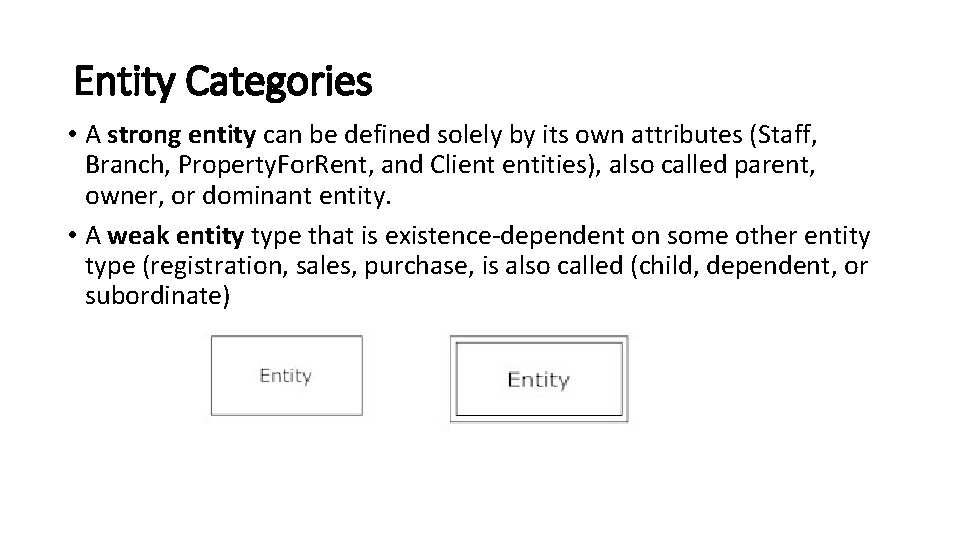
Entity Categories • A strong entity can be defined solely by its own attributes (Staff, Branch, Property. For. Rent, and Client entities), also called parent, owner, or dominant entity. • A weak entity type that is existence-dependent on some other entity type (registration, sales, purchase, is also called (child, dependent, or subordinate)
Entity keys: • Candidate key • Primary key • Foreign key
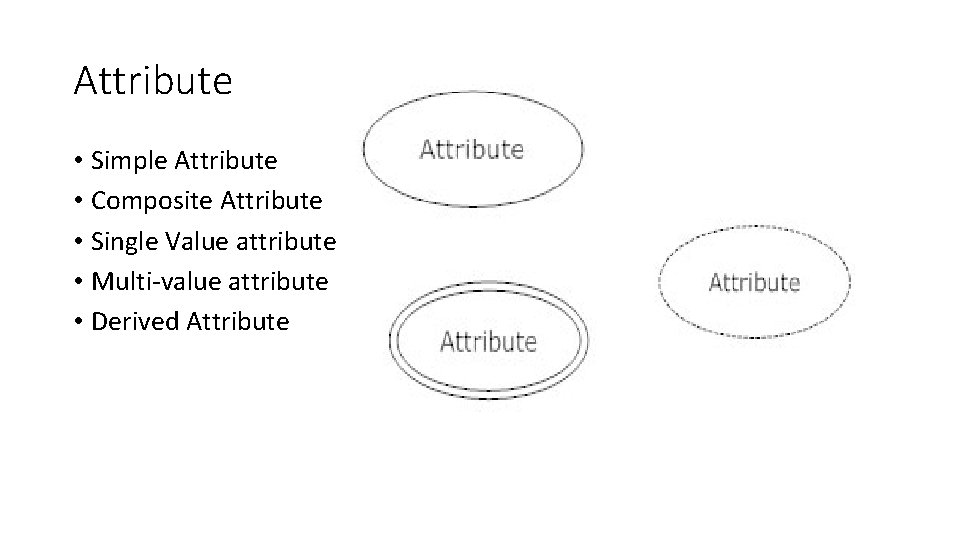
Attribute • Simple Attribute • Composite Attribute • Single Value attribute • Multi-value attribute • Derived Attribute
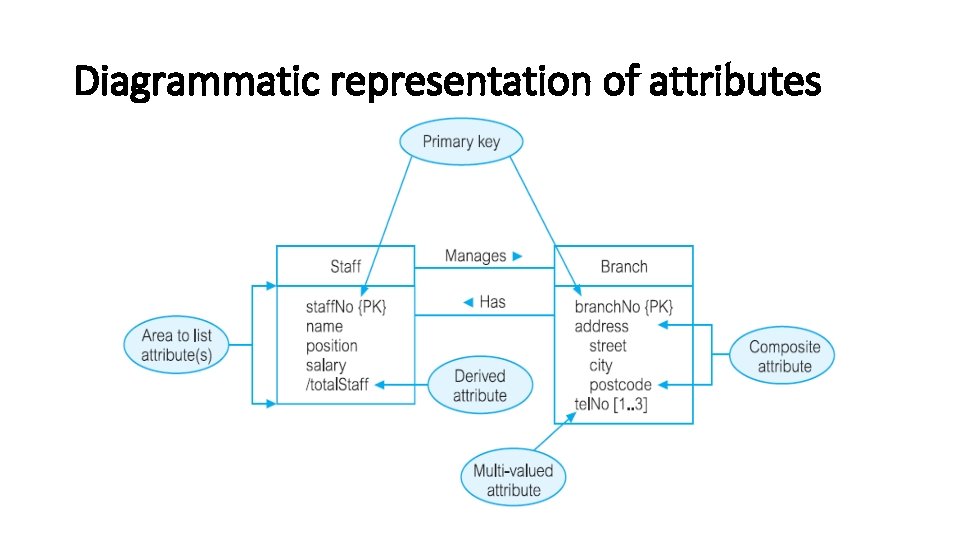
Diagrammatic representation of attributes
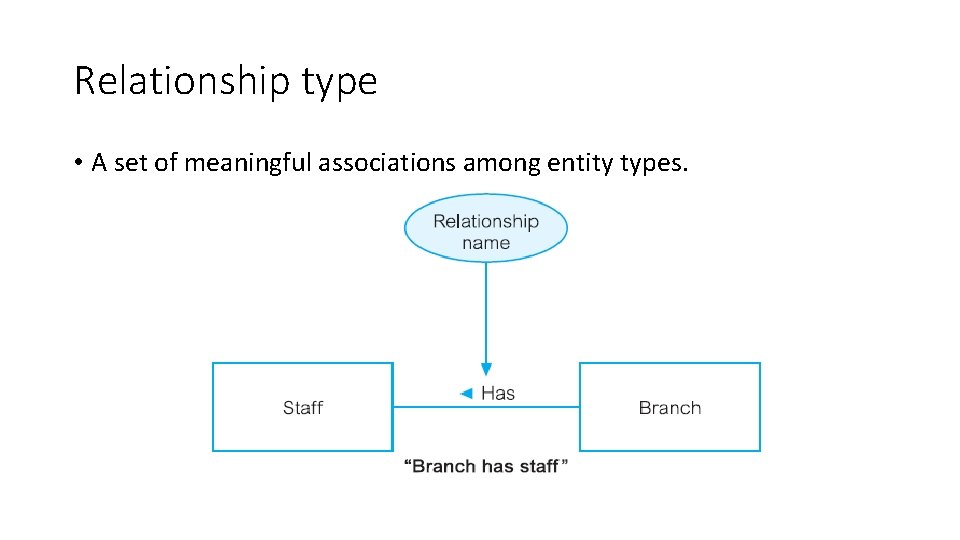
Relationship type • A set of meaningful associations among entity types.
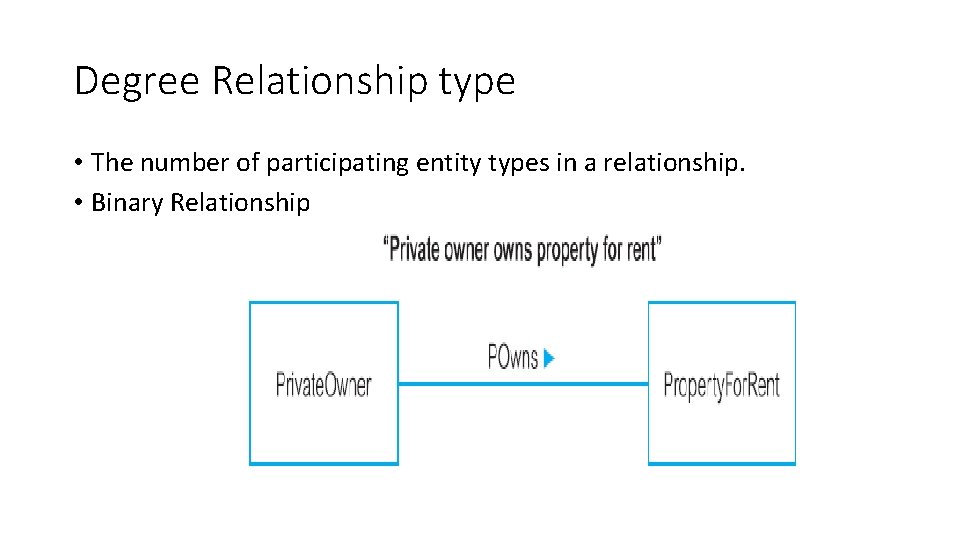
Degree Relationship type • The number of participating entity types in a relationship. • Binary Relationship
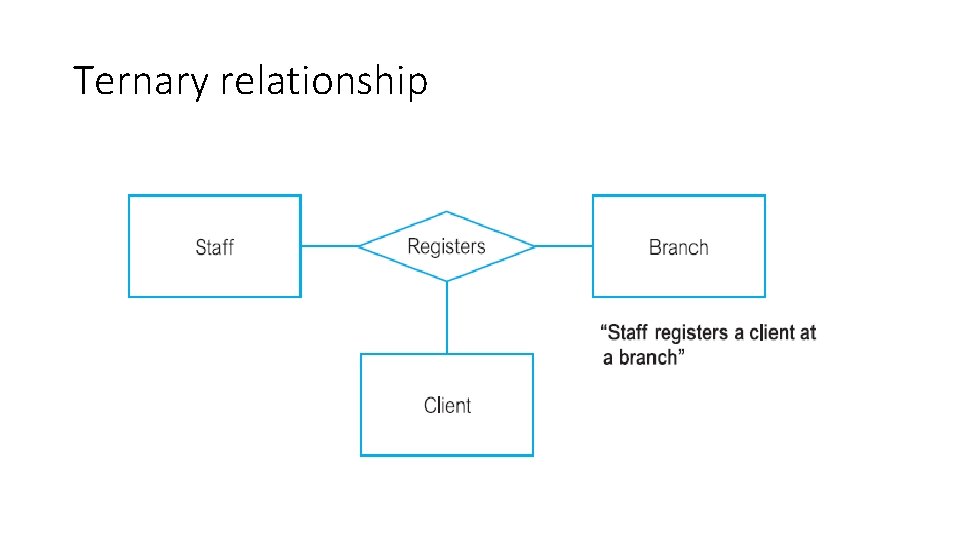
Ternary relationship
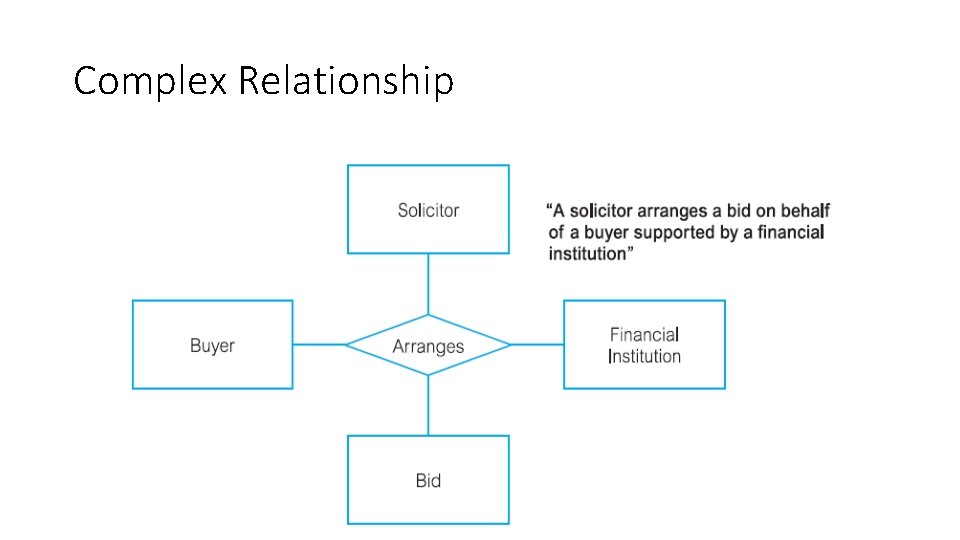
Complex Relationship
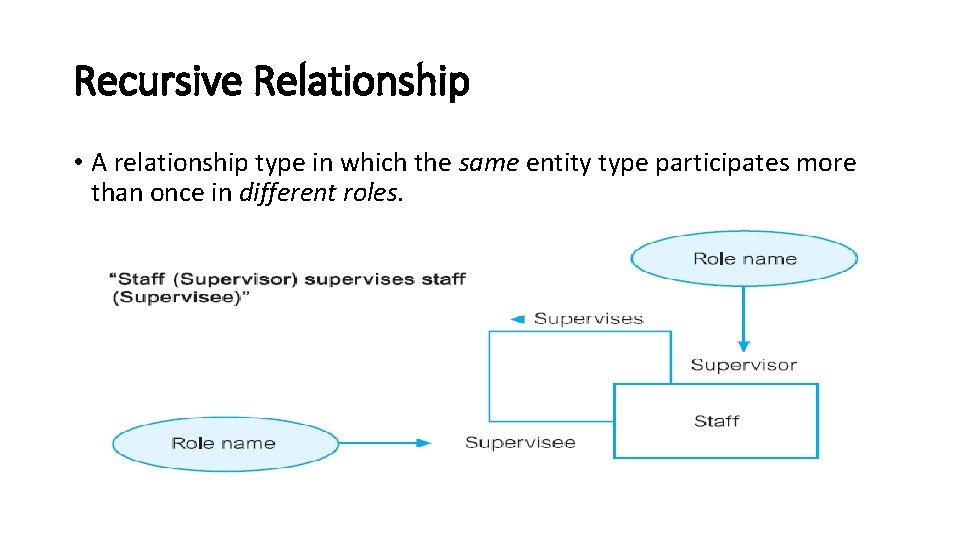
Recursive Relationship • A relationship type in which the same entity type participates more than once in different roles.
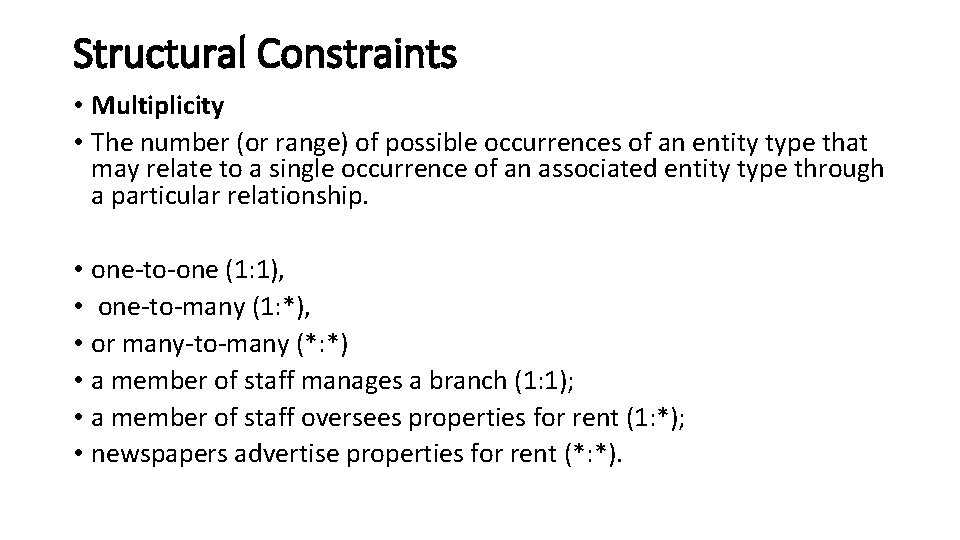
Structural Constraints • Multiplicity • The number (or range) of possible occurrences of an entity type that may relate to a single occurrence of an associated entity type through a particular relationship. • one-to-one (1: 1), • one-to-many (1: *), • or many-to-many (*: *) • a member of staff manages a branch (1: 1); • a member of staff oversees properties for rent (1: *); • newspapers advertise properties for rent (*: *).


- Slides: 34