
Database Design Conceptual Model and ER Diagramming Ray
Database Design: Conceptual Model and ER Diagramming Ray R. Larson University of California, Berkeley School of Information Management and Systems SIMS 257: Database Management IS 257 – Fall 2005 -09 -07 - SLIDE 1
Lecture Outline • Information Systems Planning – Information Systems Architecture – Information Engineering • Database Design • ER Diagrams • Developing the Conceptual Model IS 257 – Fall 2005 -09 -07 - SLIDE 2
Lecture Outline • Information Systems Planning – Information Systems Architecture – Information Engineering • Database Design • ER Diagrams • Developing the Conceptual Model IS 257 – Fall 2005 -09 -07 - SLIDE 3
Information Systems Planning • Scope of IS is now the entire organization • Sometimes called “enterprise-wide” computing • Problem: isolated groups in an organization start their own databases and it becomes impossible to find out who has what information, where there are overlaps, and to assess the accuracy of the information IS 257 – Fall 2005 -09 -07 - SLIDE 4
Information Systems Planning • To support enterprise-wide computing, there must be enterprise-wide information planning • One framework for thinking about and planning for enterprise-wide computing is an Information Systems Architecture or ISA • Most organizations do NOT have such an architecture IS 257 – Fall 2005 -09 -07 - SLIDE 5
Information Systems Architecture • An ISA is a “conceptual blueprint or plan that expresses the desired future structure for information systems in an organization” • It provides a “context within which managers throughout the organization can make consistent decisions concerning their information systems” – Quotes from Mc. Fadden (Modern Database Management, 4 th edition), Ch. 3 IS 257 – Fall 2005 -09 -07 - SLIDE 6
Information Systems Architecture • Benefits of ISA: – “Provides a basis for strategic planning of IS – Provides a basis for communicating with top management and a context for budget decisions concerning IS – Provides a unifying concept for the various stakeholders in information systems. – Communicates the overall direction for information technology and a context for decisions in this area – Helps achieve information integration when systems are distributed (increasing important in a global economy) – Provides a basis for evaluating technology options (for example, downsizing and distributed processing)” • Read Chapter 2 in Hoffer… IS 257 – Fall 2005 -09 -07 - SLIDE 7
Information Systems Architecture • Zachman ISA Framework components – Data • The “what” of the information system – Process • The “how” of the information system – Network • The “where” of the information system – People • Who performs processes and are the source and receiver of data and information. – Events and Points in time • When processes are performed – Reasons • For events and rules that govern processing IS 257 – Fall 2005 -09 -07 - SLIDE 8
Information Engineering • A formal methodology that is used to create and maintain information systems • Starts with the Business Model and works in a Top-Down fashion to build supporting data models and process models for that business model IS 257 – Fall 2005 -09 -07 - SLIDE 9
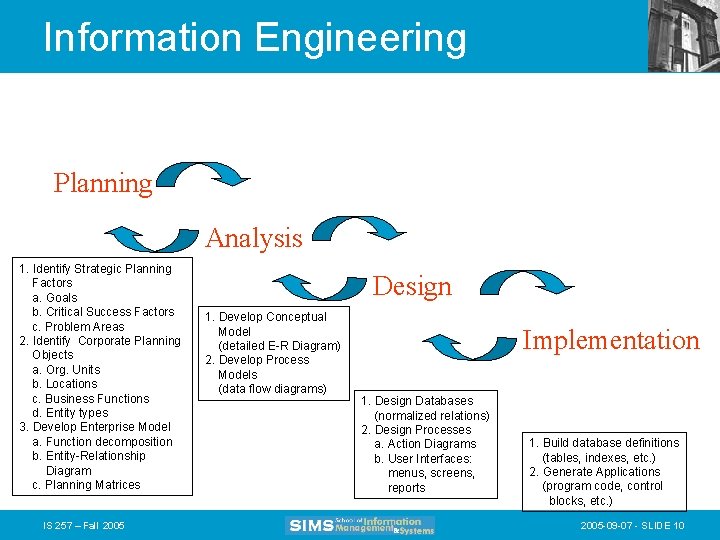
Information Engineering Planning Analysis 1. Identify Strategic Planning Factors a. Goals b. Critical Success Factors c. Problem Areas 2. Identify Corporate Planning Objects a. Org. Units b. Locations c. Business Functions d. Entity types 3. Develop Enterprise Model a. Function decomposition b. Entity-Relationship Diagram c. Planning Matrices IS 257 – Fall 2005 Design 1. Develop Conceptual Model (detailed E-R Diagram) 2. Develop Process Models (data flow diagrams) Implementation 1. Design Databases (normalized relations) 2. Design Processes a. Action Diagrams b. User Interfaces: menus, screens, reports 1. Build database definitions (tables, indexes, etc. ) 2. Generate Applications (program code, control blocks, etc. ) 2005 -09 -07 - SLIDE 10
Focus • In this course we will focus on the design aspects for databases • We will NOT focus on interaction design or interface design (That is covered in other courses) IS 257 – Fall 2005 -09 -07 - SLIDE 11
Lecture Outline • Information Systems Planning – Information Systems Architecture – Information Engineering • Database Design • ER Diagrams • Developing the Conceptual Model IS 257 – Fall 2005 -09 -07 - SLIDE 12
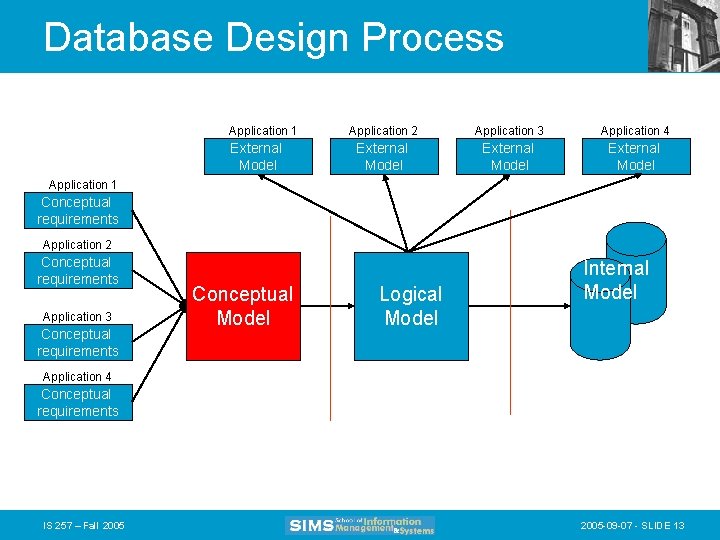
Database Design Process Application 1 External Model Application 2 Application 3 Application 4 External Model Application 1 Conceptual requirements Application 2 Conceptual requirements Application 3 Conceptual requirements Conceptual Model Logical Model Internal Model Application 4 Conceptual requirements IS 257 – Fall 2005 -09 -07 - SLIDE 13
Stages in Database Design • • Requirements formulation and analysis Conceptual Design -- Conceptual Model Implementation Design -- Logical Model Physical Design --Physical Model IS 257 – Fall 2005 -09 -07 - SLIDE 14
Database Design Process • Requirements formulation and analysis – Purpose: Identify and describe the data that are used by the organization – Results: Metadata identified, Data Dictionary, Conceptual Model-- ER diagram IS 257 – Fall 2005 -09 -07 - SLIDE 15
Database Design Process • Requirements Formulation and analysis – Systems Analysis Process • Examine all of the information sources used in existing applications • Identify the characteristics of each data element – – numeric text date/time etc. • Examine the tasks carried out using the information • Examine results or reports created using the information IS 257 – Fall 2005 -09 -07 - SLIDE 16
Database Design Process • Conceptual Model – Merge the collective needs of all applications – Determine what Entities are being used • Some object about which information is to maintained – What are the Attributes of those entities? • Properties or characteristics of the entity • What attributes uniquely identify the entity – What are the Relationships between entities • How the entities interact with each other? IS 257 – Fall 2005 -09 -07 - SLIDE 17
Database Design Process • Logical Model – How is each entity and relationship represented in the Data Model of the DBMS • • IS 257 – Fall 2005 Hierarchic? Network? Relational? Object-Oriented? 2005 -09 -07 - SLIDE 18
Database Design Process • Physical (AKA Internal) Model – Choices of index file structure – Choices of data storage formats – Choices of disk layout IS 257 – Fall 2005 -09 -07 - SLIDE 19
Database Design Process • External Model – User views of the integrated database – Making the old (or updated) applications work with the new database design IS 257 – Fall 2005 -09 -07 - SLIDE 20
Lecture Outline • Review – Information Systems Planning – Information Systems Architecture – Information Engineering • Database Design • ER Diagrams • Developing the Conceptual Model IS 257 – Fall 2005 -09 -07 - SLIDE 21
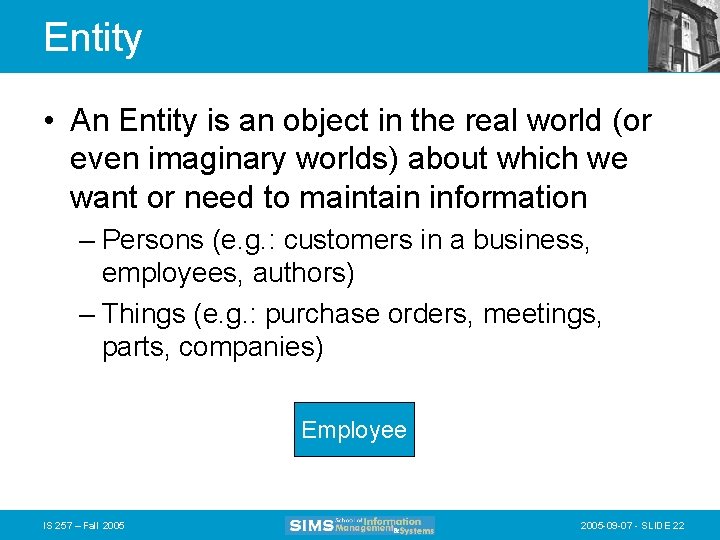
Entity • An Entity is an object in the real world (or even imaginary worlds) about which we want or need to maintain information – Persons (e. g. : customers in a business, employees, authors) – Things (e. g. : purchase orders, meetings, parts, companies) Employee IS 257 – Fall 2005 -09 -07 - SLIDE 22
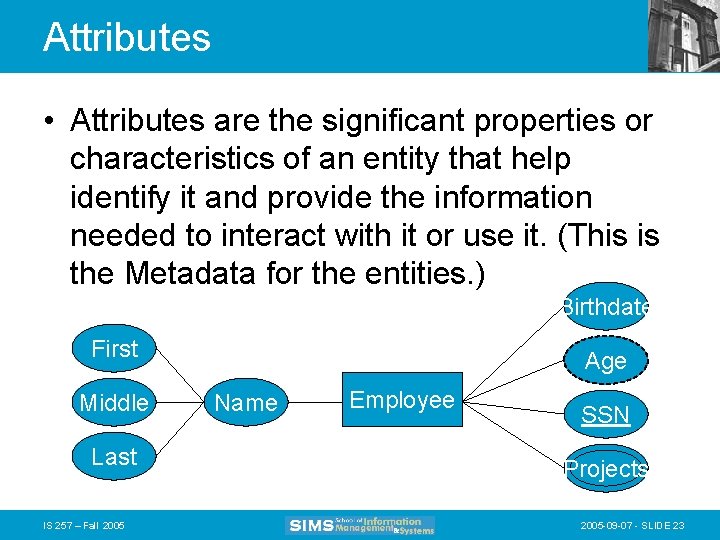
Attributes • Attributes are the significant properties or characteristics of an entity that help identify it and provide the information needed to interact with it or use it. (This is the Metadata for the entities. ) Birthdate First Middle Last IS 257 – Fall 2005 Age Name Employee SSN Projects 2005 -09 -07 - SLIDE 23
Relationships • Relationships are the associations between entities. They can involve one or more entities and belong to particular relationship types IS 257 – Fall 2005 -09 -07 - SLIDE 24
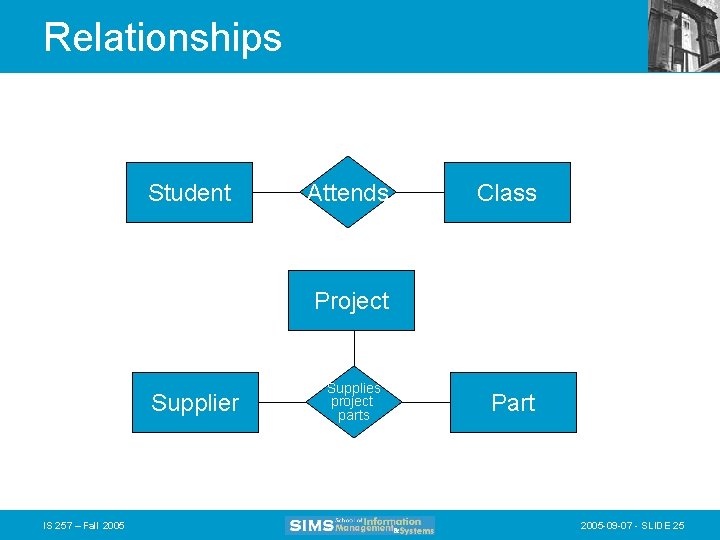
Relationships Student Attends Class Project Supplier IS 257 – Fall 2005 Supplies project parts Part 2005 -09 -07 - SLIDE 25
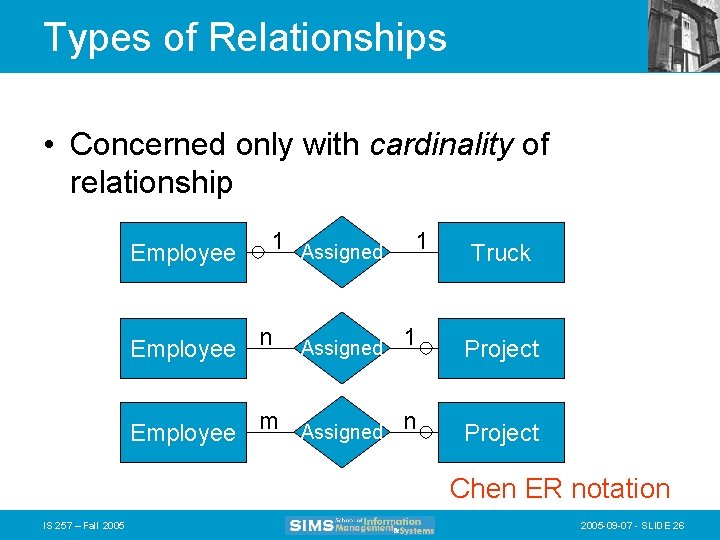
Types of Relationships • Concerned only with cardinality of relationship Employee 1 Assigned n Assigned 1 1 m Assigned n Truck Project Chen ER notation IS 257 – Fall 2005 -09 -07 - SLIDE 26
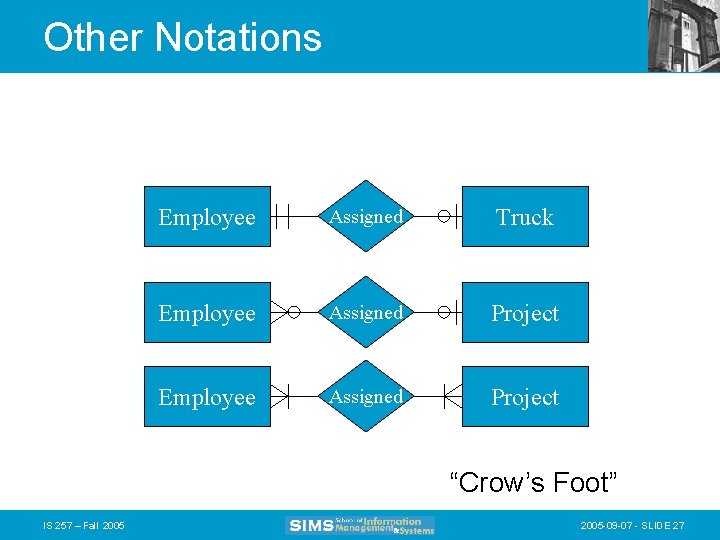
Other Notations Employee Assigned Truck Employee Assigned Project “Crow’s Foot” IS 257 – Fall 2005 -09 -07 - SLIDE 27
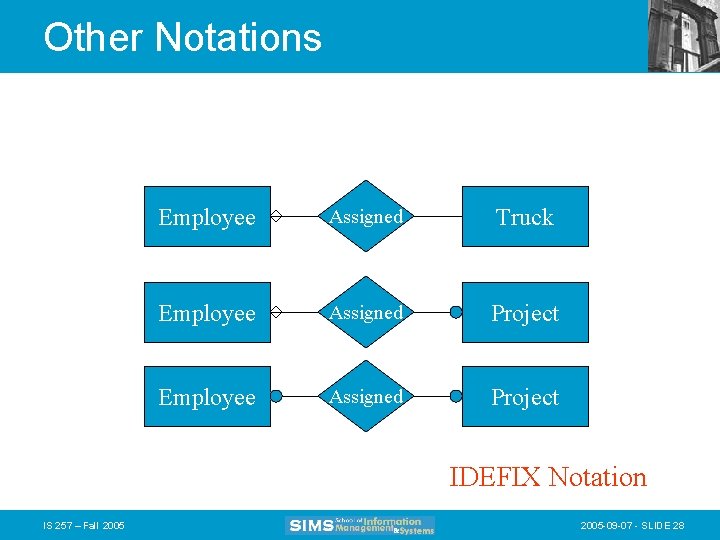
Other Notations Employee Assigned Truck Employee Assigned Project IDEFIX Notation IS 257 – Fall 2005 -09 -07 - SLIDE 28
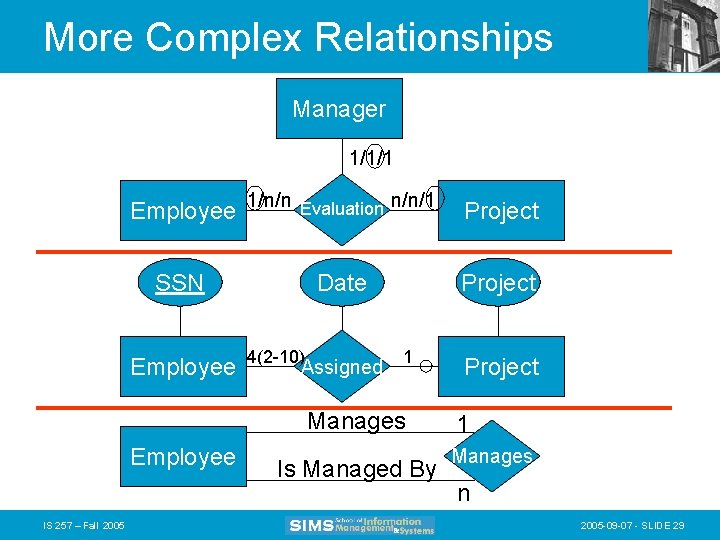
More Complex Relationships Manager 1/1/1 Employee 1/n/n Evaluation n/n/1 Project SSN Date Project Employee 4(2 -10) Assigned 1 Manages Employee IS 257 – Fall 2005 Is Managed By Project 1 Manages n 2005 -09 -07 - SLIDE 29
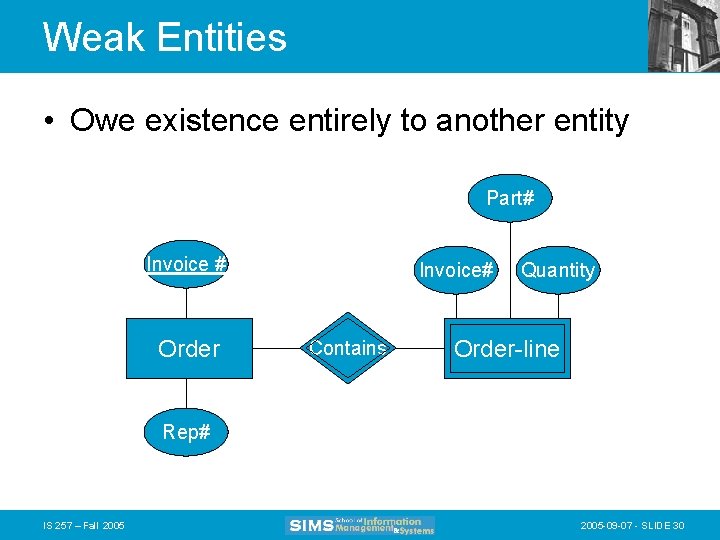
Weak Entities • Owe existence entirely to another entity Part# Invoice # Order Invoice# Contains Quantity Order-line Rep# IS 257 – Fall 2005 -09 -07 - SLIDE 30
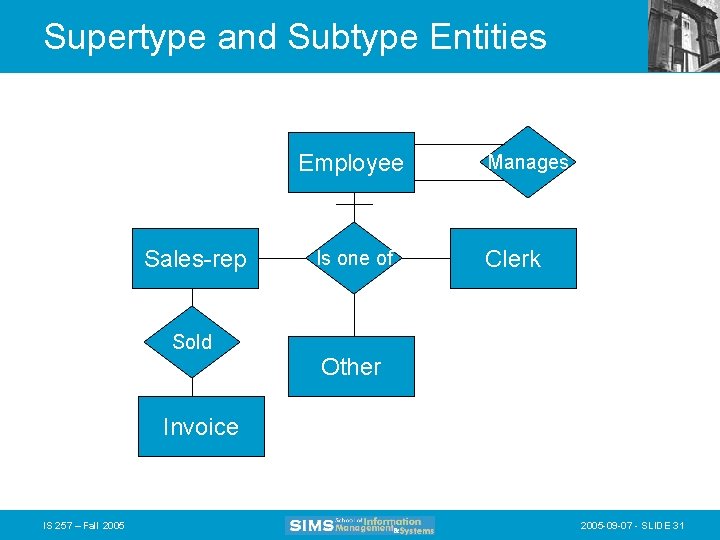
Supertype and Subtype Entities Employee Sales-rep Sold Is one of Manages Clerk Other Invoice IS 257 – Fall 2005 -09 -07 - SLIDE 31
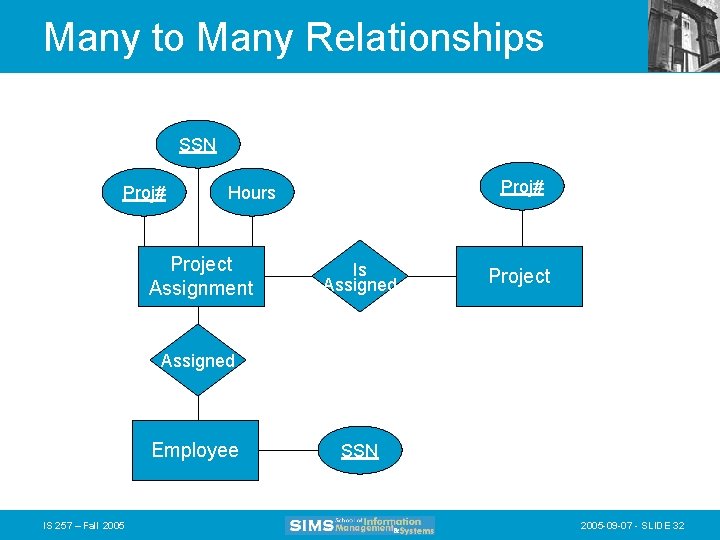
Many to Many Relationships SSN Proj# Hours Project Assignment Is Assigned Project Assigned Employee IS 257 – Fall 2005 SSN 2005 -09 -07 - SLIDE 32
Lecture Outline • Review – Information Systems Planning – Information Systems Architecture – Information Engineering • Database Design • ER Diagrams • Developing the Conceptual Model IS 257 – Fall 2005 -09 -07 - SLIDE 33
Developing a Conceptual Model • Overall view of the database that integrates all the needed information discovered during the requirements analysis. • Elements of the Conceptual Model are represented by diagrams, Entity-Relationship or ER Diagrams, that show the meanings and relationships of those elements independent of any particular database systems or implementation details. • Can also be represented using other modeling tools (such as UML) IS 257 – Fall 2005 -09 -07 - SLIDE 34
Developing a Conceptual Model • Building the Conceptual Model for the Diveshop database IS 257 – Fall 2005 -09 -07 - SLIDE 35
Developing a Conceptual Model • We will look at a small business -- a diveshop that offers diving adventure vacations • Assume that we have done interviews with the business and found out the following information about the forms used and types of information kept in files and used for business operations. . . IS 257 – Fall 2005 -09 -07 - SLIDE 36
Primary Business Operations • The shop takes orders from customers for dive vacations. • It ships information about the dive vacation to the customers. • It rents diving equipment for the divers going on the trips (these may include additional people other than the customer) • It bills the customer for the vacation and for equipment rental or sales. IS 257 – Fall 2005 -09 -07 - SLIDE 37
Business Operations (cont. ) • It arranges sub-trips to particular dive sites at the primary location – NOTE: This needs expanding – charter boats, divemasters, local dive companies • It provides information about the features of various sites to help customers choose their destinations. – Features include sea life found at the location and shipwrecks IS 257 – Fall 2005 -09 -07 - SLIDE 38
Business Operations (cont. ) • Each dive order (or sale or trip) is on an invoice to one customer. – Invoices contain: • Line items for each type of equipment ordered, • Total amount due for the invoice, • Customer information: – Name, address, phone, credit card info. • Note: could be expanded with particular charter dates and time, dive boats, etc. • Information must be kept on inventory of dive equipment. • There are multiple types of dive equipment: – The prices charged for sale or rental are maintained. IS 257 – Fall 2005 -09 -07 - SLIDE 39
Business Operations (cont. ) • Destination information includes: – Name of the destination – information about the location (accomodations, night life, travel cost, average temperatures for different times of the year • Destinations have associated dive sites. • Dive Sites have associated features – Sea life – Shipwrecks – Note: could be expanded to include the boats, etc that go to specific sites IS 257 – Fall 2005 -09 -07 - SLIDE 40
Business Operations (cont. ) • One record is kept for each order by a customer and will include the method of payment, total price, and location information. (I. e. Customers may have multiple orders) • The company needs to know how an order is to be shipped. • The shop has to keep track of what equipment is on-hand when replacements or additional equipment is needed IS 257 – Fall 2005 -09 -07 - SLIDE 41
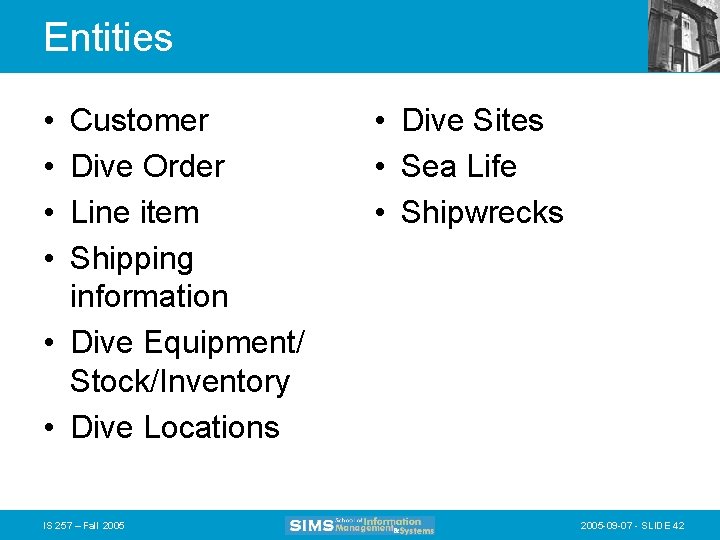
Entities • • Customer Dive Order Line item Shipping information • Dive Equipment/ Stock/Inventory • Dive Locations IS 257 – Fall 2005 • Dive Sites • Sea Life • Shipwrecks 2005 -09 -07 - SLIDE 42
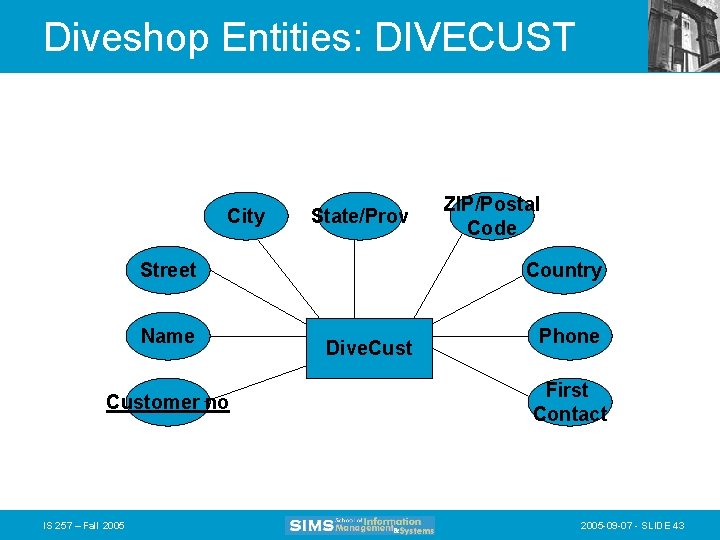
Diveshop Entities: DIVECUST City State/Prov Street Name Customer no IS 257 – Fall 2005 ZIP/Postal Code Country Dive. Cust Phone First Contact 2005 -09 -07 - SLIDE 43
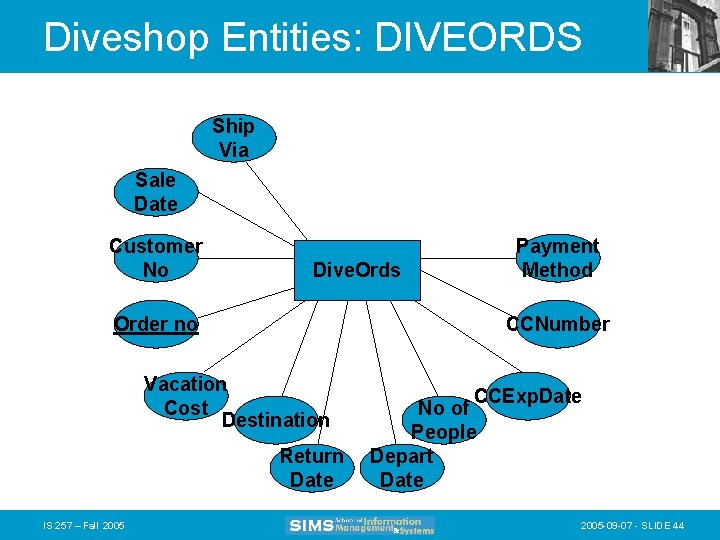
Diveshop Entities: DIVEORDS Ship Via Sale Date Customer No Dive. Ords Order no CCNumber Vacation Cost Destination Return Date IS 257 – Fall 2005 Payment Method CCExp. Date No of People Depart Date 2005 -09 -07 - SLIDE 44
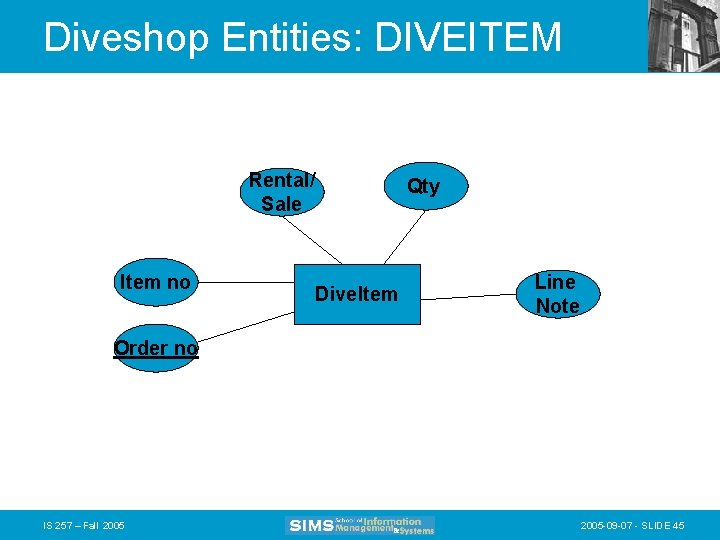
Diveshop Entities: DIVEITEM Rental/ Sale Item no Qty Dive. Item Line Note Order no IS 257 – Fall 2005 -09 -07 - SLIDE 45
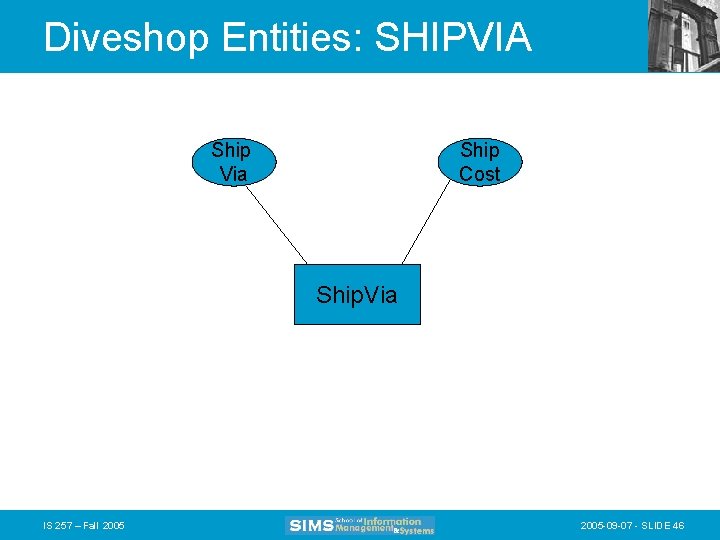
Diveshop Entities: SHIPVIA Ship Via Ship Cost Ship. Via IS 257 – Fall 2005 -09 -07 - SLIDE 46
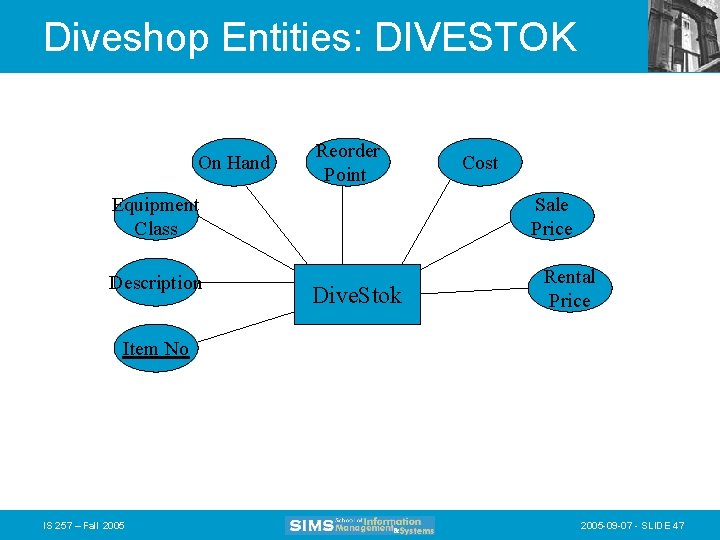
Diveshop Entities: DIVESTOK On Hand Reorder Point Equipment Class Description Cost Sale Price Dive. Stok Rental Price Item No IS 257 – Fall 2005 -09 -07 - SLIDE 47
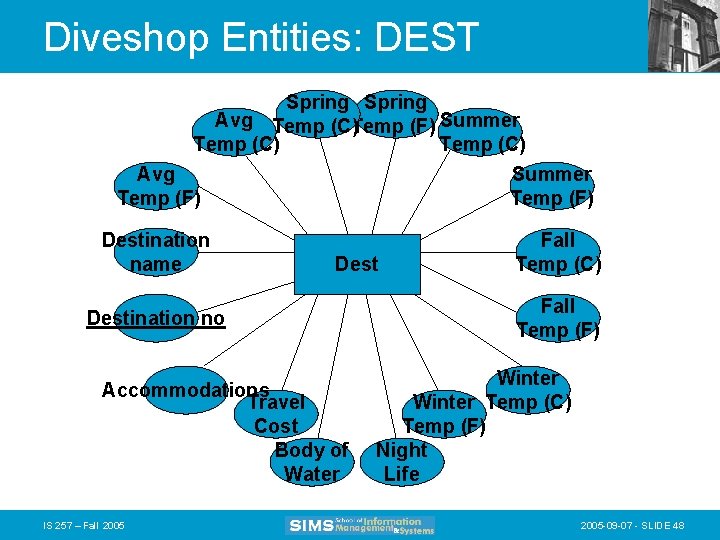
Diveshop Entities: DEST Spring Avg Temp (C)Temp (F) Summer Temp (C) Avg Temp (F) Destination name Summer Temp (F) Destination no Accommodations Travel Cost Body of Water IS 257 – Fall 2005 Fall Temp (C) Fall Temp (F) Winter Temp (C) Temp (F) Night Life 2005 -09 -07 - SLIDE 48
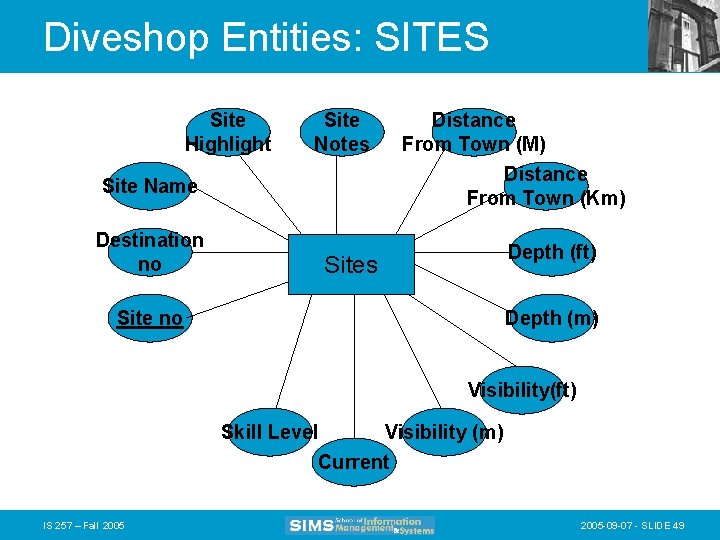
Diveshop Entities: SITES Site Highlight Site Notes Distance From Town (Km) Site Name Destination no Distance From Town (M) Depth (ft) Sites Site no Depth (m) Visibility(ft) Skill Level Visibility (m) Current IS 257 – Fall 2005 -09 -07 - SLIDE 49
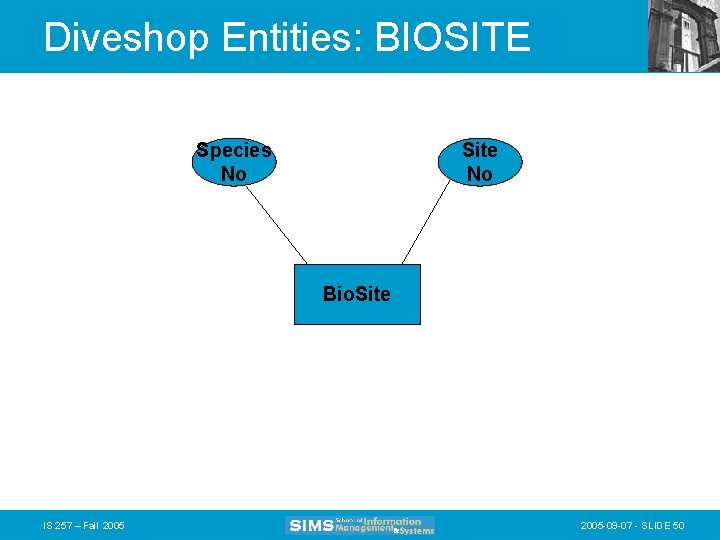
Diveshop Entities: BIOSITE Species No Site No Bio. Site IS 257 – Fall 2005 -09 -07 - SLIDE 50
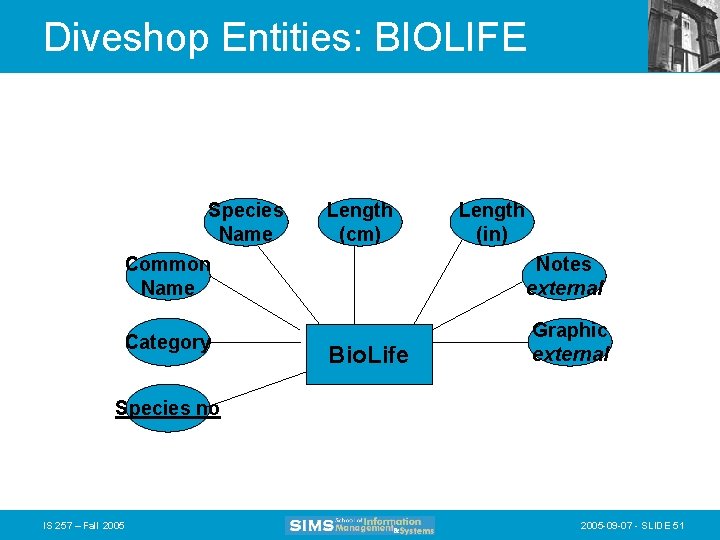
Diveshop Entities: BIOLIFE Species Name Length (cm) Length (in) Common Name Notes external Category Graphic external Bio. Life Species no IS 257 – Fall 2005 -09 -07 - SLIDE 51
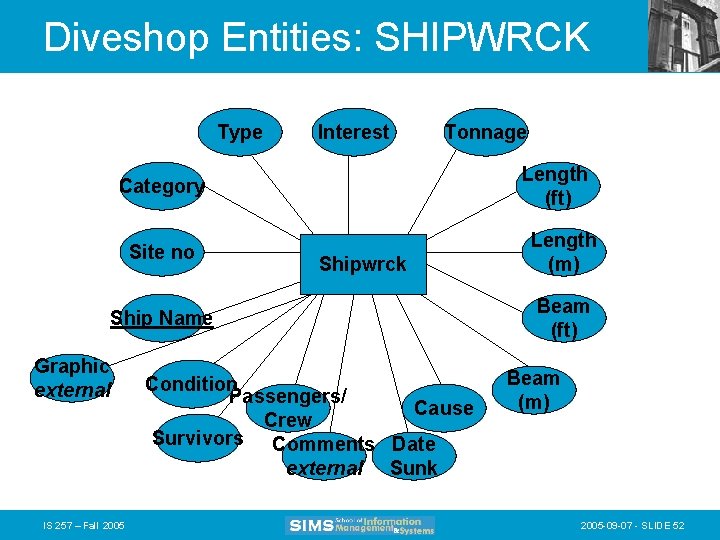
Diveshop Entities: SHIPWRCK Type Interest Tonnage Length (ft) Category Site no Shipwrck Ship Name Graphic external IS 257 – Fall 2005 Condition Passengers/ Cause Crew Survivors Comments Date external Sunk Length (m) Beam (ft) Beam (m) 2005 -09 -07 - SLIDE 52
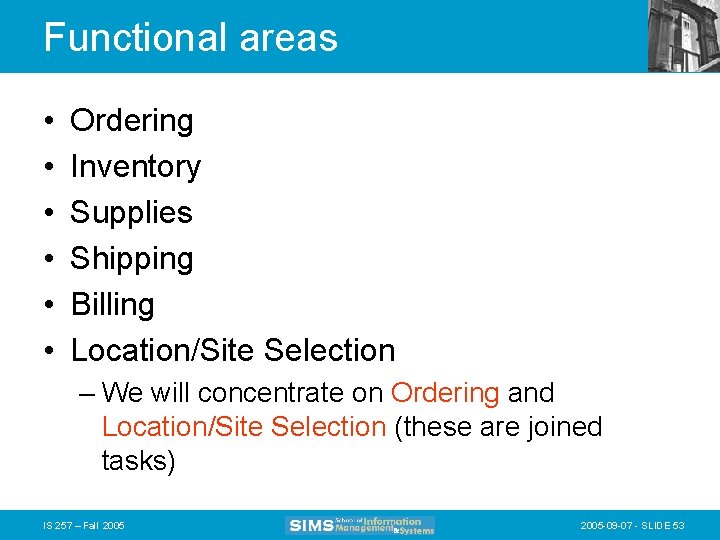
Functional areas • • • Ordering Inventory Supplies Shipping Billing Location/Site Selection – We will concentrate on Ordering and Location/Site Selection (these are joined tasks) IS 257 – Fall 2005 -09 -07 - SLIDE 53
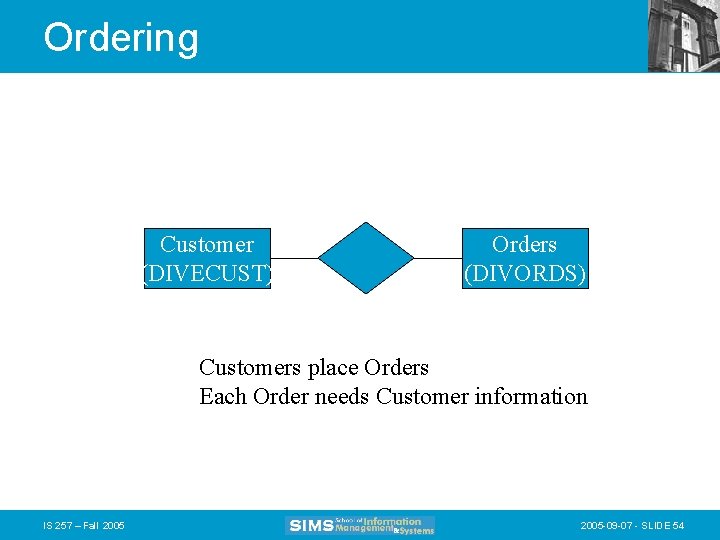
Ordering Customer (DIVECUST) Orders (DIVORDS) Customers place Orders Each Order needs Customer information IS 257 – Fall 2005 -09 -07 - SLIDE 54
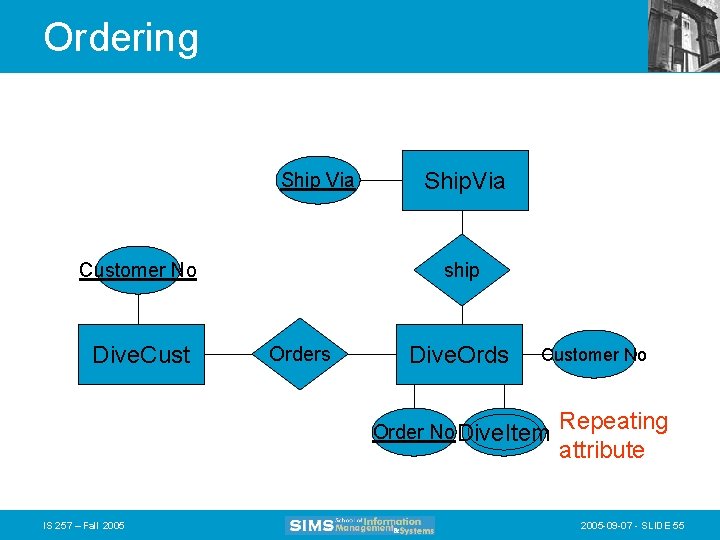
Ordering Ship Via Customer No Dive. Cust Ship. Via ship Orders Dive. Ords Customer No Order No Dive. Item IS 257 – Fall 2005 Repeating attribute 2005 -09 -07 - SLIDE 55
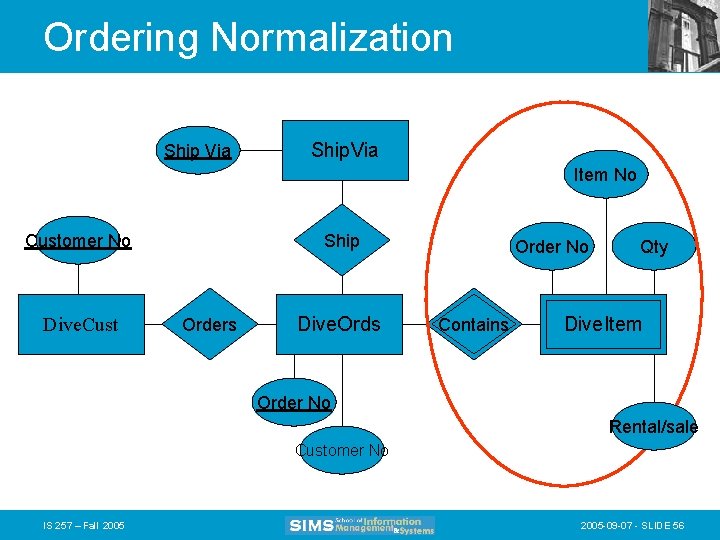
Ordering Normalization Ship Via Ship. Via Item No Customer No Dive. Cust Ship Orders Dive. Ords Order No Contains Qty Dive. Item Order No Rental/sale Customer No IS 257 – Fall 2005 -09 -07 - SLIDE 56
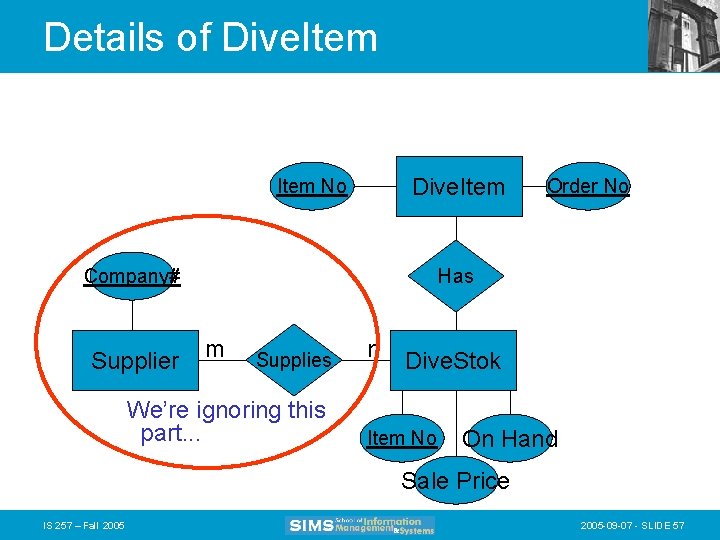
Details of Dive. Item No Company# Supplier Order No Has m Supplies We’re ignoring this part. . . n Dive. Stok Item No On Hand Sale Price IS 257 – Fall 2005 -09 -07 - SLIDE 57
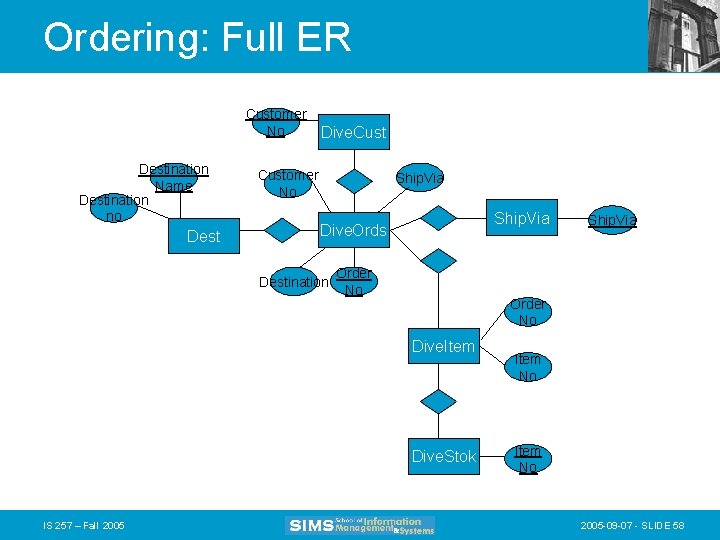
Ordering: Full ER Customer No Destination Name Destination no Dest Dive. Cust 1 Customer No 1 n Ship. Via n Dive. Ords n 1 Ship. Via 1 Destination Order No n Dive. Item n Order No Item No 1 Dive. Stok IS 257 – Fall 2005 Item No 2005 -09 -07 - SLIDE 58
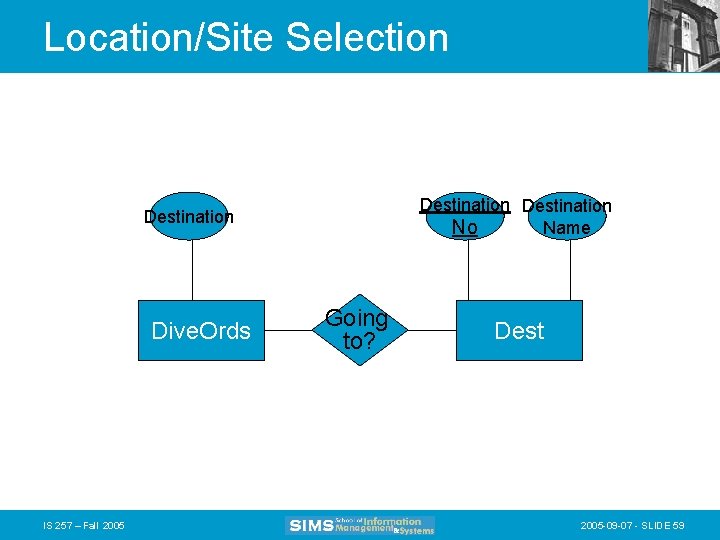
Location/Site Selection Destination Name No Destination Dive. Ords IS 257 – Fall 2005 Going to? Dest 2005 -09 -07 - SLIDE 59
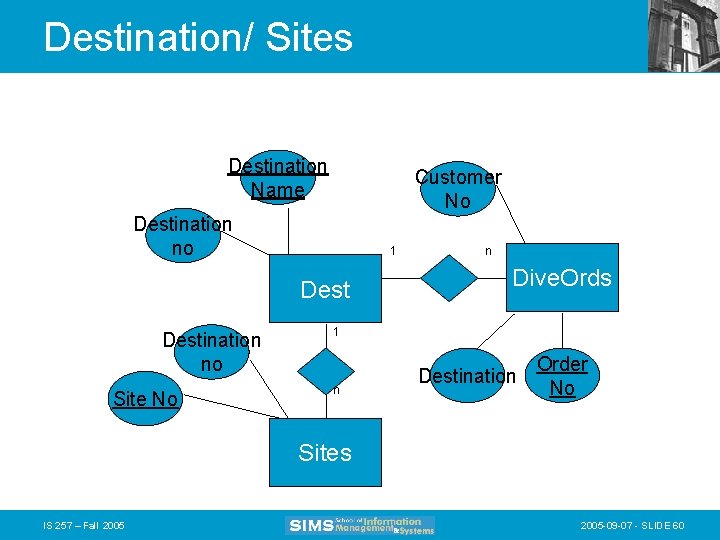
Destination/ Sites Destination Name Customer No Destination no 1 Destination no Site No n Dive. Ords 1 n Destination Order No Sites IS 257 – Fall 2005 -09 -07 - SLIDE 60
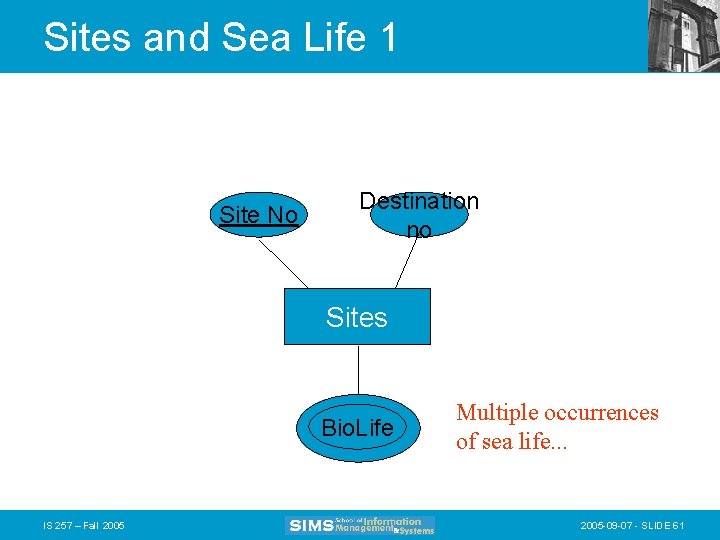
Sites and Sea Life 1 Site No Destination no Sites Bio. Life IS 257 – Fall 2005 Multiple occurrences of sea life. . . 2005 -09 -07 - SLIDE 61
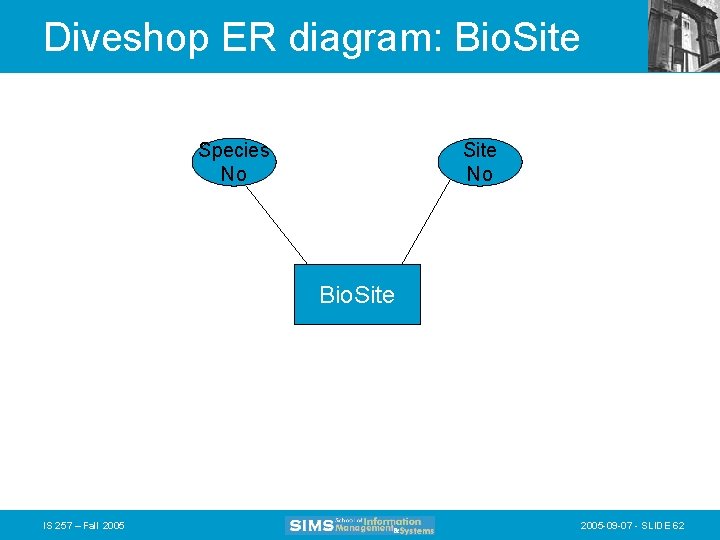
Diveshop ER diagram: Bio. Site Species No Site No Bio. Site IS 257 – Fall 2005 -09 -07 - SLIDE 62
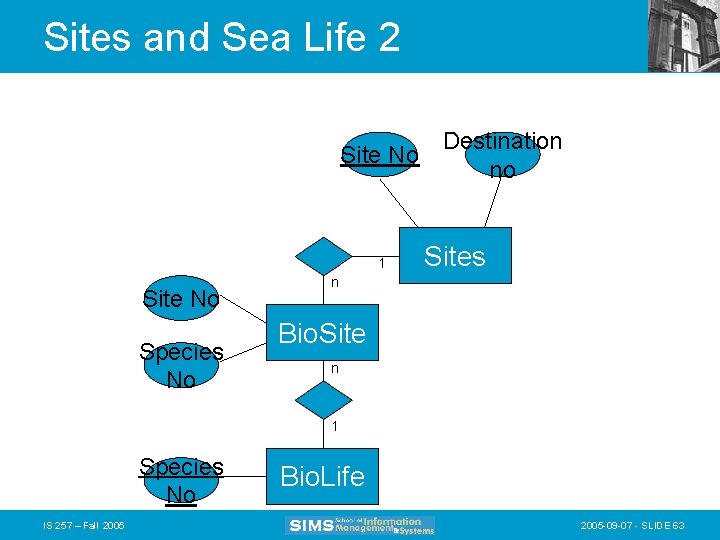
Sites and Sea Life 2 Site No 1 Site No Species No Destination no Sites n Bio. Site n 1 Species No IS 257 – Fall 2005 Bio. Life 2005 -09 -07 - SLIDE 63

Sites and Shipwrecks Site No Destination no Sites 1 1/n Ship. Wrck Site No IS 257 – Fall 2005 -09 -07 - SLIDE 64
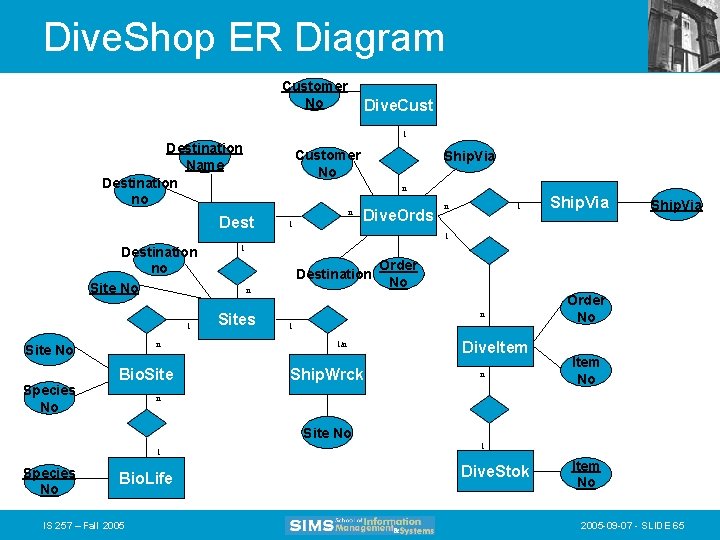
Dive. Shop ER Diagram Customer No Dive. Cust 1 Destination Name Destination no Customer No Ship. Via n Dest n 1 Dive. Ords n 1 Ship. Via 1 Destination no Site No 1 n Site No Species No Bio. Site 1 Destination n Sites Order No n 1 1/n Ship. Wrck Dive. Item n Order No Item No n Site No 1 Species No Bio. Life IS 257 – Fall 2005 1 Dive. Stok Item No 2005 -09 -07 - SLIDE 65
What must be calculated? • Total price for equipment rental? • Total price for equipment sale? • Total price of an order? – Vacation price – Equipment (rental or sale) – Shipping IS 257 – Fall 2005 -09 -07 - SLIDE 66
What is Missing? ? • Not really an “enterprise-wide” database – No personnel • • Sales people Dive masters Boat captains and crew payroll – No Local arrangements • Dive Boats – Charter bookings? • Hotels? – Suppliers/Wholesalers for dive equipment • Orders for new/replacement equipment – No history (only current or last order) IS 257 – Fall 2005 -09 -07 - SLIDE 67
Next Week • More on… – Personal database projects – ER modelling – Designing the Conceptual Model for your personal database projects – Moving from the Conceptual Model to the Logical Model IS 257 – Fall 2005 -09 -07 - SLIDE 68
Assignment 2 • • Due Wednesday Sept. 22 Personal Database Project Design • The following information should be turned in for the preliminary design of your personal database project. 1. A written description of the data you will be using for the database, and what uses you might expect the database to have. (1 -2 pages) 2. A preliminary data dictionary for the entities and attributes and format of the data elements of the database. You should have at least 5 entities with some logical connections between them. The data dictionary consists of all of the attributes that you have identified for each entity, along with indication of whether the attribute is a primary key (or part of a primary key), and what format the data will be (e. g. : text, decimal number, integer, etc. ) 3. Produce an entity-relationship diagram of the database OR a UML diagram. • These will be preliminary design specifications, so do not feel that you must follow everything that you describe here in the final database design. • The report should be printed (no handwritten reports please!). IS 257 – Fall 2005 -09 -07 - SLIDE 69
- Slides: 69