
Data transmission system for 2 D SND at
- Slides: 15
Data transmission system for 2 D -SND at CSNS ZHAO Dongxu 1, 3 ZHANG Hongyu 2, 3 WANG Xiuku 1, 3 TIAN Haolai 1 ZHANG Junrong 1 1, China Spallation Neutron Source (CSNS), Institute of High Energy Physics(IHEP), Chinese Academy of Sciences(CAS), Dongguan 523803, Peoples Republic of China 2, Institute of High Energy Physics (IHEP), Chinese Academy of Sciences (CAS), Beijing 100049, Peoples Republic of China 3, State Key Laboratory of Particle Detection and Electronics, Beijing 100049, Peoples Republic of China
Outline l. Introduction l. About CSNS l. GPPD components l. Implementation of data transmission system l. Data processing framework l. Interface with DAQ l. Interface with data analysis system l. An application l. A neutron beam experiment l. Conclusion
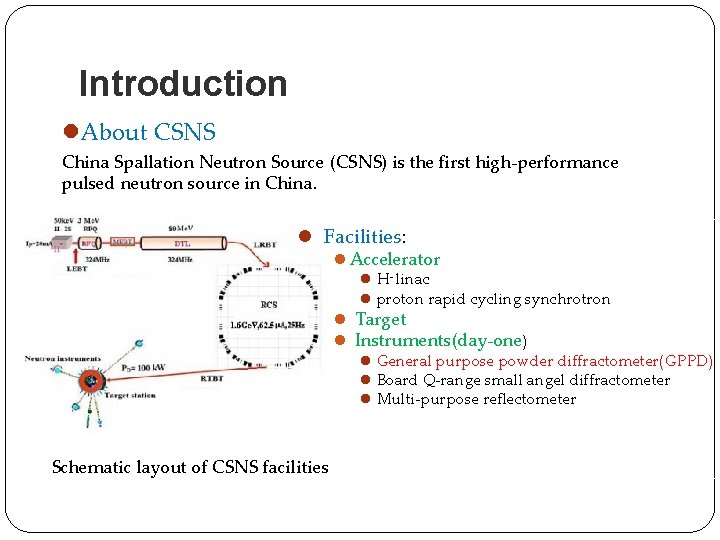
Introduction l. About CSNS China Spallation Neutron Source (CSNS) is the first high-performance pulsed neutron source in China. l Facilities: l l Accelerator l H- linac l proton rapid cycling synchrotron l Target l Instruments(day-one) l General purpose powder diffractometer(GPPD) l Board Q-range small angel diffractometer l Multi-purpose reflectometer Schematic layout of CSNS facilities
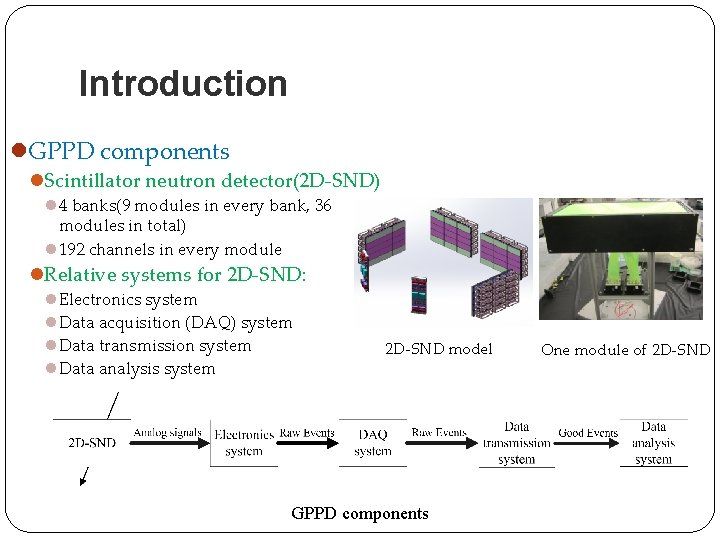
Introduction l. GPPD components l. Scintillator neutron detector(2 D-SND) l 4 banks(9 modules in every bank, 36 modules in total) l 192 channels in every module l. Relative systems for 2 D-SND: l. Electronics system l. Data acquisition (DAQ) system l. Data transmission system l. Data analysis system 2 D-SND model GPPD components One module of 2 D-SND
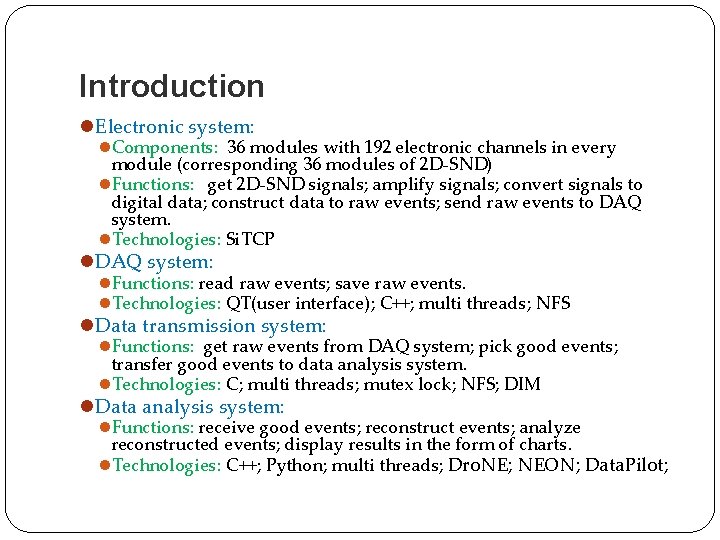
Introduction l Electronic system: l. Components: 36 modules with 192 electronic channels in every module (corresponding 36 modules of 2 D-SND) l. Functions: get 2 D-SND signals; amplify signals; convert signals to digital data; construct data to raw events; send raw events to DAQ system. l. Technologies: Si. TCP l DAQ system: l. Functions: read raw events; save raw events. l. Technologies: QT(user interface); C++; multi threads; NFS l Data transmission system: l. Functions: get raw events from DAQ system; pick good events; transfer good events to data analysis system. l. Technologies: C; multi threads; mutex lock; NFS; DIM l Data analysis system: l. Functions: receive good events; reconstruct events; analyze reconstructed events; display results in the form of charts. l. Technologies: C++; Python; multi threads; Dro. NE; NEON; Data. Pilot;
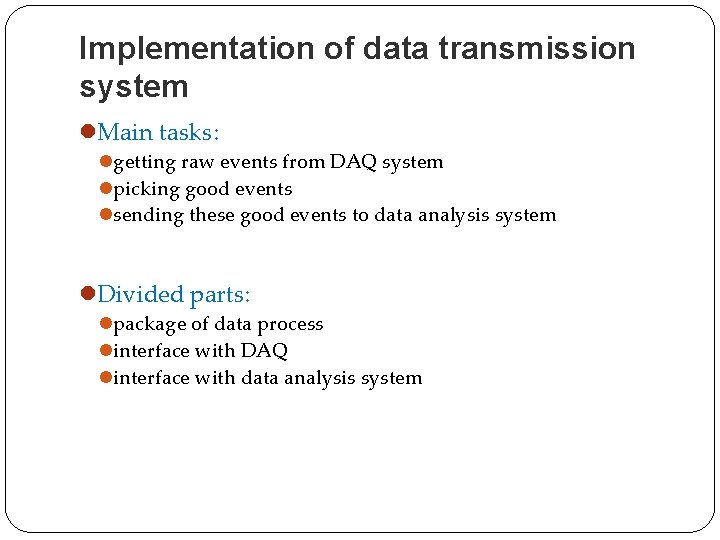
Implementation of data transmission system l. Main tasks: lgetting raw events from DAQ system lpicking good events lsending these good events to data analysis system l. Divided parts: lpackage of data process linterface with DAQ linterface with data analysis system
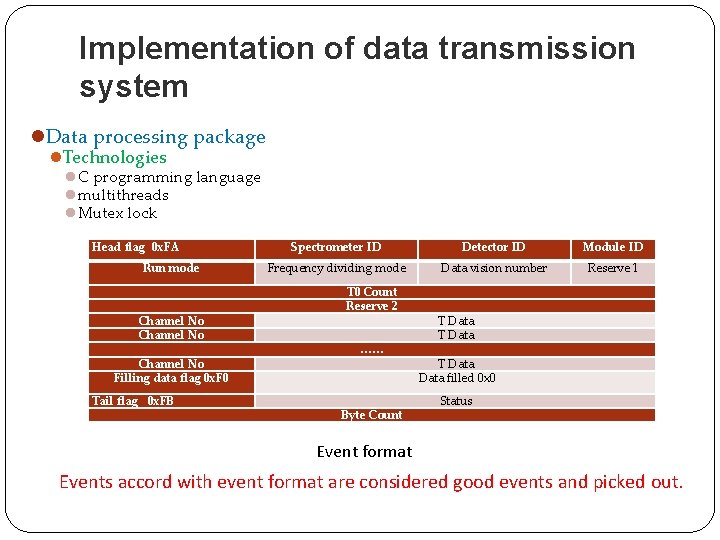
Implementation of data transmission system l Data processing package l. Technologies l C programming language l multithreads l Mutex lock Head flag 0 x. FA Run mode Channel No Filling data flag 0 x. F 0 Tail flag 0 x. FB Spectrometer ID Detector ID Module ID Frequency dividing mode Data vision number Reserve 1 T 0 Count Reserve 2 …… Byte Count T Data filled 0 x 0 Status Event format Events accord with event format are considered good events and picked out.
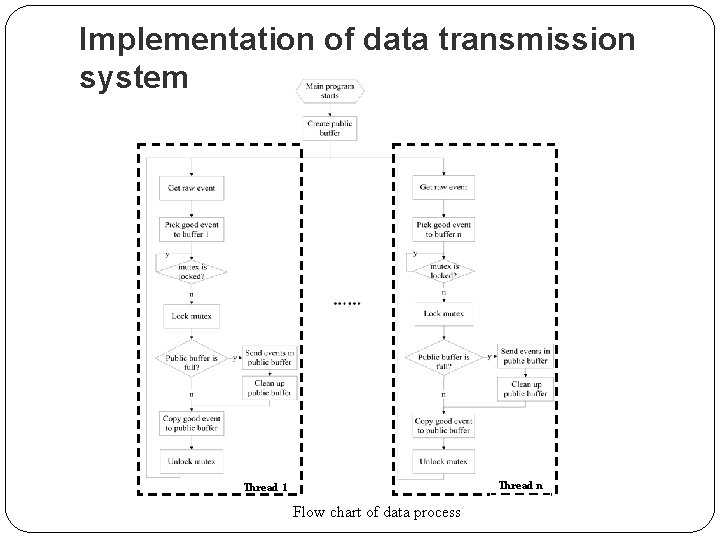
Implementation of data transmission system Thread n Thread 1 Flow chart of data process
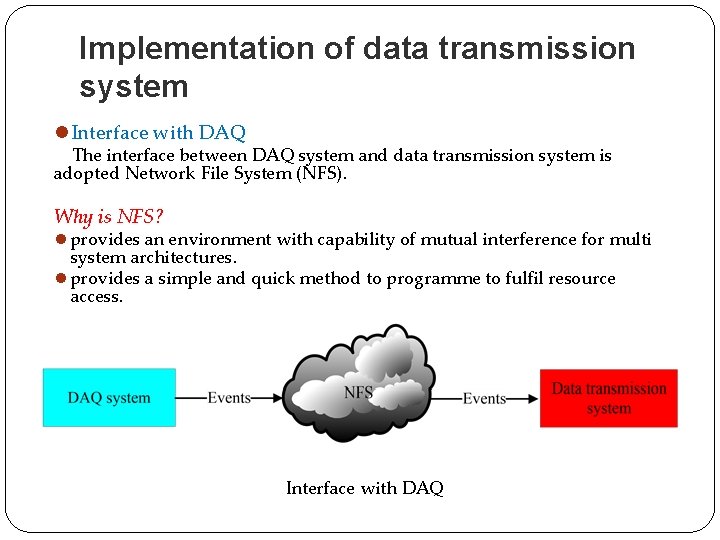
Implementation of data transmission system l Interface with DAQ The interface between DAQ system and data transmission system is adopted Network File System (NFS). Why is NFS? l provides an environment with capability of mutual interference for multi system architectures. l provides a simple and quick method to programme to fulfil resource access. Interface with DAQ
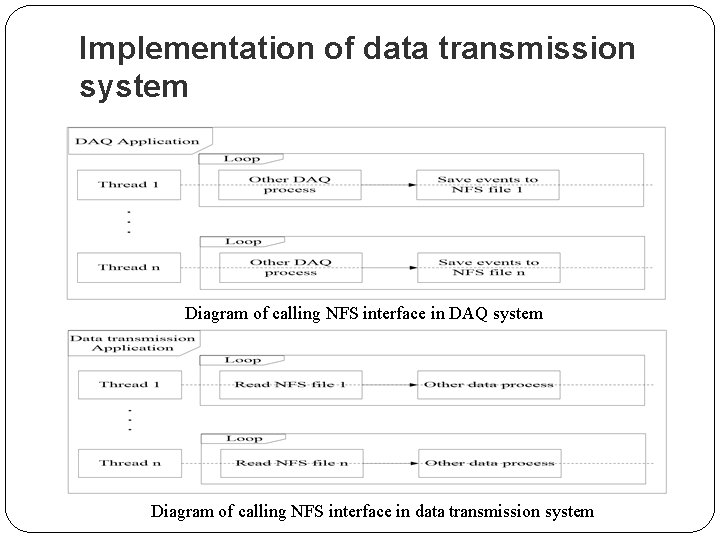
Implementation of data transmission system Diagram of calling NFS interface in DAQ system Diagram of calling NFS interface in data transmission system
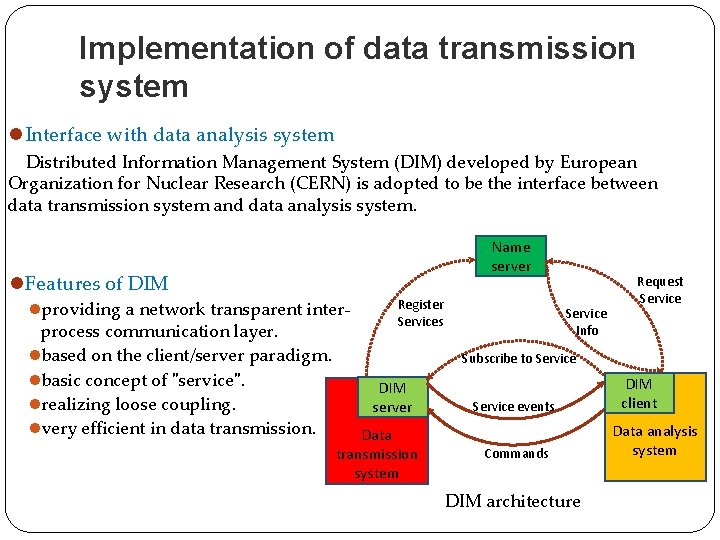
Implementation of data transmission system l Interface with data analysis system Distributed Information Management System (DIM) developed by European Organization for Nuclear Research (CERN) is adopted to be the interface between data transmission system and data analysis system. Name server l Features of DIM Register lproviding a network transparent inter. Services process communication layer. lbased on the client/server paradigm. lbasic concept of "service". DIM lrealizing loose coupling. server lvery efficient in data transmission. Data transmission system Service Info Request Service Subscribe to Service events Commands DIM architecture DIM client Data analysis system
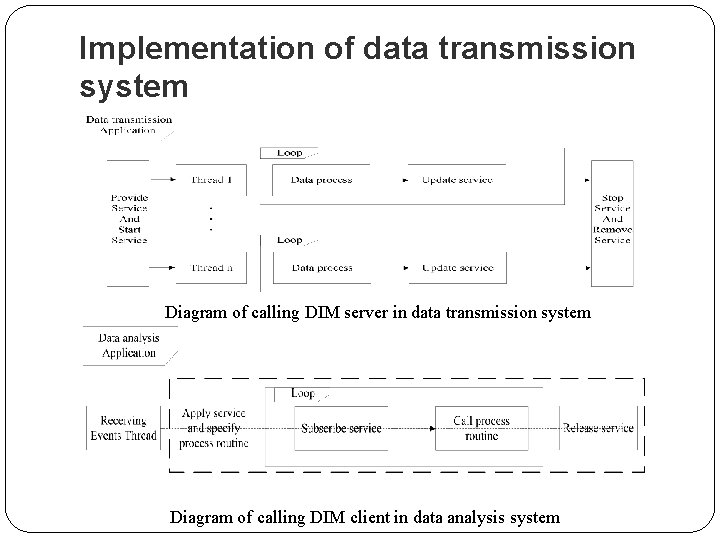
Implementation of data transmission system Diagram of calling DIM server in data transmission system Diagram of calling DIM client in data analysis system
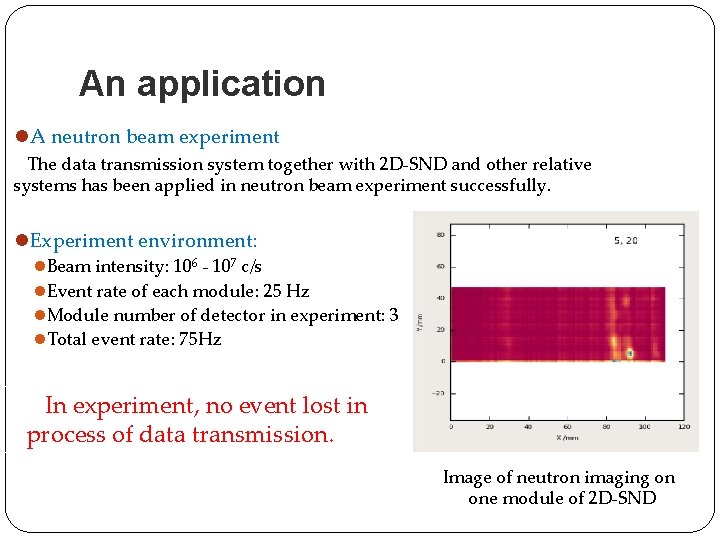
An application l A neutron beam experiment The data transmission system together with 2 D-SND and other relative systems has been applied in neutron beam experiment successfully. l Experiment environment: l. Beam intensity: 106 - 107 c/s l. Event rate of each module: 25 Hz l. Module number of detector in experiment: 3 l. Total event rate: 75 Hz In experiment, no event lost in process of data transmission. Image of neutron imaging on one module of 2 D-SND
Conclusion l. Data transmission system: l. A stable and efficient mechanism to realize credible data transfer. l. With the common framework, can easily be expanded and improved. What can we do in the future? l To fulfil real-time on data transmission and online data analysis, the interface with DAQ system should be improved. l To improve efficiency further, distributed environment should be involved.
Thanks!