
Data transformation speed The speed with which data
- Slides: 25
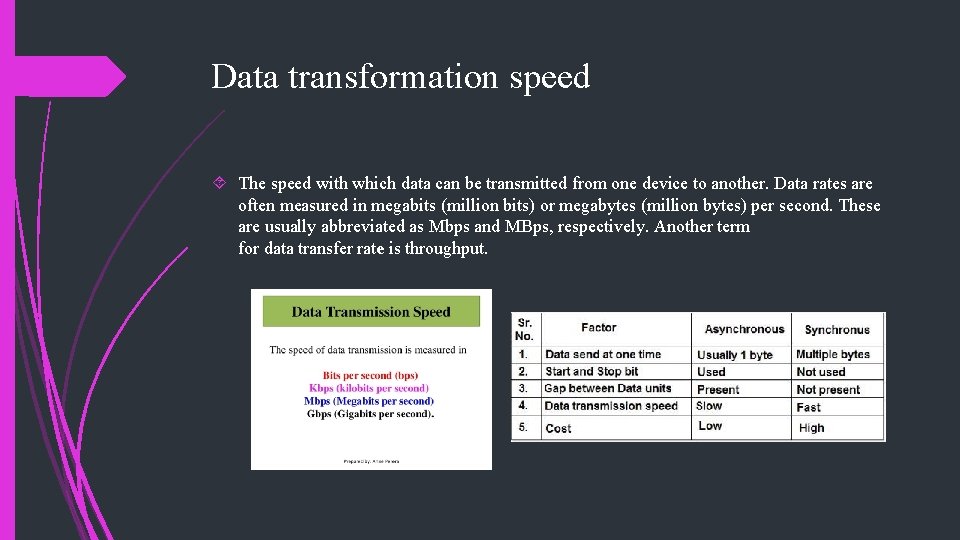
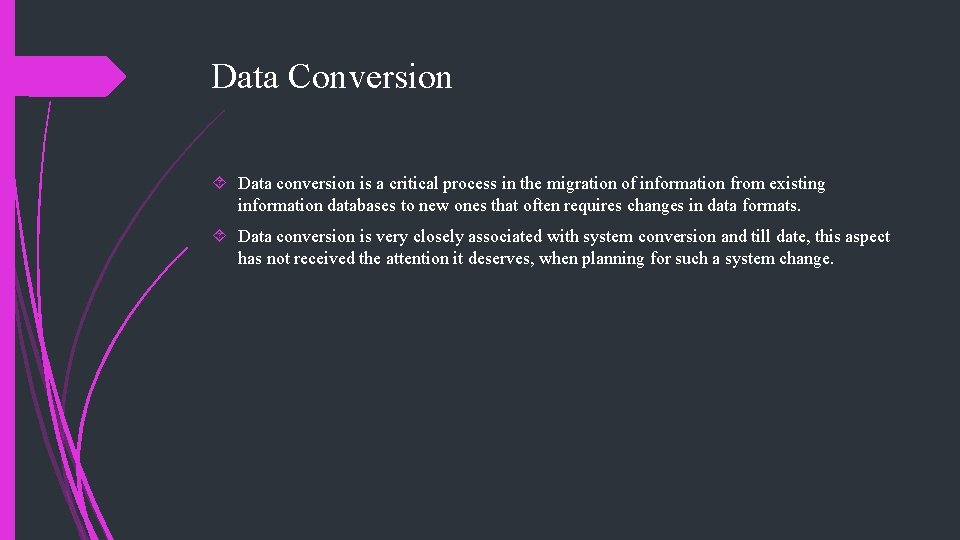
Data transformation speed The speed with which data can be transmitted from one device to another. Data rates are often measured in megabits (million bits) or megabytes (million bytes) per second. These are usually abbreviated as Mbps and MBps, respectively. Another term for data transfer rate is throughput.
Data Conversion Data conversion is a critical process in the migration of information from existing information databases to new ones that often requires changes in data formats. Data conversion is very closely associated with system conversion and till date, this aspect has not received the attention it deserves, when planning for such a system change.
5 Key Strategies of Successful Data Conversion Proper Planning: Successful data conversion requires proper planning. Any data conversion project needs to start with defining the boundaries of the project. You can plan your project by asking a variety of questions to define these boundaries. These include: What kind of data needs to be converted? What is the quality of data and its availability? Does it require full or partial conversion? Which data should be moved to the new database? Which data should not be moved?
5 Key Strategies of Successful Data Conversion Ensure Business Engagement: Sometimes, those in the business side of the organization do not understand the importance of data conversion. It is important to make them understand the importance of data conversion in data processing and management: about how the quality of data conversion can affect subsequent processes that makes use of this data. Data conversion is thus, a task critical from both business and technical perspectives.
5 Key Strategies of Successful Data Conversion Implement Data Standards: Defining and implementing data quality standards helps to ensure consistency across the different databases. Consistently measure and track data quality and constantly check the effect on the business value. (hyperlink to article on data quality impact on business value).
5 Key Strategies of Successful Data Conversion Data Profiling and Cleansing: Ensure that proper data profiling and data cleansing procedures are in place so that the original data is of high quality. This helps to smoothen out the subsequent data conversion procedures. Data Management and Data Governance: Following data conversion, ensure that the duplicate master data is eliminated, reducing the risk of incorrect transactions and unreliable reports. The project should satisfy all principles of data management and data governance.
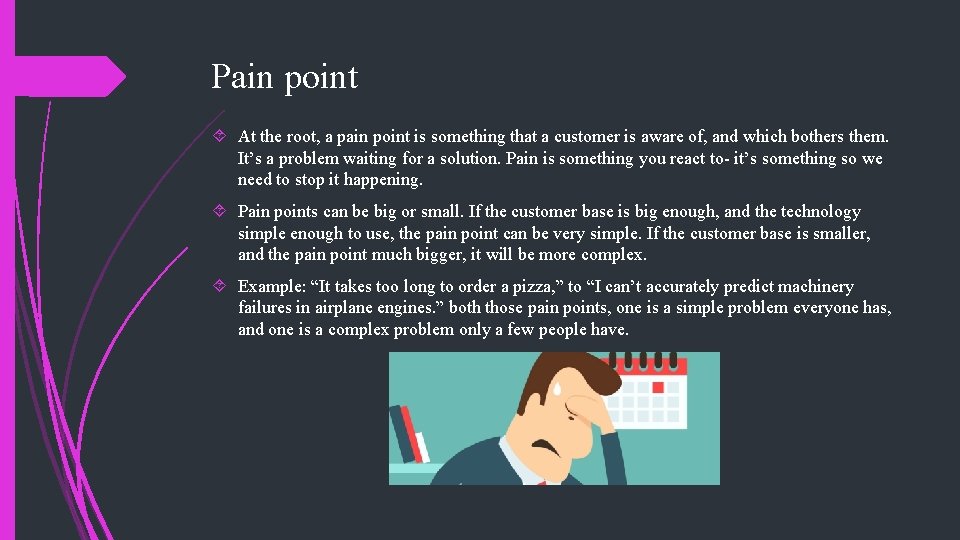
Pain point At the root, a pain point is something that a customer is aware of, and which bothers them. It’s a problem waiting for a solution. Pain is something you react to- it’s something so we need to stop it happening. Pain points can be big or small. If the customer base is big enough, and the technology simple enough to use, the pain point can be very simple. If the customer base is smaller, and the pain point much bigger, it will be more complex. Example: “It takes too long to order a pizza, ” to “I can’t accurately predict machinery failures in airplane engines. ” both those pain points, one is a simple problem everyone has, and one is a complex problem only a few people have.
Customer pain point is a specific problem that prospective customers of your business are experiencing. In other words, you can think of pain points as problems, plain and simple. Like any problem, customer pain points are as diverse and varied as your prospective customers themselves. However, not all prospects will be aware of the pain point they’re experiencing, which can make marketing to these individuals difficult as you effectively have to help your prospects realize they have a problem and convince them that your product or service will help solve it.
Employees pain point Most employees become disengaged when there is a lack of purpose. Every job is tough… that’s why it’s called work. However, work can be fun and fulfilling when there is purpose behind the effort that’s put in. I’ll even go as far as to say that when you do something with meaningful purpose behind it, you can overcome the other common pain points like lack of training, lack of respect, lack of recognition, lack of opportunities.
Challenge Underestimating data transformation requirements Raw data from disparate sources almost always needs to be cleaned and normalized before it gets to your data warehouse. Data from different systems typically don’t play well together, and it requires work to get them to cooperate. Forgetting about long-term maintenance -Some of the future maintenance costs that companies forget about: -Data formats changing over time -An increase in data velocity -The time cost of adding new data connections -The time cost of fixing broken data connections Focusing on tools and technologies rather than fundamental best practices The data engineering space is incredibly hot right now; new languages and technologies pop up every minute. There’s a tendency to want to get swept up in the latest fad
Resistance to change In today’s business reality the level of complexity and the increased rate of change cause challenges for many leaders. Motivating people to change direction, building new strategies, transforming business models, and adopting new ways of collaboration. Is required! The key to an easy change is having strong leaders who are in the know and who can explain as to why change is necessary. Communication as always is essential to put at ease the people who are impacted by the proposed change. a leader can make change happen less painful if he can explain to his workforce what is going to happen and why the change needs to be made. That way he can reduce the anger, confusion, depression and crisis phases to a minimum, but unfortunately this requires a level of openness that sometimes is lacking.
Budget The process of digital transformation does not necessarily have an end goal, rather a constant state of opportunity that businesses need to capitalize on. It is important to recognize that the digital atmosphere around us is changing customer experience. Working professionals understand that customer experience is the sole most important driving factor for their business. Poor experience ultimately leads to a loss of customers and overall revenue. Digital innovation means faster response from the business, which keeps it competitive and keeps customer experiences positive. Keeping customers satisfied is going to cost money.
Time It may be feeling some pressure to investigate and undergo a dat transformation project. Your competition is embracing it, but you are not sure what digital transformation is or what its impacts will be. How do you get there? And who's in charge? Things can quickly become overwhelming, and digital transformation can start to seem like more than IT or a business unit can successfully deploy
Discipline Organizations are at different stages and maturity levels of their digital transformation journeys. As part of this transformation, organizations are revamping their business models and underlying business processes, while building digital technology platforms, with the goal of delivering captivating customer experiences and achieving operational excellence. Organizations are building these digital platforms to support a range of functionality such as supporting users and apps from all types of devices, enabling support for Io. T networks, Big Data, AI applications and other cloud native applications and systems. Such initiatives that seek to transform the underlying fabric of enterprises can quickly become quite complex and may span a number of years. In general, change is complicated, and an enterprise’s digital transformation, unless driven professionally and methodically, can lead to undesired consequences.
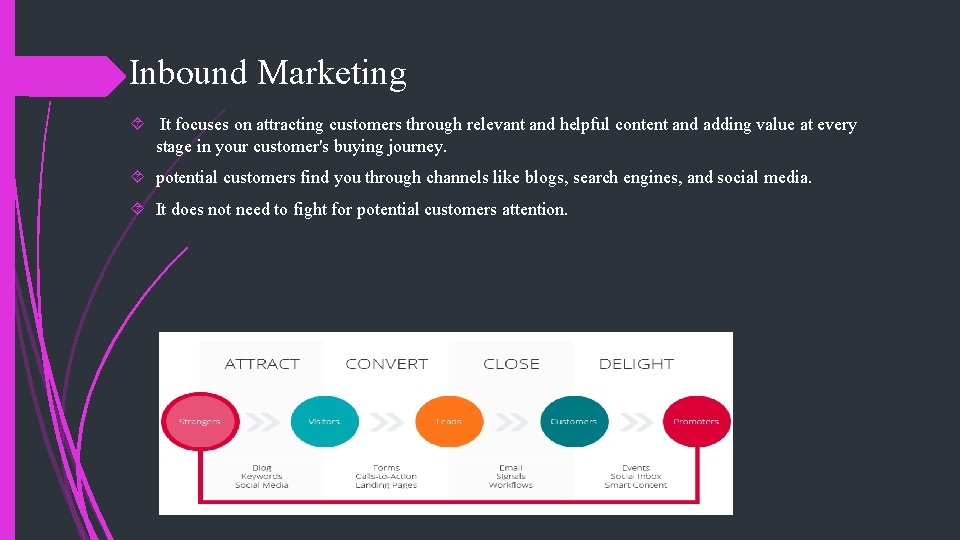
Inbound Marketing It focuses on attracting customers through relevant and helpful content and adding value at every stage in your customer's buying journey. potential customers find you through channels like blogs, search engines, and social media. It does not need to fight for potential customers attention.
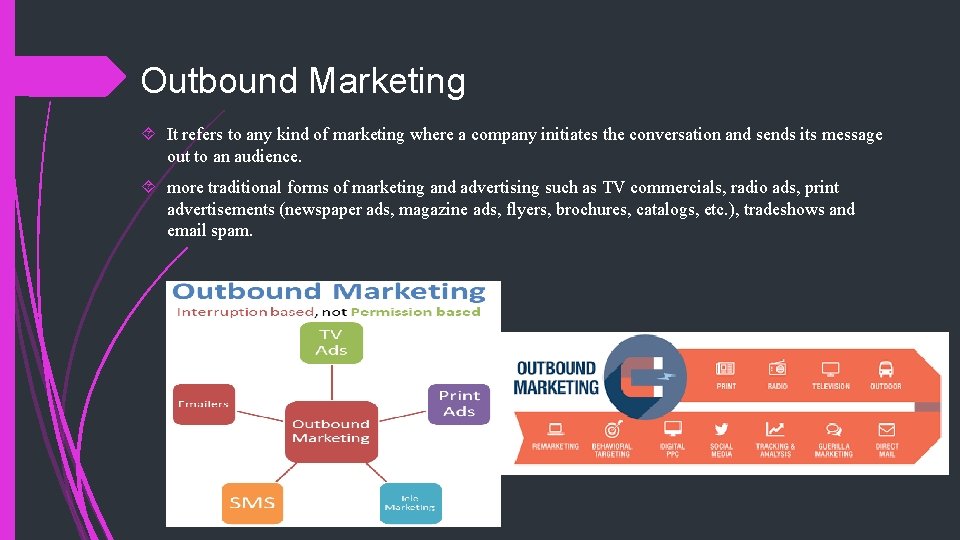
Outbound Marketing It refers to any kind of marketing where a company initiates the conversation and sends its message out to an audience. more traditional forms of marketing and advertising such as TV commercials, radio ads, print advertisements (newspaper ads, magazine ads, flyers, brochures, catalogs, etc. ), tradeshows and email spam.
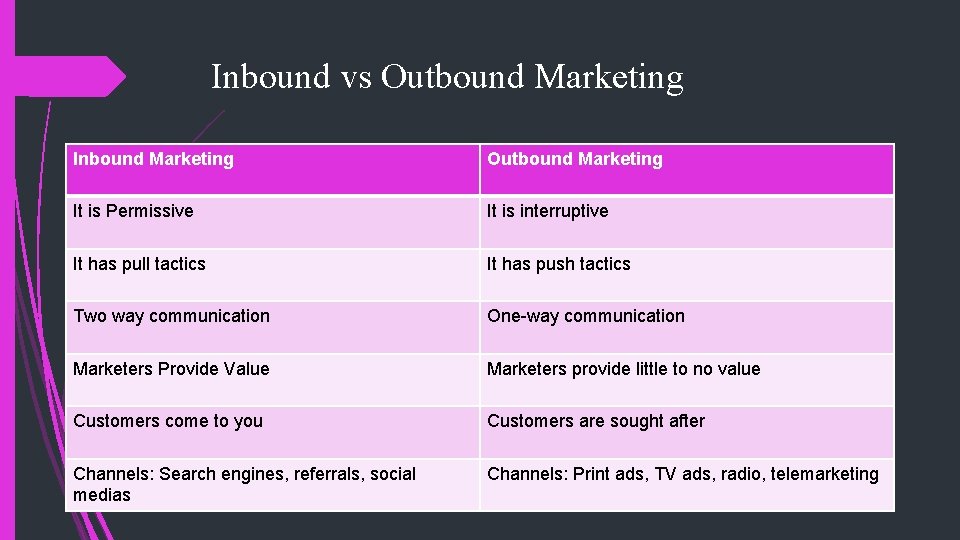
Inbound vs Outbound Marketing Inbound Marketing Outbound Marketing It is Permissive It is interruptive It has pull tactics It has push tactics Two way communication One-way communication Marketers Provide Value Marketers provide little to no value Customers come to you Customers are sought after Channels: Search engines, referrals, social medias Channels: Print ads, TV ads, radio, telemarketing
Inbound vs Traditional Buyers Journey
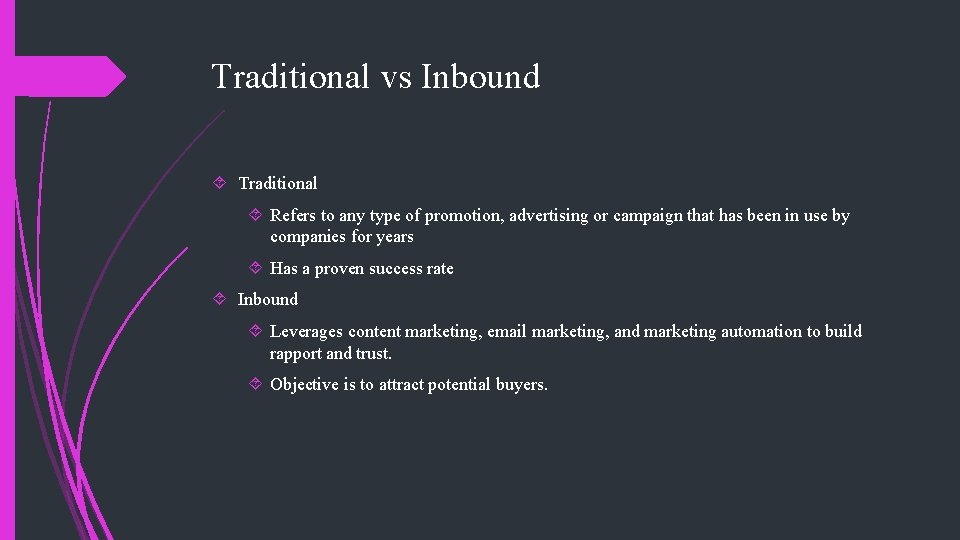
Traditional vs Inbound Traditional Refers to any type of promotion, advertising or campaign that has been in use by companies for years Has a proven success rate Inbound Leverages content marketing, email marketing, and marketing automation to build rapport and trust. Objective is to attract potential buyers.
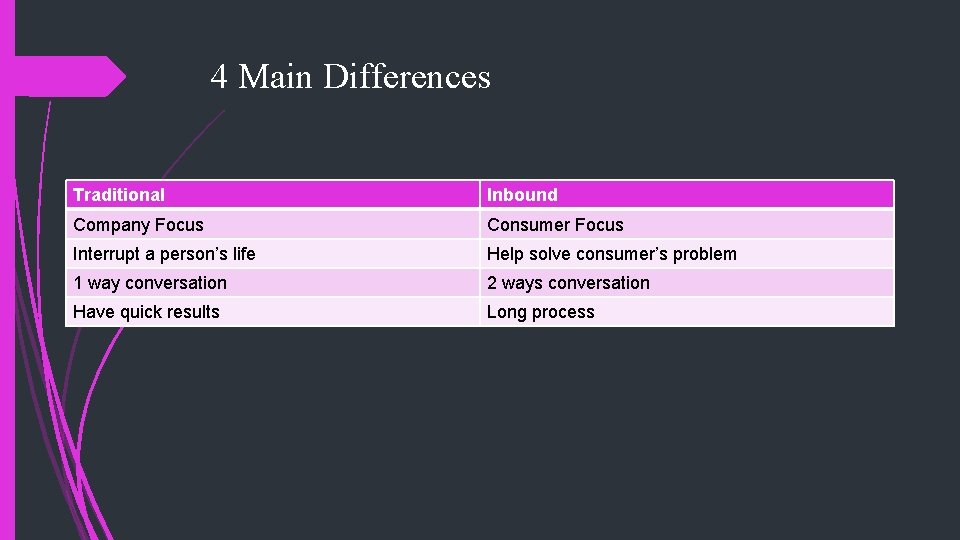
4 Main Differences Traditional Inbound Company Focus Consumer Focus Interrupt a person’s life Help solve consumer’s problem 1 way conversation 2 ways conversation Have quick results Long process
Inbound vs Traditional Companies that use Inbound Marketing generate at least 3 times the amount of leads While spend more than 60% less.
Stages of buyers journey There are 3 stages Awareness Consider Decision
Awareness Buyers know they have a problem or need a product They start to research, usually Googling Company need to have their information reach buyers Must be simple and educational
Consider Buyers have several solutions method to choose from Companies need to make themselves trusted and chosen Credential is very important Ex: Experts suggestion or comparison
Decision Method is chosen and now to the final specific decision Buyers must spend sometimes research the product They might do it through reading the description or reading and watching reviews