
Data Tables Charts Graphs and Writing a Conclusion
Data Tables, Charts, Graphs, and Writing a Conclusion
1. Collecting data in your experiment? Organize it with a data table. � Phones out? I hope not! Let’s run an experiment. Will the distance away from the teacher affect how much she catches students on their phone? IV and DV? IV- Distance from teacher DV- # of times caught on phone � Hypothesis: ◦ If you sit closer to the teacher, then you are more likely to get caught.
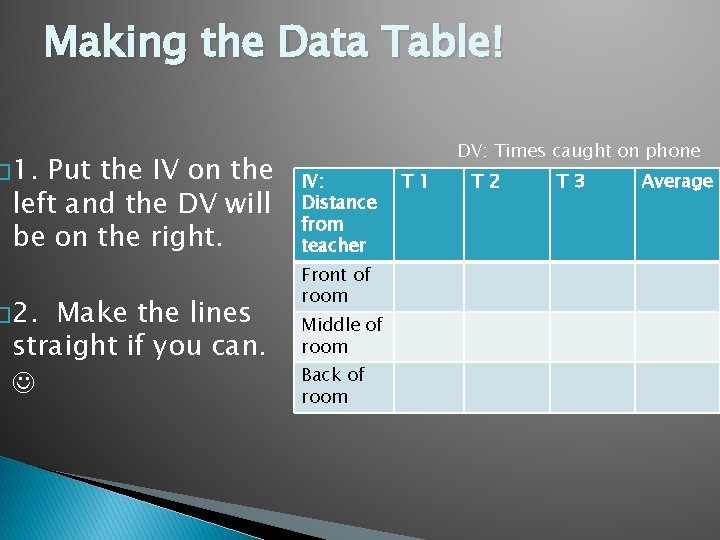
Making the Data Table! � 1. Put the IV on the left and the DV will be on the right. � 2. Make the lines straight if you can. DV: Times caught on phone IV: Distance from teacher Front of room Middle of room Back of room T 1 T 2 T 3 Average
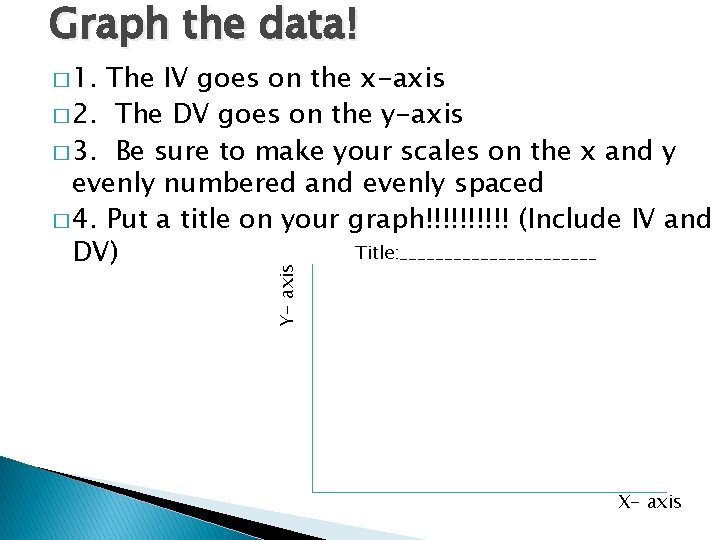
Graph the data! The IV goes on the x-axis � 2. The DV goes on the y-axis � 3. Be sure to make your scales on the x and y evenly numbered and evenly spaced � 4. Put a title on your graph!!!!! (Include IV and Title: ___________ DV) Y- axis � 1. X- axis
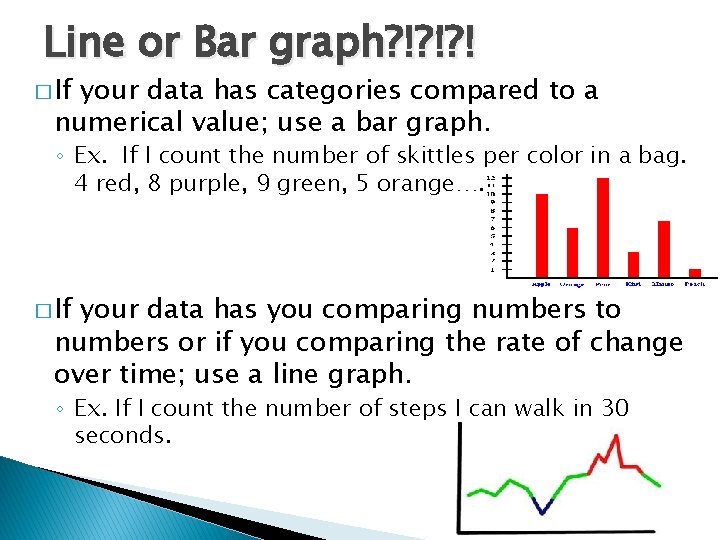
Line or Bar graph? !? !? ! � If your data has categories compared to a numerical value; use a bar graph. ◦ Ex. If I count the number of skittles per color in a bag. 4 red, 8 purple, 9 green, 5 orange…. � If your data has you comparing numbers to numbers or if you comparing the rate of change over time; use a line graph. ◦ Ex. If I count the number of steps I can walk in 30 seconds.
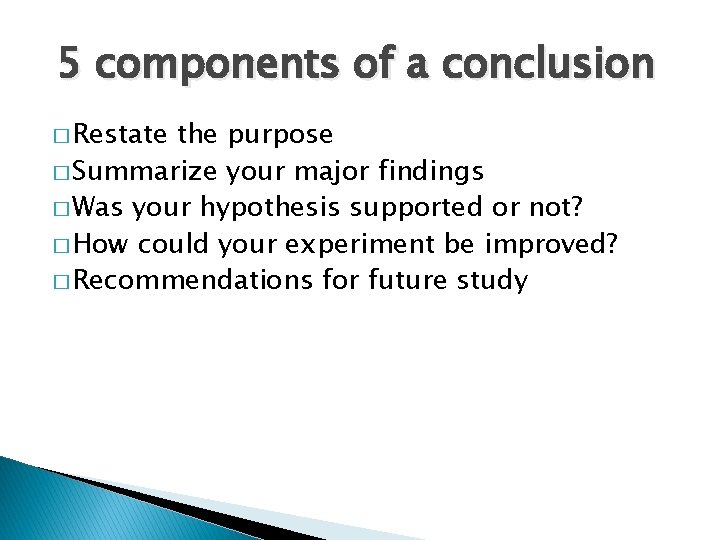
5 components of a conclusion � Restate the purpose � Summarize your major findings � Was your hypothesis supported or not? � How could your experiment be improved? � Recommendations for future study
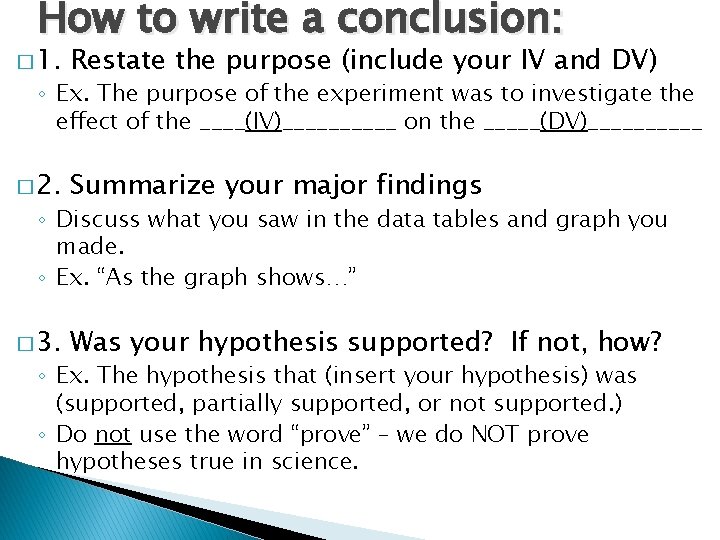
How to write a conclusion: � 1. Restate the purpose (include your IV and DV) � 2. Summarize your major findings � 3. Was your hypothesis supported? If not, how? ◦ Ex. The purpose of the experiment was to investigate the effect of the ____(IV)_____ on the _____(DV)_____ ◦ Discuss what you saw in the data tables and graph you made. ◦ Ex. “As the graph shows…” ◦ Ex. The hypothesis that (insert your hypothesis) was (supported, partially supported, or not supported. ) ◦ Do not use the word “prove” – we do NOT prove hypotheses true in science.
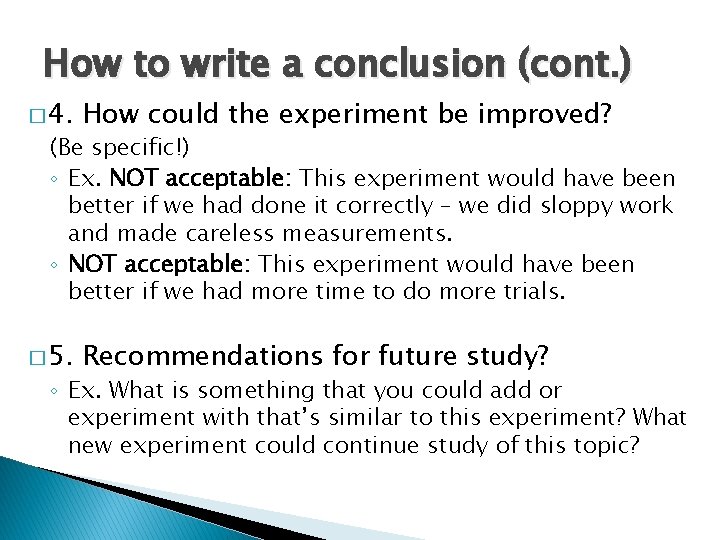
How to write a conclusion (cont. ) � 4. How could the experiment be improved? � 5. Recommendations for future study? (Be specific!) ◦ Ex. NOT acceptable: This experiment would have been better if we had done it correctly – we did sloppy work and made careless measurements. ◦ NOT acceptable: This experiment would have been better if we had more time to do more trials. ◦ Ex. What is something that you could add or experiment with that’s similar to this experiment? What new experiment could continue study of this topic?
- Slides: 8