
Data Structures Week 5 Trees Aalar Trees Aalar
- Slides: 83
Data Structures – Week #5 Trees (Ağaçlar)
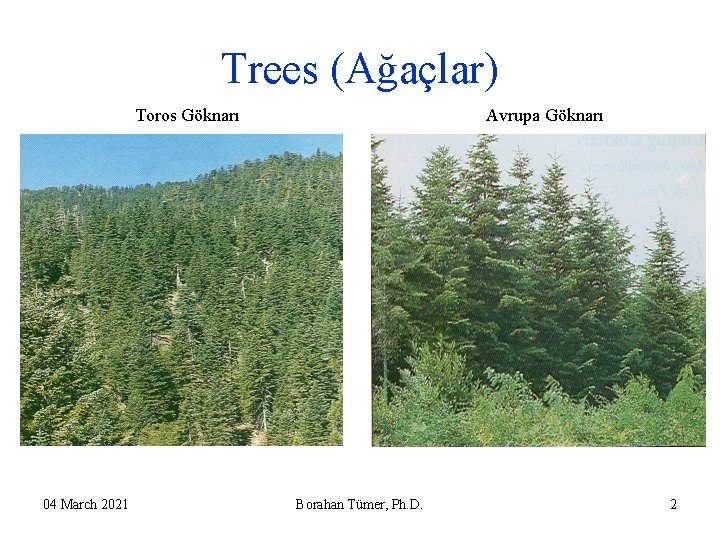
Trees (Ağaçlar) Toros Göknarı 04 March 2021 Avrupa Göknarı Borahan Tümer, Ph. D. 2
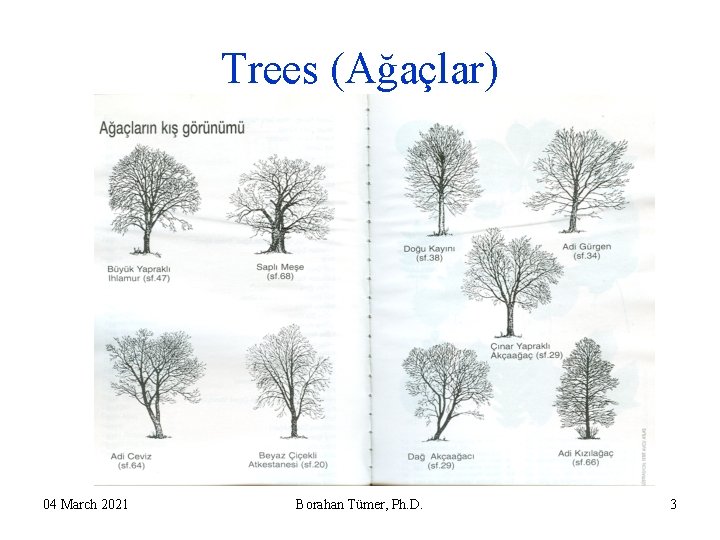
Trees (Ağaçlar) 04 March 2021 Borahan Tümer, Ph. D. 3
Outline • • • Trees Definitions Implementation of Trees Binary Trees Tree Traversals & Expression Trees Binary Search Trees 04 March 2021 Borahan Tümer, Ph. D. 4
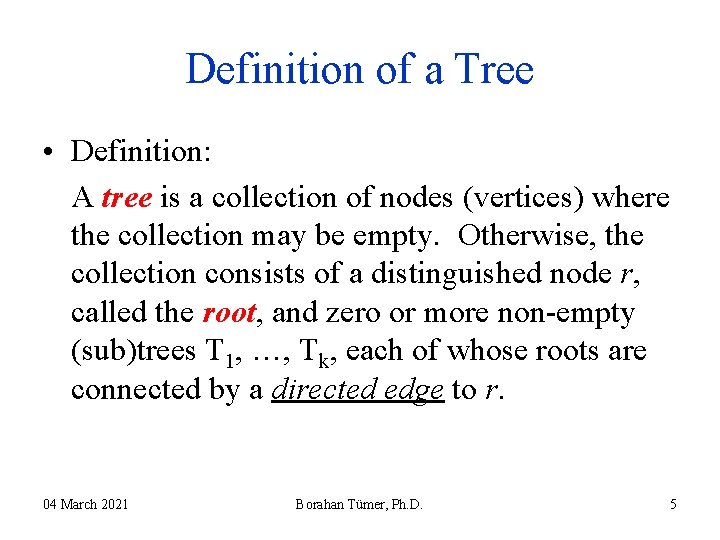
Definition of a Tree • Definition: A tree is a collection of nodes (vertices) where the collection may be empty. Otherwise, the collection consists of a distinguished node r, called the root, and zero or more non-empty (sub)trees T 1, …, Tk, each of whose roots are connected by a directed edge to r. 04 March 2021 Borahan Tümer, Ph. D. 5
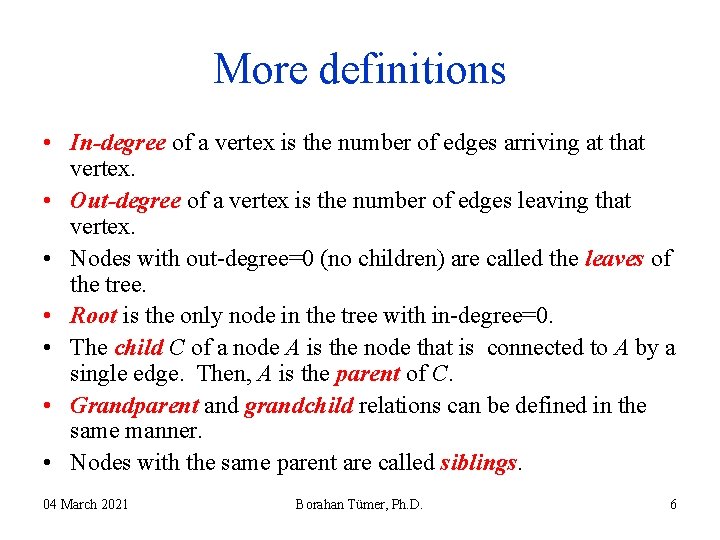
More definitions • In-degree of a vertex is the number of edges arriving at that vertex. • Out-degree of a vertex is the number of edges leaving that vertex. • Nodes with out-degree=0 (no children) are called the leaves of the tree. • Root is the only node in the tree with in-degree=0. • The child C of a node A is the node that is connected to A by a single edge. Then, A is the parent of C. • Grandparent and grandchild relations can be defined in the same manner. • Nodes with the same parent are called siblings. 04 March 2021 Borahan Tümer, Ph. D. 6
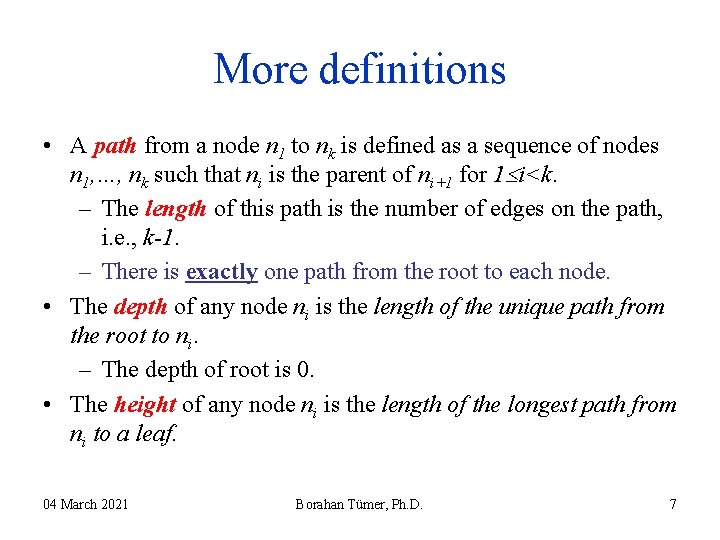
More definitions • A path from a node n 1 to nk is defined as a sequence of nodes n 1, …, nk such that ni is the parent of ni+1 for 1 i<k. – The length of this path is the number of edges on the path, i. e. , k-1. – There is exactly one path from the root to each node. • The depth of any node ni is the length of the unique path from the root to ni. – The depth of root is 0. • The height of any node ni is the length of the longest path from ni to a leaf. 04 March 2021 Borahan Tümer, Ph. D. 7
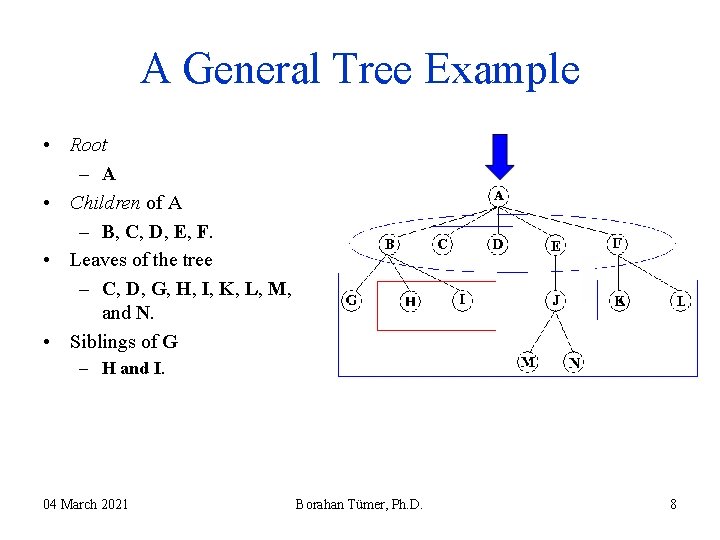
A General Tree Example • Root – A • Children of A – B, C, D, E, F. • Leaves of the tree – C, D, G, H, I, K, L, M, and N. • Siblings of G – H and I. 04 March 2021 Borahan Tümer, Ph. D. 8
Remarks The height of all leaves are 0. The height of a tree is the height of its root. The height of the above tree is 3. The height of C is 0. If there is a path from n 1 to n 2, then n 1 is an ancestor of n 2 and n 2 is a descendant of n 1. 04 March 2021 Borahan Tümer, Ph. D. 9
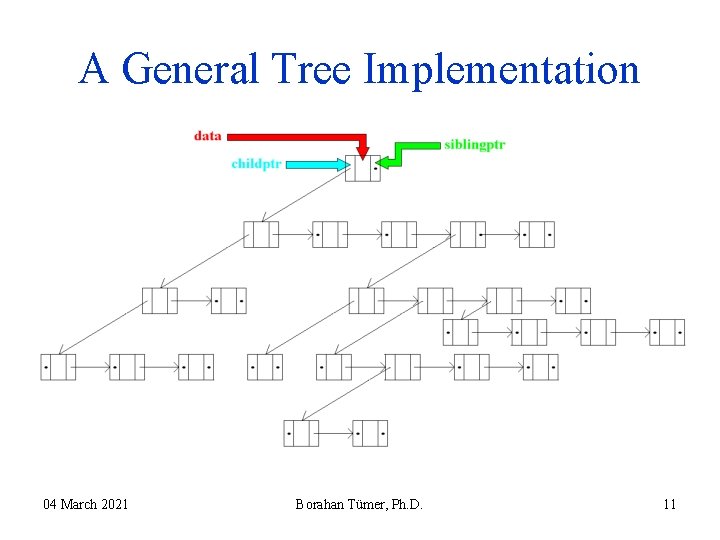
Implementation of Trees • One way to implement a tree would be to have a pointer in each node to each child, besides the data it holds. This is infeasible! • Q: Why? • A: The number of children of each node is variable, and hence, unknown. • Another option would be to keep the children in a linked list where the first node of the list is pointed to by the pointer in the parent node as a header. • A typical tree node declaration in C would be as follows: struct TNode_type { int data; struct TNodetype *childptr, *siblingptr; } 04 March 2021 Borahan Tümer, Ph. D. 10
A General Tree Implementation 04 March 2021 Borahan Tümer, Ph. D. 11
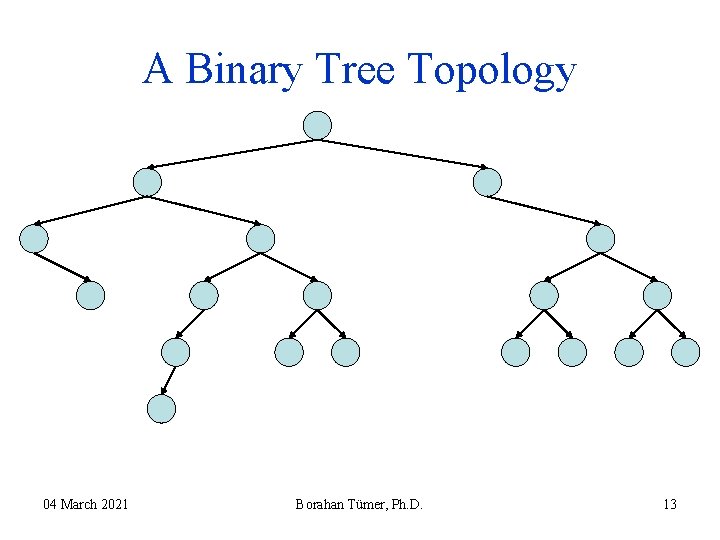
Binary Trees (BTs) • A binary tree is a tree of nodes with at most two children. • Declaration of a typical node in a binary tree – struct BTNode. Type { info. Type *data; struct BTNode. Type *left; struct BTNode. Type *right; } • Average depth in BTs: O( ) 04 March 2021 Borahan Tümer, Ph. D. 12
A Binary Tree Topology 04 March 2021 Borahan Tümer, Ph. D. 13
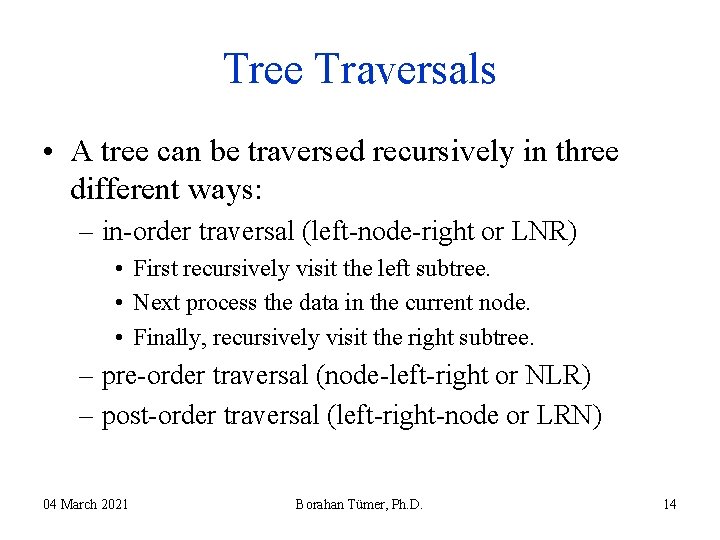
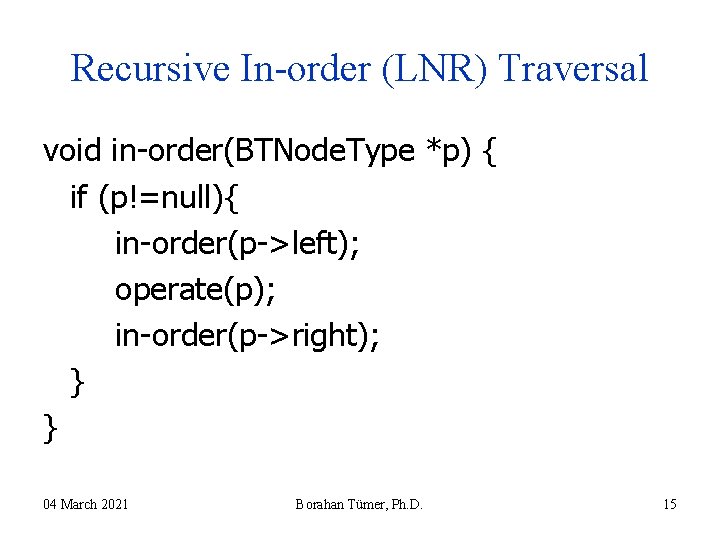
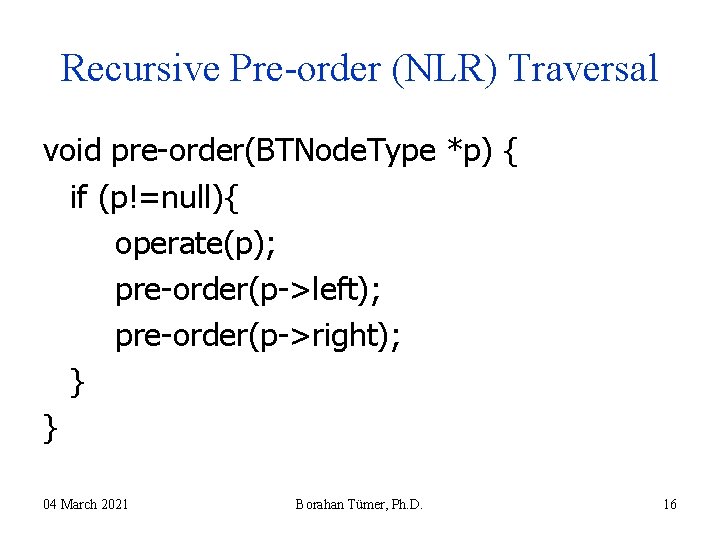
Tree Traversals • A tree can be traversed recursively in three different ways: – in-order traversal (left-node-right or LNR) • First recursively visit the left subtree. • Next process the data in the current node. • Finally, recursively visit the right subtree. – pre-order traversal (node-left-right or NLR) – post-order traversal (left-right-node or LRN) 04 March 2021 Borahan Tümer, Ph. D. 14
Recursive In-order (LNR) Traversal void in-order(BTNode. Type *p) { if (p!=null){ in-order(p->left); operate(p); in-order(p->right); } } 04 March 2021 Borahan Tümer, Ph. D. 15
Recursive Pre-order (NLR) Traversal void pre-order(BTNode. Type *p) { if (p!=null){ operate(p); pre-order(p->left); pre-order(p->right); } } 04 March 2021 Borahan Tümer, Ph. D. 16
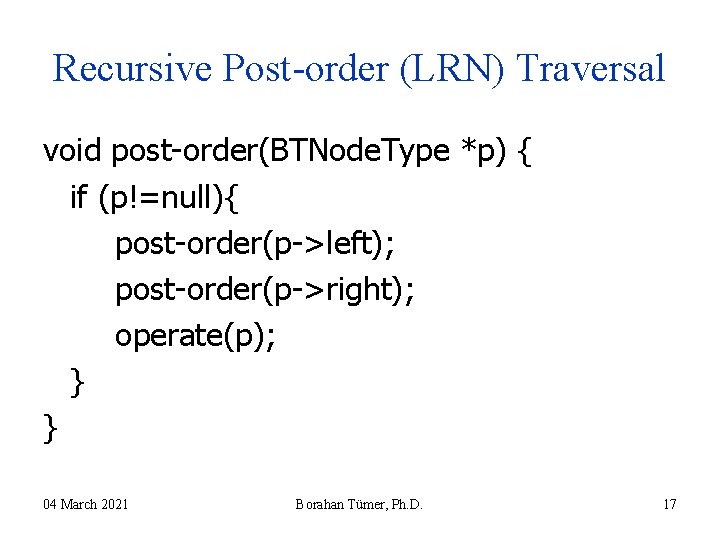
Recursive Post-order (LRN) Traversal void post-order(BTNode. Type *p) { if (p!=null){ post-order(p->left); post-order(p->right); operate(p); } } 04 March 2021 Borahan Tümer, Ph. D. 17
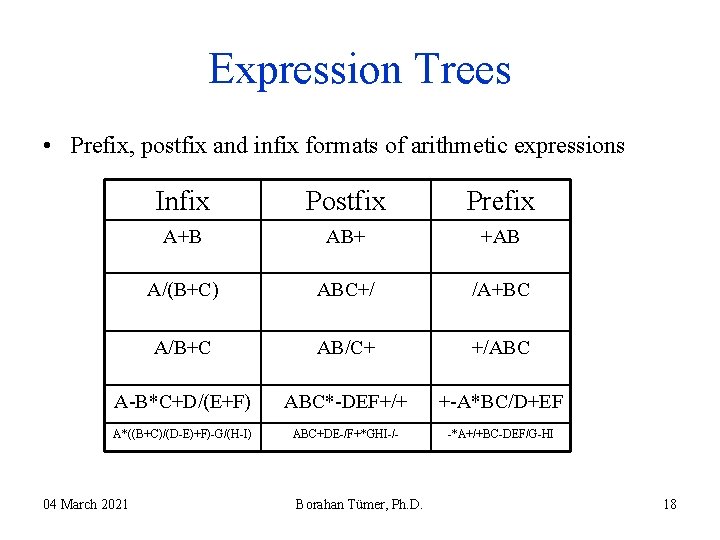
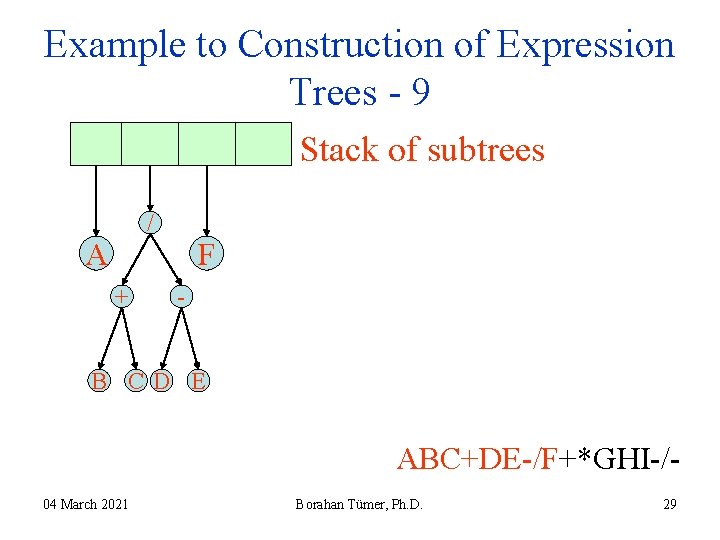
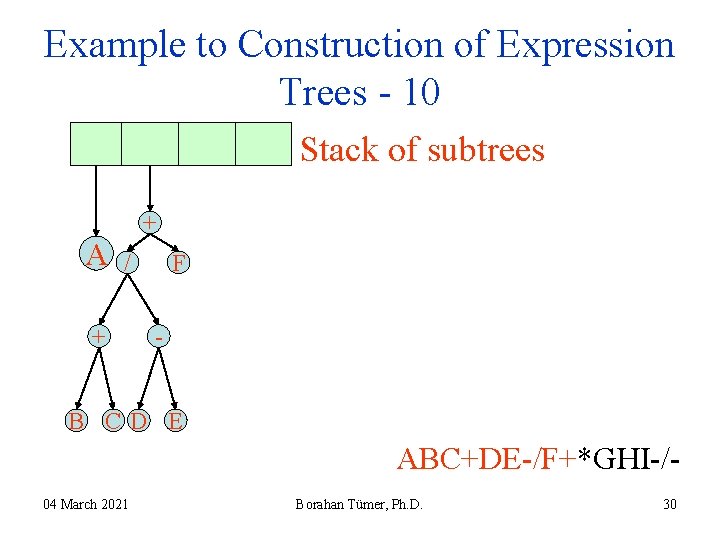
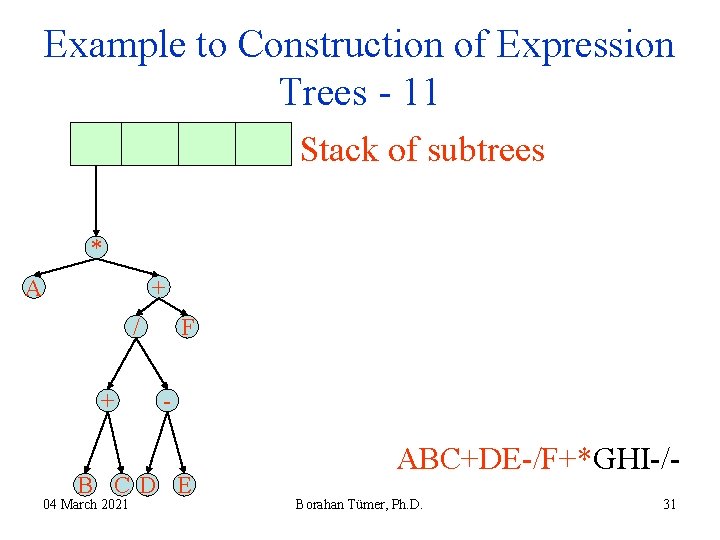
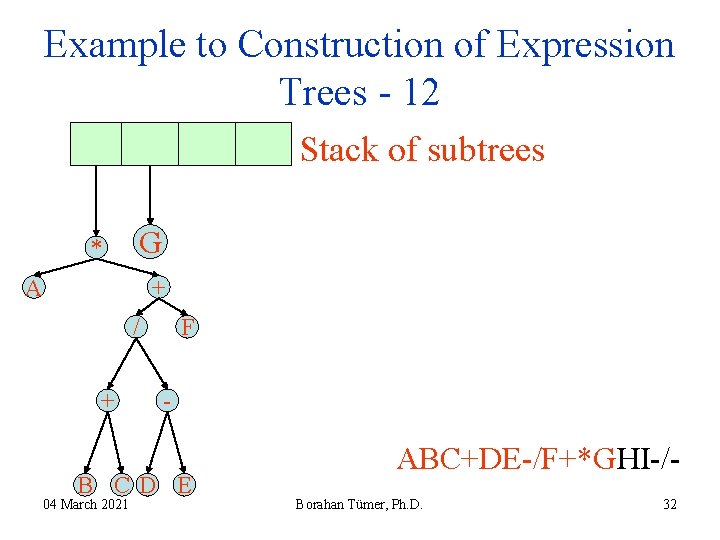
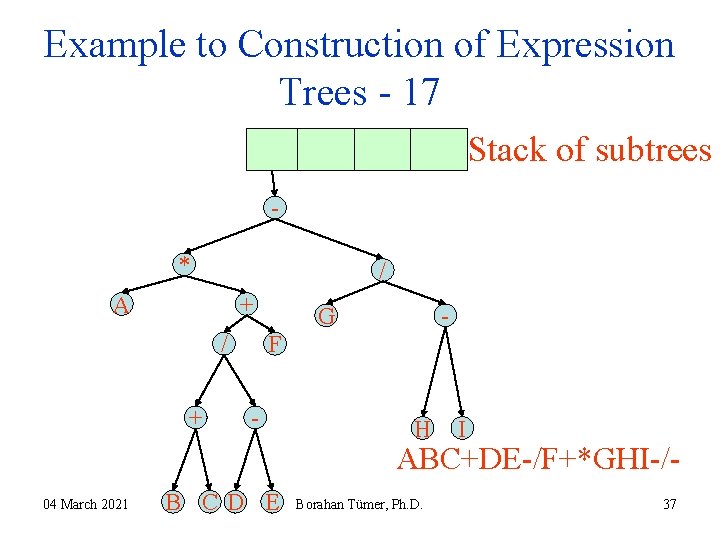
Expression Trees • Prefix, postfix and infix formats of arithmetic expressions Infix Postfix Prefix A+B AB+ +AB A/(B+C) ABC+/ /A+BC A/B+C AB/C+ +/ABC A-B*C+D/(E+F) ABC*-DEF+/+ +-A*BC/D+EF A*((B+C)/(D-E)+F)-G/(H-I) ABC+DE-/F+*GHI-/- -*A+/+BC-DEF/G-HI 04 March 2021 Borahan Tümer, Ph. D. 18
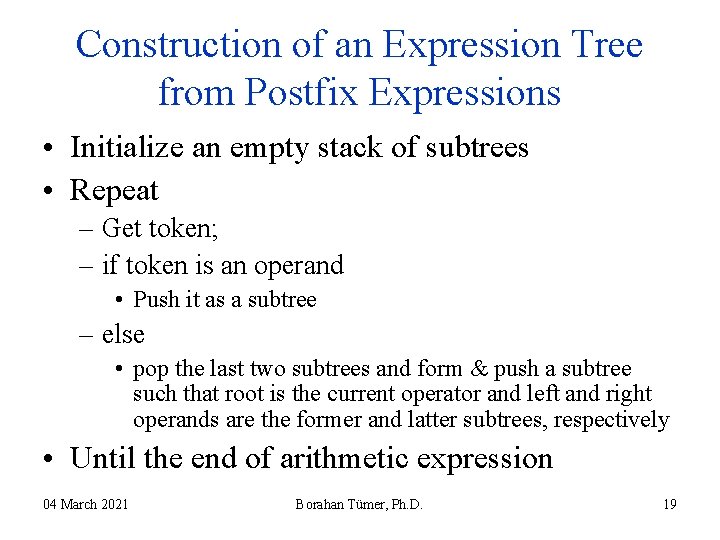
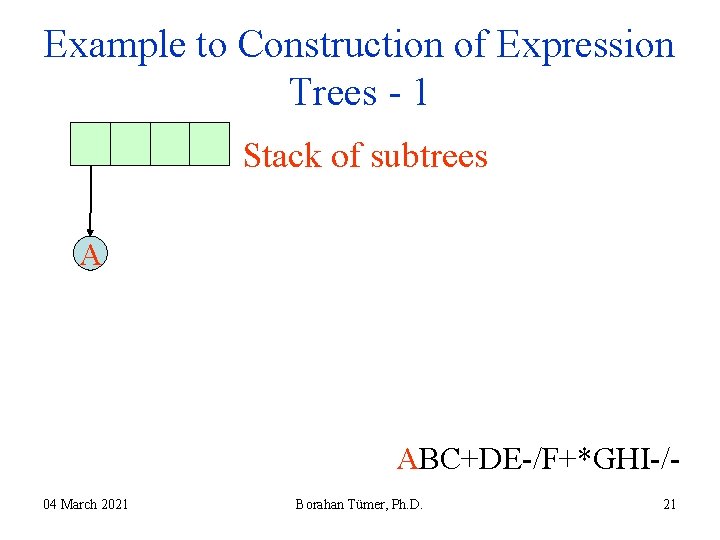
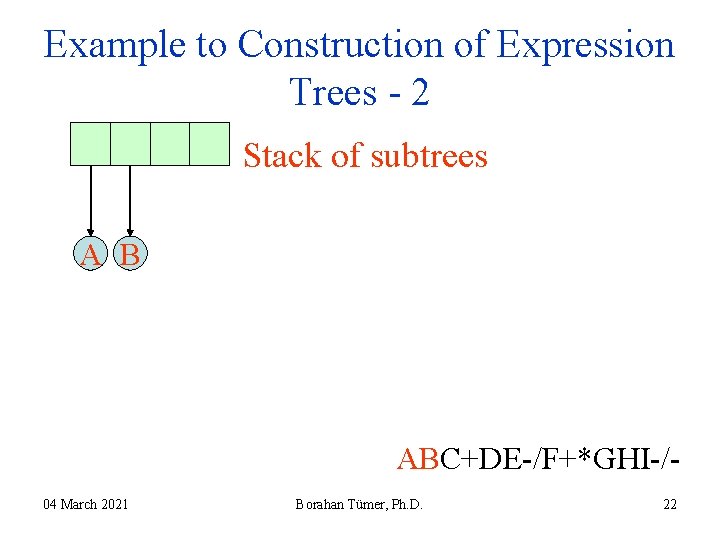
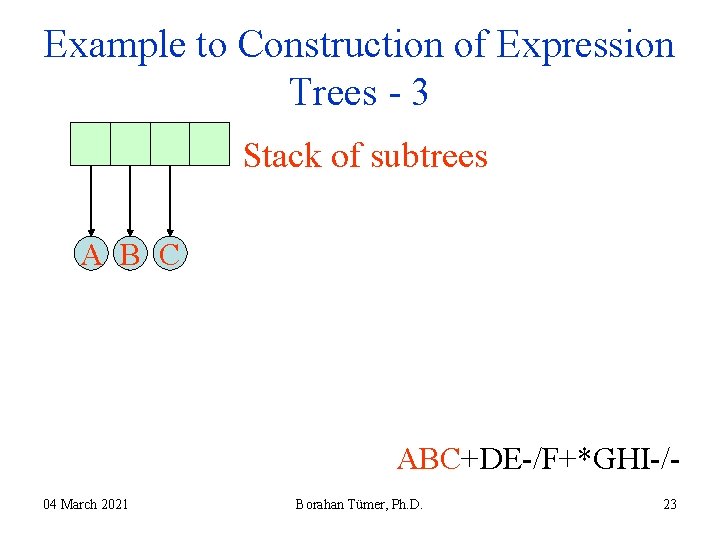
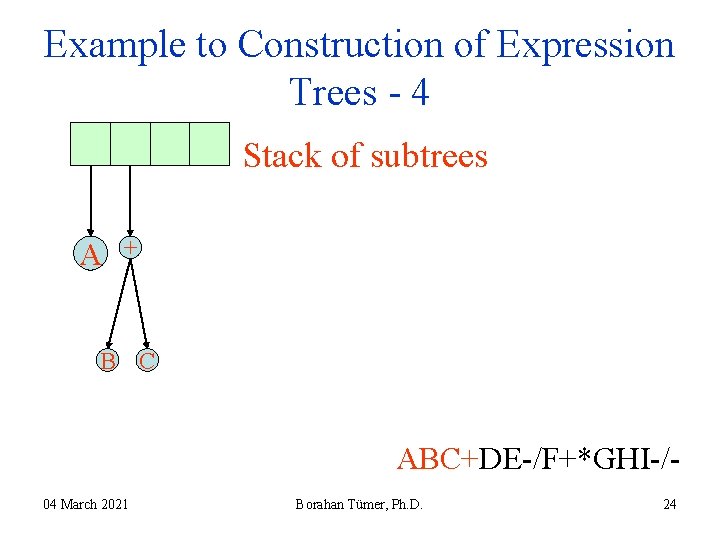
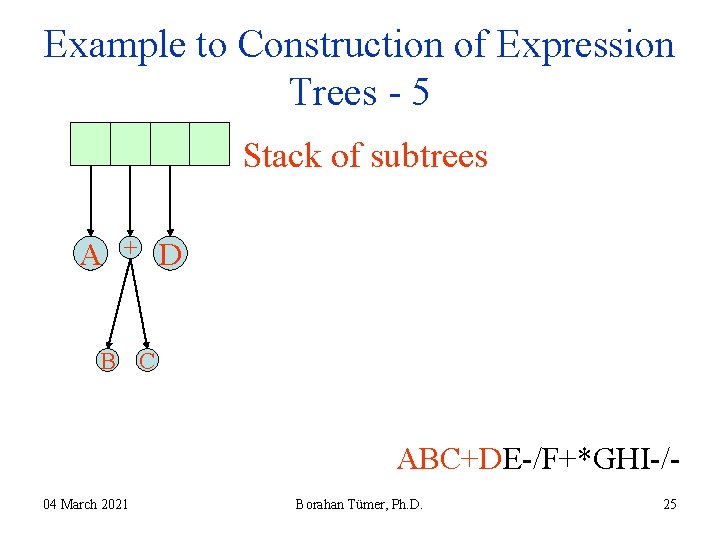
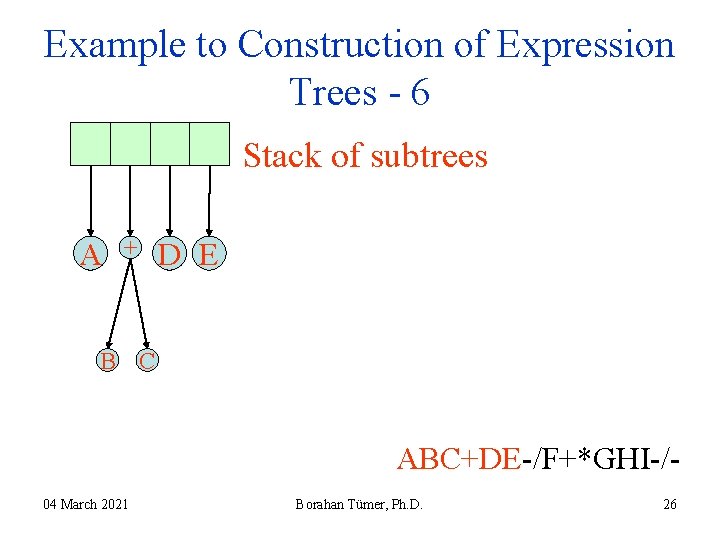
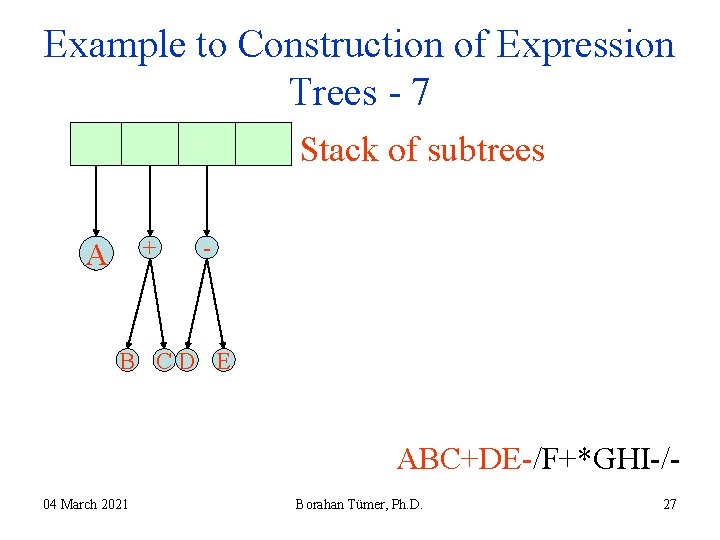
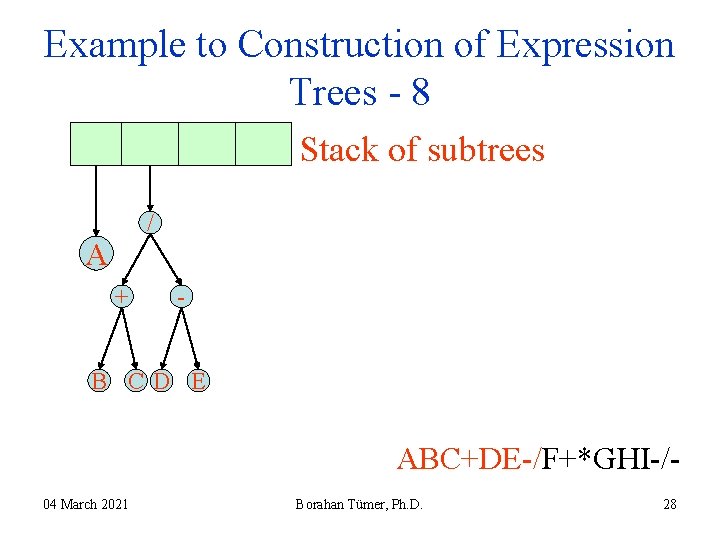
Construction of an Expression Tree from Postfix Expressions • Initialize an empty stack of subtrees • Repeat – Get token; – if token is an operand • Push it as a subtree – else • pop the last two subtrees and form & push a subtree such that root is the current operator and left and right operands are the former and latter subtrees, respectively • Until the end of arithmetic expression 04 March 2021 Borahan Tümer, Ph. D. 19
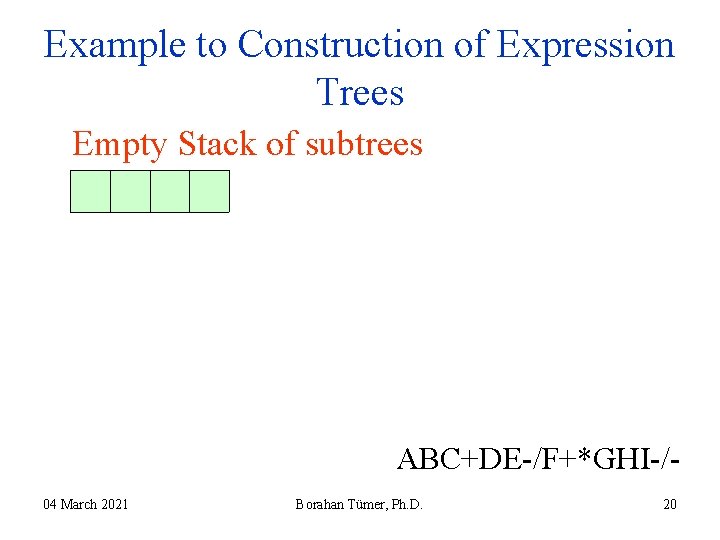
Example to Construction of Expression Trees Empty Stack of subtrees ABC+DE-/F+*GHI-/04 March 2021 Borahan Tümer, Ph. D. 20
Example to Construction of Expression Trees - 1 Stack of subtrees A ABC+DE-/F+*GHI-/04 March 2021 Borahan Tümer, Ph. D. 21
Example to Construction of Expression Trees - 2 Stack of subtrees A B ABC+DE-/F+*GHI-/04 March 2021 Borahan Tümer, Ph. D. 22
Example to Construction of Expression Trees - 3 Stack of subtrees A B C ABC+DE-/F+*GHI-/04 March 2021 Borahan Tümer, Ph. D. 23
Example to Construction of Expression Trees - 4 Stack of subtrees A + B C ABC+DE-/F+*GHI-/04 March 2021 Borahan Tümer, Ph. D. 24
Example to Construction of Expression Trees - 5 Stack of subtrees A + D B C ABC+DE-/F+*GHI-/04 March 2021 Borahan Tümer, Ph. D. 25
Example to Construction of Expression Trees - 6 Stack of subtrees A + D E B C ABC+DE-/F+*GHI-/04 March 2021 Borahan Tümer, Ph. D. 26
Example to Construction of Expression Trees - 7 Stack of subtrees + A - B CD E ABC+DE-/F+*GHI-/04 March 2021 Borahan Tümer, Ph. D. 27
Example to Construction of Expression Trees - 8 Stack of subtrees / A + - B CD E ABC+DE-/F+*GHI-/04 March 2021 Borahan Tümer, Ph. D. 28
Example to Construction of Expression Trees - 9 Stack of subtrees / A + F - B CD E ABC+DE-/F+*GHI-/04 March 2021 Borahan Tümer, Ph. D. 29
Example to Construction of Expression Trees - 10 Stack of subtrees A + / + F - B CD E ABC+DE-/F+*GHI-/04 March 2021 Borahan Tümer, Ph. D. 30
Example to Construction of Expression Trees - 11 Stack of subtrees * A + F / + - B CD E 04 March 2021 ABC+DE-/F+*GHI-/Borahan Tümer, Ph. D. 31
Example to Construction of Expression Trees - 12 Stack of subtrees * G A + F / + - B CD E 04 March 2021 ABC+DE-/F+*GHI-/Borahan Tümer, Ph. D. 32
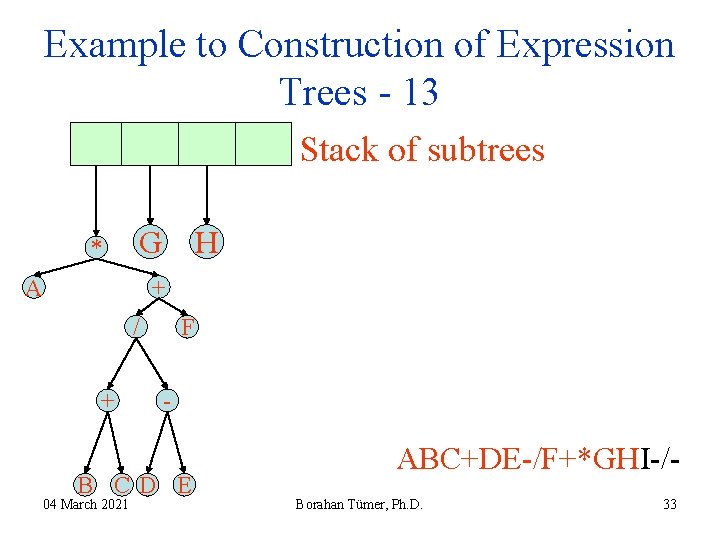
Example to Construction of Expression Trees - 13 Stack of subtrees * G A H + F / + - B CD E 04 March 2021 ABC+DE-/F+*GHI-/Borahan Tümer, Ph. D. 33
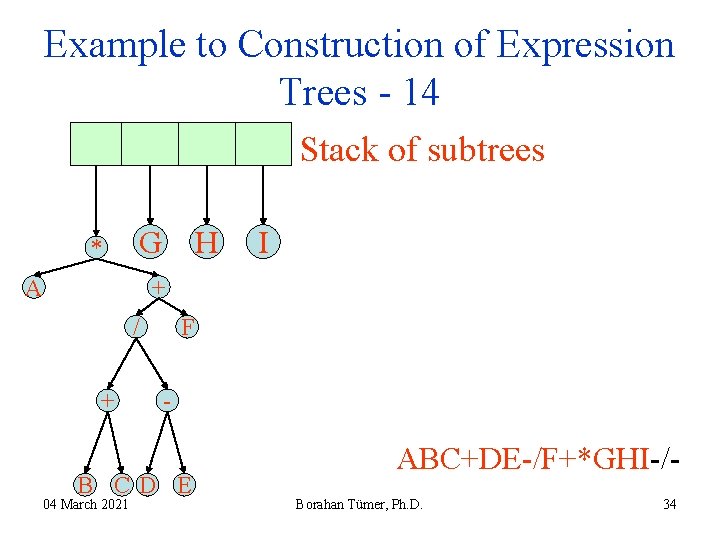
Example to Construction of Expression Trees - 14 Stack of subtrees * G A H I + F / + - B CD E 04 March 2021 ABC+DE-/F+*GHI-/Borahan Tümer, Ph. D. 34
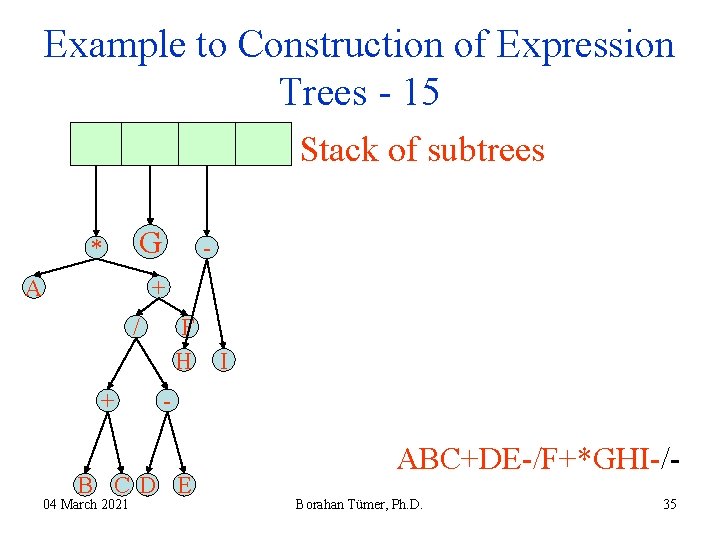
Example to Construction of Expression Trees - 15 Stack of subtrees * G A - + F H / + - B CD E 04 March 2021 I ABC+DE-/F+*GHI-/Borahan Tümer, Ph. D. 35
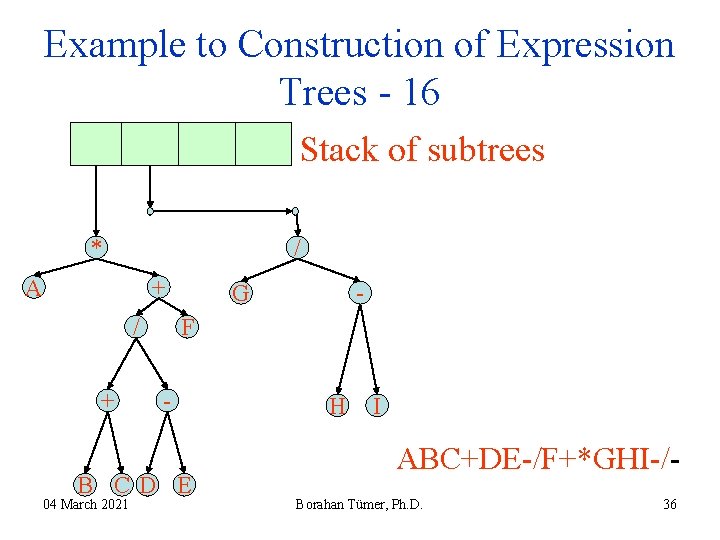
Example to Construction of Expression Trees - 16 Stack of subtrees / * A + - B CD E 04 March 2021 - F / + G H I ABC+DE-/F+*GHI-/Borahan Tümer, Ph. D. 36
Example to Construction of Expression Trees - 17 Stack of subtrees * / A + - F / + G - H I ABC+DE-/F+*GHI-/04 March 2021 B CD E Borahan Tümer, Ph. D. 37
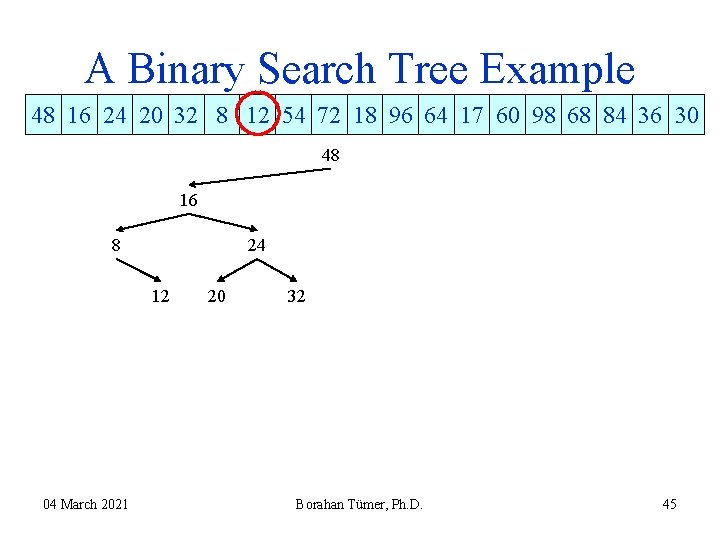
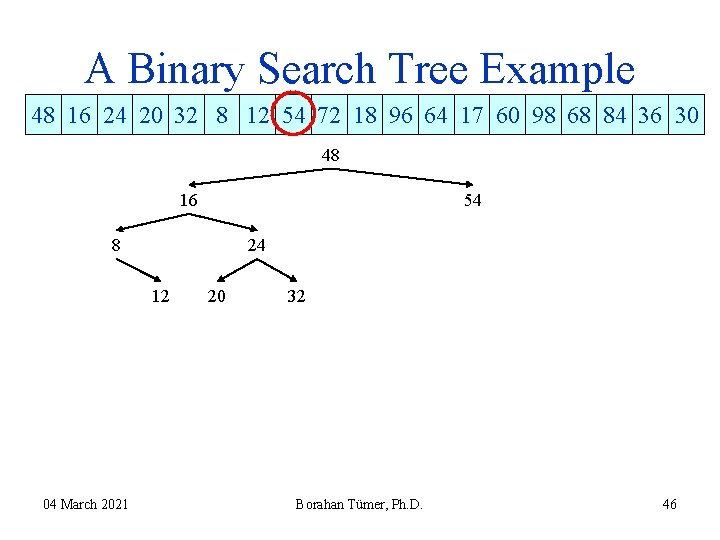
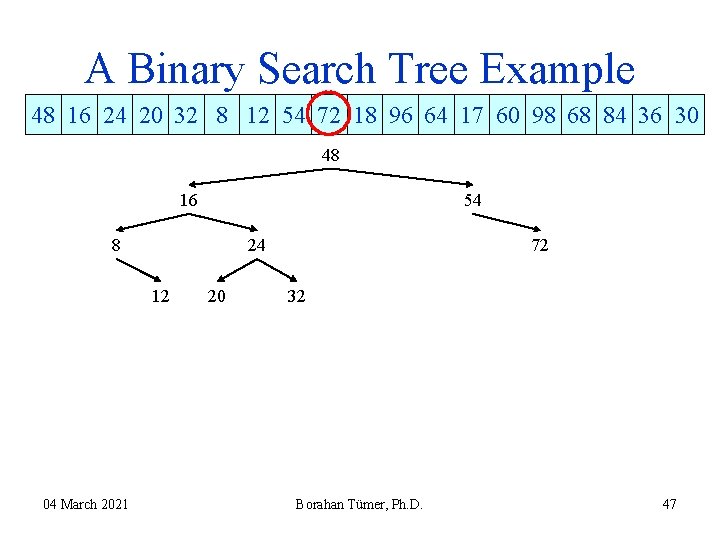
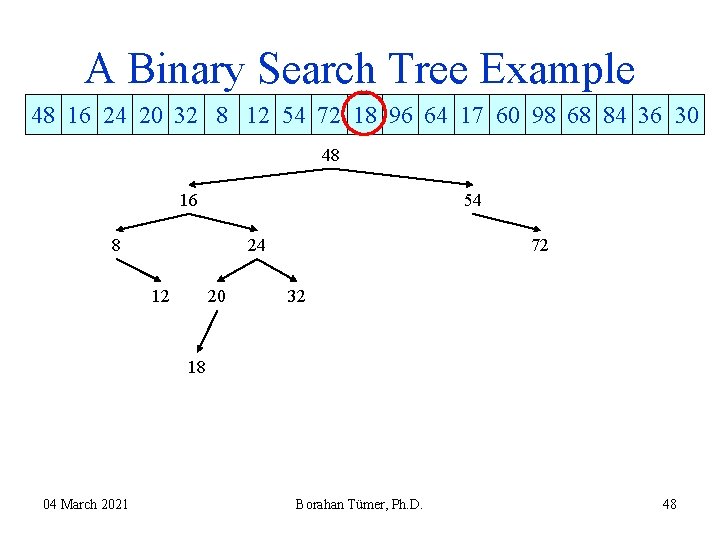
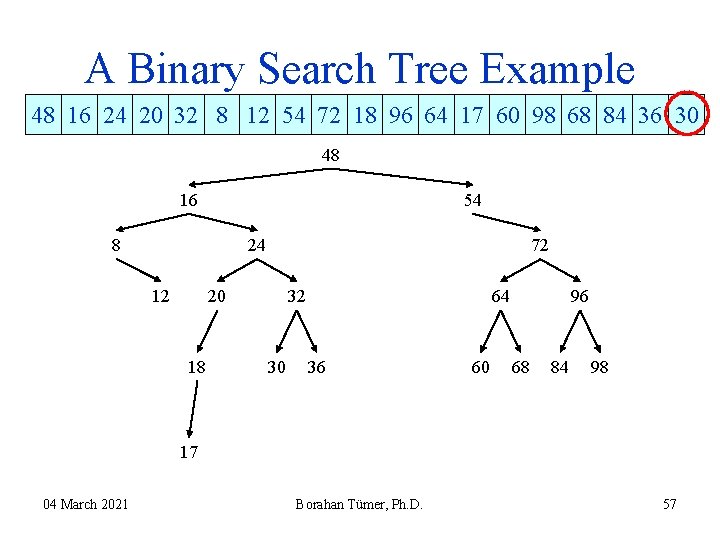
Binary Search Trees (BSTs) BSTs are binary trees with keys placed in each node in such a manner that the key of a node is greater than all keys in its left sub-tree and less than all keys in its right sub-tree. Here, we assume no replication of keys. For replicating keys, the relations are modified as “greater than or equal to” or “less than or equal to” depending on the application. 04 March 2021 Borahan Tümer, Ph. D. 38
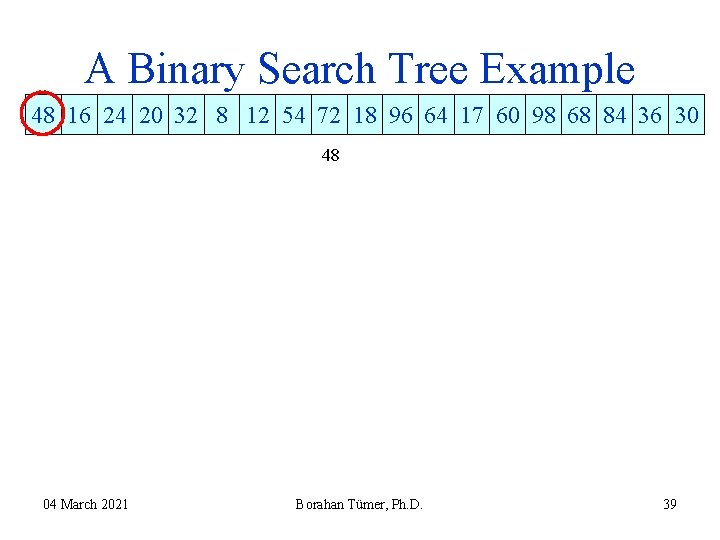
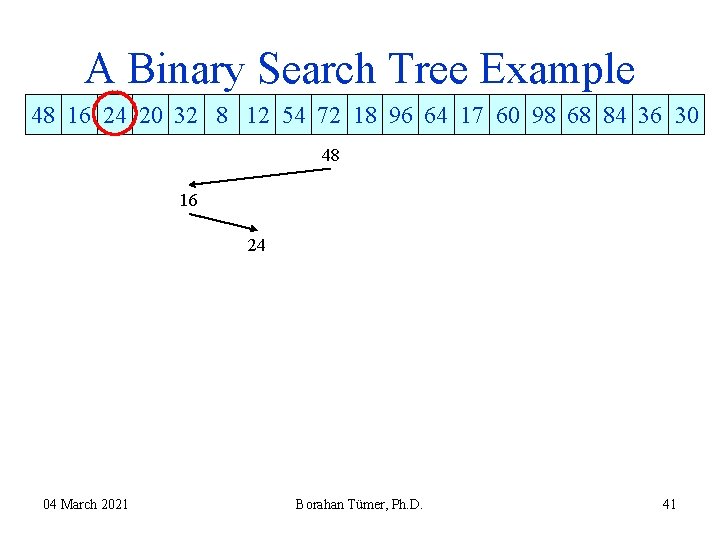
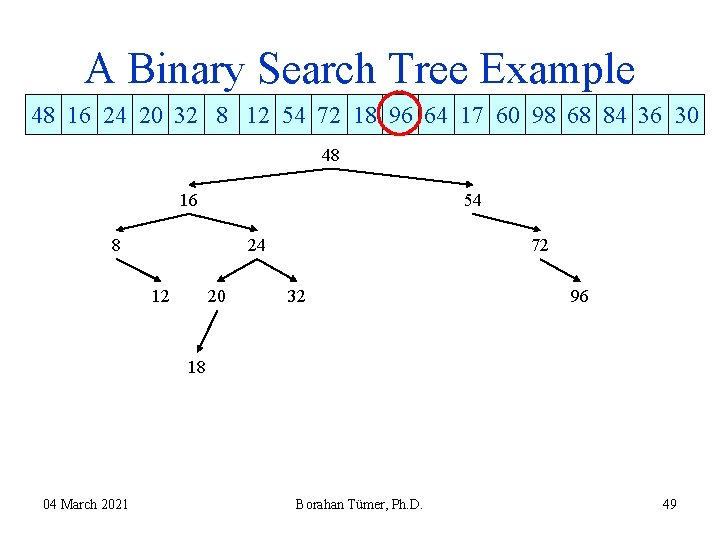
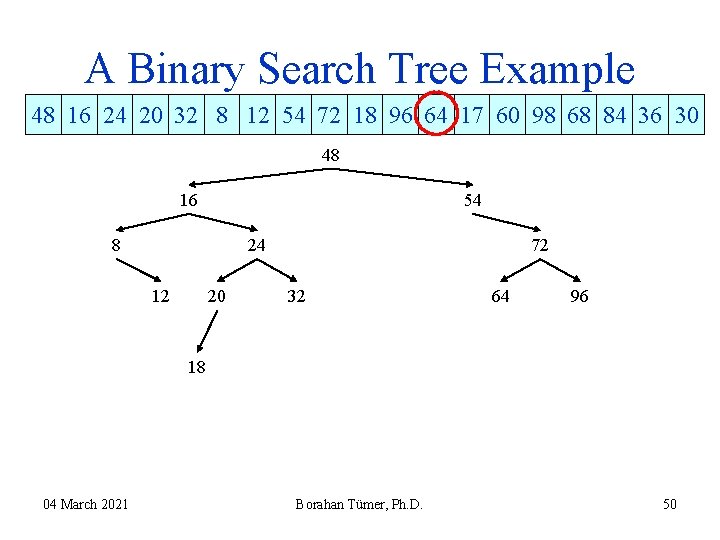
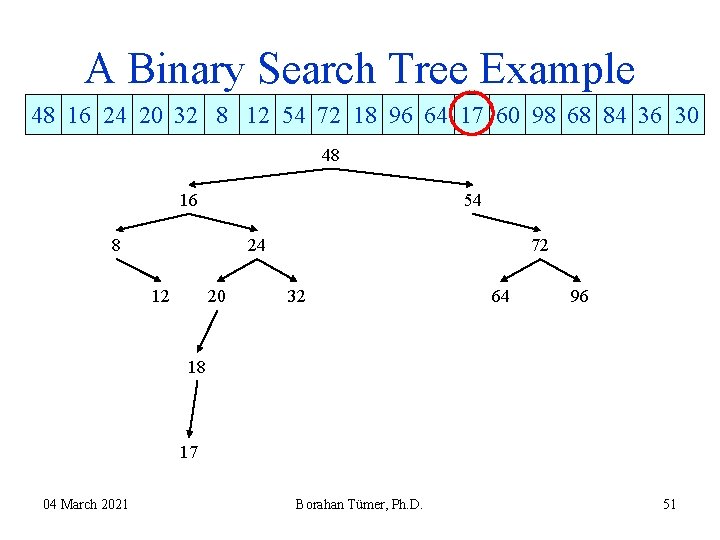
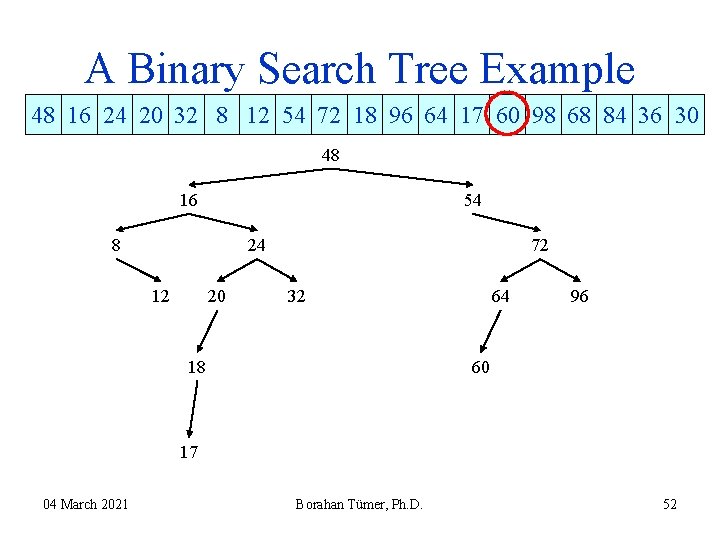
A Binary Search Tree Example 48 16 24 20 32 8 12 54 72 18 96 64 17 60 98 68 84 36 30 48 04 March 2021 Borahan Tümer, Ph. D. 39
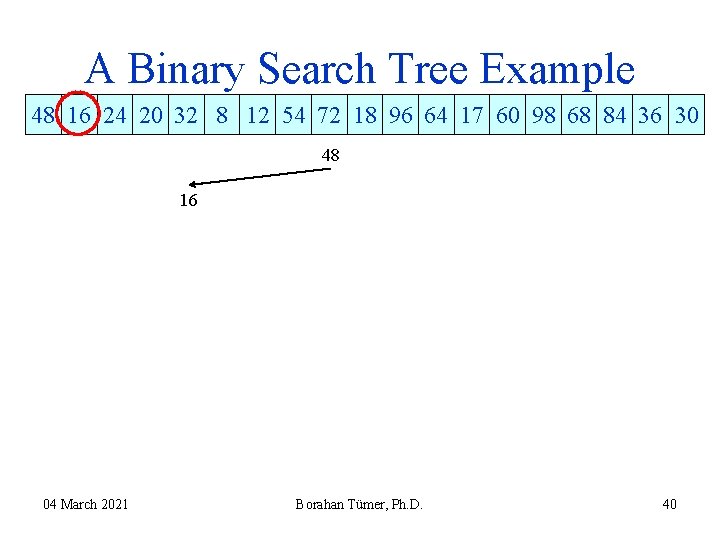
A Binary Search Tree Example 48 16 24 20 32 8 12 54 72 18 96 64 17 60 98 68 84 36 30 48 16 04 March 2021 Borahan Tümer, Ph. D. 40
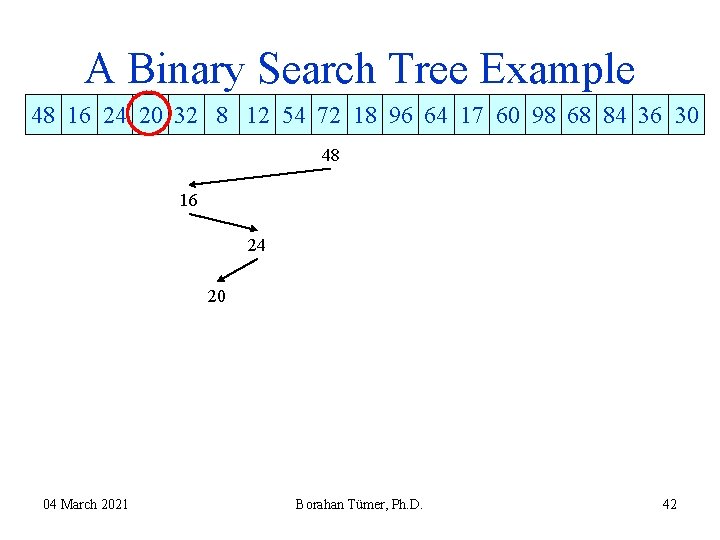
A Binary Search Tree Example 48 16 24 20 32 8 12 54 72 18 96 64 17 60 98 68 84 36 30 48 16 24 04 March 2021 Borahan Tümer, Ph. D. 41
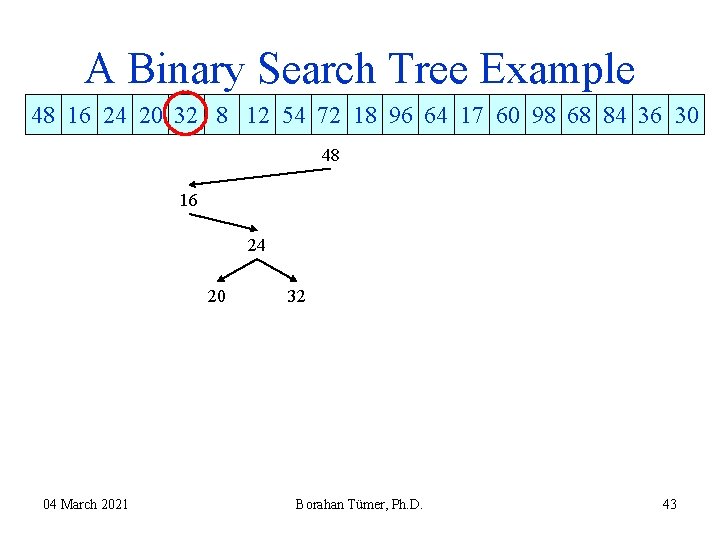
A Binary Search Tree Example 48 16 24 20 32 8 12 54 72 18 96 64 17 60 98 68 84 36 30 48 16 24 20 04 March 2021 Borahan Tümer, Ph. D. 42
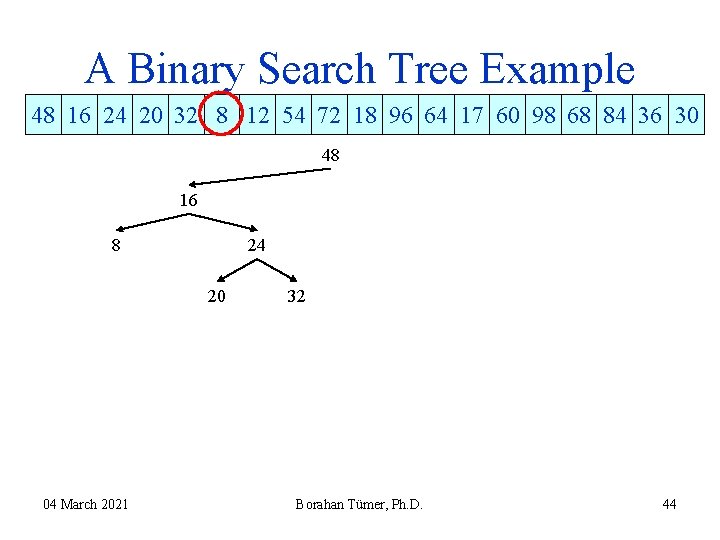
A Binary Search Tree Example 48 16 24 20 32 8 12 54 72 18 96 64 17 60 98 68 84 36 30 48 16 24 20 04 March 2021 32 Borahan Tümer, Ph. D. 43
A Binary Search Tree Example 48 16 24 20 32 8 12 54 72 18 96 64 17 60 98 68 84 36 30 48 16 8 24 20 04 March 2021 32 Borahan Tümer, Ph. D. 44
A Binary Search Tree Example 48 16 24 20 32 8 12 54 72 18 96 64 17 60 98 68 84 36 30 48 16 8 24 12 04 March 2021 20 32 Borahan Tümer, Ph. D. 45
A Binary Search Tree Example 48 16 24 20 32 8 12 54 72 18 96 64 17 60 98 68 84 36 30 48 16 54 8 24 12 04 March 2021 20 32 Borahan Tümer, Ph. D. 46
A Binary Search Tree Example 48 16 24 20 32 8 12 54 72 18 96 64 17 60 98 68 84 36 30 48 16 54 8 24 12 04 March 2021 20 72 32 Borahan Tümer, Ph. D. 47
A Binary Search Tree Example 48 16 24 20 32 8 12 54 72 18 96 64 17 60 98 68 84 36 30 48 16 54 8 24 12 20 72 32 18 04 March 2021 Borahan Tümer, Ph. D. 48
A Binary Search Tree Example 48 16 24 20 32 8 12 54 72 18 96 64 17 60 98 68 84 36 30 48 16 54 8 24 12 20 72 32 96 18 04 March 2021 Borahan Tümer, Ph. D. 49
A Binary Search Tree Example 48 16 24 20 32 8 12 54 72 18 96 64 17 60 98 68 84 36 30 48 16 54 8 24 12 20 72 32 64 96 18 04 March 2021 Borahan Tümer, Ph. D. 50
A Binary Search Tree Example 48 16 24 20 32 8 12 54 72 18 96 64 17 60 98 68 84 36 30 48 16 54 8 24 12 20 72 32 64 96 18 17 04 March 2021 Borahan Tümer, Ph. D. 51
A Binary Search Tree Example 48 16 24 20 32 8 12 54 72 18 96 64 17 60 98 68 84 36 30 48 16 54 8 24 12 20 72 32 18 64 96 60 17 04 March 2021 Borahan Tümer, Ph. D. 52
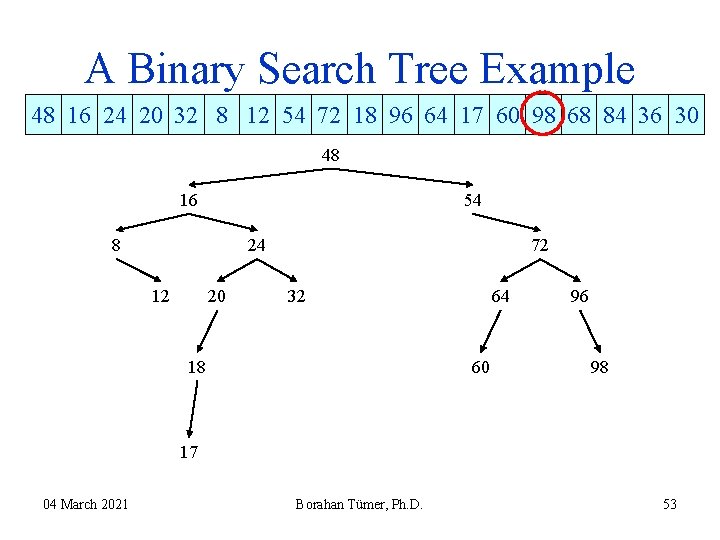
A Binary Search Tree Example 48 16 24 20 32 8 12 54 72 18 96 64 17 60 98 68 84 36 30 48 16 54 8 24 12 20 72 32 18 64 60 96 98 17 04 March 2021 Borahan Tümer, Ph. D. 53
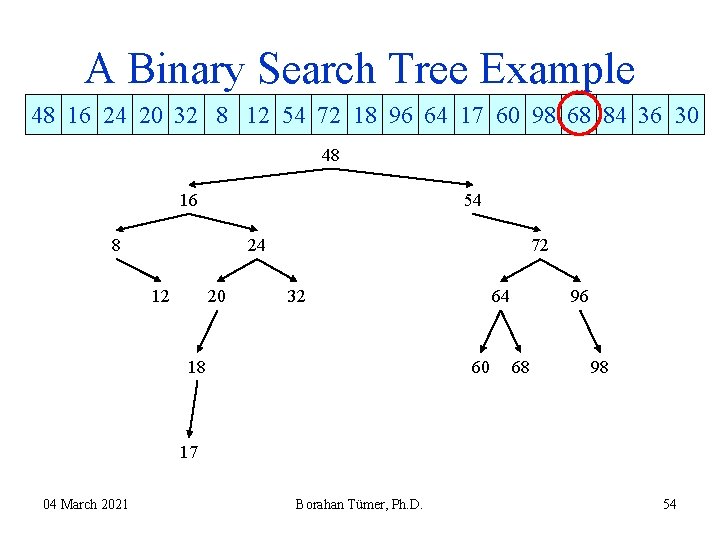
A Binary Search Tree Example 48 16 24 20 32 8 12 54 72 18 96 64 17 60 98 68 84 36 30 48 16 54 8 24 12 20 72 32 18 64 60 96 68 98 17 04 March 2021 Borahan Tümer, Ph. D. 54
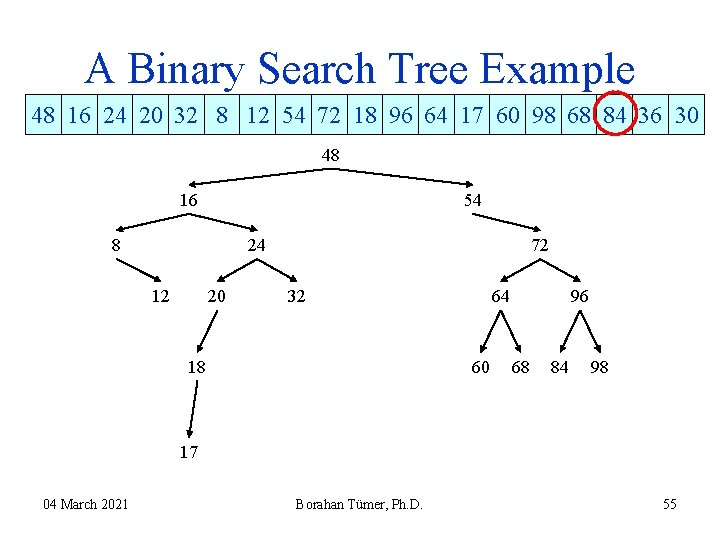
A Binary Search Tree Example 48 16 24 20 32 8 12 54 72 18 96 64 17 60 98 68 84 36 30 48 16 54 8 24 12 20 72 32 18 64 60 96 68 84 98 17 04 March 2021 Borahan Tümer, Ph. D. 55
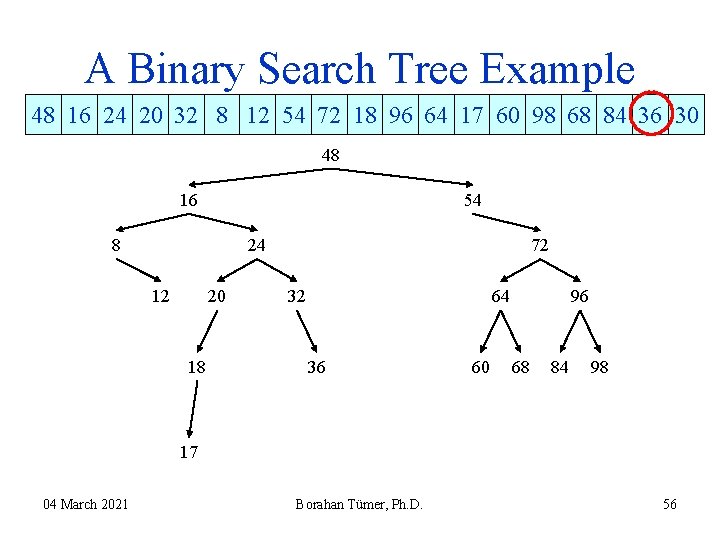
A Binary Search Tree Example 48 16 24 20 32 8 12 54 72 18 96 64 17 60 98 68 84 36 30 48 16 54 8 24 12 20 18 72 32 64 36 60 96 68 84 98 17 04 March 2021 Borahan Tümer, Ph. D. 56
A Binary Search Tree Example 48 16 24 20 32 8 12 54 72 18 96 64 17 60 98 68 84 36 30 48 16 54 8 24 12 72 20 18 32 30 64 36 60 96 68 84 98 17 04 March 2021 Borahan Tümer, Ph. D. 57
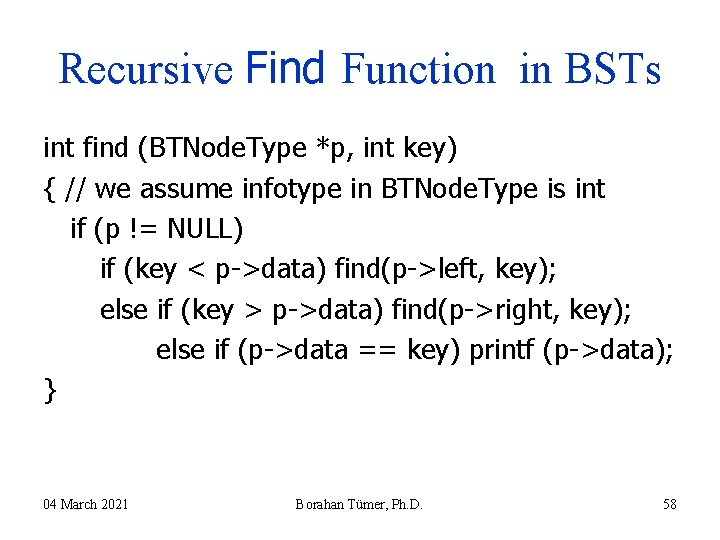
Recursive Find Function in BSTs int find (BTNode. Type *p, int key) { // we assume infotype in BTNode. Type is int if (p != NULL) if (key < p->data) find(p->left, key); else if (key > p->data) find(p->right, key); else if (p->data == key) printf (p->data); } 04 March 2021 Borahan Tümer, Ph. D. 58
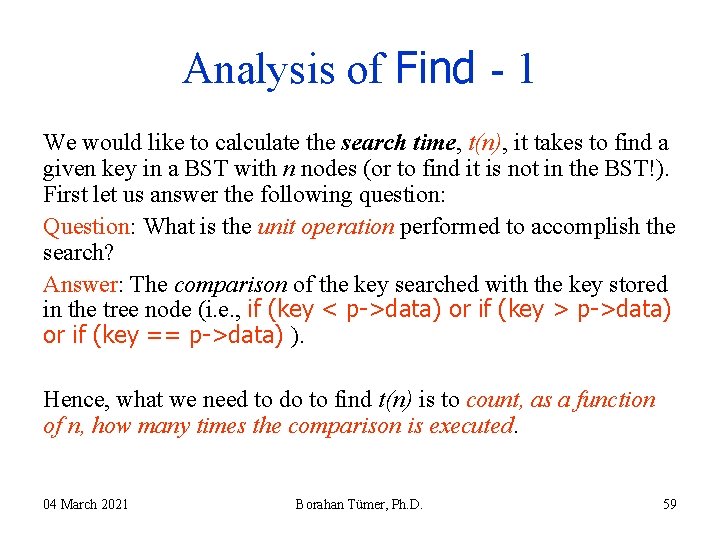
Analysis of Find - 1 We would like to calculate the search time, t(n), it takes to find a given key in a BST with n nodes (or to find it is not in the BST!). First let us answer the following question: Question: What is the unit operation performed to accomplish the search? Answer: The comparison of the key searched with the key stored in the tree node (i. e. , if (key < p->data) or if (key > p->data) or if (key == p->data) ). Hence, what we need to do to find t(n) is to count, as a function of n, how many times the comparison is executed. 04 March 2021 Borahan Tümer, Ph. D. 59
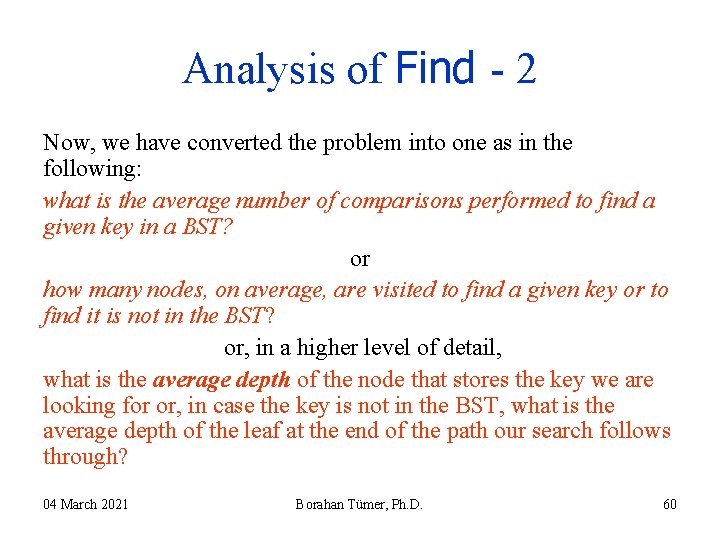
Analysis of Find - 2 Now, we have converted the problem into one as in the following: what is the average number of comparisons performed to find a given key in a BST? or how many nodes, on average, are visited to find a given key or to find it is not in the BST? or, in a higher level of detail, what is the average depth of the node that stores the key we are looking for or, in case the key is not in the BST, what is the average depth of the leaf at the end of the path our search follows through? 04 March 2021 Borahan Tümer, Ph. D. 60
Analysis of Find - 3 Now, we turn back to formulating t(n): We will do the formulation for three cases: 1. Average case 2. Worst case 3. Best case 04 March 2021 Borahan Tümer, Ph. D. 61
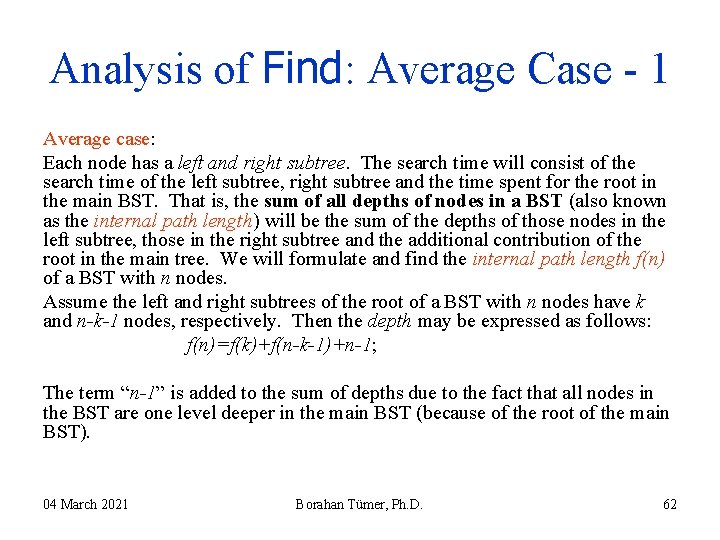
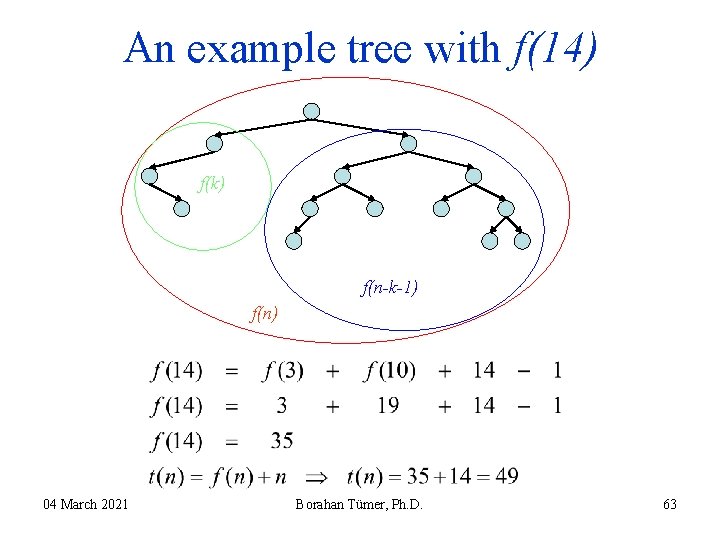
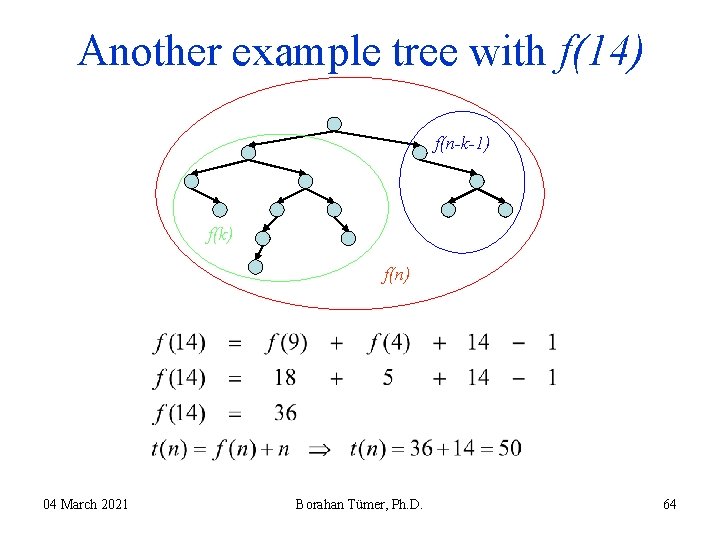
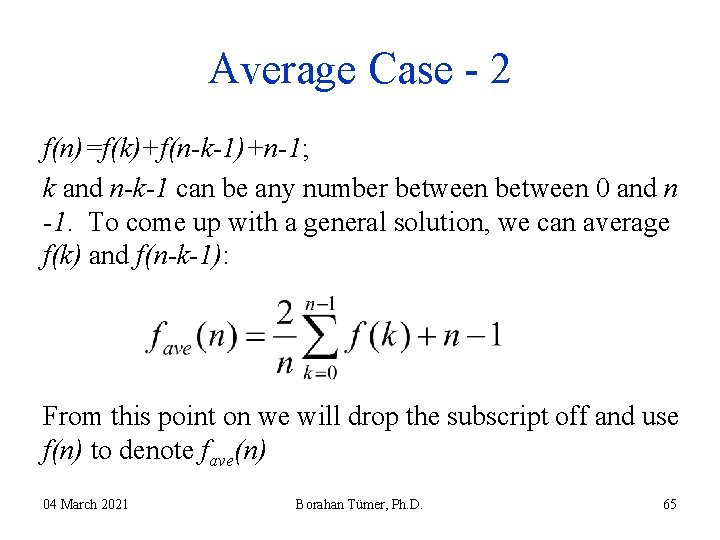
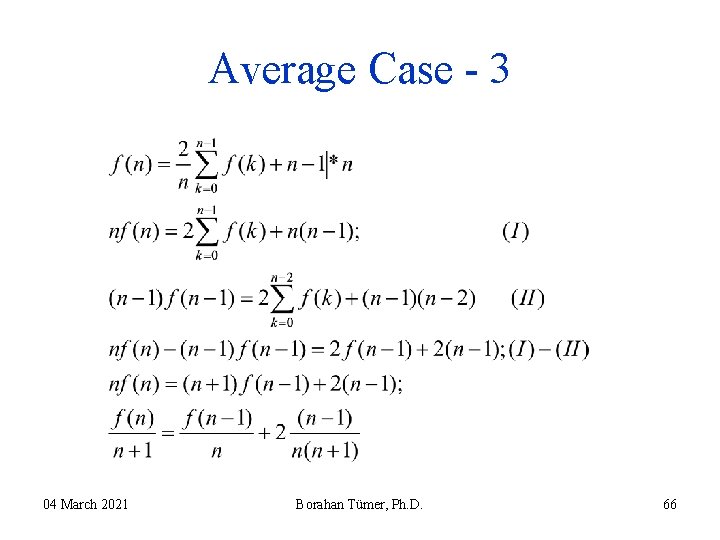
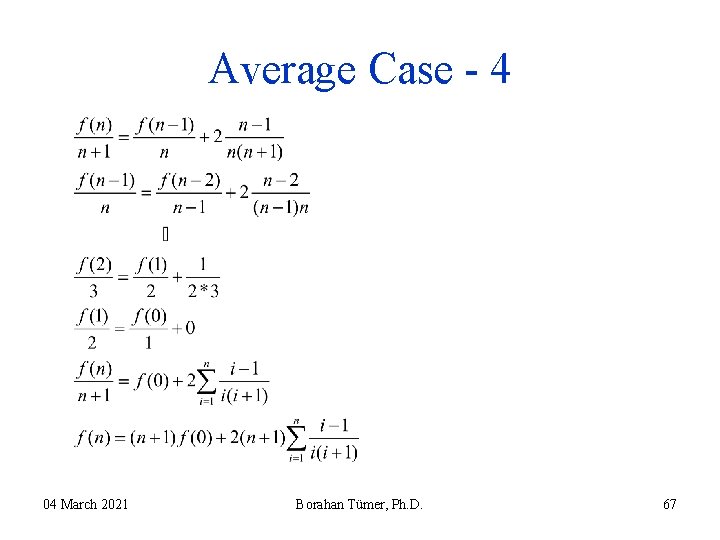
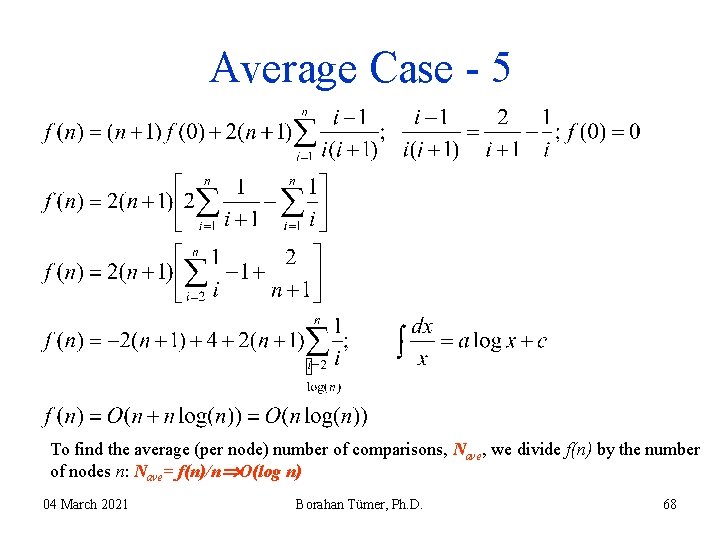
Analysis of Find: Average Case - 1 Average case: Each node has a left and right subtree. The search time will consist of the search time of the left subtree, right subtree and the time spent for the root in the main BST. That is, the sum of all depths of nodes in a BST (also known as the internal path length) will be the sum of the depths of those nodes in the left subtree, those in the right subtree and the additional contribution of the root in the main tree. We will formulate and find the internal path length f(n) of a BST with n nodes. Assume the left and right subtrees of the root of a BST with n nodes have k and n-k-1 nodes, respectively. Then the depth may be expressed as follows: f(n)=f(k)+f(n-k-1)+n-1; The term “n-1” is added to the sum of depths due to the fact that all nodes in the BST are one level deeper in the main BST (because of the root of the main BST). 04 March 2021 Borahan Tümer, Ph. D. 62
An example tree with f(14) f(k) f(n-k-1) f(n) 04 March 2021 Borahan Tümer, Ph. D. 63
Another example tree with f(14) f(n-k-1) f(k) f(n) 04 March 2021 Borahan Tümer, Ph. D. 64
Average Case - 2 f(n)=f(k)+f(n-k-1)+n-1; k and n-k-1 can be any number between 0 and n -1. To come up with a general solution, we can average f(k) and f(n-k-1): From this point on we will drop the subscript off and use f(n) to denote fave(n) 04 March 2021 Borahan Tümer, Ph. D. 65
Average Case - 3 04 March 2021 Borahan Tümer, Ph. D. 66
Average Case - 4 04 March 2021 Borahan Tümer, Ph. D. 67
Average Case - 5 To find the average (per node) number of comparisons, Nave, we divide f(n) by the number of nodes n: Nave= f(n)/n O(log n) 04 March 2021 Borahan Tümer, Ph. D. 68
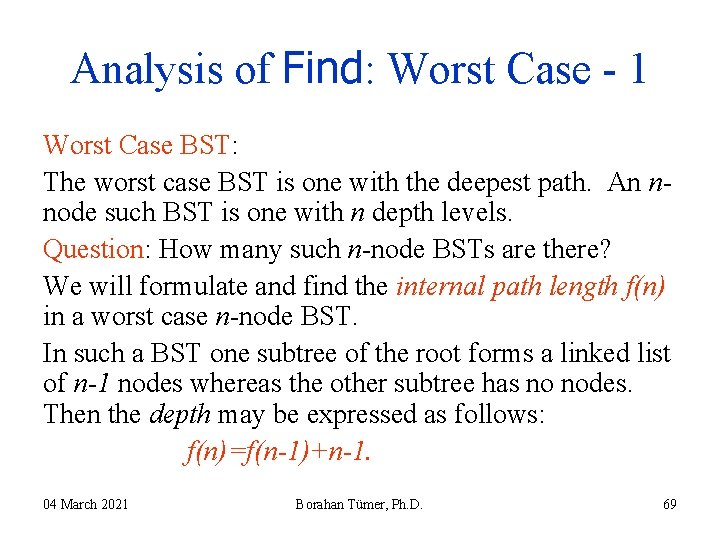
Analysis of Find: Worst Case - 1 Worst Case BST: The worst case BST is one with the deepest path. An nnode such BST is one with n depth levels. Question: How many such n-node BSTs are there? We will formulate and find the internal path length f(n) in a worst case n-node BST. In such a BST one subtree of the root forms a linked list of n-1 nodes whereas the other subtree has no nodes. Then the depth may be expressed as follows: f(n)=f(n-1)+n-1. 04 March 2021 Borahan Tümer, Ph. D. 69
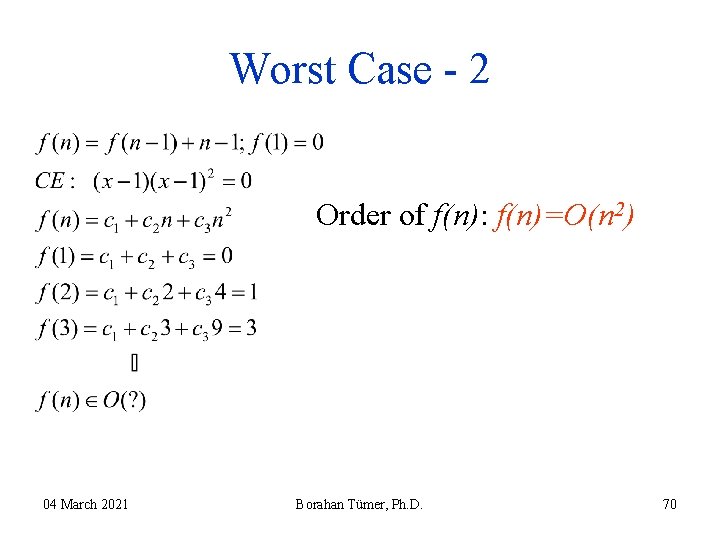
Worst Case - 2 Order of f(n): f(n)=O(n 2) 04 March 2021 Borahan Tümer, Ph. D. 70
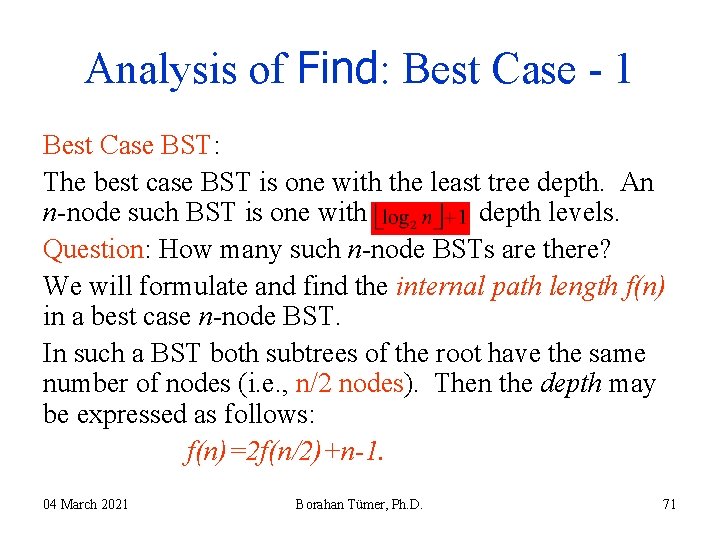
Analysis of Find: Best Case - 1 Best Case BST: The best case BST is one with the least tree depth. An n-node such BST is one with depth levels. Question: How many such n-node BSTs are there? We will formulate and find the internal path length f(n) in a best case n-node BST. In such a BST both subtrees of the root have the same number of nodes (i. e. , n/2 nodes). Then the depth may be expressed as follows: f(n)=2 f(n/2)+n-1. 04 March 2021 Borahan Tümer, Ph. D. 71
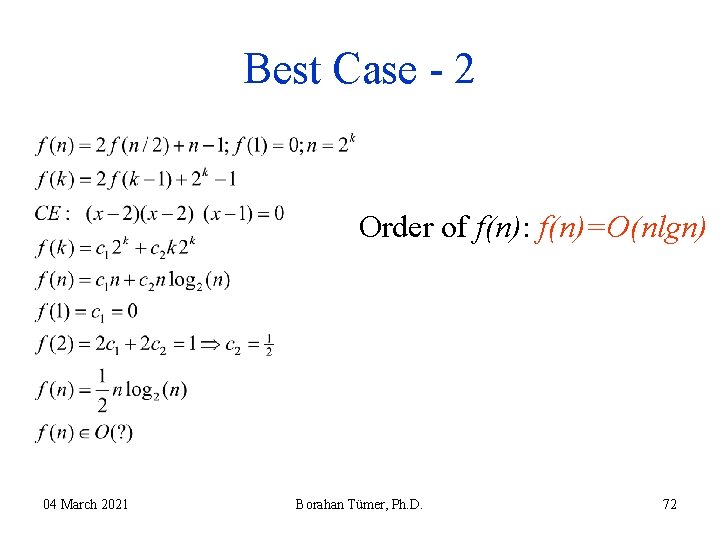
Best Case - 2 Order of f(n): f(n)=O(nlgn) 04 March 2021 Borahan Tümer, Ph. D. 72
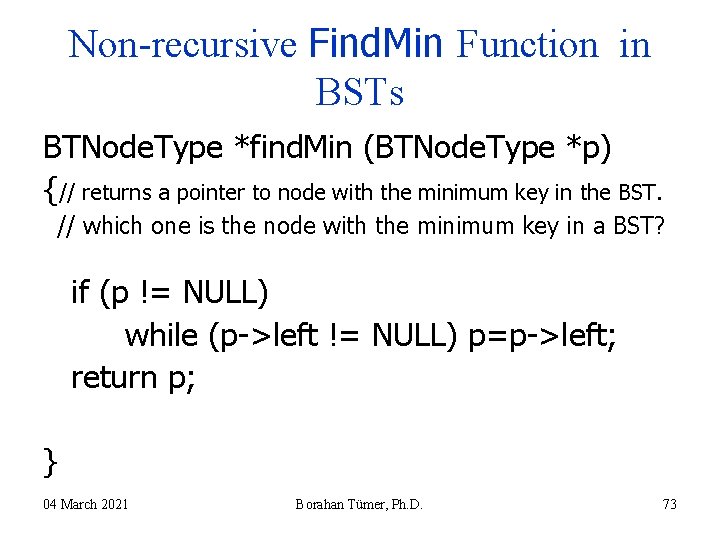
Non-recursive Find. Min Function in BSTs BTNode. Type *find. Min (BTNode. Type *p) {// returns a pointer to node with the minimum key in the BST. // which one is the node with the minimum key in a BST? if (p != NULL) while (p->left != NULL) p=p->left; return p; } 04 March 2021 Borahan Tümer, Ph. D. 73
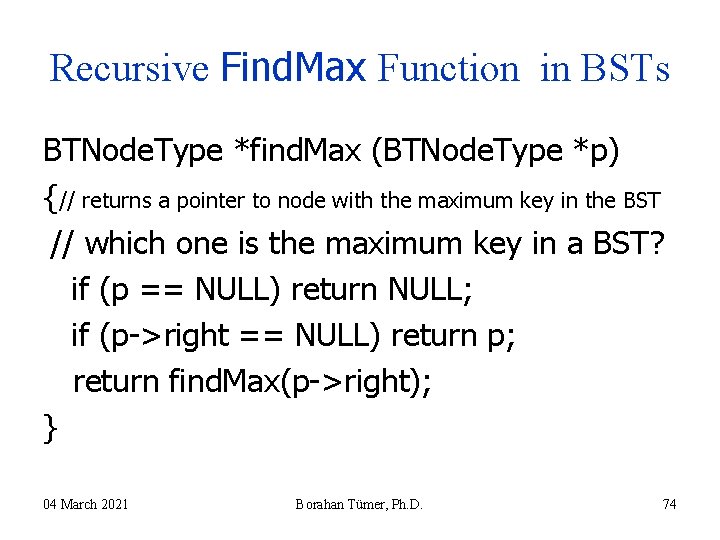
Recursive Find. Max Function in BSTs BTNode. Type *find. Max (BTNode. Type *p) {// returns a pointer to node with the maximum key in the BST // which one is the maximum key in a BST? if (p == NULL) return NULL; if (p->right == NULL) return p; return find. Max(p->right); } 04 March 2021 Borahan Tümer, Ph. D. 74
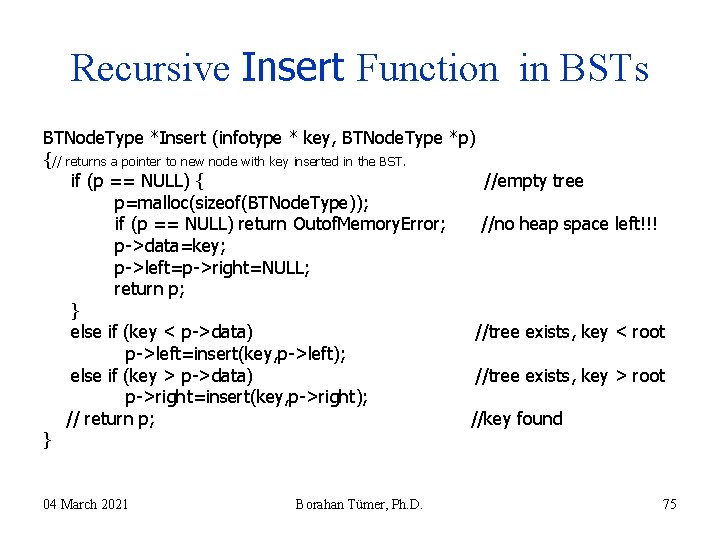
Recursive Insert Function in BSTs BTNode. Type *Insert (infotype * key, BTNode. Type *p) {// returns a pointer to new node with key inserted in the BST. if (p == NULL) { //empty tree p=malloc(sizeof(BTNode. Type)); if (p == NULL) return Outof. Memory. Error; //no heap space left!!! p->data=key; p->left=p->right=NULL; return p; } else if (key < p->data) //tree exists, key < root p->left=insert(key, p->left); else if (key > p->data) //tree exists, key > root p->right=insert(key, p->right); // return p; //key found } 04 March 2021 Borahan Tümer, Ph. D. 75
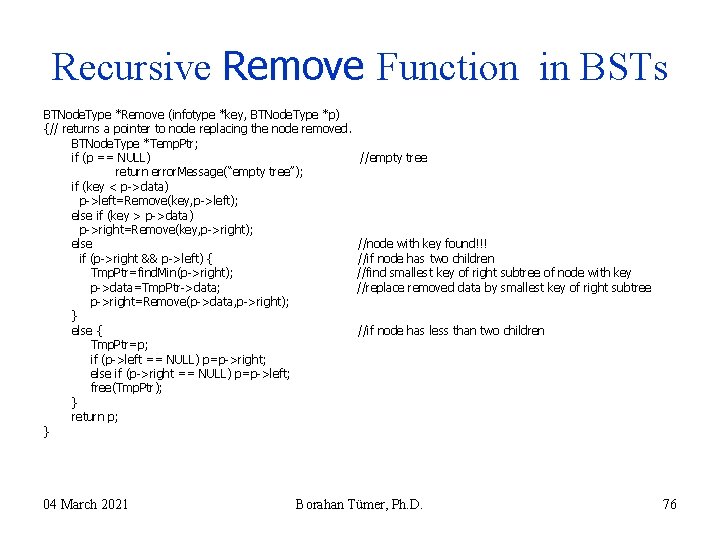
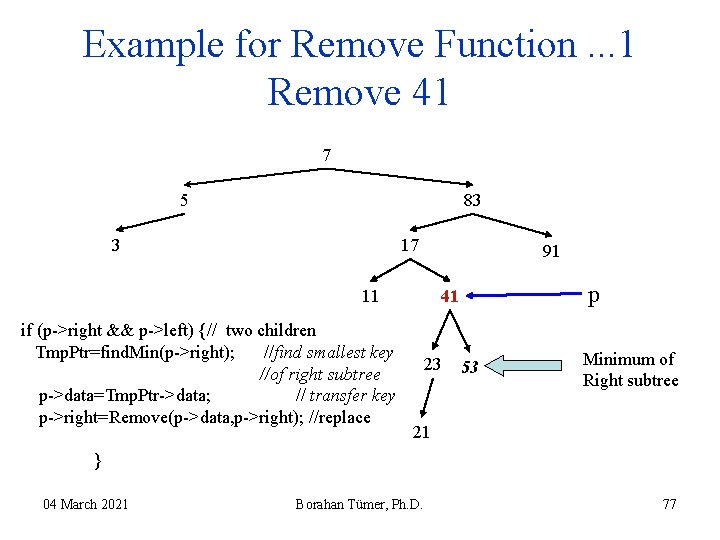
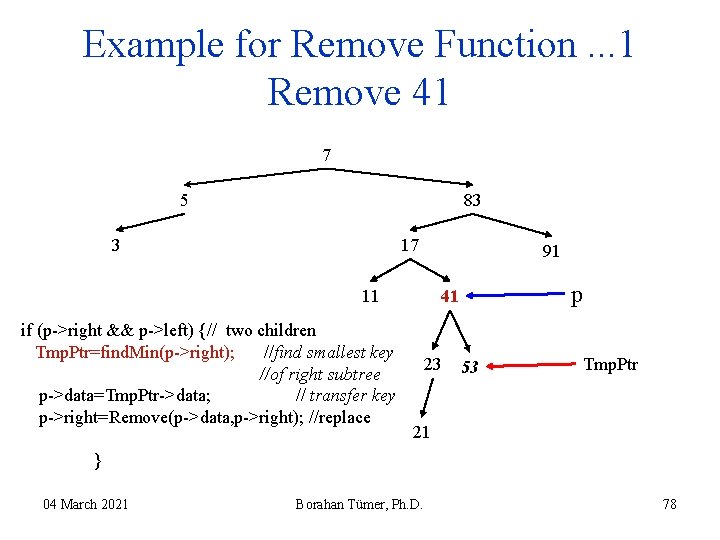
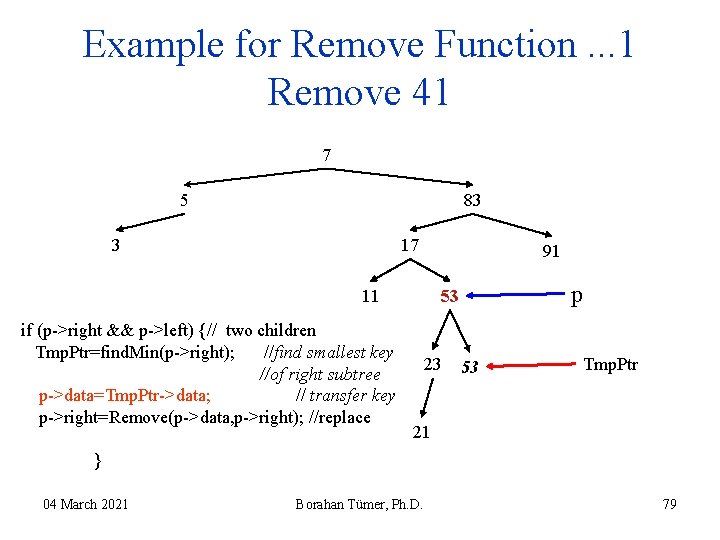
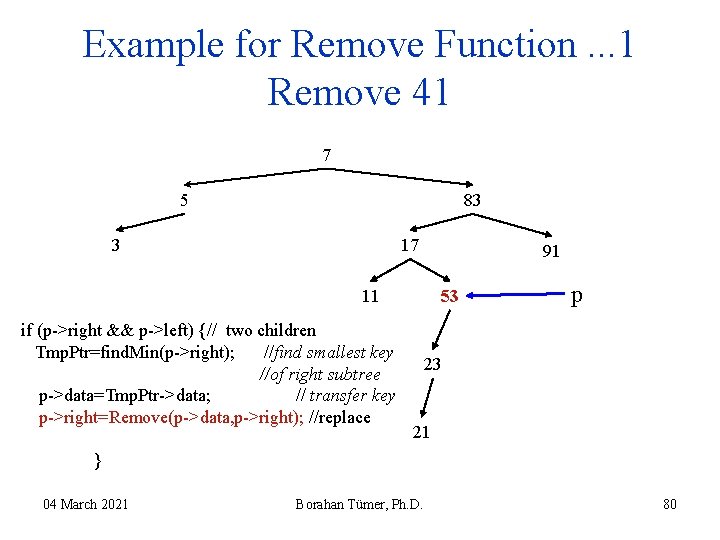
Recursive Remove Function in BSTs BTNode. Type *Remove (infotype *key, BTNode. Type *p) {// returns a pointer to node replacing the node removed. BTNode. Type *Temp. Ptr; if (p == NULL) return error. Message(“empty tree”); if (key < p->data) p->left=Remove(key, p->left); else if (key > p->data) p->right=Remove(key, p->right); else if (p->right && p->left) { Tmp. Ptr=find. Min(p->right); p->data=Tmp. Ptr->data; p->right=Remove(p->data, p->right); } else { Tmp. Ptr=p; if (p->left == NULL) p=p->right; else if (p->right == NULL) p=p->left; free(Tmp. Ptr); } return p; } 04 March 2021 //empty tree //node with key found!!! //if node has two children //find smallest key of right subtree of node with key //replace removed data by smallest key of right subtree //if node has less than two children Borahan Tümer, Ph. D. 76
Example for Remove Function. . . 1 Remove 41 7 5 83 3 17 91 11 if (p->right && p->left) {// two children Tmp. Ptr=find. Min(p->right); //find smallest key //of right subtree p->data=Tmp. Ptr->data; // transfer key p->right=Remove(p->data, p->right); //replace p 41 23 53 Minimum of Right subtree 21 } 04 March 2021 Borahan Tümer, Ph. D. 77
Example for Remove Function. . . 1 Remove 41 7 5 83 3 17 91 11 if (p->right && p->left) {// two children Tmp. Ptr=find. Min(p->right); //find smallest key //of right subtree p->data=Tmp. Ptr->data; // transfer key p->right=Remove(p->data, p->right); //replace p 41 23 53 Tmp. Ptr 21 } 04 March 2021 Borahan Tümer, Ph. D. 78
Example for Remove Function. . . 1 Remove 41 7 5 83 3 17 91 11 if (p->right && p->left) {// two children Tmp. Ptr=find. Min(p->right); //find smallest key //of right subtree p->data=Tmp. Ptr->data; // transfer key p->right=Remove(p->data, p->right); //replace p 53 23 53 Tmp. Ptr 21 } 04 March 2021 Borahan Tümer, Ph. D. 79
Example for Remove Function. . . 1 Remove 41 7 5 83 3 17 91 11 if (p->right && p->left) {// two children Tmp. Ptr=find. Min(p->right); //find smallest key //of right subtree p->data=Tmp. Ptr->data; // transfer key p->right=Remove(p->data, p->right); //replace 53 p 23 21 } 04 March 2021 Borahan Tümer, Ph. D. 80
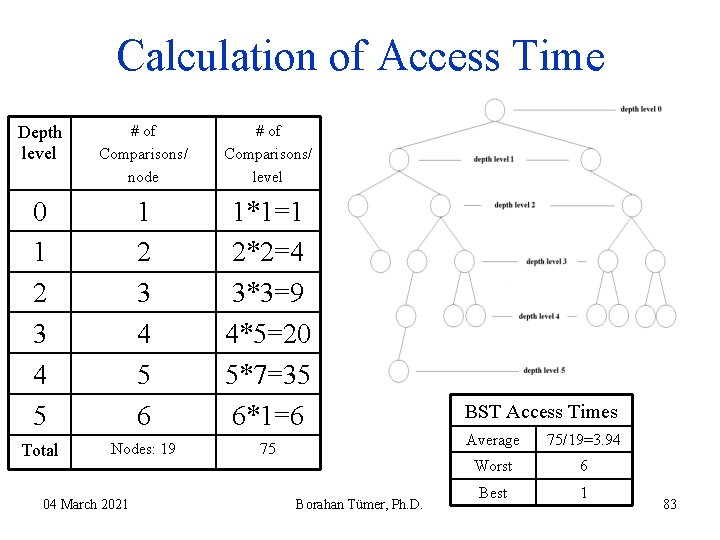
Best-Average-Worst Case Access Times of a specific BST • To find a node with some specific piece of data, a search gets started from the root. • Data at each node is compared with the key that is searched for. • Counting up the number of comparisons for each node will render the access time. 04 March 2021 Borahan Tümer, Ph. D. 81
Calculation of Access Time • Access to some specific piece of data is achieved when the node this piece of data resides is found. To find this node, a search gets started from the root. • Data at each node is compared with the key that is searched for. • Counting up the number of comparisons for each node will render the access time. 04 March 2021 Borahan Tümer, Ph. D. 82
Calculation of Access Time Depth level # of Comparisons/ node # of Comparisons/ level 0 1 2 3 4 5 6 1*1=1 2*2=4 3*3=9 4*5=20 5*7=35 6*1=6 Total Nodes: 19 75 04 March 2021 Borahan Tümer, Ph. D. BST Access Times Average 75/19=3. 94 Worst 6 Best 1 83