
Data Structures Week 4 Queues Borahan Tmer Ph
Data Structures – Week #4 Queues Borahan Tümer, Ph. D.
Outline • • • Queues Operations on Queues Array Implementation of Queues Linked List Implementation of Queues Queue Applications 12/6/2020 Borahan Tümer, Ph. D. 2
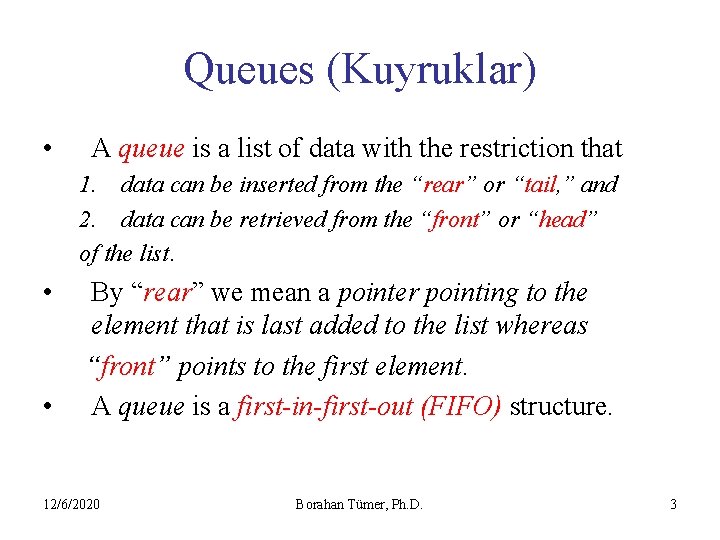
Queues (Kuyruklar) • A queue is a list of data with the restriction that 1. data can be inserted from the “rear” or “tail, ” and 2. data can be retrieved from the “front” or “head” of the list. • • By “rear” we mean a pointer pointing to the element that is last added to the list whereas “front” points to the first element. A queue is a first-in-first-out (FIFO) structure. 12/6/2020 Borahan Tümer, Ph. D. 3
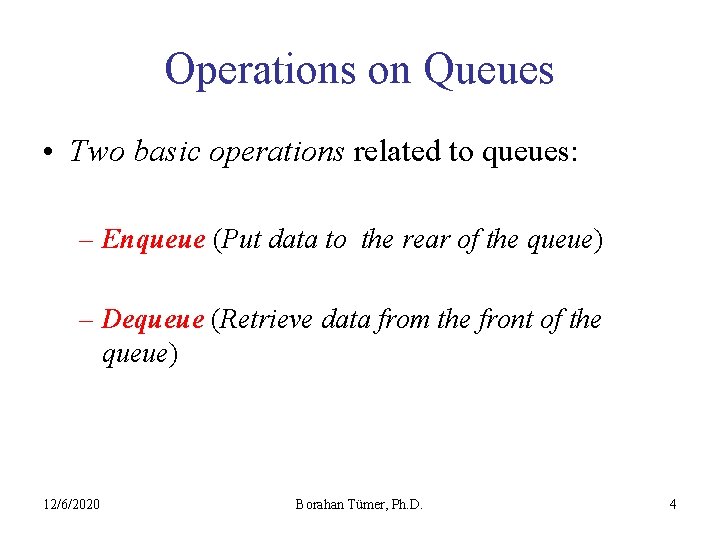
Operations on Queues • Two basic operations related to queues: – Enqueue (Put data to the rear of the queue) – Dequeue (Retrieve data from the front of the queue) 12/6/2020 Borahan Tümer, Ph. D. 4

Array Implementation of Queues • Queues can be implemented using arrays. • During the execution, queue can grow or shrink within this array. The array has two “open” ends. • One end of the doubly-open-ended array is the rear where the insertions are made. The other is the front where elements are removed. 12/6/2020 Borahan Tümer, Ph. D. 5

Array Implementation of Queues • Initialization: – front=0; rear=-1; • Condition for an empty queue: – In general: rear+1 = front – In particular: rear = -1; • Condition for a full queue – In general: rear-(n-1) = front; – In particular: rear n-1; 12/6/2020 Borahan Tümer, Ph. D. 6
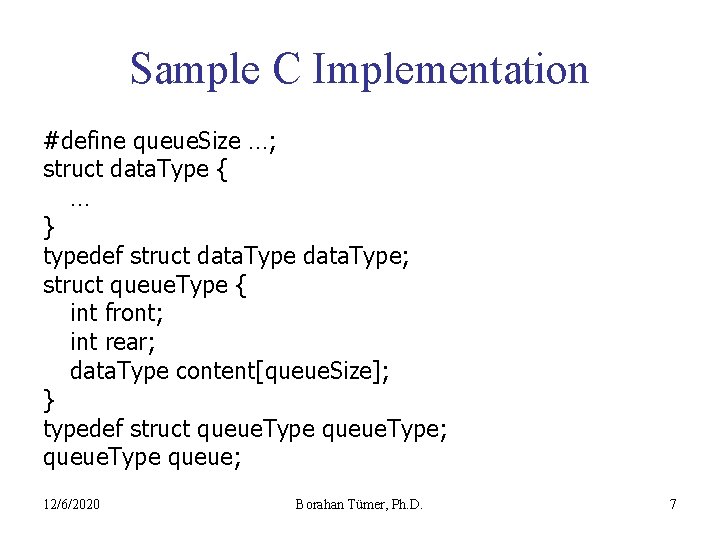
Sample C Implementation #define queue. Size …; struct data. Type { … } typedef struct data. Type; struct queue. Type { int front; int rear; data. Type content[queue. Size]; } typedef struct queue. Type; queue. Type queue; 12/6/2020 Borahan Tümer, Ph. D. 7
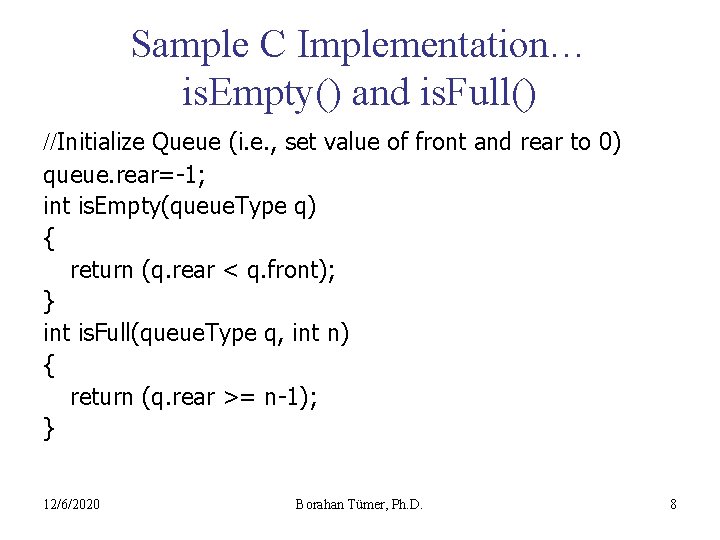
Sample C Implementation… is. Empty() and is. Full() //Initialize Queue (i. e. , set value of front and rear to 0) queue. rear=-1; int is. Empty(queue. Type q) { return (q. rear < q. front); } int is. Full(queue. Type q, int n) { return (q. rear >= n-1); } 12/6/2020 Borahan Tümer, Ph. D. 8
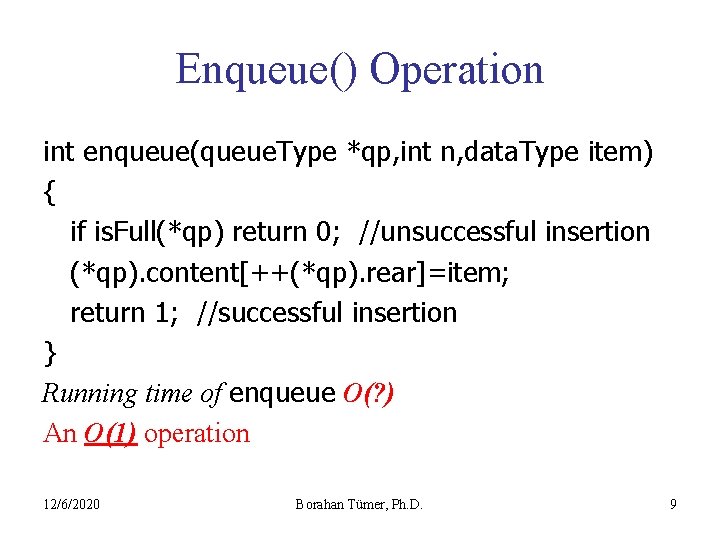
Enqueue() Operation int enqueue(queue. Type *qp, int n, data. Type item) { if is. Full(*qp) return 0; //unsuccessful insertion (*qp). content[++(*qp). rear]=item; return 1; //successful insertion } Running time of enqueue O(? ) An O(1) operation 12/6/2020 Borahan Tümer, Ph. D. 9
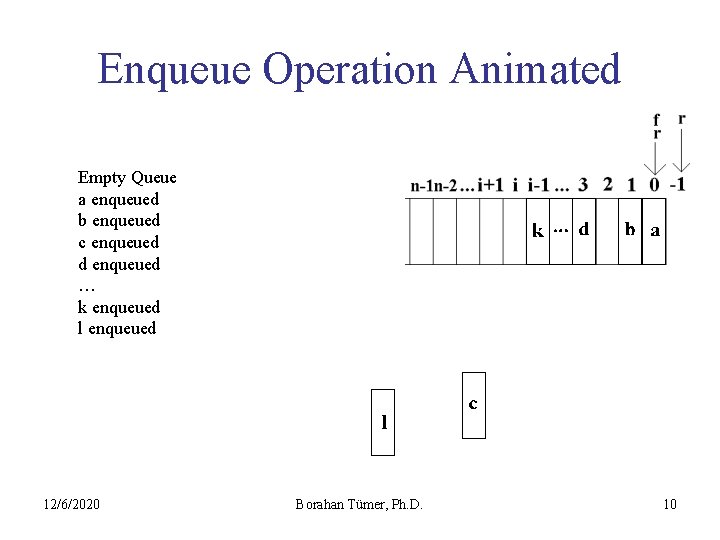
Enqueue Operation Animated Empty Queue a enqueued b enqueued c enqueued d enqueued … k enqueued l enqueued 12/6/2020 Borahan Tümer, Ph. D. 10
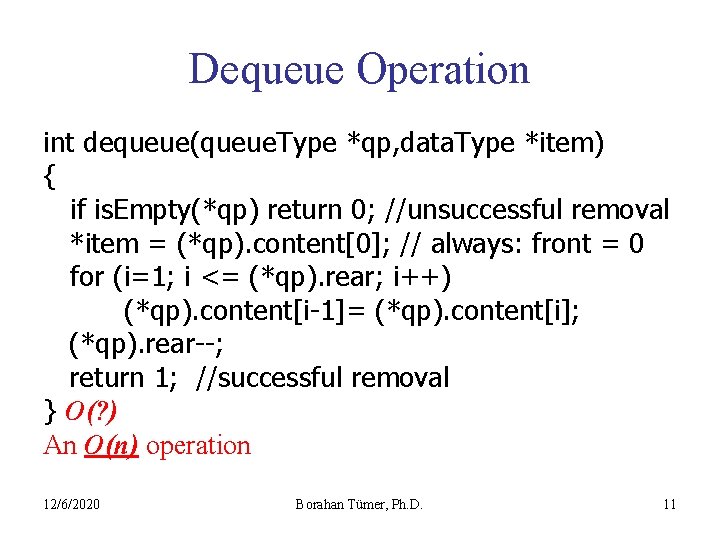
Dequeue Operation int dequeue(queue. Type *qp, data. Type *item) { if is. Empty(*qp) return 0; //unsuccessful removal *item = (*qp). content[0]; // always: front = 0 for (i=1; i <= (*qp). rear; i++) (*qp). content[i-1]= (*qp). content[i]; (*qp). rear--; return 1; //successful removal } O(? ) An O(n) operation 12/6/2020 Borahan Tümer, Ph. D. 11
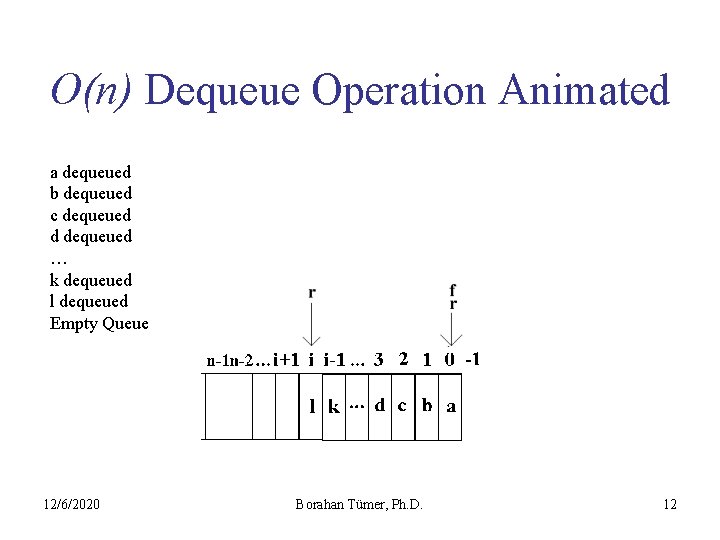
O(n) Dequeue Operation Animated a dequeued b dequeued c dequeued d dequeued … k dequeued l dequeued Empty Queue 12/6/2020 Borahan Tümer, Ph. D. 12
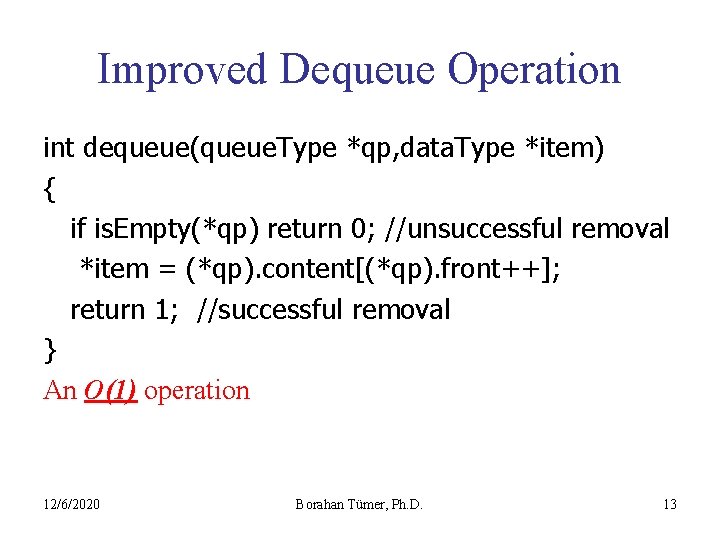
Improved Dequeue Operation int dequeue(queue. Type *qp, data. Type *item) { if is. Empty(*qp) return 0; //unsuccessful removal *item = (*qp). content[(*qp). front++]; return 1; //successful removal } An O(1) operation 12/6/2020 Borahan Tümer, Ph. D. 13
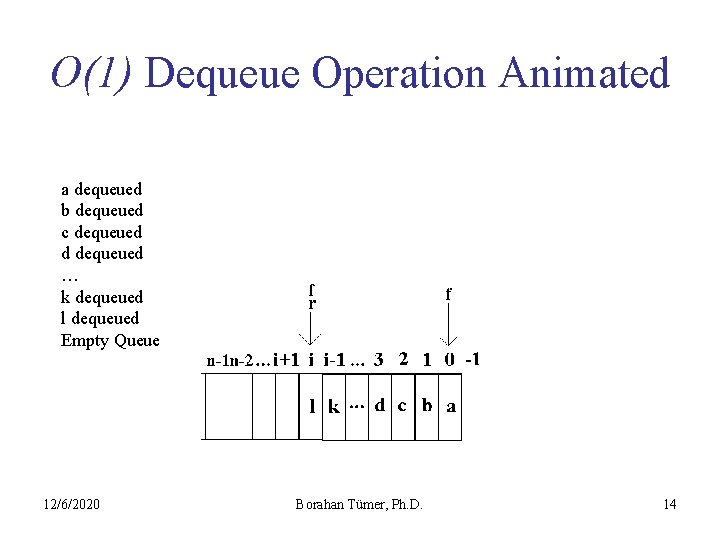
O(1) Dequeue Operation Animated a dequeued b dequeued c dequeued d dequeued … k dequeued l dequeued Empty Queue 12/6/2020 Borahan Tümer, Ph. D. 14
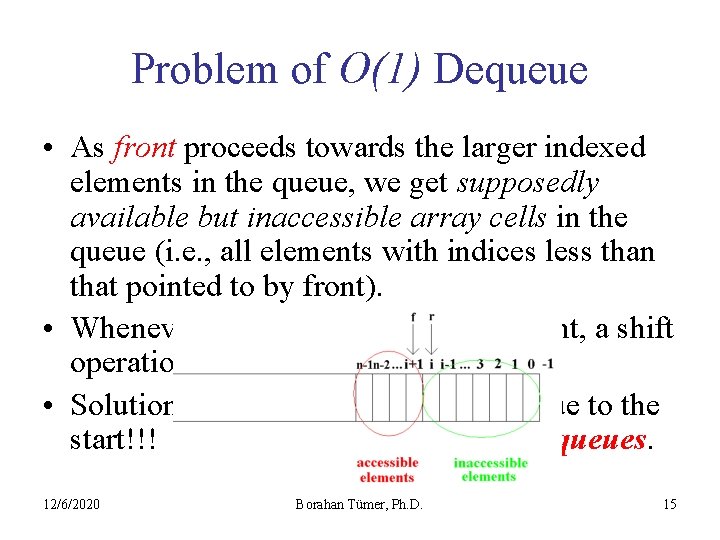
Problem of O(1) Dequeue • As front proceeds towards the larger indexed elements in the queue, we get supposedly available but inaccessible array cells in the queue (i. e. , all elements with indices less than that pointed to by front). • Whenever rear points to (n-1)st element, a shift operation still needs to be carried out. • Solution: attaching the end of the queue to the start!!! Such queues we call circular queues. 12/6/2020 Borahan Tümer, Ph. D. 15
Circular Queues • Since with the existing conditions an empty and full circular queue is indistinguishable, we redefine the conditions for empty and full queue following a new convention: • Convention: front points to the preceding cell of the cell with the data to be removed next. • Empty circular queue condition: front=rear • Full queue condition: front=(rear+1) mod n 12/6/2020 Borahan Tümer, Ph. D. 16
Circular Queues (CQs) //Initialize Queue (i. e. , set value of front and rear to n-1) queue. rear=n-1; // i. e. , -1 mod n int is. Empty. CQ(queue. Type cq) { return (cq. rear == cq. front); } int is. Full. CQ(queue. Type cq, int n) { return (cq. rear == (cq. front-1 % n)); } 12/6/2020 Borahan Tümer, Ph. D. 17
Enqueue Operation in CQs int enqueue. CQ(queue. Type *cqp, data. Type item) { if is. Full. CQ(*cqp) return 0; //unsuccessful insertion (*cqp). content[++(*cqp). rear]=item; return 1; //successful insertion } An O(1) operation 12/6/2020 Borahan Tümer, Ph. D. 18
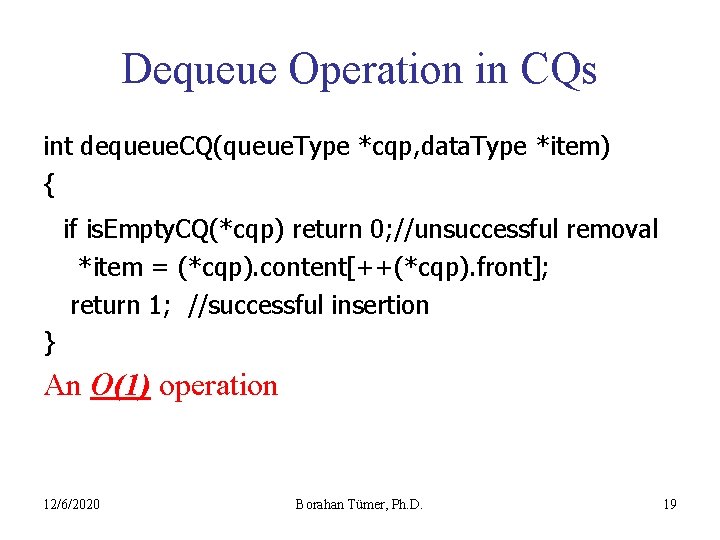
Dequeue Operation in CQs int dequeue. CQ(queue. Type *cqp, data. Type *item) { if is. Empty. CQ(*cqp) return 0; //unsuccessful removal *item = (*cqp). content[++(*cqp). front]; return 1; //successful insertion } An O(1) operation 12/6/2020 Borahan Tümer, Ph. D. 19
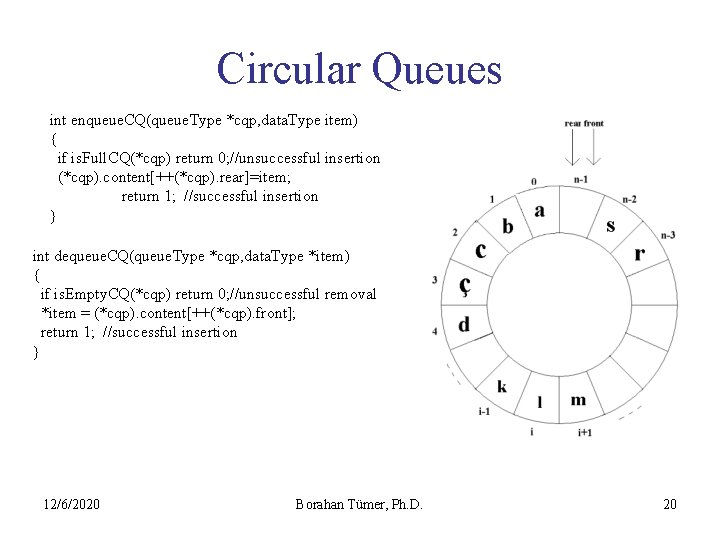
Circular Queues int enqueue. CQ(queue. Type *cqp, data. Type item) { if is. Full. CQ(*cqp) return 0; //unsuccessful insertion (*cqp). content[++(*cqp). rear]=item; return 1; //successful insertion } int dequeue. CQ(queue. Type *cqp, data. Type *item) { if is. Empty. CQ(*cqp) return 0; //unsuccessful removal *item = (*cqp). content[++(*cqp). front]; return 1; //successful insertion } 12/6/2020 Borahan Tümer, Ph. D. 20
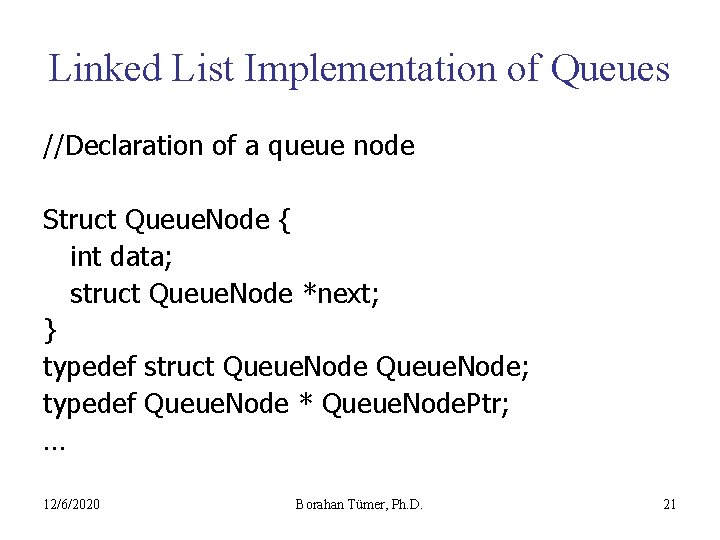
Linked List Implementation of Queues //Declaration of a queue node Struct Queue. Node { int data; struct Queue. Node *next; } typedef struct Queue. Node; typedef Queue. Node * Queue. Node. Ptr; … 12/6/2020 Borahan Tümer, Ph. D. 21
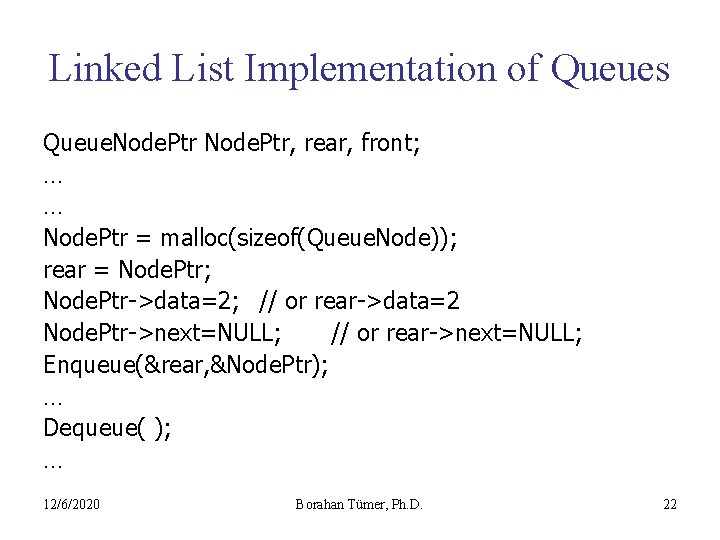
Linked List Implementation of Queues Queue. Node. Ptr, rear, front; … … Node. Ptr = malloc(sizeof(Queue. Node)); rear = Node. Ptr; Node. Ptr->data=2; // or rear->data=2 Node. Ptr->next=NULL; // or rear->next=NULL; Enqueue(&rear, &Node. Ptr); … Dequeue( ); … 12/6/2020 Borahan Tümer, Ph. D. 22
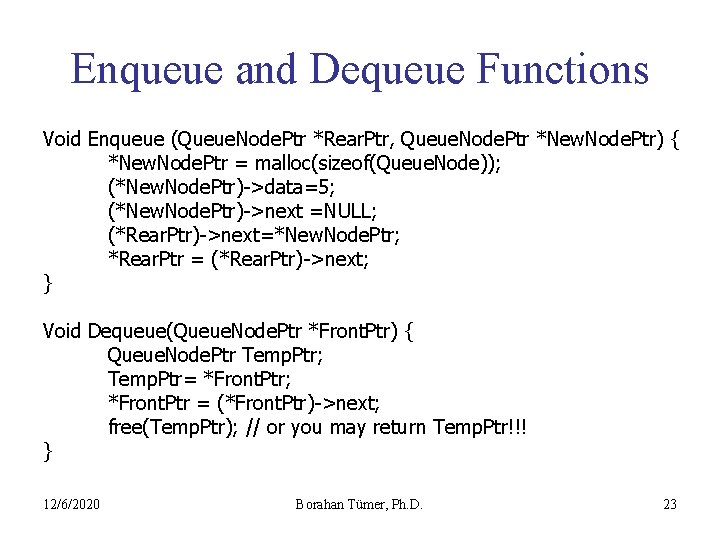
Enqueue and Dequeue Functions Void Enqueue (Queue. Node. Ptr *Rear. Ptr, Queue. Node. Ptr *New. Node. Ptr) { *New. Node. Ptr = malloc(sizeof(Queue. Node)); (*New. Node. Ptr)->data=5; (*New. Node. Ptr)->next =NULL; (*Rear. Ptr)->next=*New. Node. Ptr; *Rear. Ptr = (*Rear. Ptr)->next; } Void Dequeue(Queue. Node. Ptr *Front. Ptr) { Queue. Node. Ptr Temp. Ptr; Temp. Ptr= *Front. Ptr; *Front. Ptr = (*Front. Ptr)->next; free(Temp. Ptr); // or you may return Temp. Ptr!!! } 12/6/2020 Borahan Tümer, Ph. D. 23
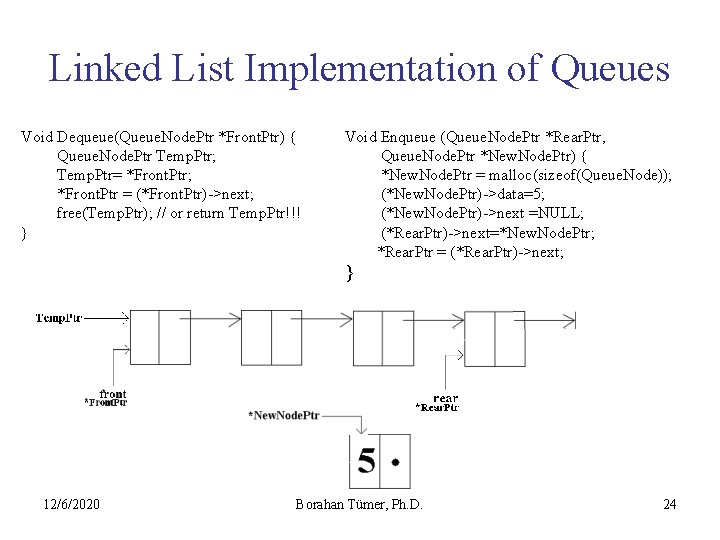
Linked List Implementation of Queues Void Dequeue(Queue. Node. Ptr *Front. Ptr) { Queue. Node. Ptr Temp. Ptr; Temp. Ptr= *Front. Ptr; *Front. Ptr = (*Front. Ptr)->next; free(Temp. Ptr); // or return Temp. Ptr!!! } Void Enqueue (Queue. Node. Ptr *Rear. Ptr, Queue. Node. Ptr *New. Node. Ptr) { *New. Node. Ptr = malloc(sizeof(Queue. Node)); (*New. Node. Ptr)->data=5; (*New. Node. Ptr)->next =NULL; (*Rear. Ptr)->next=*New. Node. Ptr; *Rear. Ptr = (*Rear. Ptr)->next; } 12/6/2020 Borahan Tümer, Ph. D. 24
Queue Applications • All systems where a queue (a FIFO structure) is applicable can make use of queues. • Possible examples from daily life are: – Bank desks – Market cashiers – Pumps in gas stations • Examples from computer science are: – Printer queues – Queue of computer processes that wait for using the microprocessor 12/6/2020 Borahan Tümer, Ph. D. 25
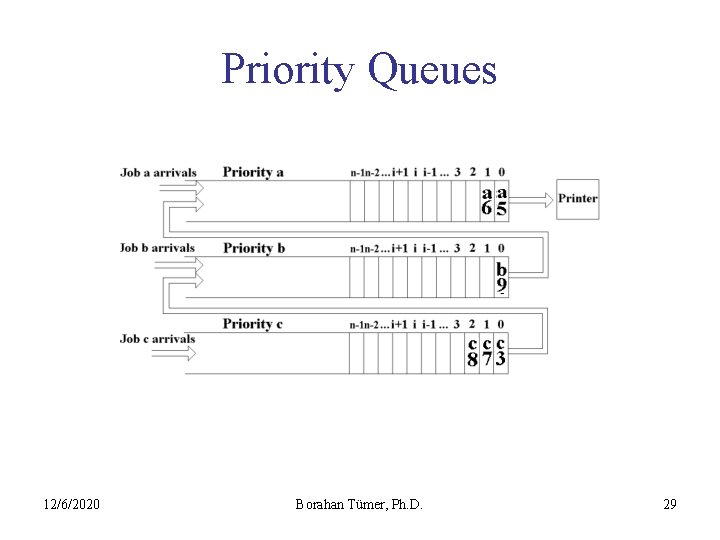
Priority Queues • While a regular queue functions based on the arrival time as the only criterion as a FIFO structure, this sometimes degrades the overall performance of the system. • Consider a printer queue in a multi-processing system where one user has submitted, say, a 200 -page-long print job seconds before many users have submitted print jobs of only several pages long. • A regular queue would start with the long print job and all others would have to wait. This would cause the average waiting time (AWT) of the queue to increase. AWT is an important measure used to evaluate the performance of the computer system, and the shorter the AWT, the better the performance of the system. 12/6/2020 Borahan Tümer, Ph. D. 26
Priority Queues • What may be done to improve the performance of the printer queue? • Solution: Assign priority values to arriving jobs • Then, jobs of the same priority will be ordered by their arrival time. 12/6/2020 Borahan Tümer, Ph. D. 27
Priority Queues • Assume a printer queue of jobs with three priorities, a, b, and c, where jobs with a (c) have the highest (lowest) priority, respectively. • That is, jobs with priority a are to be processed first by their arrival times, and jobs of priority c last. 12/6/2020 Borahan Tümer, Ph. D. 28
Priority Queues 12/6/2020 Borahan Tümer, Ph. D. 29
- Slides: 29