
Data Structures Week 3 Stacks Borahan Tmer Ph
Data Structures – Week #3 Stacks Borahan Tümer, Ph. D.

Outline • • • Stacks Operations on Stacks Array Implementation of Stacks Linked List Implementation of Stacks Stack Applications 3/12/2021 Borahan Tümer, Ph. D. 2
Stacks (Yığınlar) • • • A stack is a list of data with the restriction that data can be retrieved from or inserted to the “top” of the list. By “top” we mean a pointer pointing to the element that is last added to the list. A stack is a last-in-first-out (LIFO) structure. 3/12/2021 Borahan Tümer, Ph. D. 3
Operations on Stacks • Two basic operations related to stacks: – Push (Put data to the top of the stack) – Pop (Retrieve data from the top of the stack) 3/12/2021 Borahan Tümer, Ph. D. 4
Array Implementation of Stacks • Stacks can be implemented by arrays. • During the execution, the stack can – grow by push operations, or – shrink by pop operations • within this array. • One end of the array is the bottom and insertions and deletions (removals) are made from the other end. • We also need another field that, at each point, keeps track of the current position of the top of the stack. 3/12/2021 Borahan Tümer, Ph. D. 5
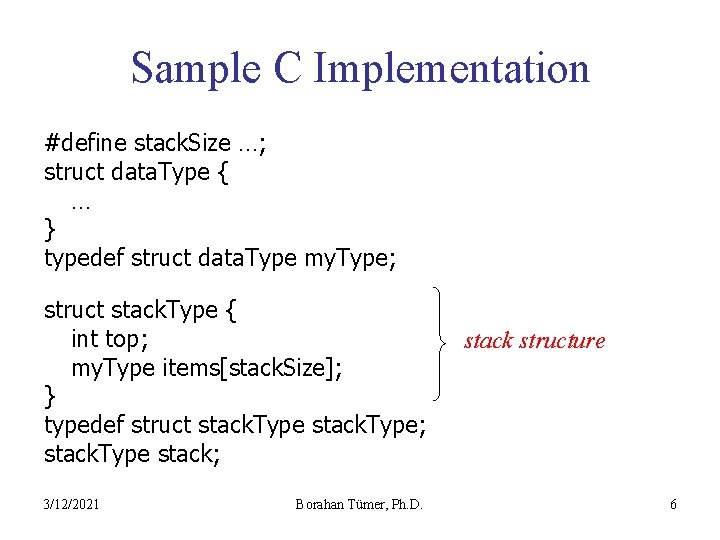
Sample C Implementation #define stack. Size …; struct data. Type { … } typedef struct data. Type my. Type; struct stack. Type { int top; my. Type items[stack. Size]; } typedef struct stack. Type; stack. Type stack; 3/12/2021 Borahan Tümer, Ph. D. stack structure 6
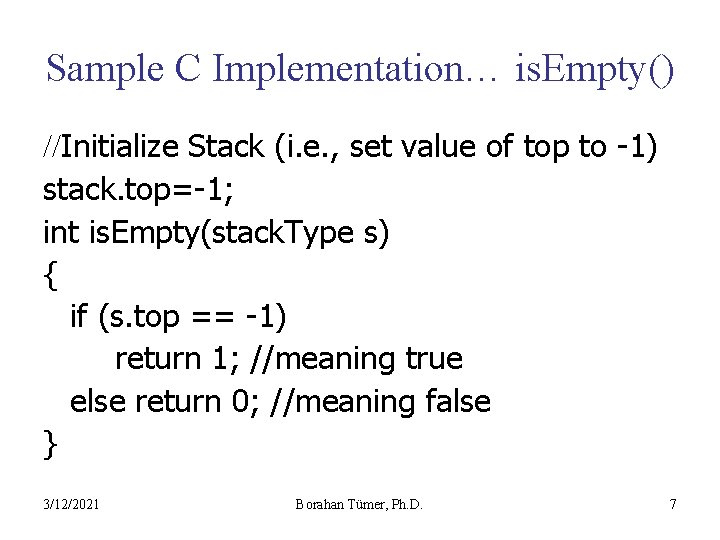
Sample C Implementation… is. Empty() //Initialize Stack (i. e. , set value of top to -1) stack. top=-1; int is. Empty(stack. Type s) { if (s. top == -1) return 1; //meaning true else return 0; //meaning false } 3/12/2021 Borahan Tümer, Ph. D. 7
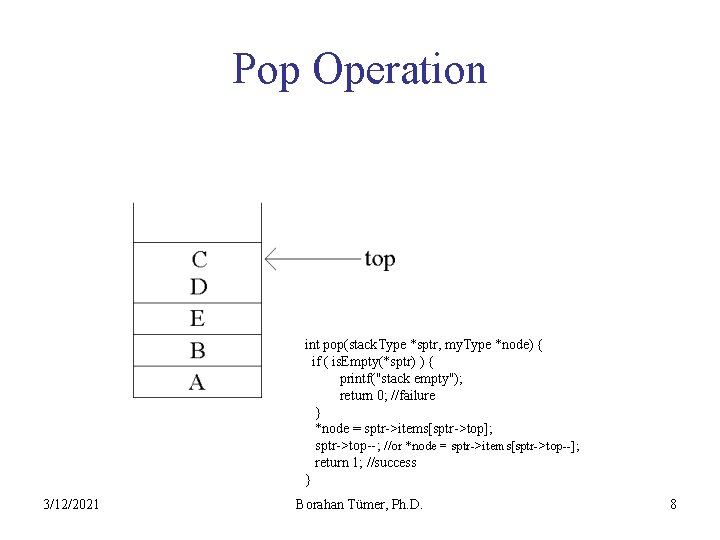
Pop Operation int pop(stack. Type *sptr, my. Type *node) { if ( is. Empty(*sptr) ) { printf("stack empty"); return 0; //failure } *node = sptr->items[sptr->top]; sptr->top--; //or *node = sptr->items[sptr->top--]; return 1; //success } 3/12/2021 Borahan Tümer, Ph. D. 8
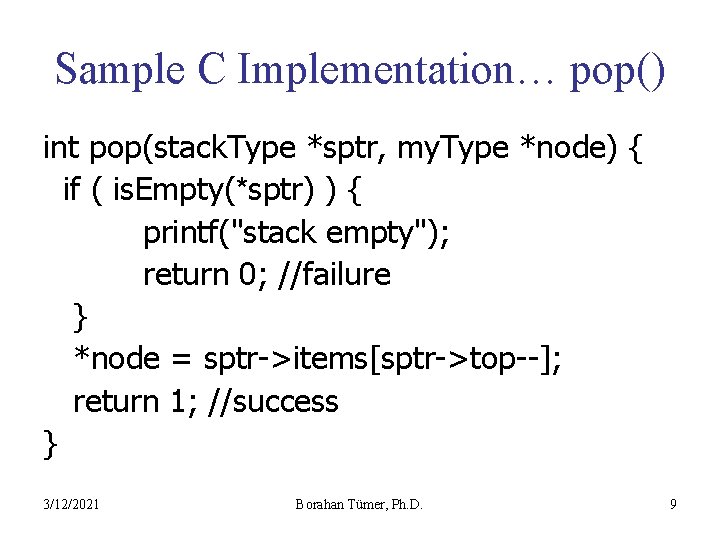
Sample C Implementation… pop() int pop(stack. Type *sptr, my. Type *node) { if ( is. Empty(*sptr) ) { printf("stack empty"); return 0; //failure } *node = sptr->items[sptr->top--]; return 1; //success } 3/12/2021 Borahan Tümer, Ph. D. 9
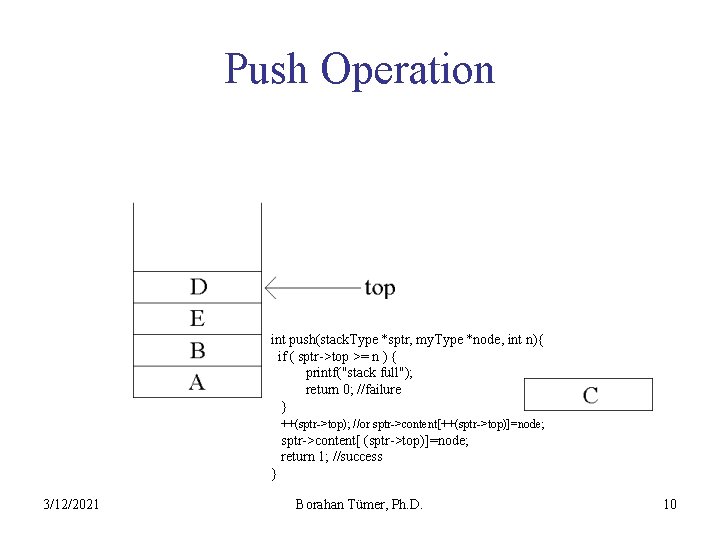
Push Operation int push(stack. Type *sptr, my. Type *node, int n){ if ( sptr->top >= n ) { printf("stack full"); return 0; //failure } ++(sptr->top); //or sptr->content[++(sptr->top)]=node; sptr->content[ (sptr->top)]=node; return 1; //success } 3/12/2021 Borahan Tümer, Ph. D. 10
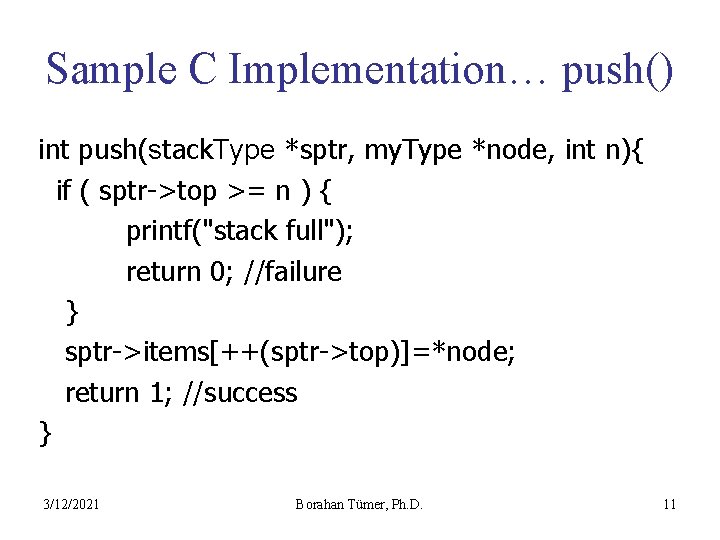
Sample C Implementation… push() int push(stack. Type *sptr, my. Type *node, int n){ if ( sptr->top >= n ) { printf("stack full"); return 0; //failure } sptr->items[++(sptr->top)]=*node; return 1; //success } 3/12/2021 Borahan Tümer, Ph. D. 11
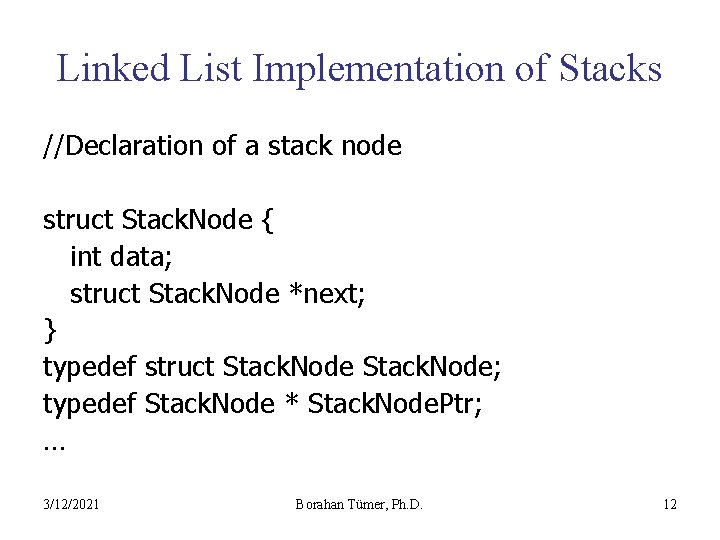
Linked List Implementation of Stacks //Declaration of a stack node struct Stack. Node { int data; struct Stack. Node *next; } typedef struct Stack. Node; typedef Stack. Node * Stack. Node. Ptr; … 3/12/2021 Borahan Tümer, Ph. D. 12
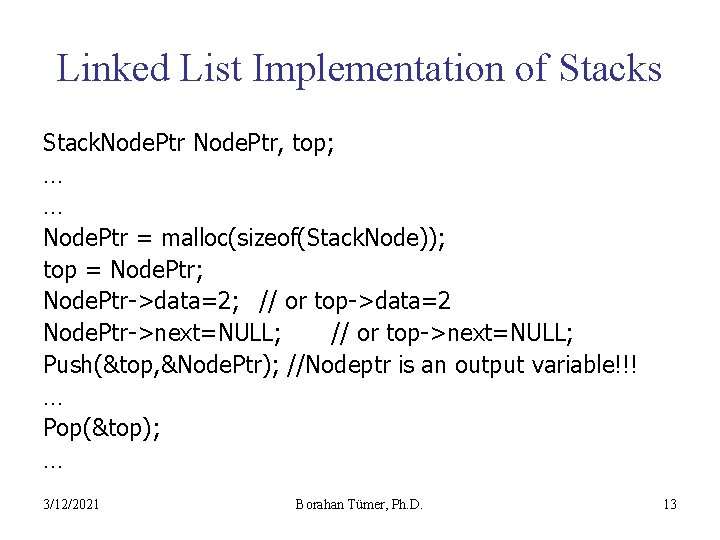
Linked List Implementation of Stacks Stack. Node. Ptr, top; … … Node. Ptr = malloc(sizeof(Stack. Node)); top = Node. Ptr; Node. Ptr->data=2; // or top->data=2 Node. Ptr->next=NULL; // or top->next=NULL; Push(&top, &Node. Ptr); //Nodeptr is an output variable!!! … Pop(&top); … 3/12/2021 Borahan Tümer, Ph. D. 13
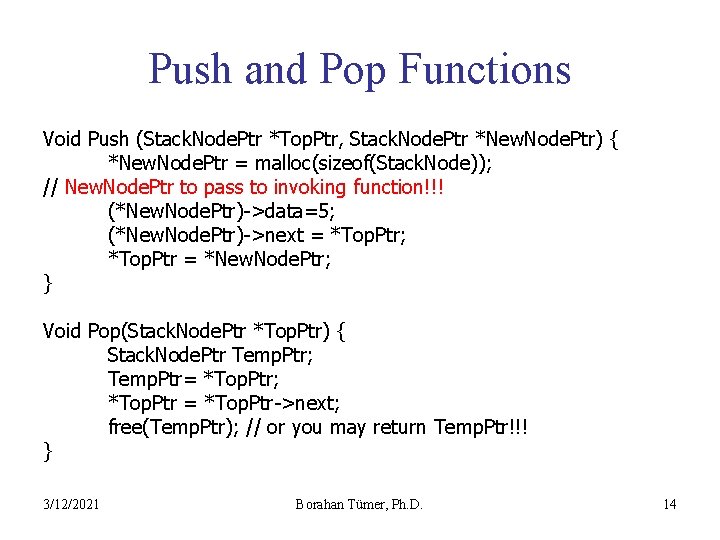
Push and Pop Functions Void Push (Stack. Node. Ptr *Top. Ptr, Stack. Node. Ptr *New. Node. Ptr) { *New. Node. Ptr = malloc(sizeof(Stack. Node)); // New. Node. Ptr to pass to invoking function!!! (*New. Node. Ptr)->data=5; (*New. Node. Ptr)->next = *Top. Ptr; *Top. Ptr = *New. Node. Ptr; } Void Pop(Stack. Node. Ptr *Top. Ptr) { Stack. Node. Ptr Temp. Ptr; Temp. Ptr= *Top. Ptr; *Top. Ptr = *Top. Ptr->next; free(Temp. Ptr); // or you may return Temp. Ptr!!! } 3/12/2021 Borahan Tümer, Ph. D. 14
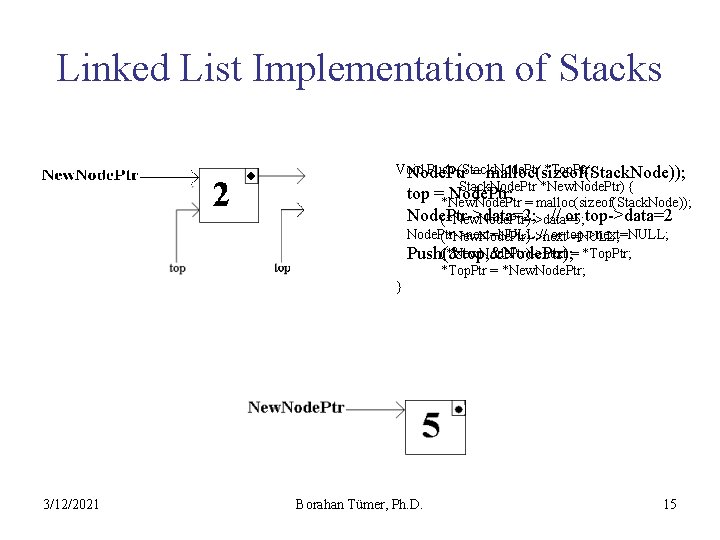
Linked List Implementation of Stacks Void Push (Stack. Node. Ptr *Top. Ptr, Node. Ptr = malloc(sizeof(Stack. Node)); Stack. Node. Ptr *New. Node. Ptr) { top =*New. Node. Ptr; = malloc(sizeof(Stack. Node)); Node. Ptr->data=2; // or top->data=2 (*New. Node. Ptr)->data=5; Node. Ptr->next=NULL; // or top->next=NULL; (*New. Node. Ptr)->next = *Top. Ptr; Push(&top, &Node. Ptr); *Top. Ptr = *New. Node. Ptr; } 3/12/2021 Borahan Tümer, Ph. D. 15
Stack Applications • Three uses of stacks – Symbol matching in compiler design – Return address storage in function invocations – Evaluation of arithmetic expressions and crossconversion into infix, prefix and postfix versions 3/12/2021 Borahan Tümer, Ph. D. 16
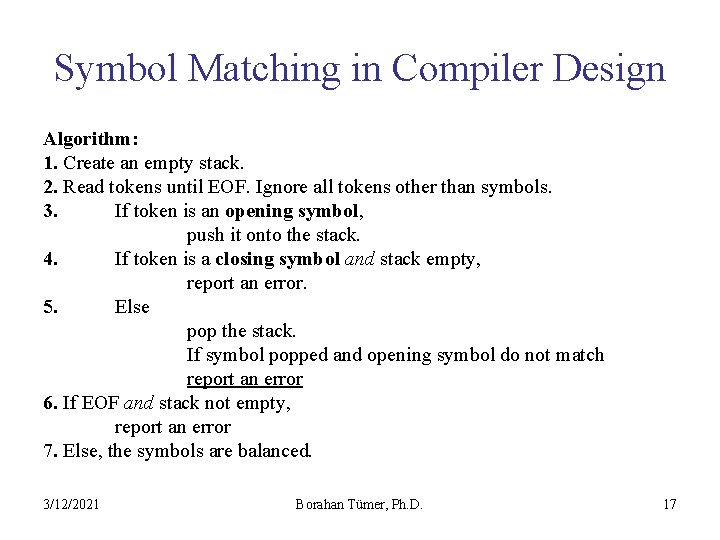
Symbol Matching in Compiler Design Algorithm: 1. Create an empty stack. 2. Read tokens until EOF. Ignore all tokens other than symbols. 3. If token is an opening symbol, push it onto the stack. 4. If token is a closing symbol and stack empty, report an error. 5. Else pop the stack. If symbol popped and opening symbol do not match report an error 6. If EOF and stack not empty, report an error 7. Else, the symbols are balanced. 3/12/2021 Borahan Tümer, Ph. D. 17
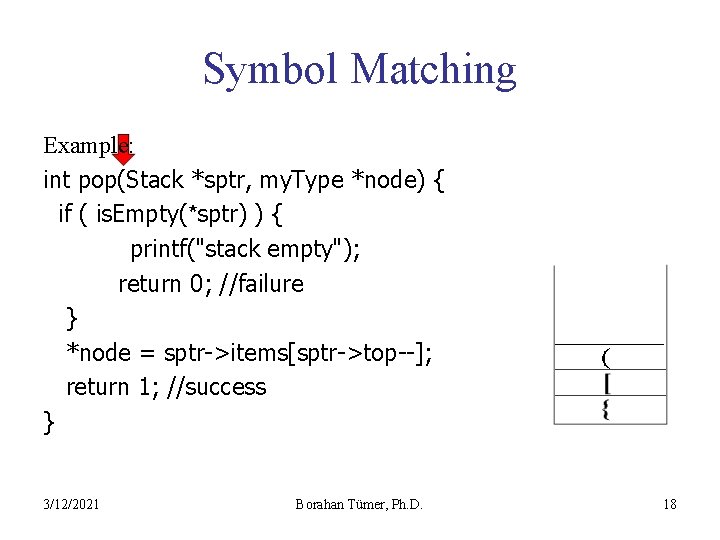
Symbol Matching Example: int pop(Stack *sptr, my. Type *node) { if ( is. Empty(*sptr) ) { printf("stack empty"); return 0; //failure } *node = sptr->items[sptr->top--]; return 1; //success } 3/12/2021 Borahan Tümer, Ph. D. 18
Use of Stacks in Function Invocation • During a function invocation (function call) – Each argument value is copied to a local variable called “a dummy variable. ” Any possible attempt to change the argument changes the dummy variable, not its counterpart in the caller. – Memory space is allocated for local and dummy variables of the called function. – Control is transferred to the called. Before this, return address of the caller must also be saved. This is the point where a system stack is used. 3/12/2021 Borahan Tümer, Ph. D. 19
Use of Stacks in Function Invocation Returning to the caller, three actions are taken: 1. Return address is retrieved. 2. Data area from the called is cleaned up. 3. Finally, control returns to the caller. Any returned value is also stored in known registers. 3/12/2021 Borahan Tümer, Ph. D. 20
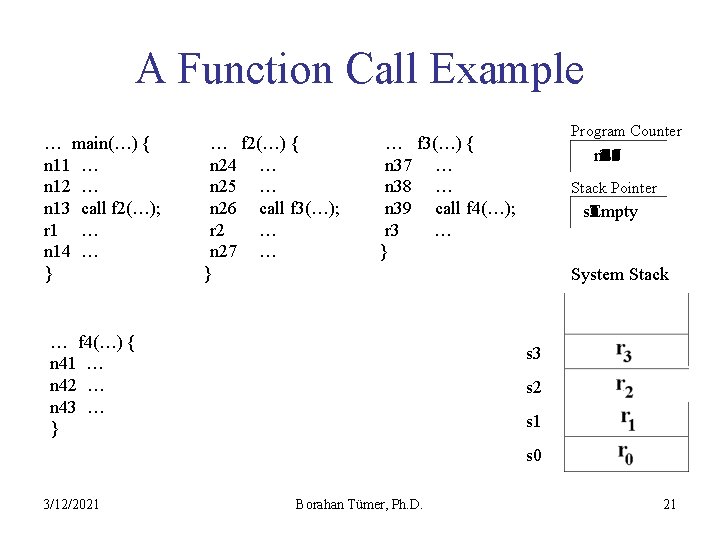
A Function Call Example … main(…) { n 11 … n 12 … n 13 call f 2(…); r 1 … n 14 … } … f 2(…) { n 24 … n 25 … n 26 call f 3(…); r 2 … n 27 … } Program Counter … f 3(…) { n 37 … n 38 … n 39 call f 4(…); r 3 … } … f 4(…) { n 41 … n 42 … n 43 … } n 13 n 12 n 11 n 24 n 26 n 25 n 39 n 38 n 37 n 14 r 1 n 27 r 2 r 3 n 42 n 41 r 0 Stack Pointer s 0 s 1 s 2 s 3 s. Empty System Stack s 3 s 2 s 1 s 0 3/12/2021 Borahan Tümer, Ph. D. 21
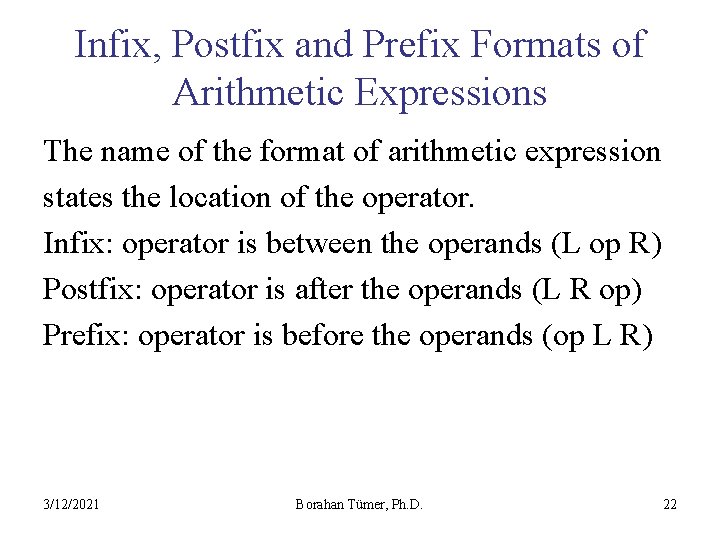
Infix, Postfix and Prefix Formats of Arithmetic Expressions The name of the format of arithmetic expression states the location of the operator. Infix: operator is between the operands (L op R) Postfix: operator is after the operands (L R op) Prefix: operator is before the operands (op L R) 3/12/2021 Borahan Tümer, Ph. D. 22
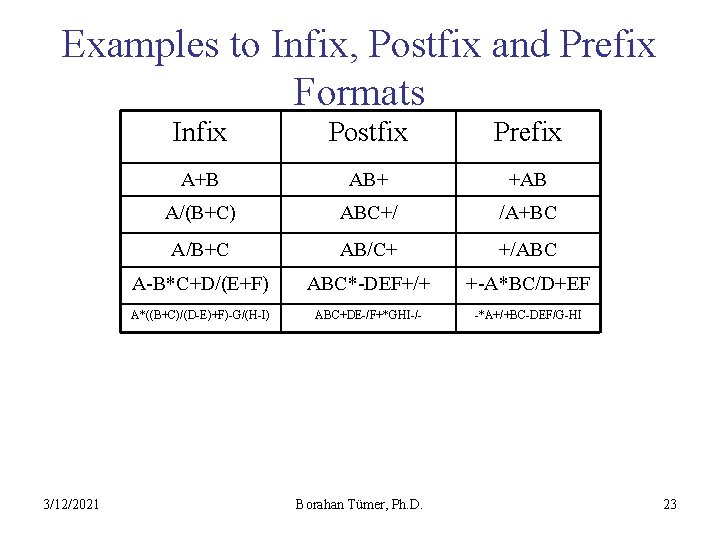
Examples to Infix, Postfix and Prefix Formats 3/12/2021 Infix Postfix Prefix A+B AB+ +AB A/(B+C) ABC+/ /A+BC A/B+C AB/C+ +/ABC A-B*C+D/(E+F) ABC*-DEF+/+ +-A*BC/D+EF A*((B+C)/(D-E)+F)-G/(H-I) ABC+DE-/F+*GHI-/- -*A+/+BC-DEF/G-HI Borahan Tümer, Ph. D. 23
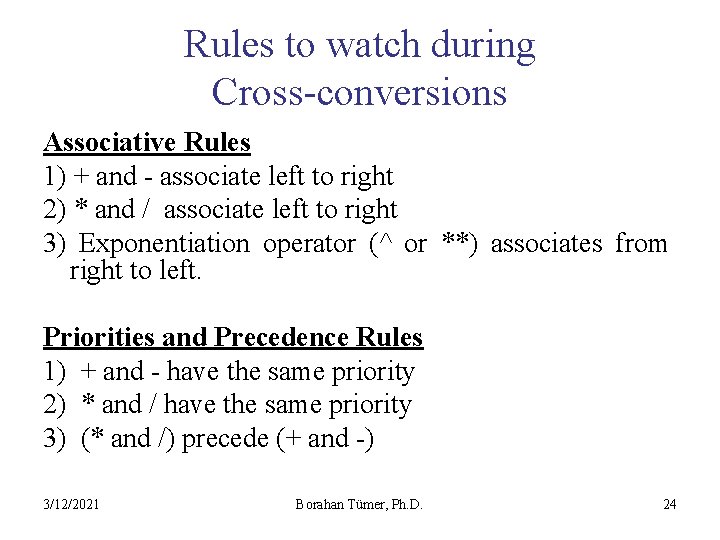
Rules to watch during Cross-conversions Associative Rules 1) + and - associate left to right 2) * and / associate left to right 3) Exponentiation operator (^ or **) associates from right to left. Priorities and Precedence Rules 1) + and - have the same priority 2) * and / have the same priority 3) (* and /) precede (+ and -) 3/12/2021 Borahan Tümer, Ph. D. 24
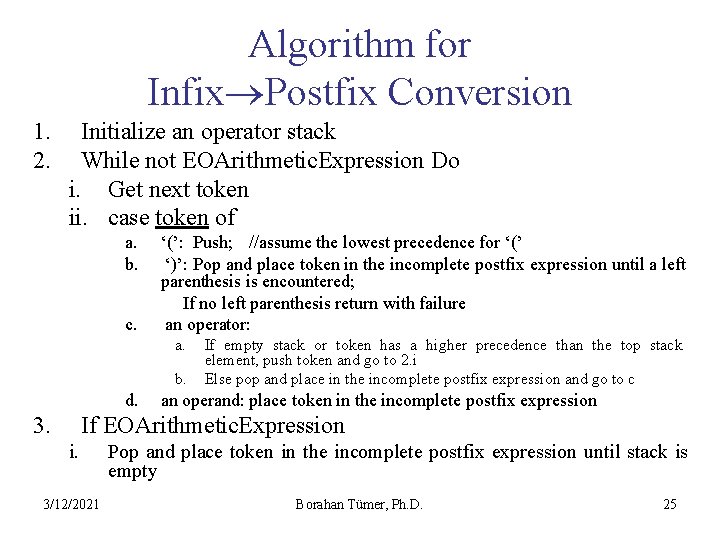
Algorithm for Infix Postfix Conversion 1. 2. Initialize an operator stack While not EOArithmetic. Expression Do i. Get next token ii. case token of a. b. c. ‘(’: Push; //assume the lowest precedence for ‘(’ ‘)’: Pop and place token in the incomplete postfix expression until a left parenthesis is encountered; If no left parenthesis return with failure an operator: a. b. d. 3. If empty stack or token has a higher precedence than the top stack element, push token and go to 2. i Else pop and place in the incomplete postfix expression and go to c an operand: place token in the incomplete postfix expression If EOArithmetic. Expression i. 3/12/2021 Pop and place token in the incomplete postfix expression until stack is empty Borahan Tümer, Ph. D. 25
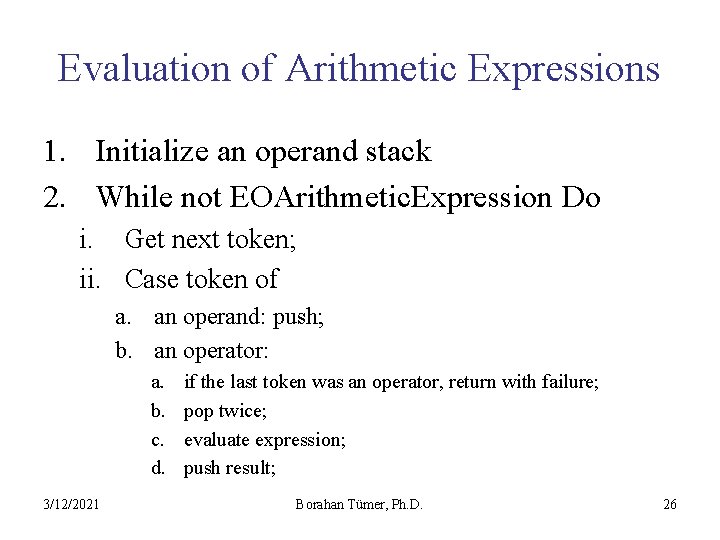
Evaluation of Arithmetic Expressions 1. Initialize an operand stack 2. While not EOArithmetic. Expression Do i. Get next token; ii. Case token of a. an operand: push; b. an operator: a. b. c. d. 3/12/2021 if the last token was an operator, return with failure; pop twice; evaluate expression; push result; Borahan Tümer, Ph. D. 26
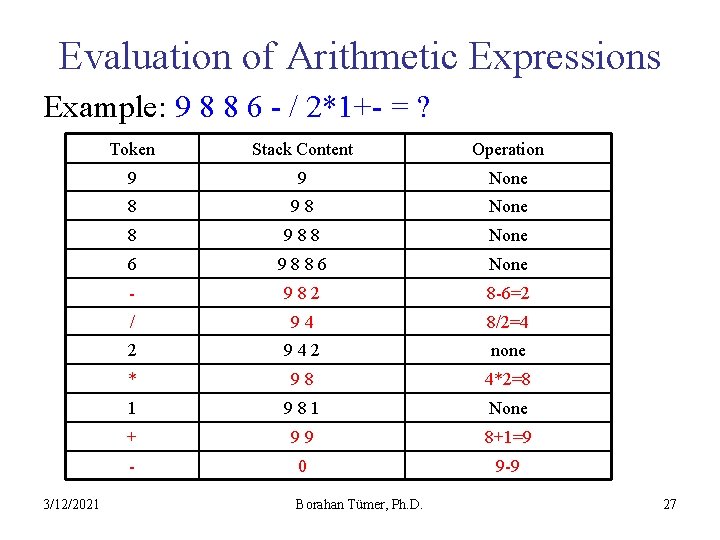
Evaluation of Arithmetic Expressions Example: 9 8 8 6 - / 2*1+- = ? 3/12/2021 Token Stack Content Operation 9 9 None 8 988 None 6 9886 None - 982 8 -6=2 / 94 8/2=4 2 942 none * 98 4*2=8 1 981 None + 99 8+1=9 - 0 9 -9 Borahan Tümer, Ph. D. 27
- Slides: 27