
Data Structures Using C 2 E Chapter 12

![Shortest Path • General algorithm – Initialize array smallest. Weight[u] = weights[vertex, u] –](https://slidetodoc.com/presentation_image_h2/1e36df4a7c16e7f2338f7d37ca1208c7/image-34.jpg "Shortest Path • General algorithm – Initialize array smallest. Weight[u] = weights[vertex, u] –")

- Slides: 60
Data Structures Using C++ 2 E Chapter 12 Graphs
Objectives • Learn about graphs • Become familiar with the basic terminology of graph theory • Discover how to represent graphs in computer memory • Examine and implement various graph traversal algorithms Data Structures Using C++ 2 E 2
Objectives (cont’d. ) • Learn how to implement a shortest path algorithm • Examine and implement the minimum spanning tree algorithm • Explore topological sort • Learn how to find Euler circuits in a graph Data Structures Using C++ 2 E 3
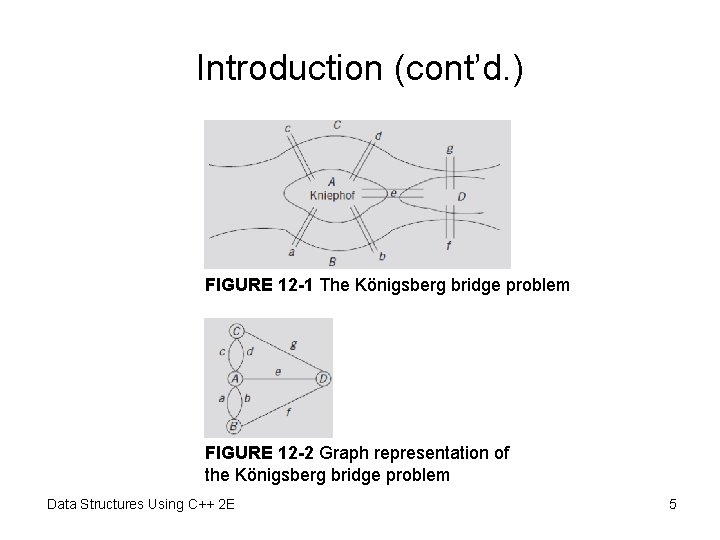
Introduction • Königsberg bridge problem – Given: river has four land areas • A, B, C, D – Given: land areas connected using seven bridges • a, b, c, d, e, f, g – Starting at one land area • Is it possible to walk across all the bridges exactly once and return to the starting land area? • Euler represented problem as a graph – Answered question in the negative – Marked birth of graph theory Data Structures Using C++ 2 E 4
Introduction (cont’d. ) FIGURE 12 -1 The Königsberg bridge problem FIGURE 12 -2 Graph representation of the Königsberg bridge problem Data Structures Using C++ 2 E 5
Graph Definitions and Notations • Borrow definitions, terminology from set theory • Subset – Set Y is a subset of X: Y X • If every element of Y is also an element of X • Intersection of sets A and B: A ∩ B – Set of all elements that are in A and B • Union of sets A and B: A U B – Set of all elements in A or in B • Cartesian product: A x B – Set of all ordered pairs of elements of A and B Data Structures Using C++ 2 E 6
Graph Definitions and Notations (cont’d. ) • Graph G pair – G = (V, E), where V is a finite nonempty set • Called the set of vertices of G, and E V x V – Elements of E • Pairs of elements of V • E: set of edges of G – G called trivial if it has only one vertex • Directed graph (digraph) – Elements in set of edges of graph G: ordered • Undirected graph: not ordered Data Structures Using C++ 2 E 7
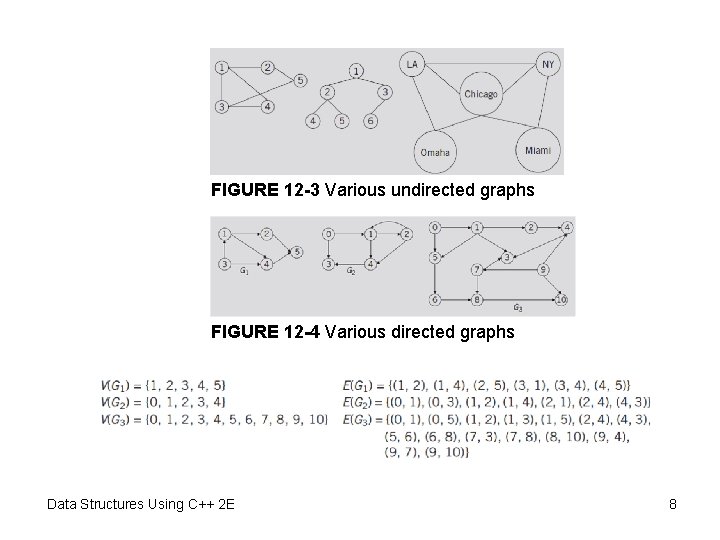
FIGURE 12 -3 Various undirected graphs FIGURE 12 -4 Various directed graphs Data Structures Using C++ 2 E 8
Graph Definitions and Notations (cont’d. ) • Graph H called subgraph of G – If V(H) V(G) and E(H) E(G) – Every vertex of H: vertex of G – Every edge in H: edge in G • Graph shown pictorially – Vertices drawn as circles • Label inside circle represents vertex • Undirected graph: edges drawn using lines • Directed graph: edges drawn using arrows Data Structures Using C++ 2 E 9
Graph Definitions and Notations (cont’d. ) • Let u and v be two vertices in G – u and v adjacent • If edge from one to the other exists: (u, v) E • Loop – Edge incident on a single vertex • e 1 and e 2 called parallel edges – If two edges e 1 and e 2 associate with same pair of vertices {u, v} • Simple graph – No loops, no parallel edges Data Structures Using C++ 2 E 10
Graph Definitions and Notations (cont’d. ) • Let e = (u, v) be an edge in G – Edge e is incident on the vertices u and v – Degree of u written deg(u) or d(u) • Number of edges incident with u • Each loop on vertex u – Contributes two to the degree of u • u is called an even (odd) degree vertex – If the degree of u is even (odd) Data Structures Using C++ 2 E 11
Graph Definitions and Notations (cont’d. ) • Path from u to v – If sequence of vertices u 1, u 2, . . . , un exists • Such that u = u 1, un = v and (ui, ui+ 1) is an edge for all i =1, 2, . . . , n – 1 • Vertices u and v called connected – If path from u to v exists • Simple path – All vertices distinct (except possibly first, last) • Cycle in G – Simple path in which first and last vertices are the same Data Structures Using C++ 2 E 12
Graph Definitions and Notations (cont’d. ) • G is connected – If path from any vertex to any other vertex exists • Component of G – Maximal subset of connected vertices • Let G be a directed graph and let u and v be two vertices in G – If edge from u to v exists: (u, v) E • u is adjacent to v • v is adjacent from u Data Structures Using C++ 2 E 13
Graph Definitions and Notations (cont’d. ) • Definitions of paths and cycles in G – Similar to those for undirected graphs • G is strongly connected – If any two vertices in G are connected Data Structures Using C++ 2 E 14
Graph Representation • Graphs represented in computer memory – Two common ways • Adjacency matrices • Adjacency lists Data Structures Using C++ 2 E 15
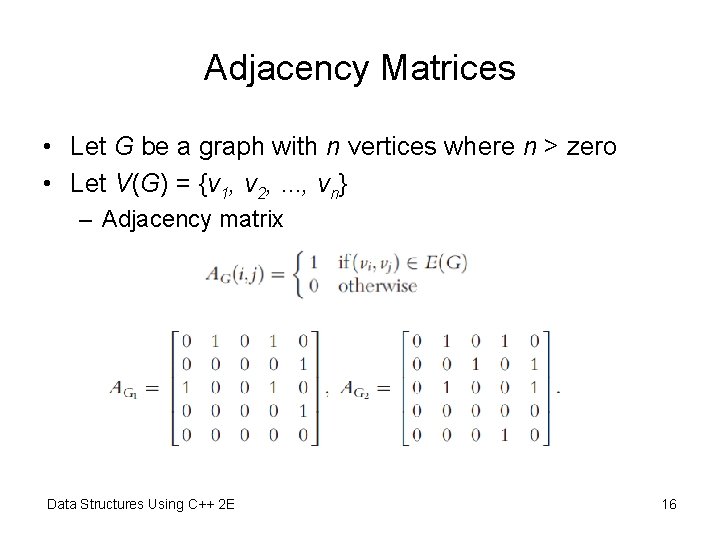
Adjacency Matrices • Let G be a graph with n vertices where n > zero • Let V(G) = {v 1, v 2, . . . , vn} – Adjacency matrix Data Structures Using C++ 2 E 16
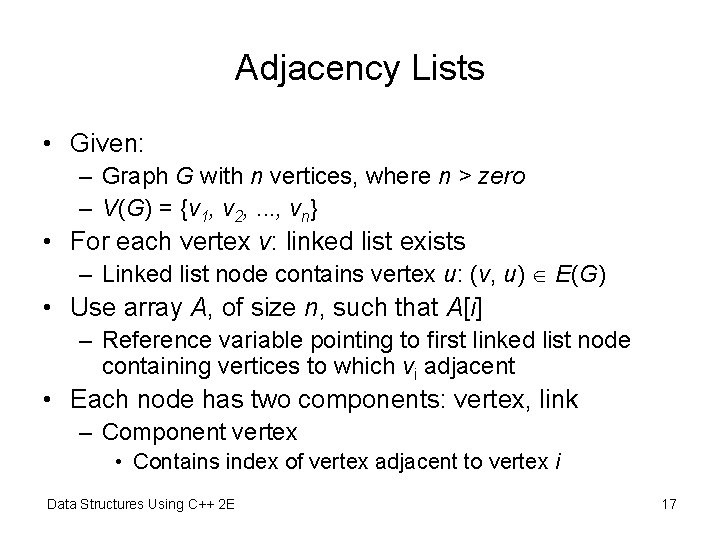
Adjacency Lists • Given: – Graph G with n vertices, where n > zero – V(G) = {v 1, v 2, . . . , vn} • For each vertex v: linked list exists – Linked list node contains vertex u: (v, u) E(G) • Use array A, of size n, such that A[i] – Reference variable pointing to first linked list node containing vertices to which vi adjacent • Each node has two components: vertex, link – Component vertex • Contains index of vertex adjacent to vertex i Data Structures Using C++ 2 E 17
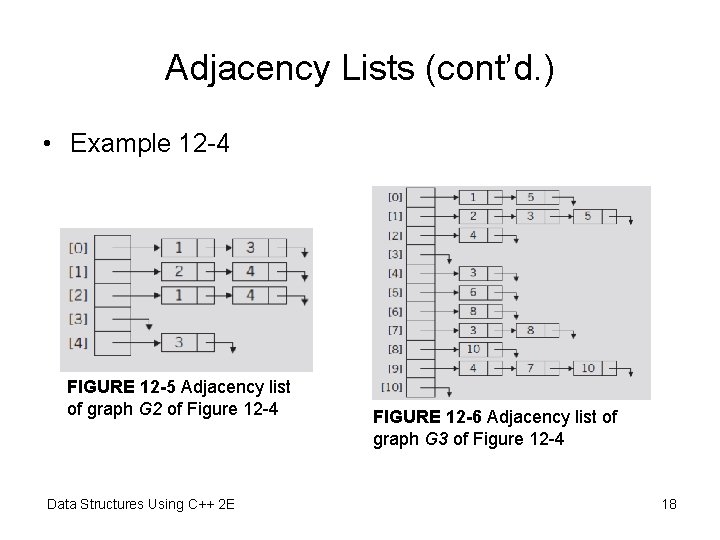
Adjacency Lists (cont’d. ) • Example 12 -4 FIGURE 12 -5 Adjacency list of graph G 2 of Figure 12 -4 Data Structures Using C++ 2 E FIGURE 12 -6 Adjacency list of graph G 3 of Figure 12 -4 18
Operations on Graphs • Commonly performed operations – Create graph • Store graph in computer memory using a particular graph representation – Clear graph • Makes graph empty – Determine if graph is empty – Traverse graph – Print graph Data Structures Using C++ 2 E 19
Operations on Graphs (cont’d. ) • Graph representation in computer memory – Depends on specific application • Use linked list representation of graphs – For each vertex v • Vertices adjacent to v (directed graph: called immediate successors) • Stored in the linked list associated with v • Managing data in a linked list – Use class unordered. Linked. List • Labeling graph vertices – Depends on specific application Data Structures Using C++ 2 E 20
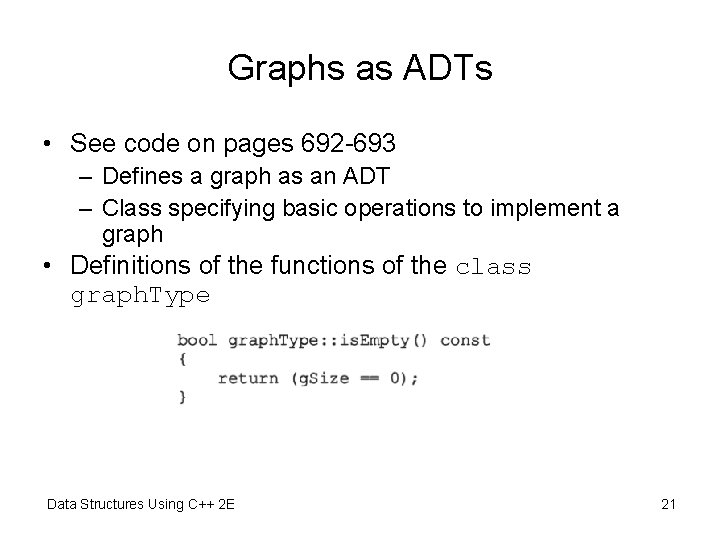
Graphs as ADTs • See code on pages 692 -693 – Defines a graph as an ADT – Class specifying basic operations to implement a graph • Definitions of the functions of the class graph. Type Data Structures Using C++ 2 E 21
Graphs as ADTs (cont’d. ) • Function create. Graph – Implementation • Depends on how data input into the program – See code on page 694 • Function clear. Graph – Empties the graph • Deallocates storage occupied by each linked list • Sets number of vertices to zero – See code on page 695 Data Structures Using C++ 2 E 22
Graph Traversals • Processing a graph – Requires ability to traverse the graph • Traversing a graph – Similar to traversing a binary tree • A bit more complicated • Two most common graph traversal algorithms – Depth first traversal – Breadth first traversal Data Structures Using C++ 2 E 23
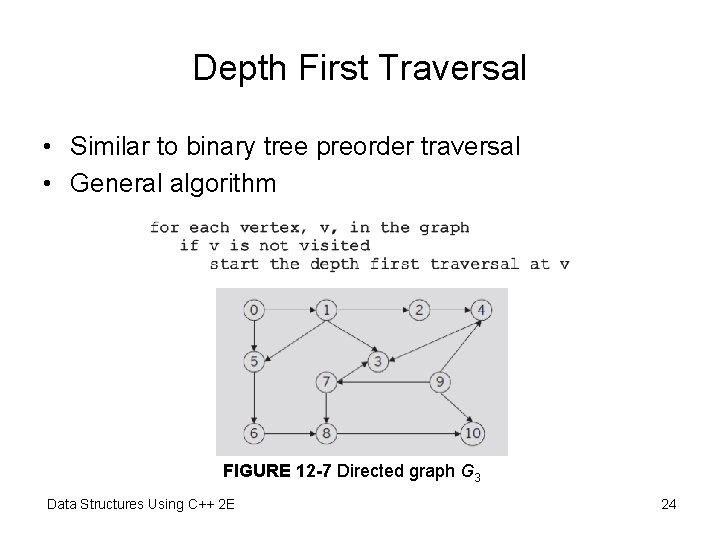
Depth First Traversal • Similar to binary tree preorder traversal • General algorithm FIGURE 12 -7 Directed graph G 3 Data Structures Using C++ 2 E 24
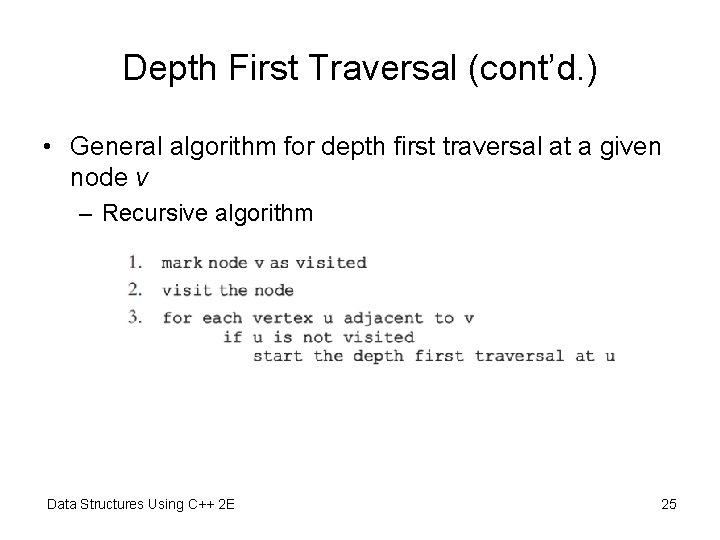
Depth First Traversal (cont’d. ) • General algorithm for depth first traversal at a given node v – Recursive algorithm Data Structures Using C++ 2 E 25
Depth First Traversal (cont’d. ) • Function dft implements algorithm Data Structures Using C++ 2 E 26
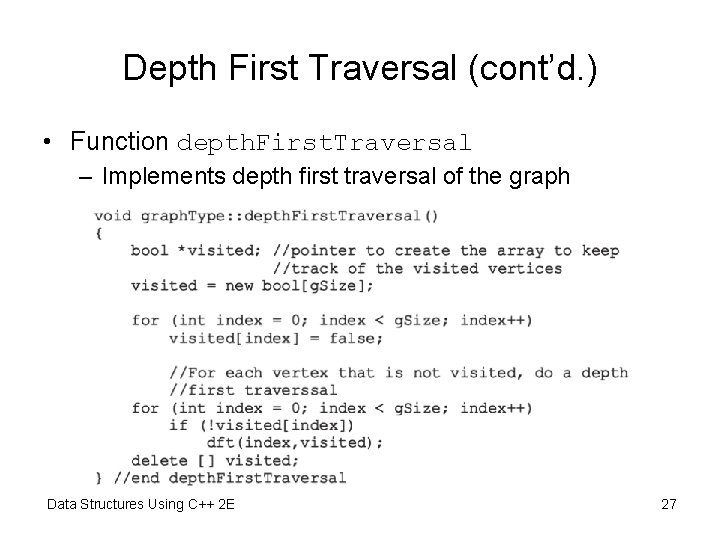
Depth First Traversal (cont’d. ) • Function depth. First. Traversal – Implements depth first traversal of the graph Data Structures Using C++ 2 E 27
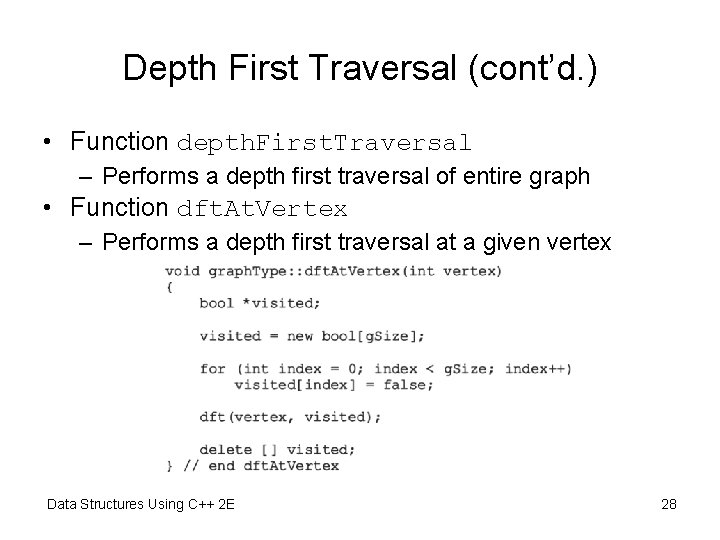
Depth First Traversal (cont’d. ) • Function depth. First. Traversal – Performs a depth first traversal of entire graph • Function dft. At. Vertex – Performs a depth first traversal at a given vertex Data Structures Using C++ 2 E 28
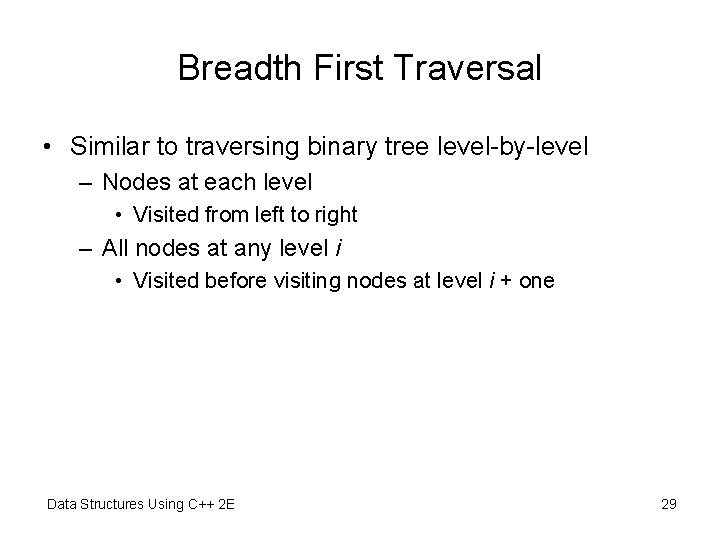
Breadth First Traversal • Similar to traversing binary tree level-by-level – Nodes at each level • Visited from left to right – All nodes at any level i • Visited before visiting nodes at level i + one Data Structures Using C++ 2 E 29
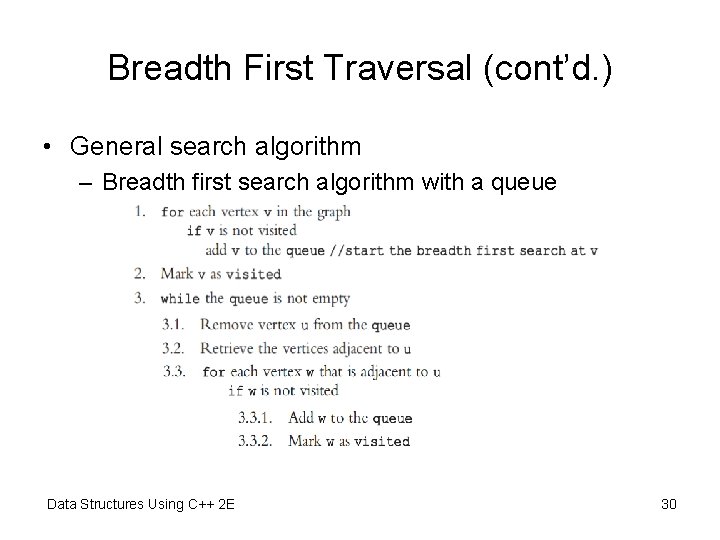
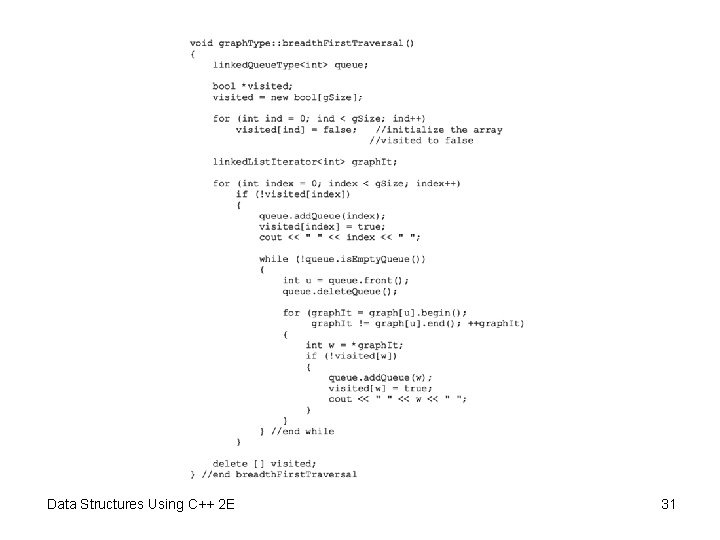
Breadth First Traversal (cont’d. ) • General search algorithm – Breadth first search algorithm with a queue Data Structures Using C++ 2 E 30
Data Structures Using C++ 2 E 31
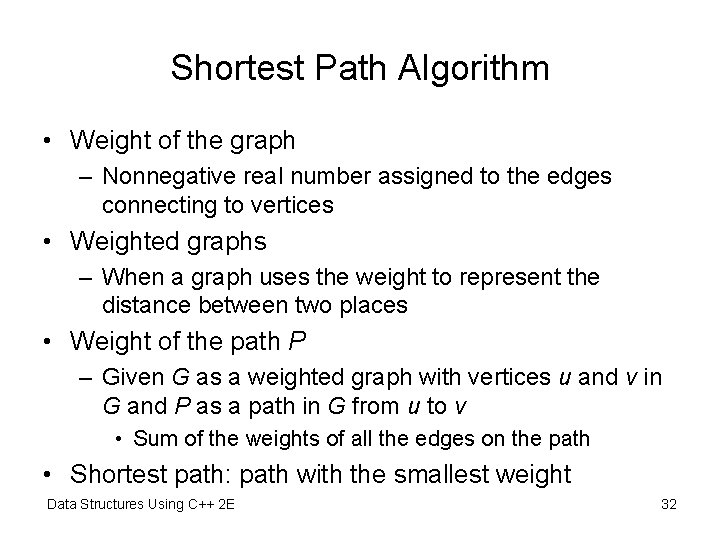
Shortest Path Algorithm • Weight of the graph – Nonnegative real number assigned to the edges connecting to vertices • Weighted graphs – When a graph uses the weight to represent the distance between two places • Weight of the path P – Given G as a weighted graph with vertices u and v in G and P as a path in G from u to v • Sum of the weights of all the edges on the path • Shortest path: path with the smallest weight Data Structures Using C++ 2 E 32
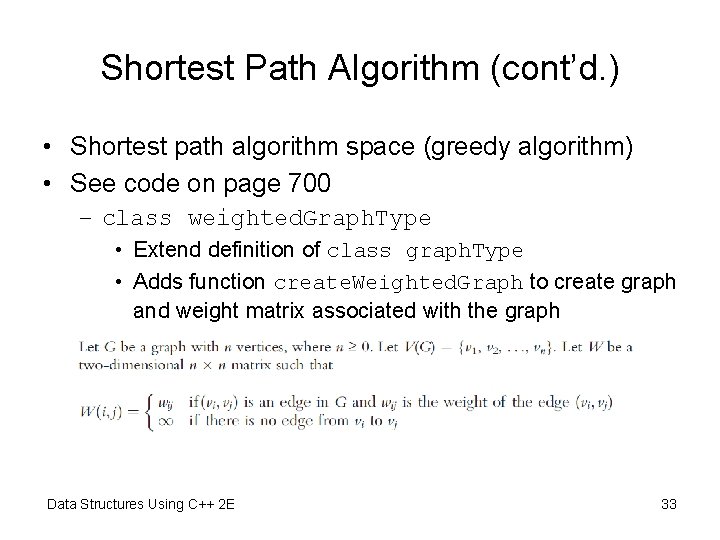
Shortest Path Algorithm (cont’d. ) • Shortest path algorithm space (greedy algorithm) • See code on page 700 – class weighted. Graph. Type • Extend definition of class graph. Type • Adds function create. Weighted. Graph to create graph and weight matrix associated with the graph Data Structures Using C++ 2 E 33
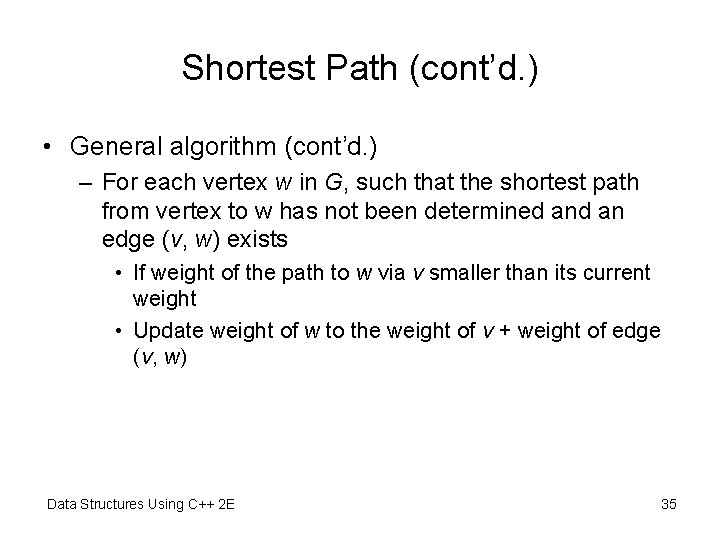
Shortest Path • General algorithm – Initialize array smallest. Weight[u] = weights[vertex, u] – Set smallest. Weight[vertex] = zero – Find vertex v closest to vertex where shortest path is not determined – Mark v as the (next) vertex for which the smallest weight is found Data Structures Using C++ 2 E 34
Shortest Path (cont’d. ) • General algorithm (cont’d. ) – For each vertex w in G, such that the shortest path from vertex to w has not been determined an edge (v, w) exists • If weight of the path to w via v smaller than its current weight • Update weight of w to the weight of v + weight of edge (v, w) Data Structures Using C++ 2 E 35
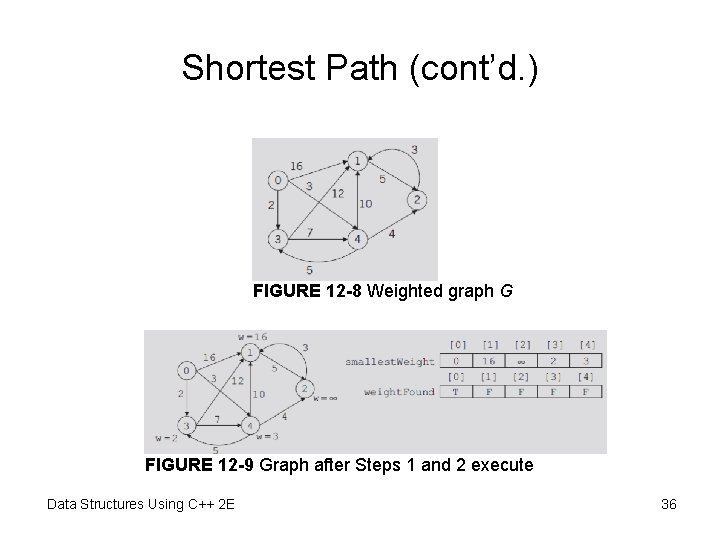
Shortest Path (cont’d. ) FIGURE 12 -8 Weighted graph G FIGURE 12 -9 Graph after Steps 1 and 2 execute Data Structures Using C++ 2 E 36
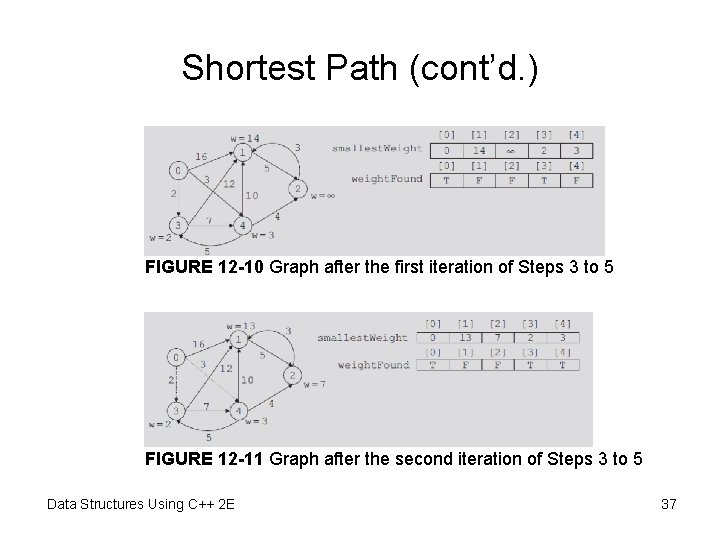
Shortest Path (cont’d. ) FIGURE 12 -10 Graph after the first iteration of Steps 3 to 5 FIGURE 12 -11 Graph after the second iteration of Steps 3 to 5 Data Structures Using C++ 2 E 37
Shortest Path (cont’d. ) FIGURE 12 -12 Graph after the third iteration of Steps 3 to 5 FIGURE 12 -13 Graph after the fourth iteration of Steps 3 through 5 Data Structures Using C++ 2 E 38
Shortest Path (cont’d. ) • See code on pages 704 -705 – C++ function shortest. Path implements previous algorithm • Records only the weight of the shortest path from the source to a vertex • Review the definitions of the function print. Shortest. Distance and the constructor and destructor on pages 705 -706 Data Structures Using C++ 2 E 39
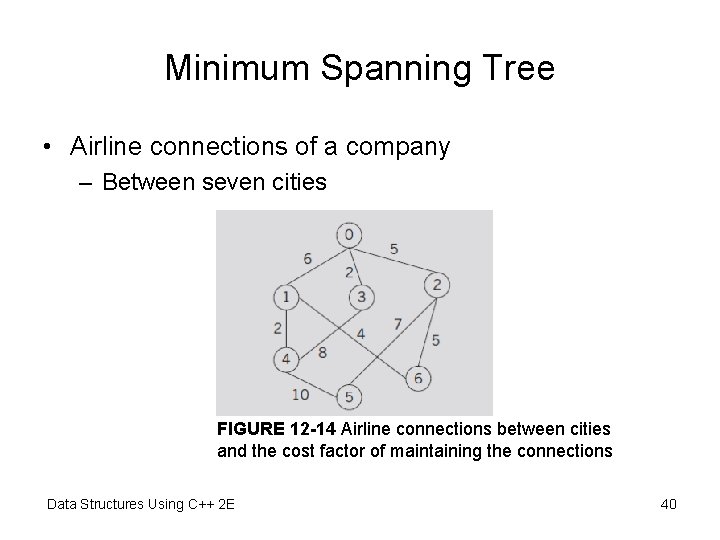
Minimum Spanning Tree • Airline connections of a company – Between seven cities FIGURE 12 -14 Airline connections between cities and the cost factor of maintaining the connections Data Structures Using C++ 2 E 40
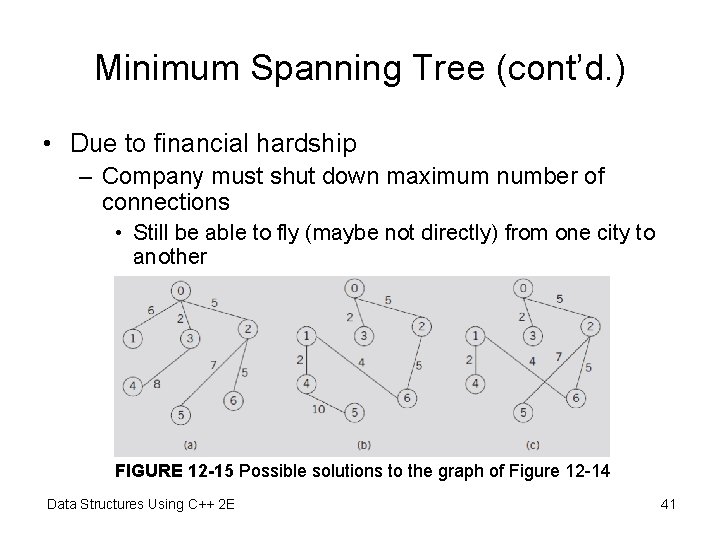
Minimum Spanning Tree (cont’d. ) • Due to financial hardship – Company must shut down maximum number of connections • Still be able to fly (maybe not directly) from one city to another FIGURE 12 -15 Possible solutions to the graph of Figure 12 -14 Data Structures Using C++ 2 E 41
Minimum Spanning Tree (cont’d. ) • Free tree T – Simple graph – If u and v are two vertices in T • Unique path from u to v exists • Rooted tree – Tree with particular vertex designated as a root Data Structures Using C++ 2 E 42
Minimum Spanning Tree (cont’d. ) • Weighted tree T – Weight assigned to edges in T – Weight denoted by W(T): sum of weights of all the edges in T • Spanning tree T of graph G – T is a subgraph of G such that V(T) = V(G) Data Structures Using C++ 2 E 43
Minimum Spanning Tree (cont’d. ) • Theorem 12 -1 – A graph G has a spanning tree if and only if G is connected – From this theorem, it follows that to determine a spanning tree of a graph • Graph must be connected • Minimum (minimal) spanning tree of G – Spanning tree with the minimum weight Data Structures Using C++ 2 E 44
Minimum Spanning Tree (cont’d. ) • Two well-known algorithms for finding a minimum spanning tree of a graph – Prim’s algorithm • Builds the tree iteratively by adding edges until a minimum spanning tree obtained – Kruskal’s algorithm Data Structures Using C++ 2 E 45
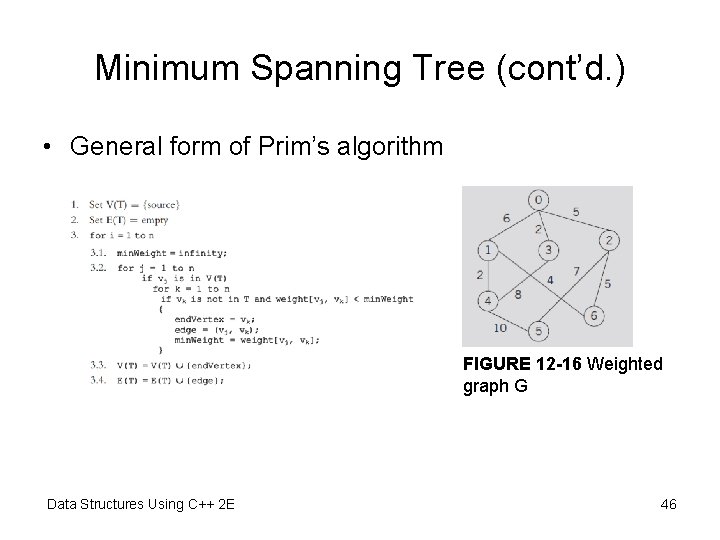
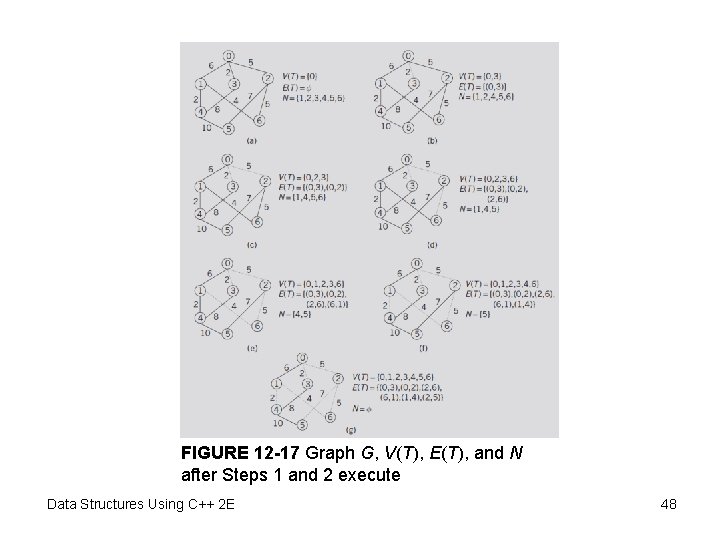
Minimum Spanning Tree (cont’d. ) • General form of Prim’s algorithm FIGURE 12 -16 Weighted graph G Data Structures Using C++ 2 E 46
Minimum Spanning Tree (cont’d. ) • See code on page 710 – class ms. Tree. Type defines spanning tree as an ADT • See code on page 712 – C++ function minimum. Spanning implementing Prim’s algorithm – Prim’s algorithm given in this section: O(n 3) • Possible to design Prim’s algorithm order O(n 2) • See function print. Tree. And. Weight code • See constructor and destructor code Data Structures Using C++ 2 E 47
FIGURE 12 -17 Graph G, V(T), E(T), and N after Steps 1 and 2 execute Data Structures Using C++ 2 E 48
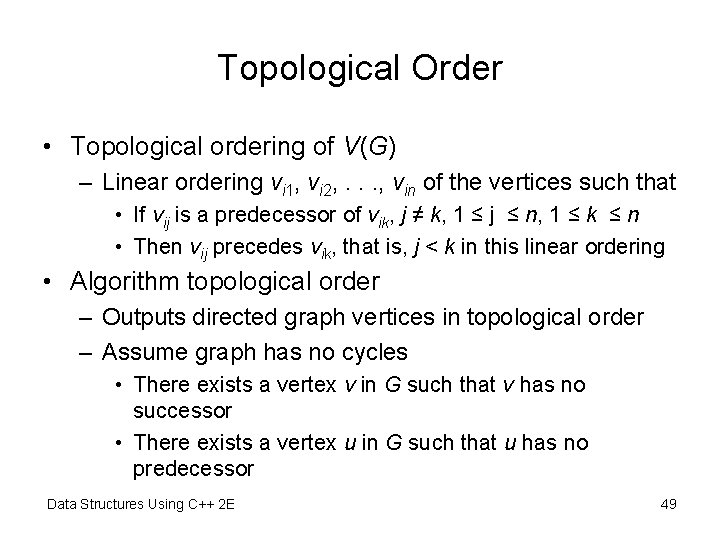
Topological Order • Topological ordering of V(G) – Linear ordering vi 1, vi 2, . . . , vin of the vertices such that • If vij is a predecessor of vik, j ≠ k, 1 ≤ j ≤ n, 1 ≤ k ≤ n • Then vij precedes vik, that is, j < k in this linear ordering • Algorithm topological order – Outputs directed graph vertices in topological order – Assume graph has no cycles • There exists a vertex v in G such that v has no successor • There exists a vertex u in G such that u has no predecessor Data Structures Using C++ 2 E 49
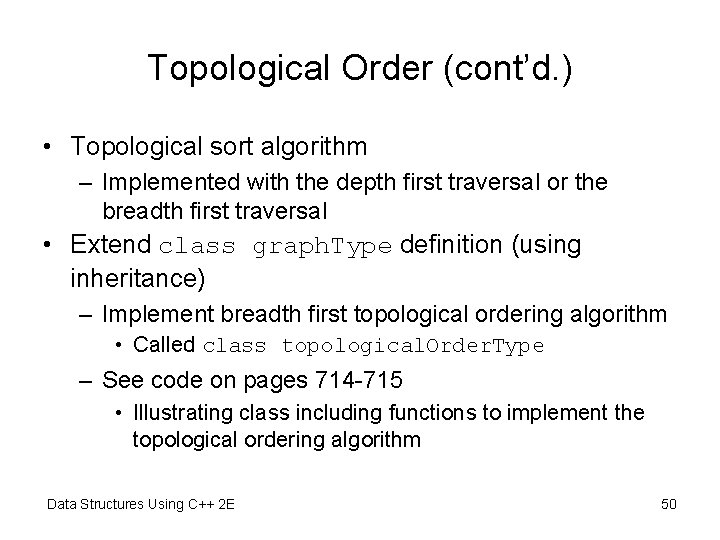
Topological Order (cont’d. ) • Topological sort algorithm – Implemented with the depth first traversal or the breadth first traversal • Extend class graph. Type definition (using inheritance) – Implement breadth first topological ordering algorithm • Called class topological. Order. Type – See code on pages 714 -715 • Illustrating class including functions to implement the topological ordering algorithm Data Structures Using C++ 2 E 50
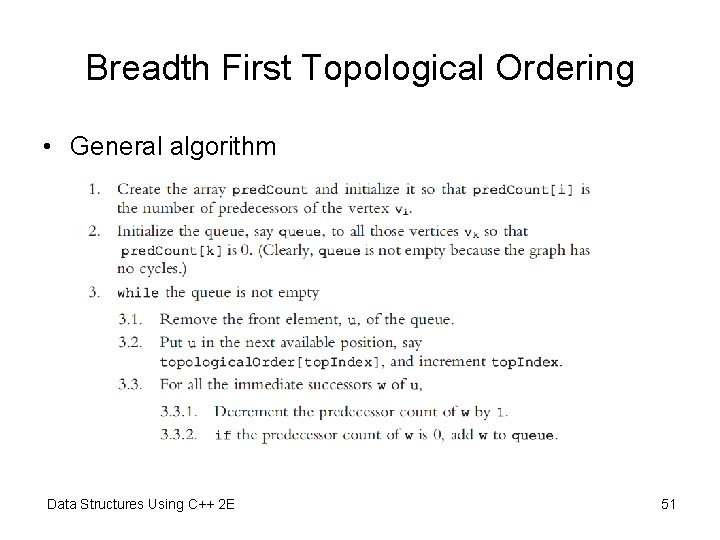
Breadth First Topological Ordering • General algorithm Data Structures Using C++ 2 E 51
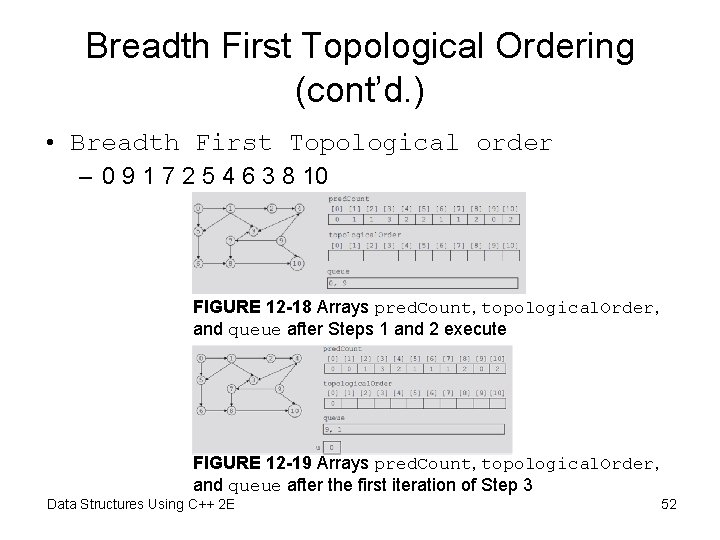
Breadth First Topological Ordering (cont’d. ) • Breadth First Topological order – 0 9 1 7 2 5 4 6 3 8 10 FIGURE 12 -18 Arrays pred. Count, topological. Order, and queue after Steps 1 and 2 execute FIGURE 12 -19 Arrays pred. Count, topological. Order, and queue after the first iteration of Step 3 Data Structures Using C++ 2 E 52
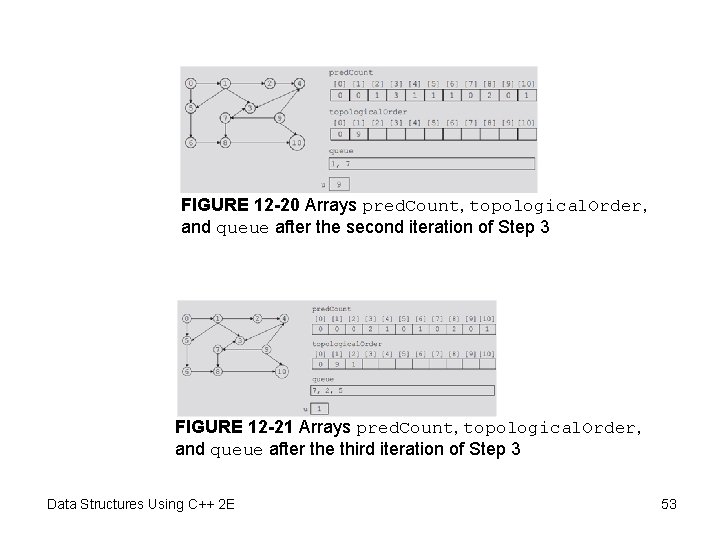
FIGURE 12 -20 Arrays pred. Count, topological. Order, and queue after the second iteration of Step 3 FIGURE 12 -21 Arrays pred. Count, topological. Order, and queue after the third iteration of Step 3 Data Structures Using C++ 2 E 53
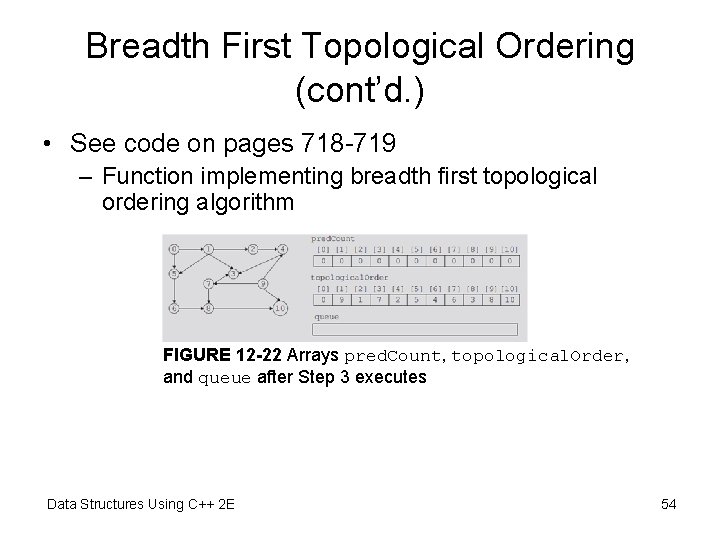
Breadth First Topological Ordering (cont’d. ) • See code on pages 718 -719 – Function implementing breadth first topological ordering algorithm FIGURE 12 -22 Arrays pred. Count, topological. Order, and queue after Step 3 executes Data Structures Using C++ 2 E 54
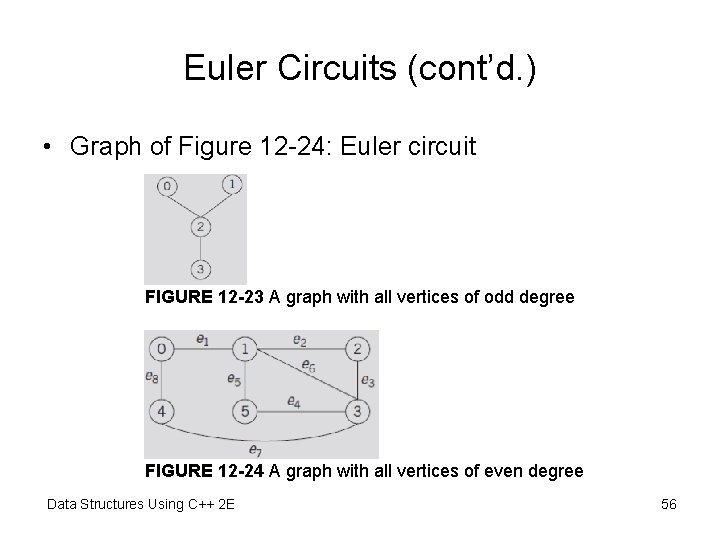
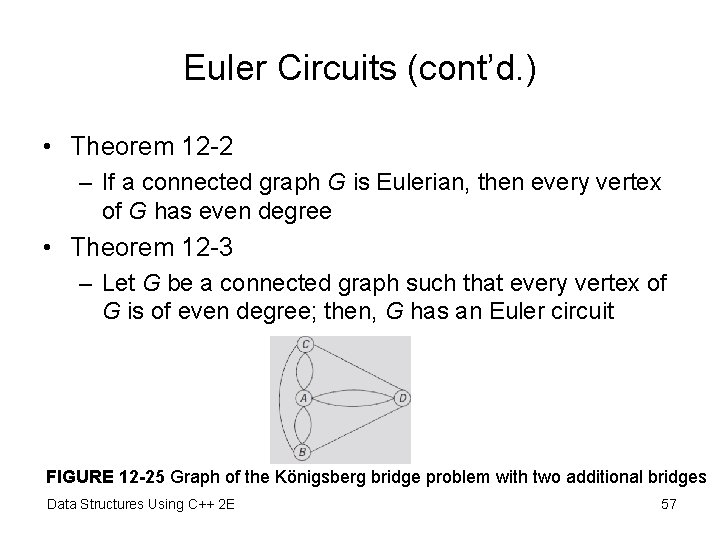
Euler Circuits • Euler’s solution to Königsberg bridge problem – Reduces problem to finding circuit in the graph • Circuit – Path of nonzero length • From a vertex u to u with no repeated edges • Euler circuit – Circuit in a graph including all the edges of the graph • Eulerian graph G – If either G is a trivial graph or G has an Euler circuit Data Structures Using C++ 2 E 55
Euler Circuits (cont’d. ) • Graph of Figure 12 -24: Euler circuit FIGURE 12 -23 A graph with all vertices of odd degree FIGURE 12 -24 A graph with all vertices of even degree Data Structures Using C++ 2 E 56
Euler Circuits (cont’d. ) • Theorem 12 -2 – If a connected graph G is Eulerian, then every vertex of G has even degree • Theorem 12 -3 – Let G be a connected graph such that every vertex of G is of even degree; then, G has an Euler circuit FIGURE 12 -25 Graph of the Königsberg bridge problem with two additional bridges Data Structures Using C++ 2 E 57
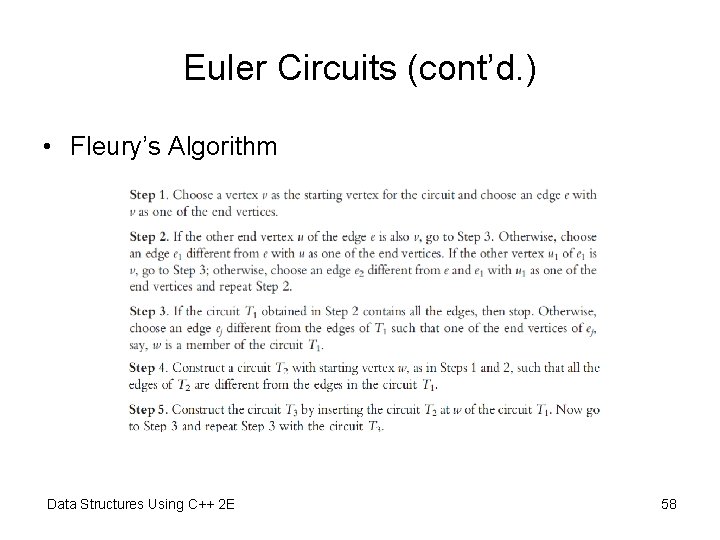
Euler Circuits (cont’d. ) • Fleury’s Algorithm Data Structures Using C++ 2 E 58
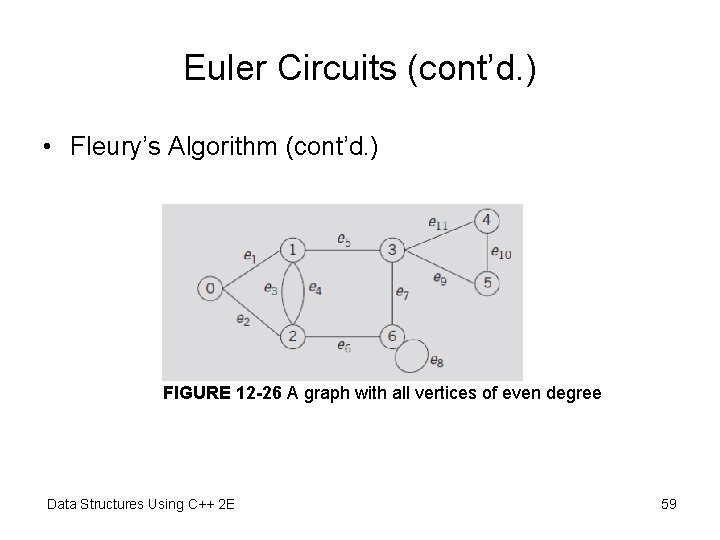
Euler Circuits (cont’d. ) • Fleury’s Algorithm (cont’d. ) FIGURE 12 -26 A graph with all vertices of even degree Data Structures Using C++ 2 E 59
Summary • Many types of graphs – Directed, undirected, subgraph, weighted • Graph theory borrows set theory notation • Graph representation in memory – Adjacency matrices, adjacency lists • Graph traversal – Depth first, breadth first • Shortest path algorithm • Prim’s algorithm • Euler circuit Data Structures Using C++ 2 E 60