
Data Structures Overview Algorithm Analysis Some slides are

- Slides: 35
Data Structures • Overview. • Algorithm Analysis. Some slides are borrowed from Mr. Mohammad Alqahtani
Objectives Be familiar with problem solving. Be able to develop (and implement) algorithms. Be able to trace algorithms. Be able to select appropriate data structures and algorithms for given problems.
Background Prerequisites: ◦ Variables and expressions. ◦ Methods (functions or procedures ). ◦ Decision structures( like if-statements and switch -statements. ◦ Iteration structures (for-loops and while-loops). ◦ Classes and objects
What is data? Data ◦ A collection of facts from which conclusion may be drawn. ◦ e. g. Data: Temperature 35°C; Conclusion: It is hot. Types of data ◦ ◦ ◦ Textual: For example, your name (Alya) Numeric: For example, your ID (090254) Audio: For example, your voice Video: For example, your voice and picture (. . . )
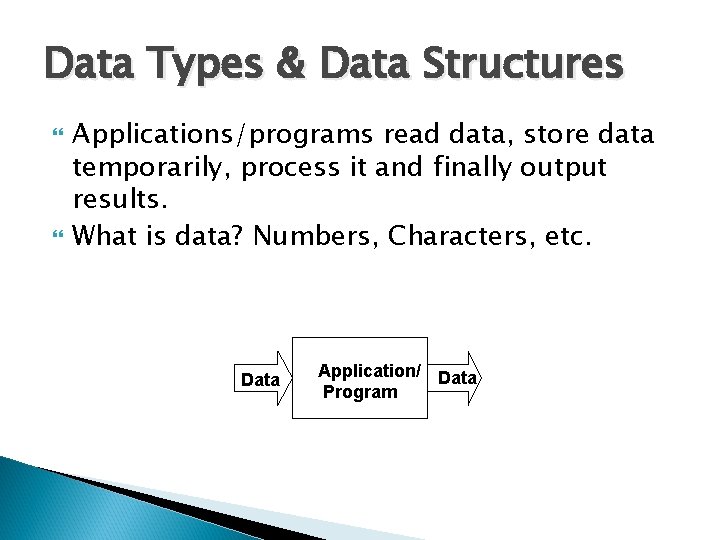
Data Types & Data Structures Applications/programs read data, store data temporarily, process it and finally output results. What is data? Numbers, Characters, etc. Data Application/ Data Program 5
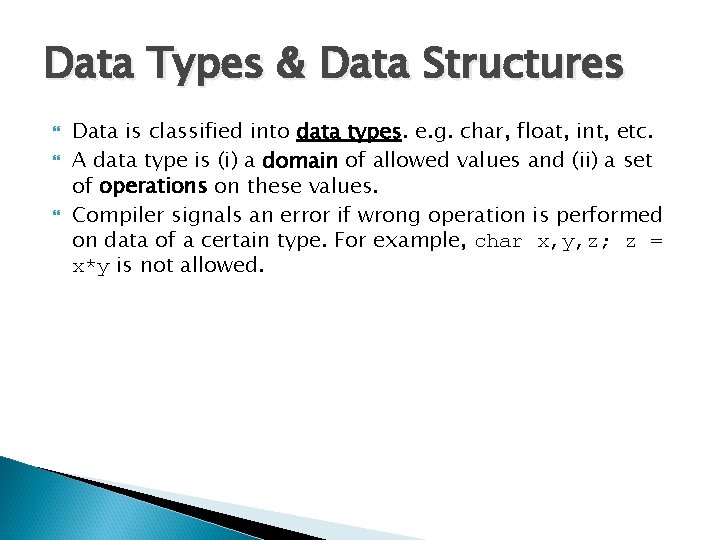
Data Types & Data Structures Data is classified into data types. e. g. char, float, int, etc. A data type is (i) a domain of allowed values and (ii) a set of operations on these values. Compiler signals an error if wrong operation is performed on data of a certain type. For example, char x, y, z; z = x*y is not allowed. 6
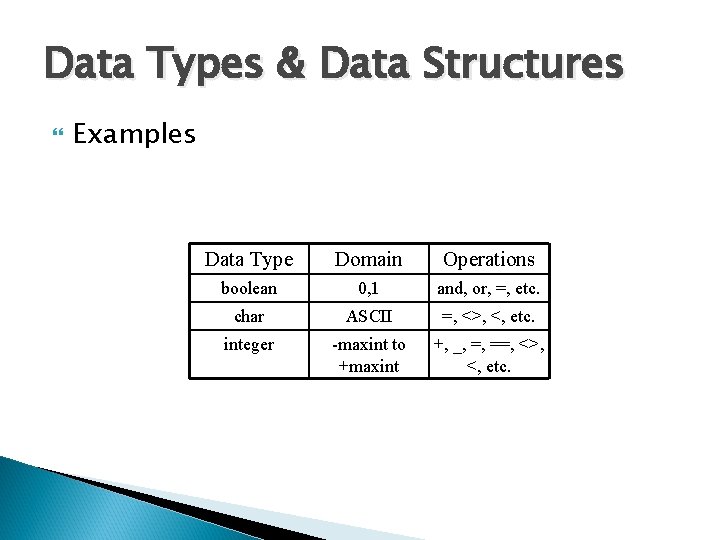
Data Types & Data Structures Examples Data Type Domain Operations boolean 0, 1 and, or, =, etc. char ASCII =, <>, <, etc. integer -maxint to +maxint +, _, =, ==, <>, <, etc. 7
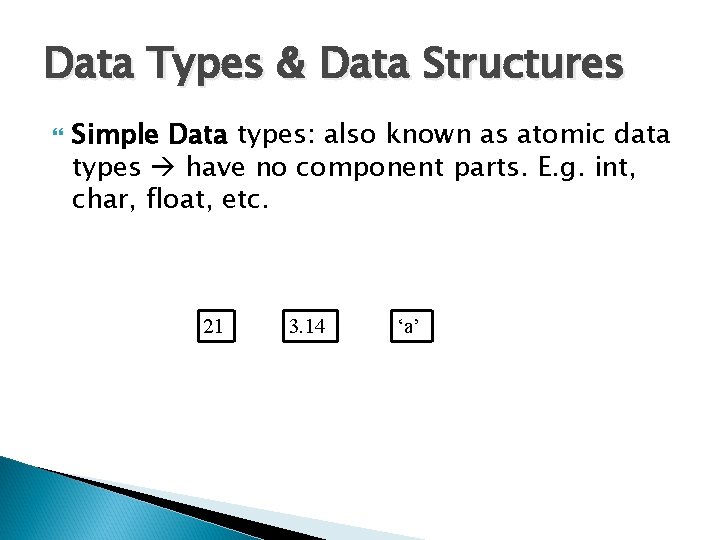
Data Types & Data Structures Simple Data types: also known as atomic data types have no component parts. E. g. int, char, float, etc. 21 3. 14 ‘a’ 8
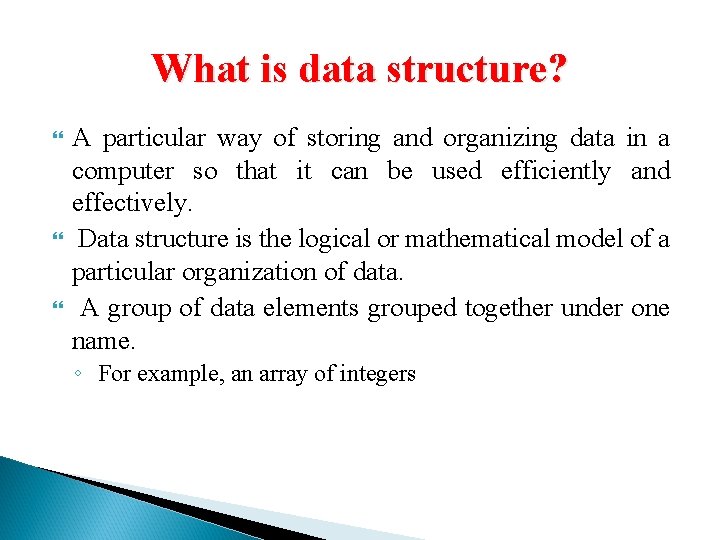
What is data structure? A particular way of storing and organizing data in a computer so that it can be used efficiently and effectively. Data structure is the logical or mathematical model of a particular organization of data. A group of data elements grouped together under one name. ◦ For example, an array of integers
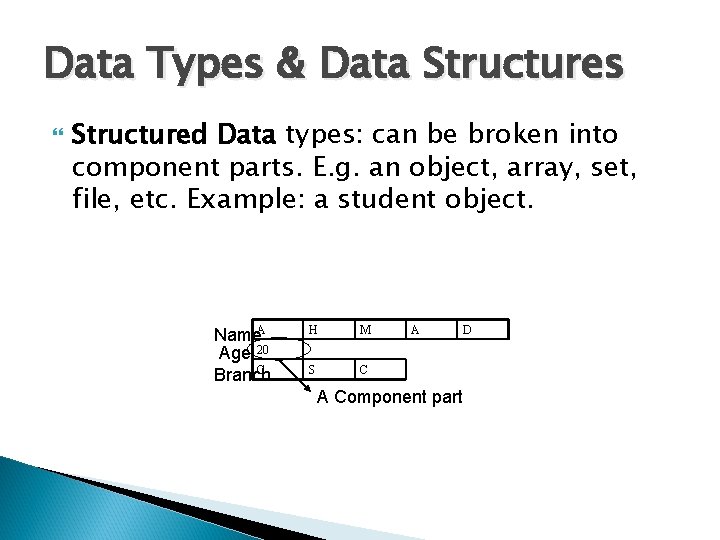
Data Types & Data Structures Structured Data types: can be broken into component parts. E. g. an object, array, set, file, etc. Example: a student object. Name. A Age 20 C Branch H M S C A D A Component part 10
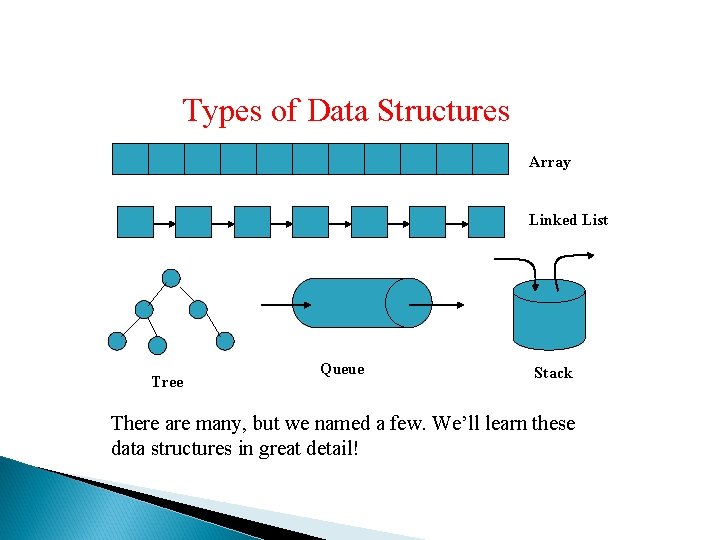
Types of Data Structures Array Linked List Tree Queue Stack There are many, but we named a few. We’ll learn these data structures in great detail!
The Need for Data Structures Goal: to organize data Criteria: to facilitate efficient ◦ storage of data ◦ retrieval of data ◦ manipulation of data Design Issue: ◦ select and design appropriate data types (This is the main motivation to learn and understand data structures)
Data Structure Operations (Demonstrate using class room example!) q Navigating §Accessing each data element exactly once so that certain items in the data may be processed q Searching §Finding the location of the data element (key) in the structure q Insertion §Adding a new data element to the structure
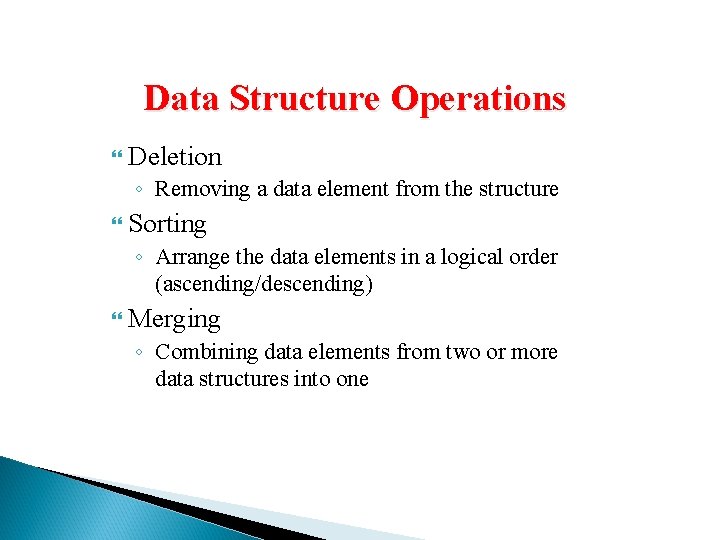
Data Structure Operations Deletion ◦ Removing a data element from the structure Sorting ◦ Arrange the data elements in a logical order (ascending/descending) Merging ◦ Combining data elements from two or more data structures into one
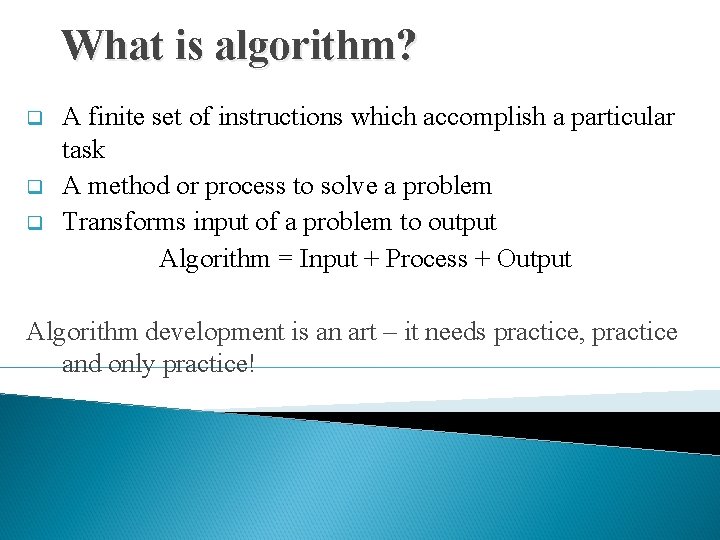
What is algorithm? q q q A finite set of instructions which accomplish a particular task A method or process to solve a problem Transforms input of a problem to output Algorithm = Input + Process + Output Algorithm development is an art – it needs practice, practice and only practice!
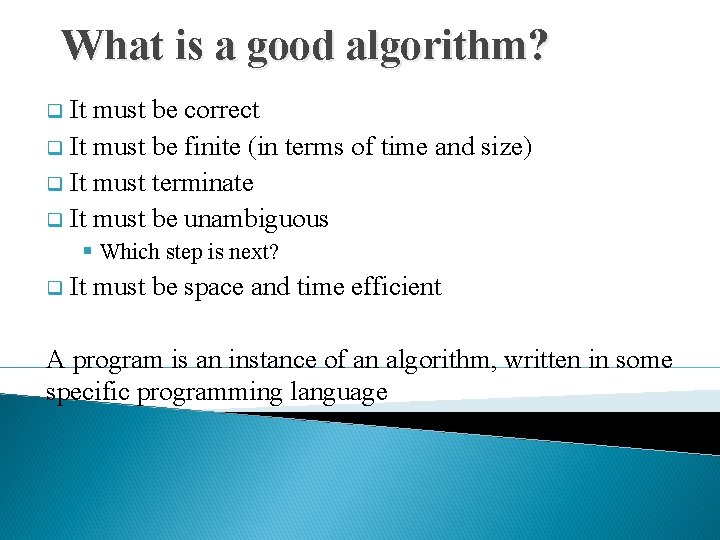
What is a good algorithm? It must be correct q It must be finite (in terms of time and size) q It must terminate q It must be unambiguous q § Which step is next? q It must be space and time efficient A program is an instance of an algorithm, written in some specific programming language
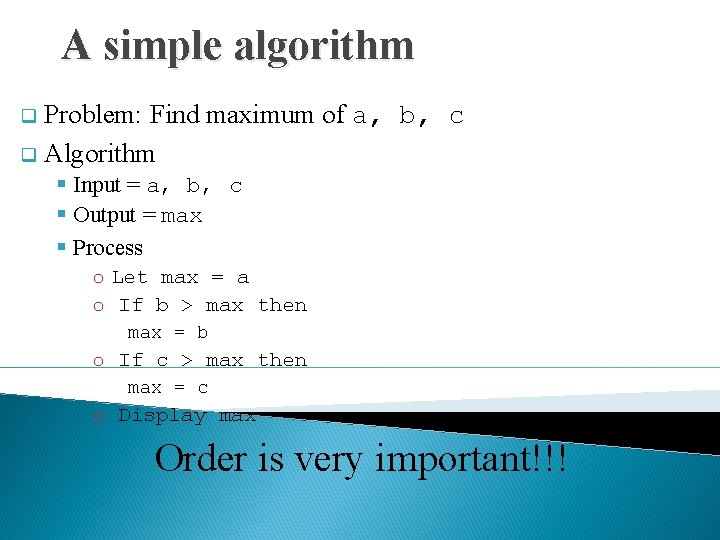
A simple algorithm Problem: Find maximum of a, b, c q Algorithm q § Input = a, b, c § Output = max § Process o Let max = a o If b > max then max = b o If c > max then max = c o Display max Order is very important!!!
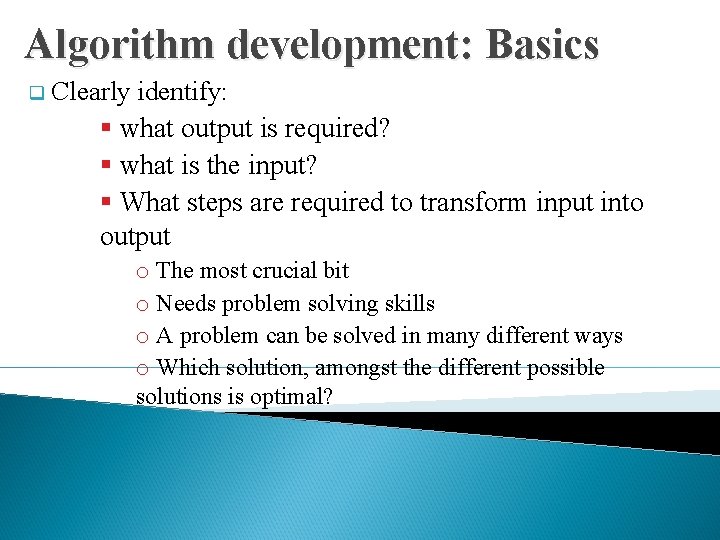
Algorithm development: Basics q Clearly identify: § what output is required? § what is the input? § What steps are required to transform input into output o The most crucial bit o Needs problem solving skills o A problem can be solved in many different ways o Which solution, amongst the different possible solutions is optimal?
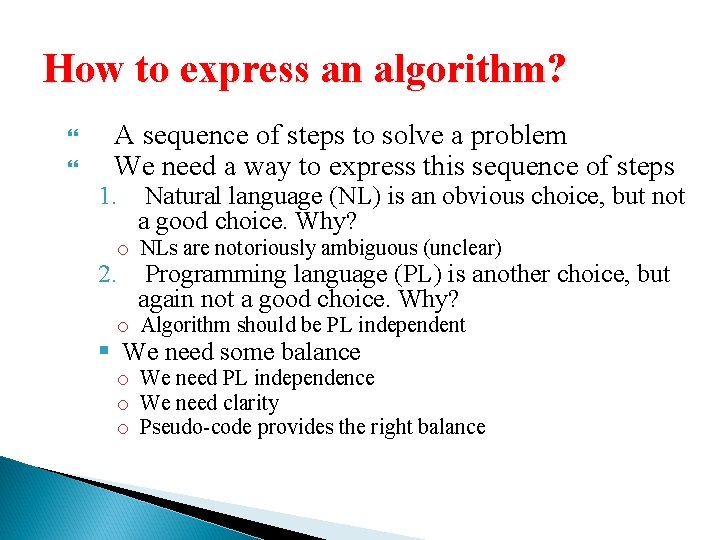
How to express an algorithm? A sequence of steps to solve a problem We need a way to express this sequence of steps 1. Natural language (NL) is an obvious choice, but not a good choice. Why? o NLs are notoriously ambiguous (unclear) 2. Programming language (PL) is another choice, but again not a good choice. Why? o Algorithm should be PL independent § We need some balance o We need PL independence o We need clarity o Pseudo-code provides the right balance
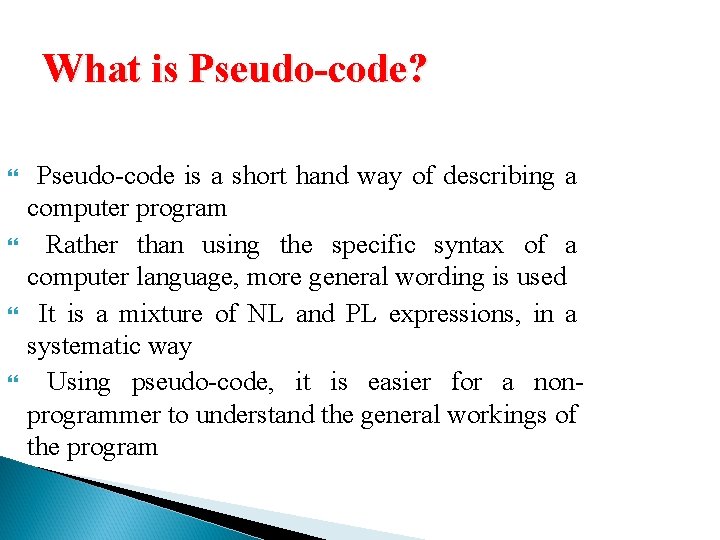
What is Pseudo-code? Pseudo-code is a short hand way of describing a computer program Rather than using the specific syntax of a computer language, more general wording is used It is a mixture of NL and PL expressions, in a systematic way Using pseudo-code, it is easier for a nonprogrammer to understand the general workings of the program
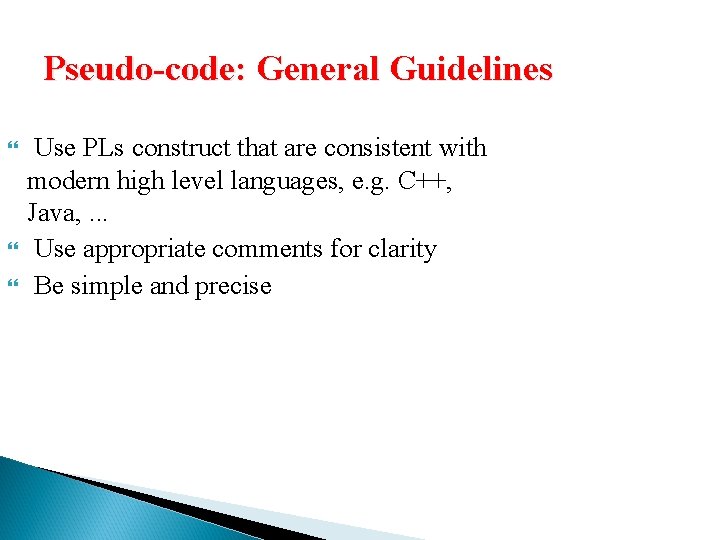
Pseudo-code: General Guidelines Use PLs construct that are consistent with modern high level languages, e. g. C++, Java, . . . Use appropriate comments for clarity Be simple and precise
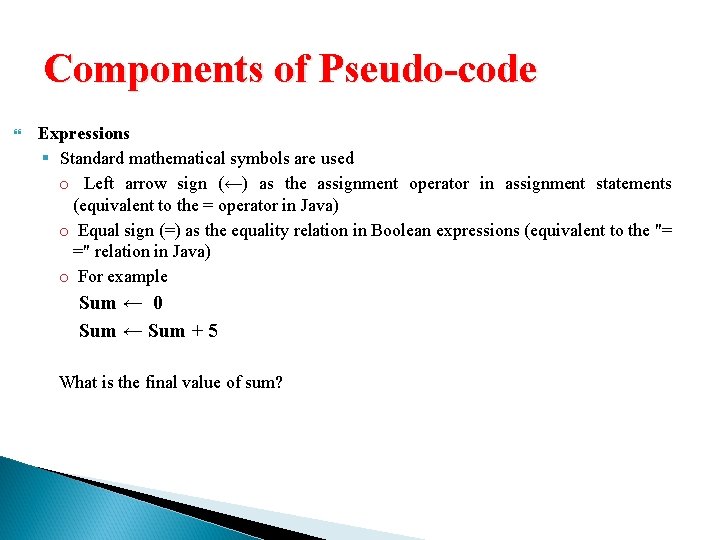
Components of Pseudo-code Expressions § Standard mathematical symbols are used o Left arrow sign (←) as the assignment operator in assignment statements (equivalent to the = operator in Java) o Equal sign (=) as the equality relation in Boolean expressions (equivalent to the "= =" relation in Java) o For example Sum ← 0 Sum ← Sum + 5 What is the final value of sum?
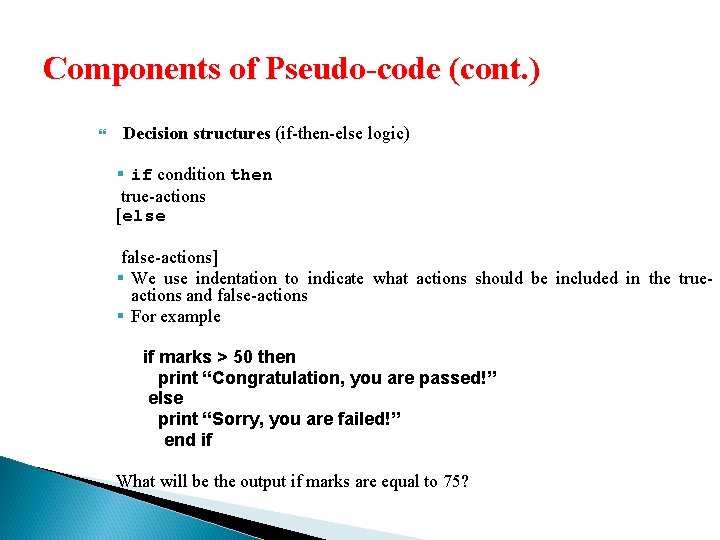
Components of Pseudo-code (cont. ) Decision structures (if-then-else logic) § if condition then true-actions [else false-actions] § We use indentation to indicate what actions should be included in the trueactions and false-actions § For example if marks > 50 then print “Congratulation, you are passed!” else print “Sorry, you are failed!” end if What will be the output if marks are equal to 75?
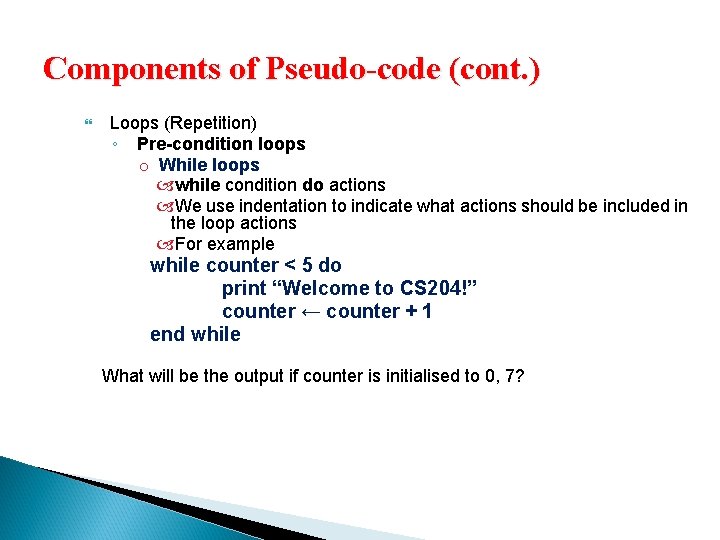
Components of Pseudo-code (cont. ) Loops (Repetition) ◦ Pre-condition loops o While loops while condition do actions We use indentation to indicate what actions should be included in the loop actions For example while counter < 5 do print “Welcome to CS 204!” counter ← counter + 1 end while What will be the output if counter is initialised to 0, 7?
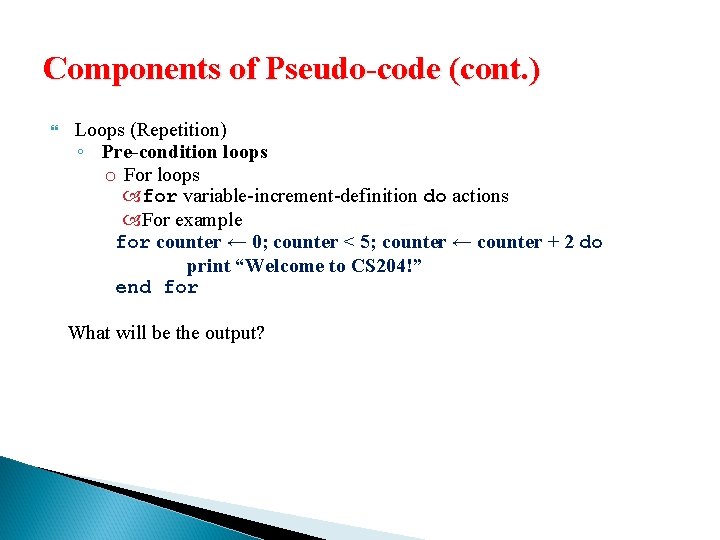
Components of Pseudo-code (cont. ) Loops (Repetition) ◦ Pre-condition loops o For loops for variable-increment-definition do actions For example for counter ← 0; counter < 5; counter ← counter + 2 do print “Welcome to CS 204!” end for What will be the output?
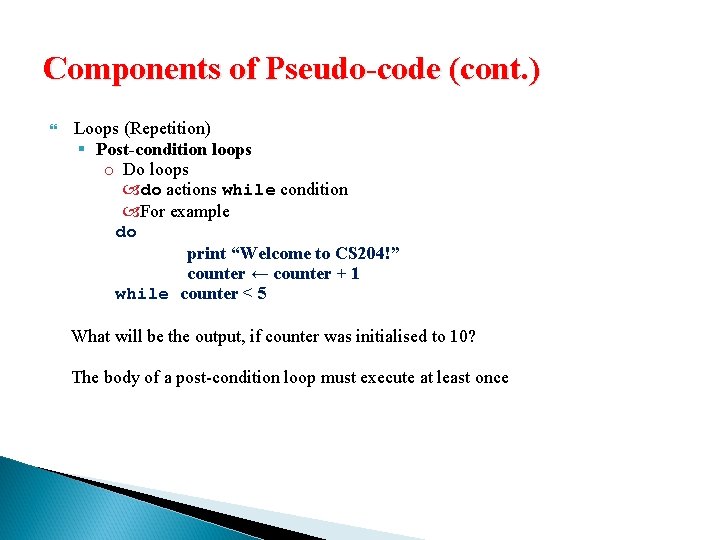
Components of Pseudo-code (cont. ) Loops (Repetition) § Post-condition loops o Do loops do actions while condition For example do print “Welcome to CS 204!” counter ← counter + 1 while counter < 5 What will be the output, if counter was initialised to 10? The body of a post-condition loop must execute at least once
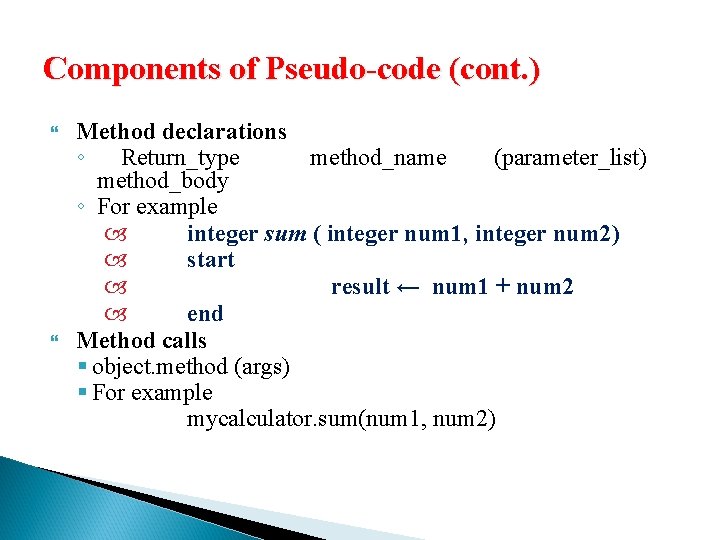
Components of Pseudo-code (cont. ) Method declarations ◦ Return_type method_name (parameter_list) method_body ◦ For example integer sum ( integer num 1, integer num 2) start result ← num 1 + num 2 end Method calls § object. method (args) § For example mycalculator. sum(num 1, num 2)
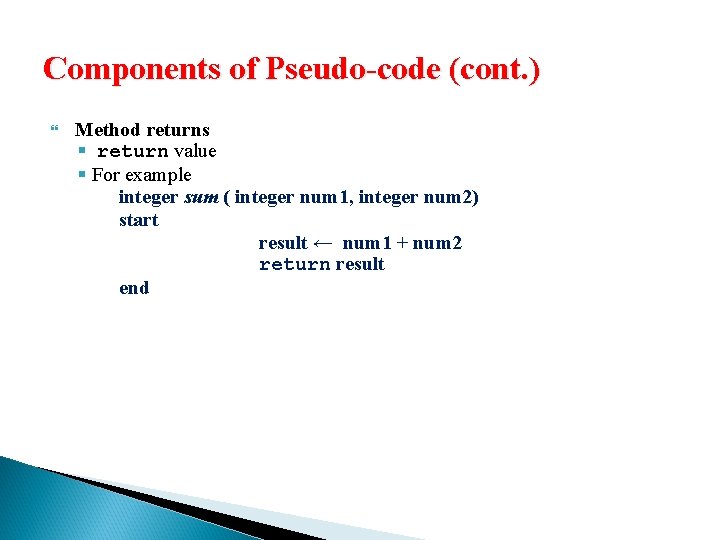
Components of Pseudo-code (cont. ) Method returns § return value § For example integer sum ( integer num 1, integer num 2) start result ← num 1 + num 2 return result end
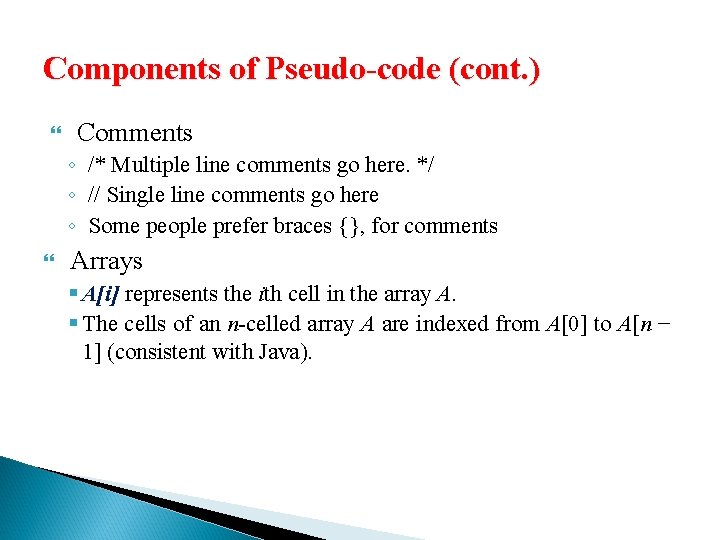
Components of Pseudo-code (cont. ) Comments ◦ /* Multiple line comments go here. */ ◦ // Single line comments go here ◦ Some people prefer braces {}, for comments Arrays § A[i] represents the ith cell in the array A. § The cells of an n-celled array A are indexed from A[0] to A[n − 1] (consistent with Java).
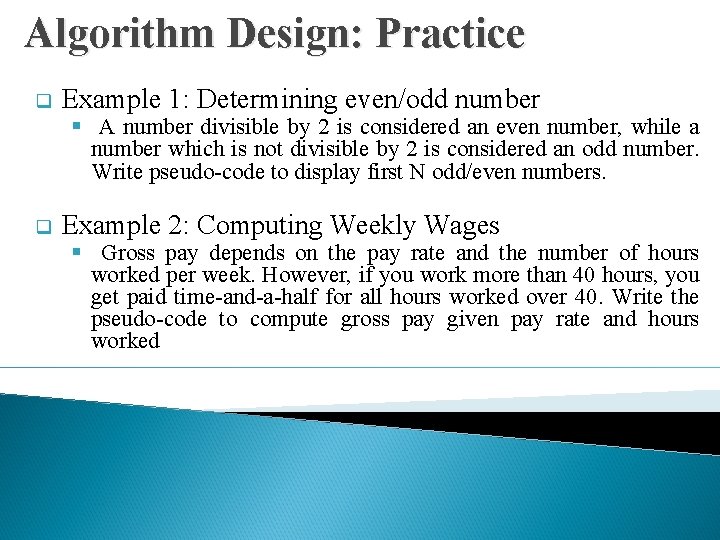
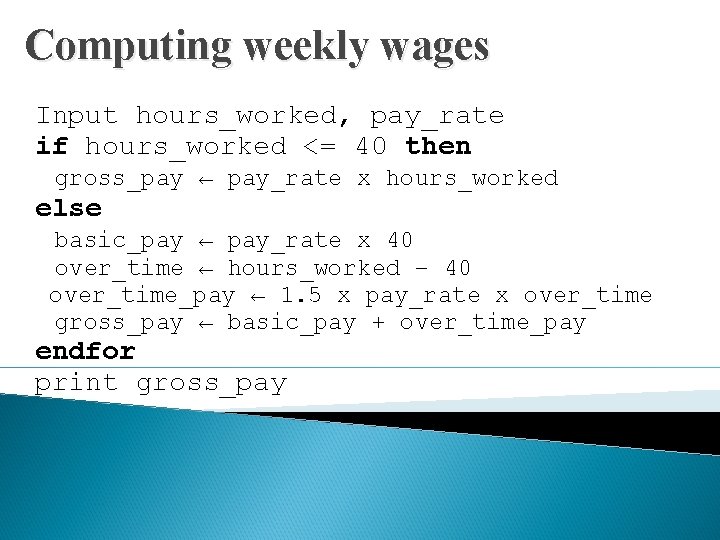
Algorithm Design: Practice q Example 1: Determining even/odd number § A number divisible by 2 is considered an even number, while a number which is not divisible by 2 is considered an odd number. Write pseudo-code to display first N odd/even numbers. q Example 2: Computing Weekly Wages § Gross pay depends on the pay rate and the number of hours worked per week. However, if you work more than 40 hours, you get paid time-and-a-half for all hours worked over 40. Write the pseudo-code to compute gross pay given pay rate and hours worked
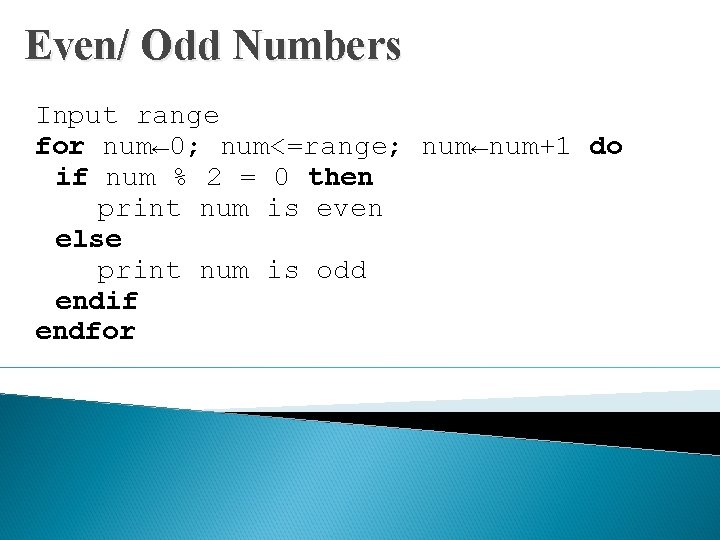
Even/ Odd Numbers Input range for num← 0; num<=range; num←num+1 do if num % 2 = 0 then print num is even else print num is odd endif endfor
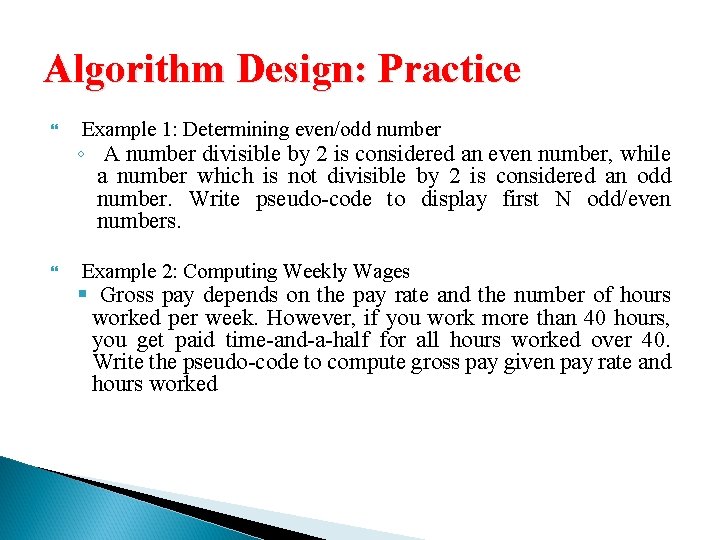
Algorithm Design: Practice Example 1: Determining even/odd number ◦ A number divisible by 2 is considered an even number, while a number which is not divisible by 2 is considered an odd number. Write pseudo-code to display first N odd/even numbers. Example 2: Computing Weekly Wages § Gross pay depends on the pay rate and the number of hours worked per week. However, if you work more than 40 hours, you get paid time-and-a-half for all hours worked over 40. Write the pseudo-code to compute gross pay given pay rate and hours worked
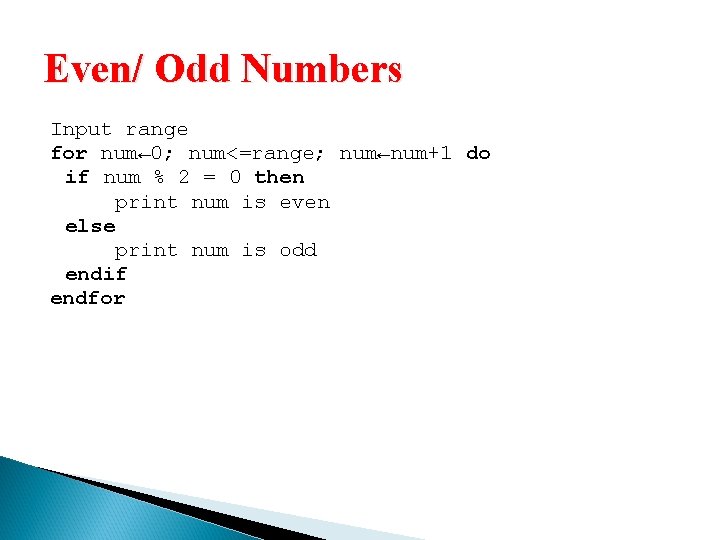
Even/ Odd Numbers Input range for num← 0; num<=range; num←num+1 do if num % 2 = 0 then print num is even else print num is odd endif endfor
Computing weekly wages Input hours_worked, pay_rate if hours_worked <= 40 then gross_pay ← pay_rate x hours_worked else basic_pay ← pay_rate x 40 over_time ← hours_worked – 40 over_time_pay ← 1. 5 x pay_rate x over_time gross_pay ← basic_pay + over_time_pay endfor print gross_pay
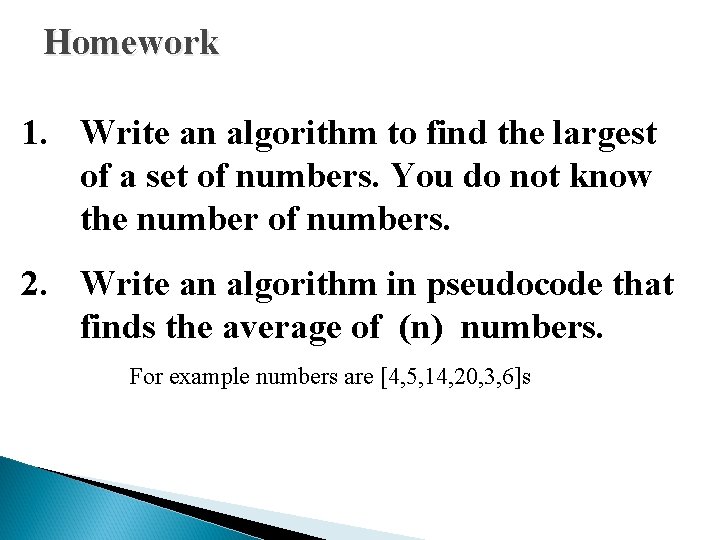
Homework 1. Write an algorithm to find the largest of a set of numbers. You do not know the number of numbers. 2. Write an algorithm in pseudocode that finds the average of (n) numbers. For example numbers are [4, 5, 14, 20, 3, 6]s