
Data Structures Bad programmers worry about the code
Data Structures "Bad programmers worry about the code. Good programmers worry about data structures and their relationships. " - Linus Torvalds

Data Structures 8 A Data Structure is: – “an organization of information, usually in computer memory, for better algorithm efficiency. " CS 321 - Data Structures 2
Data Structure Concepts 8 Data Structures are containers. – They hold other data. – Arrays are a data structure. – So are linked lists. 8 Other types of data structures: – stack, queue, tree, binary search tree, hash table, dictionary or map, heap, priority queue, … – en. wikipedia. org/wiki/List_of_data_structures 8 Different types of data structures are optimized for certain types of operations. CS 321 - Data Structures 3
Core Operations 8 Data Structures have three core operations: – A way to add things. – A way to remove things. – A way to access things, without modifying the data structure. 8 Details depend on the data structure. – For instance, a Indexed List data structure may need to: – add data at position in the List. – access by data by position. – remove by data by position. 8 More operations are added depending on what data structure is designed to do. CS 321 - Data Structures 4
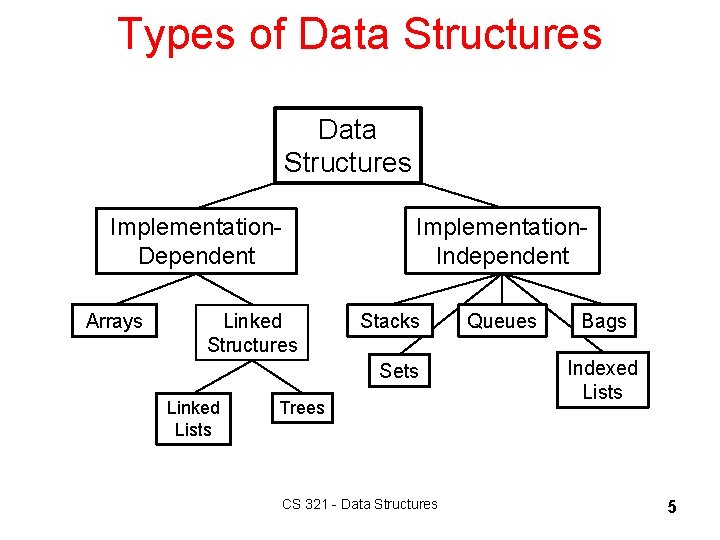
Types of Data Structures Implementation. Dependent Arrays Linked Structures Implementation. Independent Stacks Sets Linked Lists Trees CS 321 - Data Structures Queues Bags Indexed Lists 5
Implementation-Dependent Data Structures 8 Arrays – Collection of objects stored contiguously in memory. – Accessed by index. 8 Linked Structures – Collection of node objects. • Store data and reference to one or more other nodes. – Linked Lists • Linear collection of nodes. • Single-linked List – nodes contain references to next node in list. • Double-Linked List – nodes contain reference to next and previous nodes in list. – Trees • Hierarchical structure. • Nodes reference two or more “children. ” 6
Implementation-Independent Data Structures 8 Abstract Data Types (ADTs): – Descriptions of how a data type will work without implementation details. – Description can be a formal, mathematical description. – Many Java interfaces are a form of ADTs. 8 Examples: – Stack, Queue, Indexed List, Heap, Binary Search Tree, etc. CS 321 - Data Structures 7
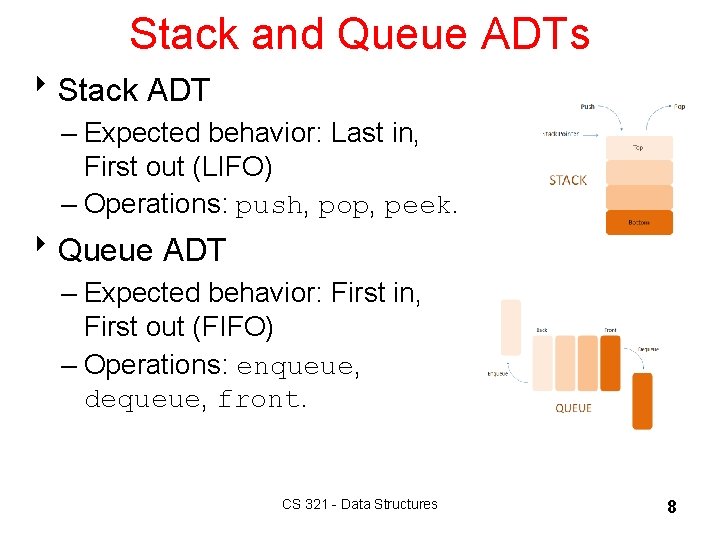
Stack and Queue ADTs 8 Stack ADT – Expected behavior: Last in, First out (LIFO) – Operations: push, pop, peek. 8 Queue ADT – Expected behavior: First in, First out (FIFO) – Operations: enqueue, dequeue, front. CS 321 - Data Structures 8
List ADTs 8 Sorted List – Items in list are arranged according to “natural ordering. ” – Operations: add, max/min, find, etc. 8 Indexed List – Items are accessed by position in list. – Operations: get, remove(index), add(index), etc. 8 Unsorted List – Items are stored without an implicit ordering. – Operations: add. To. Front, remove(element), last, etc. CS 321 - Data Structures 9
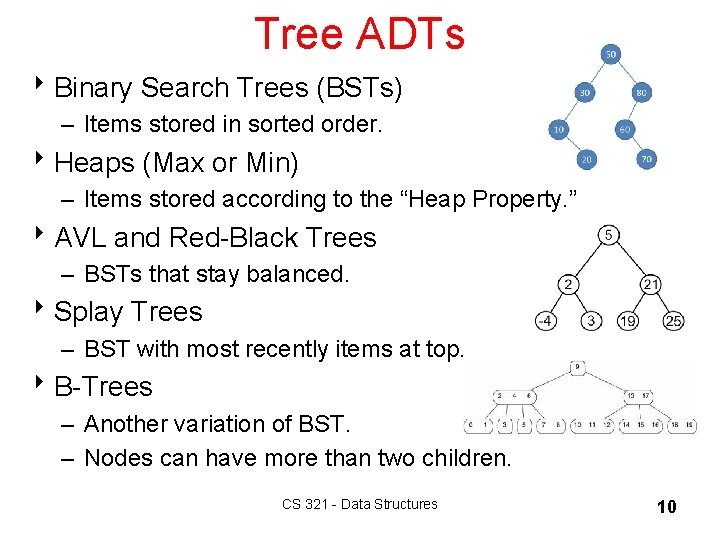
Tree ADTs 8 Binary Search Trees (BSTs) – Items stored in sorted order. 8 Heaps (Max or Min) – Items stored according to the “Heap Property. ” 8 AVL and Red-Black Trees – BSTs that stay balanced. 8 Splay Trees – BST with most recently items at top. 8 B-Trees – Another variation of BST. – Nodes can have more than two children. CS 321 - Data Structures 10
Other ADTs 8 Priority Queues – Next item removed has highest / lowest priority. 8 Hash Tables – Hash function: • Computes an index into a table of buckets or slots. • Look in the bucket for the desired value. 8 Maps – Collection of items with a key and associated values. – Similar to hash tables. 8 Graphs – Nodes with unlimited connections between other nodes. CS 321 - Data Structures 11
Implementing ADTs 8 The operations and behaviors are already specified. – For instance, every Stack has push, pop and peek methods. – Think Java interface. 8 But given an interface describing an ADT, how implement it? – Must decide which internal storage container to use to hold the items in the ADT. – Usually one of the Implementation-Dependent Data Structures: • Arrays, Linked Lists, Trees – But can be another ADT. • Using Heap to implement a Priority Queue. 12
ADTs and Data Structures in Programming Languages 8 Modern programming languages usually have a library of ADTs. – Java collections framework – C++ standard template library –. Net framework (portion of VERY large library) – Python lists and tuples – Lisp lists 8 However, most provided collection classes aren’t pure ADTs. CS 321 - Data Structures 13
ADTs in Java 8 Part of the Java Standard Library is the Collections Framework. – A library of data structures – Built on two interfaces • Collection • Iterator – http: //java. sun. com/j 2 se/1. 5. 0/docs/guide/collecti ons/index. html CS 321 - Data Structures 14
CS 321 - Data Structures 15
Stacks and Queues in the Java Collection API 8 No queue class in the Java collections API. – Can implement Queue interface using Java Linked. List class. 8 Stack extends Vector (which is almost exactly like Array. List). – Hmmm? 8 One reason the Java Collections Library is often said to be broken. CS 321 - Data Structures 16
- Slides: 16