
Data Structures and Algorithms 1 Outline 2 2

- Slides: 31
Data Structures and Algorithms 1 Outline 2. 2 This topic will describe: – The concrete data structures that can be used to store information – The basic forms of memory allocation • Contiguous • Linked • Indexed – The prototypical examples of these: arrays and linked lists – Other data structures: • Trees • Hybrids • Higher-dimensional arrays – Finally, we will discuss the run-time of queries and operations on arrays and linked lists
Data Structures and Algorithms 2 Memory Allocation 2. 2. 1 Memory allocation can be classified as either – Contiguous – Linked – Indexed Prototypical examples: – Contiguous allocation: – Linked allocation: arrays linked lists
Data Structures and Algorithms 3 Memory Allocation 2. 2. 1. 1 Contiguous, adj. Touching or connected throughout in an unbroken sequence. Meriam Webster Touching, in actual contact, next in space; meeting at a common boundary, bordering, adjoining. www. oed. com
Data Structures and Algorithms 4 2. 2. 1. 1 2. 2. 1 Contiguous Allocation An array stores n objects in a single contiguous space of memory Unfortunately, if more memory is required, a request for new memory usually requires copying all information into the new memory – In general, you cannot request for the operating system to allocate to you the next n memory locations
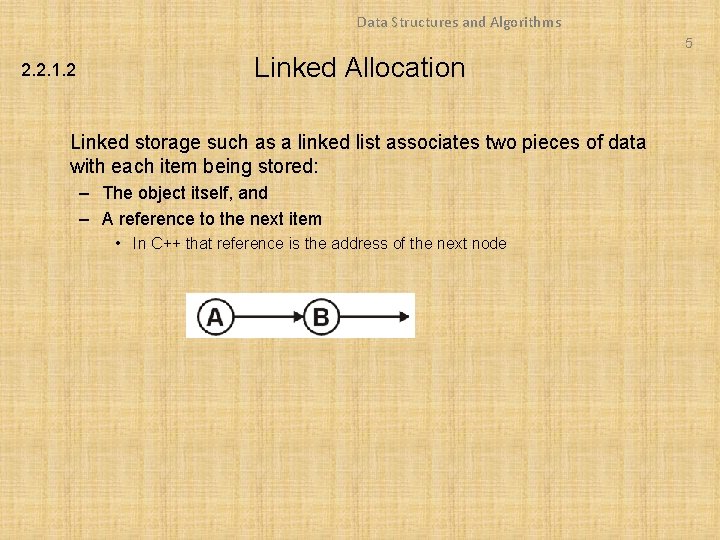
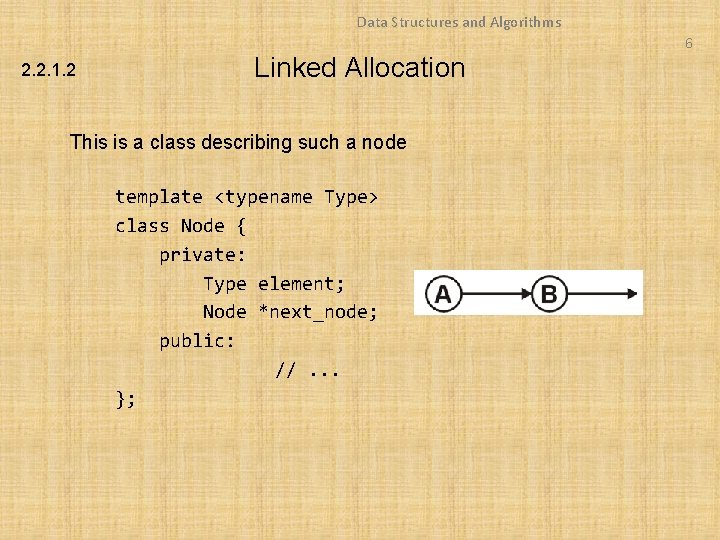
Data Structures and Algorithms 5 2. 2. 1. 2 Linked Allocation Linked storage such as a linked list associates two pieces of data with each item being stored: – The object itself, and – A reference to the next item • In C++ that reference is the address of the next node
Data Structures and Algorithms 6 2. 2. 1. 2 Linked Allocation This is a class describing such a node template <typename Type> class Node { private: Type element; Node *next_node; public: //. . . };
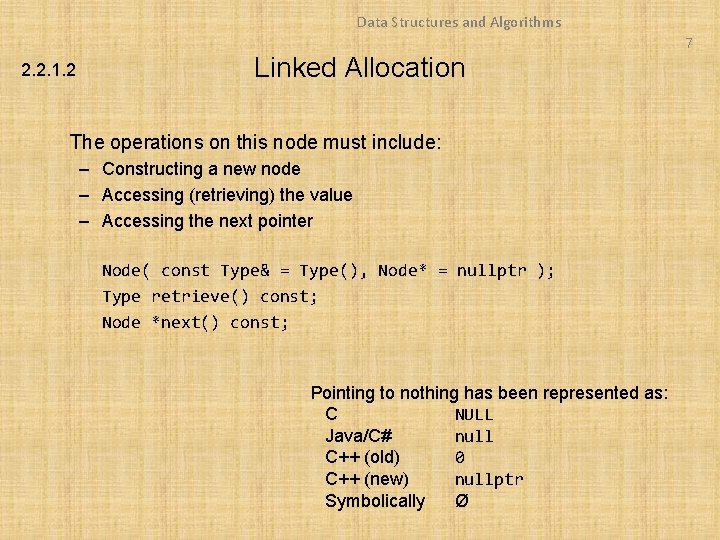
Data Structures and Algorithms 7 2. 2. 1. 2 Linked Allocation The operations on this node must include: – Constructing a new node – Accessing (retrieving) the value – Accessing the next pointer Node( const Type& = Type(), Node* = nullptr ); Type retrieve() const; Node *next() const; Pointing to nothing has been represented as: C NULL Java/C# null C++ (old) 0 C++ (new) nullptr Symbolically Ø
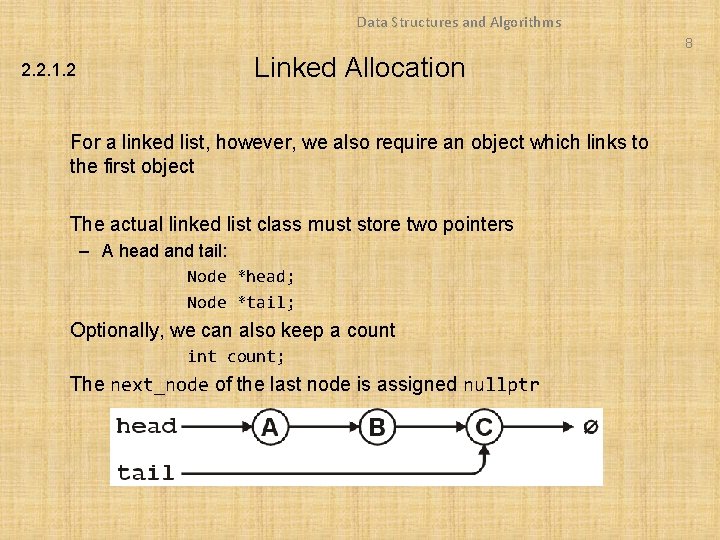
Data Structures and Algorithms 8 2. 2. 1. 2 Linked Allocation For a linked list, however, we also require an object which links to the first object The actual linked list class must store two pointers – A head and tail: Node *head; Node *tail; Optionally, we can also keep a count int count; The next_node of the last node is assigned nullptr
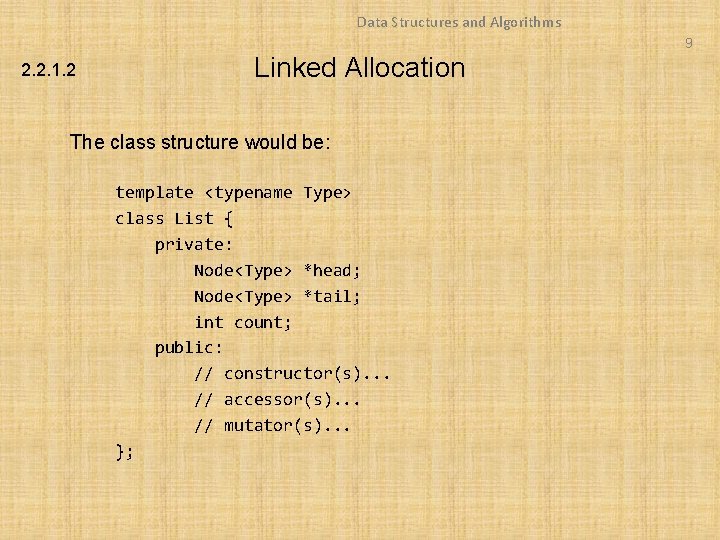
Data Structures and Algorithms 9 2. 2. 1. 2 Linked Allocation The class structure would be: template <typename Type> class List { private: Node<Type> *head; Node<Type> *tail; int count; public: // constructor(s). . . // accessor(s). . . // mutator(s). . . };
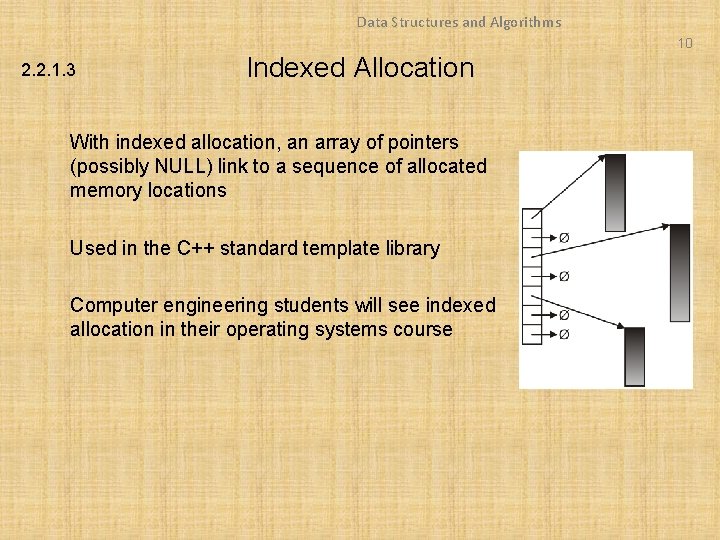
Data Structures and Algorithms 10 2. 2. 1. 3 Indexed Allocation With indexed allocation, an array of pointers (possibly NULL) link to a sequence of allocated memory locations Used in the C++ standard template library Computer engineering students will see indexed allocation in their operating systems course
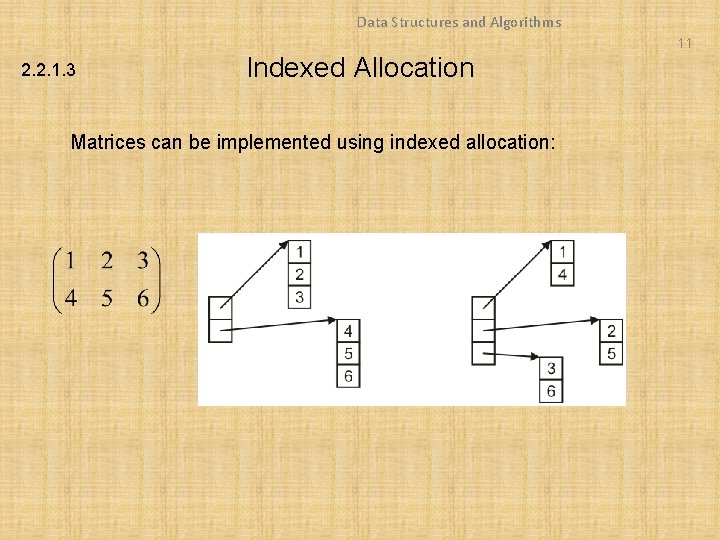
Data Structures and Algorithms 11 2. 2. 1. 3 Indexed Allocation Matrices can be implemented using indexed allocation:
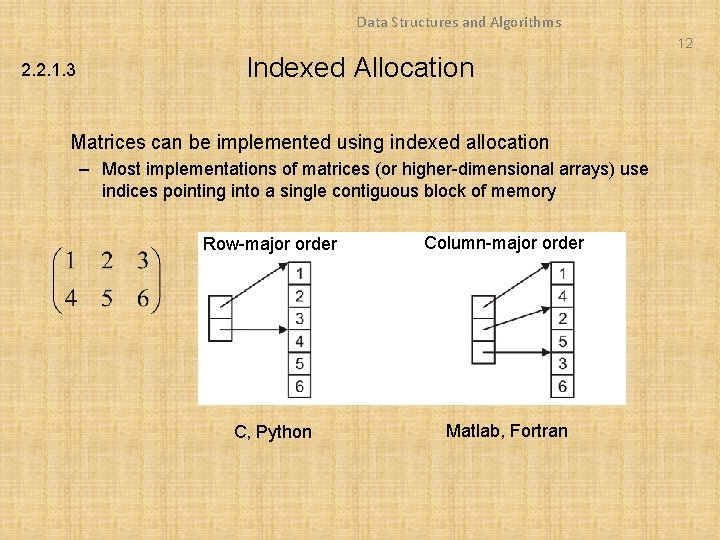
Data Structures and Algorithms 12 2. 2. 1. 3 Indexed Allocation Matrices can be implemented using indexed allocation – Most implementations of matrices (or higher-dimensional arrays) use indices pointing into a single contiguous block of memory Row-major order Column-major order C, Python Matlab, Fortran
Data Structures and Algorithms 13 Other Allocation Formats 2. 2. 2 We will look at some variations or hybrids of these memory allocations including: – – Trees Graphs Deques (linked arrays) inodes
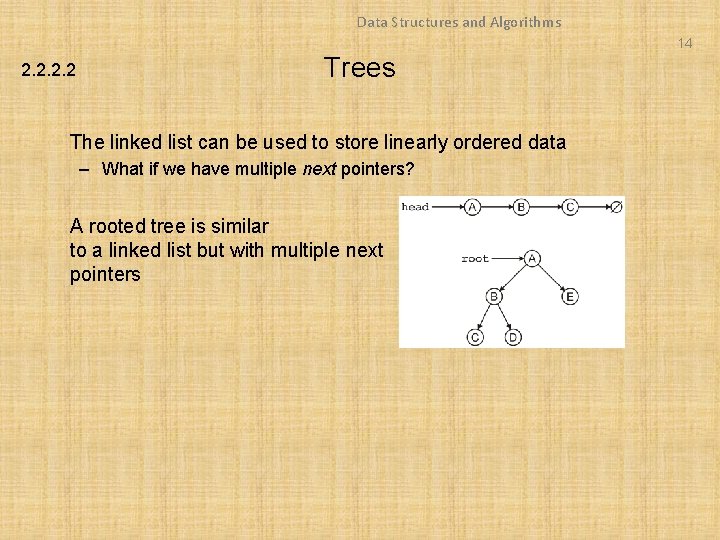
Data Structures and Algorithms 14 2. 2 Trees The linked list can be used to store linearly ordered data – What if we have multiple next pointers? A rooted tree is similar to a linked list but with multiple next pointers
Data Structures and Algorithms 15 Trees 2. 2 A tree is a variation on a linked list: – – Each node points to an arbitrary number of subsequent nodes Useful for storing hierarchical data We will see that it is also useful for storing sorted data Usually we will restrict ourselves to trees where each node points to at most two other nodes
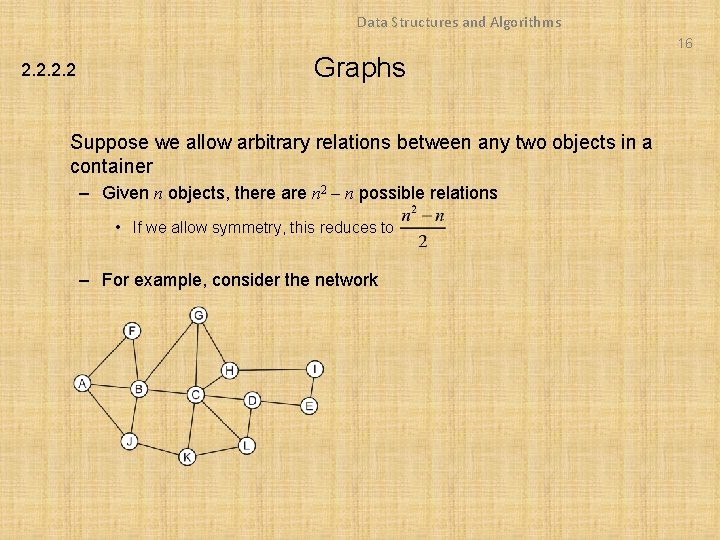
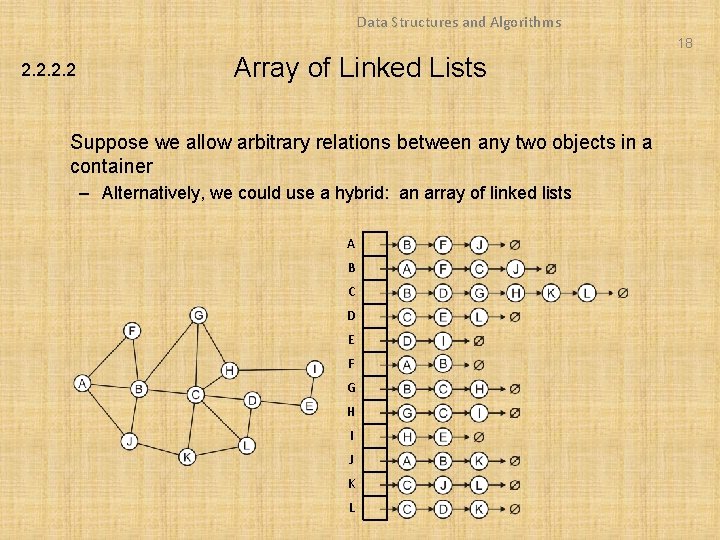
Data Structures and Algorithms 16 2. 2 Graphs Suppose we allow arbitrary relations between any two objects in a container – Given n objects, there are n 2 – n possible relations • If we allow symmetry, this reduces to – For example, consider the network
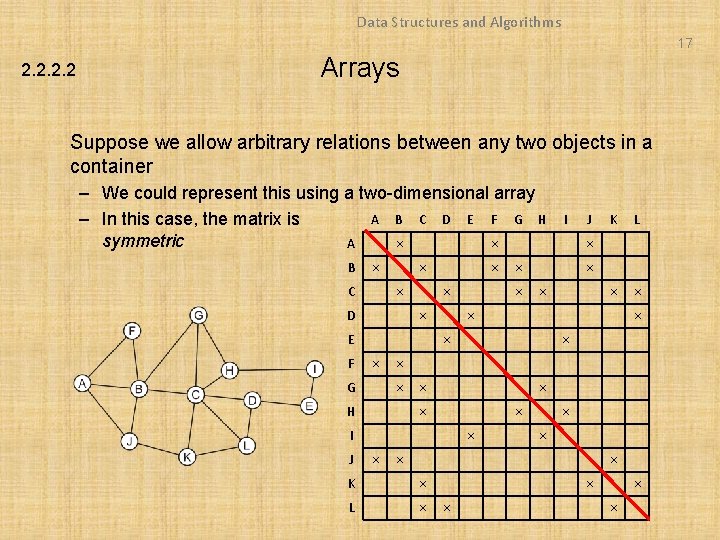
Data Structures and Algorithms 17 2. 2 Arrays Suppose we allow arbitrary relations between any two objects in a container – We could represent this using a two-dimensional array A B C D E F G H – In this case, the matrix is symmetric A × × B × C × × D × × E F × G × L × × × I × × K × H J × × × × I × × K × L × × ×
Data Structures and Algorithms 18 2. 2 Array of Linked Lists Suppose we allow arbitrary relations between any two objects in a container – Alternatively, we could use a hybrid: an array of linked lists A B C D E F G H I J K L
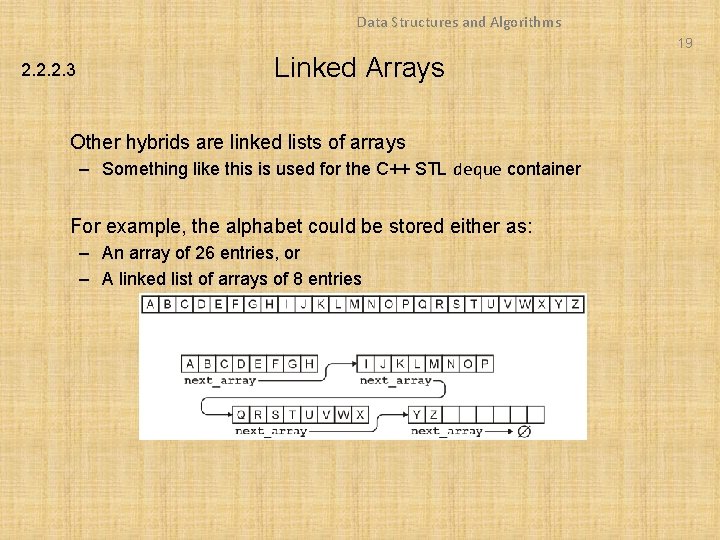
Data Structures and Algorithms 19 2. 2. 2. 3 Linked Arrays Other hybrids are linked lists of arrays – Something like this is used for the C++ STL deque container For example, the alphabet could be stored either as: – An array of 26 entries, or – A linked list of arrays of 8 entries
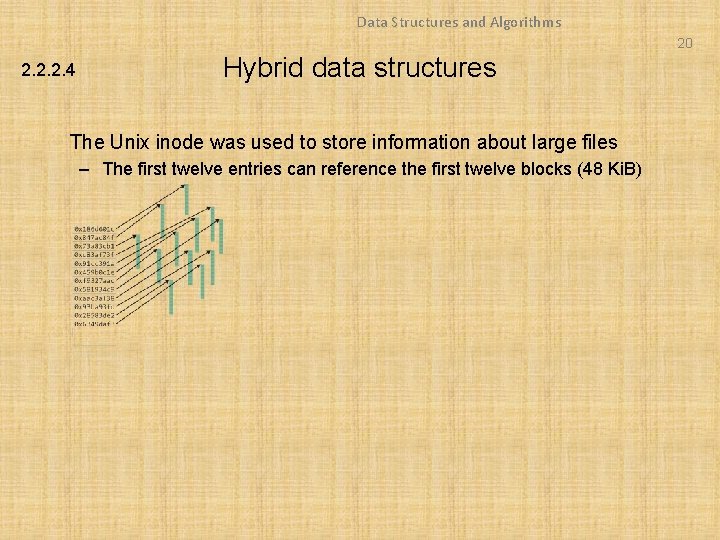
Data Structures and Algorithms 20 2. 2. 2. 4 Hybrid data structures The Unix inode was used to store information about large files – The first twelve entries can reference the first twelve blocks (48 Ki. B)
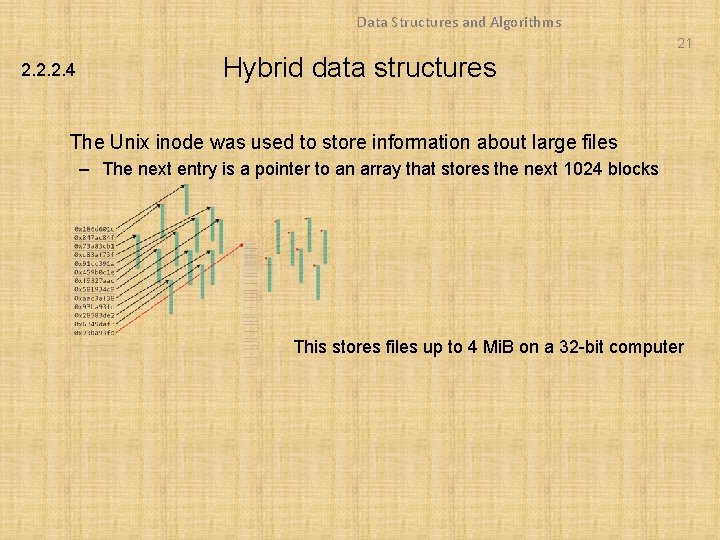
Data Structures and Algorithms 21 2. 2. 2. 4 Hybrid data structures The Unix inode was used to store information about large files – The next entry is a pointer to an array that stores the next 1024 blocks This stores files up to 4 Mi. B on a 32 -bit computer
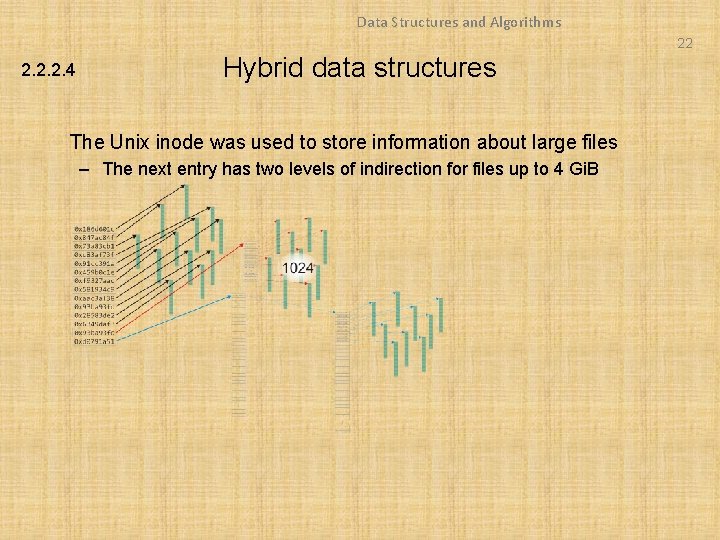
Data Structures and Algorithms 22 2. 2. 2. 4 Hybrid data structures The Unix inode was used to store information about large files – The next entry has two levels of indirection for files up to 4 Gi. B
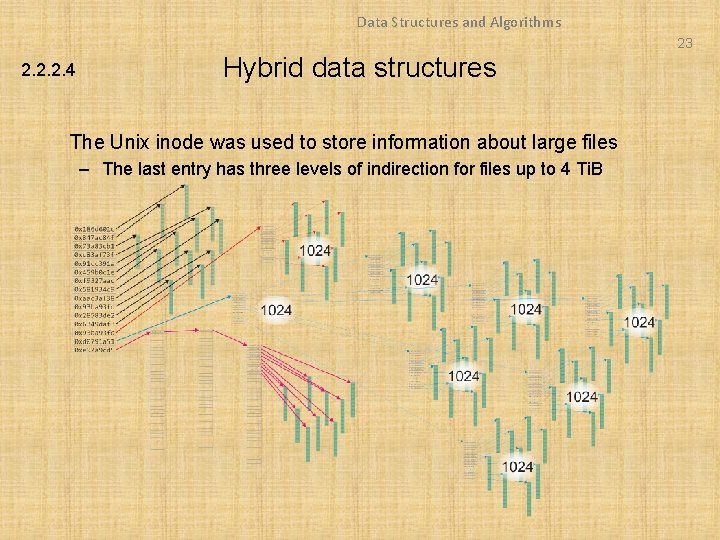
Data Structures and Algorithms 23 2. 2. 2. 4 Hybrid data structures The Unix inode was used to store information about large files – The last entry has three levels of indirection for files up to 4 Ti. B
Data Structures and Algorithms 24 2. 2. 3 Algorithm run times Once we have chosen a data structure to store both the objects and the relationships, we must implement the queries or operations as algorithms – The Abstract Data Type will be implemented as a class – The data structure will be defined by the member variables – The member functions will implement the algorithms The question is, how do we determine the efficiency of the algorithms?
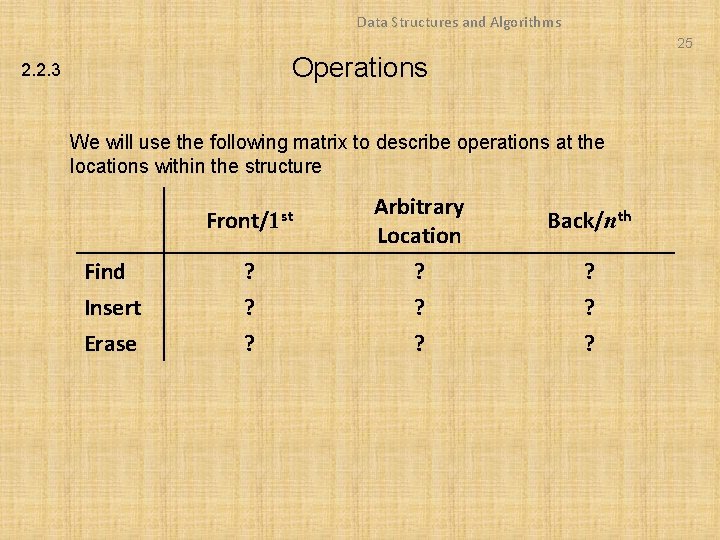
Data Structures and Algorithms 25 Operations 2. 2. 3 We will use the following matrix to describe operations at the locations within the structure Front/1 st Arbitrary Location Back/nth Find Insert ? ? Erase ? ? ?
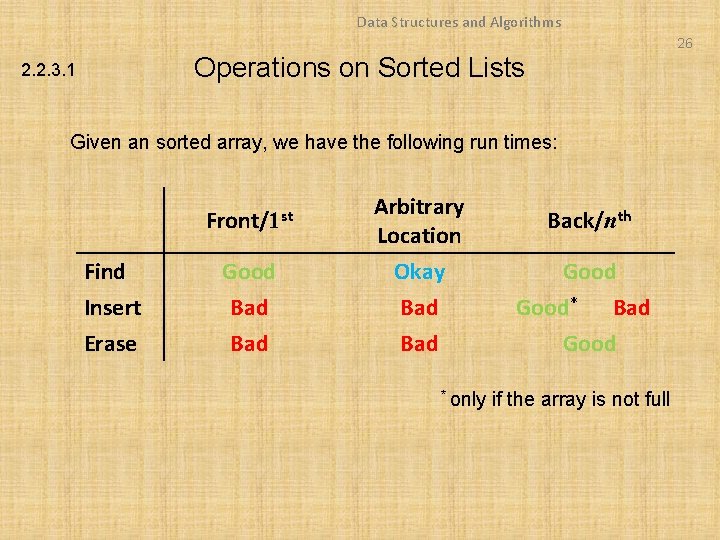
Data Structures and Algorithms 26 Operations on Sorted Lists 2. 2. 3. 1 Given an sorted array, we have the following run times: Front/1 st Arbitrary Location Back/nth Find Insert Good Bad Okay Bad Good* Bad Erase Bad Good * only if the array is not full
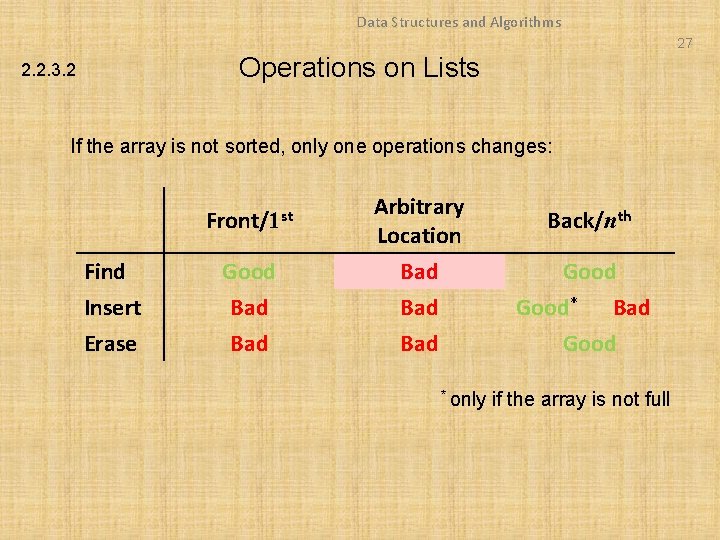
Data Structures and Algorithms 27 Operations on Lists 2. 2. 3. 2 If the array is not sorted, only one operations changes: Front/1 st Arbitrary Location Back/nth Find Insert Good Bad Bad Good* Bad Erase Bad Good * only if the array is not full
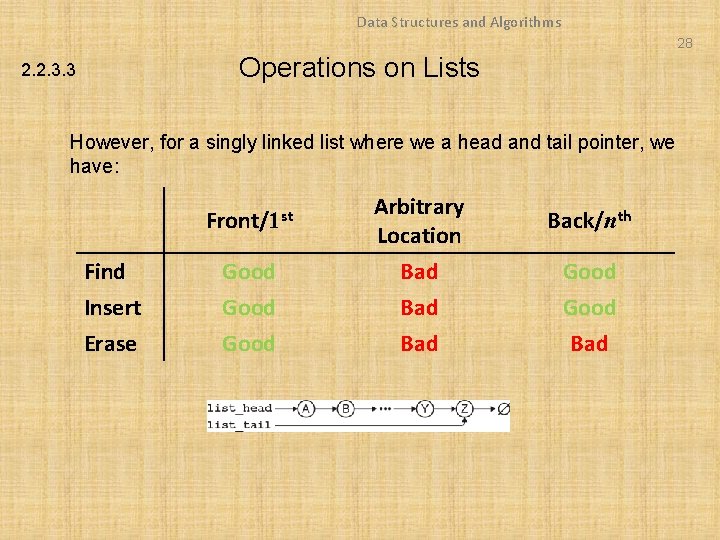
Data Structures and Algorithms 28 Operations on Lists 2. 2. 3. 3 However, for a singly linked list where we a head and tail pointer, we have: Front/1 st Arbitrary Location Back/nth Find Insert Good Bad Good Erase Good Bad
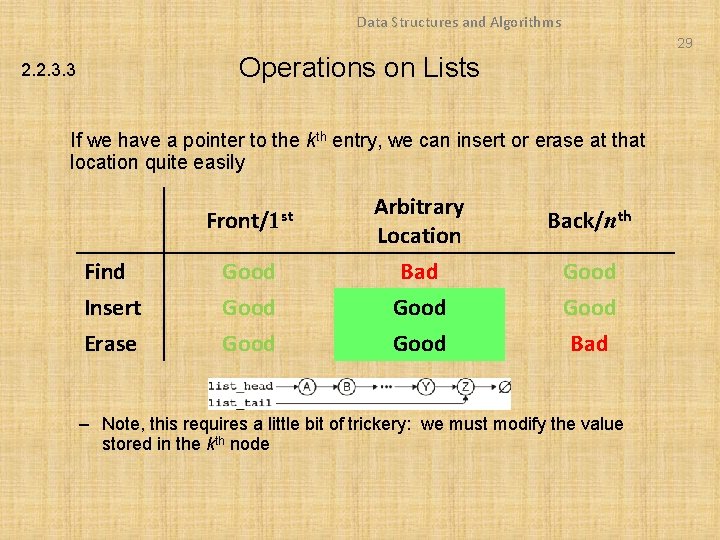
Data Structures and Algorithms 29 Operations on Lists 2. 2. 3. 3 If we have a pointer to the kth entry, we can insert or erase at that location quite easily Front/1 st Arbitrary Location Back/nth Find Insert Good Bad Good Erase Good Bad – Note, this requires a little bit of trickery: we must modify the value stored in the kth node
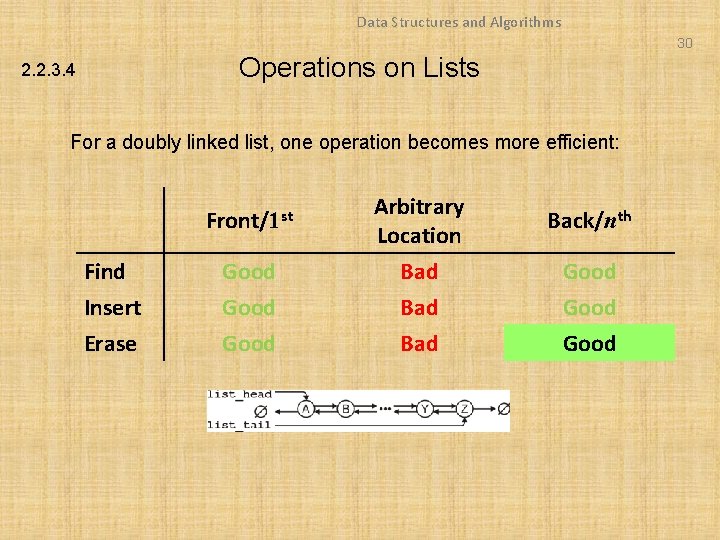
Data Structures and Algorithms 30 Operations on Lists 2. 2. 3. 4 For a doubly linked list, one operation becomes more efficient: Front/1 st Arbitrary Location Back/nth Find Insert Good Bad Good Erase Good Bad Good
Data Structures and Algorithms 31 Summary In this topic, we have introduced the concept of data structures – We discussed contiguous, linked, and indexed allocation – We looked at arrays and linked lists – We considered • Trees • Two-dimensional arrays • Hybrid data structures – We considered the run time of the algorithms required to perform various queries and operations on specific data structures: • Arrays and linked lists