
Data Structures and Abstractions with Java 5 th
Data Structures and Abstractions with Java™ 5 th Edition Chapter 11 A List Implementation That Uses an Array Copyright © 2019, 2015, 2012 Pearson Education, Inc. All Rights Reserved
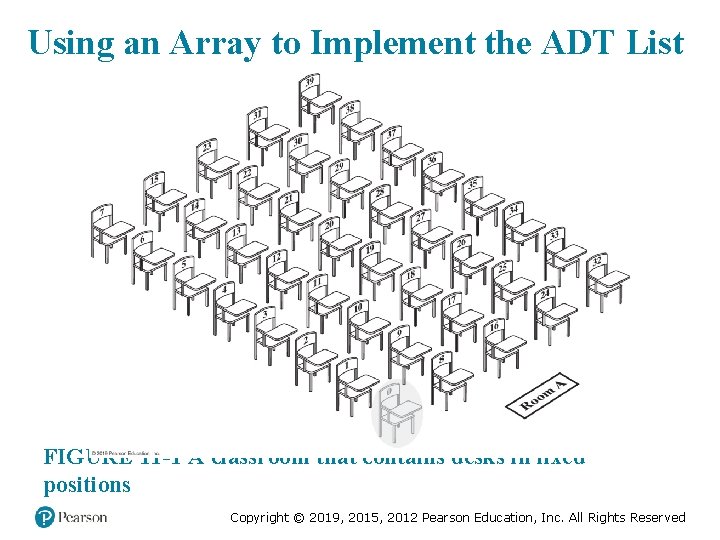
Using an Array to Implement the ADT List FIGURE 11 -1 A classroom that contains desks in fixed positions Copyright © 2019, 2015, 2012 Pearson Education, Inc. All Rights Reserved
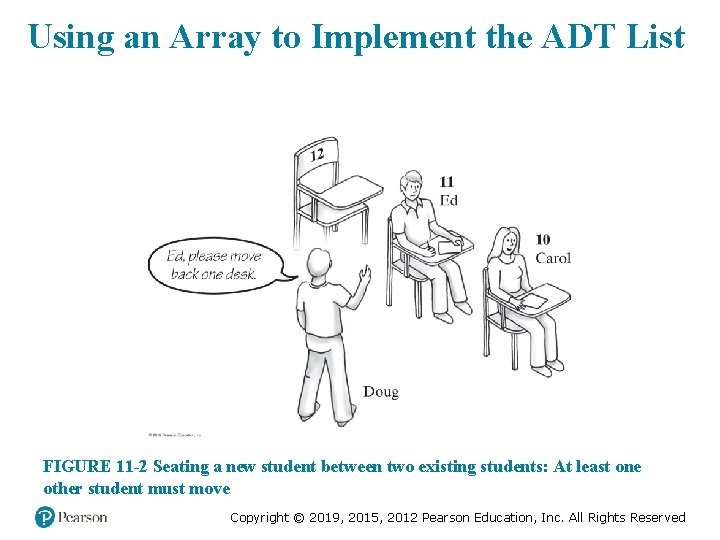
Using an Array to Implement the ADT List FIGURE 11 -2 Seating a new student between two existing students: At least one other student must move Copyright © 2019, 2015, 2012 Pearson Education, Inc. All Rights Reserved
![Using an Array to Implement the ADT List AList –list: T[] –number. Of. Entries:](http://slidetodoc.com/presentation_image_h/305ca2be25724170e7fd7a2da3c353dc/image-4.jpg "Using an Array to Implement the ADT List AList –list: T[] –number. Of. Entries:")
Using an Array to Implement the ADT List AList –list: T[] –number. Of. Entries: integer –DEFAULT_CAPACITY: integer –MAX_CAPACITY: integer –integrity. OK: boolean +add(new. Entry: T): void +add(given. Position: integer, new. Entry: T): void +remove(given. Position: integer): T +clear(): void +replace(given. Position: integer, new. Entry: T): T +get. Entry(given. Position: integer): T +to. Array(): T[] +contains(an. Entry: T): boolean +get. Length(): integer +is. Empty(): boolean FIGURE 11 -3 UML notation for the class AList Copyright © 2019, 2015, 2012 Pearson Education, Inc. All Rights Reserved
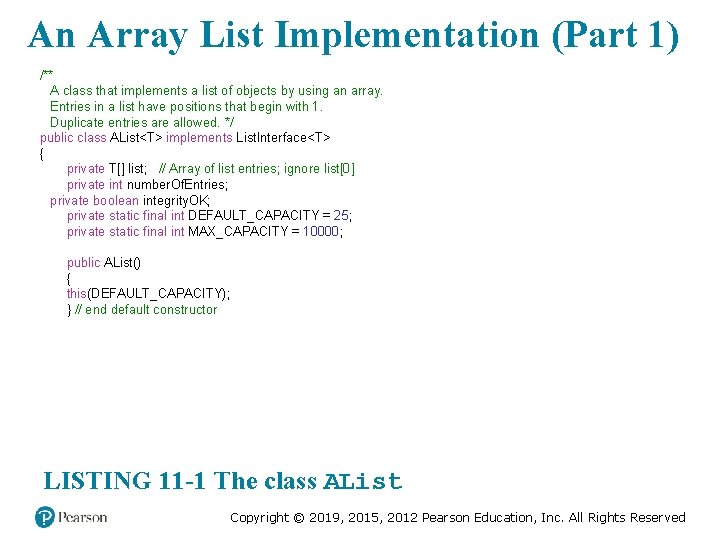
An Array List Implementation (Part 1) /** A class that implements a list of objects by using an array. Entries in a list have positions that begin with 1. Duplicate entries are allowed. */ public class AList<T> implements List. Interface<T> { private T[] list; // Array of list entries; ignore list[0] private int number. Of. Entries; private boolean integrity. OK; private static final int DEFAULT_CAPACITY = 25; private static final int MAX_CAPACITY = 10000; public AList() { this(DEFAULT_CAPACITY); } // end default constructor LISTING 11 -1 The class AList Copyright © 2019, 2015, 2012 Pearson Education, Inc. All Rights Reserved
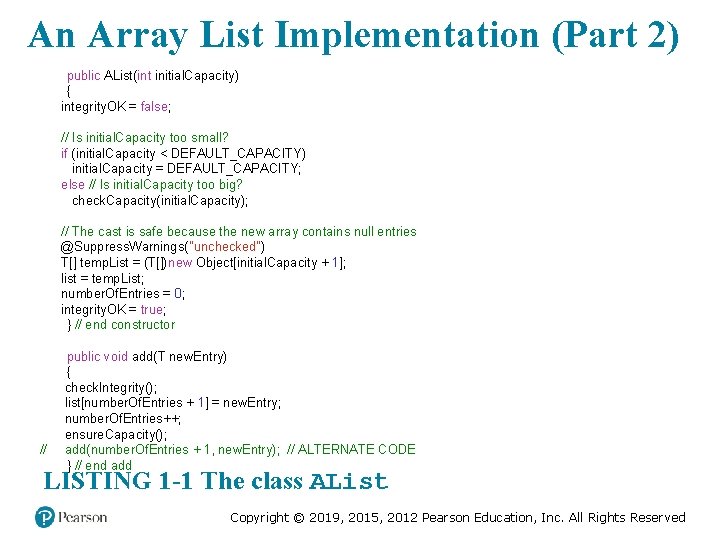
An Array List Implementation (Part 2) public AList(int initial. Capacity) { integrity. OK = false; // Is initial. Capacity too small? if (initial. Capacity < DEFAULT_CAPACITY) initial. Capacity = DEFAULT_CAPACITY; else // Is initial. Capacity too big? check. Capacity(initial. Capacity); // The cast is safe because the new array contains null entries @Suppress. Warnings("unchecked") T[] temp. List = (T[])new Object[initial. Capacity + 1]; list = temp. List; number. Of. Entries = 0; integrity. OK = true; } // end constructor // public void add(T new. Entry) { check. Integrity(); list[number. Of. Entries + 1] = new. Entry; number. Of. Entries++; ensure. Capacity(); add(number. Of. Entries + 1, new. Entry); // ALTERNATE CODE } // end add LISTING 1 -1 The class AList Copyright © 2019, 2015, 2012 Pearson Education, Inc. All Rights Reserved
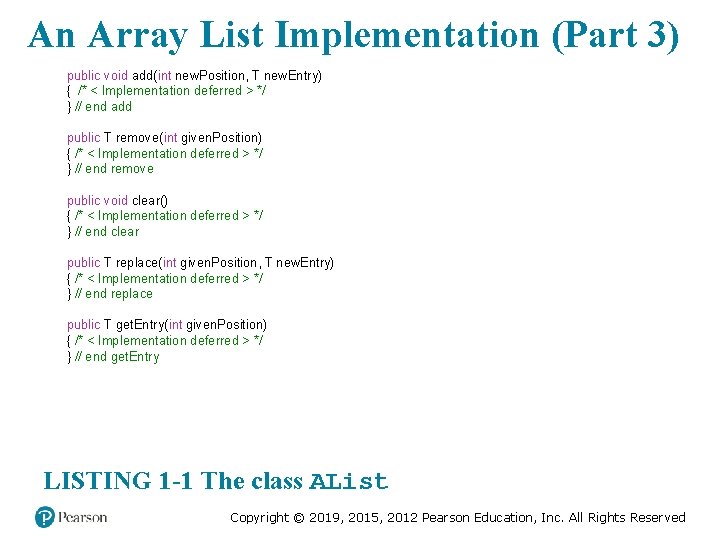
An Array List Implementation (Part 3) public void add(int new. Position, T new. Entry) { /* < Implementation deferred > */ } // end add public T remove(int given. Position) { /* < Implementation deferred > */ } // end remove public void clear() { /* < Implementation deferred > */ } // end clear public T replace(int given. Position, T new. Entry) { /* < Implementation deferred > */ } // end replace public T get. Entry(int given. Position) { /* < Implementation deferred > */ } // end get. Entry LISTING 1 -1 The class AList Copyright © 2019, 2015, 2012 Pearson Education, Inc. All Rights Reserved
![An Array List Implementation (Part 4) public T[] to. Array() { check. Integrity(); //](http://slidetodoc.com/presentation_image_h/305ca2be25724170e7fd7a2da3c353dc/image-8.jpg "An Array List Implementation (Part 4) public T[] to. Array() { check. Integrity(); //")
An Array List Implementation (Part 4) public T[] to. Array() { check. Integrity(); // The cast is safe because the new array contains null entries @Suppress. Warnings("unchecked") T[] result = (T[])new Object[number. Of. Entries]; // Unchecked cast for (int index = 0; index < number. Of. Entries; index++) { result[index] = list[index + 1]; } // end for return result; } // end to. Array public boolean contains(T an. Entry) { /* < Implementation deferred > */ } // end contains public int get. Length() { return number. Of. Entries; } // end get. Length LISTING 11 -1 The class AList Copyright © 2019, 2015, 2012 Pearson Education, Inc. All Rights Reserved
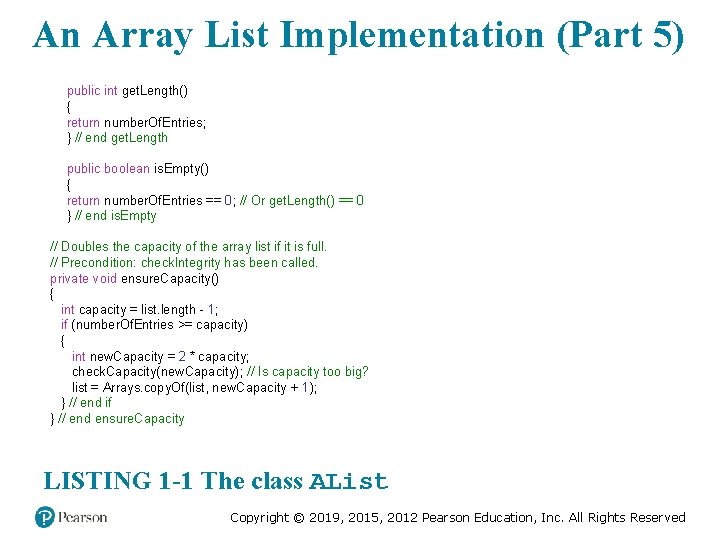
An Array List Implementation (Part 5) public int get. Length() { return number. Of. Entries; } // end get. Length public boolean is. Empty() { return number. Of. Entries == 0; // Or get. Length() == 0 } // end is. Empty // Doubles the capacity of the array list if it is full. // Precondition: check. Integrity has been called. private void ensure. Capacity() { int capacity = list. length - 1; if (number. Of. Entries >= capacity) { int new. Capacity = 2 * capacity; check. Capacity(new. Capacity); // Is capacity too big? list = Arrays. copy. Of(list, new. Capacity + 1); } // end if } // end ensure. Capacity LISTING 1 -1 The class AList Copyright © 2019, 2015, 2012 Pearson Education, Inc. All Rights Reserved
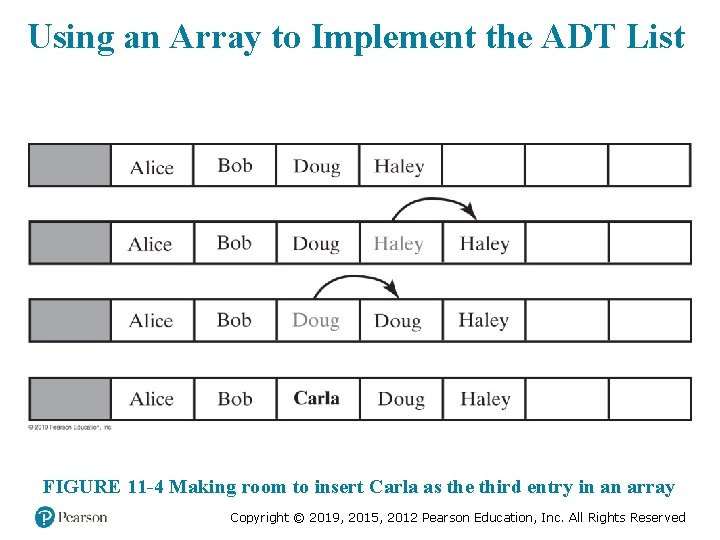
Using an Array to Implement the ADT List FIGURE 11 -4 Making room to insert Carla as the third entry in an array Copyright © 2019, 2015, 2012 Pearson Education, Inc. All Rights Reserved
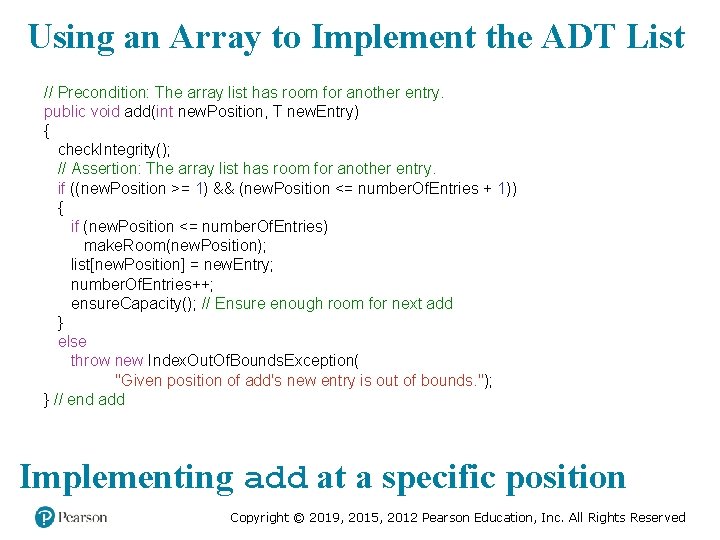
Using an Array to Implement the ADT List // Precondition: The array list has room for another entry. public void add(int new. Position, T new. Entry) { check. Integrity(); // Assertion: The array list has room for another entry. if ((new. Position >= 1) && (new. Position <= number. Of. Entries + 1)) { if (new. Position <= number. Of. Entries) make. Room(new. Position); list[new. Position] = new. Entry; number. Of. Entries++; ensure. Capacity(); // Ensure enough room for next add } else throw new Index. Out. Of. Bounds. Exception( "Given position of add's new entry is out of bounds. "); } // end add Implementing add at a specific position Copyright © 2019, 2015, 2012 Pearson Education, Inc. All Rights Reserved
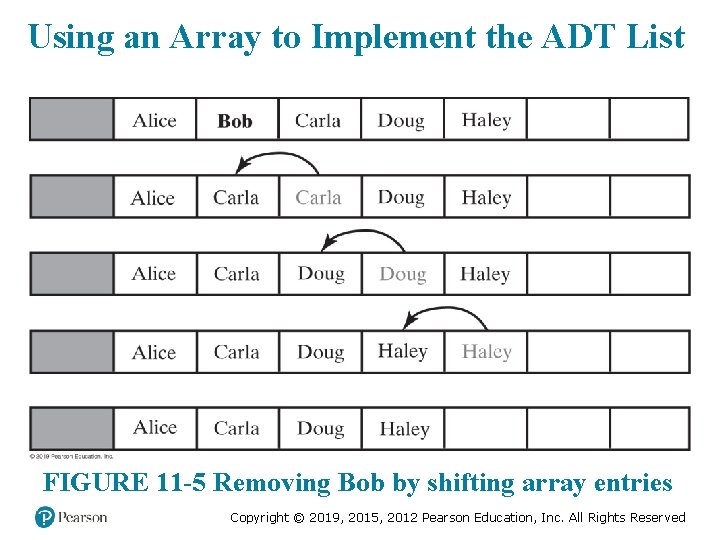
Using an Array to Implement the ADT List FIGURE 11 -5 Removing Bob by shifting array entries Copyright © 2019, 2015, 2012 Pearson Education, Inc. All Rights Reserved
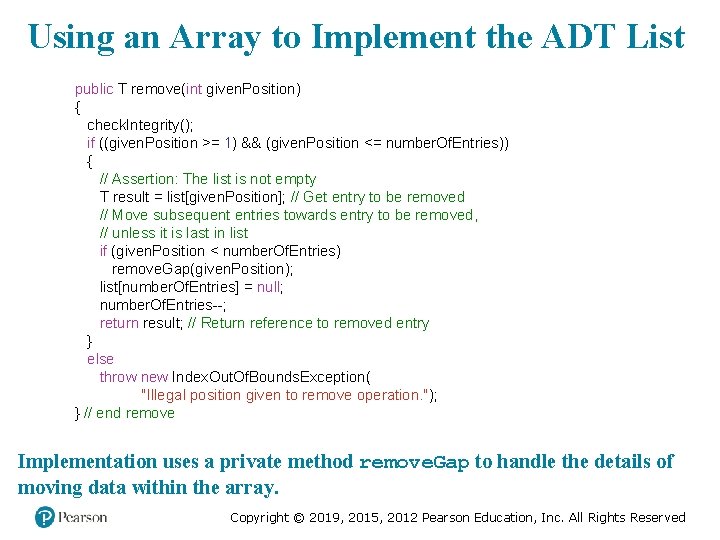
Using an Array to Implement the ADT List public T remove(int given. Position) { check. Integrity(); if ((given. Position >= 1) && (given. Position <= number. Of. Entries)) { // Assertion: The list is not empty T result = list[given. Position]; // Get entry to be removed // Move subsequent entries towards entry to be removed, // unless it is last in list if (given. Position < number. Of. Entries) remove. Gap(given. Position); list[number. Of. Entries] = null; number. Of. Entries--; return result; // Return reference to removed entry } else throw new Index. Out. Of. Bounds. Exception( "Illegal position given to remove operation. "); } // end remove Implementation uses a private method remove. Gap to handle the details of moving data within the array. Copyright © 2019, 2015, 2012 Pearson Education, Inc. All Rights Reserved
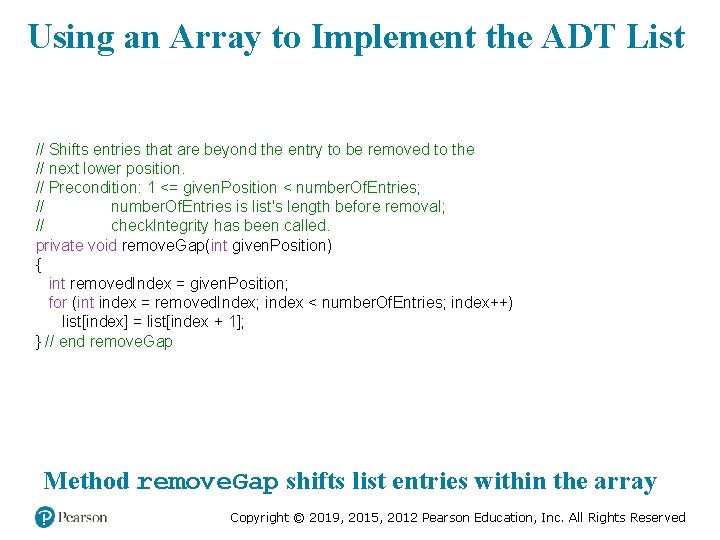
Using an Array to Implement the ADT List // Shifts entries that are beyond the entry to be removed to the // next lower position. // Precondition: 1 <= given. Position < number. Of. Entries; // number. Of. Entries is list's length before removal; // check. Integrity has been called. private void remove. Gap(int given. Position) { int removed. Index = given. Position; for (int index = removed. Index; index < number. Of. Entries; index++) list[index] = list[index + 1]; } // end remove. Gap Method remove. Gap shifts list entries within the array Copyright © 2019, 2015, 2012 Pearson Education, Inc. All Rights Reserved
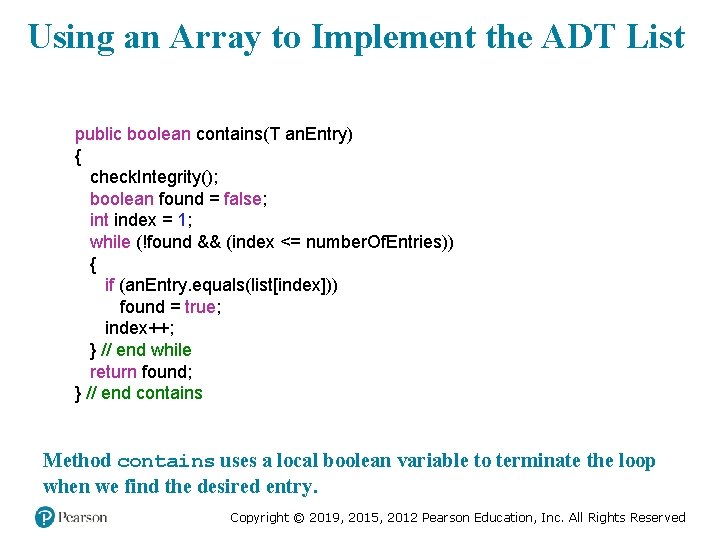
Using an Array to Implement the ADT List public boolean contains(T an. Entry) { check. Integrity(); boolean found = false; int index = 1; while (!found && (index <= number. Of. Entries)) { if (an. Entry. equals(list[index])) found = true; index++; } // end while return found; } // end contains Method contains uses a local boolean variable to terminate the loop when we find the desired entry. Copyright © 2019, 2015, 2012 Pearson Education, Inc. All Rights Reserved
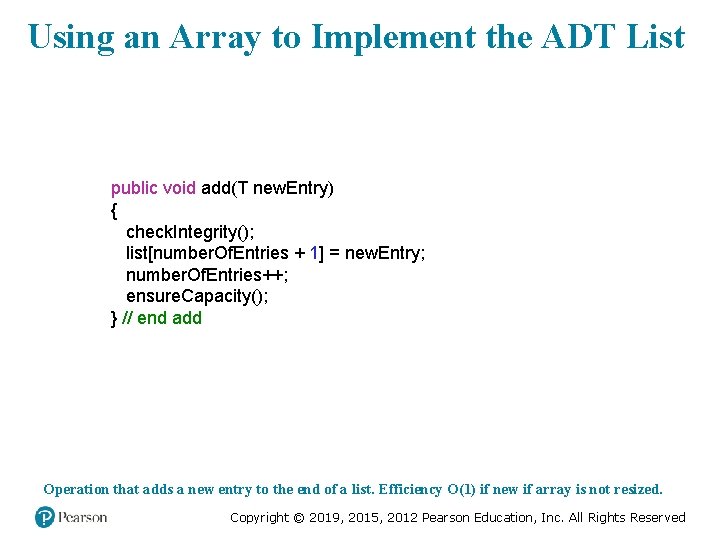
Using an Array to Implement the ADT List public void add(T new. Entry) { check. Integrity(); list[number. Of. Entries + 1] = new. Entry; number. Of. Entries++; ensure. Capacity(); } // end add Operation that adds a new entry to the end of a list. Efficiency O(1) if new if array is not resized. Copyright © 2019, 2015, 2012 Pearson Education, Inc. All Rights Reserved
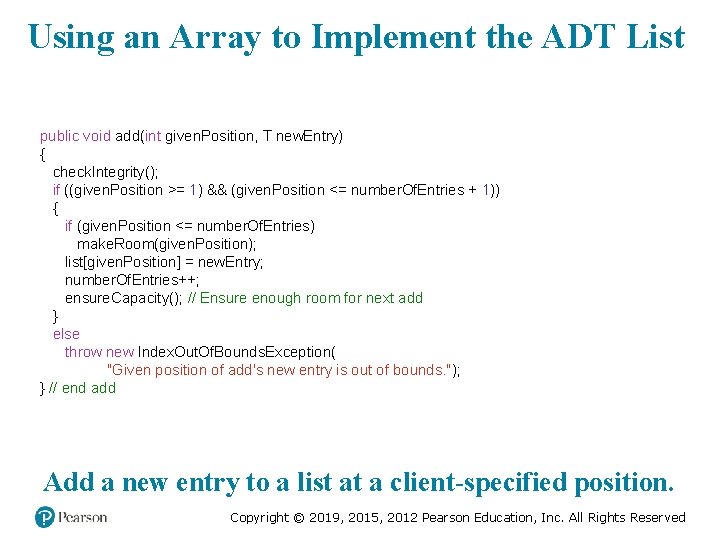
Using an Array to Implement the ADT List public void add(int given. Position, T new. Entry) { check. Integrity(); if ((given. Position >= 1) && (given. Position <= number. Of. Entries + 1)) { if (given. Position <= number. Of. Entries) make. Room(given. Position); list[given. Position] = new. Entry; number. Of. Entries++; ensure. Capacity(); // Ensure enough room for next add } else throw new Index. Out. Of. Bounds. Exception( "Given position of add's new entry is out of bounds. "); } // end add Add a new entry to a list at a client-specified position. Copyright © 2019, 2015, 2012 Pearson Education, Inc. All Rights Reserved
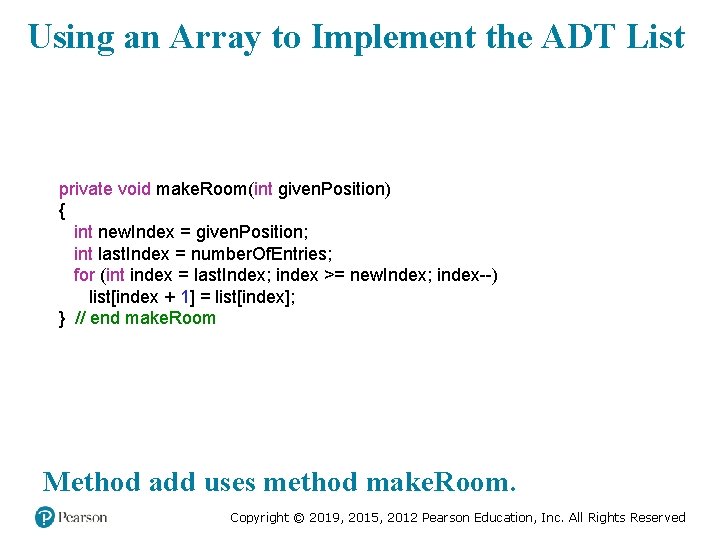
Using an Array to Implement the ADT List private void make. Room(int given. Position) { int new. Index = given. Position; int last. Index = number. Of. Entries; for (int index = last. Index; index >= new. Index; index--) list[index + 1] = list[index]; } // end make. Room Method add uses method make. Room. Copyright © 2019, 2015, 2012 Pearson Education, Inc. All Rights Reserved

End Chapter 11 Copyright © 2019, 2015, 2012 Pearson Education, Inc. All Rights Reserved
- Slides: 19