
Data Statistics Division Guide to completing Form BT
Data & Statistics Division Guide to completing Form BT Balance sheet BE BT This guide captures… • Form BT – which collects information for all UK Monetary Financial Institutions (MFIs) with a deposit taking license • It captures all assets and liabilities held on balance sheet, as well as several off-balance sheet items including custody holdings, SPV balances and Facilities Look out for this icon throughout the presentation for extra information Navigate through the presentation using the icons in the bottom-right corner Click on Part of Balance sheet and breakdowns from Bank of England’s Core Statistical Returns to take you back to the contents
Data & Statistics Division Guide to completing Form BT Contents Overview Family of Statistical Returns Form content Form Purpose How are the data used? Common Classification and Reporting Issues Form Reconciliations Timetable Resources Contact details

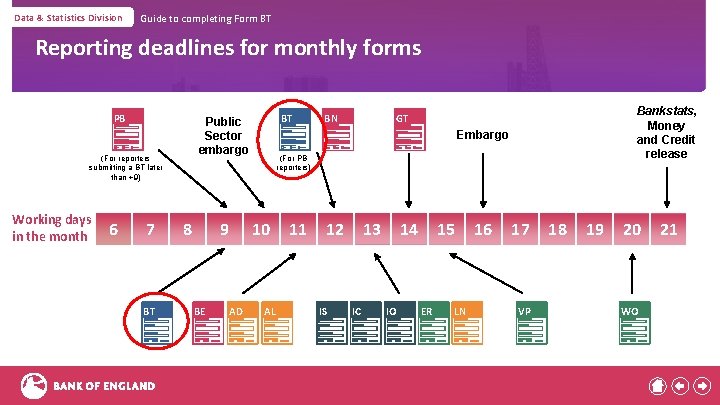
Data & Statistics Division Guide to completing Form BT BT overview Reporting panel Monthly: Total assets > £ 3 bn or private sector business > £ 1 bn Quarterly: all other institutions Reporting deadline 9 working days after month end for non. PB reporters, 12 working days after month-end for PB reporters Data finalised for publication 16 working days after month end Main uses Monetary aggregates published in Bankstats, More detailed analysis for monetary policy and financial stability
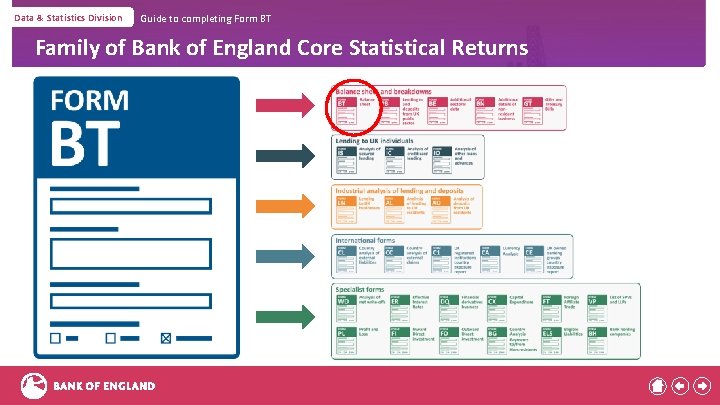
Data & Statistics Division Guide to completing Form BT Family of Bank of England Core Statistical Returns
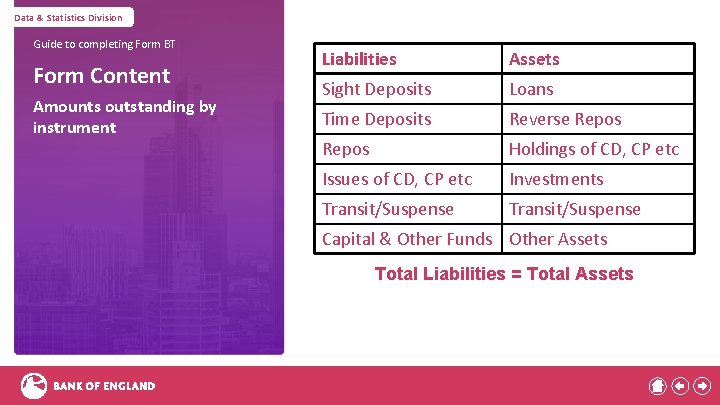
Data & Statistics Division Guide to completing Form BT Form Content Amounts outstanding by instrument Liabilities Assets Sight Deposits Loans Time Deposits Reverse Repos Holdings of CD, CP etc Issues of CD, CP etc Investments Transit/Suspense Capital & Other Funds Other Assets Total Liabilities = Total Assets
Data & Statistics Division Guide to completing Form BT Form content: Sectors Most of these elements of the balance sheet are also split by sector: Bank of England UK Banks UK Building Societies Other MFIs (nil) UK Central Government UK Local Government UK Public Corporations Other UK Residents Non-Residents
Data & Statistics Division Guide to completing Form BT Form Content: Intragroup business • Form BT also collects information on “intragroup” balances on several lines, • A counterparty is considered connected, and therefore intragroup, if: One institution either owns more than half the share capital or controls the board of the other institution, directly or indirectly (e. g. via a holding company) or when the two institutions are both controlled by the same third party, • This is used to define intragroup interbank business (items ending in BG/DG), • Intragroup Other Financial Corporations (OFCs) are excluded from retail deposits.

Data & Statistics Division Guide to completing Form BT Form Purpose The form purpose is to capture the Balance Sheets and breakdown for all UK MFIs with a deposit taking license. As with all balance sheets it should balance, and therefore Form BT 20 (total liabilities) and Form BT 40 (total assets) should be equal when summed across currencies.
Data & Statistics Division Guide to completing Form BT Interest rate/QE decisions. How are the data used Monetary Policy Committee Used to calculate our headline measure of broad money and its counterparts, M 4 = banks’ & building societies’ sterling liabilities to the UK private sector. Used to calculate our headline measure of broad credit, M 4 Lending = banks’ & building societies’ sterling lending to the UK private sector. Analysis of aggregate MFIs’ balance sheets.
Data & Statistics Division Guide to completing Form BT How are the data used Bo. E publications Inflation Report Financial Stability Report Credit Conditions Review Quarterly Bulletin Bankstats External publications ONS – National Accounts ECB IMF
Data & Statistics Division Guide to completing Form BT Common Reporting Issues • • Set off arrangements Other MFI boxes Inter-MFI business Public sector reporting Stock borrowing & lending Loans and investments Securitisations Custody holdings
Data & Statistics Division Guide to completing Form BT Common Reporting Issues Set off arrangements In general, all liabilities and assets should be shown gross and not netted off Netting allowed if certain conditions are all met: • • Legal right of set-off exists Both debit & credit balances in same currency Same customer, managed & controlled on a net basis All customers UK residents
Data & Statistics Division Guide to completing Form BT Common Reporting Issues Other MFI boxes There are some boxes on Form BT that were added in case of the eventuality the UK joined the Euro. These refer to “Monetary financial institutions in the UK other than banks and building societies”. Since the UK definition of MFIs is banks and building societies, then these items should always be zero.
Data & Statistics Division Guide to completing Form BT Common Reporting Issues Inter-MFI Data We collect data from all UK MFIs We have lines on Form BT that capture loans/deposits from UK MFIs Therefore, in theory we should be able to match movements in corresponding assets and liabilities lines from reporters’ Form BT reported data: e. g. loans to UK MFIs = deposits from UK MFIs If we don’t get the same amount, then we call the difference the “inter-MFI difference”, and this means an institution has reported something incorrectly. We need to ensure the “inter-MFI difference” is as small as possible as some is allocated to the calculation of M 4 and M 4 L and we require accurate aggregates.
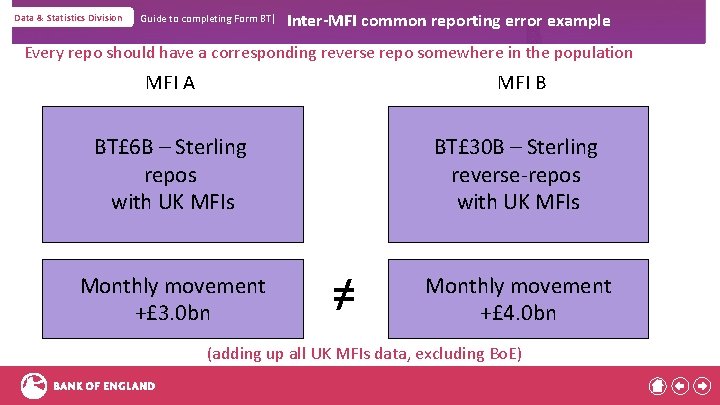
Data & Statistics Division Guide to completing Form BT| Inter-MFI common reporting error example Every repo should have a corresponding reverse repo somewhere in the population MFI A MFI B BT£ 6 B – Sterling repos with UK MFIs BT£ 30 B – Sterling reverse-repos with UK MFIs Monthly movement +£ 3. 0 bn Monthly movement +£ 4. 0 bn ≠ (adding up all UK MFIs data, excluding Bo. E)
Data & Statistics Division Guide to completing Form BT Common Reporting Issues Inter-MFI difference • Bank holding companies: These should be classified as other financial corporations rather than MFIs. • Subsidiaries These should be classified as other financial corporations rather than MFIs. • Misclassification of the residency of counterparties Where a transaction is with a non-resident company, rather than the UK branch of that MFI, this should be recorded in the corresponding non-res line. • To check: Bank of England list of UK MFIs • We always make sure we have permission before discussing these transactions with the other reporter.
Data & Statistics Division Guide to completing Form BT Common Reporting Issues Public sector data The Bank of England export these data to the ONS 11 working days after month end. The ONS publishes UK Public Sector Finance data on 14 working days after month end. As this is a relatively quick turnaround, we need to ensure counterparties are classified correctly.
Data & Statistics Division Guide to completing Form BT Common Reporting Issues Public sector classifications Network Rail – reclassified to Central Government w. e. f. July 2015, Northern Rock Asset Management and Bradford and Bingley – both reclassified to Central Government w. e. f. October 2014, Transport for London – local authorities, Police authorities – local authorities, Fire services – local authorities, RBS and Lloyds – not classified as public sector for BT reporting because they are MFIs. Worked examples are available from the website see the ONS sector classification guide: https: //www. ons. gov. uk/methodology/classificationsandstandards/economicstatisticscl assifications/introductiontoeconomicstatisticsclassifications
Data & Statistics Division Guide to completing Form BT Common Reporting Issues Stock borrowing & lending (SBL) Several scenarios : • Only report as sale & repurchase agreements (in Form BT 6 and Form BT 30) if the collateral is cash and there is a firm commitment to repurchase, • If there is not a firm commitment to repurchase, SBL deals with cash collateral should be reported as outright transactions in the underlying security (affecting Form BT 32), • If no cash involved and securities are exchanged for other securities then no impact on balance sheet. For example FLS should not show on Form BT.
Data & Statistics Division Guide to completing Form BT Common Reporting Issues Loans and investments Loans should be reported at nominal value, Investments should generally be reported at market value (long positions net of short positions), If you are aware of any one-off revaluations of investments which are not reported at market value, please inform us.
Data & Statistics Division Guide to completing Form BT Common Reporting Issues Securitisations Securitised loans should remain on balance sheet for MFI reporting There are several BT boxes for positions relating to securitisation: • Loans securitised to SPVs (BT 29 DW/X, BT 29 EW/X), • Deposits from SPVs (BT 48 A/B), • Securities issued by SPVs (BTMEM 1/2), • Securities issued by SPVs and retained by the MFI (BT 32 HS), And as securitised loans remain on balance sheet for reporting purposes, there needs to be an offsetting liability created so that the balance sheet balances – and this should be reported in deposits from other UK residents (BT 2 H/BT 3 H). Worked examples are available from the website see: SPV worked examples
Data & Statistics Division Guide to completing Form BT Common Reporting Issues Non-resident custody holdings If your institution holds any instruments in custody for non-residents these should be reported in Form BT Appendix, Exclude items placed by clearing systems or other custodians if the residency of the ultimate owner is unknown. Include if the ultimate owner is known to be non-resident.
Data & Statistics Division Guide to completing Form BT Common Reporting Issues Form Reconciliations Because of the scope of Form BT, it reconciles with several other forms including: • Form AD/AL and Form BE which offer industrial/sectoral expansion on boxes relating to other UK residents (see next slide), • Form GT is a direct breakdown of BT 32 D and BT 26 A, • Form BN is a direct breakdown of BT boxes concerning non-residents, • Form PB corresponds with the BT public sector boxes for those that report it, • Form PL has some corroborations with Form BT, notably in line 19, • These are identified where relevant in the BT definitions.
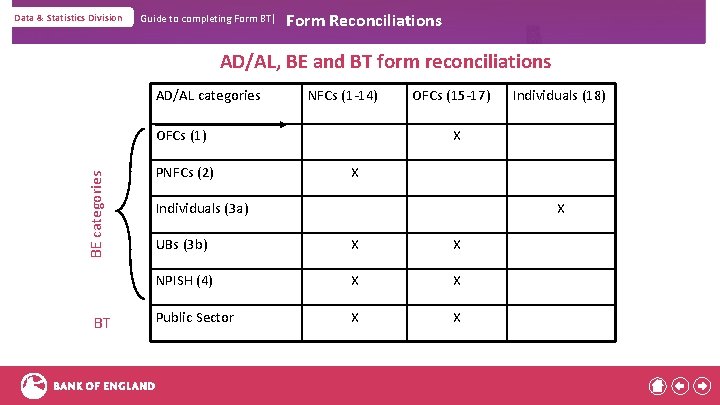
Data & Statistics Division Guide to completing Form BT| Form Reconciliations AD/AL, BE and BT form reconciliations AD/AL categories NFCs (1 -14) BE categories OFCs (1) BT PNFCs (2) OFCs (15 -17) Individuals (18) X X Individuals (3 a) X UBs (3 b) X X NPISH (4) X X Public Sector X X
Data & Statistics Division Guide to completing Form BT Reporting deadlines for monthly forms PB (For reporters submitting a BT later than +9) Working days in the month 6 7 BT BT Public Sector embargo 8 9 BE Bankstats, Money and Credit release GT Embargo (For PB reporters) 10 AD BN AL 11 12 IS 13 IC 14 IO 15 ER LN 16 17 VP 18 19 20 WO 21
Data & Statistics Division Guide to completing Form BT BT definitions Resources General notes and definitions Classification of Accounts guide (residency guidance) SPV worked examples
Data & Statistics Division Guide to completing Form BT Contacts Monetary Statistics queries dsd_ms@bankofengland. co. uk DSD MCG Balance Sheets – DSD-MCG-Balance. Sheets@bankofengland. co. uk
- Slides: 27