
Data smoothing Raymond Cuijpers Index The moving average
- Slides: 15
Data smoothing Raymond Cuijpers
Index • • • The moving average Convolution The difference operator Fourier transforms Gaussian smoothing Butterworth filters
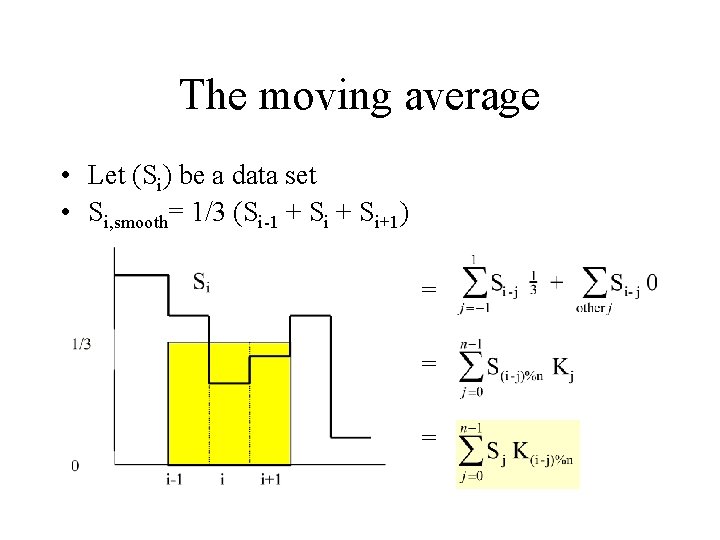
The moving average • Let (Si) be a data set • Si, smooth= 1/3 (Si-1 + Si+1) = = =
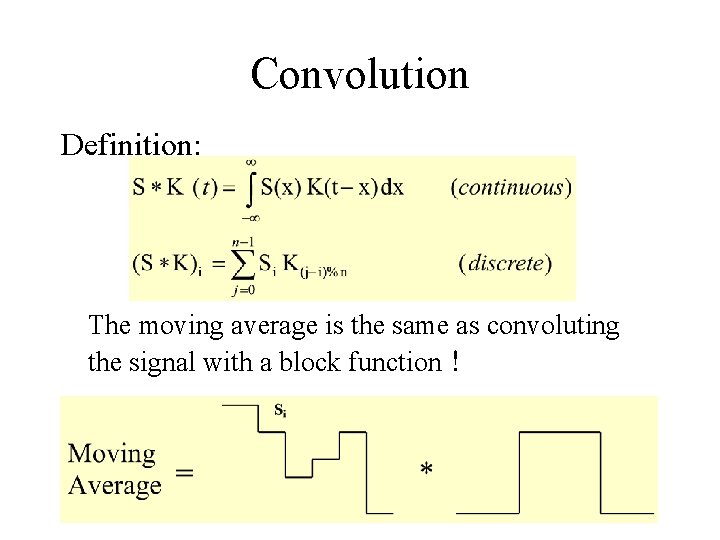
Convolution Definition: The moving average is the same as convoluting the signal with a block function !
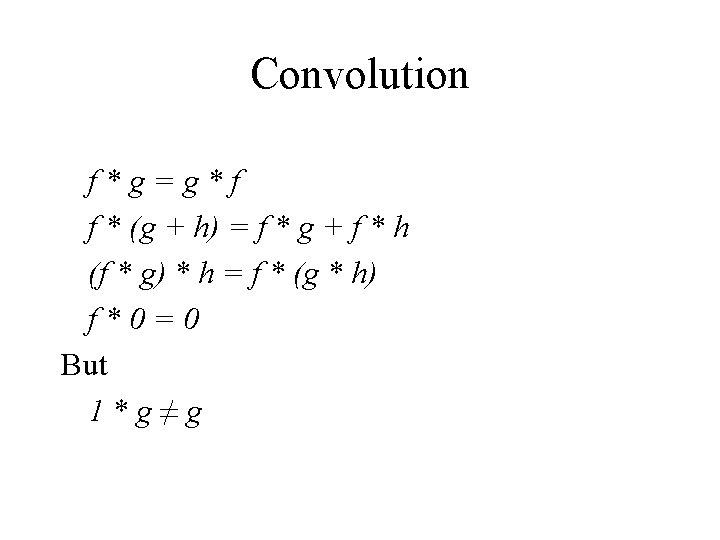
Convolution f*g=g*f f * (g + h) = f * g + f * h (f * g) * h = f * (g * h) f*0=0 But 1*g≠g
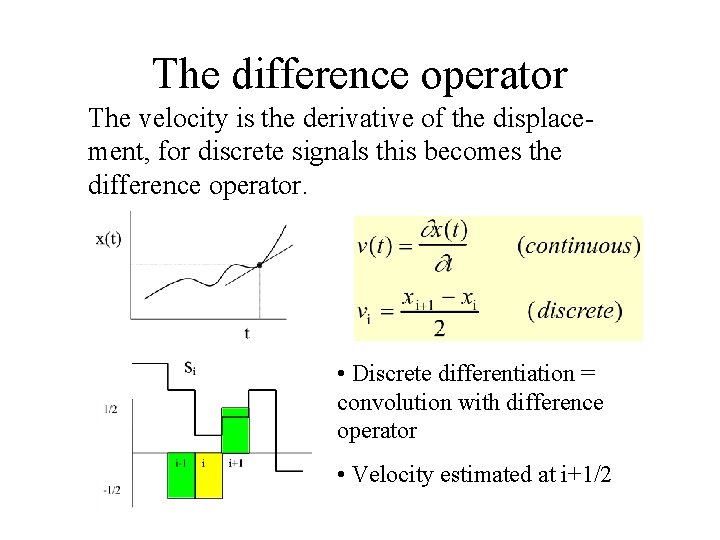
The difference operator The velocity is the derivative of the displacement, for discrete signals this becomes the difference operator. • Discrete differentiation = convolution with difference operator • Velocity estimated at i+1/2
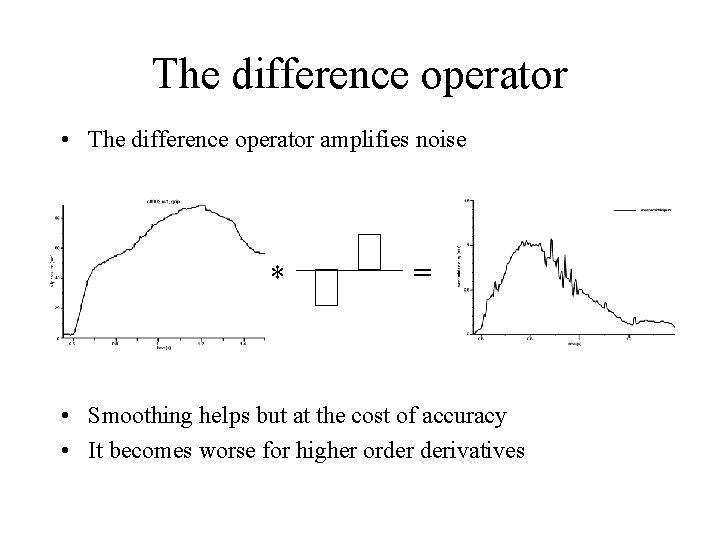
The difference operator • The difference operator amplifies noise * = • Smoothing helps but at the cost of accuracy • It becomes worse for higher order derivatives
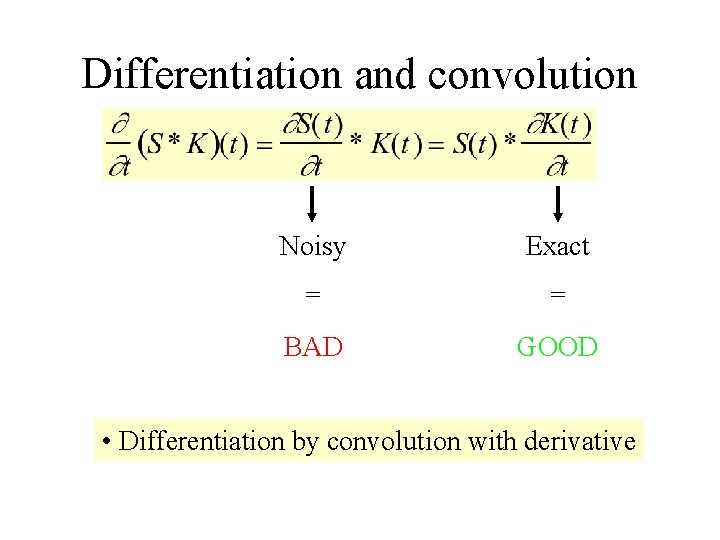
Differentiation and convolution Noisy Exact = = BAD GOOD • Differentiation by convolution with derivative
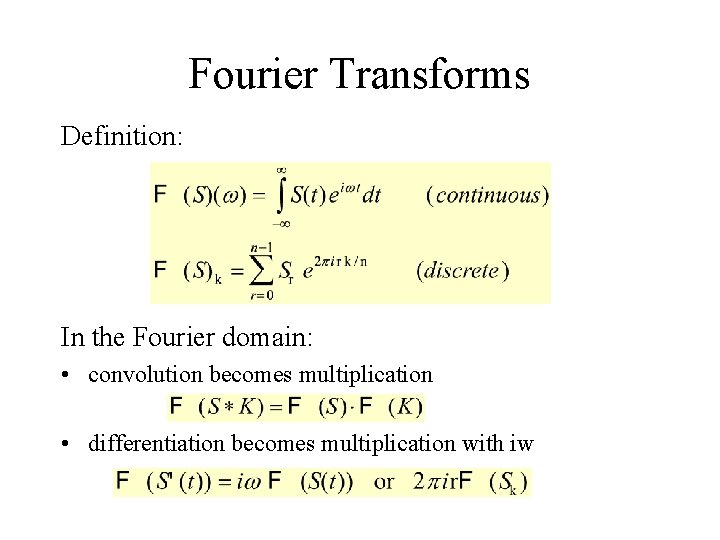
Fourier Transforms Definition: In the Fourier domain: • convolution becomes multiplication • differentiation becomes multiplication with iw
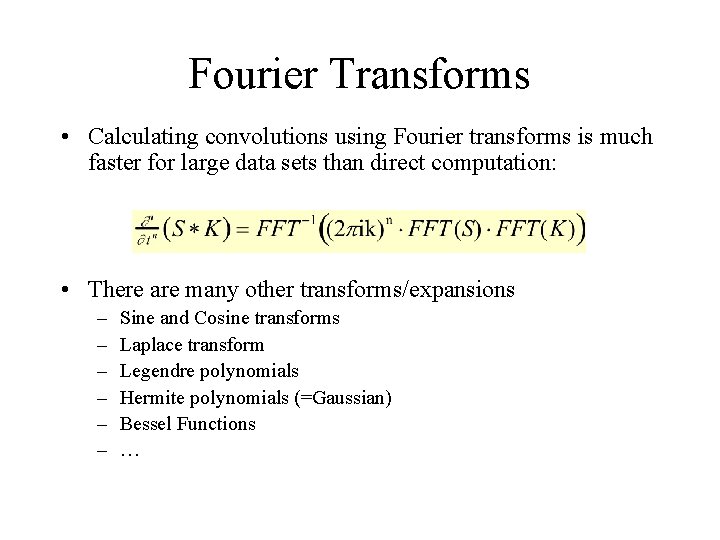
Fourier Transforms • Calculating convolutions using Fourier transforms is much faster for large data sets than direct computation: • There are many other transforms/expansions – – – Sine and Cosine transforms Laplace transform Legendre polynomials Hermite polynomials (=Gaussian) Bessel Functions …
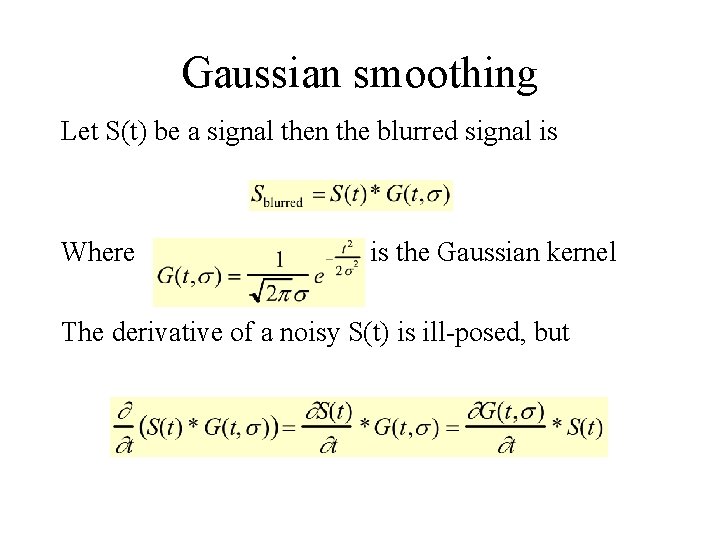
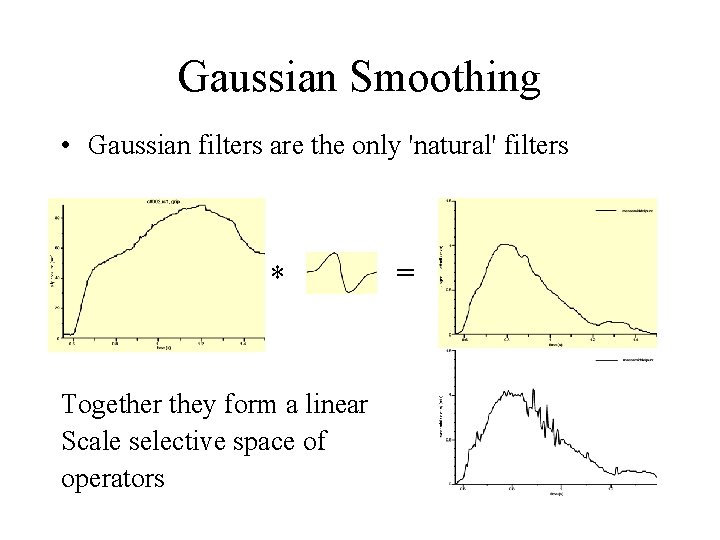
Gaussian smoothing Let S(t) be a signal then the blurred signal is Where is the Gaussian kernel The derivative of a noisy S(t) is ill-posed, but
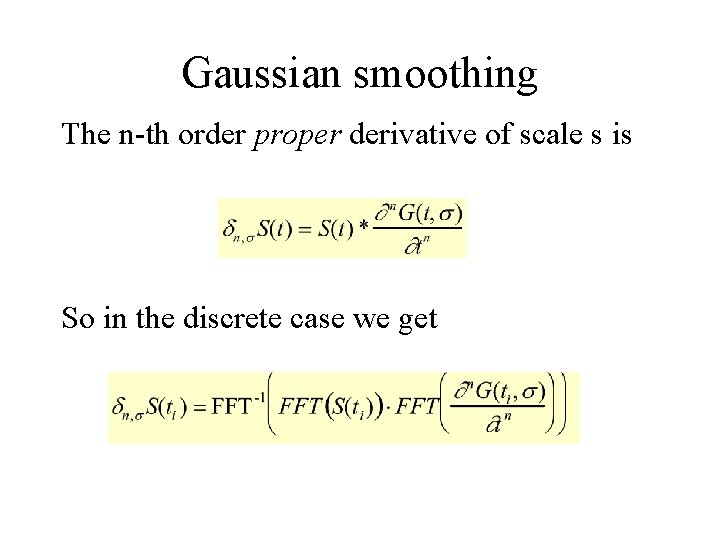
Gaussian smoothing The n-th order proper derivative of scale s is So in the discrete case we get
Gaussian Smoothing • Gaussian filters are the only 'natural' filters * Together they form a linear Scale selective space of operators =
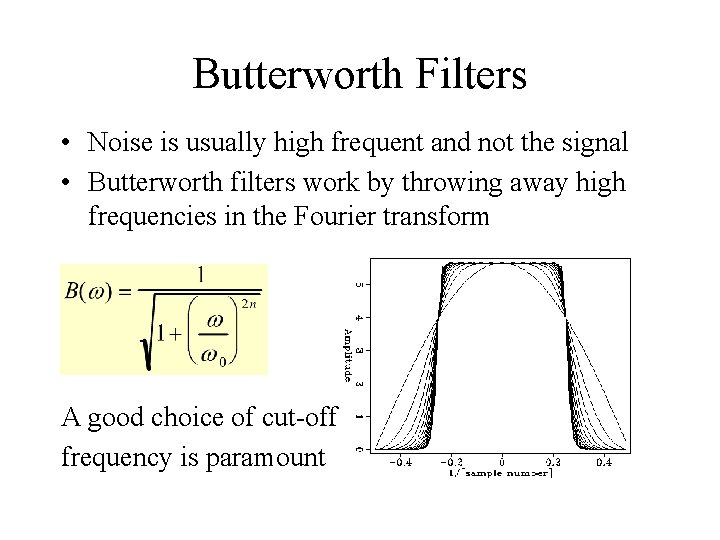
Butterworth Filters • Noise is usually high frequent and not the signal • Butterworth filters work by throwing away high frequencies in the Fourier transform A good choice of cut-off frequency is paramount
Butterworth filters Advantage: • Easy to implement in electronic circuit Disadvantage: • Introduces a phase shift. Solution is to apply it twice in opposite directions • 'Ringing': jumps in the signal produces oscillations • Depends strongly on the nature of the noise and the choice of cut-off frequency