
Data Science Challenges and Directions By Longbing Lao
Data Science: Challenges and Directions By Longbing Lao ANDREAS IOANNOU & GIORGOS MOLESKIS
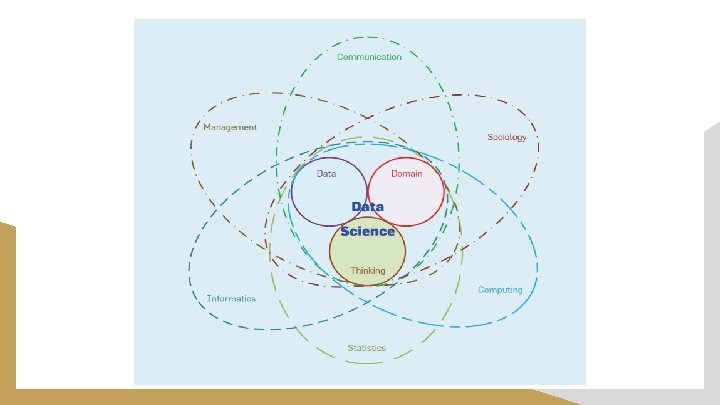
INTRODUCTION ● Data Science ● Observations concerning big data and the data science in: ○ Statistics ○ Computing ○ Informatics ○ Social Science ○ Business management ● Complexities and intelligence hidden in complex data science problems ● Research issues and methodologies needed to develop data science from a complex-system perspective
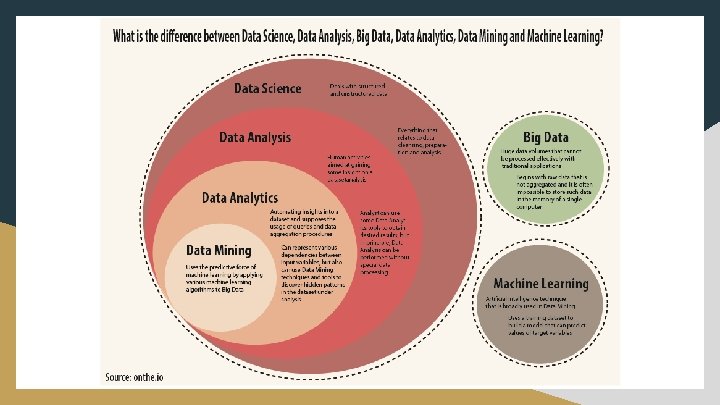
What is Data Science ● Originated from statistics and mathematics ● Expanded to data mining and machine learning ● Understanding of complex data and related business problems ● Translate data into insight and intelligence for decision making ● Data science problems are complex systems

X-Complexities in Data Science Comprehensive system complexities ● Data ○ Large scale, high dimensionality, real time interaction and processing, noise mixed with data, unclear structures ○ Wrongly targeted participants, low response rate, questions unanswered ○ Data-driven discovery ● Behavior ○ Business activities ○ Semantics and processes ○ Behavioral subjects and objects ○ Connection to physical world
X-Complexities in Data Science Comprehensive system complexities ● Domain ○ Discovering important data characteristics value, and actionable insight. ○ Domain knowledge, domain factors, domain processes, human-machine synthesis, and roles and leadership in the domain ● Social ○ In business activity and its related data ○ social networking, social media, group interaction and collaboration, economic and cultural factors, social norms, emotion, sentiment and opinion influence processes, and social issues ● Environment ○ Complex contextual interactions between the business environment and data systems
X-Complexities in Data Science Comprehensive system complexities ● Learning ○ Handle data, domain, behavioral, social, and environmental complexity. ○ Heterogeneous sources and inputs, parallel and distributed inputs, and their infinite dynamics in real time ○ Learn non-IID data-mixing coupling relationships with heterogeneity ● Deliverable-product ○ Must satisfy and have Actionable insight for business ○ Must be easy to understand interpretable by non professionals, revealing insights to business users ○ Designing the appropriate evaluation, presentation, visualization, refinement, and prescription of learning outcomes and deliverables to satisfy diverse business needs, stakeholders
X-Intelligence in Data Science Transform data into knowledge, intelligence, and wisdom Transformation, comprehensive intelligence ● Data ● ○ Valuable information about business problems ○ Understand data characteristics and complexities. ○ Deeply understand represent data characteristics and complexities Behavior ○ Activities, processes, dynamics, impact, behavior and business quantifiers of owners, users in the physical world ○ Bridge the gap between the data world and the physical world ○ Understanding robot's behavior

X-Intelligence in Data Science ● Domain ○ Domain factors, Knowledge associated with a problem and its target data ○ Deep understanding of domain complexities => Can help discover unknown knowledge and actionable insight ● Human ○ Human intuition, imagination, empirical knowledge, belief ○ Intention, expectation, runtime supervision, evaluation ○ Emotional intelligence, inspiration, brainstorming ● Network ○ Web intelligence and broad-based networking and connected activities and resources ○ Example: crowdsourcing-based open source system development and algorithm design
X-Intelligence in Data Science ● Organizational ○ Organizational goals, actors, and roles, structures, behaviors, evolution and dynamics, ○ For example, the cost effectiveness of enterprise analytics and functioning of data science teams rely on organizational intelligence. ● Social ○ ○ Social interactions, group goals and intentions Social cognition, emotional intelligence Group decision making Interactions among social systems as business rules, law, trust, reputation ● Environmental ○ Hidden in data science problems ■ Underlying domain and related organizational, social, human, and network intelligence ○ Interactions between the world of transformed data and the physical world functioning as the overall data environment.
Known-to-Unknown Transformation ● “We know there are some things we do not know” ● Understand known to unknown complexities in order to transform data into knowledge, intelligence, and insight for decision taking(CKI) ● Knowledge = processed information
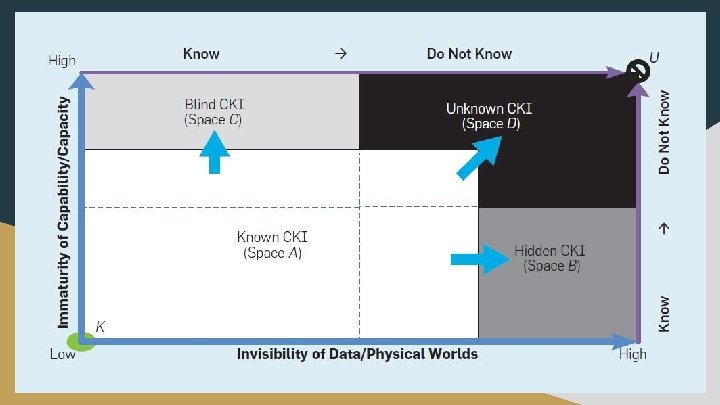
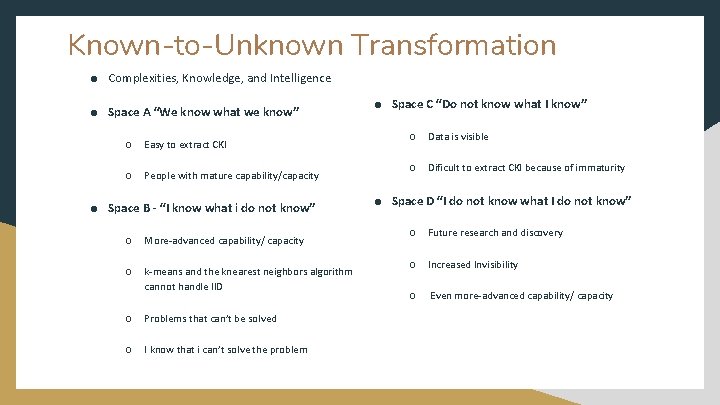
Known-to-Unknown Transformation ● Complexities, Knowledge, and Intelligence ● Space A “We know what we know” ○ Easy to extract CKI ○ People with mature capability/capacity ● Space B - “I know what i do not know” ○ More-advanced capability/ capacity ○ k-means and the knearest neighbors algorithm cannot handle IID ○ Problems that can’t be solved ○ I know that i can’t solve the problem ● Space C “Do not know what I know” ○ Data is visible ○ Dificult to extract CKI because of immaturity ● Space D “I do not know what I do not know” ○ Future research and discovery ○ Increased Invisibility ○ Even more-advanced capability/ capacity
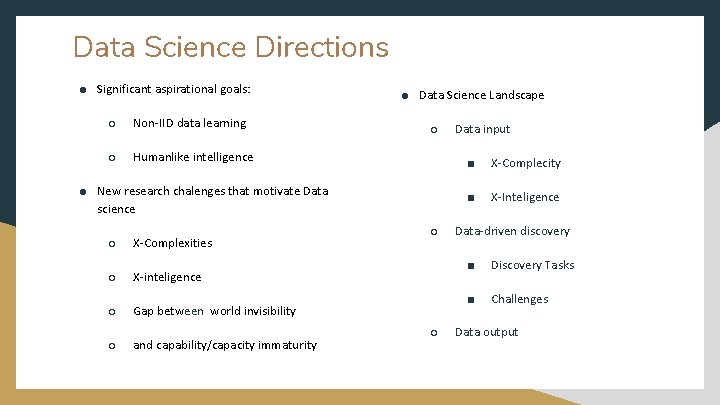
Data Science Directions ● Significant aspirational goals: ○ Νon-IID data learning ○ Ηumanlike intelligence ● Data Science Landscape ○ ● New research chalenges that motivate Data science ○ X-Complexities ○ X-inteligence ○ Gap between world invisibility ○ and capability/capacity immaturity ○ ○ Data input ■ X-Complecity ■ X-Inteligence Data-driven discovery ■ Discovery Tasks ■ Challenges Data output
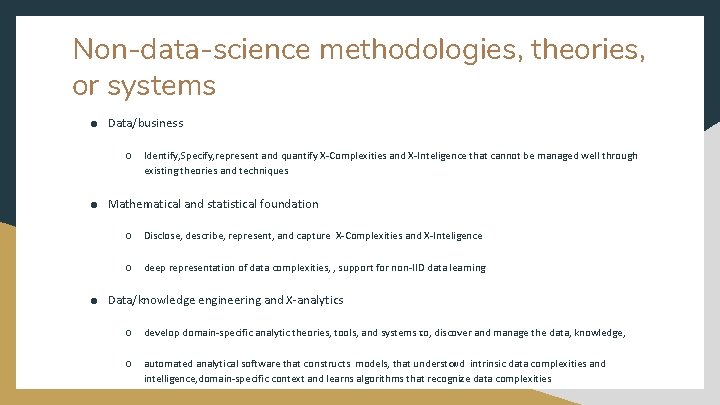
Non-data-science methodologies, theories, or systems ● Data/business ○ Identify, Specify, represent and quantify X-Complexities and X-Inteligence that cannot be managed well through existing theories and techniques ● Mathematical and statistical foundation ○ Disclose, describe, represent, and capture X-Complexities and X-Inteligence ○ deep representation of data complexities, , support for non-IID data learning ● Data/knowledge engineering and X-analytics ○ develop domain-specific analytic theories, tools, and systems το, discover and manage the data, knowledge, ○ automated analytical software that constructs models, that understανd intrinsic data complexities and intelligence, domain-specific context and learns algorithms that recognize data complexities
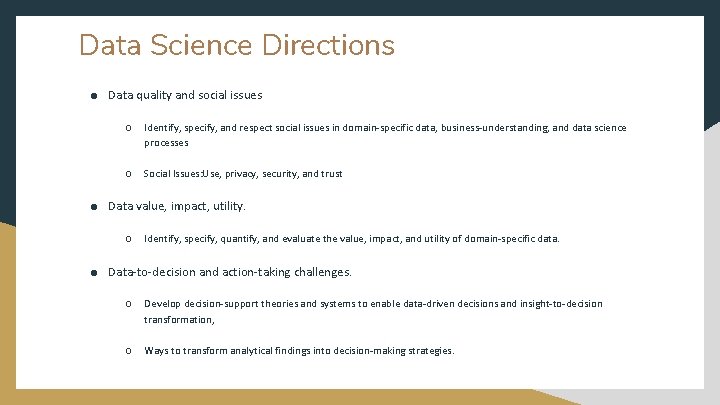
Data Science Directions ● Data quality and social issues ○ Identify, specify, and respect social issues in domain-specific data, business-understanding, and data science processes ○ Social Issues: Use, privacy, security, and trust ● Data value, impact, utility. ○ Identify, specify, quantify, and evaluate the value, impact, and utility of domain-specific data. ● Data-to-decision and action-taking challenges. ○ Develop decision-support theories and systems to enable data-driven decisions and insight-to-decision transformation, ○ Ways to transform analytical findings into decision-making strategies.
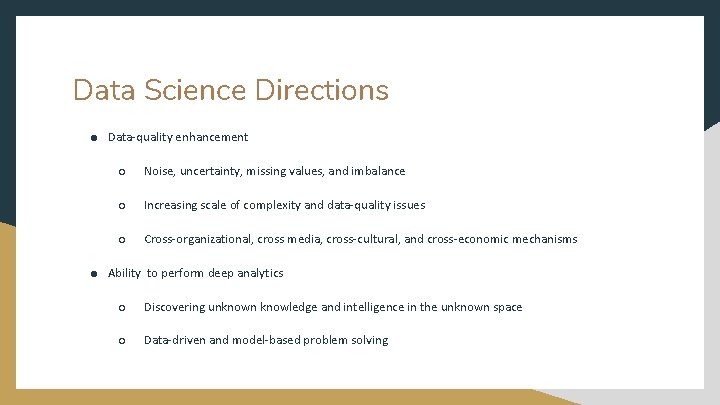
Data Science Directions ● Data-quality enhancement ○ Noise, uncertainty, missing values, and imbalance ○ Increasing scale of complexity and data-quality issues ○ Cross-organizational, cross media, cross-cultural, and cross-economic mechanisms ● Ability to perform deep analytics ○ Discovering unknown knowledge and intelligence in the unknown space ○ Data-driven and model-based problem solving
Data Science Directions ● X-complexity and X-intelligence ○ Simulate the complexities, intelligence, working mechanisms, processes ○ Big-data analytics ■ High-performance processing and analytics ■ Large-scale, real-time, online, high-frequency ■ New distributed, parallel, high-performance infrastructure ■ Batch, array, memory, disk, and cloud-based processing and storage, data-structure and -management systems, and data to-knowledge management. ● Another important issue for developers of data systems is how to support the networking, communication, and interoperation of the various data science roles within a distributed data science team.
Violating assumptions in data science. ● Violated assumptions lead to inaccurate, distorted, or misleading results. ● Many complex problems include complex coupling, relationships, distributions, formats, types and variables, and unstructured and weakly structured data. ● Detection and verification of validations is limited ● Tools to manage and circumvent assumption violations in big data.
IID assumption Violation ● Big, complex data (referring to objects, attributes, and values ) is essentially non-IID ● Most existing analytical methods are IID that ignores or simplifies all these properties ● Learning visible and especially invisible non-IIDness => deep understanding of data with weak and/or unclear structures, distributions, relationships, and semantics. ● Individual learners cannot tell the whole story due to their inability to identify such complex non. IIDness. ● Effectively learning the widespread, visible, and invisible non-IIDness of big data=> complete picture of an underlying business problem.
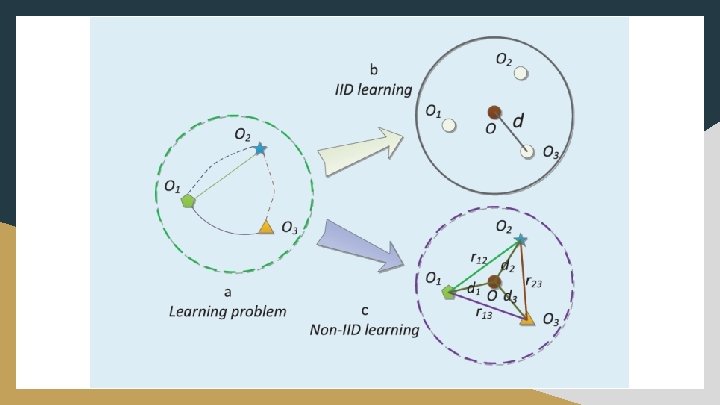
Non-IIDness and non. IID data learning ● Deep understanding of non-IID data characteristics. ○ Identify, specify, and quantify non-IID data characteristics, factors, types, and levels of non-IIDness in data and business ○ Identify the difference between what can be captured and what cannot be captured through existing technologies ● Non-IID feature analysis and construction ○ invent new theories and tools for analyzing feature relationships ● Non-IID learning theories, algorithms, and models ○ Analyzing, learning, and mining ● Non-IID similarity and evaluation metrics ○ Similarity and dissimilarity learning methods and metrics
Data characteristics and X-complexities. Understanding data characteristics and X-complexities challenges and directions ● Data characteristics and X-complexities ○ assume data characteristics and X-complexities determine the values, complexities, and quality of data driven discovery. ● Understanding data characteristics and X-complexities ○ Definition of data characteristics and x complexities ○ Represent and model data characteristics and x complexities ○ Data understanding, analysis, learning and management ○ Evaluate the quality of data
Data-brain and human like machine intelligence ● Curiosity ○ Imagination, reasoning, aggregation, creativity ○ Experience, exploration, learning, and reflection ○ Create machines that generate, retain, and simulate human curiosity through learning ● Imaginative thinking ○ Intuitive, creative, evolving, and uncertain ○ Transform logic and patterns into human like data systems ○ Machines to simulate human imagination ○ Cognitive science, social science, data science, and intelligence science ● Discovery ○ Synthesizing comprehensive data, information, knowledge, and intelligence through cognitive-processing methods and processes
Complex Systems ● Large-scale data objects ● Data from online, business, mobile, or social networks ● Human involvement ● Domain constraints, ● Societal characteristics, ● Uncertainty
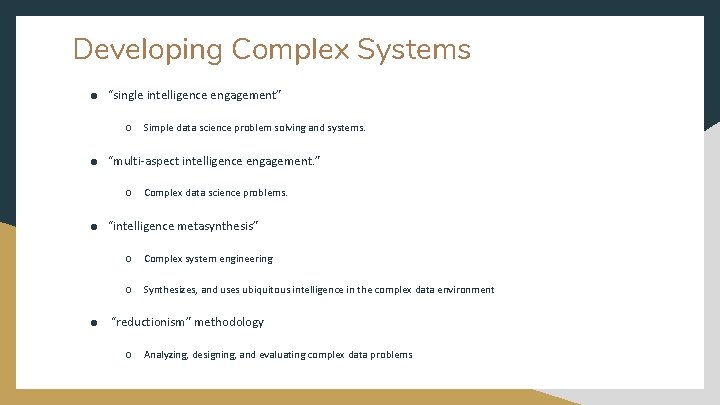
Developing Complex Systems ● “single intelligence engagement” ○ Simple data science problem solving and systems. ● “multi-aspect intelligence engagement. ” ○ Complex data science problems. ● “intelligence metasynthesis” ○ Complex system engineering ○ Synthesizes, and uses ubiquitous intelligence in the complex data environment ● “reductionism” methodology ○ Analyzing, designing, and evaluating complex data problems
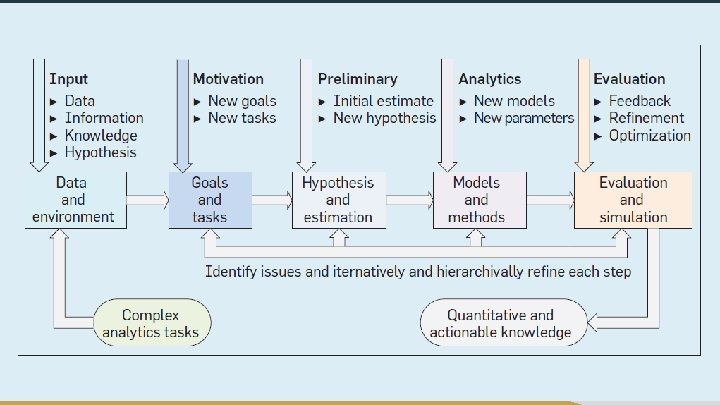
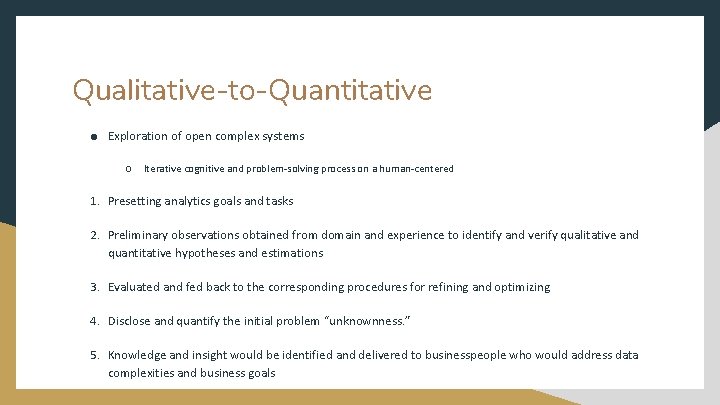
Qualitative-to-Quantitative ● Exploration of open complex systems ○ Iterative cognitive and problem-solving process on a human-centered 1. Presetting analytics goals and tasks 2. Preliminary observations obtained from domain and experience to identify and verify qualitative and quantitative hypotheses and estimations 3. Evaluated and fed back to the corresponding procedures for refining and optimizing 4. Disclose and quantify the initial problem “unknownness. ” 5. Knowledge and insight would be identified and delivered to businesspeople who would address data complexities and business goals
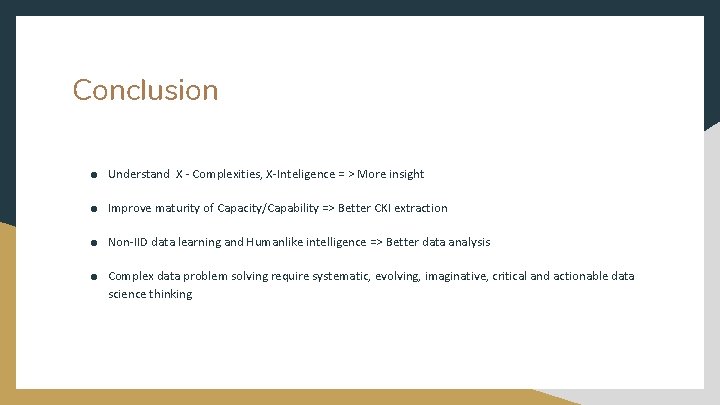
Conclusion ● Understand X - Complexities, X-Inteligence = > More insight ● Improve maturity of Capacity/Capability => Better CKI extraction ● Νon-IID data learning and Ηumanlike intelligence => Better data analysis ● Complex data problem solving require systematic, evolving, imaginative, critical and actionable data science thinking
Thank you for your attention ! Questions?
- Slides: 31