
Data Preparation for Using the ROLO GIRO Model


- Slides: 4
Data Preparation for Using the ROLO / GIRO Model Objectives of the session, and topics for presentation and discussion: • Methods for measuring lunar irradiance from images ― to identify potential sources of error ― covering all aspects of lunar irradiance measurements from images • Comparisons of lunar irradiance measurements to model outputs ― individually, for each instrument ― collectively, to identify common characteristics that may indicate potential errors in the lunar model • New developments toward advancing lunar models for a calibration reference
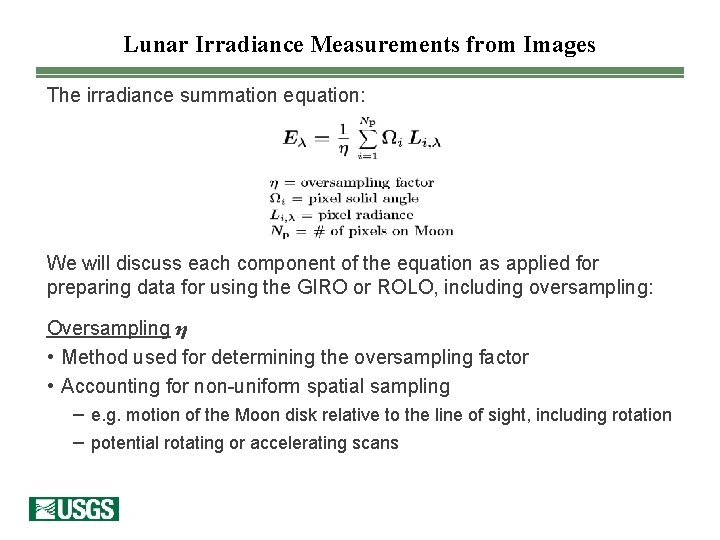
Lunar Irradiance Measurements from Images The irradiance summation equation: We will discuss each component of the equation as applied for preparing data for using the GIRO or ROLO, including oversampling: Oversampling η • Method used for determining the oversampling factor • Accounting for non-uniform spatial sampling ― e. g. motion of the Moon disk relative to the line of sight, including rotation ― potential rotating or accelerating scans
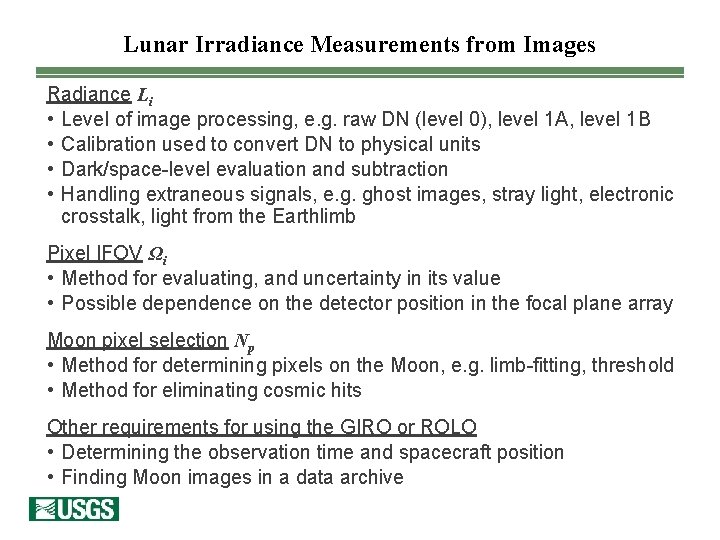
Lunar Irradiance Measurements from Images Radiance Li • Level of image processing, e. g. raw DN (level 0), level 1 A, level 1 B • Calibration used to convert DN to physical units • Dark/space-level evaluation and subtraction • Handling extraneous signals, e. g. ghost images, stray light, electronic crosstalk, light from the Earthlimb Pixel IFOV Ωi • Method for evaluating, and uncertainty in its value • Possible dependence on the detector position in the focal plane array Moon pixel selection Np • Method for determining pixels on the Moon, e. g. limb-fitting, threshold • Method for eliminating cosmic hits Other requirements for using the GIRO or ROLO • Determining the observation time and spacecraft position • Finding Moon images in a data archive
Part 2: Lunar Model Development • Current status of ROLO and its future development at USGS • Validation against ROLO: the GIRO benchmark ― currently in development phase ― to be used by GSICS lunar model developers • New models developed using recent lunar measurements ― including radiance models