
Data on educational qualification in national and crossnational





- Slides: 22
Data on educational qualification in national and cross-national research Professor Vernon Gayle University of Stirling & ISER University of Essex Cross-Nationally Comparative Social Survey Research 24 th June 2009, Cologne 1
Structure of this Talk 1. Introduction 2. Social Survey Datasets 3. Analysing Social Survey Data 4. Issues Associated with Measures of Educational Qualifications – – 5. Example from England & Wales Example of Harmonisation Conclusion 2
Measuring Educational Qualifications “the question of how to measure education and qualifications – or indeed what ‘measure’ means – raises interesting issues…Since there is no agreed standard way of categorising educational qualifications” (Prandy, Unt & Lambert 2004) 3
Educational Qualifications: • Educational qualifications are a key social science measure included in an extremely wide variety of substantive analyses • Qualifications as an explanatory (X) variable: Qualification level is frequently used in statistical analyses as a key explanatory variable (usually with a number of other explanatory variables) This is usual in areas such as sociology, social policy and economics 4
Educational Qualifications: • Educational qualifications as an outcome (Y) variable: In more specialist studies an educational measure is itself of interest as an outcome (for example gaining a specific qualification or level of attainment) This is common in educational studies and within the sociology of education 5
Concepts and Measures MEASURE e. g. qualifications CONCEPT e. g. “ability” 6
Survey Datasets: Educational • Specialist comparative educational datasets – (most notably PISA – Programme for International Student Assessment) • National datasets – Specifically education oriented • Norwegian Youth Survey; Scottish Young People’s Survey - Hammer & Furlong 1996) – More general datasets on children and young people • Birth cohort datasets - Stockholm birth cohort of 1953 and British National Child Development Study 1958 • Administrative – Common in the Nordic countries • Recent example - English National Pupils Database (NPD) 7
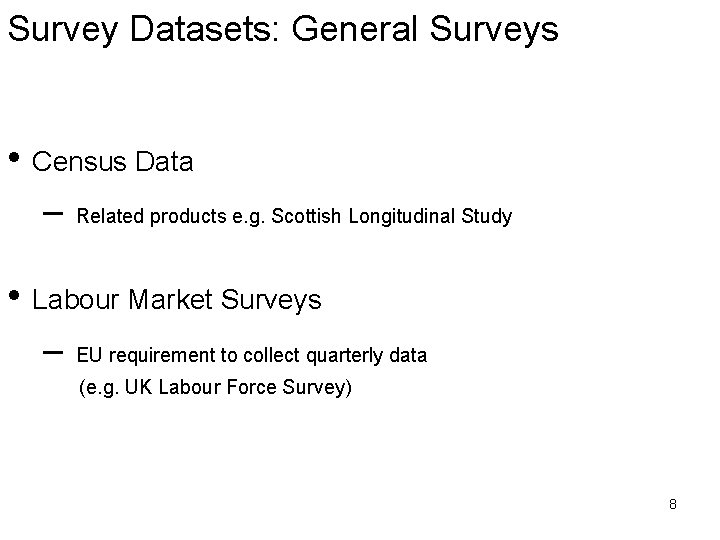
Survey Datasets: General Surveys • Census Data – Related products e. g. Scottish Longitudinal Study • Labour Market Surveys – EU requirement to collect quarterly data (e. g. UK Labour Force Survey) 8
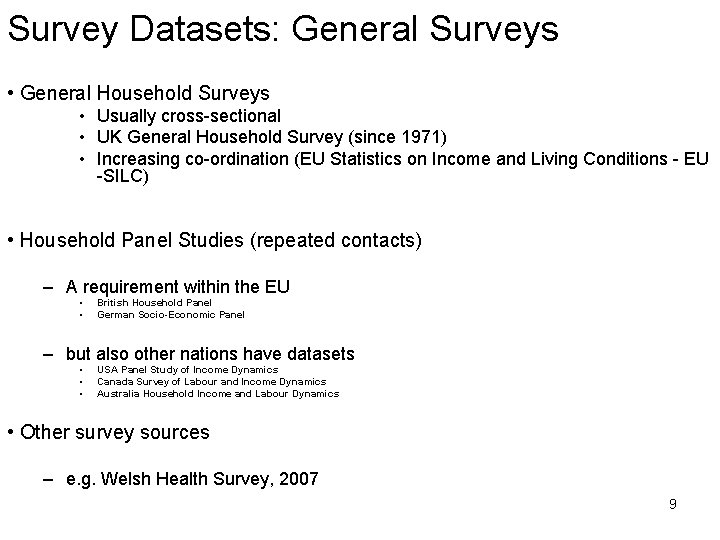
Survey Datasets: General Surveys • General Household Surveys • Usually cross-sectional • UK General Household Survey (since 1971) • Increasing co-ordination (EU Statistics on Income and Living Conditions - EU -SILC) • Household Panel Studies (repeated contacts) – A requirement within the EU • • British Household Panel German Socio-Economic Panel – but also other nations have datasets • • • USA Panel Study of Income Dynamics Canada Survey of Labour and Income Dynamics Australia Household Income and Labour Dynamics • Other survey sources – e. g. Welsh Health Survey, 2007 9
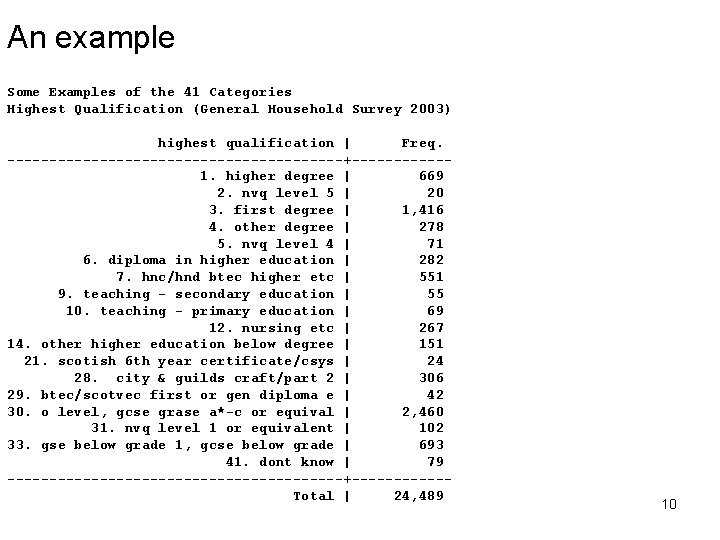
An example Some Examples of the 41 Categories Highest Qualification (General Household Survey 2003) highest qualification | Freq. --------------------+------1. higher degree | 669 2. nvq level 5 | 20 3. first degree | 1, 416 4. other degree | 278 5. nvq level 4 | 71 6. diploma in higher education | 282 7. hnc/hnd btec higher etc | 551 9. teaching - secondary education | 55 10. teaching - primary education | 69 12. nursing etc | 267 14. other higher education below degree | 151 21. scotish 6 th year certificate/csys | 24 28. city & guilds craft/part 2 | 306 29. btec/scotvec first or gen diploma e | 42 30. o level, gcse grase a*-c or equival | 2, 460 31. nvq level 1 or equivalent | 102 33. gse below grade 1, gcse below grade | 693 41. dont know | 79 --------------------+------Total | 24, 489 10
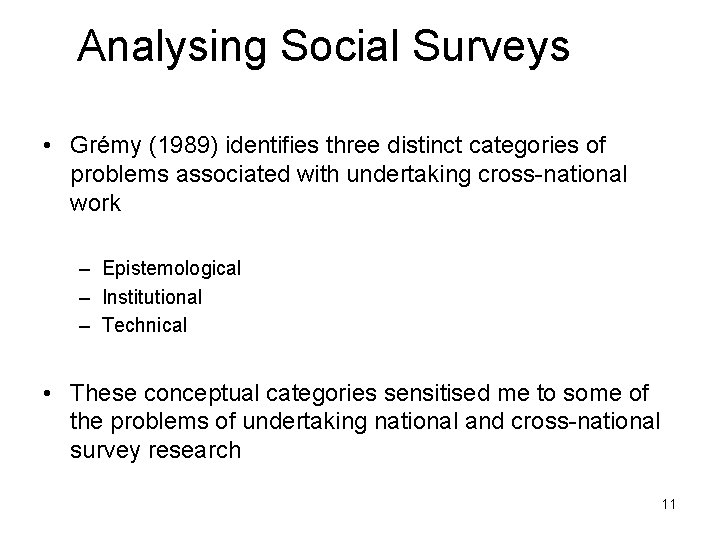
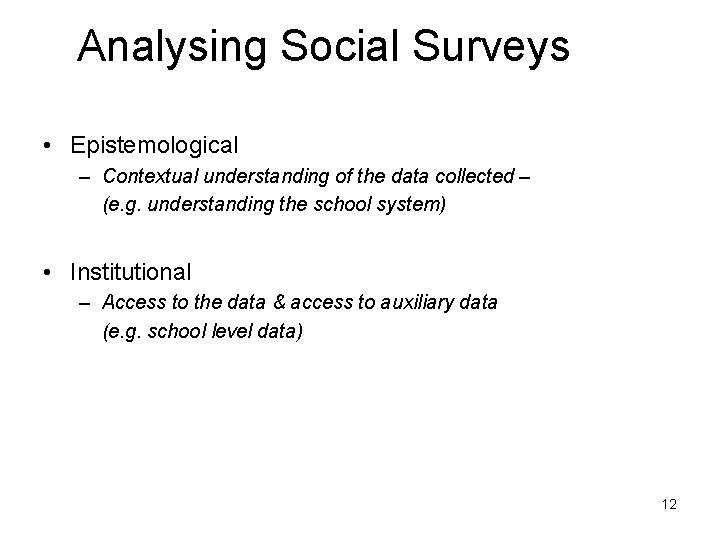
Analysing Social Surveys • Grémy (1989) identifies three distinct categories of problems associated with undertaking cross-national work – Epistemological – Institutional – Technical • These conceptual categories sensitised me to some of the problems of undertaking national and cross-national survey research 11
Analysing Social Surveys • Epistemological – Contextual understanding of the data collected – (e. g. understanding the school system) • Institutional – Access to the data & access to auxiliary data (e. g. school level data) 12
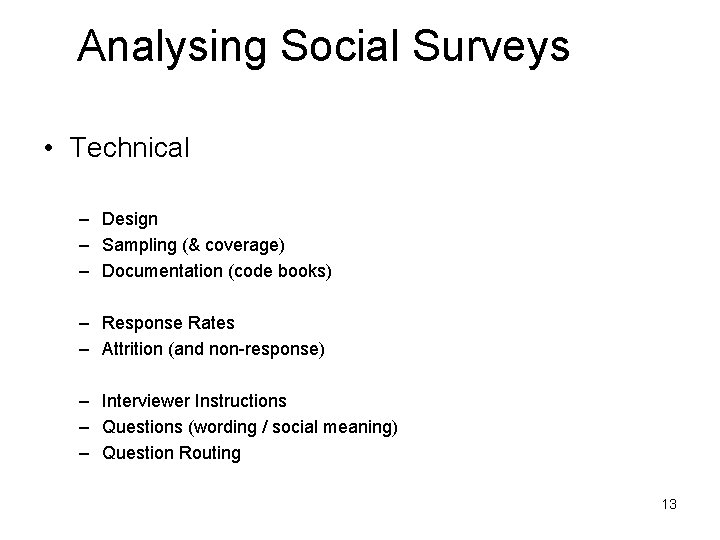
Analysing Social Surveys • Technical – Design – Sampling (& coverage) – Documentation (code books) – Response Rates – Attrition (and non-response) – Interviewer Instructions – Questions (wording / social meaning) – Question Routing 13
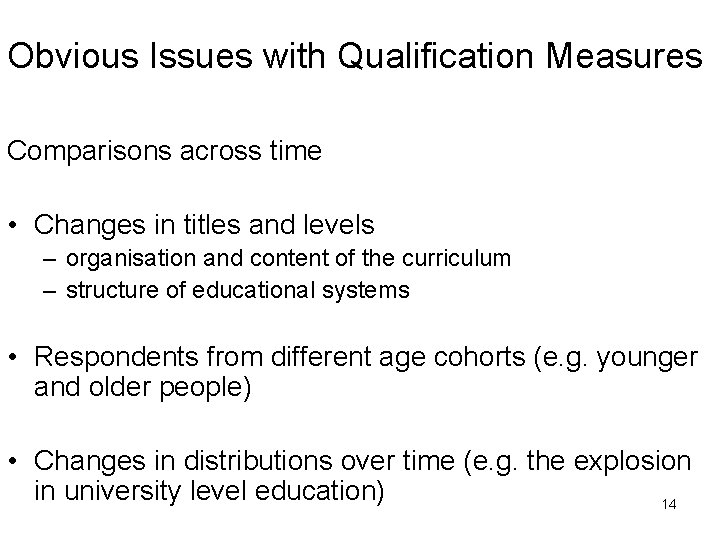
Obvious Issues with Qualification Measures Comparisons across time • Changes in titles and levels – organisation and content of the curriculum – structure of educational systems • Respondents from different age cohorts (e. g. younger and older people) • Changes in distributions over time (e. g. the explosion in university level education) 14
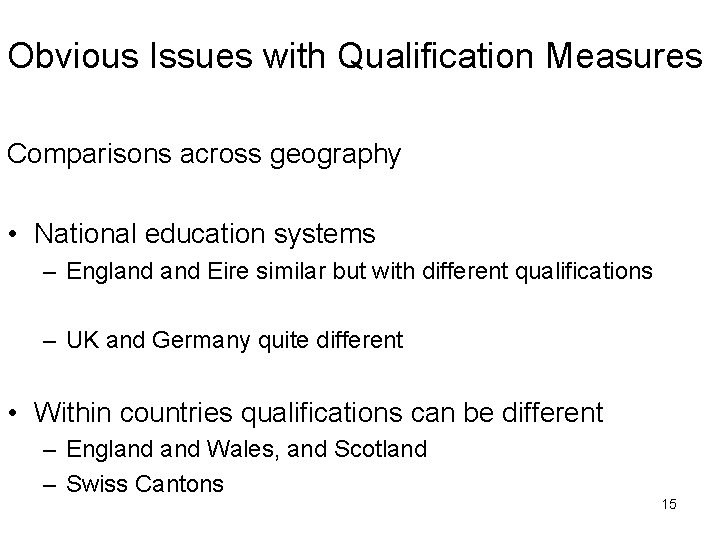
Obvious Issues with Qualification Measures Comparisons across geography • National education systems – England Eire similar but with different qualifications – UK and Germany quite different • Within countries qualifications can be different – England Wales, and Scotland – Swiss Cantons 15
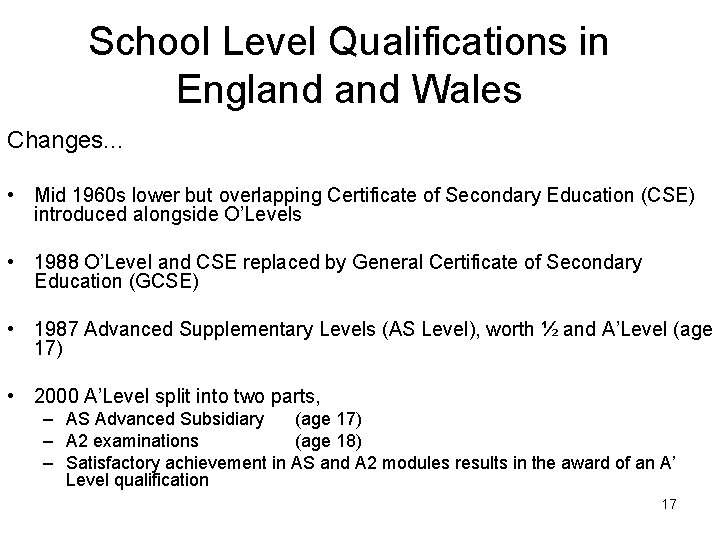
School Level Qualifications in England Wales • General Certificate of Education GCE • England Wales (Not Scotland) • Introduced in the 1950 s – Ordinary Level (O'Level) (age 16) – Advanced Level (A'Level) (age 18) • Some other related qualifications – AO Level - between O’Level and A’Level – S’Level, Scholarship level, or Special paper (more advanced) 16
School Level Qualifications in England Wales Changes. . . • Mid 1960 s lower but overlapping Certificate of Secondary Education (CSE) introduced alongside O’Levels • 1988 O’Level and CSE replaced by General Certificate of Secondary Education (GCSE) • 1987 Advanced Supplementary Levels (AS Level), worth ½ and A’Level (age 17) • 2000 A’Level split into two parts, – AS Advanced Subsidiary (age 17) – A 2 examinations (age 18) – Satisfactory achievement in AS and A 2 modules results in the award of an A’ Level qualification 17
School Level Qualifications in England Wales Therefore • Analysing English and Welsh social survey data with measures of school qualifications obtained over the last 50 years can be fraught • Problem is amplified in cross-national • In-depth knowledge of the education system is required • Beware this is a simple example of school-level qualifications – Even more complicated with post-school – Training & vocational qualifications 18
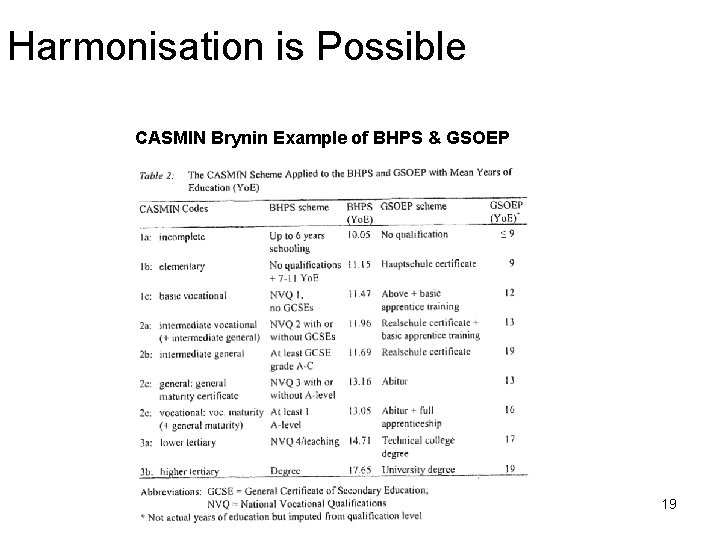
Harmonisation is Possible CASMIN Brynin Example of BHPS & GSOEP 19
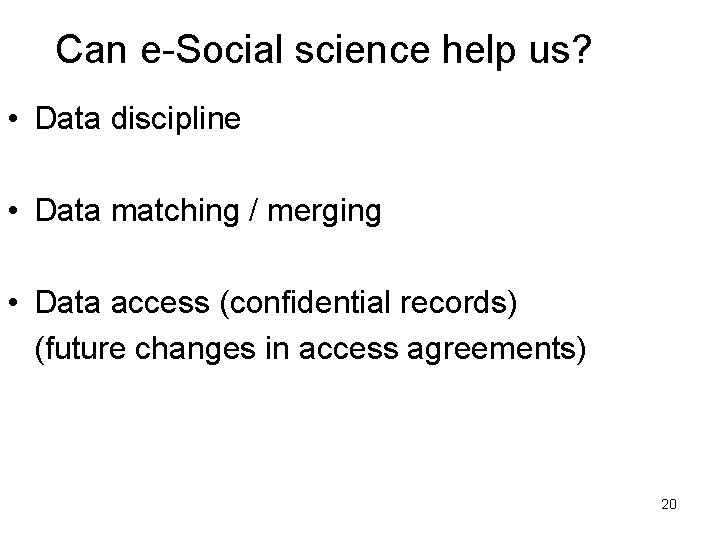
Can e-Social science help us? • Data discipline • Data matching / merging • Data access (confidential records) (future changes in access agreements) 20
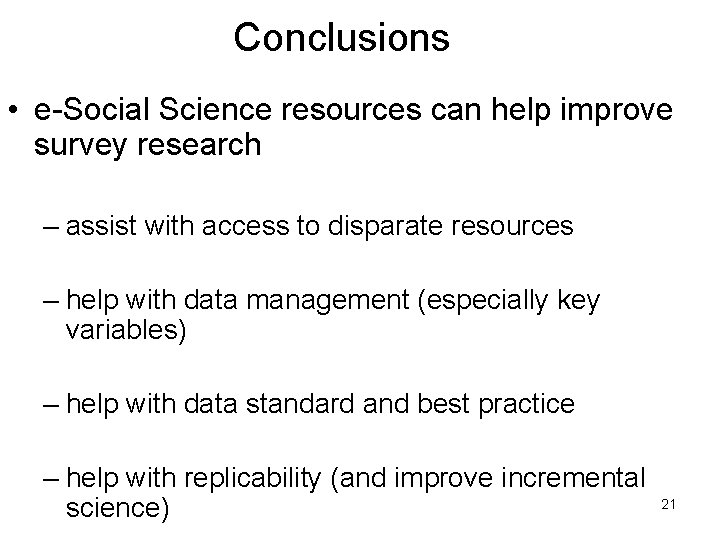
Conclusions • e-Social Science resources can help improve survey research – assist with access to disparate resources – help with data management (especially key variables) – help with data standard and best practice – help with replicability (and improve incremental science) 21
References Brynin, M. (2003) Using CASMIN: the effect of education on wages in Britain and Germany, in Hoffmeyer-Zlotnik, J. and Wolf, C. , Advances in Cross. National Comparison: A European Working Book for Demographic and Socio. Economic Variables, Kluwer: Amsterdam, 327 -44. Gremy, J-P. (1989) ‘Problemes de l'analyse secondaire’, in Girard, A. and Malinvaud, E. (eds) Les enquetes d'opinion et la rechearche en sciences socials, Paris: L'Harmattan. Hammer, T. and Furlong, A. (1996) “Staying on’: the effects of recent changes in educational participation for 17 -19 year olds in Norway and Scotland’, The Sociological Review, 44: 675 - 691. Prandy, K. , Unt, M. , & Lambert, P. S. (2004) ‘Not by degrees: Education and social reproduction in twentieth-century Britain’ Paper presented at the ISA RC 28 Research Committee on Social Stratification and Mobility. 22