
Data Mining with Weka Putting it all together



- Slides: 43
Data Mining with Weka Putting it all together TEAM MEMBERS: HAO ZHOU, YUJIA TIAN, PENGFEI GENG, YANQING ZHOU, YA LIU KEXIN LIU DIRECTOR: PROF. ELKE A. RUNDENSTEINER PROF. IAN H. WITTEN
Outline � 5. 1 The data mining process By Hao � 5. 2 Pitfalls and pratfalls By Yujia, Pengfei � 5. 3 Data mining and ethics By Yanqing � 5. 4 Summary By Ya, Kexin
5. 1 The data mining process By Hao
5. 1 The data mining process �Feel Lucky: �- Weka is not everything I need to talk about in my part (Know how rather than why to use Weka) �Maybe Not so Lucky: �- Talking about Weka is time- consuming. =)
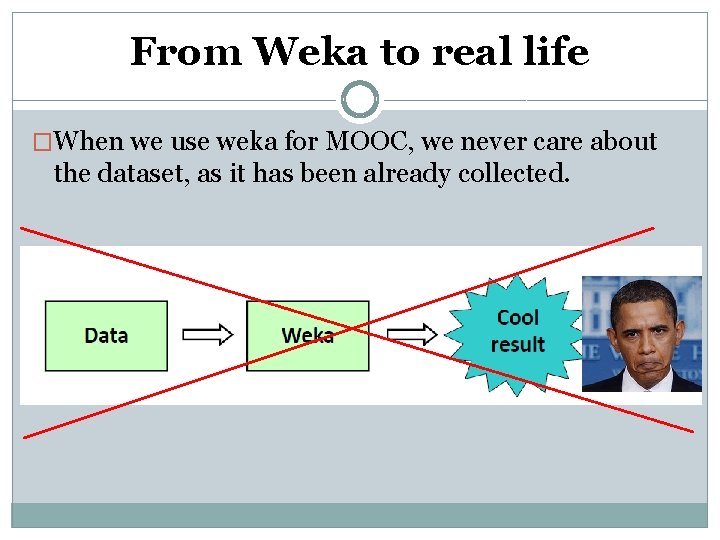
From Weka to real life �When we use weka for MOOC, we never care about the dataset, as it has been already collected.
Procedures in real life �Why we do data mining in real life? �- for course projects (This is my current situation) �- for solving real life problem �- for fun �- for … �Now, we have specified our “question[1]”, then what we do is to gather the data[2] we need.
Real life project �This summer vacation, I worked as volunteer programmer(no payment) for a start-up, whose objective is to provide article recommendations for developers[1]. �In this case, we must keep our database, which will index all the up-to-date articles we gather from the whole Internet(mongo. DB). �We use many ways to gather articles, and I just focused on one of them – Get articles links from influencers’ tweets through APIs.
Procedures in real life �Do all the links I gathered work? � - Never, even I wish they did � 1. Due to algorithm issue, some links I got are in bad format. � 2. Even links are correct, I cannot get articles from all links, as some of them are not links for articles. �[3. More problems after getting articles from links] �-- We must do some clean up[3], after we gathered our data, to better use it.
Procedures in real life �OK, assume that now we have all the [raw] data(articles here) we need. �The most important jobs comes – one of them is how to rank articles for different keywords [how to define keywords collection]. (It is more about mathematics issue than computer science here, and I did not participate in this part) �-- Define new features
Procedures in real life �After new features defined, the last step is to generate a web app, so that users can enjoy “our” work. �Now the last step of this project is still under construction, which means “we” still need more time to “deploy the result”. We will go to section 5. 2 now -->
5. 2 Pitfalls and pratfalls By Yujia, Pengfei
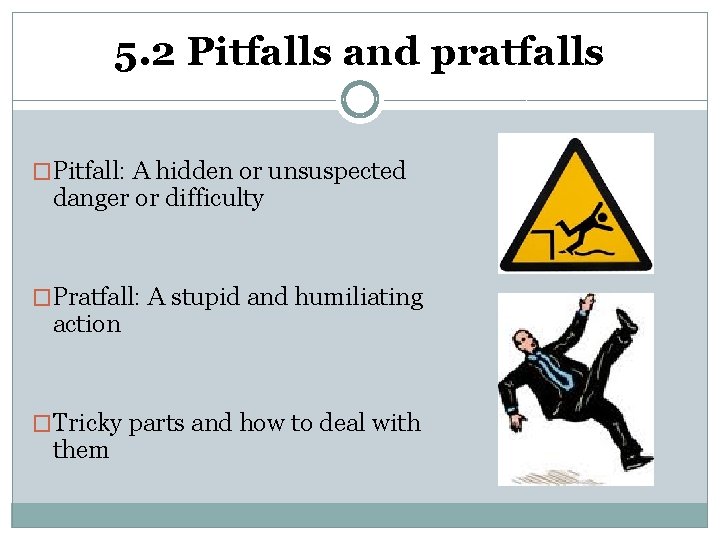
5. 2 Pitfalls and pratfalls �Pitfall: A hidden or unsuspected danger or difficulty �Pratfall: A stupid and humiliating action �Tricky parts and how to deal with them
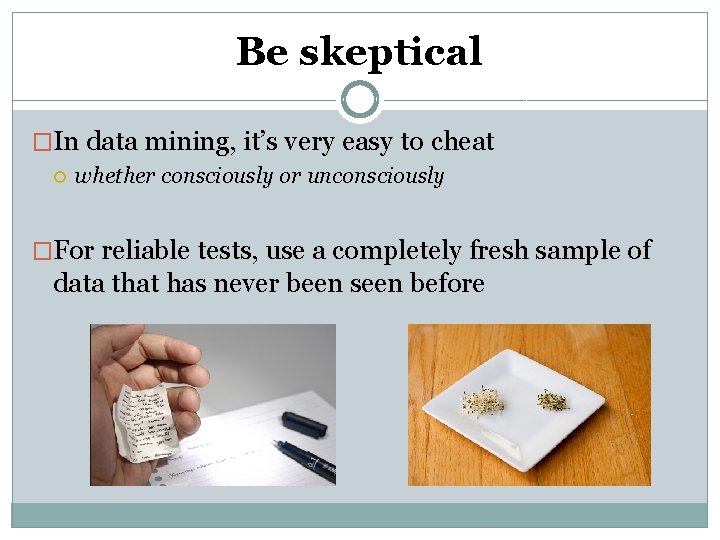
Be skeptical �In data mining, it’s very easy to cheat whether consciously or unconsciously �For reliable tests, use a completely fresh sample of data that has never been seen before
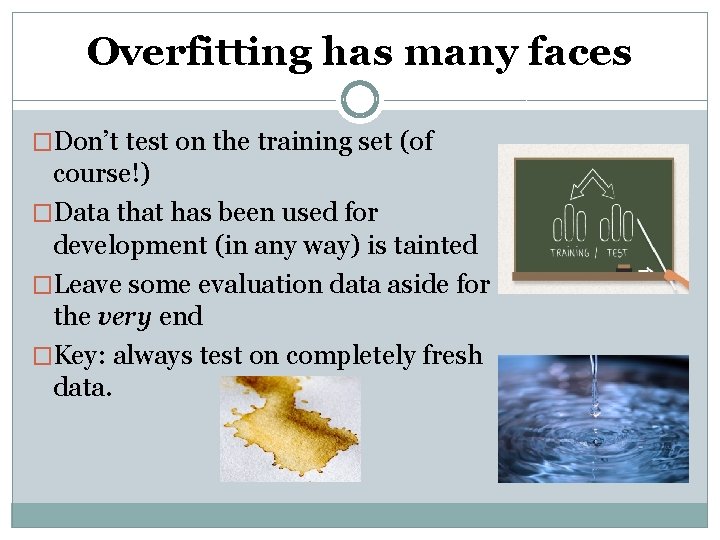
Overfitting has many faces �Don’t test on the training set (of course!) �Data that has been used for development (in any way) is tainted �Leave some evaluation data aside for the very end �Key: always test on completely fresh data.
Missing values �“Missing” means what … �� Unknown? �� Unrecorded? �� Irrelevant? �Missing values �Omit instances where the attribute value is missing? � or �Treat “missing” as a separate possible value? �Is there significance in the fact that a value is missing? �Most learning algorithms deal with missing values �– but they make different assumptions about them
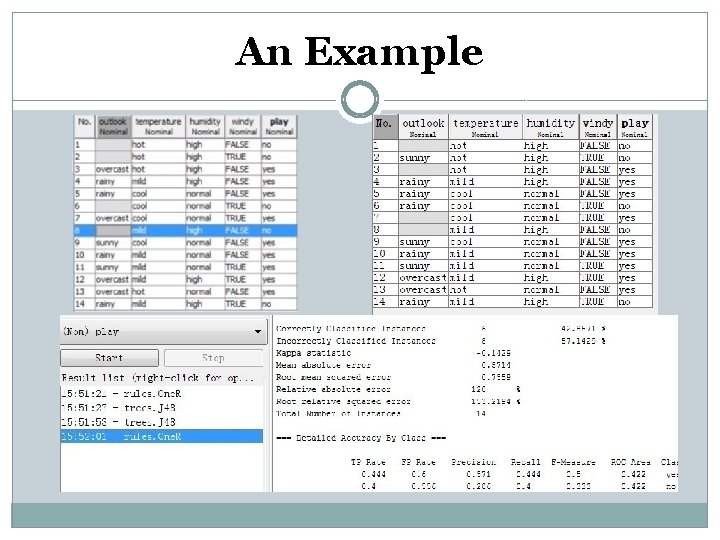
An Example �One. R and J 48 deal with missing values in different ways� �Load weather‐nominal. arff �One. R gets 43%, J 48 gets 50% (using 10‐fold cross‐validation) �Change the outlook value to unknown on the first four no instances �One. R gets 93%, J 48 still gets 50% �Look at One. R’s rules: it uses “? ” as a fourth value for outlook
An Example
5. 2 Pitfalls and pratfalls Part 2 By Pengfei
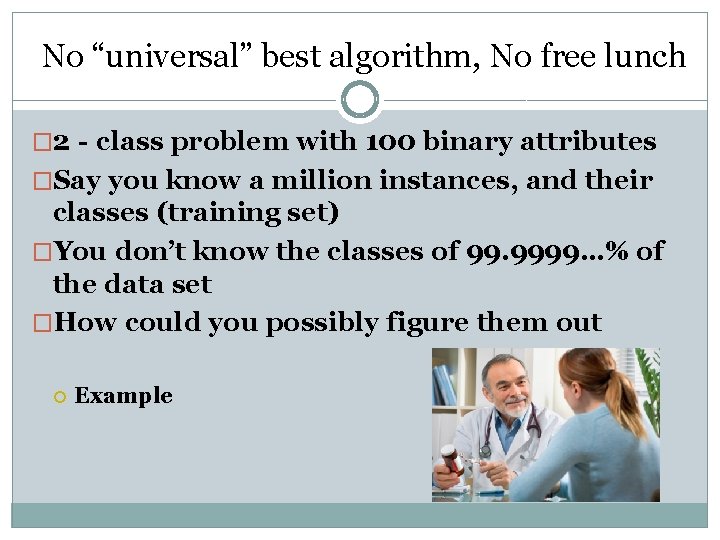
No “universal” best algorithm, No free lunch � 2‐class problem with 100 binary attributes �Say you know a million instances, and their classes (training set) �You don’t know the classes of 99. 9999…% of the data set �How could you possibly figure them out Example
No “universal” best algorithm, No free lunch �In order to generalize, every learner must embody some knowledge or assumptions beyond the data it’s given ��Delete less useful attributes ��Find better filter �Data mining is an experimental science
5. 3 Data mining and ethics By Yanqing
5. 3 Data mining and ethics �Information privacy laws �Anonymization �The purpose of data mining �Correlation causation Source: www. zerohedge. com Source: www. ediscoveryreadingroom. com Source: www. mum. edu Source: www. johnmyleswhite. com
Information privacy laws �In Europe Purpose; Keep secret; Accurately update; Provider can review; Deleted asap; Un-transmittable (if less protection) No sensitive data (sexual orientation, religion ) �In US Not highly legislated or regulated Computer Security, Privacy and Criminal Law But hard to be anonymous. . . Source: www. livingwithgod. org �Be aware ethical issues and laws AOL (2006) � 650, 000 users (3 days in public web) � at least $5, 000 for the identifiable person Source: blog. brainhost. com
Anonymization �It is much harder than you think. Story: MA release medical records (mid‐ 1990 s) No name, address, social security number Re-identification technique Source: eofdreams. com � Public records: City, Birthday, gender: 50% of US can be identify One more attribute – zipcode: 85% identification �Netflix Use movie rating system to identify people 99% 6 movies 70% 2 movies www. resteasypestcontrol. com
The purpose of data mining �The purpose of data mining is to discriminate … who gets the loan who gets the special offer �Certain kinds of discrimination are unethical, and illegal racial, sexual, religious, … �But it depends on the context sexual discrimination is usually illegal … except for doctors, who are expected to take gender into account �… and information that appears innocuous may not be ZIP code correlates with race membership of certain organizations correlates with gender
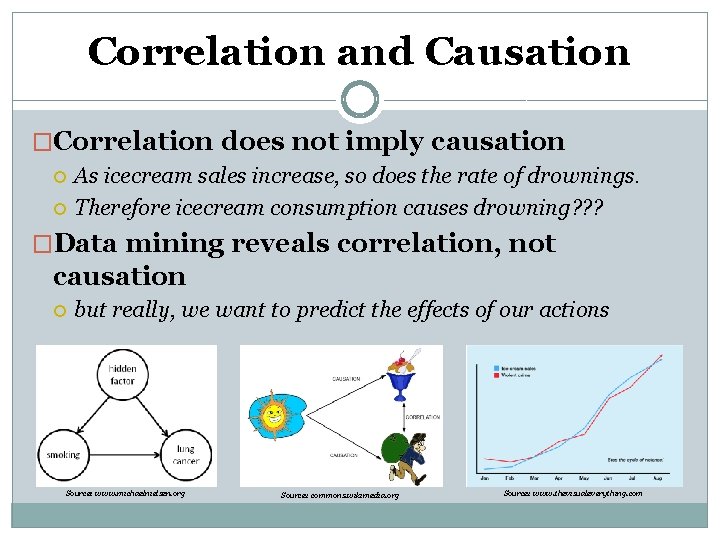
Correlation and Causation �Correlation does not imply causation As icecream sales increase, so does the rate of drownings. Therefore icecream consumption causes drowning? ? ? �Data mining reveals correlation, not causation but really, we want to predict the effects of our actions Source: www. michaelnielsen. org Source: commons. wikimedia. org Source: www. thevisualeverything. com
5. 3 Summary �Privacy of personal information �Anonymization is harder than you think �Reidentification from supposedly anonymized data �Data mining and discrimination �Correlation does not imply causation
5. 4 Summary By Ya, Kexin
5. 4 SUMMARY � There’s no magic in data mining – Instead, a huge array of alternative techniques � There’s no single universal “best method” – It’s an experimental science! – What works best on your problem?
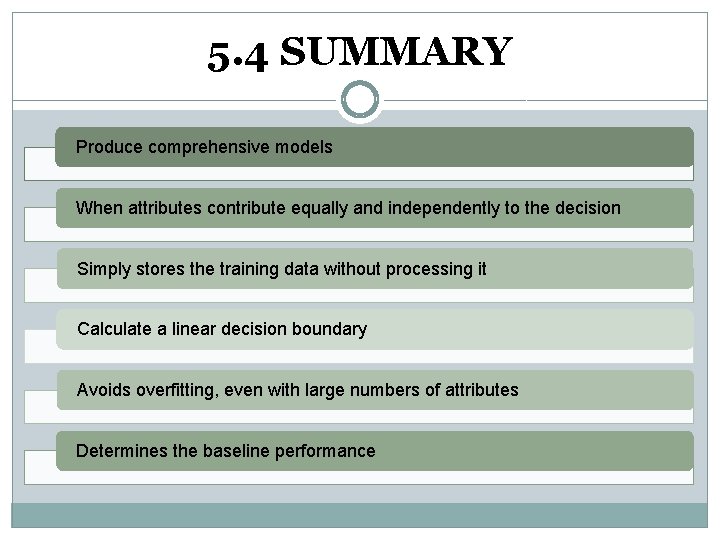
5. 4 SUMMARY Produce comprehensive models When attributes contribute equally and independently to the decision Simply stores the training data without processing it Calculate a linear decision boundary Avoids overfitting, even with large numbers of attributes Determines the baseline performance
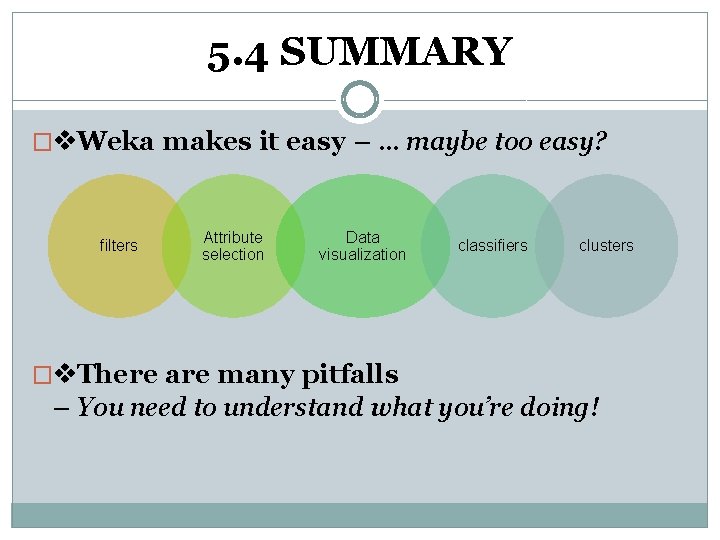
5. 4 SUMMARY � Weka makes it easy –. . . maybe too easy? filters Attribute selection Data visualization classifiers clusters � There are many pitfalls – You need to understand what you’re doing!
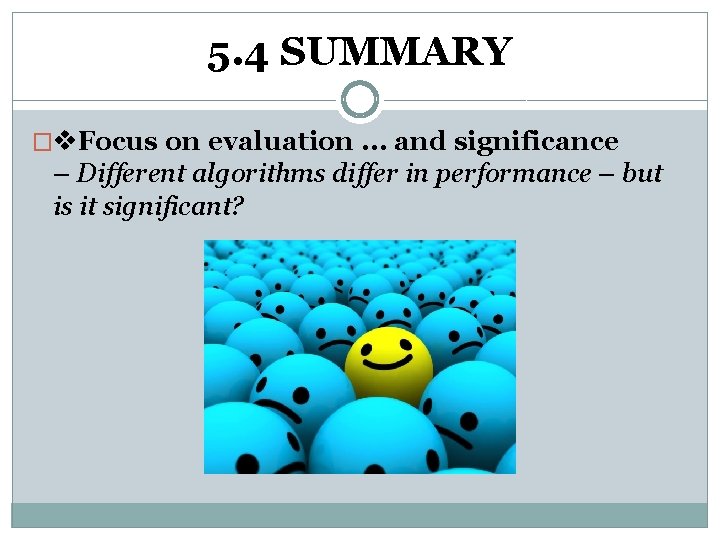
5. 4 SUMMARY � Focus on evaluation. . . and significance – Different algorithms differ in performance – but is it significant?
Advanced Datamining with Weka �Some missing parts in the lectures �Filtered Classifier �Cost-sensitive evaluation and classification �Attribute selection �Clustering �Association rules �Text classification �Weka Experimenter
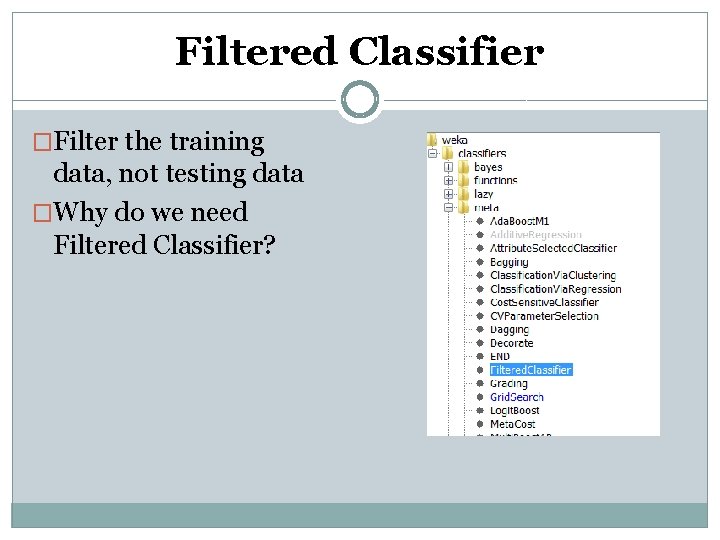
Filtered Classifier �Filter the training data, not testing data �Why do we need Filtered Classifier?
Cost-sensitive evaluation and classification �Costs of different decisions and different kinds of errors �Costs in datamining Misclassification Costs Test Costs of Cases Computation Costs
Attribute Selection �Uesful parts of Attribute Selection �Select relevant attributes �Remove irrelevant attributes �Reasons for Attribute Selction �Simpler model �More Transparent and easier to understand �Shorter Training time �Knowing which attribute is important
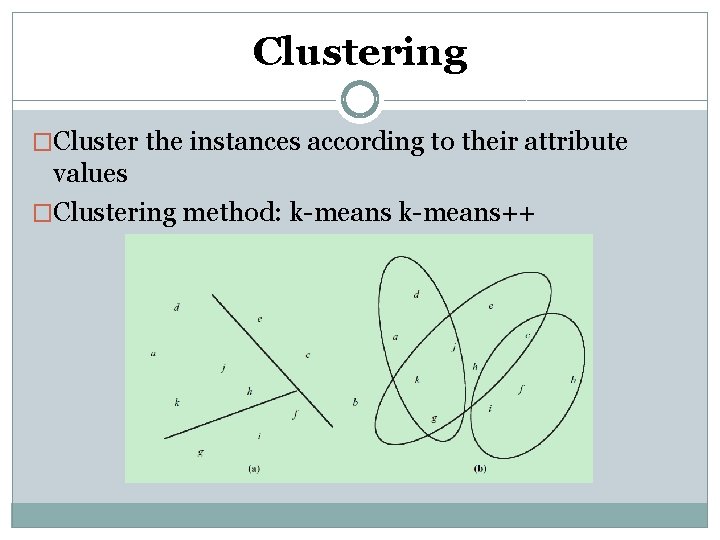
Clustering �Cluster the instances according to their attribute values �Clustering method: k-means++
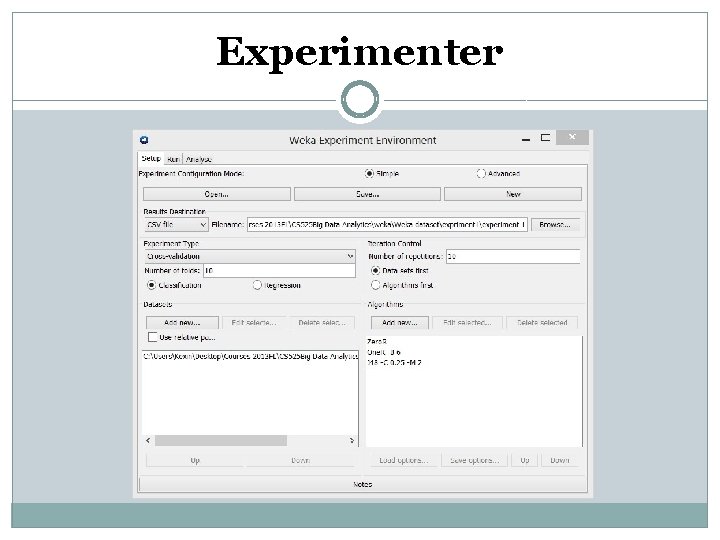
Experimenter
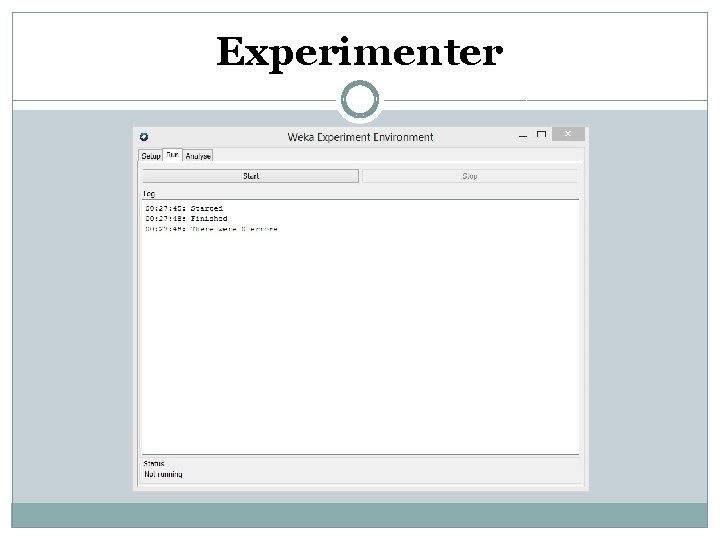
Experimenter
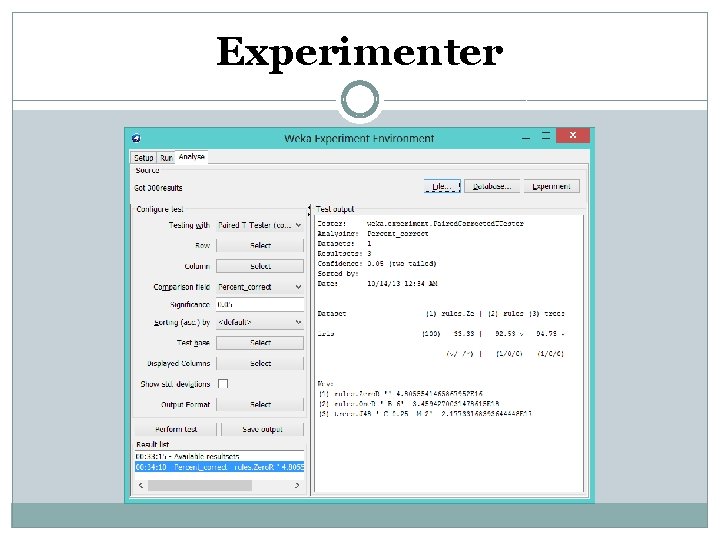
Experimenter
Acknowledgement �Thanks Prof. Ian H. Witten and his Weka MOOC direction.