
DATA MINING LECTURE 4 Similarity and Distance Recommender



- Slides: 52
DATA MINING LECTURE 4 Similarity and Distance Recommender Systems
SIMILARITY AND DISTANCE Thanks to: Tan, Steinbach, and Kumar, “Introduction to Data Mining” Rajaraman and Ullman, “Mining Massive Datasets”
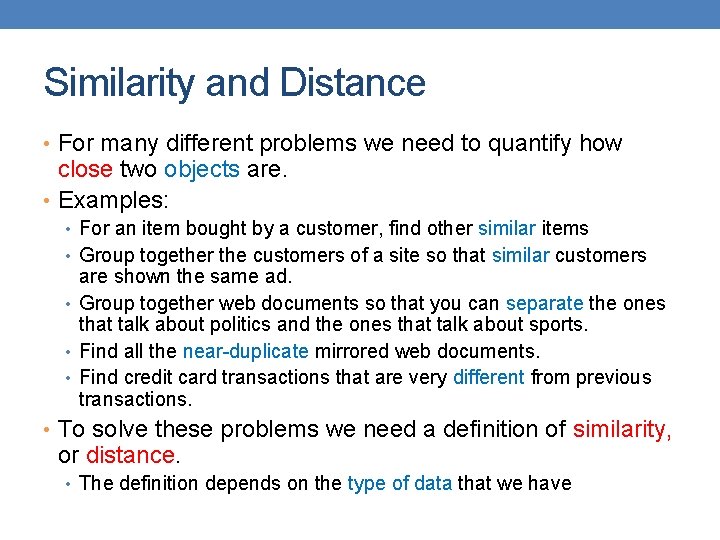
Similarity and Distance • For many different problems we need to quantify how close two objects are. • Examples: • For an item bought by a customer, find other similar items • Group together the customers of a site so that similar customers are shown the same ad. • Group together web documents so that you can separate the ones that talk about politics and the ones that talk about sports. • Find all the near-duplicate mirrored web documents. • Find credit card transactions that are very different from previous transactions. • To solve these problems we need a definition of similarity, or distance. • The definition depends on the type of data that we have
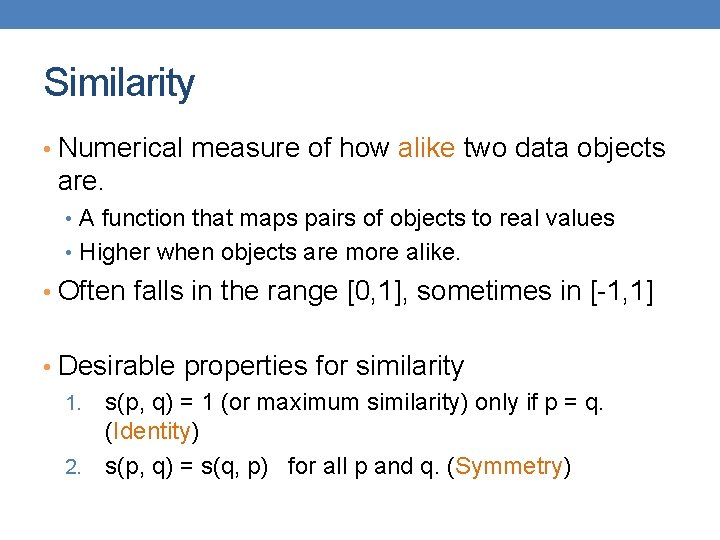
Similarity • Numerical measure of how alike two data objects are. • A function that maps pairs of objects to real values • Higher when objects are more alike. • Often falls in the range [0, 1], sometimes in [-1, 1] • Desirable properties for similarity 1. s(p, q) = 1 (or maximum similarity) only if p = q. (Identity) 2. s(p, q) = s(q, p) for all p and q. (Symmetry)
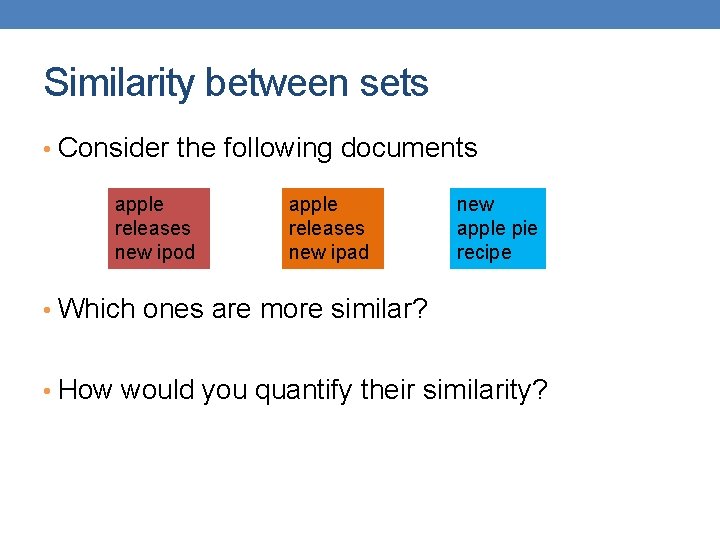
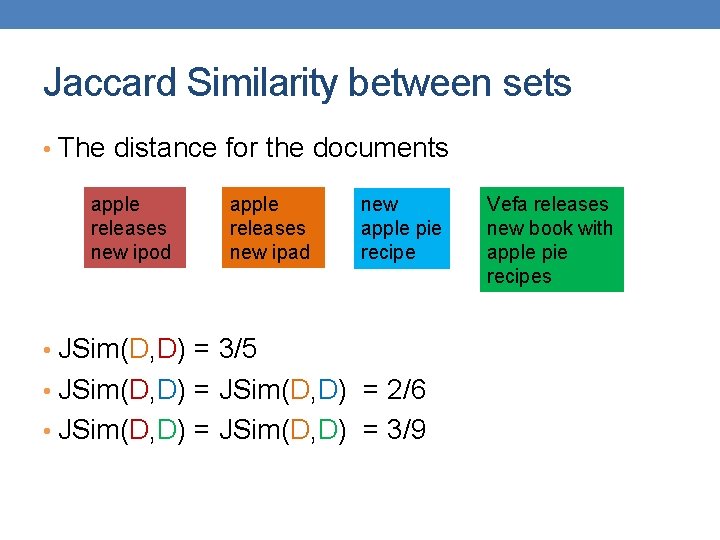
Similarity between sets • Consider the following documents apple releases new ipod apple releases new ipad new apple pie recipe • Which ones are more similar? • How would you quantify their similarity?
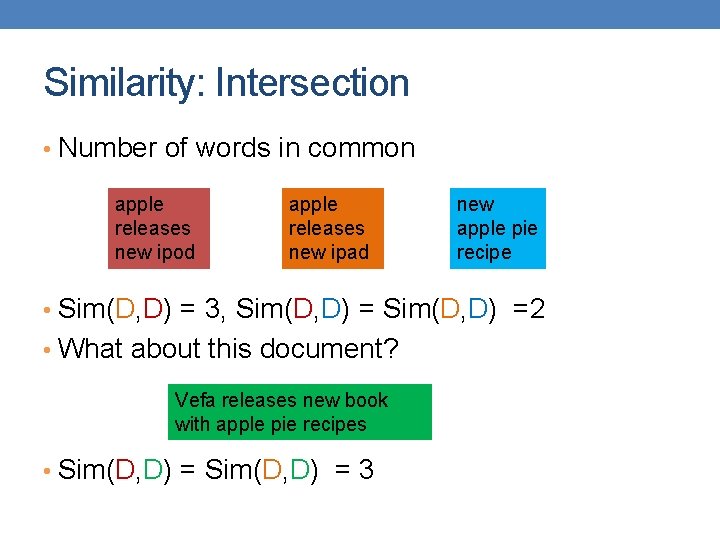
Similarity: Intersection • Number of words in common apple releases new ipod apple releases new ipad new apple pie recipe • Sim(D, D) = 3, Sim(D, D) =2 • What about this document? Vefa releases new book with apple pie recipes • Sim(D, D) = 3
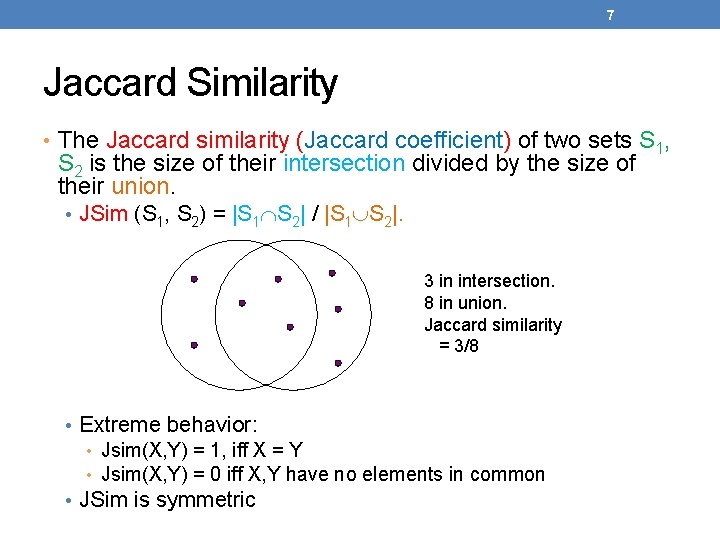
7 Jaccard Similarity • The Jaccard similarity (Jaccard coefficient) of two sets S 1, S 2 is the size of their intersection divided by the size of their union. • JSim (S 1, S 2) = |S 1 S 2| / |S 1 S 2|. 3 in intersection. 8 in union. Jaccard similarity = 3/8 • Extreme behavior: • Jsim(X, Y) = 1, iff X = Y • Jsim(X, Y) = 0 iff X, Y have no elements in common • JSim is symmetric
Jaccard Similarity between sets • The distance for the documents apple releases new ipod apple releases new ipad new apple pie recipe • JSim(D, D) = 3/5 • JSim(D, D) = 2/6 • JSim(D, D) = 3/9 Vefa releases new book with apple pie recipes
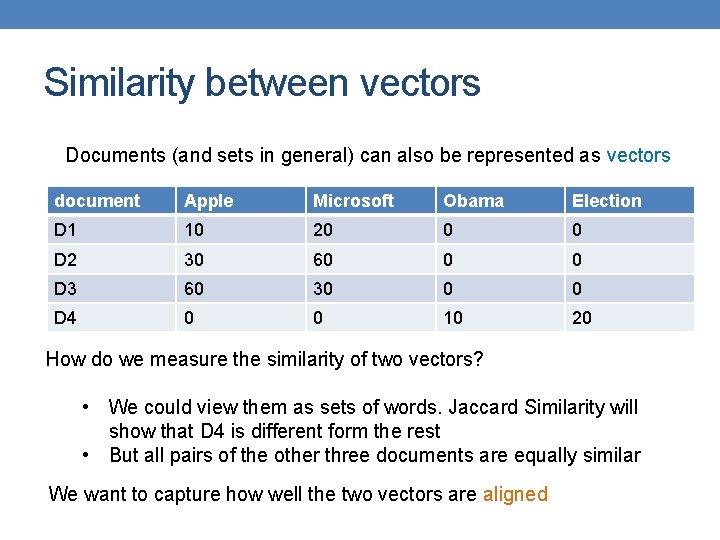
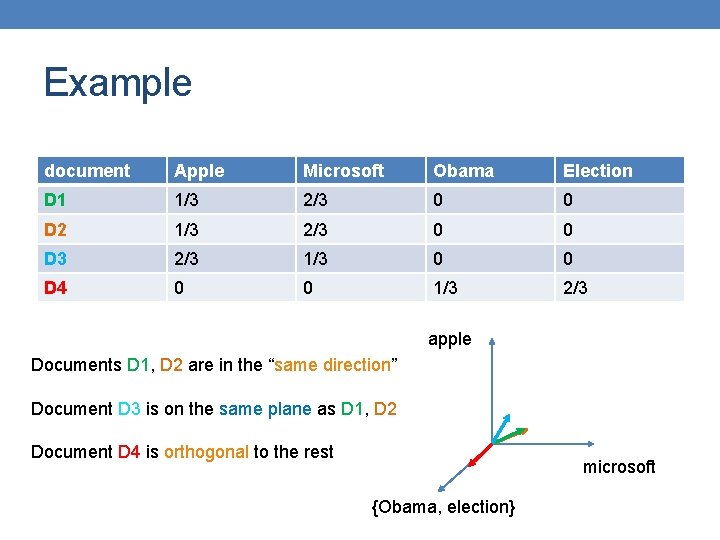
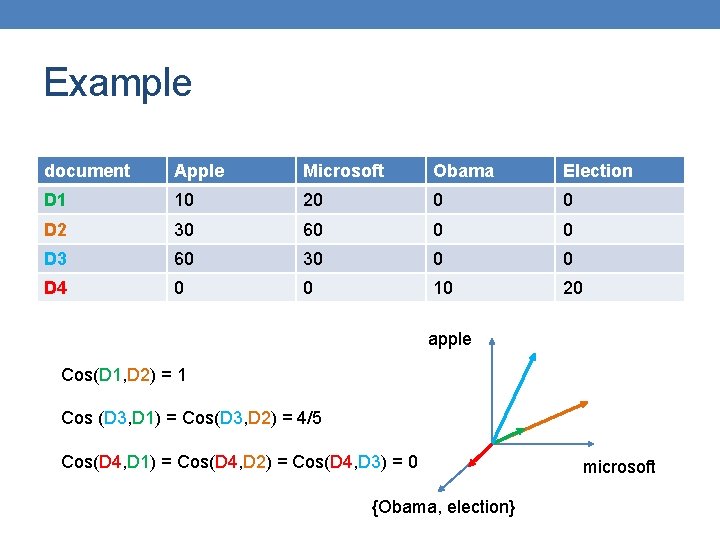
Similarity between vectors Documents (and sets in general) can also be represented as vectors document Apple Microsoft Obama Election D 1 10 20 0 0 D 2 30 60 0 0 D 3 60 30 0 0 D 4 0 0 10 20 How do we measure the similarity of two vectors? • We could view them as sets of words. Jaccard Similarity will show that D 4 is different form the rest • But all pairs of the other three documents are equally similar We want to capture how well the two vectors are aligned
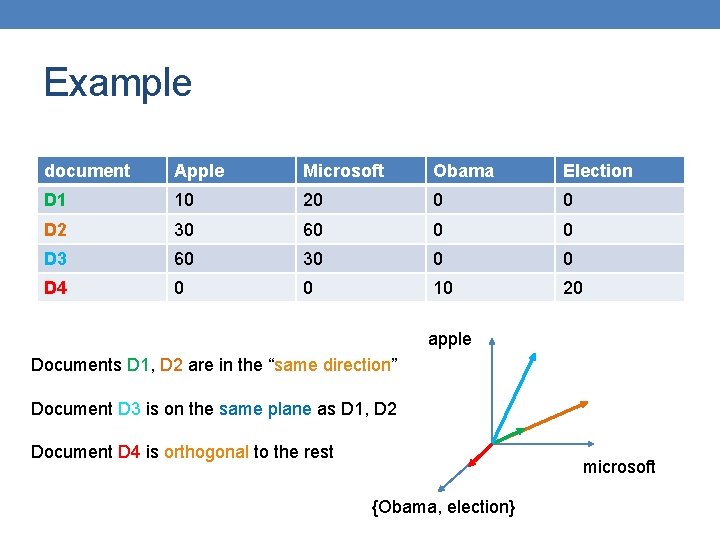
Example document Apple Microsoft Obama Election D 1 10 20 0 0 D 2 30 60 0 0 D 3 60 30 0 0 D 4 0 0 10 20 apple Documents D 1, D 2 are in the “same direction” Document D 3 is on the same plane as D 1, D 2 Document D 4 is orthogonal to the rest microsoft {Obama, election}
Example document Apple Microsoft Obama Election D 1 1/3 2/3 0 0 D 2 1/3 2/3 0 0 D 3 2/3 1/3 0 0 D 4 0 0 1/3 2/3 apple Documents D 1, D 2 are in the “same direction” Document D 3 is on the same plane as D 1, D 2 Document D 4 is orthogonal to the rest microsoft {Obama, election}
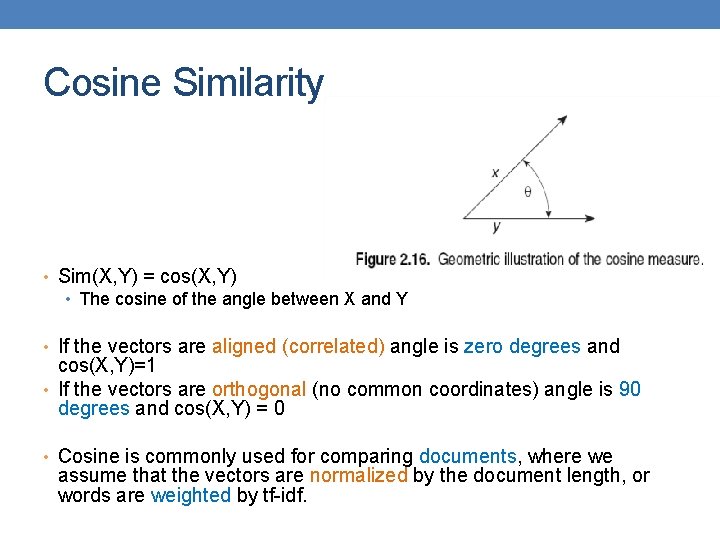
Cosine Similarity • Sim(X, Y) = cos(X, Y) • The cosine of the angle between X and Y • If the vectors are aligned (correlated) angle is zero degrees and cos(X, Y)=1 • If the vectors are orthogonal (no common coordinates) angle is 90 degrees and cos(X, Y) = 0 • Cosine is commonly used for comparing documents, where we assume that the vectors are normalized by the document length, or words are weighted by tf-idf.
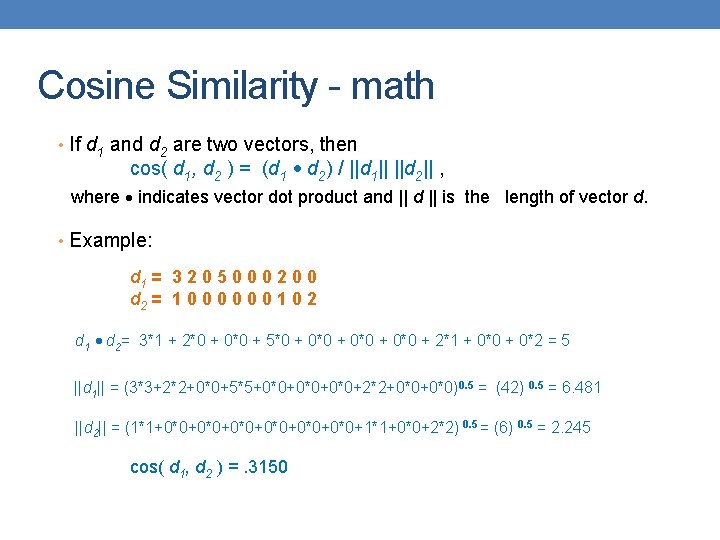
Cosine Similarity - math • If d 1 and d 2 are two vectors, then cos( d 1, d 2 ) = (d 1 d 2) / ||d 1|| ||d 2|| , where indicates vector dot product and || is the length of vector d. • Example: d 1 = 3 2 0 5 0 0 0 2 0 0 d 2 = 1 0 0 0 1 0 2 d 1 d 2= 3*1 + 2*0 + 0*0 + 5*0 + 0*0 + 2*1 + 0*0 + 0*2 = 5 ||d 1|| = (3*3+2*2+0*0+5*5+0*0+0*0+2*2+0*0)0. 5 = (42) 0. 5 = 6. 481 ||d 2|| = (1*1+0*0+0*0+0*0+1*1+0*0+2*2) 0. 5 = (6) 0. 5 = 2. 245 cos( d 1, d 2 ) =. 3150
Example document Apple Microsoft Obama Election D 1 10 20 0 0 D 2 30 60 0 0 D 3 60 30 0 0 D 4 0 0 10 20 apple Cos(D 1, D 2) = 1 Cos (D 3, D 1) = Cos(D 3, D 2) = 4/5 Cos(D 4, D 1) = Cos(D 4, D 2) = Cos(D 4, D 3) = 0 {Obama, election} microsoft
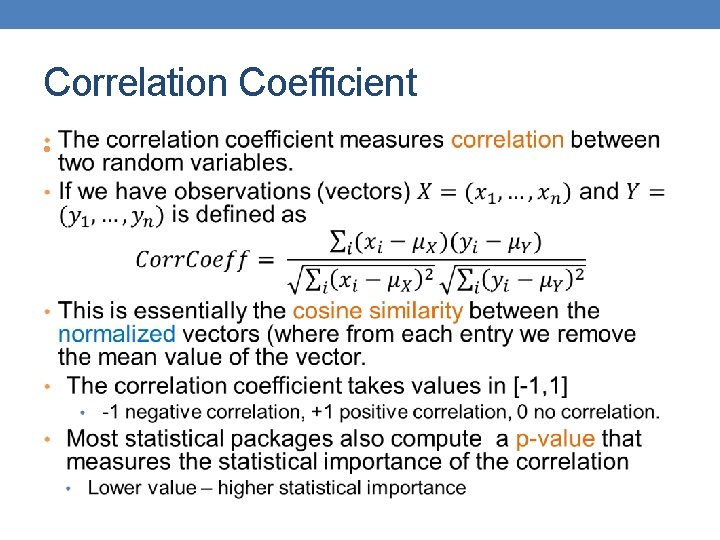
Correlation Coefficient •
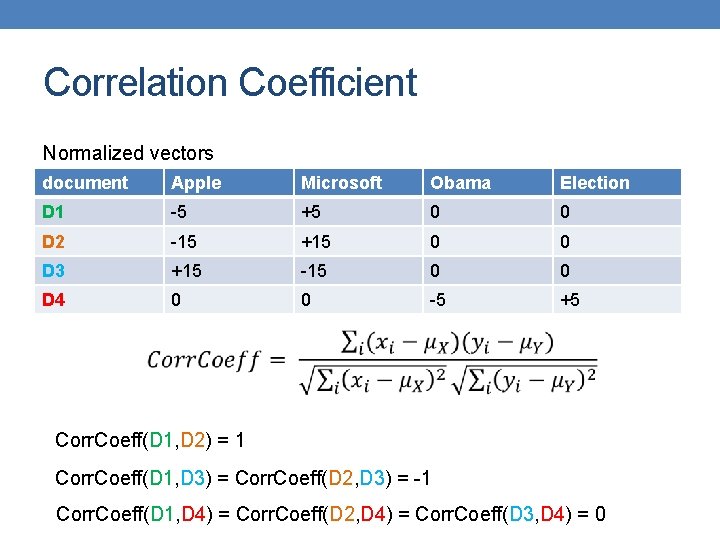
Correlation Coefficient Normalized vectors document Apple Microsoft Obama Election D 1 -5 +5 0 0 D 2 -15 +15 0 0 D 3 +15 -15 0 0 D 4 0 0 -5 +5 Corr. Coeff(D 1, D 2) = 1 Corr. Coeff(D 1, D 3) = Corr. Coeff(D 2, D 3) = -1 Corr. Coeff(D 1, D 4) = Corr. Coeff(D 2, D 4) = Corr. Coeff(D 3, D 4) = 0
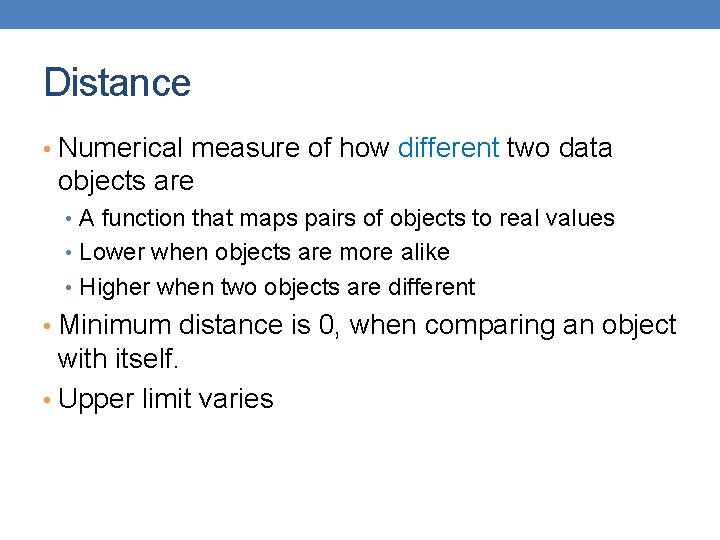
Distance • Numerical measure of how different two data objects are • A function that maps pairs of objects to real values • Lower when objects are more alike • Higher when two objects are different • Minimum distance is 0, when comparing an object with itself. • Upper limit varies
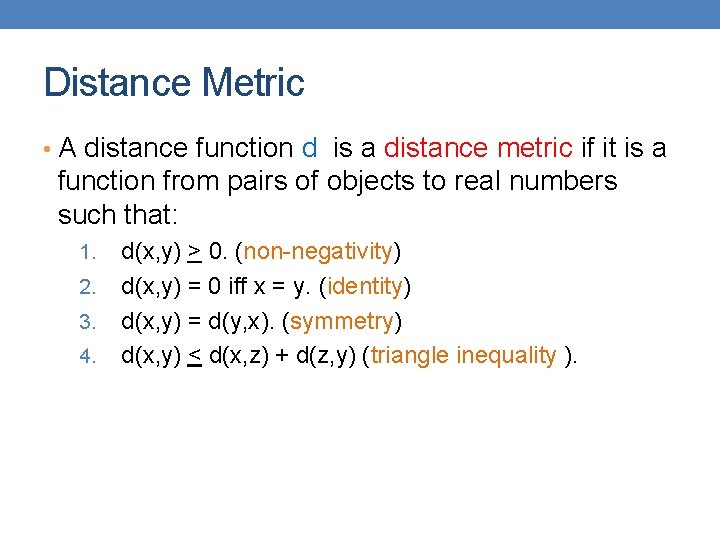
Distance Metric • A distance function d is a distance metric if it is a function from pairs of objects to real numbers such that: 1. 2. 3. 4. d(x, y) > 0. (non-negativity) d(x, y) = 0 iff x = y. (identity) d(x, y) = d(y, x). (symmetry) d(x, y) < d(x, z) + d(z, y) (triangle inequality ).
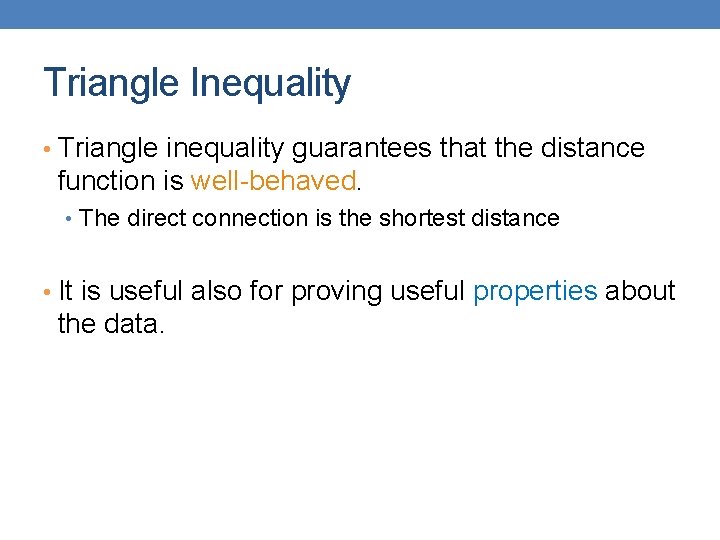
Triangle Inequality • Triangle inequality guarantees that the distance function is well-behaved. • The direct connection is the shortest distance • It is useful also for proving useful properties about the data.
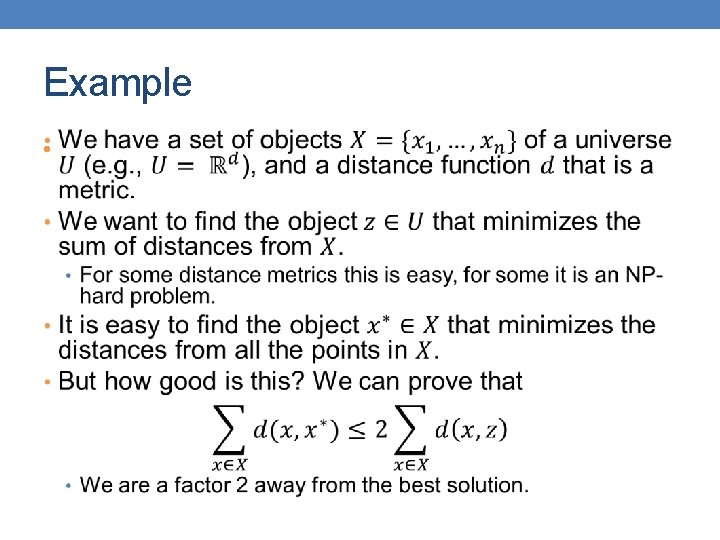
Example •
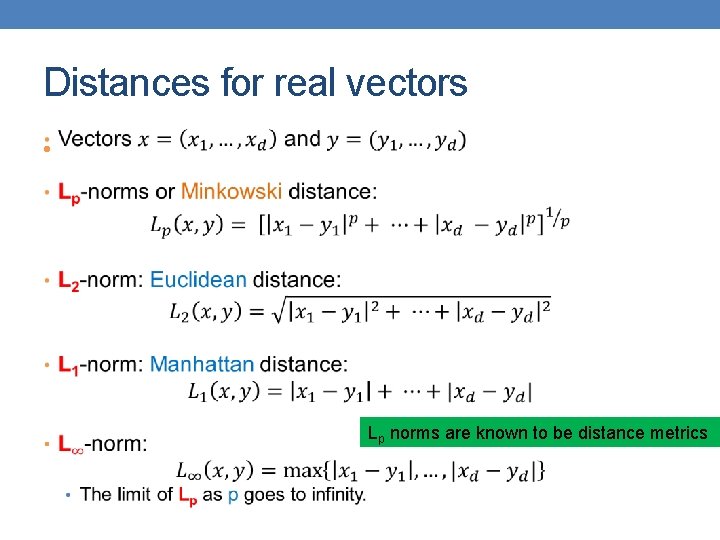
Distances for real vectors • Lp norms are known to be distance metrics
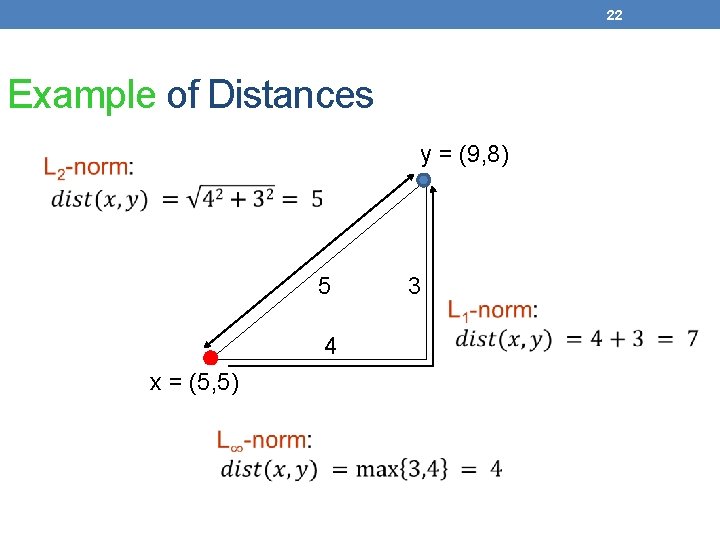
22 Example of Distances y = (9, 8) 5 4 x = (5, 5) 3
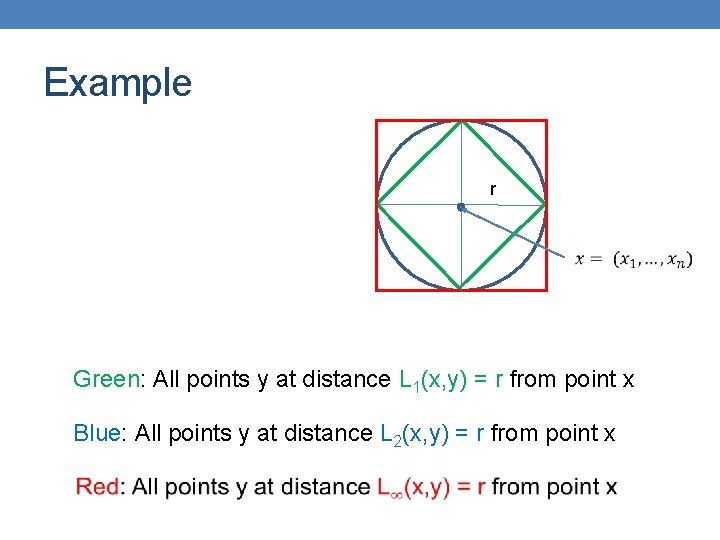
Example r Green: All points y at distance L 1(x, y) = r from point x Blue: All points y at distance L 2(x, y) = r from point x
Lp distances for sets • We can apply all the Lp distances to the cases of sets of attributes, with or without counts, if we represent the sets as vectors • E. g. , a transaction is a 0/1 vector • E. g. , a document is a vector of counts.
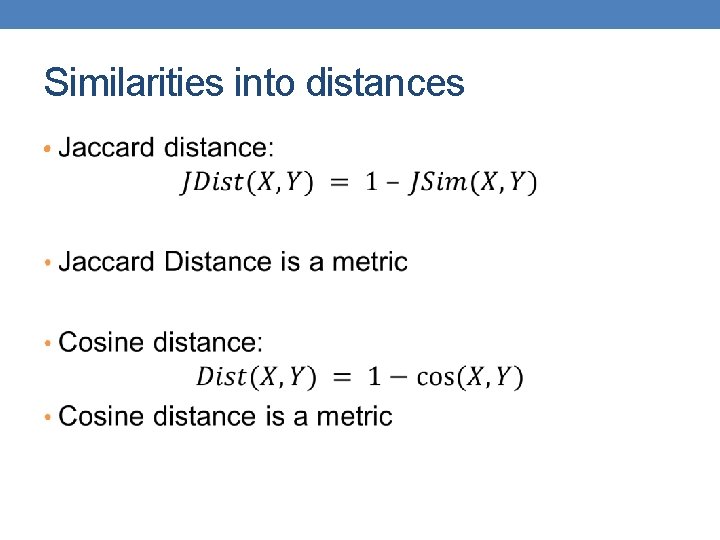
Similarities into distances •
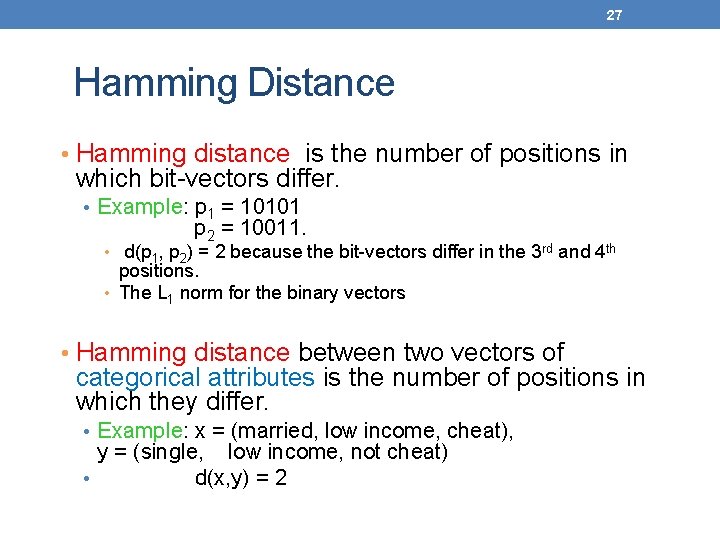
27 Hamming Distance • Hamming distance is the number of positions in which bit-vectors differ. • Example: p 1 = 10101 p 2 = 10011. • d(p 1, p 2) = 2 because the bit-vectors differ in the 3 rd and 4 th positions. • The L 1 norm for the binary vectors • Hamming distance between two vectors of categorical attributes is the number of positions in which they differ. • Example: x = (married, low income, cheat), y = (single, low income, not cheat) • d(x, y) = 2
28 Why Hamming Distance Is a Distance Metric • d(x, x) = 0 since no positions differ. • d(x, y) = d(y, x) by symmetry of “different from. ” • d(x, y) > 0 since strings cannot differ in a negative number of positions. • Triangle inequality: changing x to z and then to y is one way to change x to y. • For binary vectors if follows from the fact that L 1 norm is a metric
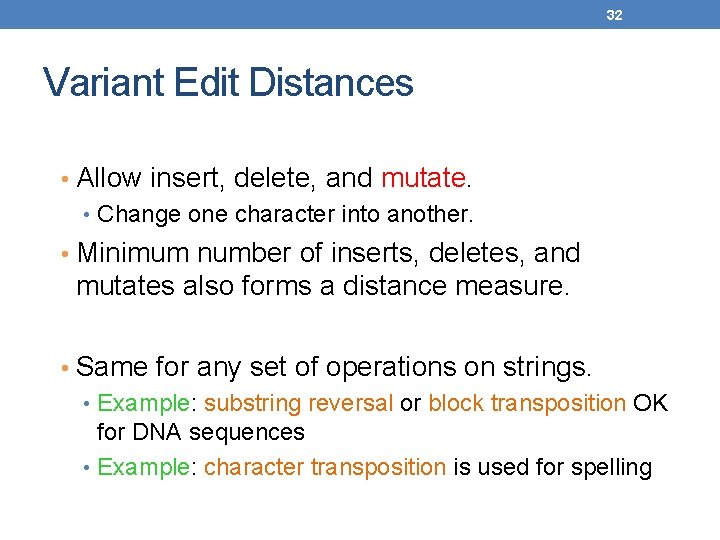
Distance between strings • How do we define similarity between strings? weird intelligent Athena wierd unintelligent Athina • Important for recognizing and correcting typing errors and analyzing DNA sequences.
30 Edit Distance for strings • The edit distance of two strings is the number of inserts and deletes of characters needed to turn one into the other. • Example: x = abcde ; y = bcduve. • Turn x into y by deleting a, then inserting u and v after d. • Edit distance = 3. • Minimum number of operations can be computed using dynamic programming • Common distance measure for comparing DNA sequences
31 Why Edit Distance Is a Distance Metric • d(x, x) = 0 because 0 edits suffice. • d(x, y) = d(y, x) because insert/delete are inverses of each other. • d(x, y) > 0: no notion of negative edits. • Triangle inequality: changing x to z and then to y is one way to change x to y. The minimum is no more than that
32 Variant Edit Distances • Allow insert, delete, and mutate. • Change one character into another. • Minimum number of inserts, deletes, and mutates also forms a distance measure. • Same for any set of operations on strings. • Example: substring reversal or block transposition OK for DNA sequences • Example: character transposition is used for spelling
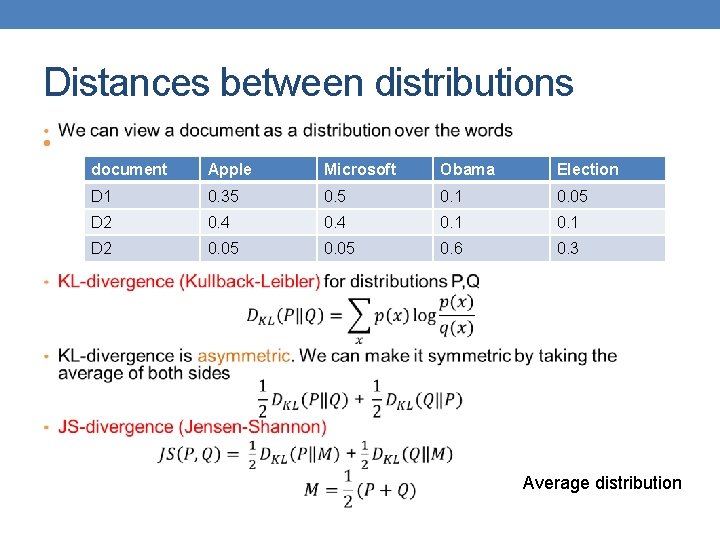
Distances between distributions • document Apple Microsoft Obama Election D 1 0. 35 0. 1 0. 05 D 2 0. 4 0. 1 D 2 0. 05 0. 6 0. 3 Average distribution
Why is similarity important? • We saw many definitions of similarity and distance • How do we make use of similarity in practice? • What issues do we have to deal with?
APPLICATIONS OF SIMILARITY: RECOMMENDATION SYSTEMS
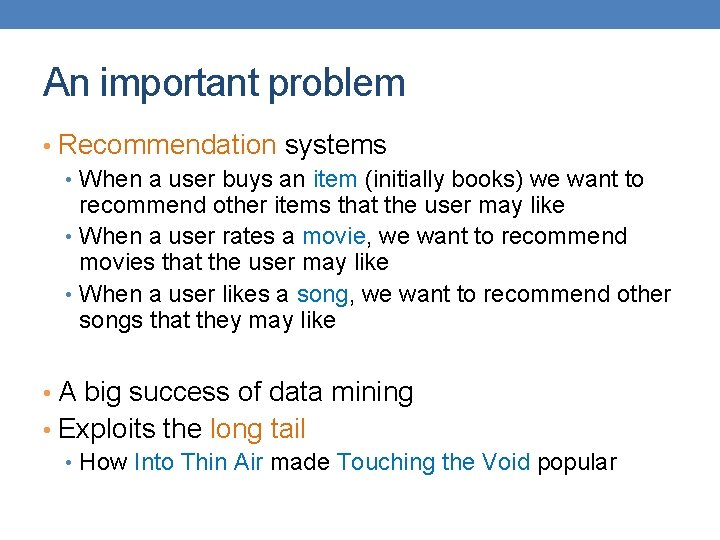
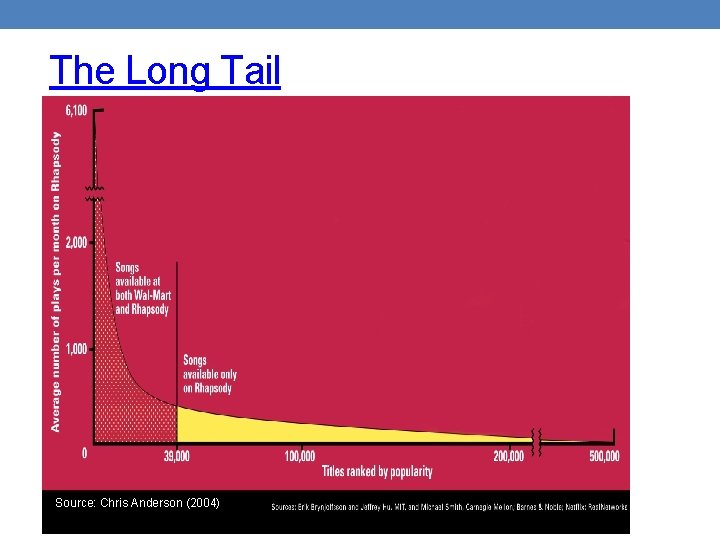
An important problem • Recommendation systems • When a user buys an item (initially books) we want to recommend other items that the user may like • When a user rates a movie, we want to recommend movies that the user may like • When a user likes a song, we want to recommend other songs that they may like • A big success of data mining • Exploits the long tail • How Into Thin Air made Touching the Void popular
The Long Tail Source: Chris Anderson (2004)
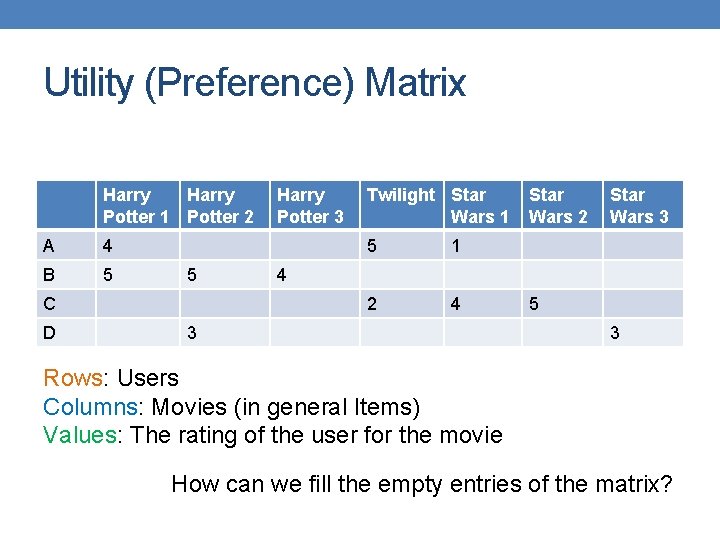
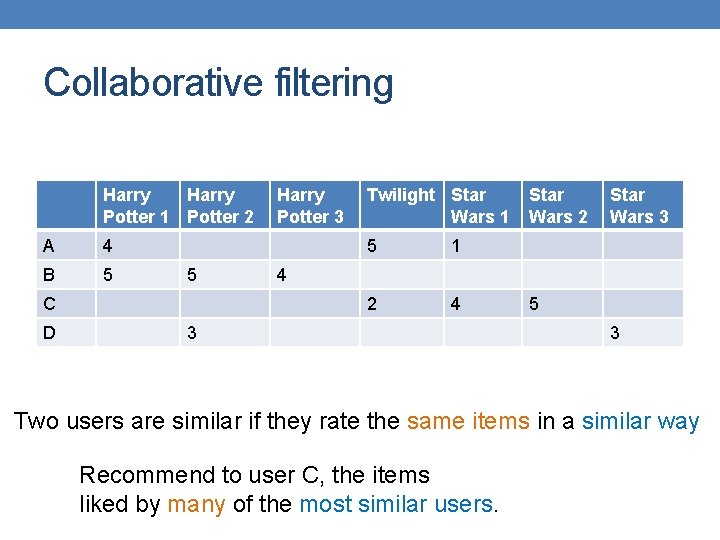
Utility (Preference) Matrix Harry Potter 1 Potter 2 A 4 B 5 5 C D Harry Potter 3 Twilight Star Wars 1 5 1 2 4 Star Wars 2 Star Wars 3 4 3 5 3 Rows: Users Columns: Movies (in general Items) Values: The rating of the user for the movie How can we fill the empty entries of the matrix?
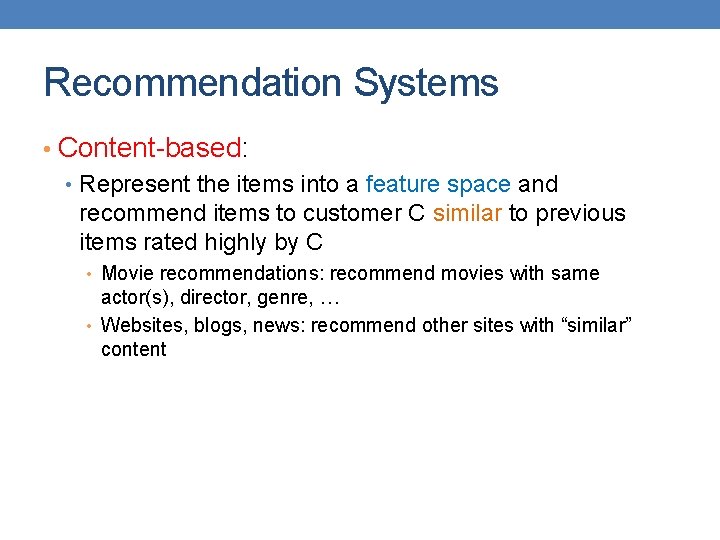
Recommendation Systems • Content-based: • Represent the items into a feature space and recommend items to customer C similar to previous items rated highly by C • Movie recommendations: recommend movies with same actor(s), director, genre, … • Websites, blogs, news: recommend other sites with “similar” content
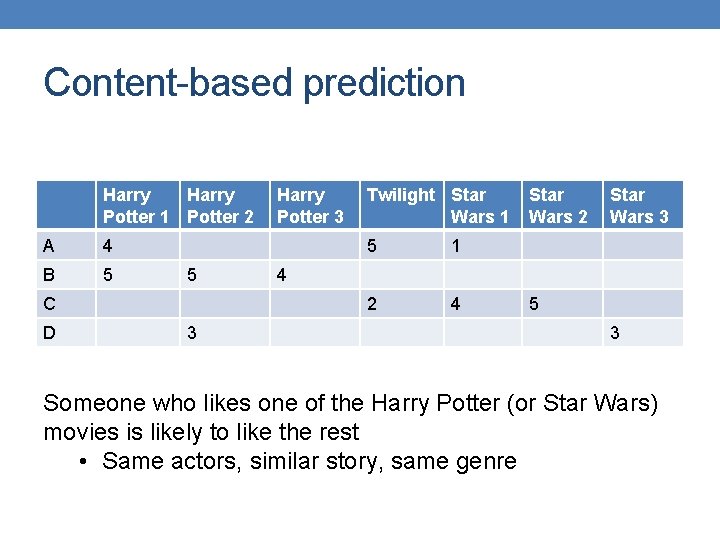
Content-based prediction Harry Potter 1 Potter 2 A 4 B 5 5 C D 3 Harry Potter 3 Twilight Star Wars 1 5 1 2 4 Star Wars 2 Star Wars 3 4 5 3 Someone who likes one of the Harry Potter (or Star Wars) movies is likely to like the rest • Same actors, similar story, same genre
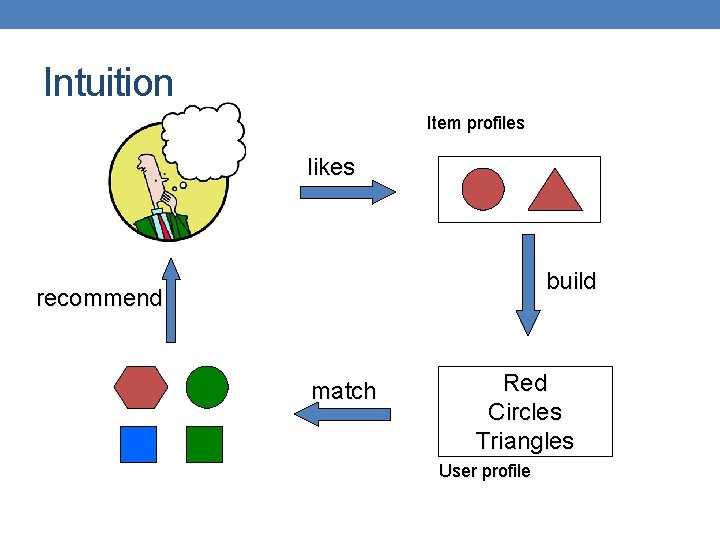
Intuition Item profiles likes build recommend match Red Circles Triangles User profile
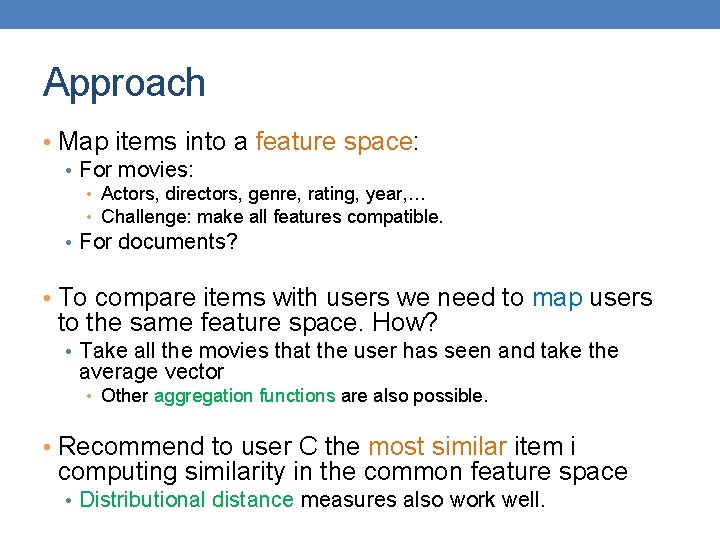
Approach • Map items into a feature space: • For movies: • Actors, directors, genre, rating, year, … • Challenge: make all features compatible. • For documents? • To compare items with users we need to map users to the same feature space. How? • Take all the movies that the user has seen and take the average vector • Other aggregation functions are also possible. • Recommend to user C the most similar item i computing similarity in the common feature space • Distributional distance measures also work well.
Limitations of content-based approach • Finding the appropriate features • e. g. , images, movies, music • Overspecialization • Never recommends items outside user’s content profile • People might have multiple interests • Recommendations for new users • How to build a profile?
Collaborative filtering Harry Potter 1 Potter 2 A 4 B 5 5 C D Harry Potter 3 Twilight Star Wars 1 5 1 2 4 Star Wars 2 Star Wars 3 4 3 5 3 Two users are similar if they rate the same items in a similar way Recommend to user C, the items liked by many of the most similar users.
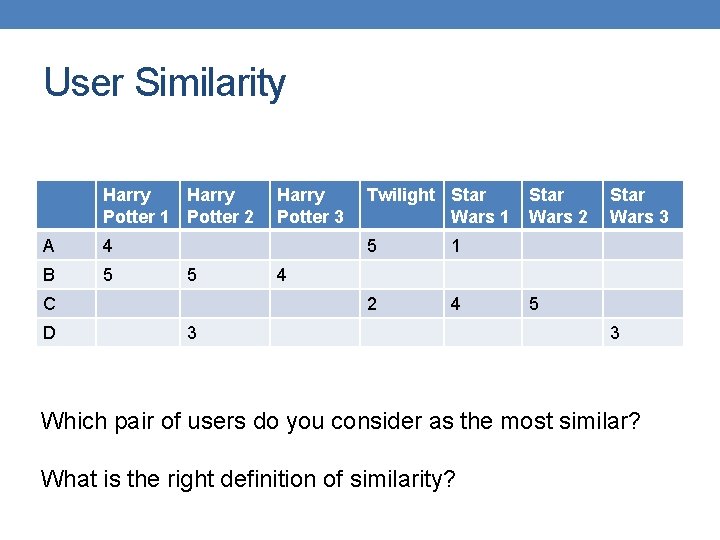
User Similarity Harry Potter 1 Potter 2 A 4 B 5 5 C D Harry Potter 3 Twilight Star Wars 1 5 1 2 4 Star Wars 2 Star Wars 3 4 3 5 3 Which pair of users do you consider as the most similar? What is the right definition of similarity?
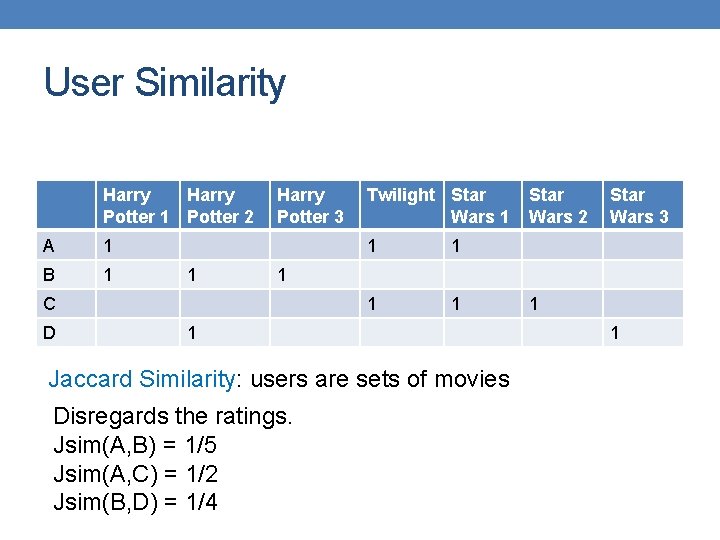
User Similarity Harry Potter 1 Potter 2 A 1 B 1 1 Harry Potter 3 1 1 Star Wars 2 Star Wars 3 1 C D Twilight Star Wars 1 1 Jaccard Similarity: users are sets of movies Disregards the ratings. Jsim(A, B) = 1/5 Jsim(A, C) = 1/2 Jsim(B, D) = 1/4 1 1
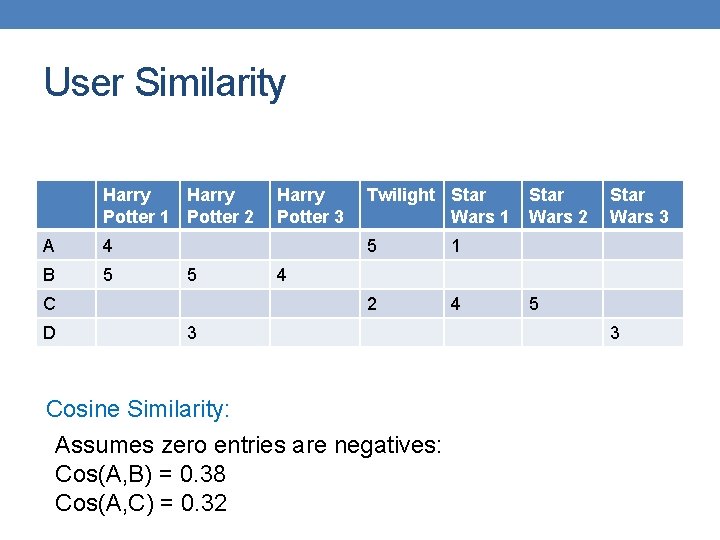
User Similarity Harry Potter 1 Potter 2 A 4 B 5 5 C D Harry Potter 3 Twilight Star Wars 1 5 1 2 4 Star Wars 2 Star Wars 3 4 3 Cosine Similarity: Assumes zero entries are negatives: Cos(A, B) = 0. 38 Cos(A, C) = 0. 32 5 3
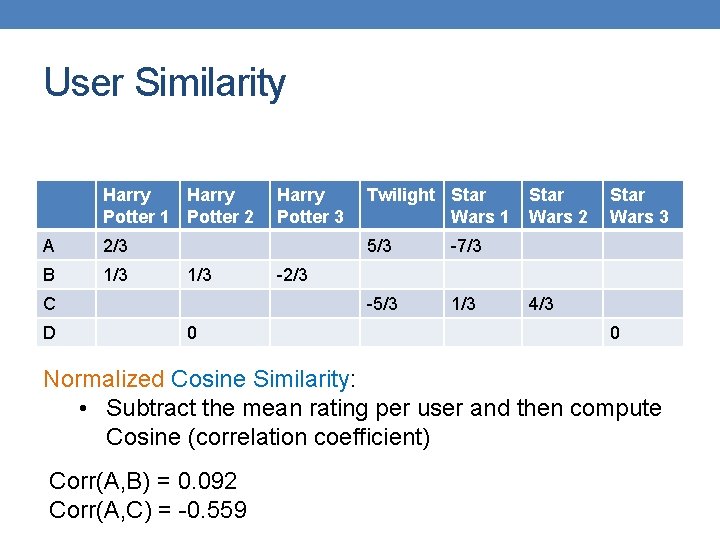
User Similarity Harry Potter 1 Potter 2 A 2/3 B 1/3 C D 0 Harry Potter 3 Twilight Star Wars 1 5/3 -7/3 -5/3 1/3 Star Wars 2 Star Wars 3 -2/3 4/3 0 Normalized Cosine Similarity: • Subtract the mean rating per user and then compute Cosine (correlation coefficient) Corr(A, B) = 0. 092 Corr(A, C) = -0. 559
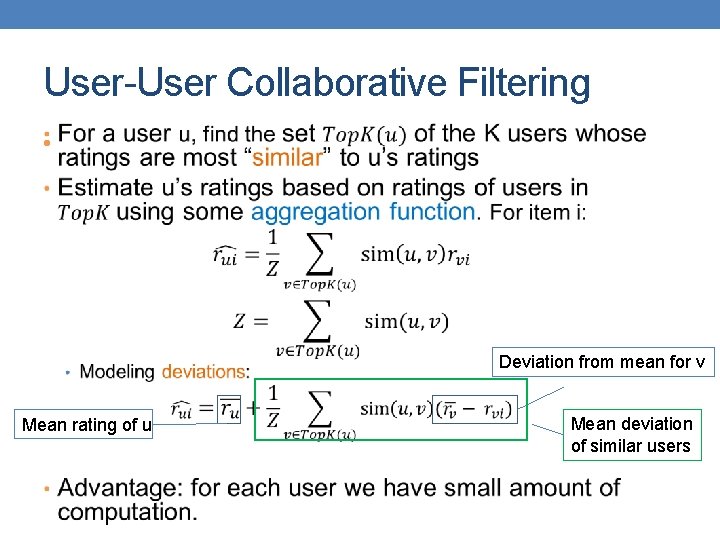
User-User Collaborative Filtering • Deviation from mean for v Mean rating of u Mean deviation of similar users
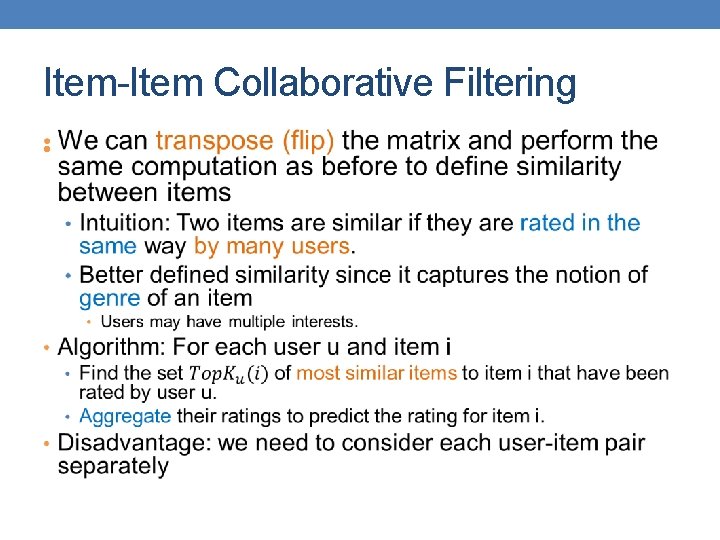
Item-Item Collaborative Filtering •
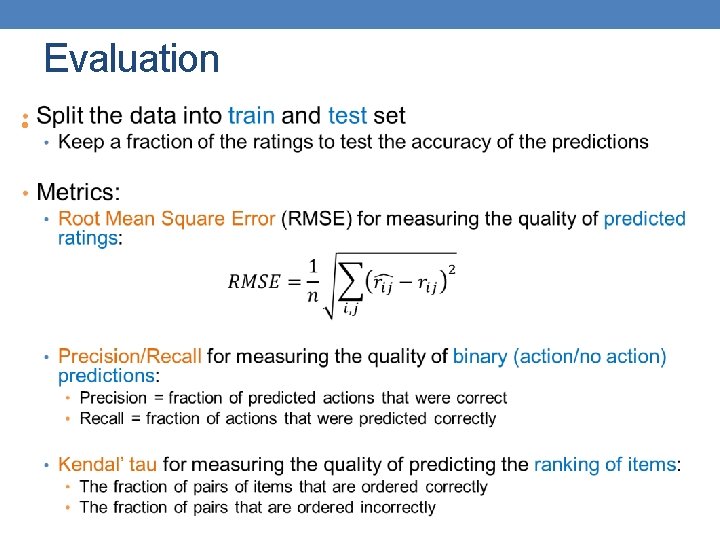
Evaluation •
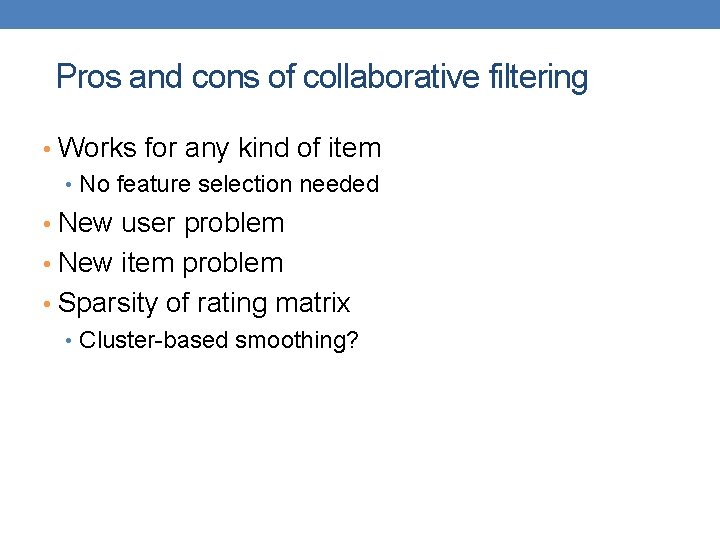
Pros and cons of collaborative filtering • Works for any kind of item • No feature selection needed • New user problem • New item problem • Sparsity of rating matrix • Cluster-based smoothing?
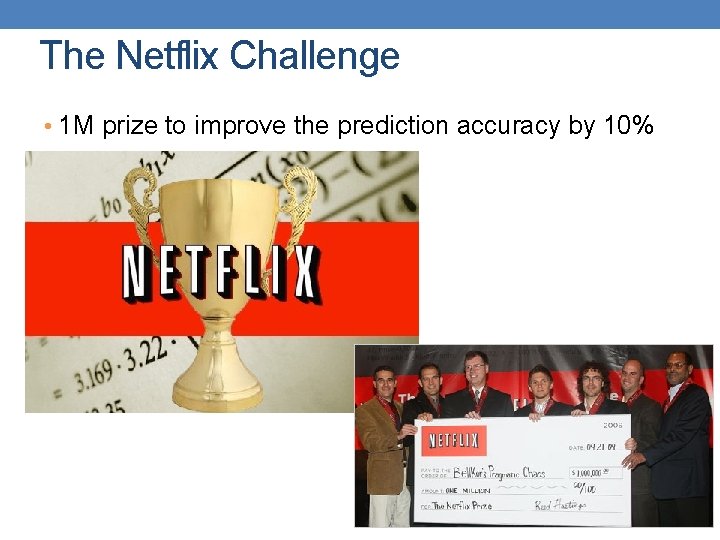
The Netflix Challenge • 1 M prize to improve the prediction accuracy by 10%